
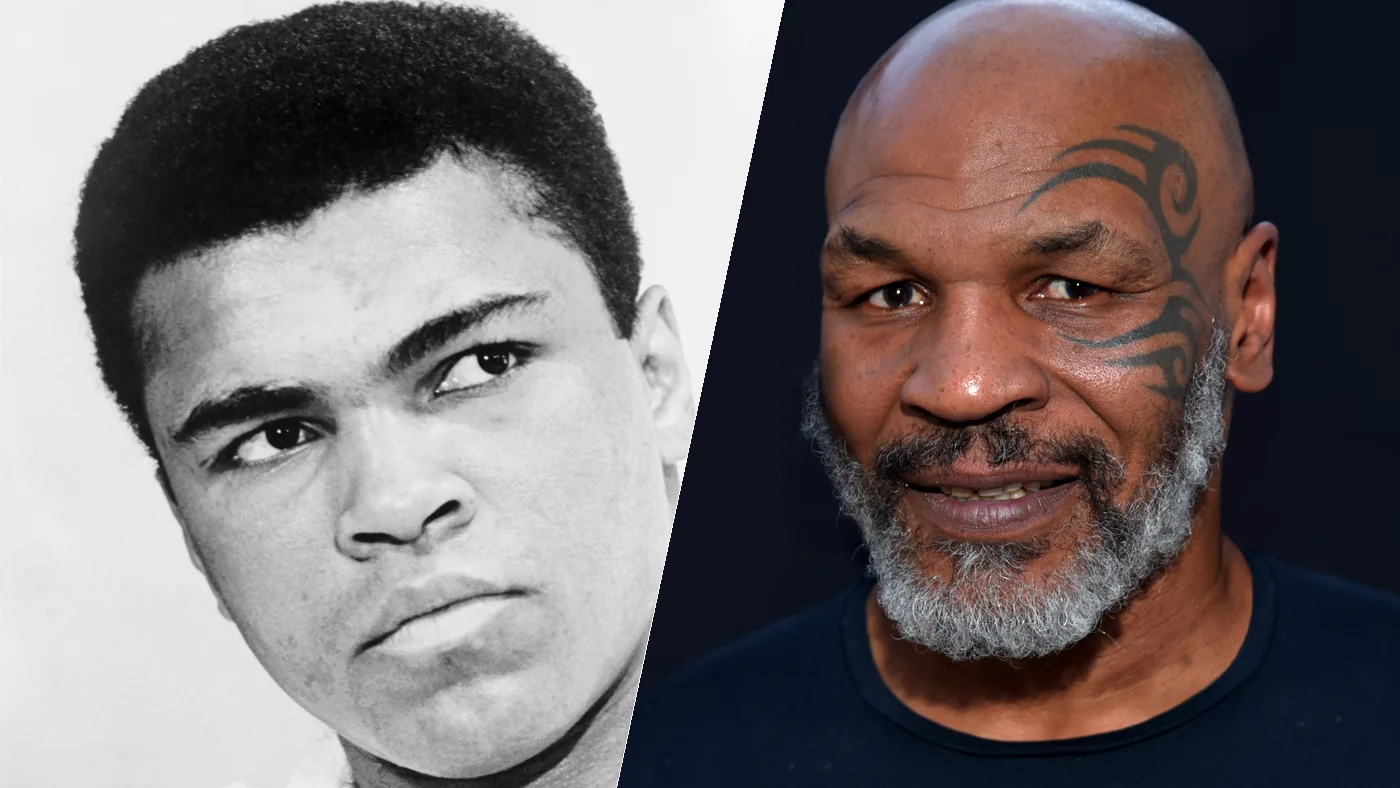
Muhammad Ali retired in December 1981. Mike Tyson's first professional fight came in March 1985. The two best-known heavyweights American sport has produced missed each other by three years, which is why their fight only ever happens in an argument.
They do share an opponent. Trevor Berbick won the last fight Ali ever had, then lost his world title to a 20-year-old Tyson five years later.
Both men have been in the news this summer. Ali died in June 2016, and on the tenth anniversary this June the Muhammad Ali Center in Louisville held its first Day of Compassion.1 Tyson reached his sixtieth birthday on 30 June.2
The only ring Ali and Tyson share is a list, and thirteen of them cannot agree whether the thing worth measuring is four years of terror or twenty of reinvention.
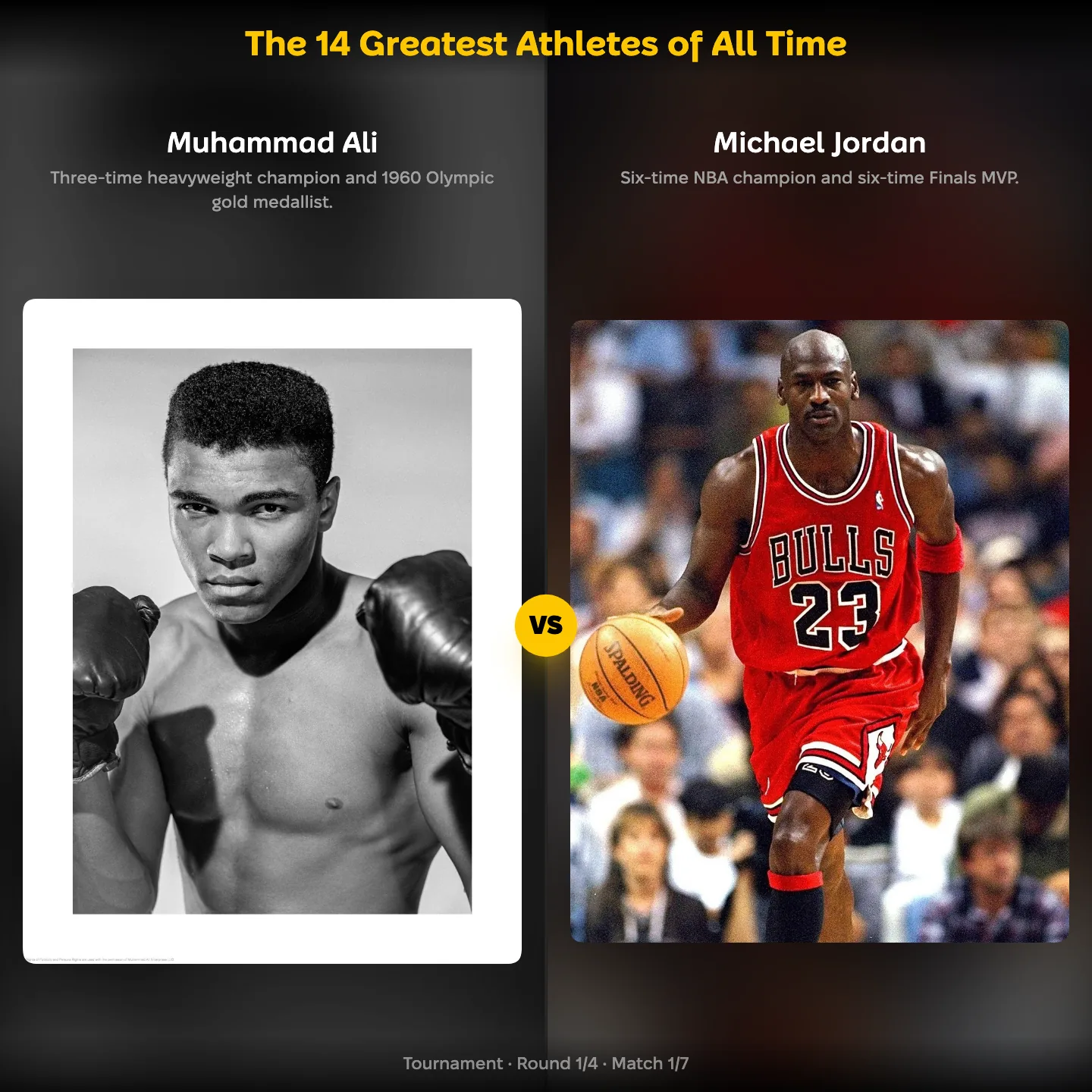
Ali, Tyson and Michael Jordan on the same list
Widen the question past boxing and the company changes entirely. Muhammad Ali and Mike Tyson stand here beside Pelé, Serena Williams, Usain Bolt and Michael Jordan.
Ali arrives with the widest brief. Sports Illustrated named him Sportsman of the Century in 1999, and the BBC gave him its equivalent title for sport as a whole.3
Tyson's claim is narrower and sharper. He was heavyweight champion of the world at 20, and no heavyweight has taken the title younger.
Against a swimmer with 23 Olympic golds and a footballer with three World Cups, both boxers are asking a crowded room to agree that one sport counts more than another.
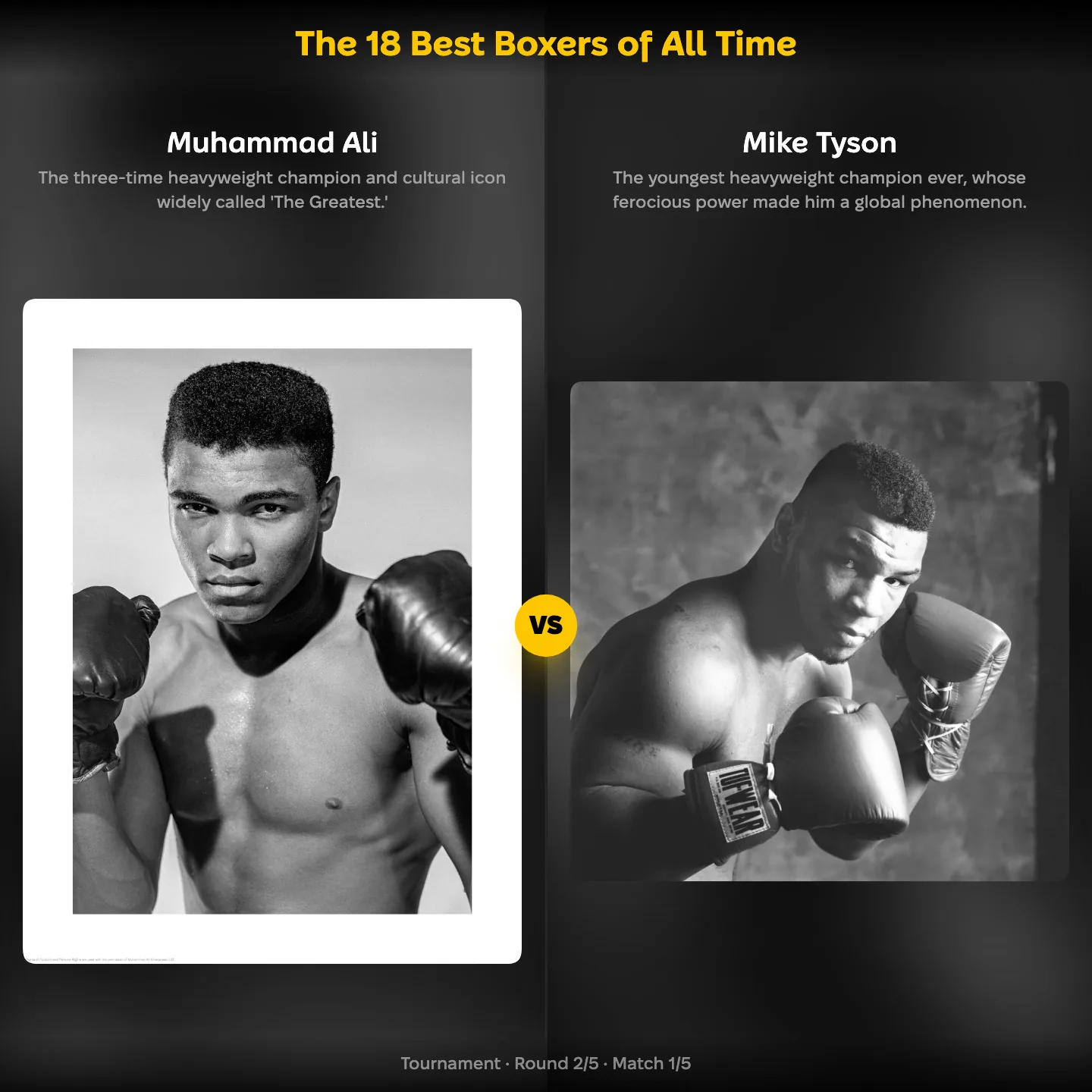
Muhammad Ali vs Mike Tyson: the whole of boxing in one list
Narrow the question to boxing and the field grows rather than shrinks. Eighteen names, every weight class, a century of fighters.
Ali finished 56–5 with 37 knockouts and won the heavyweight title three separate times.3
Tyson finished 50–7 with 44 knockouts.2 The knockout total is higher. The number of title reigns is not.
Sugar Ray Robinson and Henry Armstrong complicate both cases, because neither man was a heavyweight and the pound-for-pound standard exists to measure exactly that.
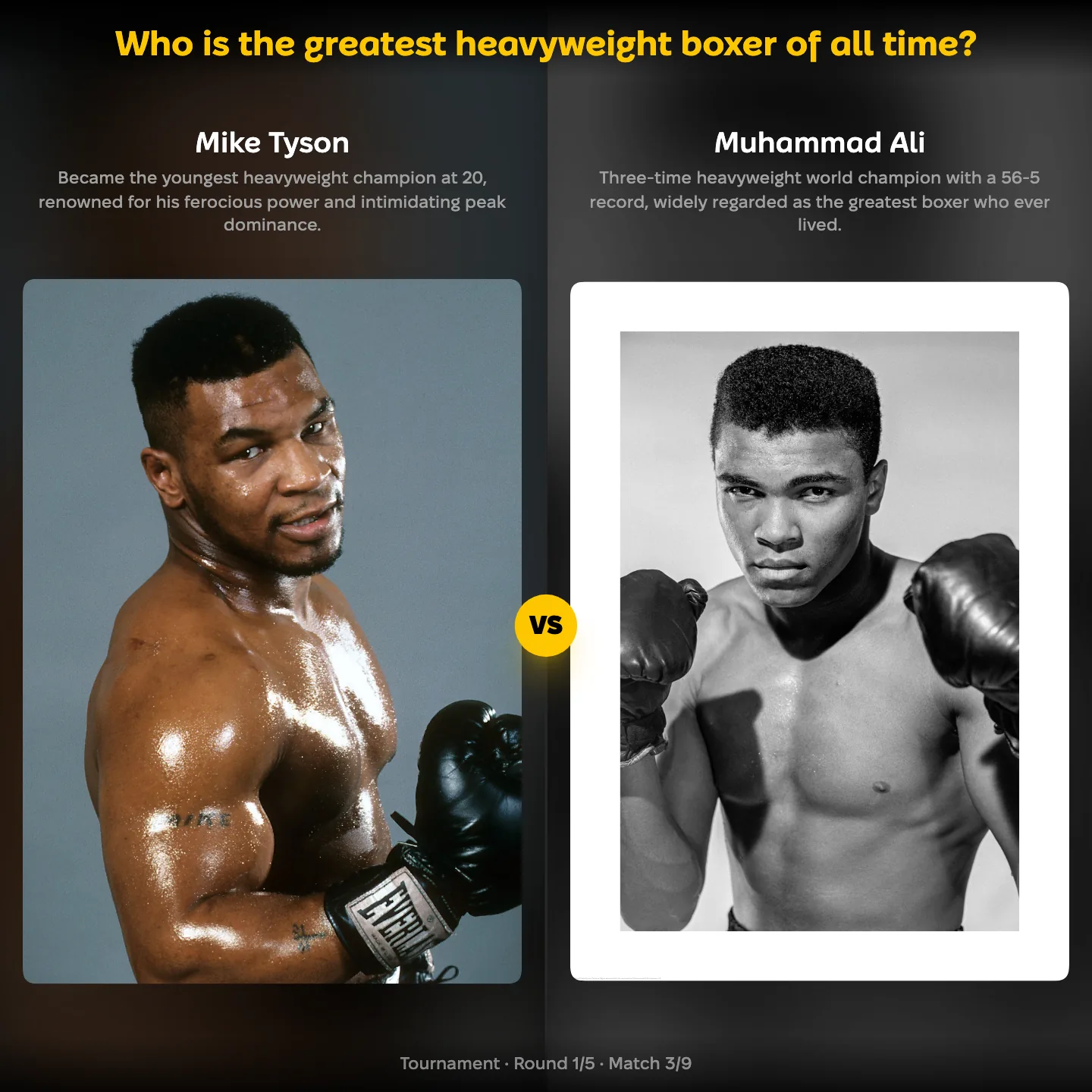
Heavyweight for heavyweight: Ali vs Tyson
Cut the list to heavyweights and this is the closest the two men ever come to an actual fight. Seventeen champions, and the two most argued-over names sit among them.
Ali's heavyweight career is the longer story. He took the title from Sonny Liston in February 1964, lost it outside the ring in 1967 after refusing induction into the US Army, and won it back from George Foreman in Kinshasa in October 1974.3 The Supreme Court had overturned his conviction three years earlier, unanimously.
Tyson's is the concentrated one. He took the WBC title from Trevor Berbick in November 1986 at 20 years and four months, and held a version of the championship until February 1990.2
Four years of that against twenty of Ali's is the whole disagreement. Pick Tyson and you are measuring a peak; pick Ali and you are measuring a career, while Joe Louis, Larry Holmes and Lennox Lewis make the same case in different proportions further down the same list.
Ali, Tyson and Sugar Ray Robinson: the American list
Fifteen American boxers, and nationality is the single biographical fact Ali and Tyson fully share. Ali came out of Louisville, Tyson out of Brownsville in Brooklyn.
Sugar Ray Robinson is the complication. He is the fighter most often called the finest America has produced at any weight, and he never boxed above middleweight.
Joe Louis, Jack Dempsey and Floyd Mayweather are on the same fifteen, which stretches the question across a century and four weight divisions.
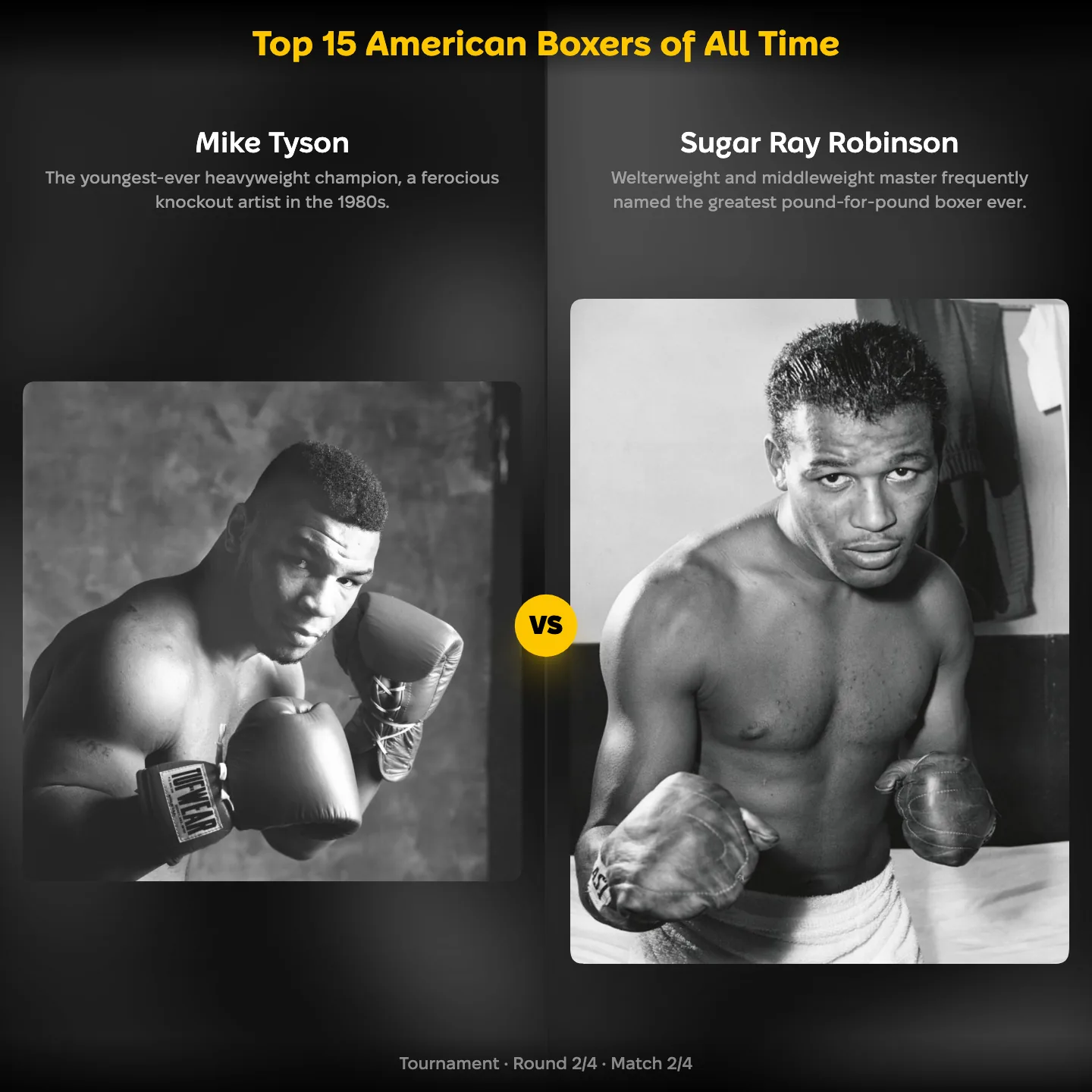
Punching power: Tyson's 44 knockouts against Ali's 37
Ask about power rather than greatness and the order rearranges itself. Forty-four of Tyson's fifty wins came inside the distance. Thirty-seven of Ali's fifty-six did.
Tyson's case is the length of his fights. He was built to finish contests early and usually did.
Ali's case is that he was never a one-punch heavyweight. He beat Foreman by absorbing eight rounds of him first, which is the opposite skill.
George Foreman and Earnie Shavers are on this list with knockout rates higher than either man's, and that is why a power ranking and a greatness ranking rarely produce the same order.
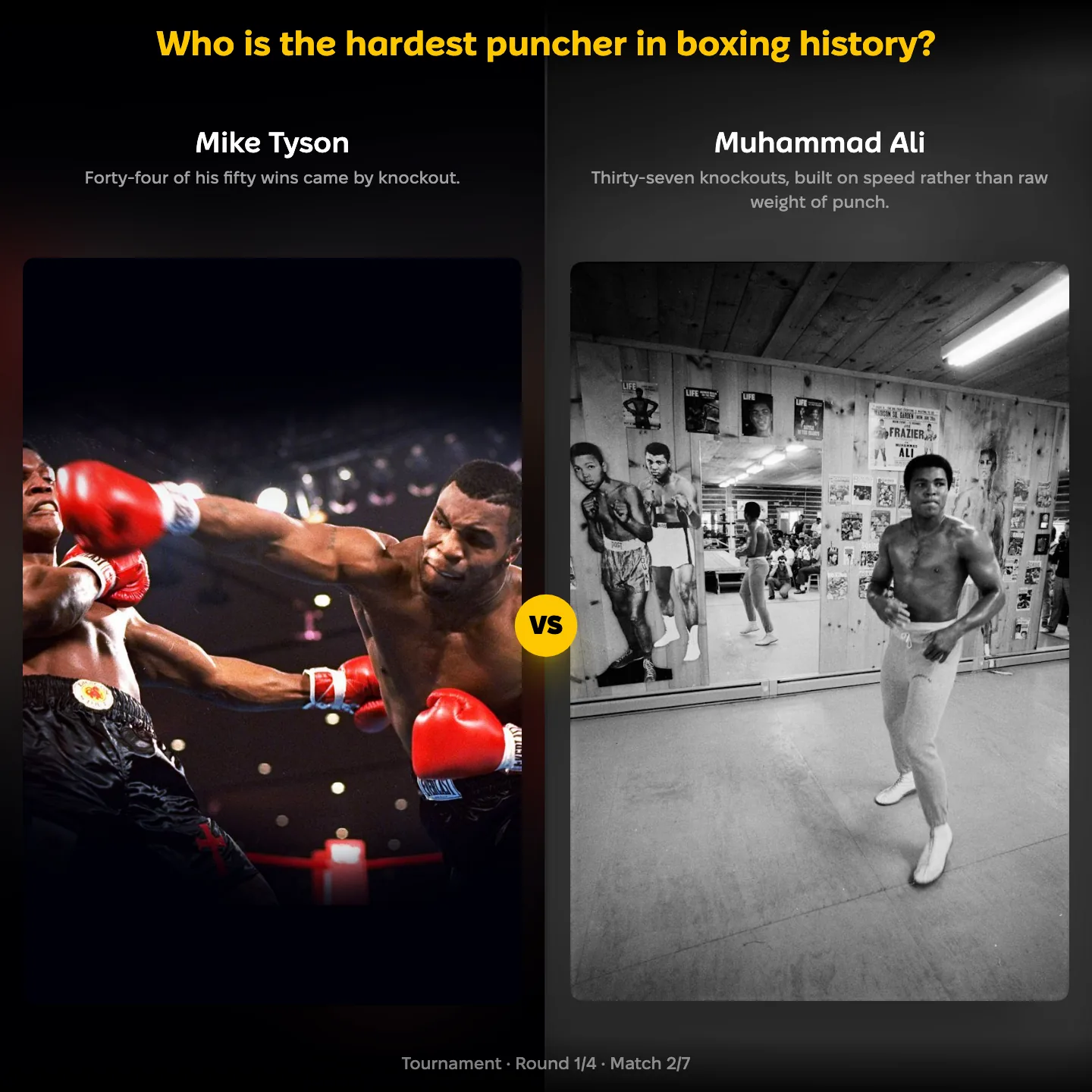
Sonny Liston, Ali and Tyson: fear as a tactic
Intimidation is the one quality both men were famous for, and neither used it the same way.
Ali talked. He predicted rounds, insulted opponents in verse, and made the press conference part of the contest.
Tyson said very little. Opponents walked to the ring against a man whose recent fights had ended in the opening minutes, and several of them boxed like it.
Sonny Liston belongs in the same conversation, and he is what makes the comparison work: in 1964 he was the most feared heavyweight alive, and a 22-year-old Ali took his title anyway. Shaquille O'Neal, Lawrence Taylor and Dennis Rodman push the question well past boxing.
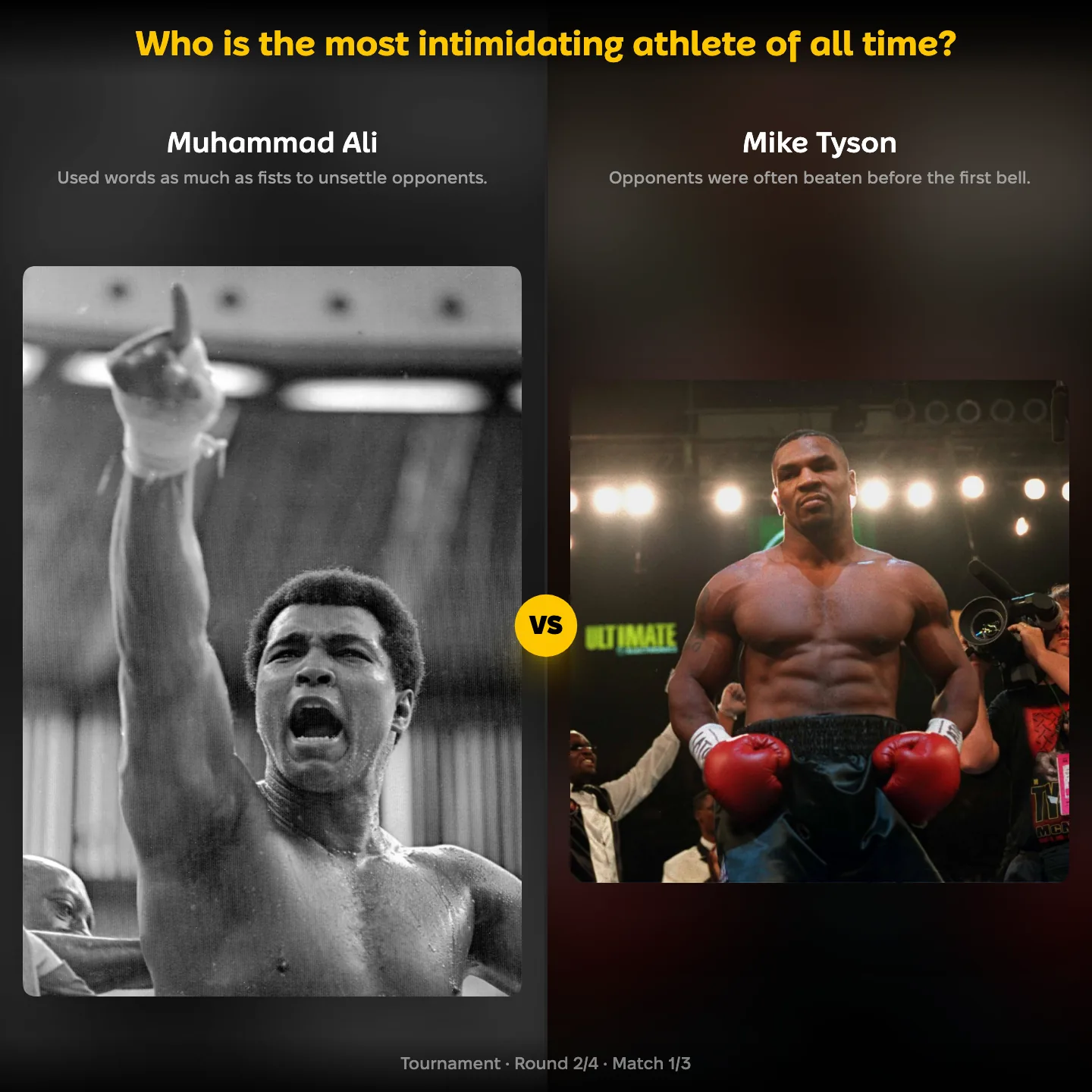
Ali–Frazier against Tyson–Holyfield
Neither man is ranked here as a fighter. They appear as halves of the rivalries that defined them.
Ali and Joe Frazier fought three times in the 1970s, including the Thrilla in Manila. Ali has two further entries on this list, against Ken Norton and George Foreman.
Tyson has one. He fought Evander Holyfield twice, and the second meeting ended in the third round when Tyson bit Holyfield's ear and was disqualified.
Three entries against one is what a twenty-one-year career buys. Sugar Ray Robinson and Jake LaMotta are on the same list to remind both men that the format predates them.
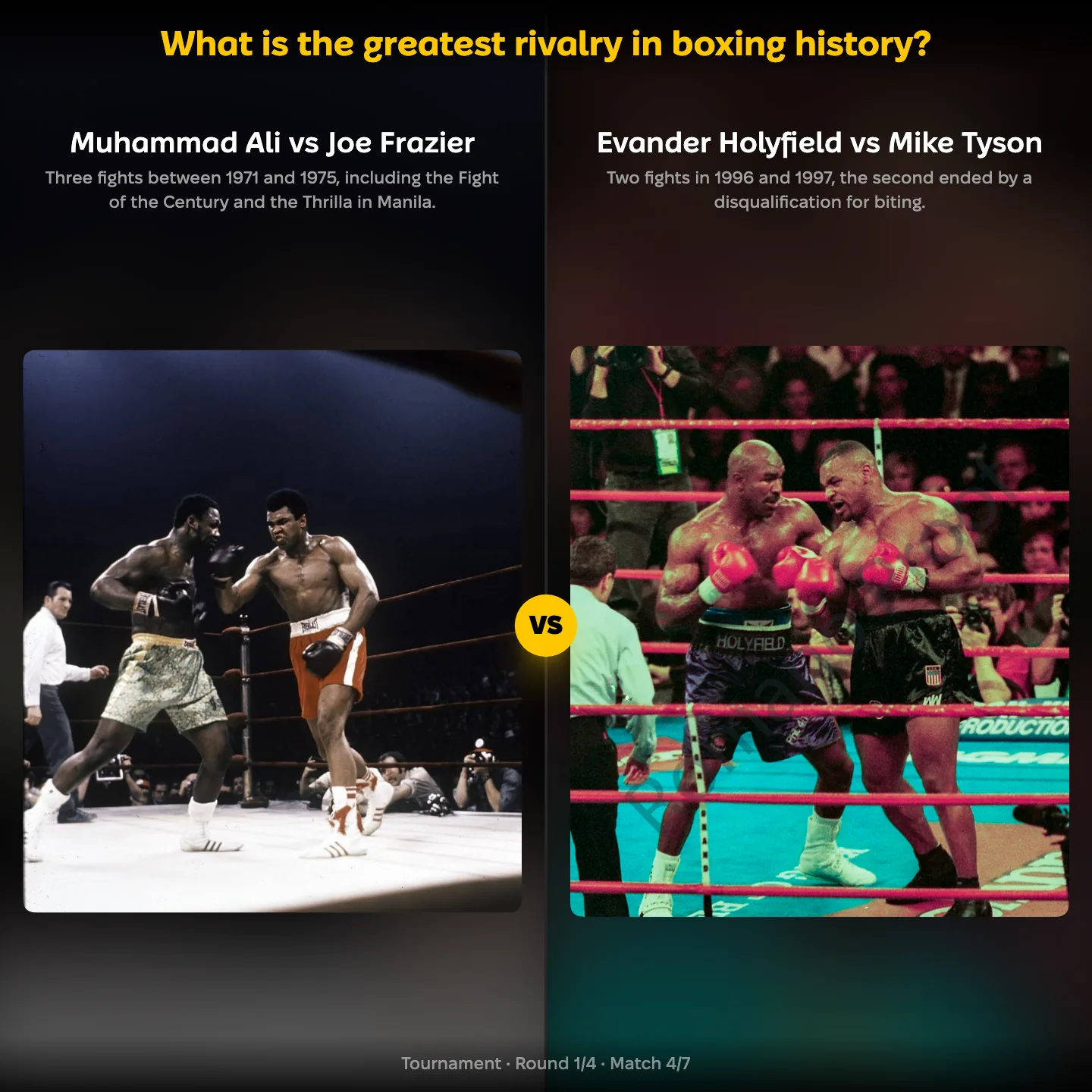
Buster Douglas and Leon Spinks: the nights the favourite lost
Appearing on this list is no compliment, and both men manage it twice.
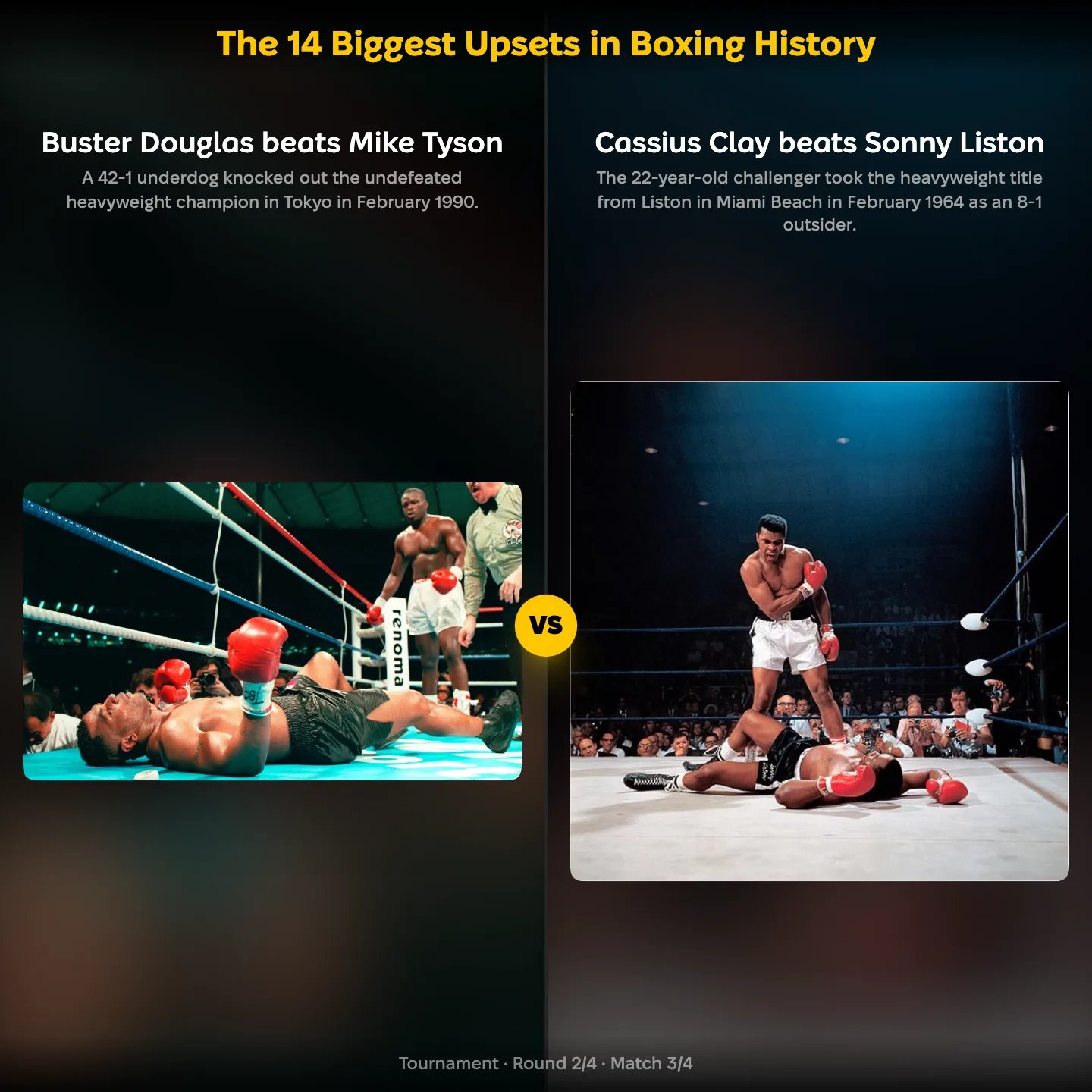
Tyson is the beaten favourite in two of the fourteen entries. Buster Douglas, a 42-to-1 underdog, knocked him out in the tenth round in Tokyo in February 1990.2 Evander Holyfield stopped him in 1996 when the odds again said otherwise.
Ali is on both sides of the same list. He is the upset in February 1964, when a 22-year-old Cassius Clay took the title from Liston, and he is the victim in 1978, when Leon Spinks beat him in Spinks's eighth professional fight. He is the underdog again in Kinshasa against an unbeaten Foreman.
James J. Braddock and Randolph Turpin fill out a ranking whose real subject is how badly boxing predicts itself.
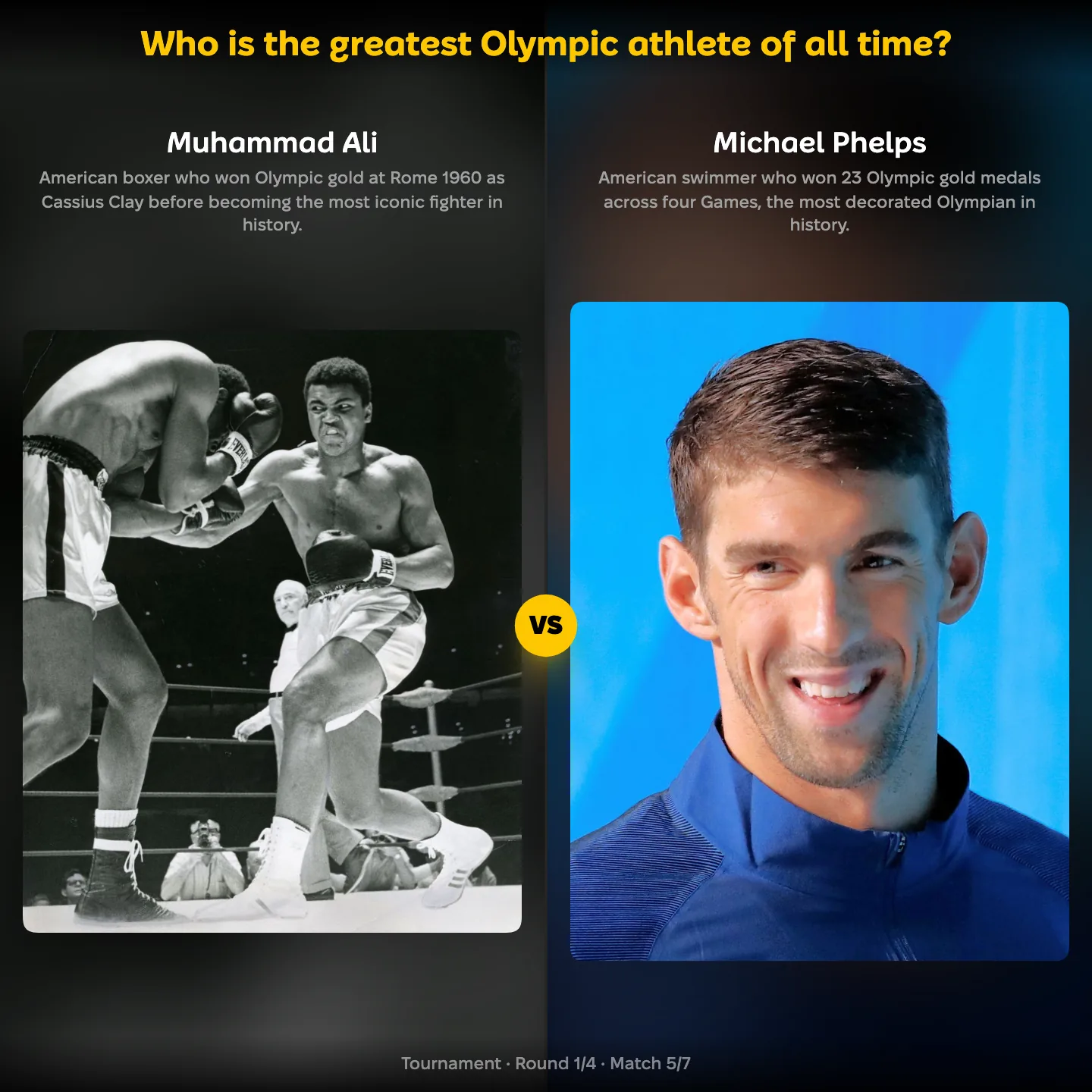
Rome 1960: the list Tyson cannot enter
Ali won light-heavyweight gold at the 1960 Rome Olympics under the name Cassius Clay, which puts him on a list of Olympians next to Michael Phelps, Usain Bolt and Simone Biles.3
Tyson is absent, and the absence has a precise cause. He lost twice in the American trials to Henry Tillman, who then won heavyweight gold at Los Angeles 1984.2
The fighter who would be world champion twenty-eight months later never made the team.
Set against 23 Olympic golds, Ali's single medal is a small entry in his own career. It is still one more than Tyson has.
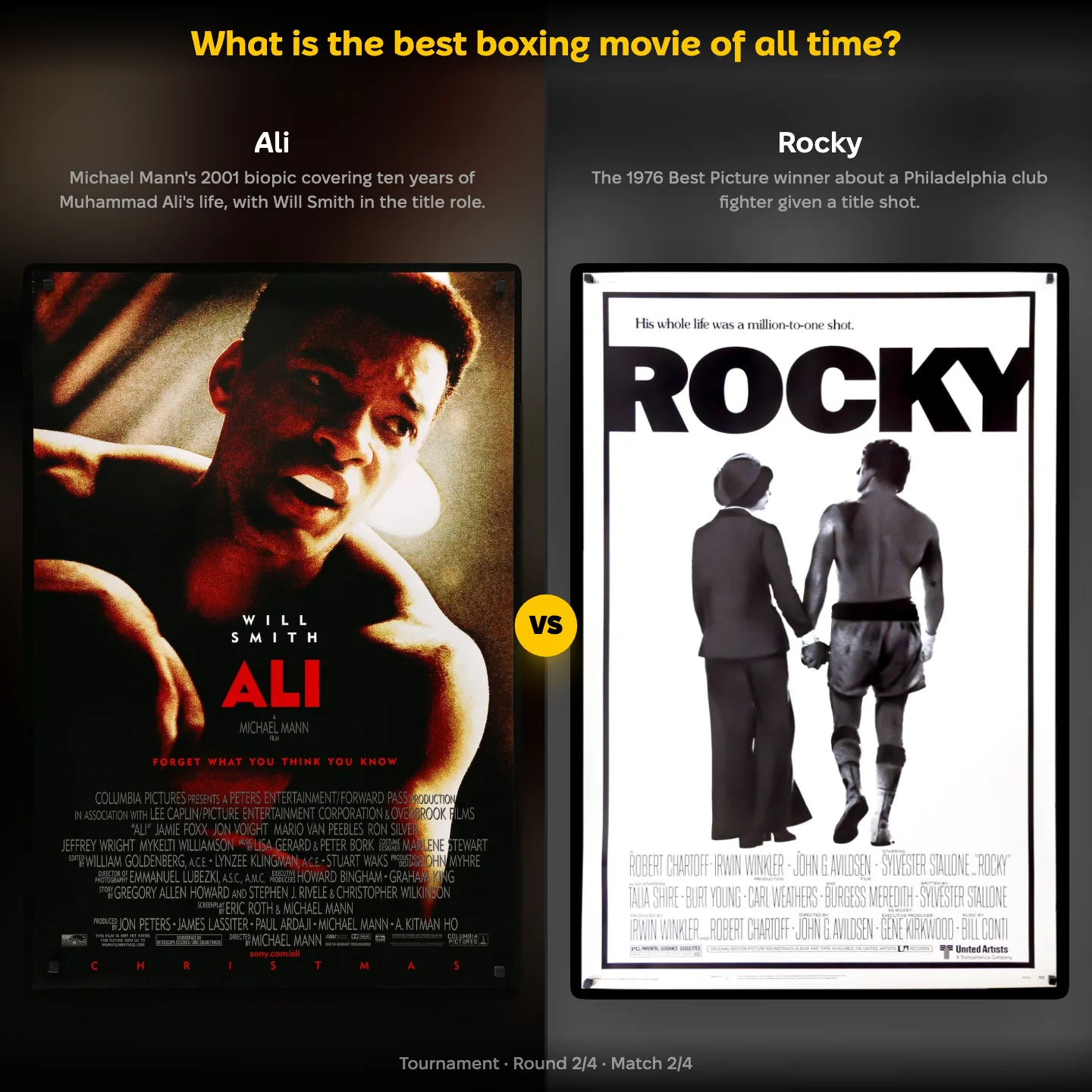
Michael Mann's Ali against Rocky
Fifteen boxing films, and Ali is the subject of two of them: Michael Mann's 2001 biopic starring Will Smith, and When We Were Kings, the documentary about Kinshasa.
Tyson has no entry here, although a documentary about him was released in 2008.
The ranking is carried by fighters who were never real. Rocky won Best Picture for 1976, and four Rocky films are on the list.
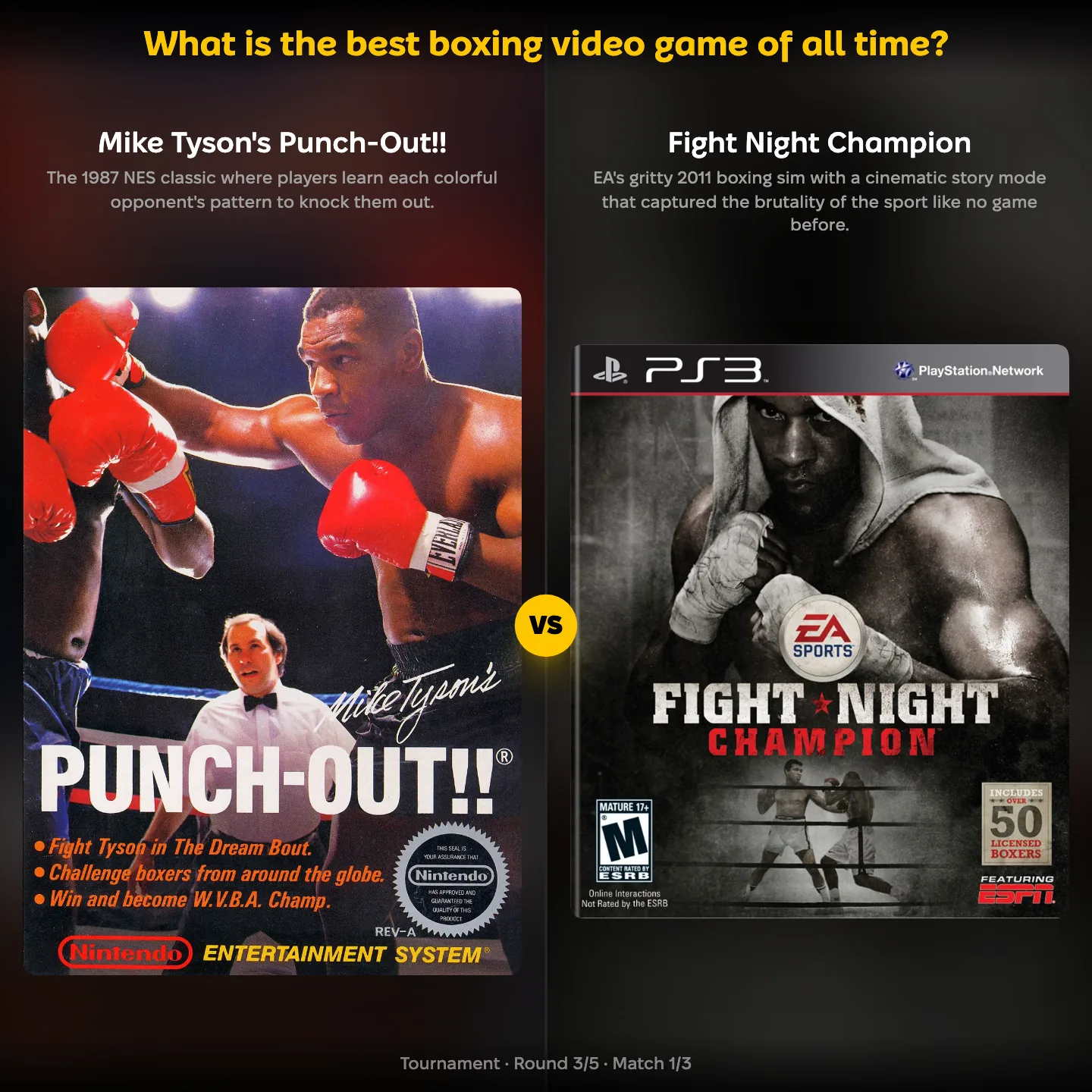
Mike Tyson's Punch-Out!!: a game with his name on the box
Nintendo put Tyson's name and face on a 1987 NES cartridge, and for a generation too young to have watched him fight, that game was Mike Tyson.
Ali has no equivalent. He appears inside boxing games rather than on their covers.
Twenty titles are ranked here, most of them simulations. The one with a real fighter in its name is the one people still quote.
Jake Paul vs Mike Tyson, forty years after the trials
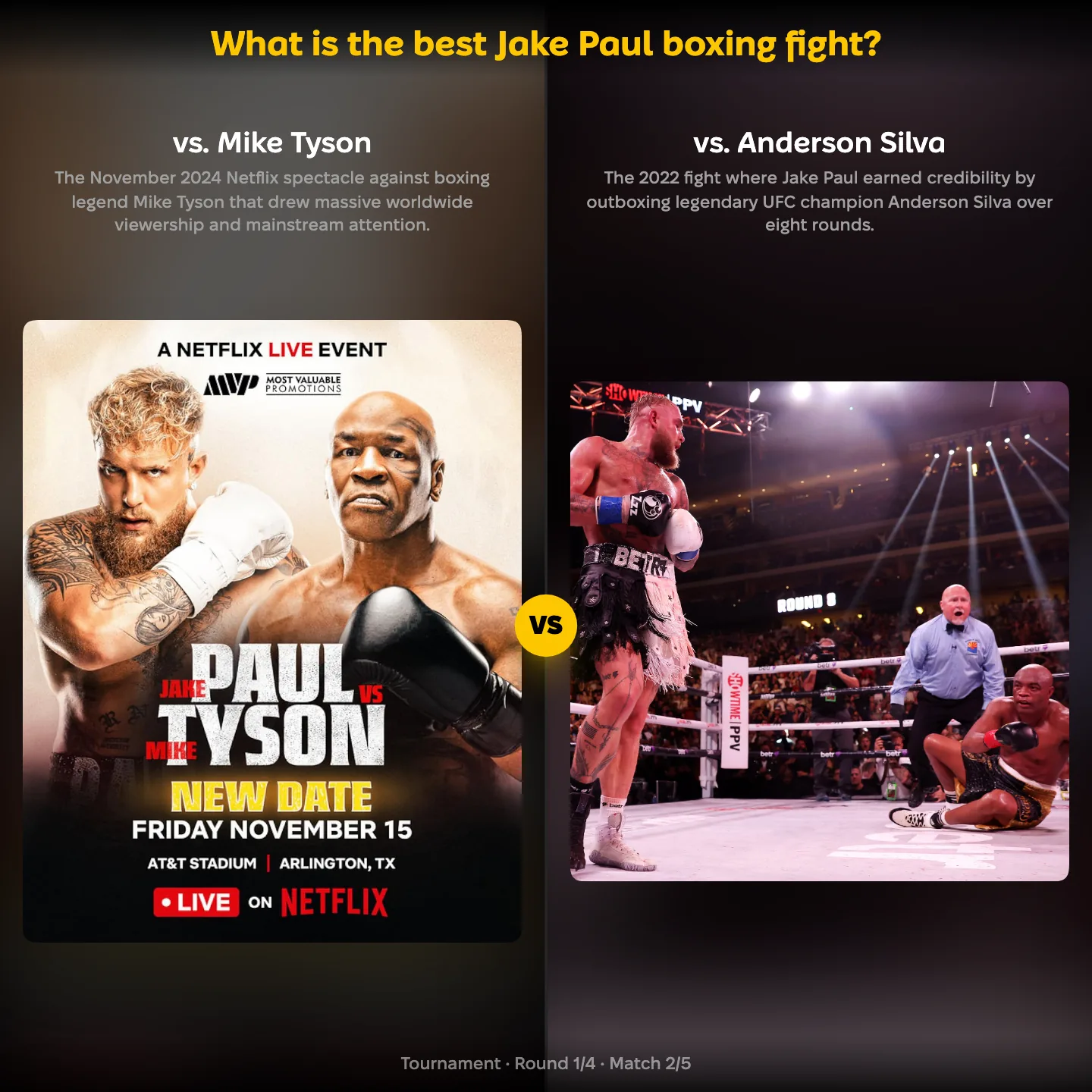
Tyson's most recent appearance on any ranking belongs to somebody else's career. In November 2024, aged 58, he fought Jake Paul at AT&T Stadium in Arlington and lost on all three scorecards: 80–72, 79–73, 79–73.2
Nine Jake Paul fights are ranked here, and the Tyson one drew the audience.
Ali never appears here, for reasons of chronology alone. He had his own version of the same night in 1980 and 1981, which is the subject of the last ranking in this article.
Four decades separate Tyson's failed Olympic trials from the evening a YouTuber outpointed him over eight rounds.
Trevor Berbick: the man who closed one career and opened the other
Trevor Berbick is the link between these two careers, and he is rarely remembered for it.
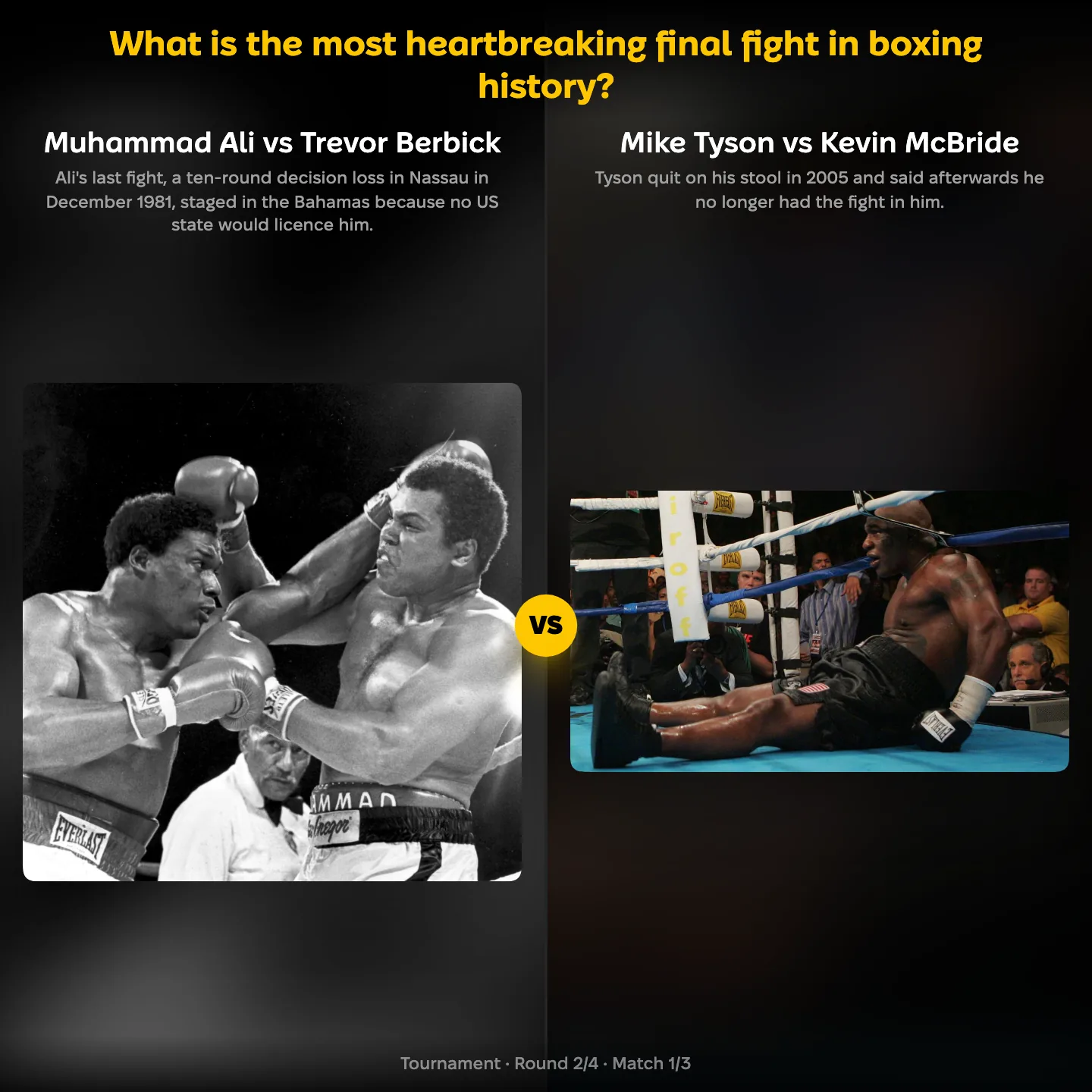
On 11 December 1981 in Nassau, Berbick beat Ali over ten rounds. It was the last fight of Ali's career, staged in the Bahamas because no American state would licence him, and Ali was 39.4
Five years later, on 22 November 1986 in Las Vegas, Berbick lost the WBC heavyweight title to a 20-year-old Mike Tyson. One opponent closed the first career and opened the second.
Both men have their own entry on this ranking of last fights. Ali's is Berbick. Tyson's is Kevin McBride in 2005, after which he said he no longer had the fight in him. Twelve final fights are listed, and the pattern holds across all of them: boxing is much better at starting careers than at ending them.
Thirteen questions, one fight that never happened
Ali and Tyson shared an opponent and never shared a ring. Thirteen rankings put them in the same frame anyway, and each one decides the matter by deciding what to count: knockouts, title reigns, an Olympic medal, a film, or the night the favourite lost. Each is settled by choosing between two names, over and over.
Every ranking in this article:
- The 14 Greatest Athletes of All Time
- The 18 Best Boxers of All Time
- Who is the greatest heavyweight boxer of all time?
- Top 15 American Boxers of All Time
- Who is the hardest puncher in boxing history?
- Who is the most intimidating athlete of all time?
- What is the greatest rivalry in boxing history?
- The 14 Biggest Upsets in Boxing History
- Who is the greatest Olympic athlete of all time?
- What is the best boxing movie of all time?
- What is the best boxing video game of all time?
- What is the best Jake Paul boxing fight?
- What is the most heartbreaking final fight in boxing history?
If the question you actually argue about is missing from those thirteen, build that ranking and let other people fight it out.
More rankings, more angles
- Magic Johnson vs Larry Bird: 47 Years of the Same Argument — two rookies of 1979, never settled since
- Pelé vs Maradona — the Answer Changes With the Question — two greats who also never shared a peak
- Where Does Mike Tyson Actually Rank? — ten of his sixteen rankings sit outside boxing
- Which Muhammad Ali Are You Ranking? — boxer, draft resister, Olympic torchbearer
Sources
- Muhammad Ali Center — inaugural Day of Compassion, ten years after Ali's death: alicenter.org (checked 2026-08-02)
- Mike Tyson — date of birth, professional record, youngest heavyweight champion, the Berbick, Douglas, Holyfield and Jake Paul fights, and the 1984 Olympic trials: en.wikipedia.org (checked 2026-08-02)
- Muhammad Ali — professional record, three heavyweight title reigns, 1960 Olympic gold, the 1967 refusal and 1971 Supreme Court ruling, the 1974 Foreman fight, and Sportsman of the Century: en.wikipedia.org (checked 2026-08-02)
- Trevor Berbick — the December 1981 win over Ali in Nassau and the November 1986 title loss to Tyson: en.wikipedia.org (checked 2026-08-02)