
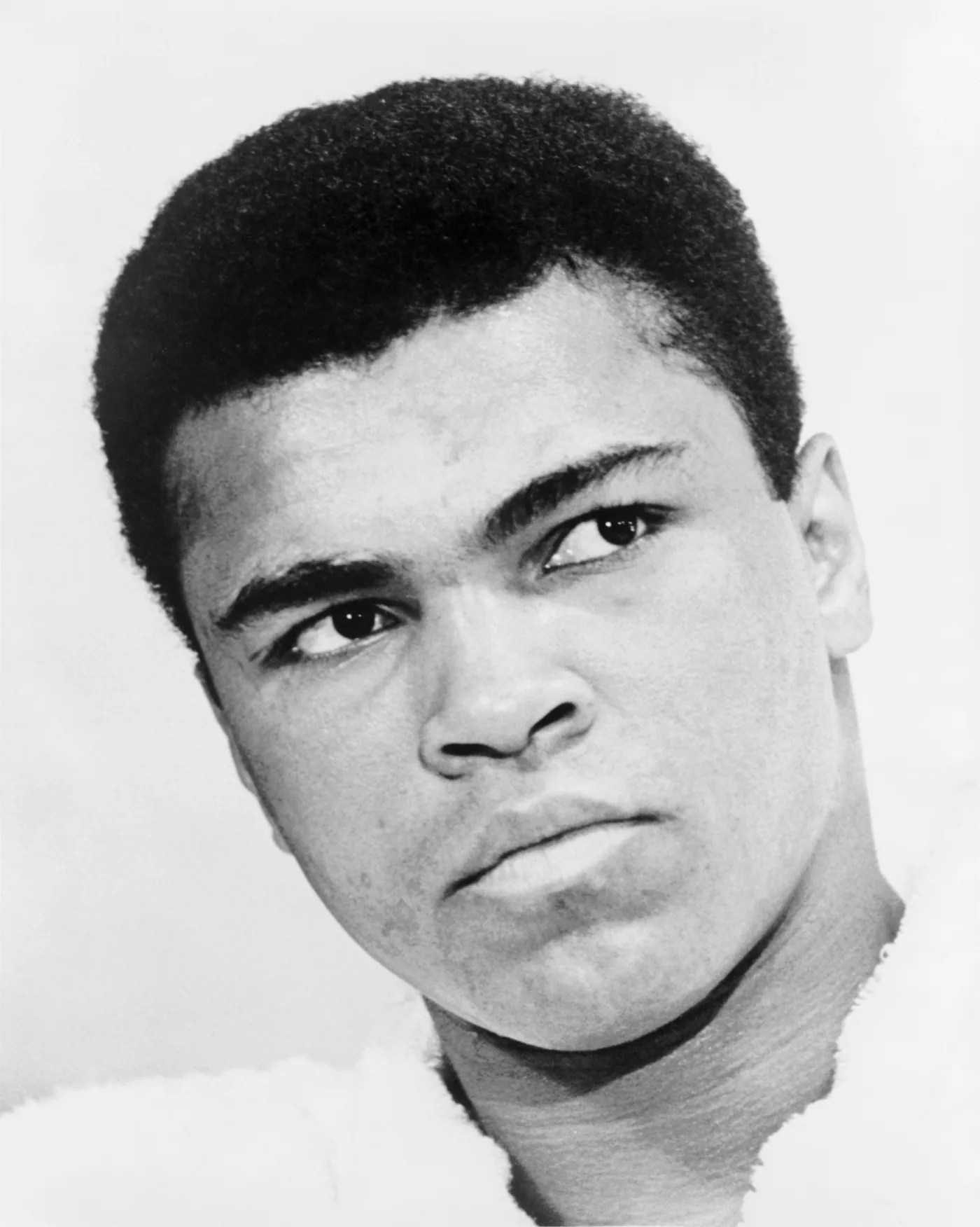
Muhammad Ali finished with 56 wins and 5 defeats, won Olympic gold in Rome at 18, held the heavyweight title in three separate decades, and spent three and a half years out of boxing after refusing induction into the US Army in 1967.1 That career fits into a boxing ranking easily enough. It also fits into a ranking of film, of Olympic ceremonies, of press conferences, and of careers that went on a fight too long.
Sports Illustrated named him Sportsman of the Century in 1999, and Prime Video puts an eight-episode authorised series about him, The Greatest, on air on 4 November 2026.2 Forty-five years after his last fight, people are still arguing about where he goes.
He is an option in fourteen rankings here, and they are not variations on one theme: one is about documentaries, one about upsets, one about the last night of a fighter's career.
Ali is the rare subject who belongs on the boxing lists and the film lists and the one about knowing when to stop.
Ali vs Joe Louis: the list he is meant to win
This is the ranking Ali is supposed to own, and the field is why he might not. Seventeen heavyweights are in it.
Joe Louis held the title for nearly twelve years and made 25 successful defences, a record no heavyweight has approached since. Rocky Marciano retired without a defeat.
Ali's case rests on three separate reigns and on beating the two most feared punchers of his era, Sonny Liston and George Foreman, when neither was supposed to be beatable.1
Louis, Marciano, Mike Tyson and Lennox Lewis are all here, and the counter-argument for each of them is a different kind of dominance.
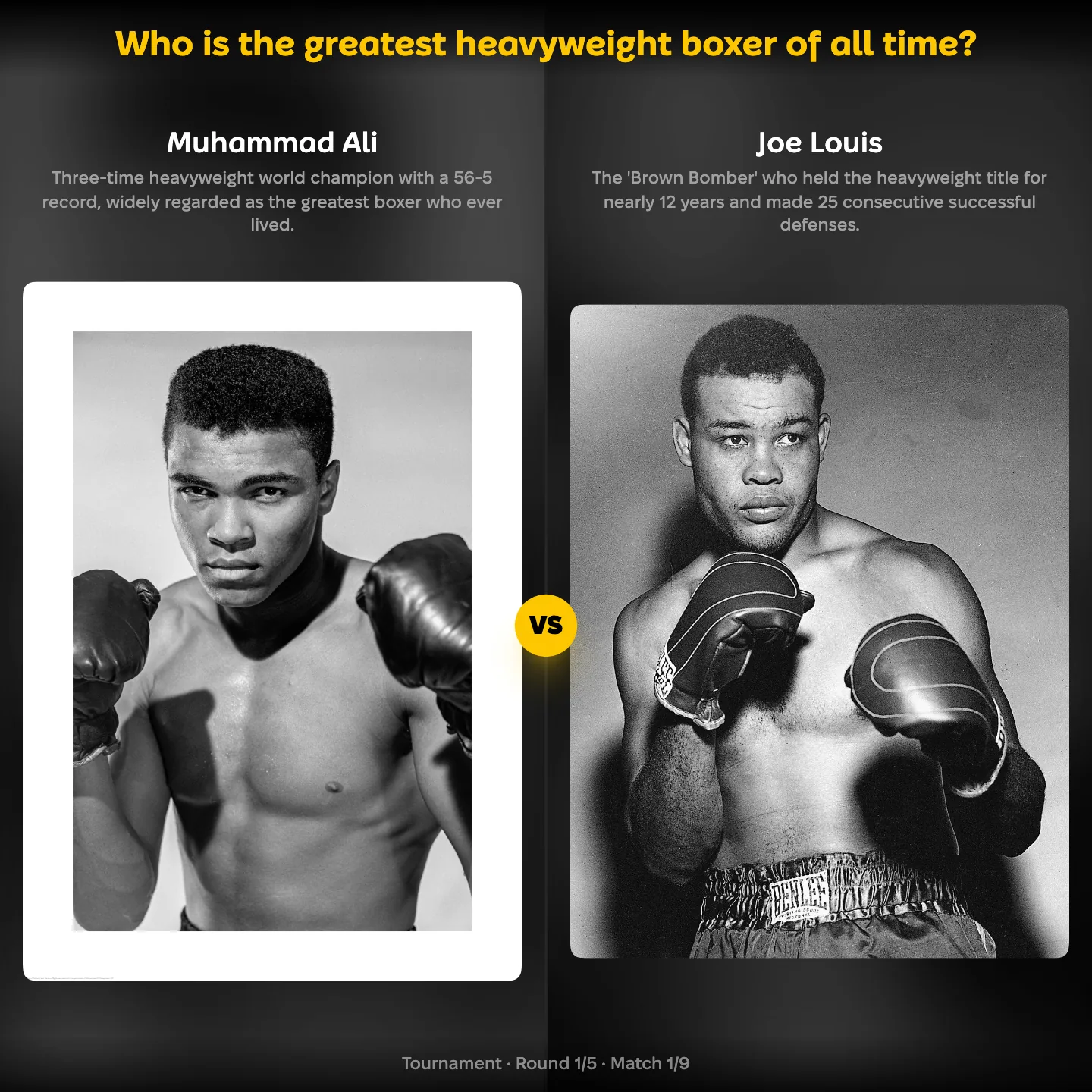
Pound for pound, Sugar Ray Robinson is in the way
Open the ranking to every weight class and the shape of the question changes. Eighteen fighters, one division no longer protecting anybody.
Sugar Ray Robinson won titles at welterweight and middleweight and is the man most trainers name first when the phrase "pound for pound" comes up. Henry Armstrong held three world titles at the same time.
Ali arrives as a heavyweight in a category that has usually rewarded smaller men, and the argument for him is not technique but the size of what he beat.
Floyd Mayweather Jr. finished 50–0. Manny Pacquiao won titles in eight weight classes. This is a ranking where the boxing case has to be made in numbers, and Ali's are not the biggest ones on the page.
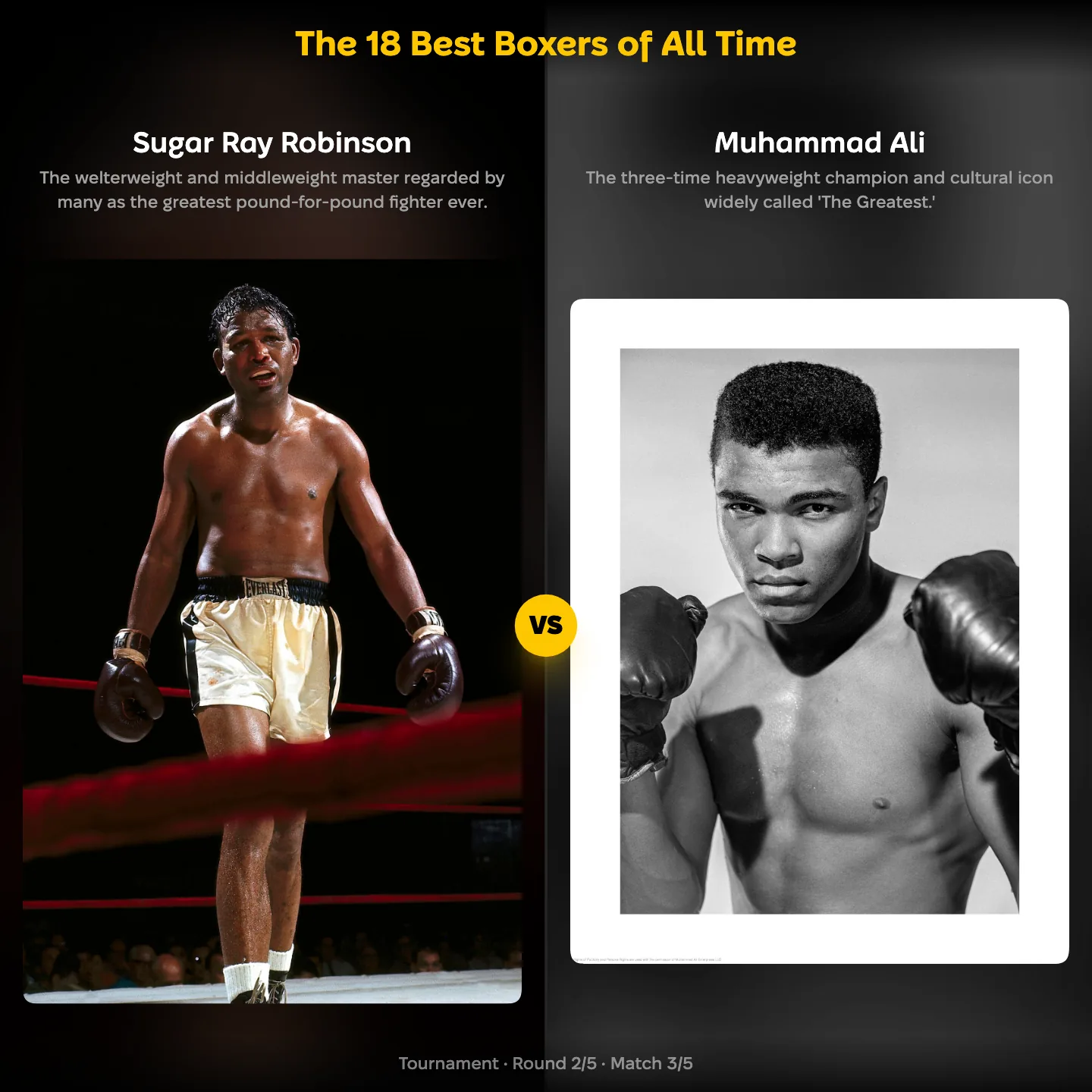
Rocky Marciano retired 49–0. Ali finished 56–5
Narrowing a ranking to one country usually thins the field. American boxing is the exception.
The fifteen names here include Robinson, Louis, Marciano, Tyson, Sugar Ray Leonard and Jack Johnson. Every one of them held a world title.
Ali's five defeats are part of his case rather than a hole in it: two came at the end, and the other three came against Frazier, Ken Norton and Leon Spinks, all of whom he beat afterwards.
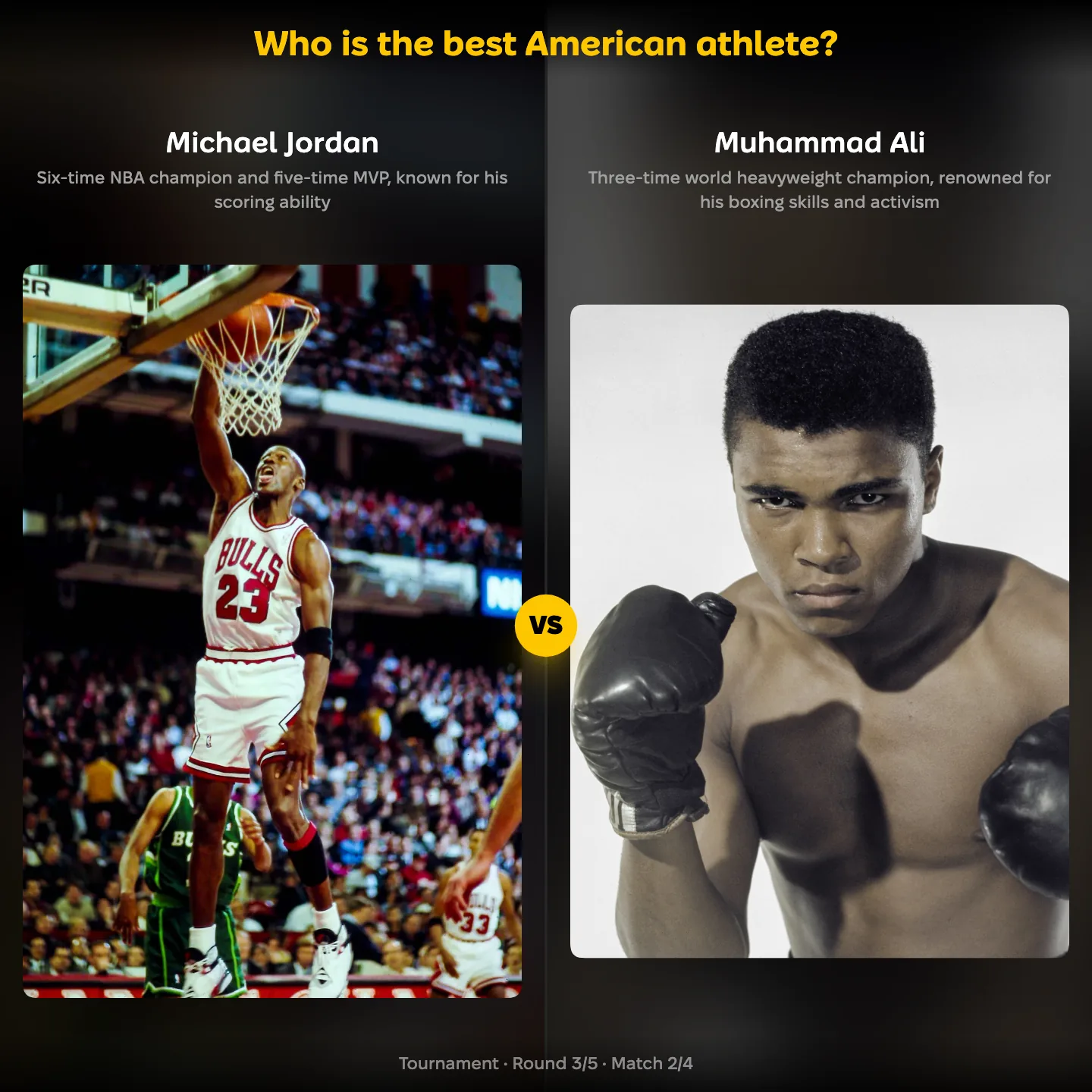
Ali vs Michael Jordan, with every American sport in the room
Thirty-one athletes, and boxing is suddenly a minority interest. Basketball, baseball, football, swimming, track and tennis all send their best.
Michael Jordan took six NBA titles. Michael Phelps left the pool with 23 golds. Babe Ruth and Jackie Robinson changed what baseball was for.
Ali's number in this company is not a total. It is 1974, 1996 and 1967: a title regained at 32, a torch lit at 54, and a refusal that cost him the best three years a heavyweight gets.1
Serena Williams, Jim Brown and Jesse Owens are on the same page, which is a good indication of how narrow the top of this ranking is.
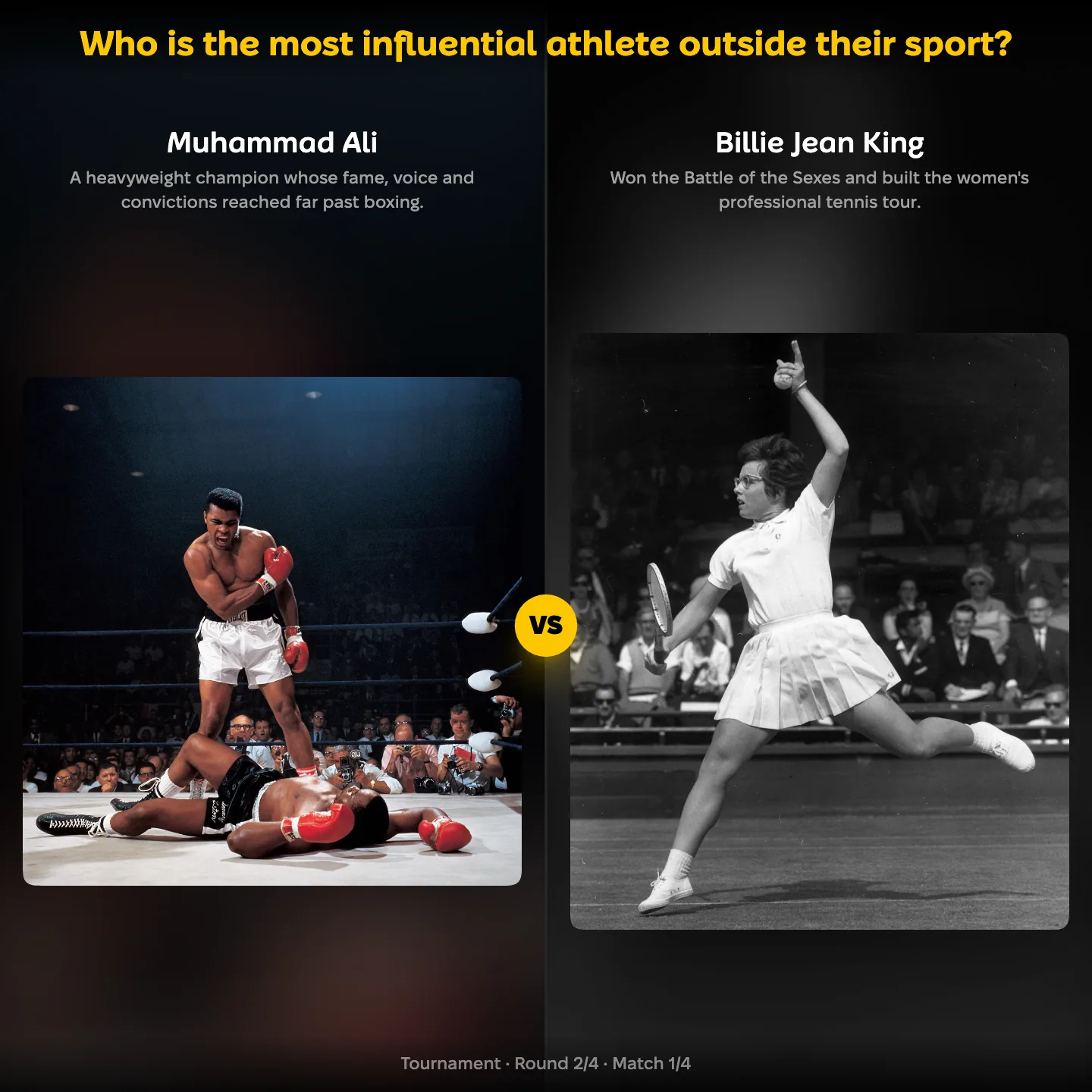
The lens where Billie Jean King is the competition
This ranking ignores what the athletes did inside their sport, which is the only way Ali's boxing record stops being the headline.
Billie Jean King won the Battle of the Sexes in front of 30,000 people at the Astrodome and then built the women's professional tour that followed it. Jackie Robinson's 1947 debut with the Brooklyn Dodgers changed American sport before it changed anything else.
Ali's entry is the 1967 refusal and the four years of litigation that ended on 28 June 1971, when the Supreme Court reversed his conviction in Clay v. United States without a dissent.3 He was 25 when it started and 29 when it finished.
Michael Jordan is here on a different basis entirely: a shoe line that turned an athlete's name into a global business, and a template every sport has copied since.
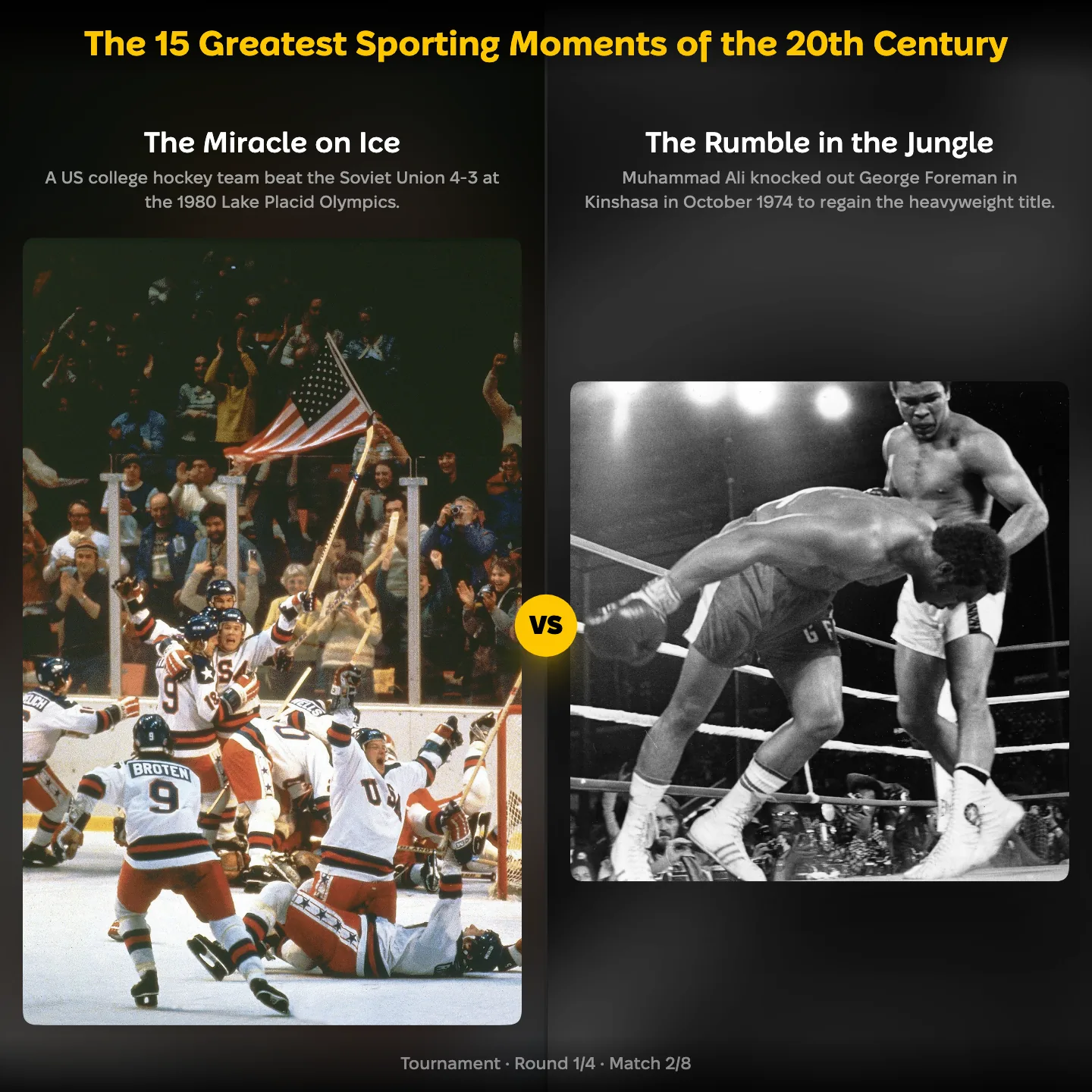
Kinshasa, 1974: one night against the Miracle on Ice
Now Ali is not a person on the list. He is an event, and the event has to beat fourteen others from a century of sport.
The Rumble in the Jungle was staged at the Stade du 20 Mai in Kinshasa on 30 October 1974, paid each fighter a record five million dollars, and was watched by a reported billion people.4 Ali was 32 and had been beaten by Frazier three years earlier; Foreman was unbeaten and had destroyed Frazier in two rounds. Ali let him punch for seven rounds and knocked him out in the eighth.
The competition is the 1980 US hockey team beating the Soviet Union, Jesse Owens winning four golds in Berlin in 1936, Roger Bannister's four-minute mile and Nadia Comăneci's perfect 10.
Most of those are single achievements. Kinshasa was a whole story: two Americans fighting in Zaire, a bout postponed six weeks by a cut over Foreman's eye, and a strategy nobody in the arena believed in until it worked.
The fight also started at four in the morning local time so that American television could show it in prime time, which is how a stadium in central Africa ended up holding the most-watched sporting event of its decade.
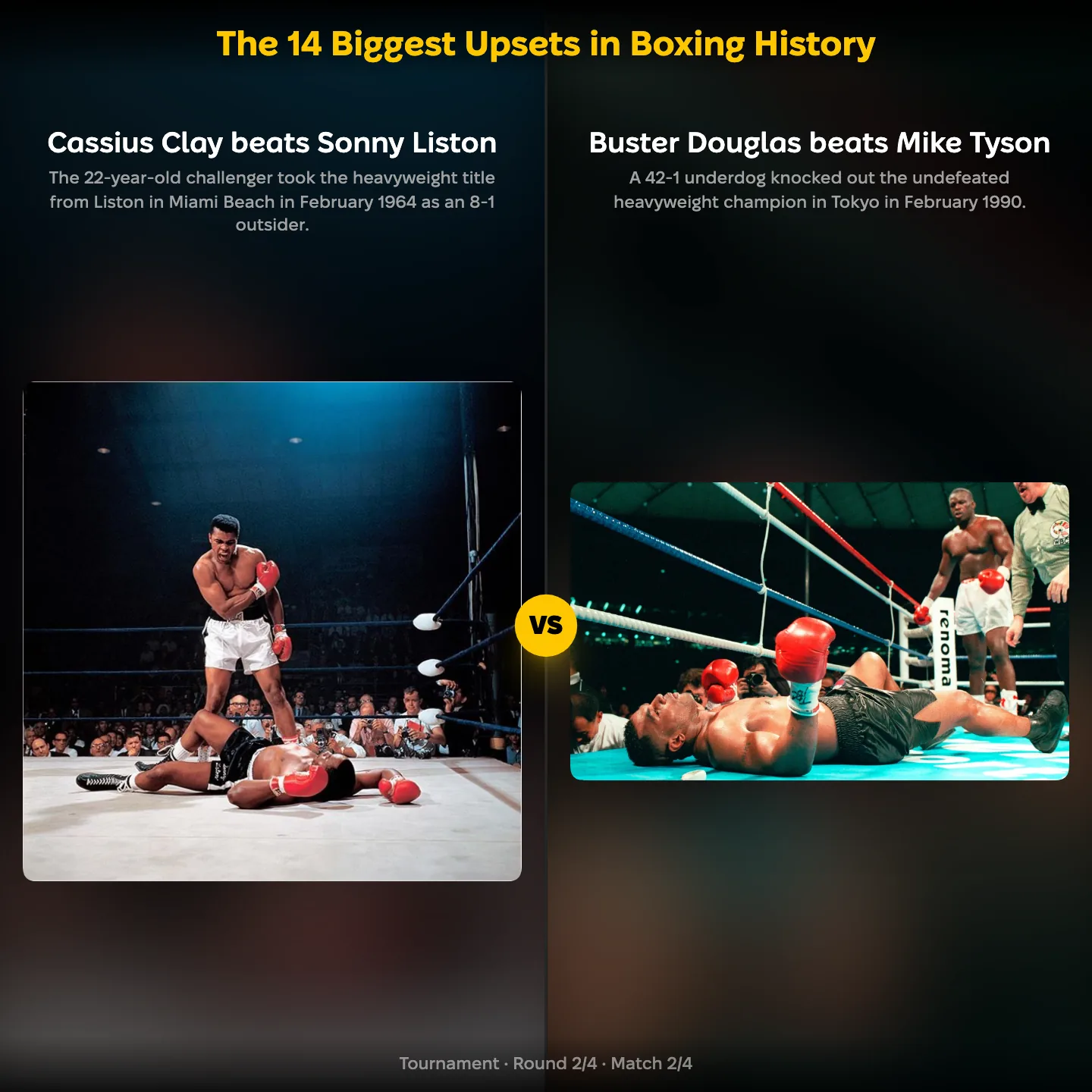
Miami Beach, 1964: an 8–1 outsider
Fourteen upsets, and Ali appears in three of them. That is the unusual thing about this ranking.
He is the underdog twice. In Miami Beach in February 1964 he took the title from Sonny Liston at 22, an 8–1 outsider against a champion most reporters thought would hurt him.1 Ten years later he was 4–1 against Foreman.
He is also the favourite who lost. Leon Spinks, in his eighth professional fight, took the title from Ali on a split decision in February 1978.
Buster Douglas knocking out Mike Tyson in Tokyo at 42–1 is the entry most people name first, and it is the one Ali has to get past.
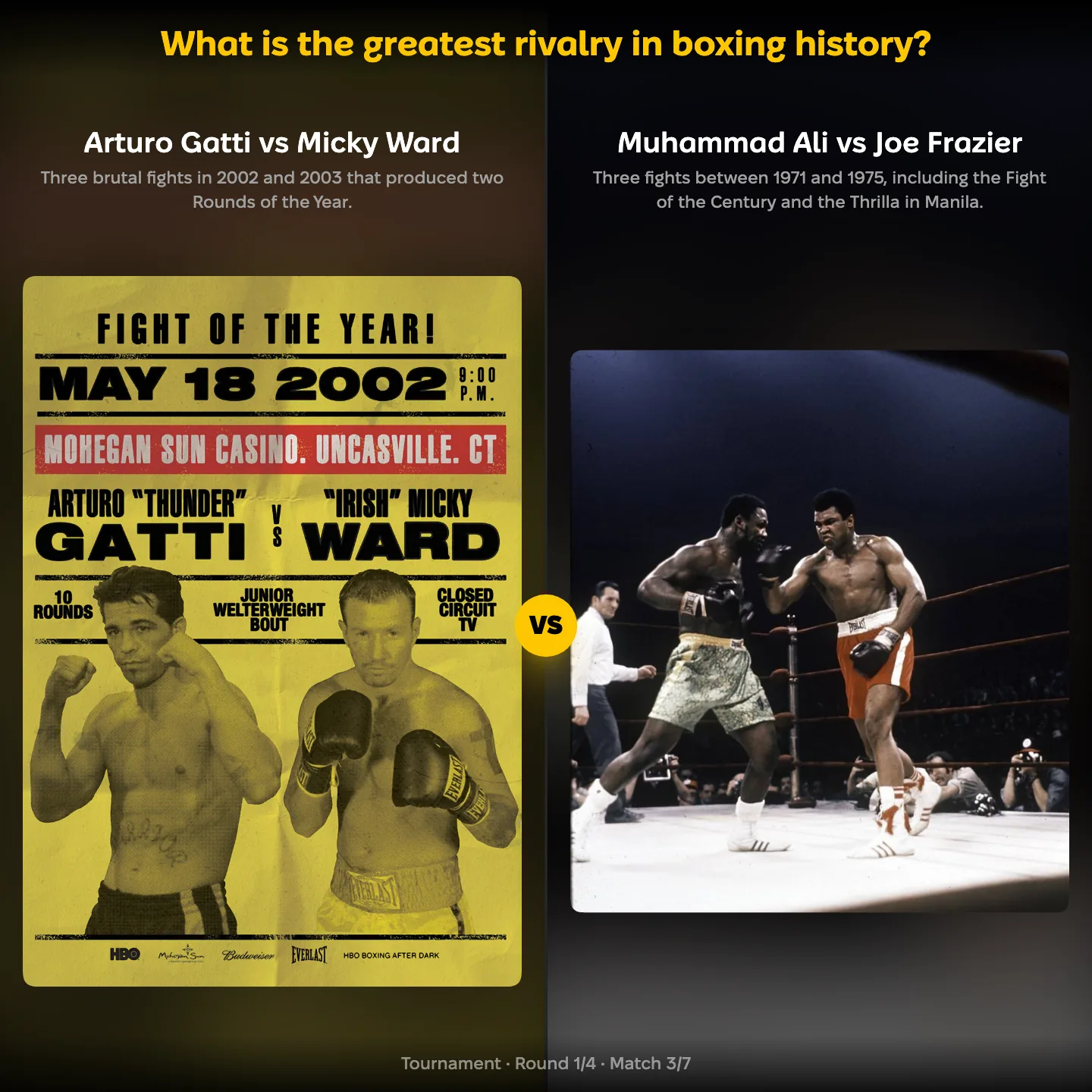
Ali–Frazier, three fights and a hospital
Thirteen rivalries, and Ali's name is on three of the bills: Frazier, Norton and Foreman.
The Frazier trilogy is the one that carries the section. Both men were undefeated when they met at Madison Square Garden on 8 March 1971, both were paid $2.5 million, and Frazier won over fifteen rounds to hand Ali his first professional defeat.5 The third fight, in Manila in 1975, ended with Frazier's corner stopping it and Ali saying afterwards it was the closest thing to dying he knew.
What Ali did to Frazier outside the ring is part of the record too. He called him a gorilla and an Uncle Tom in front of television cameras, and Frazier never forgave him for it.
Sugar Ray Leonard against Roberto Durán, Gatti against Ward, Robinson against LaMotta: every one of these is three or more fights between men who could not settle it in one.
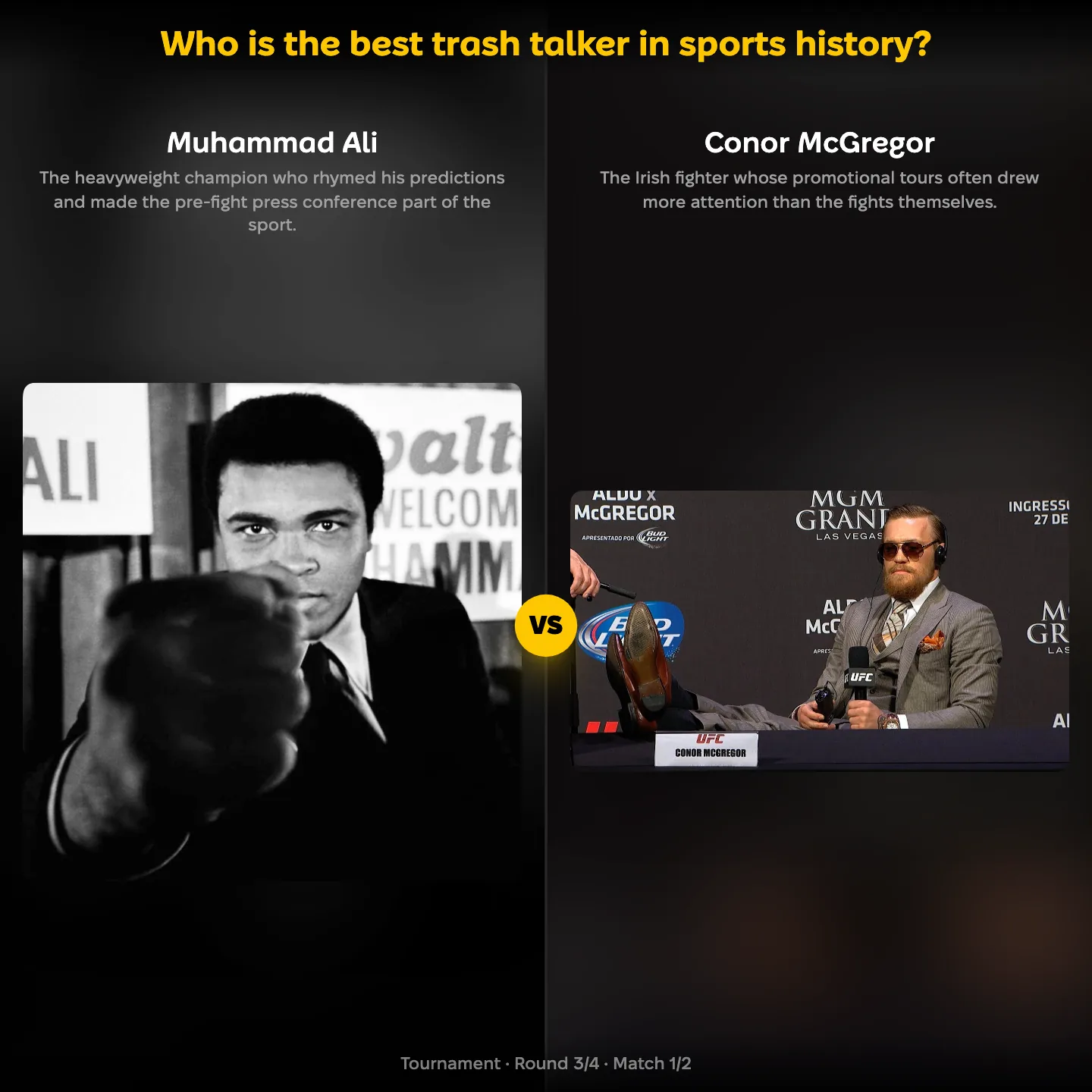
The press conference as a sport: Ali vs Conor McGregor
Fourteen names, and none of them are here for anything they did while the clock was running.
Ali predicted the round, in verse, and was usually right. The habit came from the wrestler Gorgeous George, who told him that people who hate you still buy tickets.
Conor McGregor built a promotional tour that outsold the fight at the end of it. Floyd Mayweather turned "Money" into a brand. Larry Bird told opponents where he was going to shoot from before shooting from there.
Richard Sherman, Deion Sanders, Charles Barkley and Zlatan Ibrahimović make it a wider field than boxing, which is the point of putting them on one page.
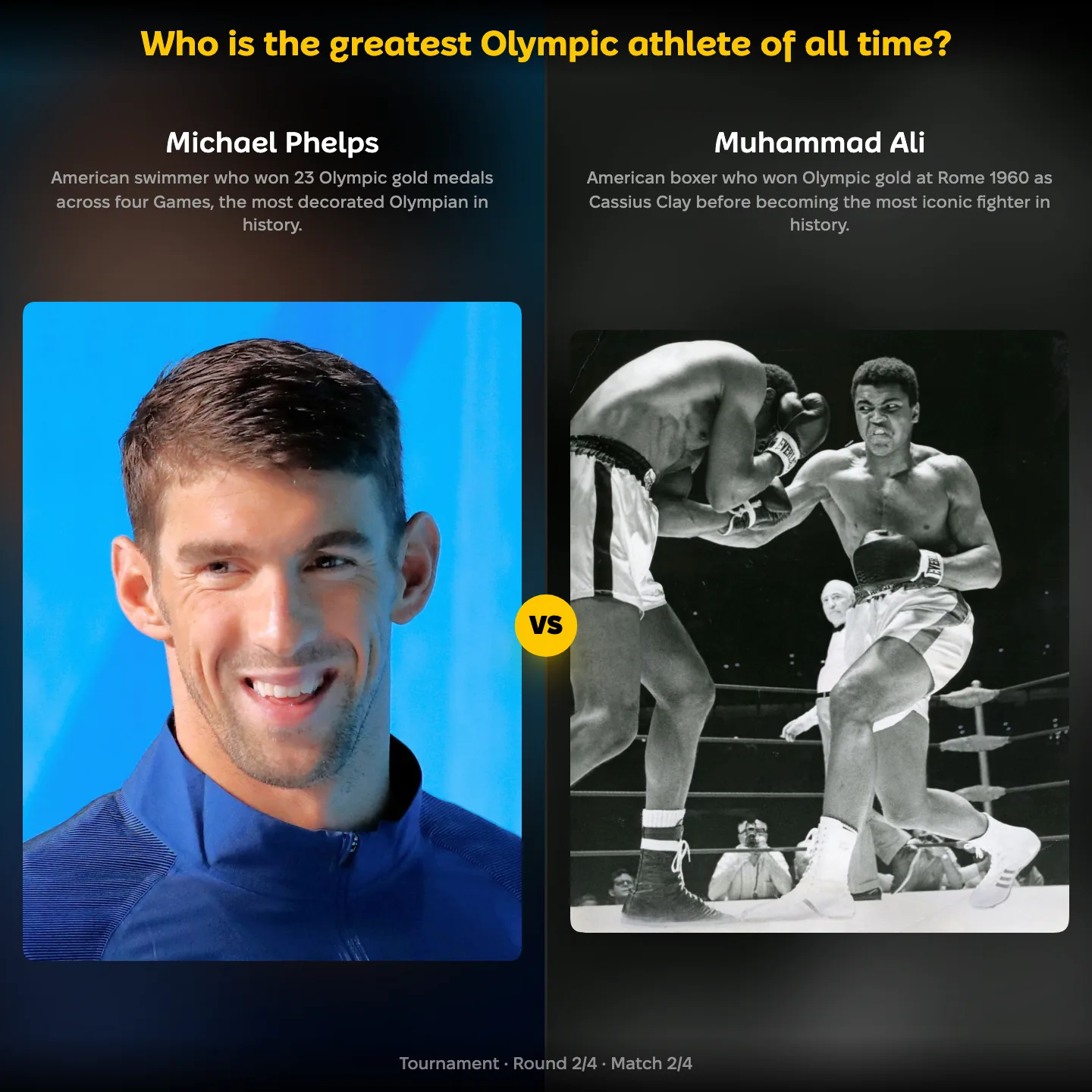
Rome 1960 next to Michael Phelps' 23 golds
Thirteen Olympians, and Ali has one gold medal among them.
He won it in the light-heavyweight final in Rome in 1960, aged 18, four years before he beat Liston.1 Then he turned professional, which in that era meant the Olympics were over for him.
Michael Phelps has 23 golds. Larisa Latynina has nine. Carl Lewis and Paavo Nurmi have nine each, Jesse Owens has four from a single Games in a hostile stadium.
Here the most famous name on the page carries the thinnest Olympic record on it, and a medal count leaves nothing to argue with.
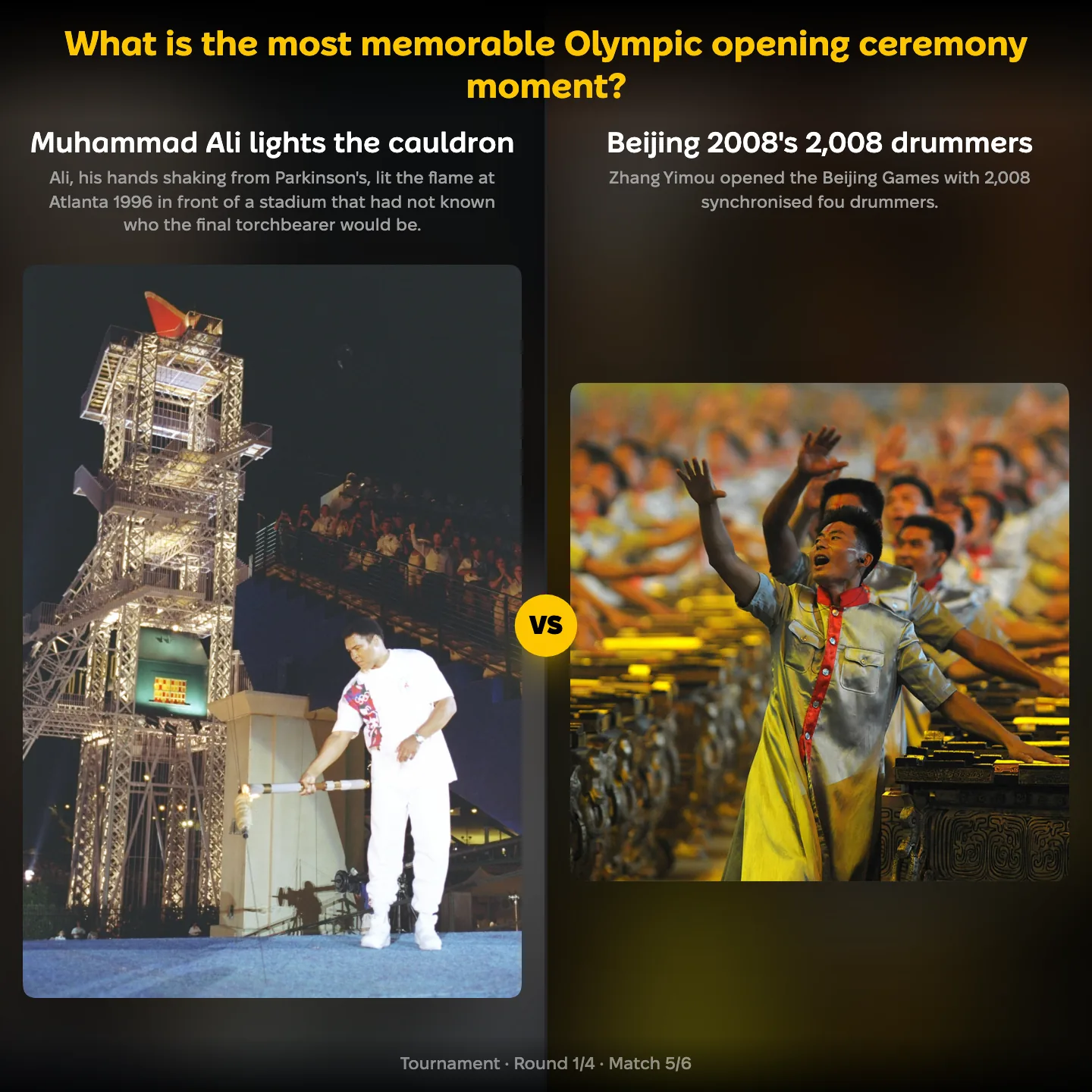
Atlanta 1996: the hand that shook
Thirty-six years after Rome, Ali came back to the Olympics without competing in them.
At the Atlanta opening ceremony on 19 July 1996 the torch reached Janet Evans, who passed it to Ali. He lit the cauldron with his left hand shaking from Parkinson's disease, in front of a stadium and a broadcast audience that had not been told who the final torchbearer would be.6
The other entries are pieces of stagecraft: Antonio Rebollo's flaming arrow over Barcelona in 1992, 2,008 drummers opening Beijing in 2008, a jet pack landing in the Los Angeles Coliseum in 1984.
Ali's is the only one on the page that works because of who was holding the torch rather than what the torch did.
When We Were Kings against The Last Dance
Sixteen documentaries, and Ali is in this ranking as a subject rather than an athlete.
Leon Gast filmed the Rumble in the Jungle in 1974 and spent twenty-two years getting the footage into a cinema. When We Were Kings reached cinemas in 1996 and took that year's Oscar for best documentary feature.7
Its competition here is Hoop Dreams, Senna, The Last Dance and O.J.: Made in America, which runs to seven and a half hours and won the same Oscar twenty years later.
Tyson and Diego Maradona are also on the page, so the section is really asking which sporting life makes the better film, not which athlete was better.
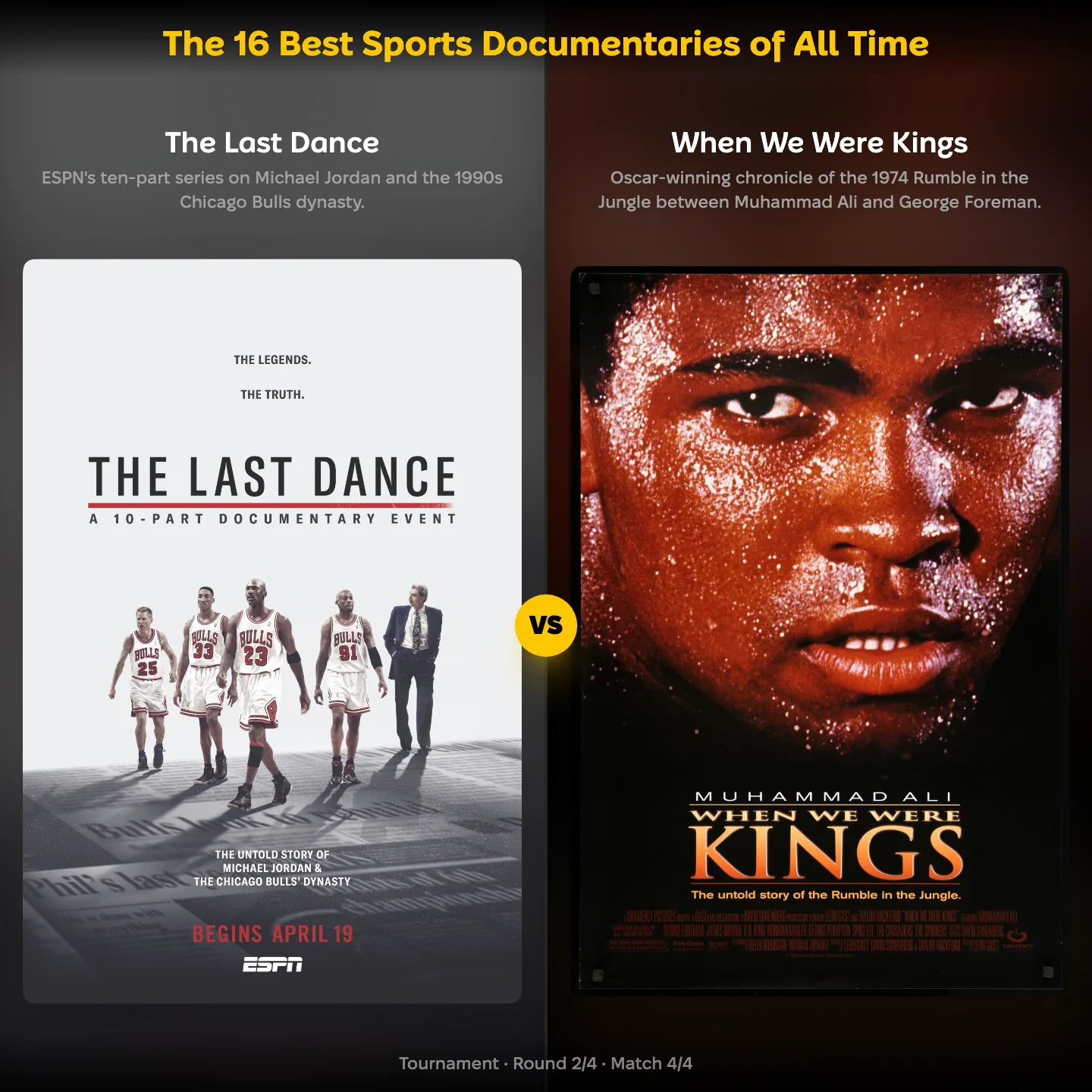
Will Smith's Ali, up against Raging Bull
Fifteen boxing films, and the one with his name on it has the hardest draw on the page.
Michael Mann's Ali covers the ten years that end in Kinshasa. Will Smith was nominated for Best Actor and Jon Voight for Best Supporting Actor. The film took $87.7 million worldwide against a budget of at least $107 million.8
Raging Bull and Rocky are the two films this genre is measured by, and Million Dollar Baby, The Fighter and Creed all arrived with Oscars or nominations of their own.
A biopic about a man whose real footage exists in enormous quantity has a particular problem: the documentary in the previous section is competing with it, and it is made of the actual fight.
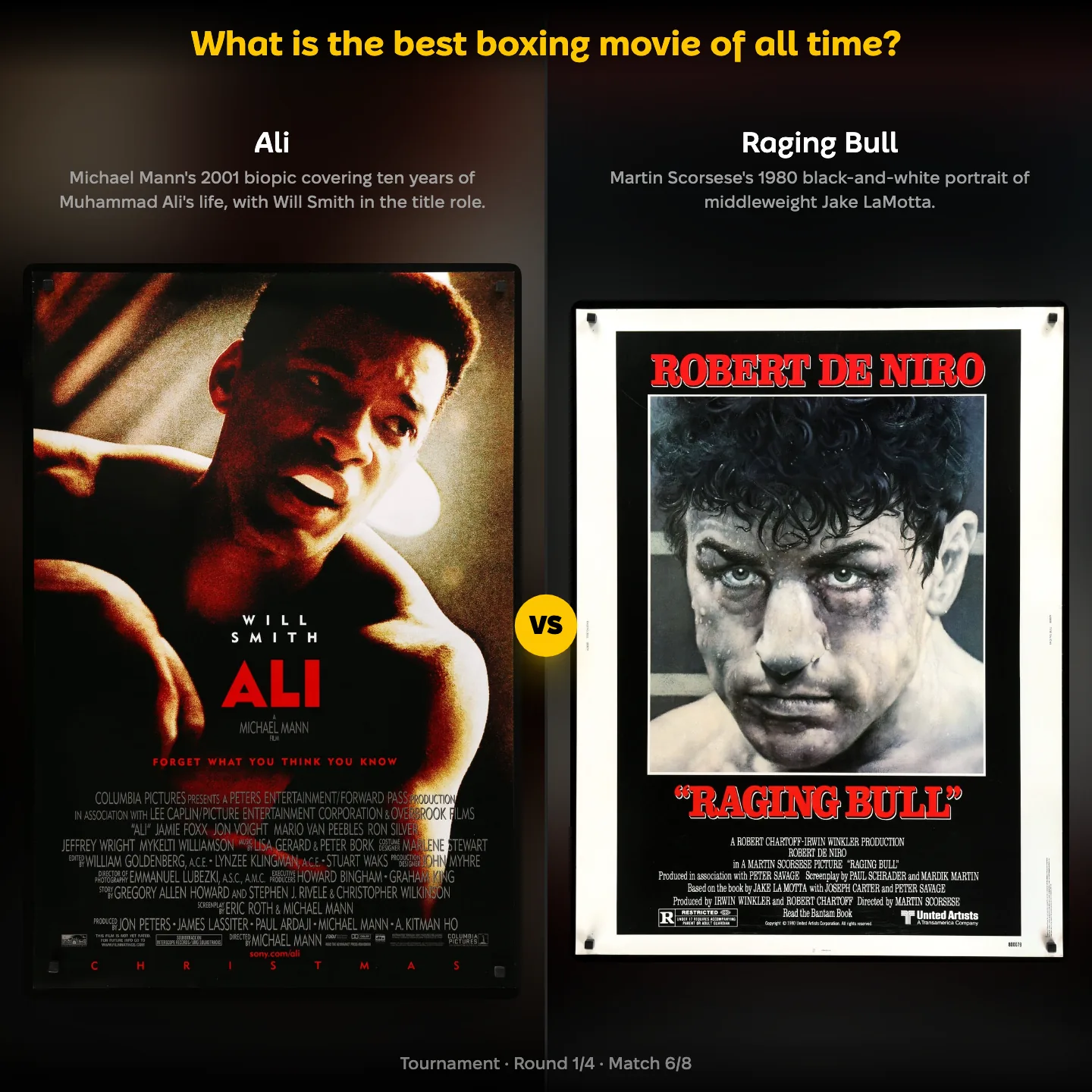
Nassau, 1981: the fight nobody wanted to sanction
The final entry in this article is the one he tops by losing.
Ali's final fight was against Trevor Berbick at the Queen Elizabeth Sports Centre in Nassau on 11 December 1981. He was 39, he lost a unanimous decision over ten rounds, and the bout was held in the Bahamas because no American state would licence him after what Larry Holmes had done to him fourteen months earlier.9
The other twelve entries are the same story with different names. Joe Louis was knocked through the ropes by Rocky Marciano at 37. Mike Tyson quit on his stool against Kevin McBride in 2005 and said he no longer had it. Evander Holyfield was stopped in the first round of an exhibition at 58.
Boxing has no mechanism for telling a fighter that the last one was the last one, which is why this ranking exists and why it is longer than it should be.
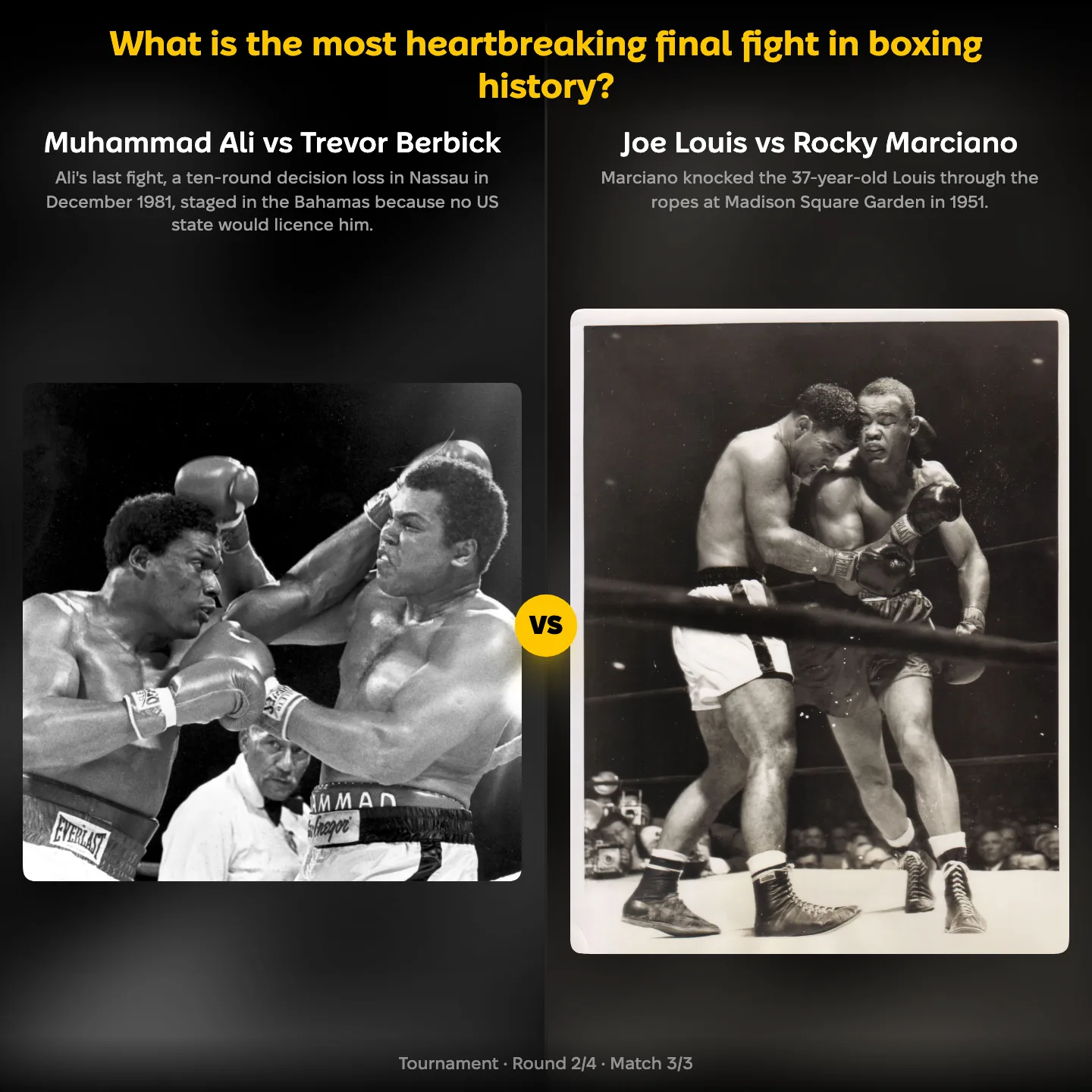
Fourteen questions, fourteen different Alis
A heavyweight, a pound-for-pound entry, an American athlete, an activist, an event, an upset, a rivalry, a talker, an Olympian, a torchbearer, a documentary, a biopic, and a fighter who stayed two years past the end. Ali is the only subject on this site who fits all fourteen without a stretch, and the reason is that he spent a career being several public figures at once.
Every one of these is decided by putting two names on screen and choosing one, over and over, until the field sorts itself. Start with the ranking where you think the obvious answer is wrong.
More rankings, more angles
- Where Does Mike Tyson Actually Rank? — the next heavyweight down, on ten lists that have nothing to do with boxing
- Ronda Rousey Had Four Careers. Every List Picks a Different One — judo, the UFC, WrestleMania, Hollywood
- Muhammad Ali vs Mike Tyson: They Never Fought. These 13 Lists Did. — the fight that never happened
- Mayweather vs Pacquiao Was Five Years Late — six years of talks, one decision
Sources
- Wikipedia — Muhammad Ali: professional record, 1960 Rome gold, the 1964 Liston fight, the 1967 refusal and Clay v. United States (1971): en.wikipedia.org (checked 2026-08-02)
- Wikipedia — The Greatest (2026 TV series): Prime Video premiere on 4 November 2026, created by Ben Watkins, executive produced by Michael B. Jordan and Lonnie Ali: en.wikipedia.org (checked 2026-08-02)
- Supreme Court of the United States — Clay, aka Ali v. United States, 403 U.S. 698, decided 28 June 1971 ("Judgment reversed"; Justice Marshall took no part), full opinion via Cornell LII: law.cornell.edu (checked 2026-08-04)
- Wikipedia — The Rumble in the Jungle: 30 October 1974, Stade du 20 Mai, Kinshasa, eighth-round knockout, $5m purses, reported billion viewers: en.wikipedia.org (checked 2026-08-02)
- Wikipedia — Fight of the Century: 8 March 1971, Madison Square Garden, both men undefeated, $2.5m each, Frazier by unanimous decision: en.wikipedia.org (checked 2026-08-02)
- Wikipedia — 1996 Summer Olympics opening ceremony: 19 July 1996, torch relay through Janet Evans, Ali lighting the cauldron: en.wikipedia.org (checked 2026-08-02)
- Wikipedia — When We Were Kings: Leon Gast, 1996 release, Academy Award for Best Documentary Feature: en.wikipedia.org (checked 2026-08-02)
- Wikipedia — Ali (2001 film): Michael Mann, Will Smith and Jon Voight Oscar nominations, $87.7m worldwide against a $107m+ budget: en.wikipedia.org (checked 2026-08-02)
- Wikipedia — Muhammad Ali vs. Trevor Berbick: 11 December 1981, Queen Elizabeth Sports Centre, Nassau, unanimous decision, no US state would licence Ali after the Holmes fight: en.wikipedia.org (checked 2026-08-02)