
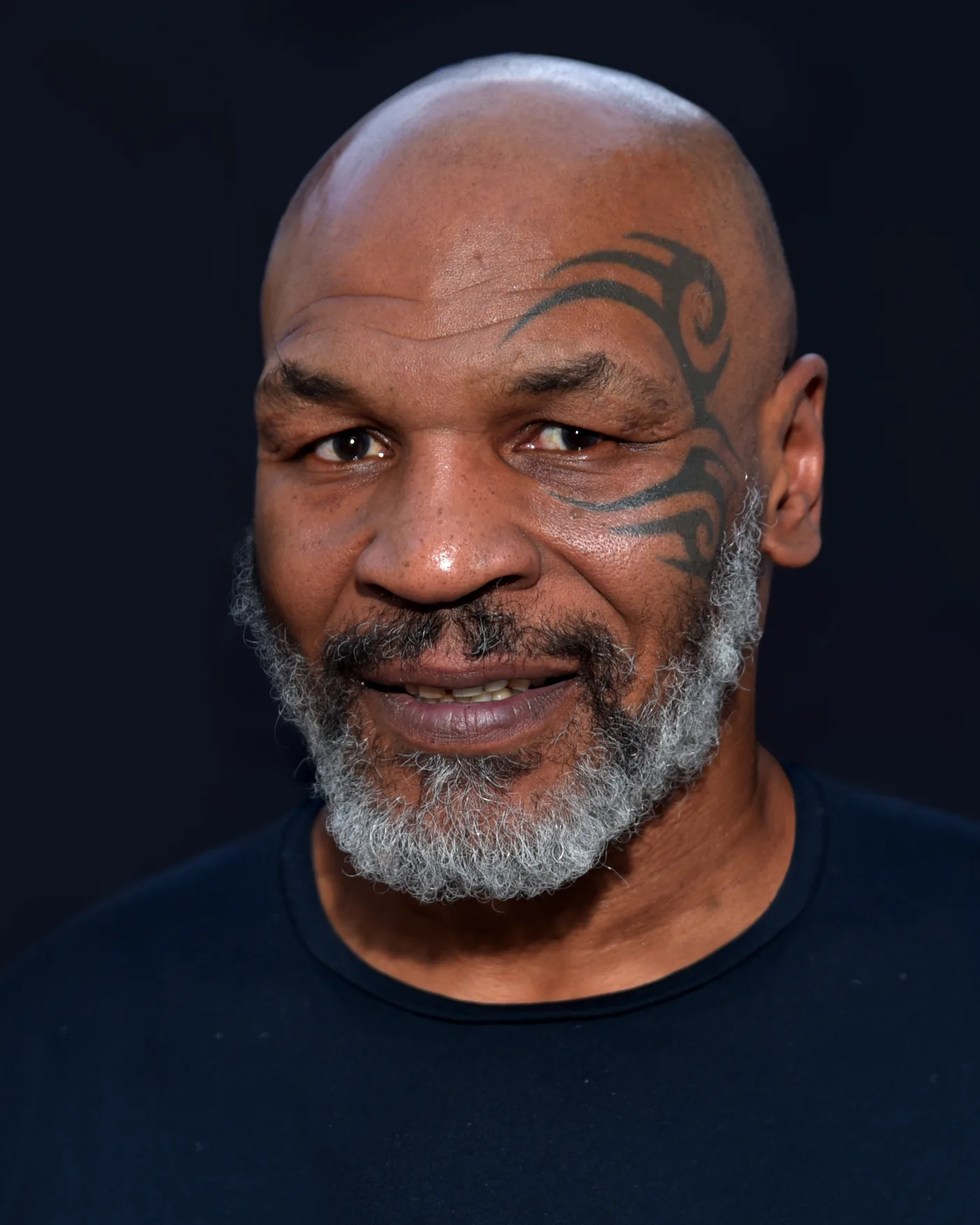

Mike Tyson turned 60 on 30 June 2026, and he is still scheduled to fight: the exhibition against Floyd Mayweather Jr. slipped to autumn 2026 while a broken hand heals.1 He beat Trevor Berbick on 22 November 1986 aged 20, walking in 27-0 with 26 knockouts, and no younger heavyweight champion has arrived since.2 Forty years of that has left him scattered across the site in places boxing does not explain: an NES cartridge, a Todd Phillips comedy, a memoir, a list of ruined fortunes.
Half the rankings Mike Tyson appears on are not about boxing, and those are the ones that explain him.
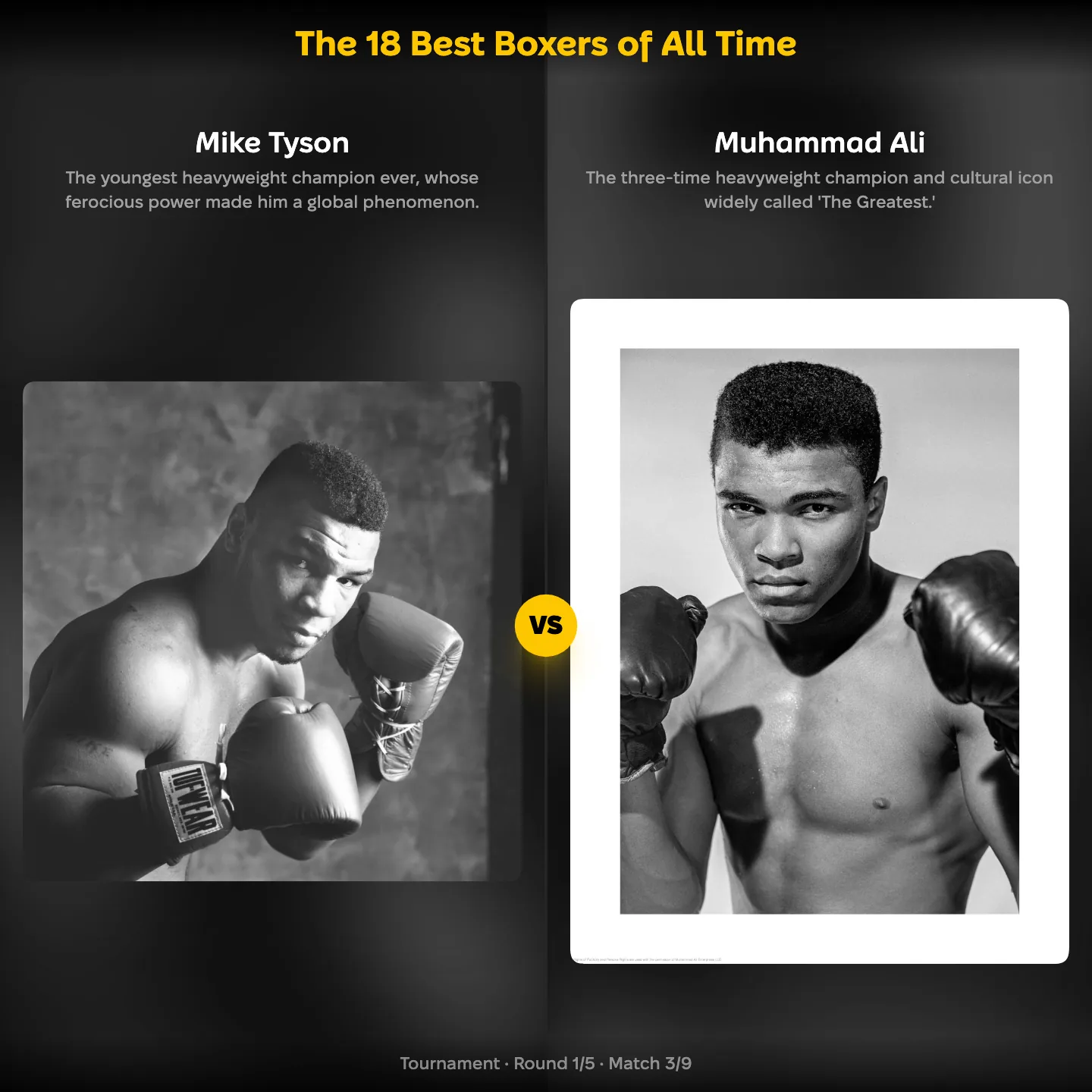
Mike Tyson vs Muhammad Ali: the whole sport at once
Widen the question to every boxer who ever fought and the field stops being a division and starts being a century.
Tyson's case rests on a four-year stretch nobody has matched for compressed violence. Between 1985 and 1989 he unified the heavyweight titles and beat almost everyone put in front of him inside the distance.
Muhammad Ali is the standing answer to this question, and Sugar Ray Robinson is the pick of the technicians. Both fought longer and against better opposition than Tyson did.
The counter-argument for Tyson is that peak matters. Nobody has ever been more frightening for a shorter time.
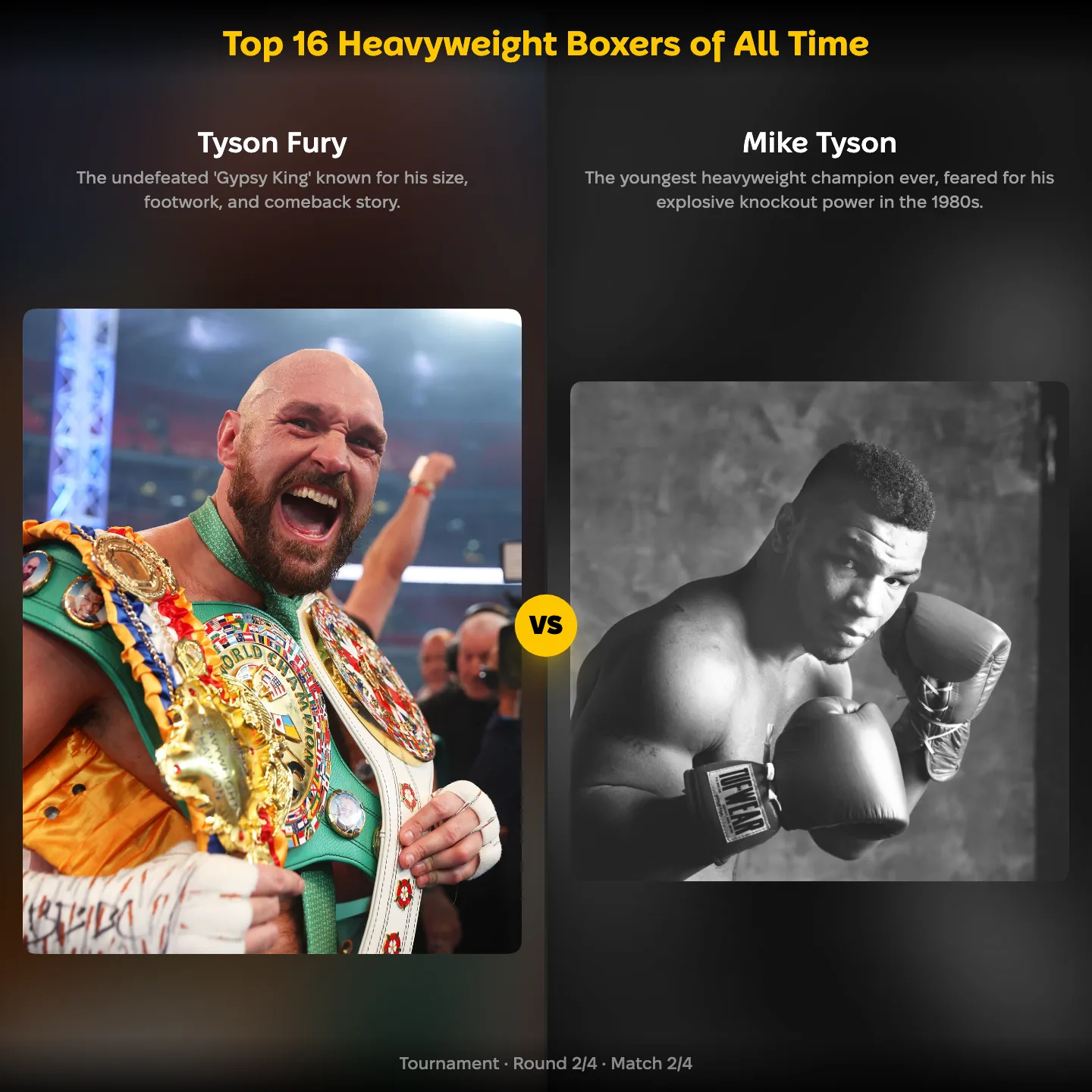
Two Tysons: Mike against Fury
Narrowing to heavyweights should help him, and it produces the article's only accidental joke: the list holds two men called Tyson.
Tyson Fury was named after him. Fury's father chose the name in 1988, the year Mike Tyson knocked out Michael Spinks in 91 seconds and was as famous as any athlete alive.5
Mike Tyson's heavyweight case is the youngest-champion record and the terror of the late eighties. Fury's is the Klitschko win in Düsseldorf and the Deontay Wilder trilogy.
Ali, Joe Louis and Rocky Marciano are also here, which is the trouble with the heavyweight question. It is the most crowded room in sport.
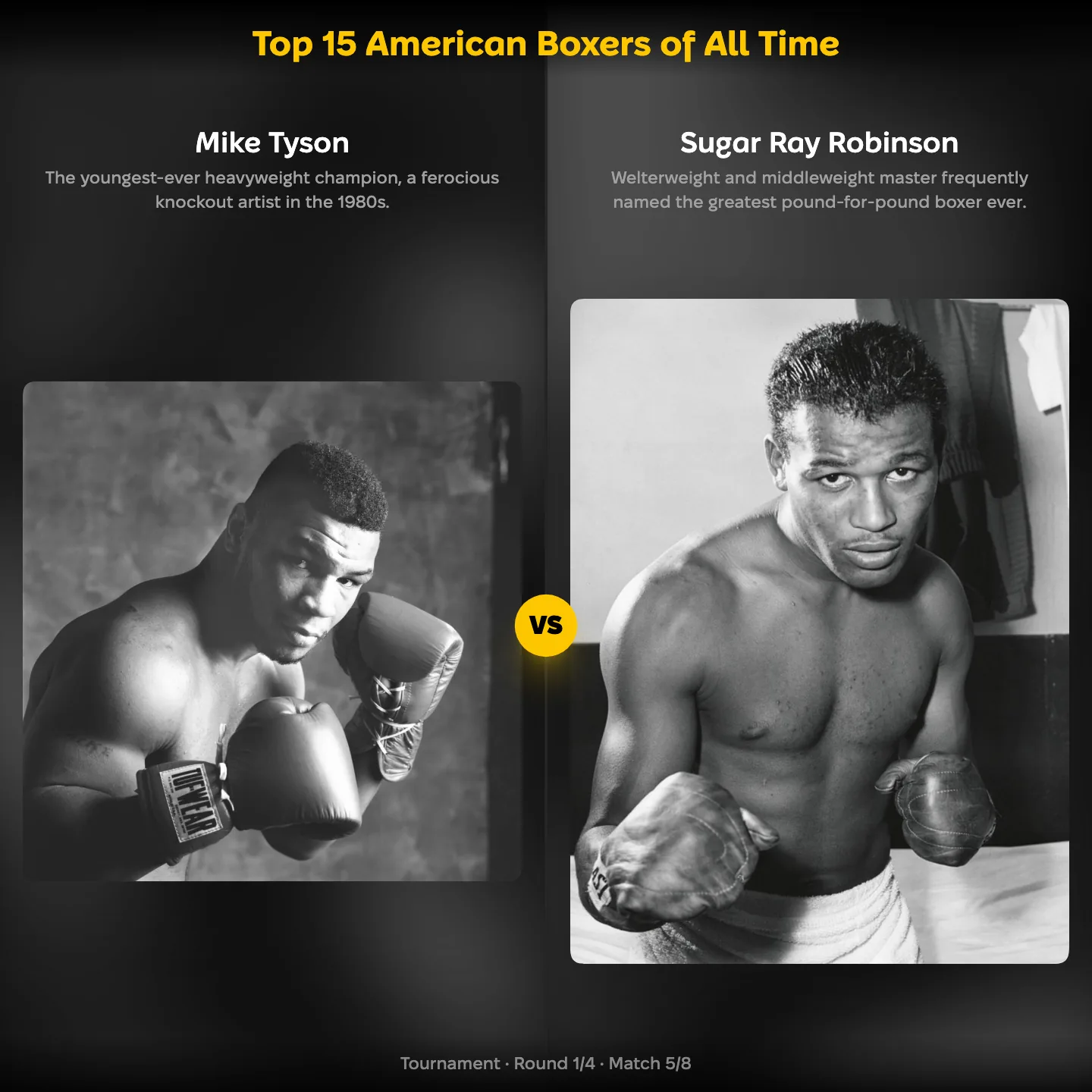
Brooklyn, Detroit, Louisville: the American list
Restricting the field to one country makes the competition harder rather than easier, because the United States produced most of boxing's canon.
Tyson qualifies twice over. He came out of Brownsville, Brooklyn, and was raised in the sport by Cus D'Amato in Catskill, New York.
Sugar Ray Robinson complicates it immediately. Robinson held welterweight and middleweight titles across two decades and is the fighter other fighters cite.
Ali, Joe Louis, Marciano and Sugar Ray Leonard occupy the same fifteen slots. Four American heavyweight eras and two of the finest pound-for-pound careers on record, in one question.
Marvin Hagler and the 1980s, the decade Tyson only half owns
This is the ranking his supporters expect him to walk, and the decade does not quite cooperate.
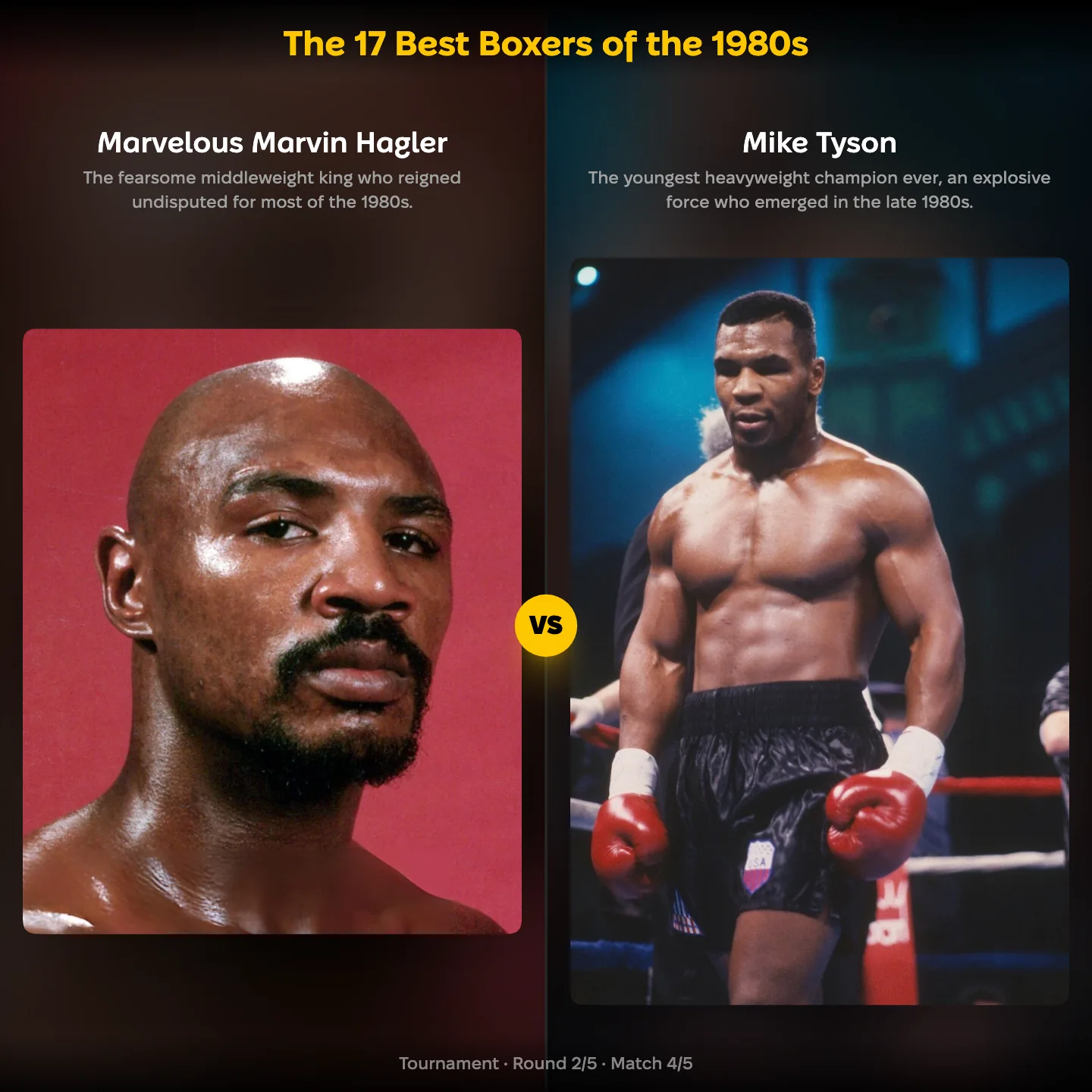
Tyson turned professional in March 1985 and won the WBC title in November 1986. His claim covers four years of the ten.
Marvelous Marvin Hagler held the undisputed middleweight championship from 1980 to 1987 and defended it twelve times. Sugar Ray Leonard, Thomas Hearns and Roberto Durán fought each other repeatedly across the same decade.
Those four are usually treated as the story of eighties boxing, with Tyson arriving late to close it. His four years were louder than anyone else's ten, which is a different claim from being the decade's best fighter.
Three entries, one of them a defeat
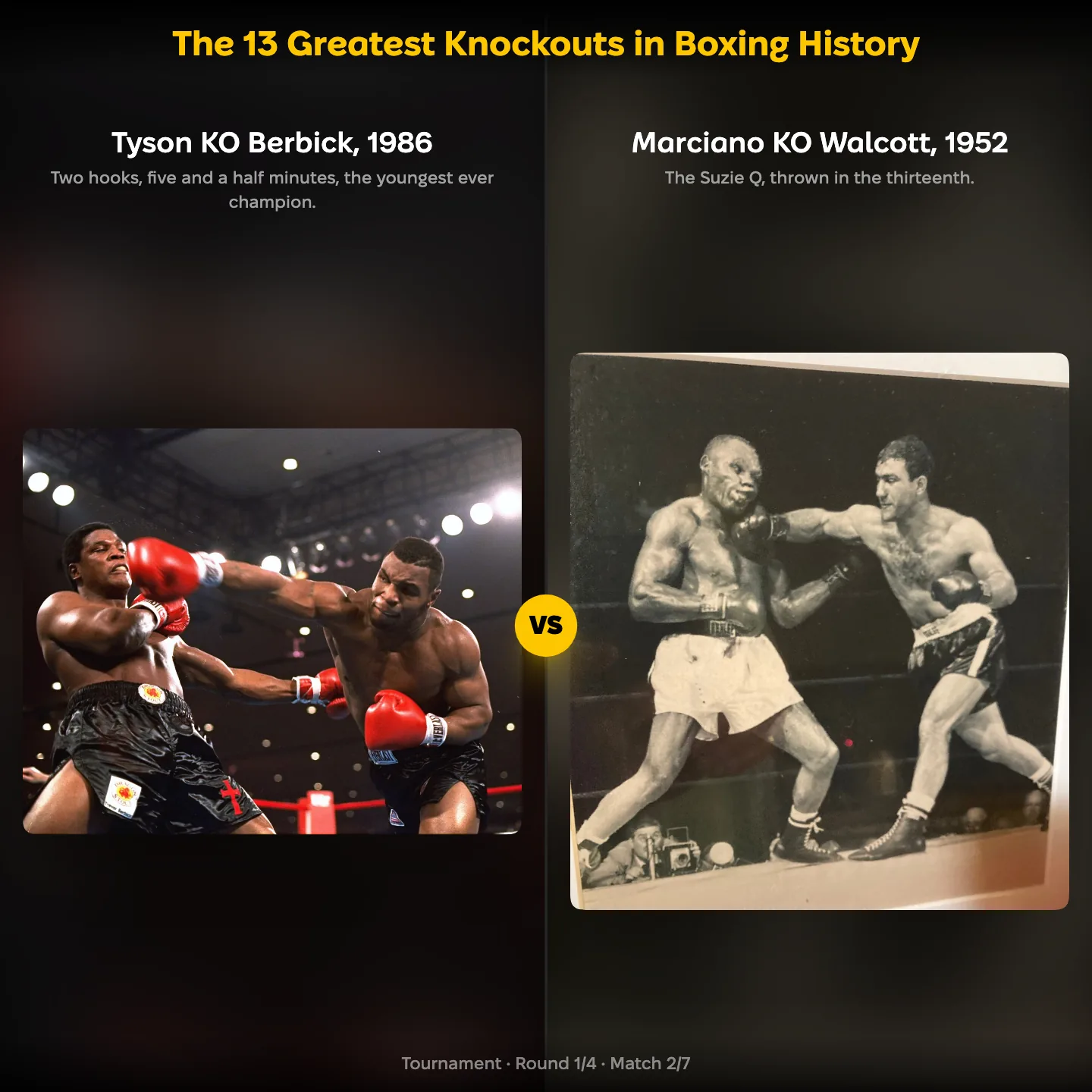
Rank the knockouts rather than the fighters and Tyson's name attaches to three of the thirteen.
Two are his. Berbick in 1986, five and a half minutes for the title.2 Spinks in 1988, 91 seconds against a man who was 31-0.5
The third is Buster Douglas in Tokyo, and it goes against him.
Rocky Marciano's thirteenth-round finish of Jersey Joe Walcott in 1952 and George Foreman's single right hand against Michael Moorer in 1994 are the historical competition. Appearing three times says something about how reliably Tyson was the most interesting thing in a boxing ring, in both directions.
Nadia Comăneci vs Mike Tyson: twenty is not that young
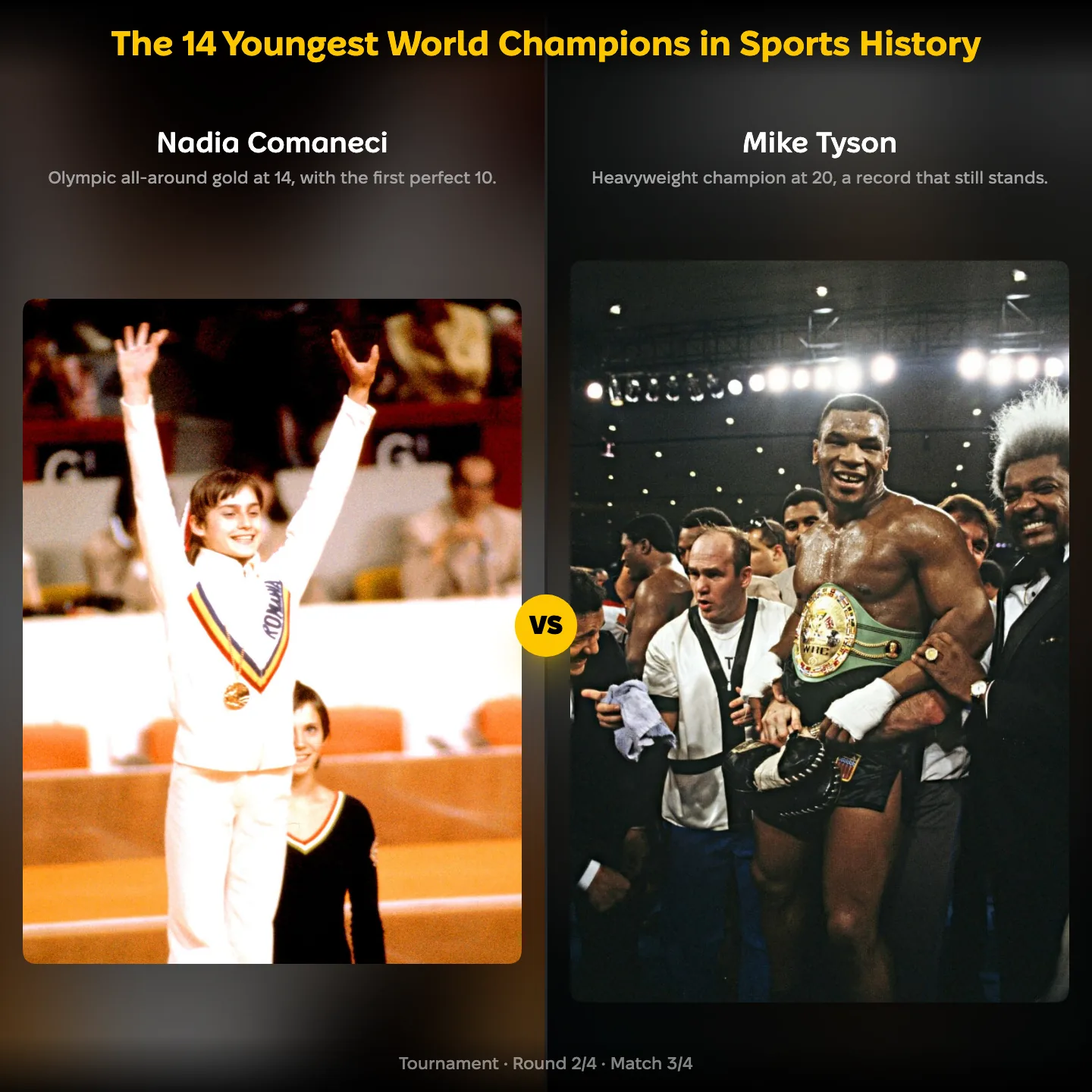
Twenty years old is the record in heavyweight boxing. Measured against every other sport it is close to middle-aged.
Tyson's mark has stood for forty years because heavyweights need adult bodies. He is the youngest man to win a heavyweight title and nobody has come near it.
Nadia Comăneci won Olympic all-around gold at 14 with the first perfect 10 in Olympic gymnastics. Fu Mingxia was a diving world champion at 12. Tara Lipinski took Olympic figure skating gold at 15.
Boris Becker, Martina Hingis, Michael Chang and Monica Seles all won majors as teenagers. Against that field Tyson is the oldest name in the room, which says more about boxing than about him.
The one list built for him
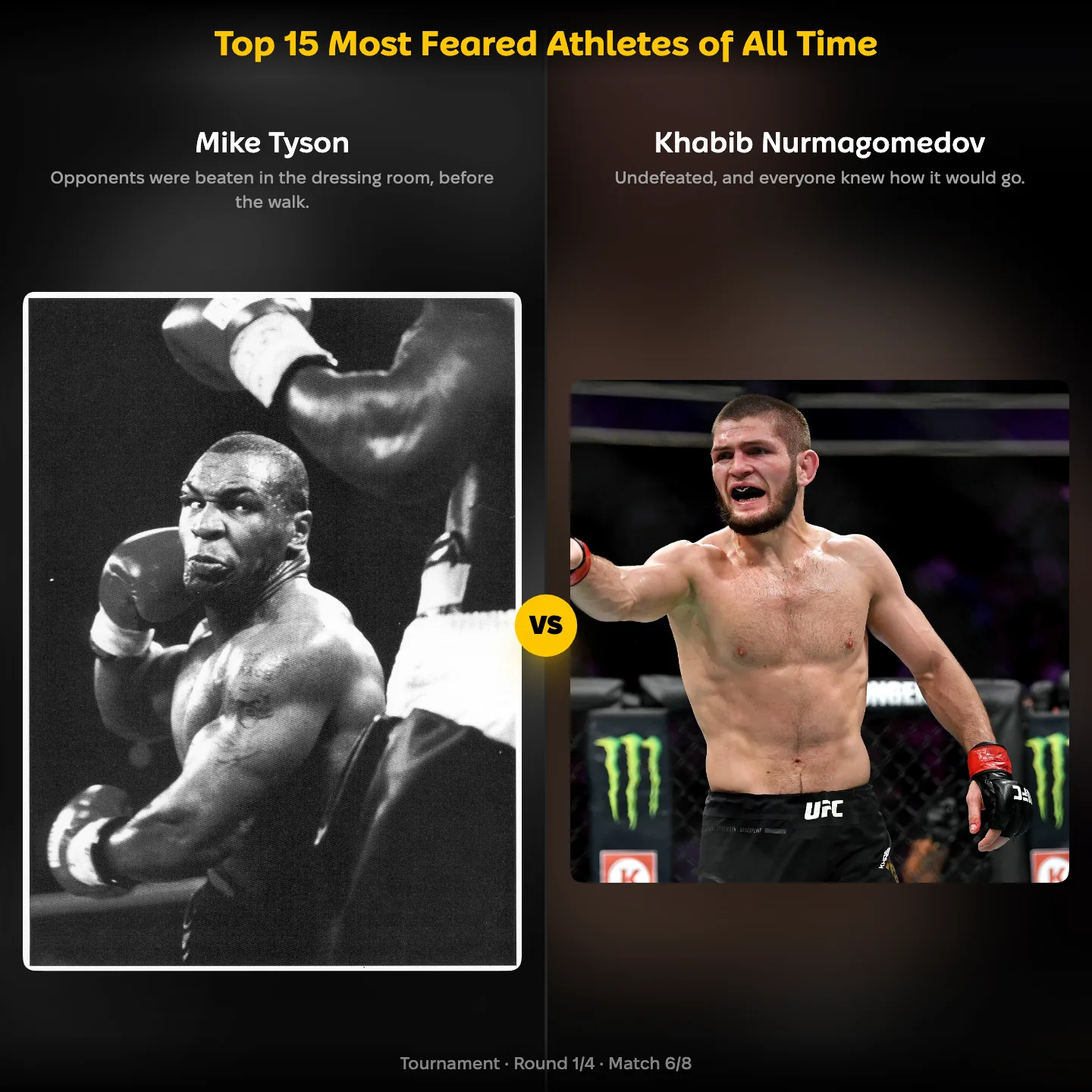
Fear is not a statistic. It is the thing Tyson had more of than anyone.
Opponents in the late eighties were routinely described as beaten before the first bell.
Khabib Nurmagomedov retired 29-0 with the same quality of inevitability, and Sonny Liston had the stare. Neither emptied a division quite like this.
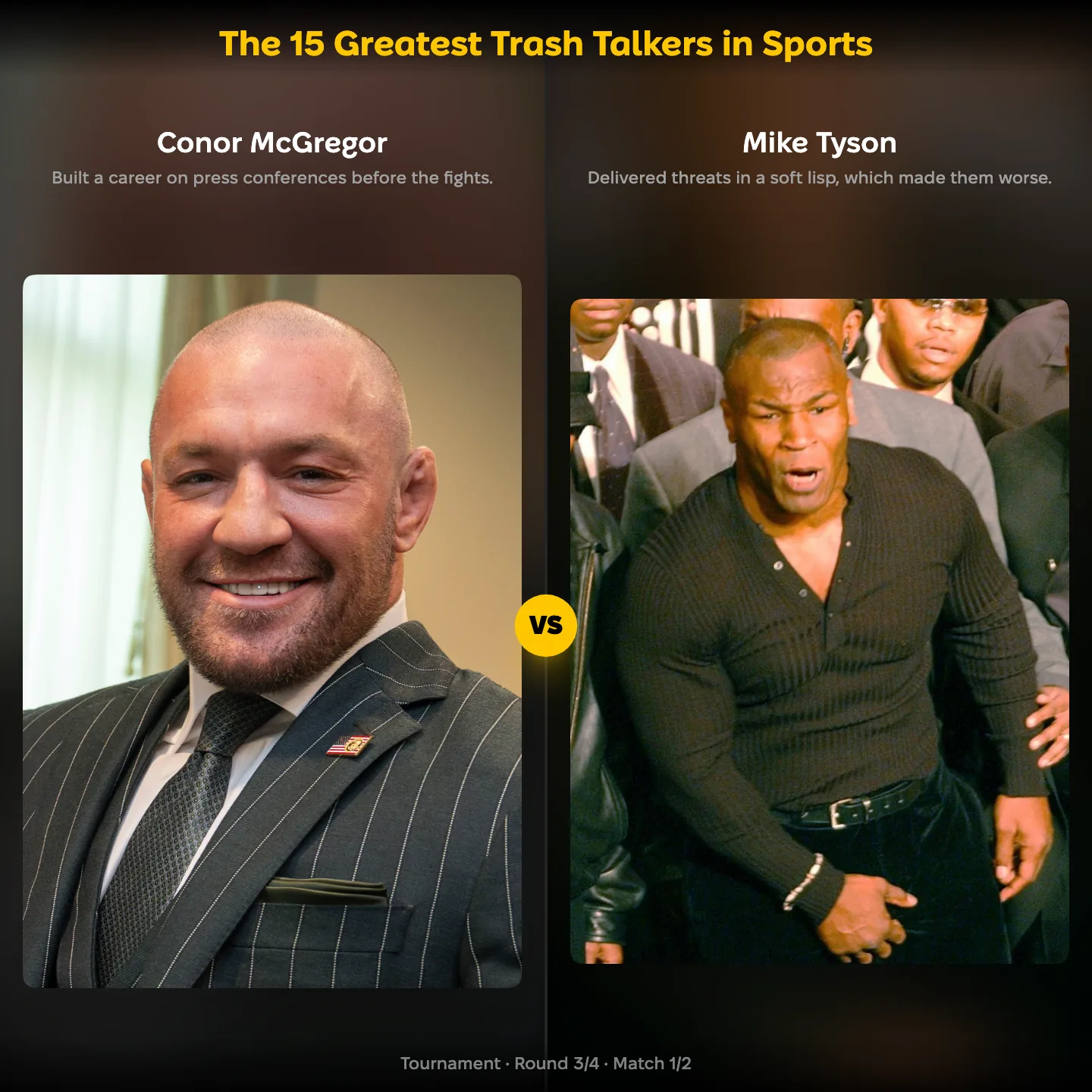
Conor McGregor vs Mike Tyson at the microphone
Tyson's talking was quieter than the field and stranger for it.
The lisp did the work. Lines delivered flatly, in a high soft voice, about eating children or driving a nose bone into a brain, landed harder than anything shouted.
Conor McGregor built an entire business on the press conference, and Muhammad Ali invented the form in rhyming couplets. Both were performing for a crowd.
Michael Jordan and Larry Bird belong here too, and neither ever needed a microphone. Bird told opponents where the shot was going and then put it there, which is a purer version of the same skill.
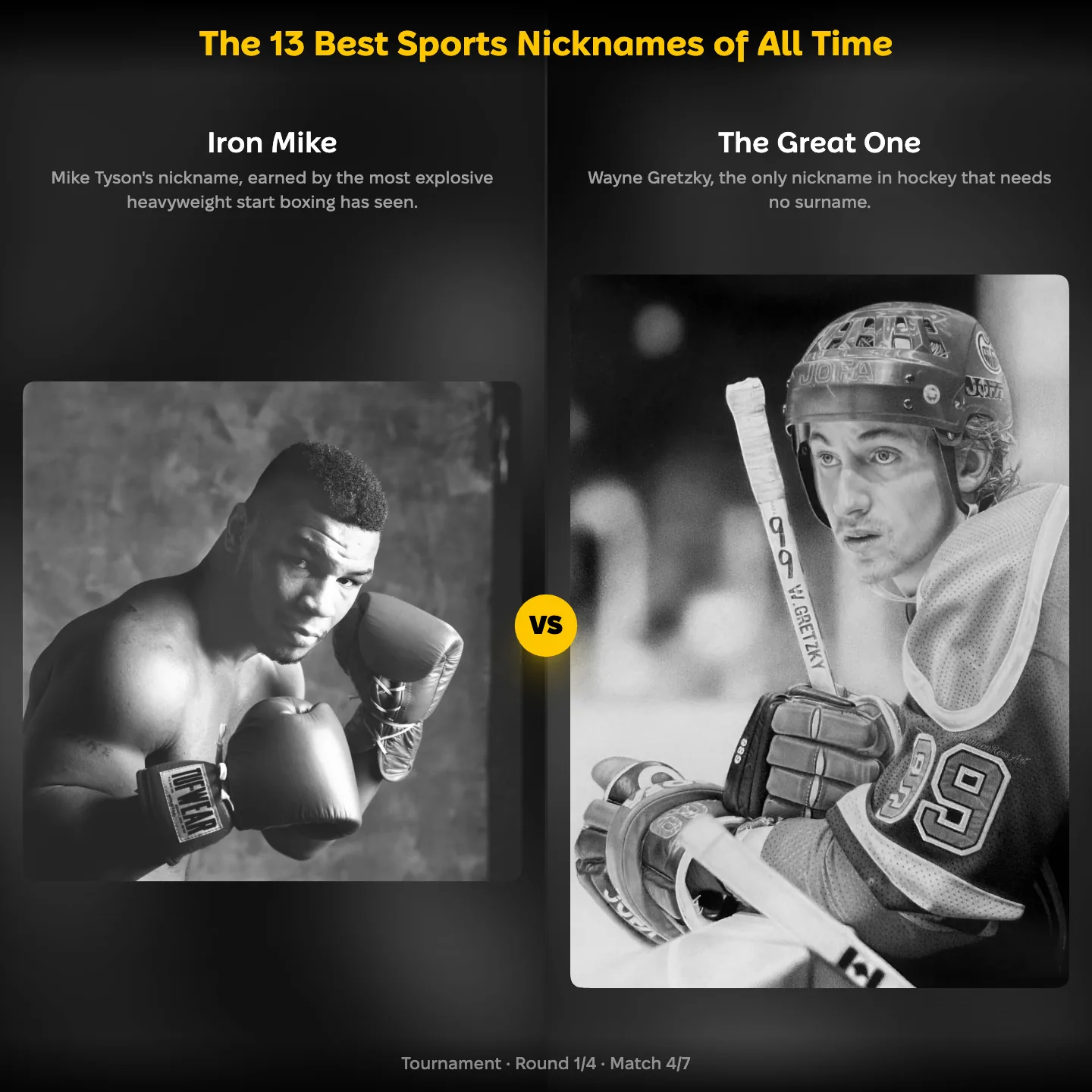
Iron Mike vs The Great One: ranking the name, not the man
Here the option is not Tyson at all. It is two words.
"Iron Mike" works because it is short, physical and needs no surname. It attached to him at 19 and never came off, surviving the prison sentence, the bankruptcy and the cameos.
Wayne Gretzky's "The Great One" is the counter-case: an absolute claim that hockey simply accepted. Muhammad Ali went further and named himself "The Greatest" before he had earned it.
"The Sultan of Swat", "The Round Mound of Rebound" and "Broadway Joe" are all doing something more inventive than "Iron Mike". Tyson's has the advantage of being literally descriptive.
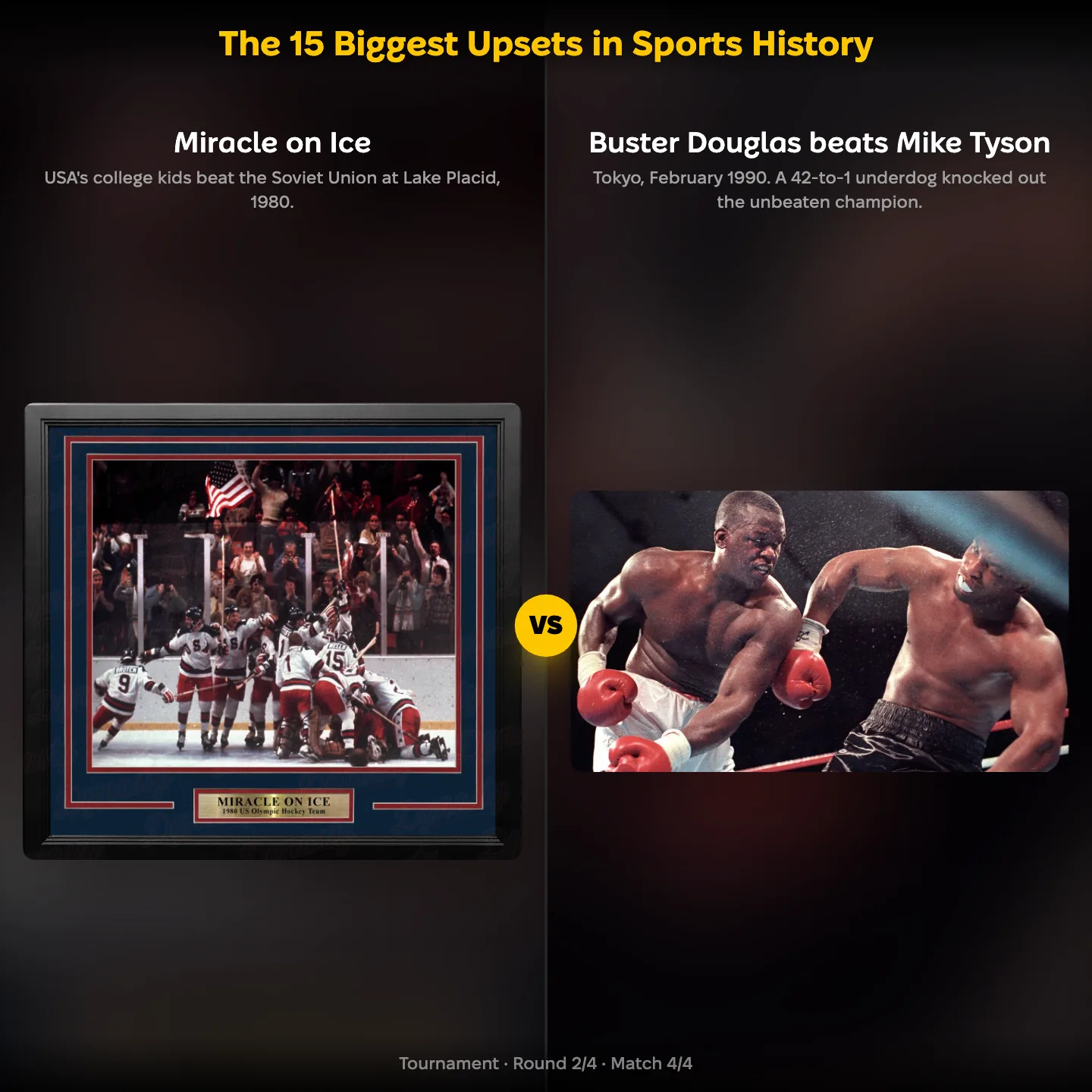
Tokyo, 11 February 1990
On the biggest-upsets list Tyson is not a competitor. He is the thing that got upset.
James "Buster" Douglas knocked him out at 1:22 of the tenth round at the Tokyo Dome on 11 February 1990. Tyson was undefeated and held every recognised belt. Douglas had lost his mother three weeks earlier, used a twelve-inch reach advantage all night, and put Tyson on the canvas for the first time in his professional life.6
The odds are the part that has kept the story alive. One Las Vegas book, the Mirage, was the only house that bothered to price the fight at all, and it made Douglas a 42-to-1 outsider.6
The Miracle on Ice, Leicester City's title and Greece at Euro 2004 are the other candidates. Each of those is a team overachieving across a season or a tournament. Douglas is a different shape of upset, because the story is the favourite collapsing inside 35 minutes.
Tyson never held an undisputed heavyweight title again. That single night is why the second half of his career reads the way it does, and why so many of his entries elsewhere have nothing to do with winning.
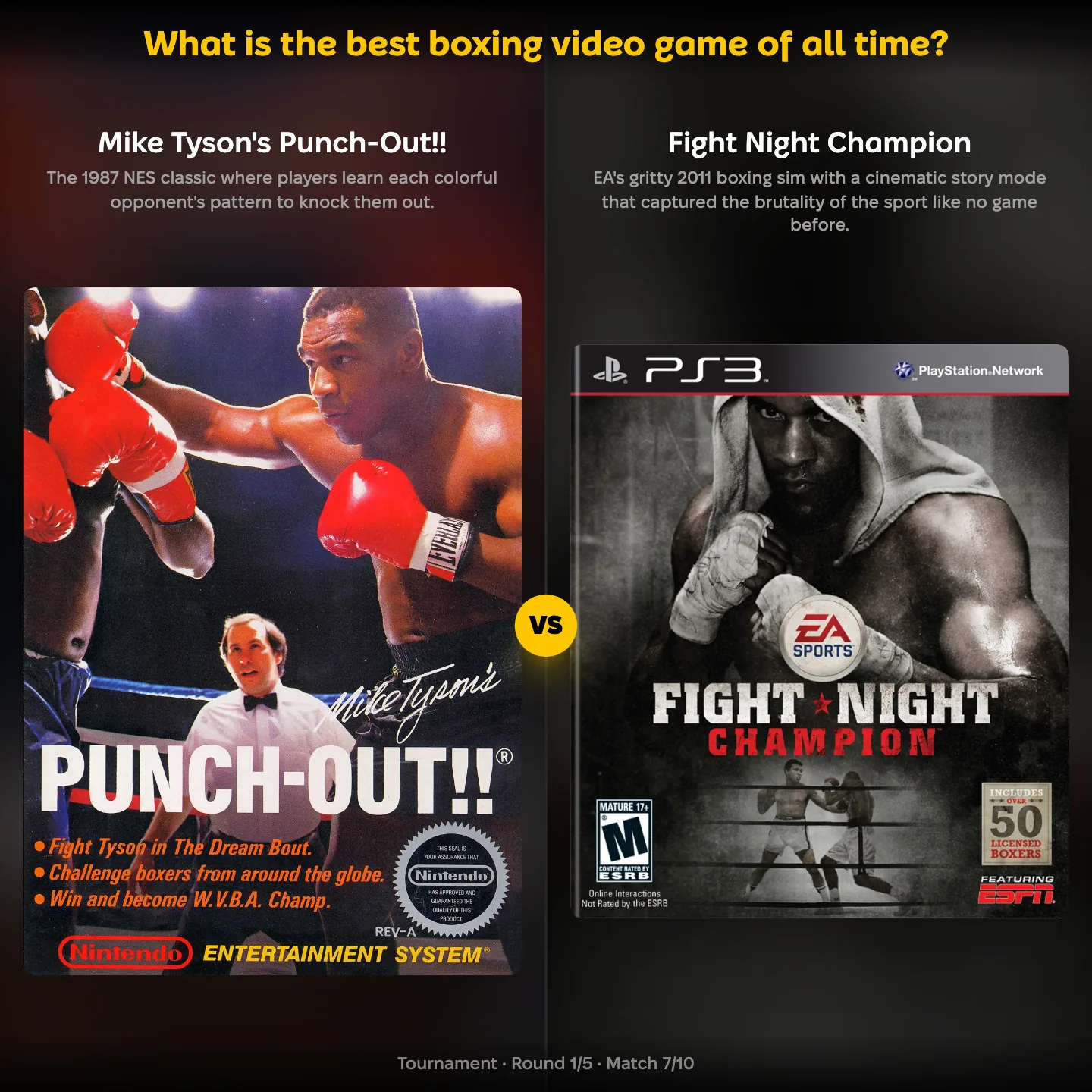
Punch-Out!! vs Fight Night: the cartridge with his name on it
The first non-boxing ranking, and the option is a video game.
Nintendo licensed him for the NES version in 1987 and put him at the end as the final opponent, a fighter who could end the game in under two minutes. Millions of people who never watched a Tyson fight met him this way.
EA's Fight Night Champion arrived in 2011 with a story mode and a serious attempt at simulating the sport. Undisputed and the Creed games take the same route.
Mike Tyson's Punch-Out!! simulates nothing. It is a pattern-recognition puzzle in boxing gloves, which is why people still play it. No other option in the ranking was created by a licence agreement.
Tom Cruise vs Mike Tyson: the comedy list
Tyson is on a ranking of comic performances, competing with actors.
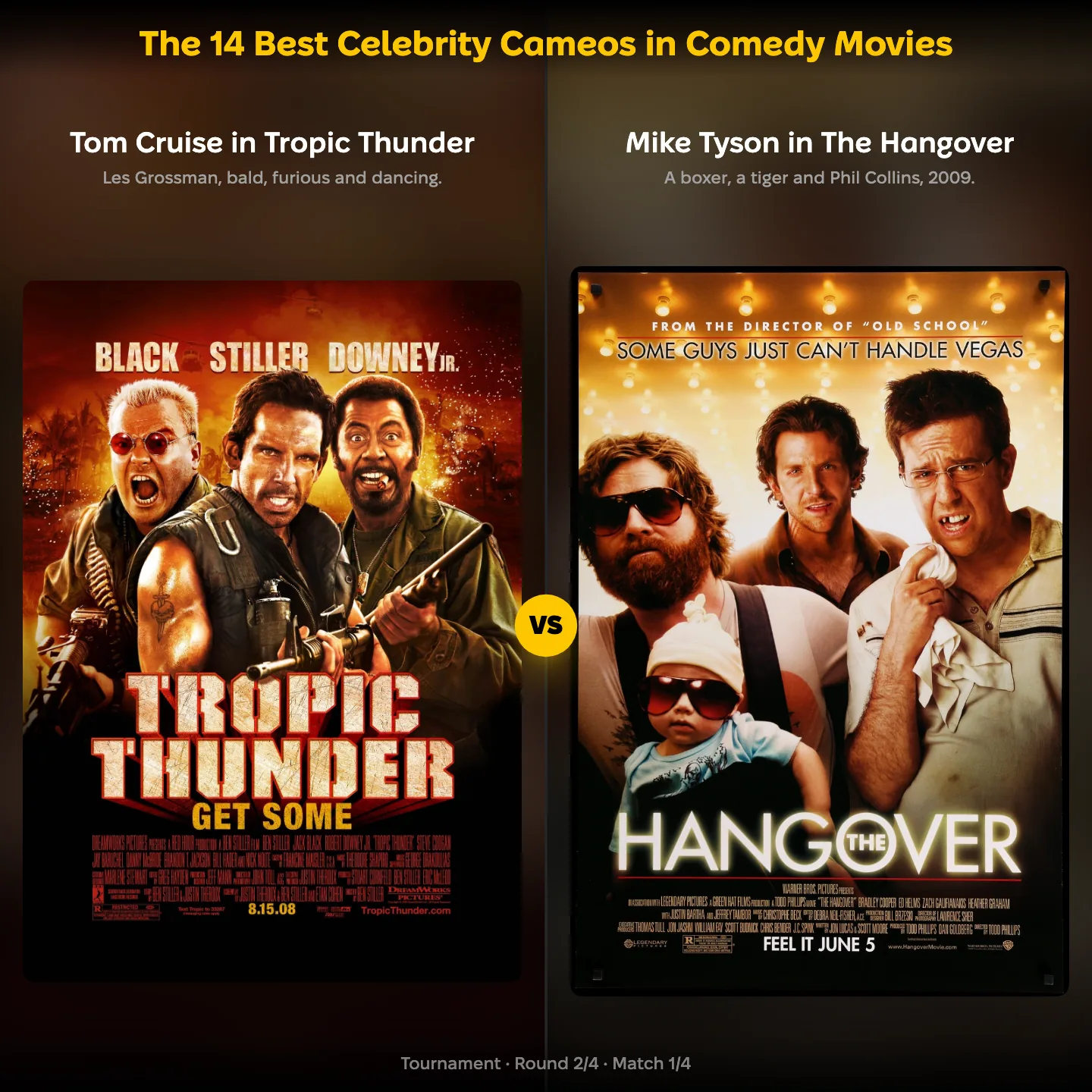
The Hangover used him in 2009 as himself, at home with a tiger, singing along to Phil Collins. The joke works because the audience arrives already frightened of him and the film refuses to explain why he is there.
Tom Cruise's Les Grossman in Tropic Thunder is the heavyweight of this category: prosthetics, a wig and several minutes of dancing.
Bill Murray in Zombieland, Bob Barker in Happy Gilmore and Alice Cooper in Wayne's World round out the field. Among those performers, Tyson alone did his day job by hurting people.
Hoop Dreams vs Tyson: him as a film
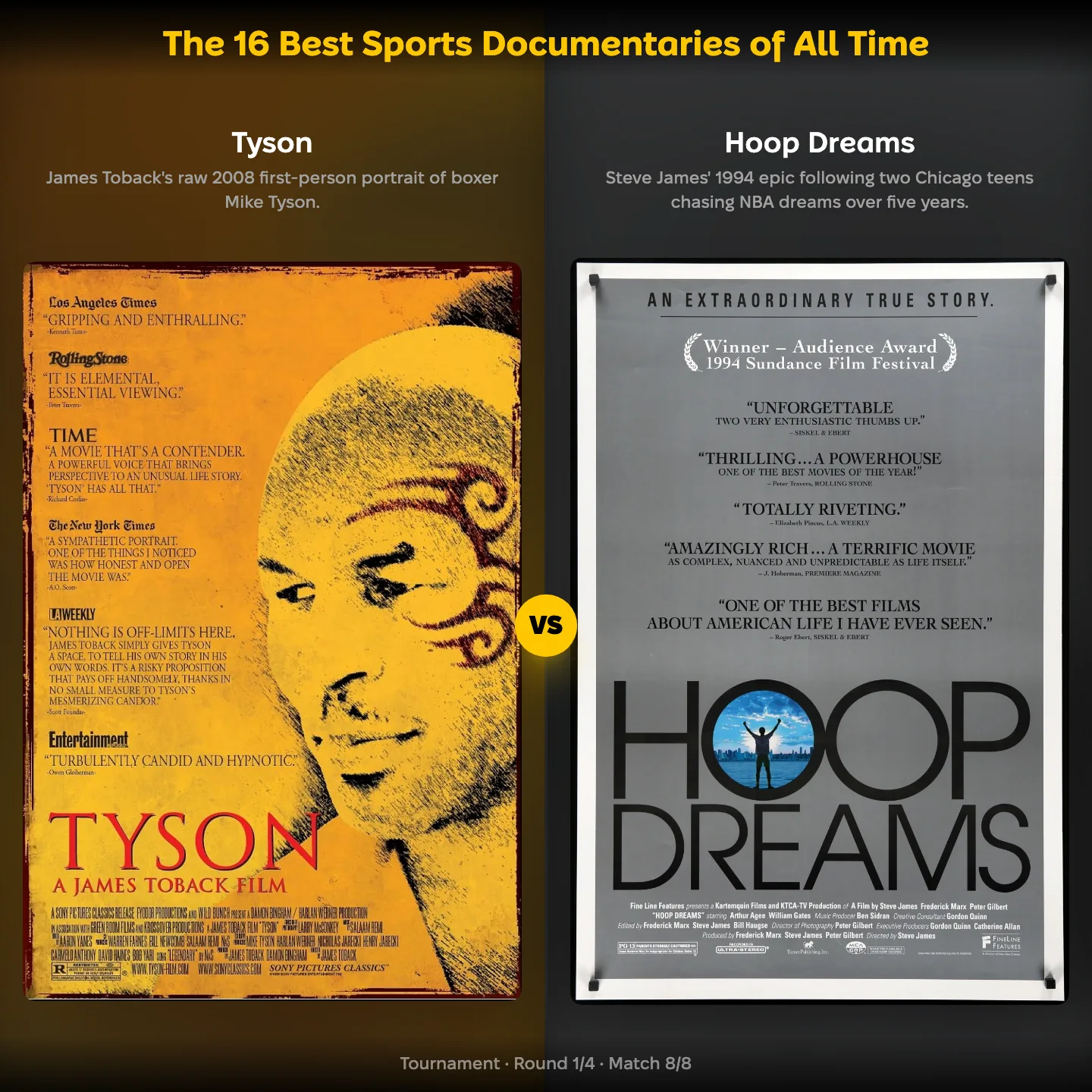
James Toback's Tyson came out in 2008 and is almost entirely Tyson talking to camera, in overlapping layers, about his own life.
The film exists because the subject is a compelling and unreliable narrator of himself. It covers Cus D'Amato, the prison sentence, Robin Givens and Evander Holyfield's ear, without an interviewer to push back.
Hoop Dreams followed two Chicago teenagers for five years and is the usual answer to this question. Senna, When We Were Kings and The Last Dance are the other serious contenders.
Against those, Tyson is the least ambitious film and the most unusual document. It is one man explaining himself for 90 minutes and being believed intermittently.
Andre Agassi vs Mike Tyson: him as a book
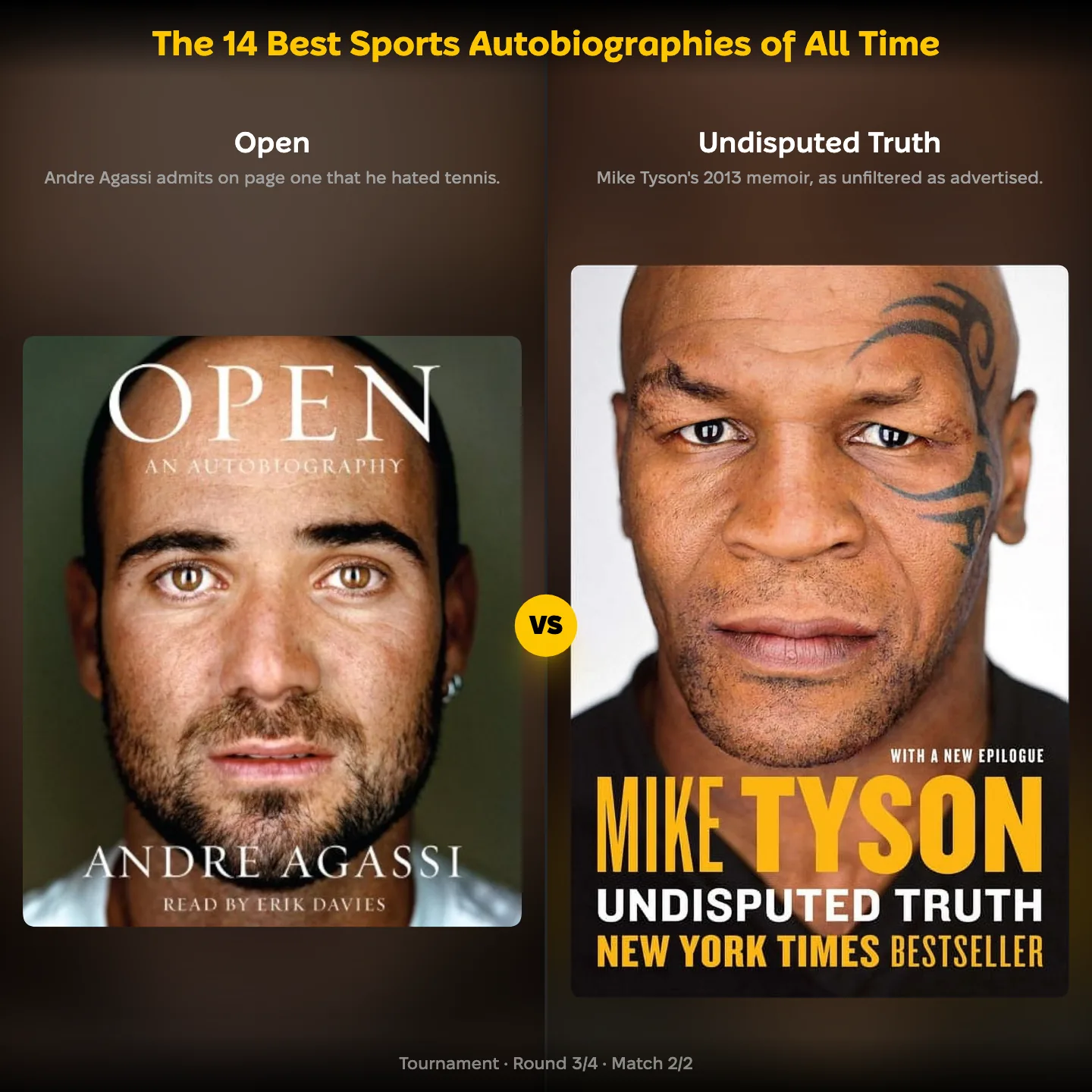
Undisputed Truth came out in 2013 and reached the New York Times bestseller list.
Ghostwritten sports memoirs are usually careful. This one is not, which is the point of it.
Andre Agassi's Open is the benchmark, and it opens by admitting he hated tennis. Jim Bouton's Ball Four got him unofficially blacklisted by baseball in 1970 for writing down what happened in the clubhouse.
Those three share a category that most athlete autobiographies never reach: books people finish who do not follow the sport.
Allen Iverson and the money that went
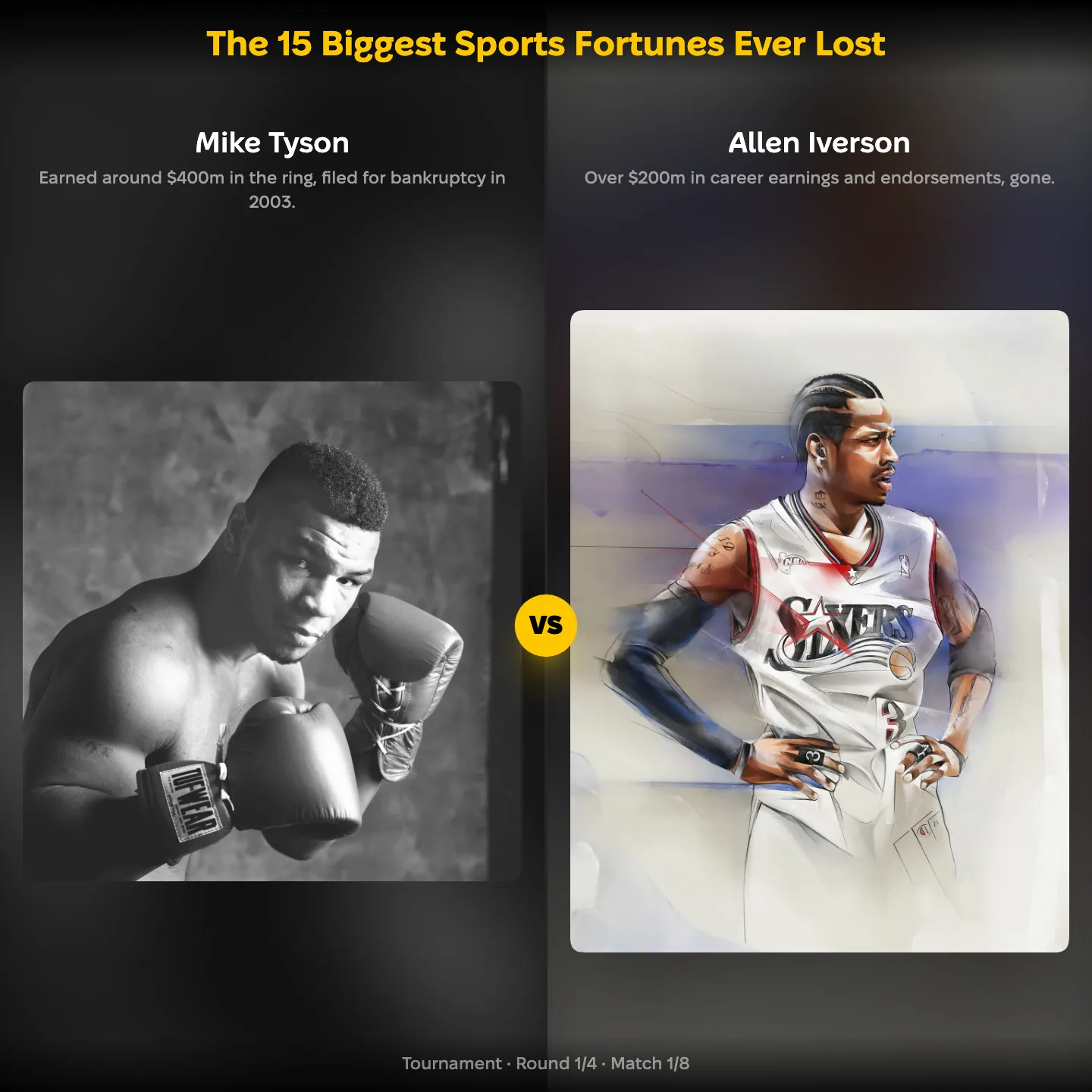
Tyson filed for Chapter 11 bankruptcy on 3 August 2003, having squandered something in the region of $300 million.3
His attorney's filing said the debts far exceeded the assets. The money had gone on Bentleys, jewellery and, at one point, Bengal tigers.
Allen Iverson earned more than $200 million across salary and endorsements and ended up in court over a jeweller's bill. Evander Holyfield lost a 109-room house to foreclosure.
Boris Becker, Diego Maradona, Scottie Pippen and Björn Borg are all here as well. What separates Tyson is the scale and the speed, and that he has since talked about it at length rather than around it.
Jake Paul's opponents: Tyson as somebody else's list
The last ranking is not about Tyson at all. It is about Jake Paul, and Tyson is one of the men Paul has fought.
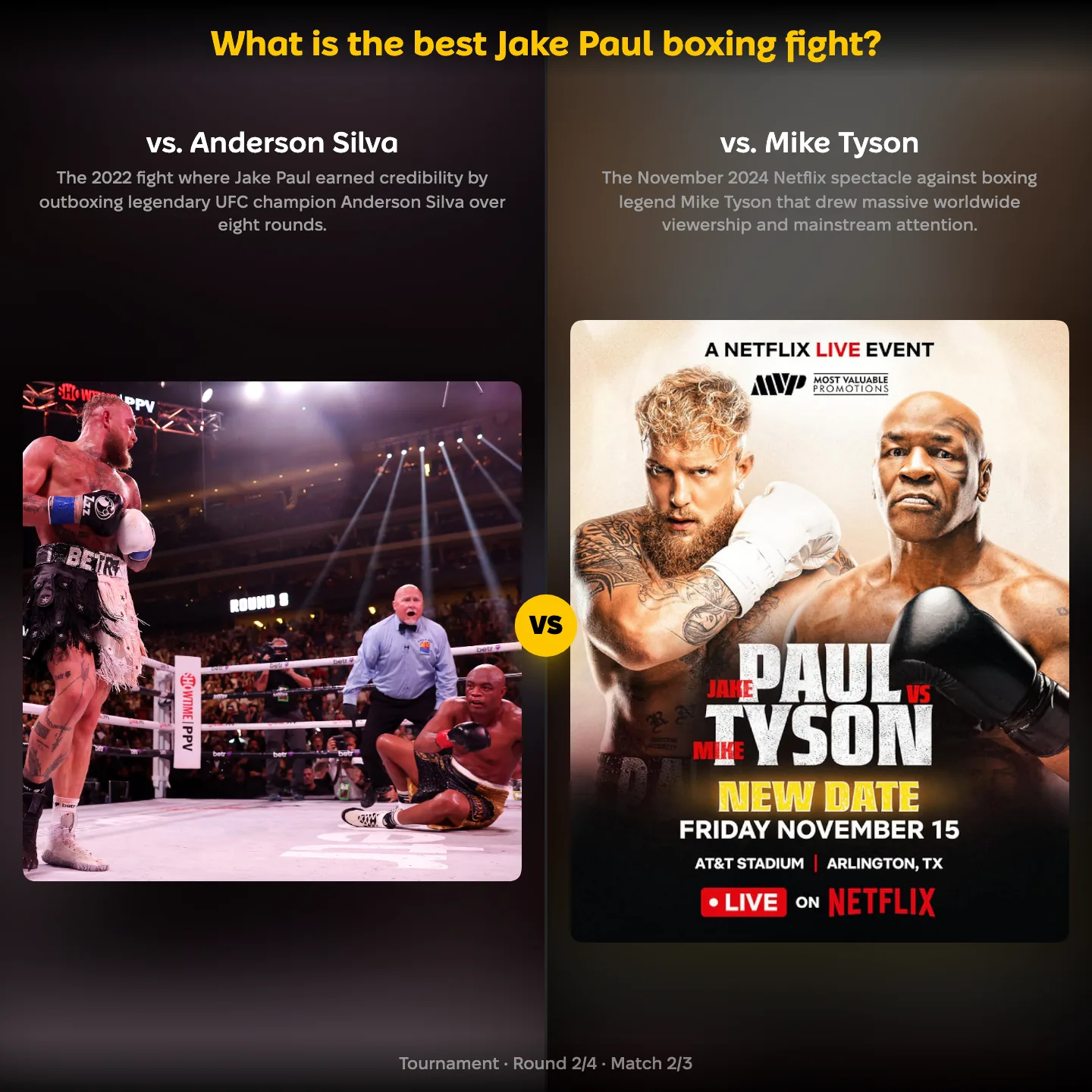
They met on 15 November 2024 at AT&T Stadium in Arlington, Texas. Paul won a unanimous decision over eight rounds, 80-72, 79-73 and 79-73, against a 58-year-old.4
Netflix carried it and peaked at 65 million concurrent viewers, which made it one of the most-watched boxing events ever staged.4 Anderson Silva, Nate Diaz and Tyron Woodley fill out the rest of Paul's record. Judged as contests, several of those were better fights than the Tyson one, which was widely panned.
Judged as events, none of them are close. Paul's opponents are the measure of his career, and Tyson is the biggest name on the list by a distance he did not have to win anything to earn.
Thirty-eight years after Berbick, the youngest heavyweight champion boxing has had appears on a ranking of another man's fights. The name alone sold the event, which is the entire reason it happened.
Sixteen questions, and boxing answers six of them
Ten of these sixteen rankings are not boxing questions. Tyson is on them as a nickname, a cartridge, a cameo, a documentary, a memoir, a bankruptcy and a line on Jake Paul's record, and each one is a real category he genuinely belongs in.
That is what forty years of being famous does to a fighter: the sport becomes the smaller part of the file. Every one of these questions gets settled the same way, by comparing them two at a time, which is the only method that copes with a field this mixed.
Pick the version of Tyson you actually want to argue about and go settle it.
More rankings, more angles
- Which Muhammad Ali Are You Ranking? — boxer, draft resister, Olympic torchbearer
- Muhammad Ali vs Mike Tyson: They Never Fought. These 13 Lists Did. — the fight that never happened
- Ronda Rousey Had Four Careers. Every List Picks a Different One — judo, the UFC, WrestleMania, Hollywood
- Anderson Silva: Six Years Champion, One Left Hook — 2,457 days champion, then seven losses in nine
Sources
- Yahoo Sports — Tyson vs Mayweather exhibition delayed to fall 2026 after a broken hand: sports.yahoo.com (checked 2026-08-04)
- HISTORY — Tyson beats Trevor Berbick, 22 November 1986, aged 20, entering 27-0 with 26 knockouts: history.com (checked 2026-08-04)
- Al Jazeera — Tyson files for bankruptcy, 3 August 2003, having squandered some $300 million: aljazeera.com (checked 2026-08-04)
- Mike Tyson vs. Michael Spinks — 27 June 1988, Atlantic City, 91 seconds, Spinks 31-0 going in: en.wikipedia.org (checked 2026-08-04)
- Buster Douglas — the 11 February 1990 Tokyo Dome knockout at 1:22 of the tenth, and the Mirage's 42-to-1 line: en.wikipedia.org (checked 2026-08-04)
- Jake Paul vs. Mike Tyson — date, venue, unanimous-decision scorecards and the Netflix concurrent-viewer peak: en.wikipedia.org (checked 2026-08-04)