
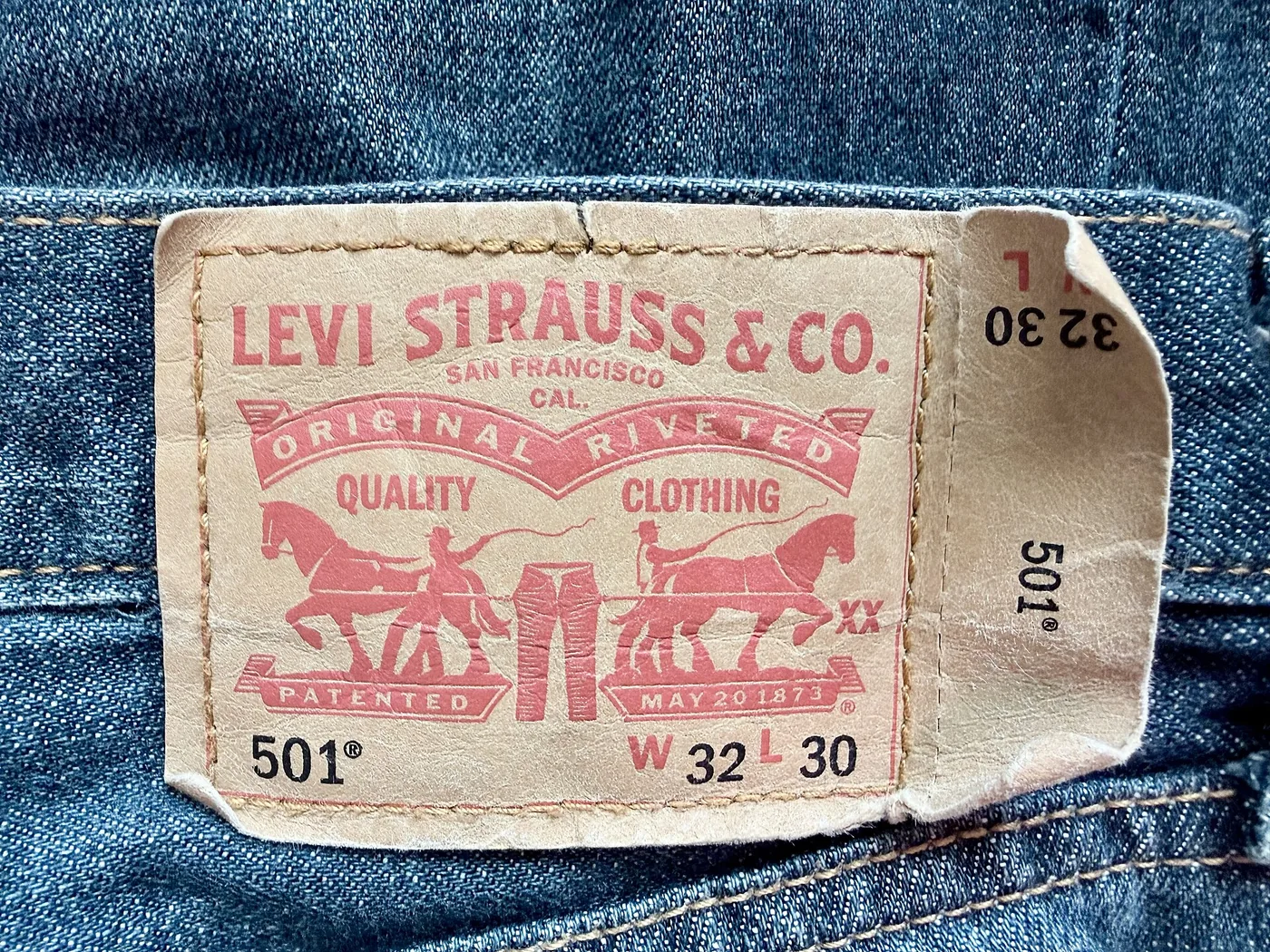
Levi's still prints its patent date on the product. The leather patch on every pair of 501s reads "Patented May 20 1873", the day Levi Strauss & Co. and the tailor Jacob Davis were granted the patent on riveted work trousers. On October 7, 2026 the San Francisco company reported $1.6 billion in quarterly revenue and raised its full-year outlook again.1
The patent explains why Levi's belongs on lists about jeans, fashion and American design. It does not explain the rest: an NFL stadium, a Beyoncé song, a 1985 television advert and a Bruce Springsteen album cover. Fourteen rankings place the brand, its founder and the trousers next to very different company.
Levi's invented the thing every jeans list is about; on every other list it is the backdrop: a stadium's name, or the jeans on an album cover.
Levi's vs Wrangler: The Best Jeans Brand of All Time
This ranking asks the question in the title: which jeans brand is the best ever made. Levi's has the strongest historical claim of the twelve, because it holds the 1873 patent on riveted work trousers that every other brand on the ballot followed.
Wrangler is the American rival with a different customer in mind. Its 13MWZ cowboy cut was built for rodeo riders, and the brand still sells itself on horseback. Lee, the third old American name, completes the founding trio.
The other names trace where denim went after the workwear years. Diesel and Guess made jeans a fashion item in the 1980s; A.P.C. and Acne Studios turned raw denim into minimalist luxury. Evisu and Pepe Jeans complete a list where Levi's is the oldest name by decades.
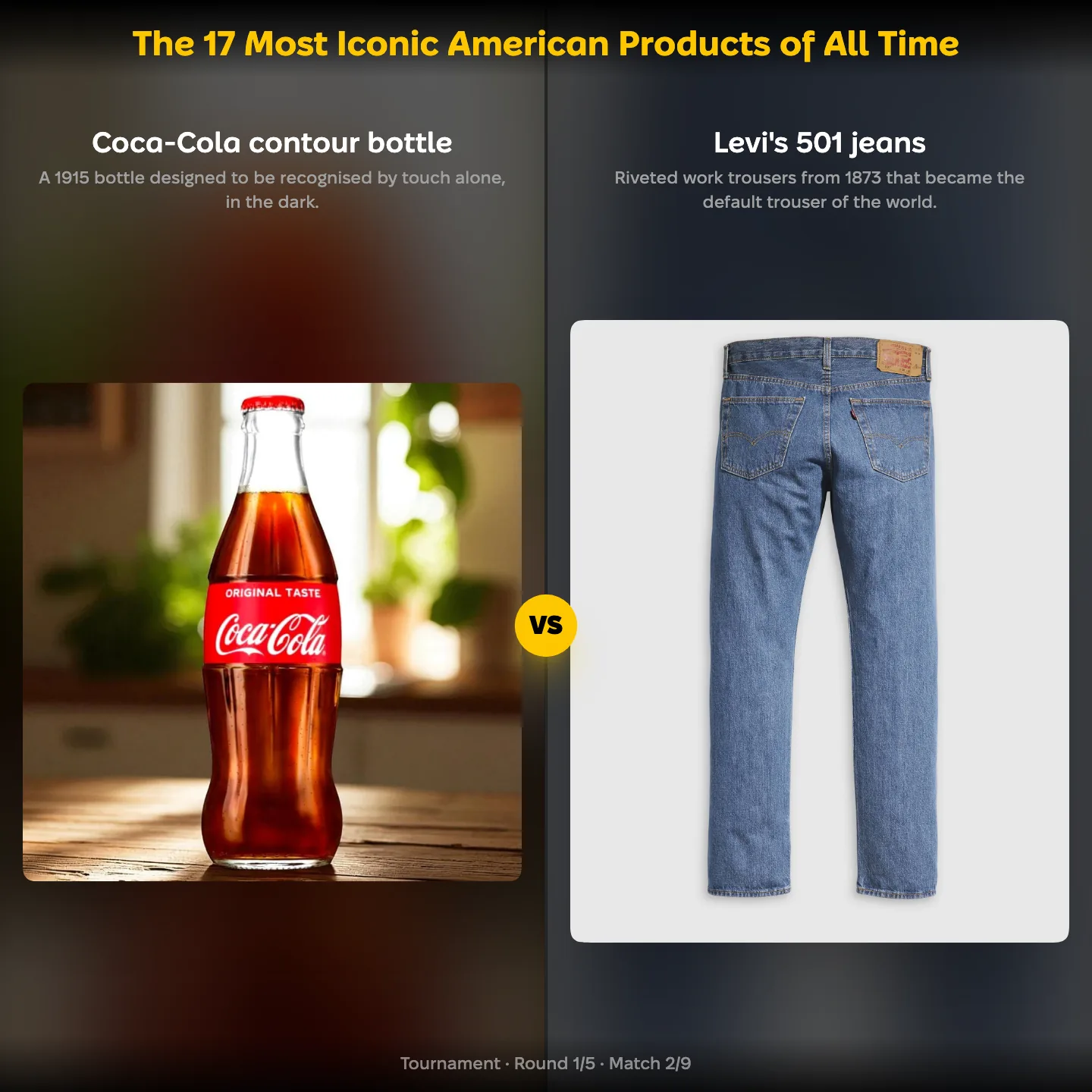
Levi's 501 vs the Coca-Cola Bottle: Made in America
The 17 most iconic American products include exactly two things you wear: the Levi's 501 and the Converse Chuck Taylor. The rest are machines, instruments and packages, from the Ford Model T and the Fender Stratocaster to the iPhone and the Zippo.
The 501 earns its place on age. Levi's itself treats old pairs as artefacts: in 2001 the company paid $46,532 on eBay for a pair made in the 1880s and found in the mud of a Nevada mining town.2
The Coca-Cola contour bottle is the closest match in spirit. It dates from 1915, was designed to be recognised by touch, and has changed as little as the 501 has. Both are products whose shape became the trademark.
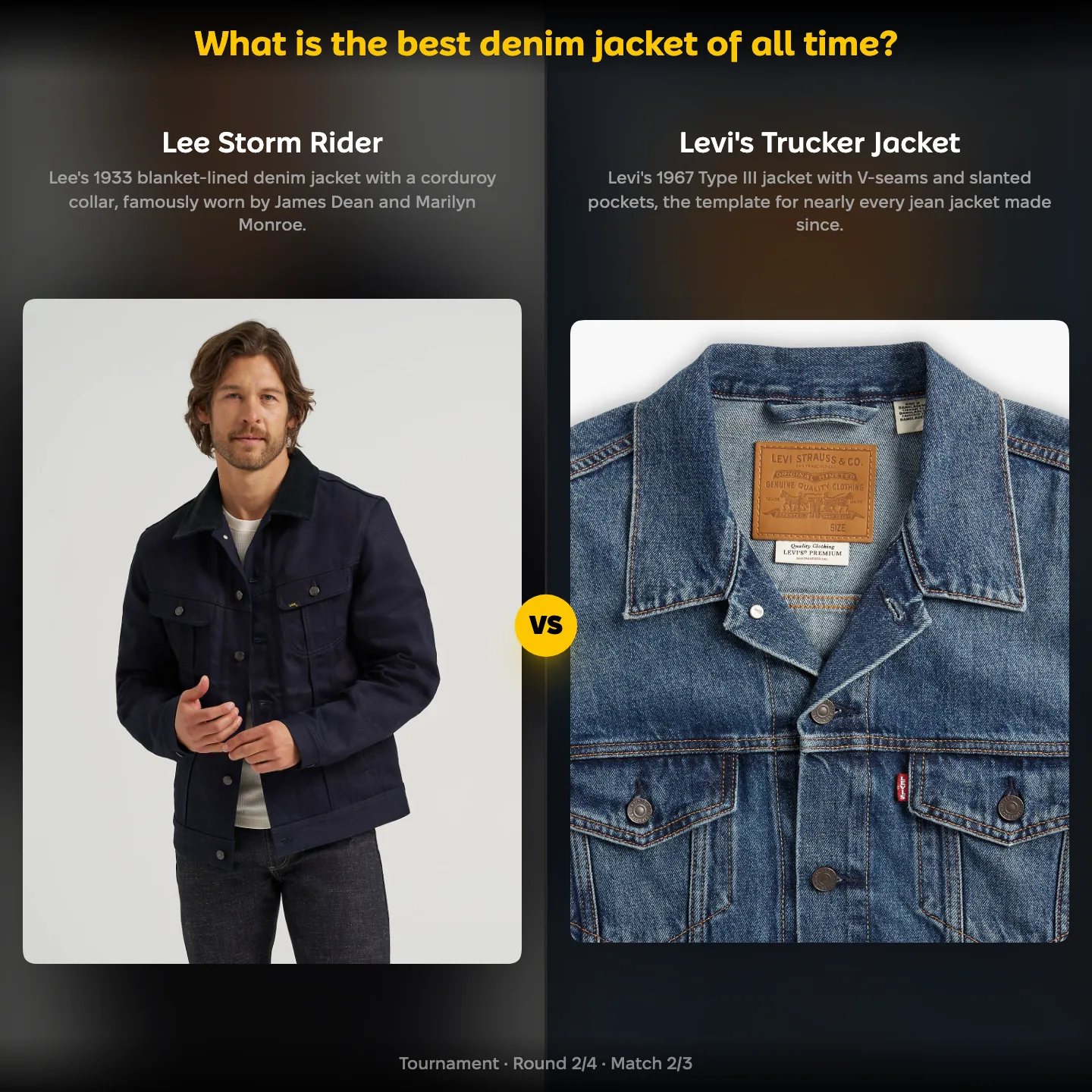
Levi's Trucker Jacket vs Lee Storm Rider
The best denim jacket ballot is close to a Levi's family reunion: four of its eleven options are Levi's cuts: the Type I, the Type II, the Trucker and the Sherpa Trucker. The Trucker is the one the others are measured against.
Levi's introduced it in 1962 as Lot 557, designed by Jack Lucier, and renumbered it 70505 in 1967. Lucier dropped the pleats and front rivets of the older jackets and added the pointed seams that still define the shape.3
Lee's Storm Rider is the strongest outside answer. It dates from 1933, carries a blanket lining and a corduroy collar, and is the jacket people picture on a ranch rather than on a stage. Wrangler's 11MJ, Gap, Calvin Klein and Acne Studios make up the rest.
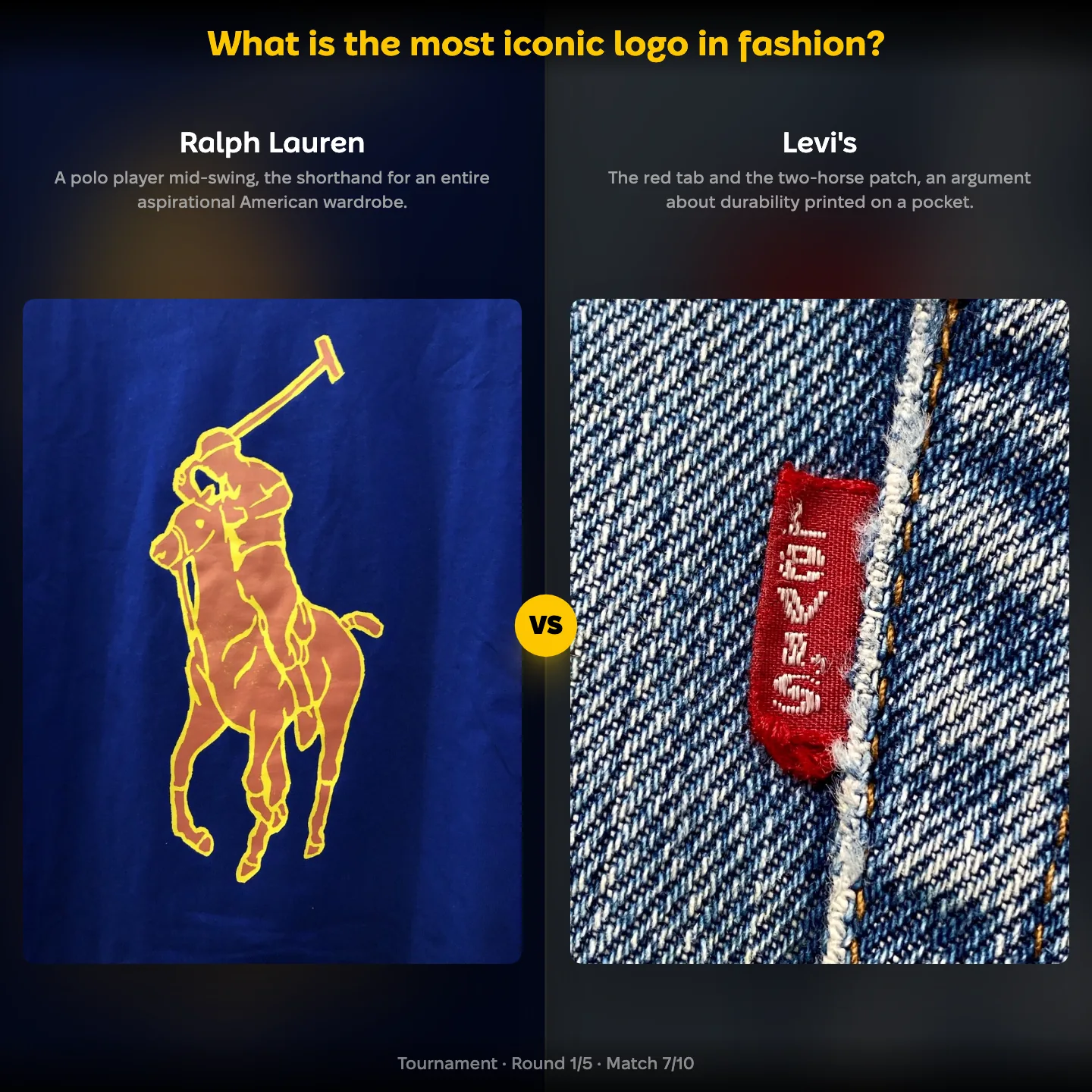
Levi's Red Tab vs the Ralph Lauren Polo Player
Fashion logos are usually printed, embroidered or cast in metal. Levi's has two that are sewn on: the leather Two Horse patch on the waistband and the Red Tab on the right back pocket, first used in 1936.4
The patch makes a claim rather than showing a name. It pictures two horses failing to pull a pair of jeans apart, a durability test readable without a word of English.
Ralph Lauren's polo player sells the opposite idea: leisure, money and a sport most buyers have never played. Chanel's interlocking Cs, the Nike swoosh and the Lacoste crocodile fill out a ranking where Levi's is the only workwear label.
Levi's vs Shein: Gen Z Picks a Fashion Brand
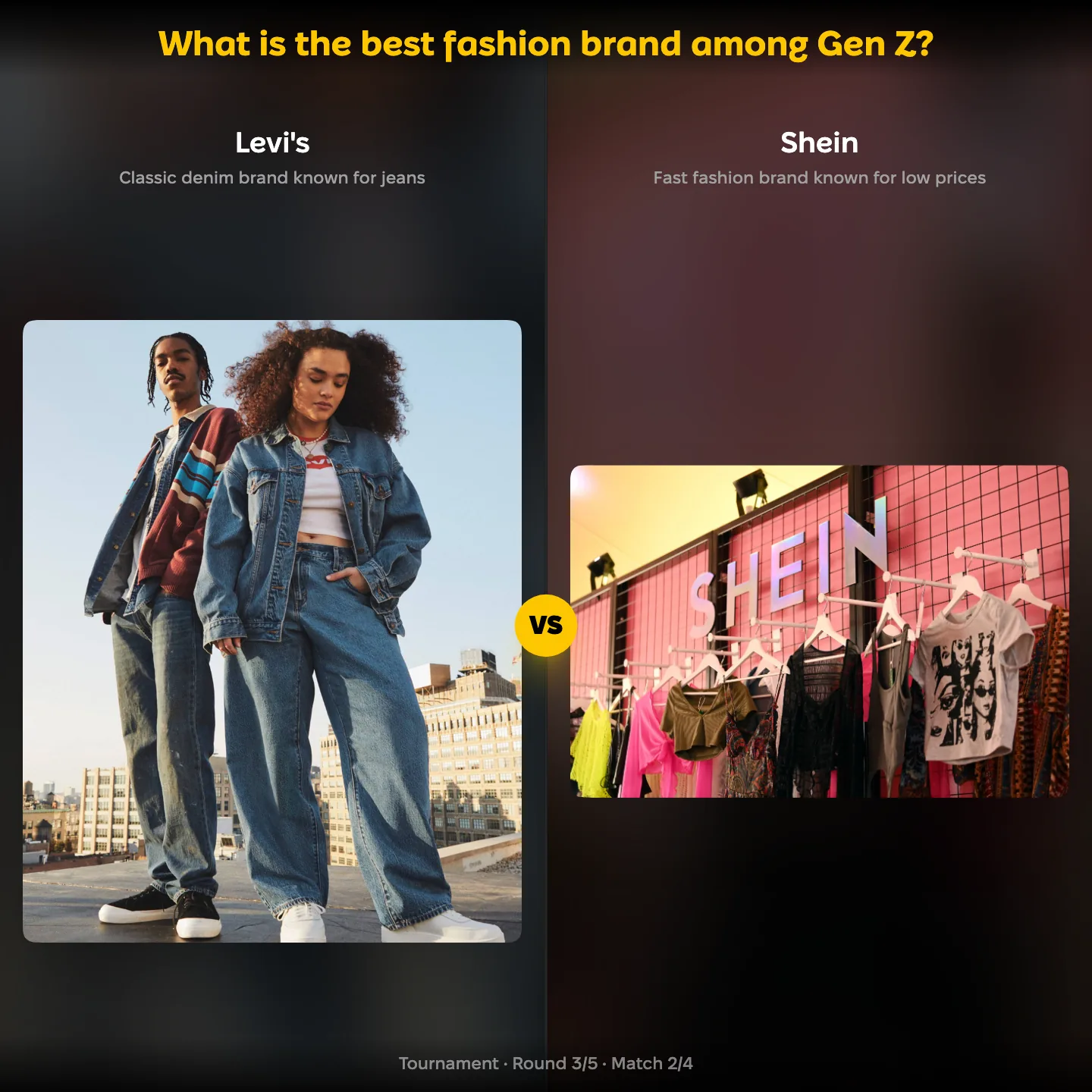
A brand founded in 1853 shares this ballot with Shein, Brandy Melville, Princess Polly and Fashion Nova. The question is which fashion brand Gen Z rates highest.
Levi's qualifies because Gen Z went back to straight and baggy denim, the cuts the 501 has always sold. The heritage that once made the brand look like its customers' parents now reads as vintage.
Shein is the opposite proposition: an online catalogue that changes daily, at prices a 501 cannot approach. Carhartt, Dickies and Dr. Martens sit between the two, old workwear labels that found the same young audience.
Levi's vs Gucci: The Greatest Fashion Comebacks
To be on a comeback list, a brand first has to fall. Levi's fell hard. Its sales peaked at $7.1 billion in 1996 and then declined two years running, with a 13% drop in 1998 alone, as younger buyers moved to designer denim and cheaper store brands.5
The recovery was slow. The company returned to the stock market in 2019, its second listing, and the straight-leg revival of the 2020s put the 501 back on the people who had left it.4
Gucci is the textbook rival: a family house close to bankruptcy in the early 1990s, rebuilt by Tom Ford into the most talked-about label of the decade. Burberry, Crocs, Converse and Birkenstock each recovered from a slump of their own, and Hush Puppies is the reminder that some comebacks were short.
Levi's vs Carhartt: The Best Workwear Brand
Levi's started as workwear and the patent says so. Jacob Davis began riveting the pocket corners of work trousers in late 1870 because miners and labourers kept tearing them.6
Carhartt has the purer claim to the category today. The Detroit company has made duck-canvas coats and bib overalls since 1889, and it never left the job site even after streetwear adopted it.
Dickies, Red Wing and Caterpillar keep the list close to real work. Engelbert Strauss and Blåkläder bring in the European trade brands most American buyers have never heard of, and Duluth Trading Co. sells the joke of being tougher than everyone else.
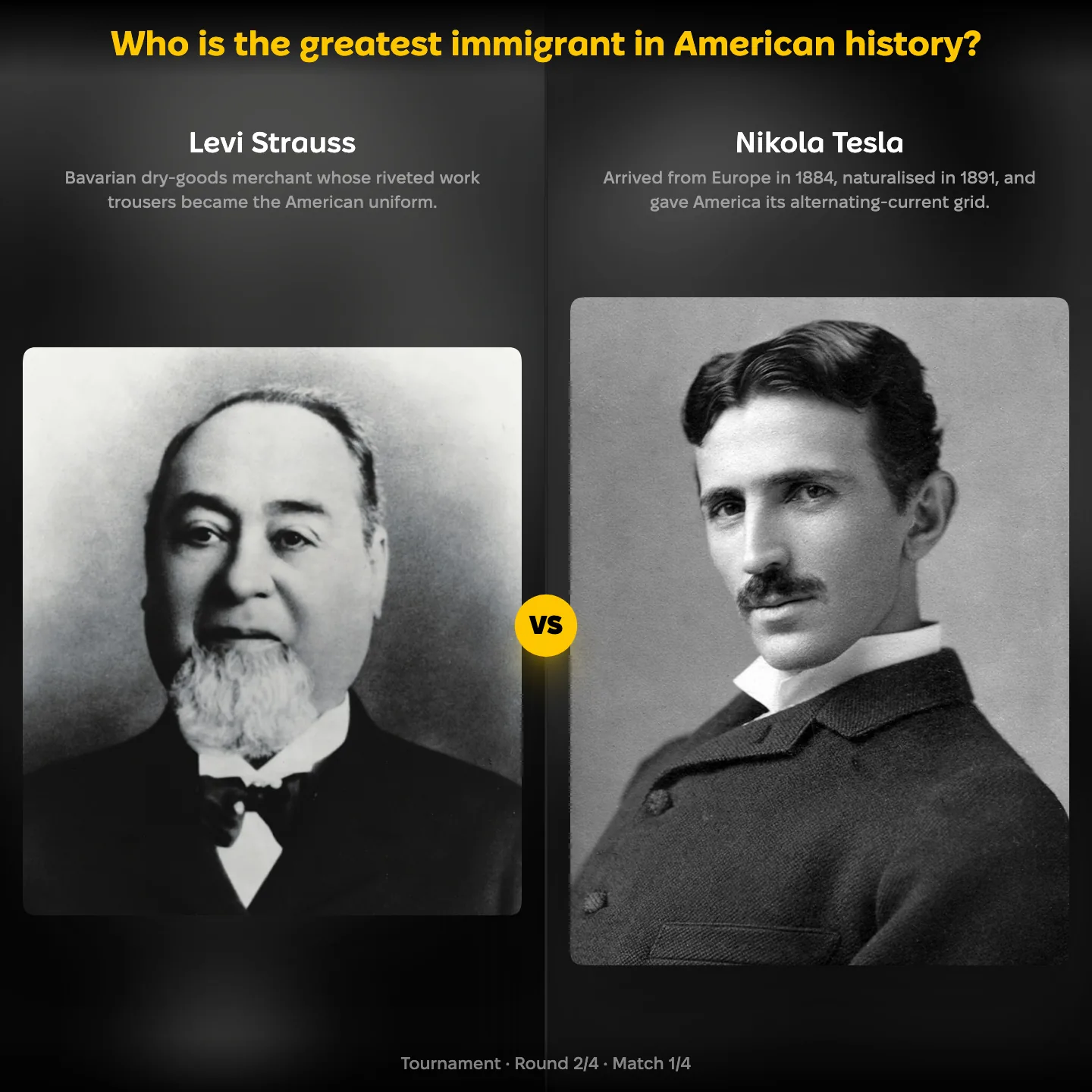
Levi Strauss vs Nikola Tesla: The Immigrant Who Sold the Cloth
Levi Strauss appears here as a person, not a brand. The ranking asks for the greatest immigrant in American history, and he arrived from Bavaria and opened a dry-goods business in Gold Rush San Francisco in 1853.4
His claim rests on a partnership. Jacob Davis, a Latvian-born tailor in Reno, needed a backer to patent his riveted trousers. Strauss had sold him the cloth, so Davis wrote to him, and patent #139,121 was granted to both of them.6
The competition is brutal. Nikola Tesla gave America alternating current, Albert Einstein and Enrico Fermi reshaped physics, and Alexander Hamilton built the Treasury. A cloth merchant is the most down-to-earth name among them.
Levi Strauss & Co. vs Ghirardelli: Born in Gold Rush San Francisco
The greatest company founded in San Francisco is a contest between two eras. One group came out of the Gold Rush: Levi Strauss & Co., Ghirardelli and Folgers. The other came out of the internet: Twitter, Uber, Airbnb, Salesforce and OpenAI.
Ghirardelli is the closest match to Levi's. Domingo Ghirardelli opened his chocolate business in 1852, a year before Strauss arrived, and both sold to the same mining-town customers. Both brands still name the city on their packaging.
Gap sits between the eras. It opened in 1969 as a single San Francisco shop selling Levi's and records, then grew into a rival brand of its own.
Levi's Launderette vs Apple 1984: The Greatest TV Commercial
Only one ranking here represents Levi's with sixty seconds of film. "Launderette" first ran on British television on Boxing Day 1985: the model Nick Kamen strips to his boxers in a laundrette and washes his 501s, to Marvin Gaye's "I Heard It Through the Grapevine".
The agency was BBH. Levi's own historians say 501 sales rose by as much as 800% by some estimates, and the Gaye single went back into the charts.7
Apple's "1984" is the obvious rival, Ridley Scott's Super Bowl advert that launched the Macintosh. Coca-Cola appears twice, with "Hilltop" and "Mean Joe Greene", and the newer entries include Old Spice and Volkswagen's "The Force".
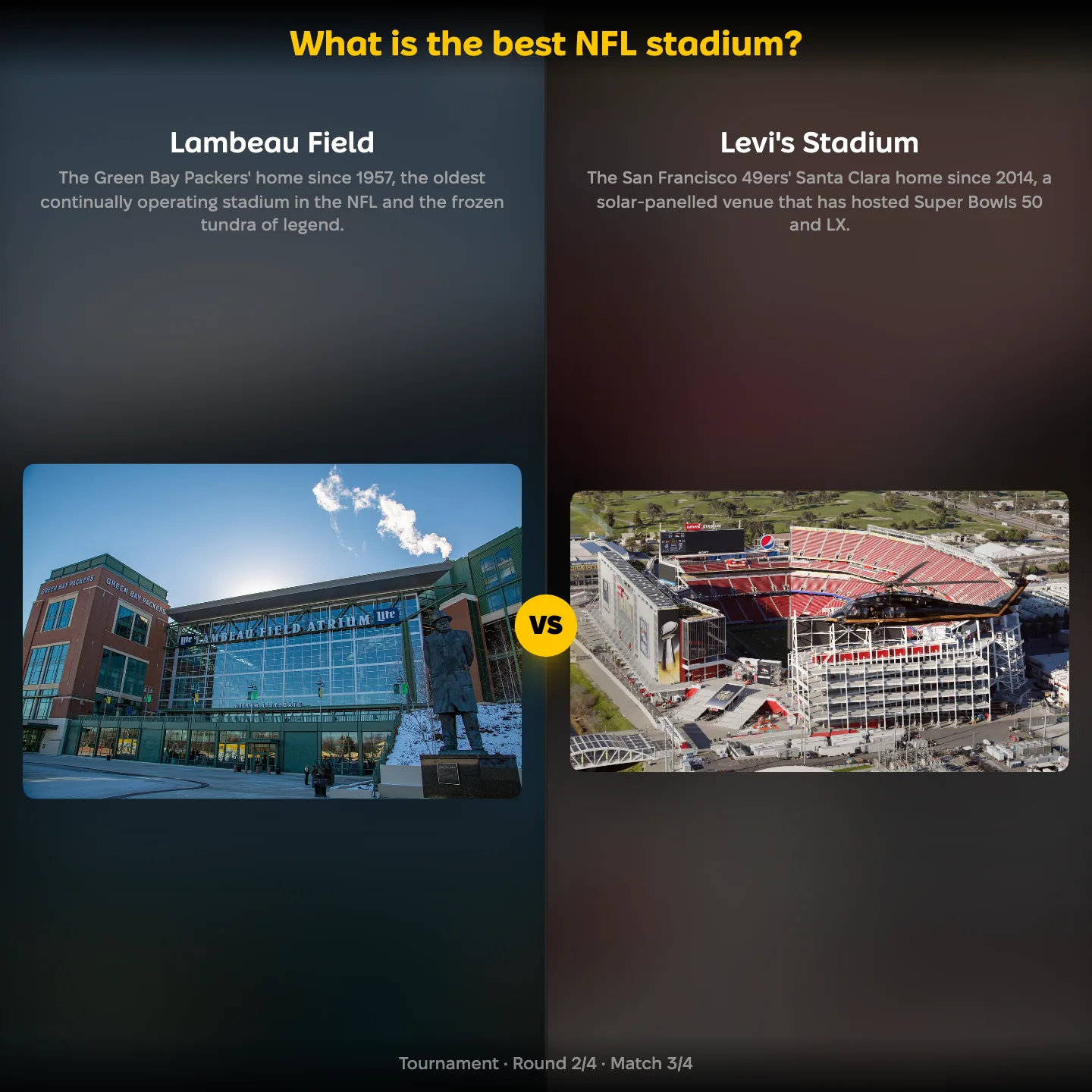
Levi's Stadium vs Lambeau Field
The NFL ballot includes Levi's only by naming rights. Levi's Stadium in Santa Clara opened in July 2014 as the home of the San Francisco 49ers, and it hosted Super Bowl 50, where Denver beat Carolina 24–10.8 Super Bowl LX followed there in February 2026.
The stadium's case is modern: solar panels, wide concourses, a Silicon Valley location. Its critics point to the sun on the east stands and the distance from San Francisco itself.
Lambeau Field is the opposite argument. The Green Bay Packers have played there since 1957, and its claim is history rather than amenities. Arrowhead's noise, SoFi's price tag and the Superdome's Super Bowl record complete the ballot.
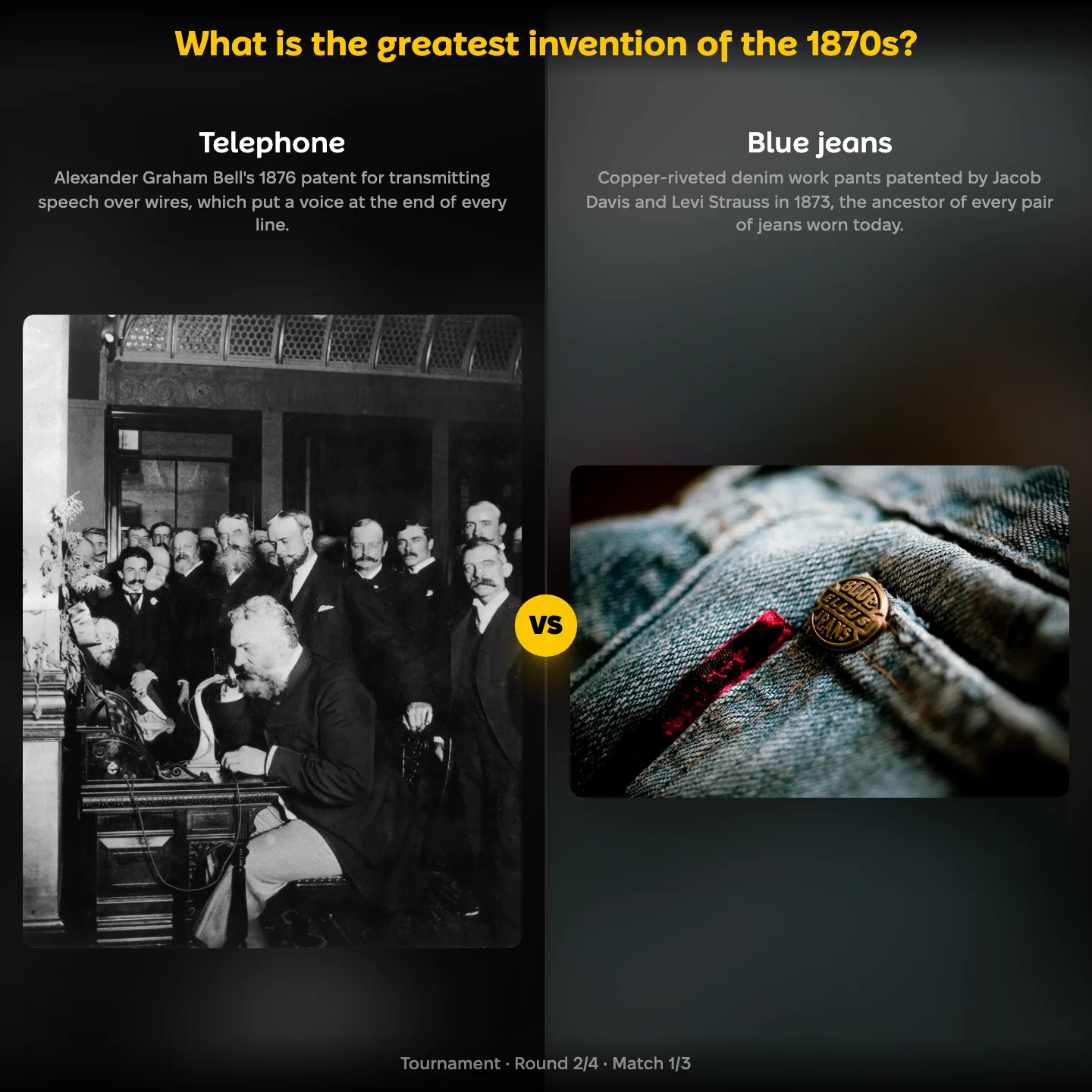
Blue Jeans vs the Telephone: Inventions of the 1870s
The 1870s were a crowded decade for invention, and blue jeans are the humblest entry. The ranking holds the telephone (1876), the phonograph (1877), the incandescent light bulb (1879), the QWERTY typewriter and barbed wire.
Jeans qualify through the 1873 patent. The invention was small: copper rivets at the points where work trousers tore. The result outlasted most of the decade's machines in daily use.
The telephone is the giant here, Alexander Graham Bell's patent that turned the human voice into an electrical signal. The four-stroke engine and the cash register are the quieter rivals that, like jeans, still sit in daily life.
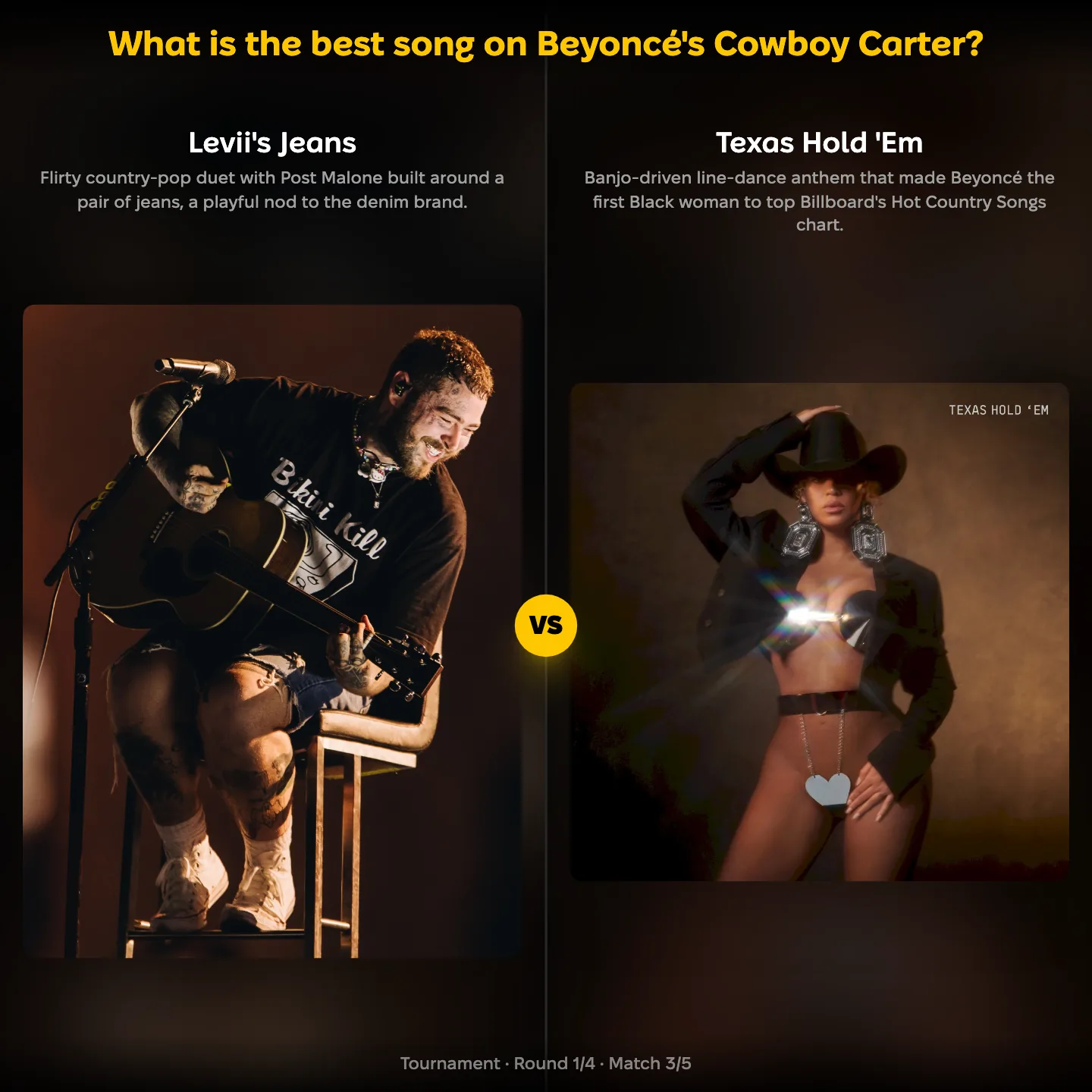
Levii's Jeans vs Texas Hold 'Em: Beyoncé's Cowboy Carter
Beyoncé spelled the brand into a song title. "Levii's Jeans", her duet with Post Malone on Cowboy Carter, uses a pair of jeans as its whole conceit, and the extra "i" matches the album's other doubled titles, from "Blackbiird" to "Ameriican Requiem".
Cowboy Carter came out on March 29, 2024 and took the Grammy for Album of the Year the following February, which keeps a song about a pair of Levi's on one of the most-played country records of the decade.
The best-known track is "Texas Hold 'Em", the lead single that made Beyoncé the first Black woman to top Billboard's Hot Country Songs chart. "16 Carriages", "Jolene" and "II Most Wanted" with Miley Cyrus are the other strong cases.
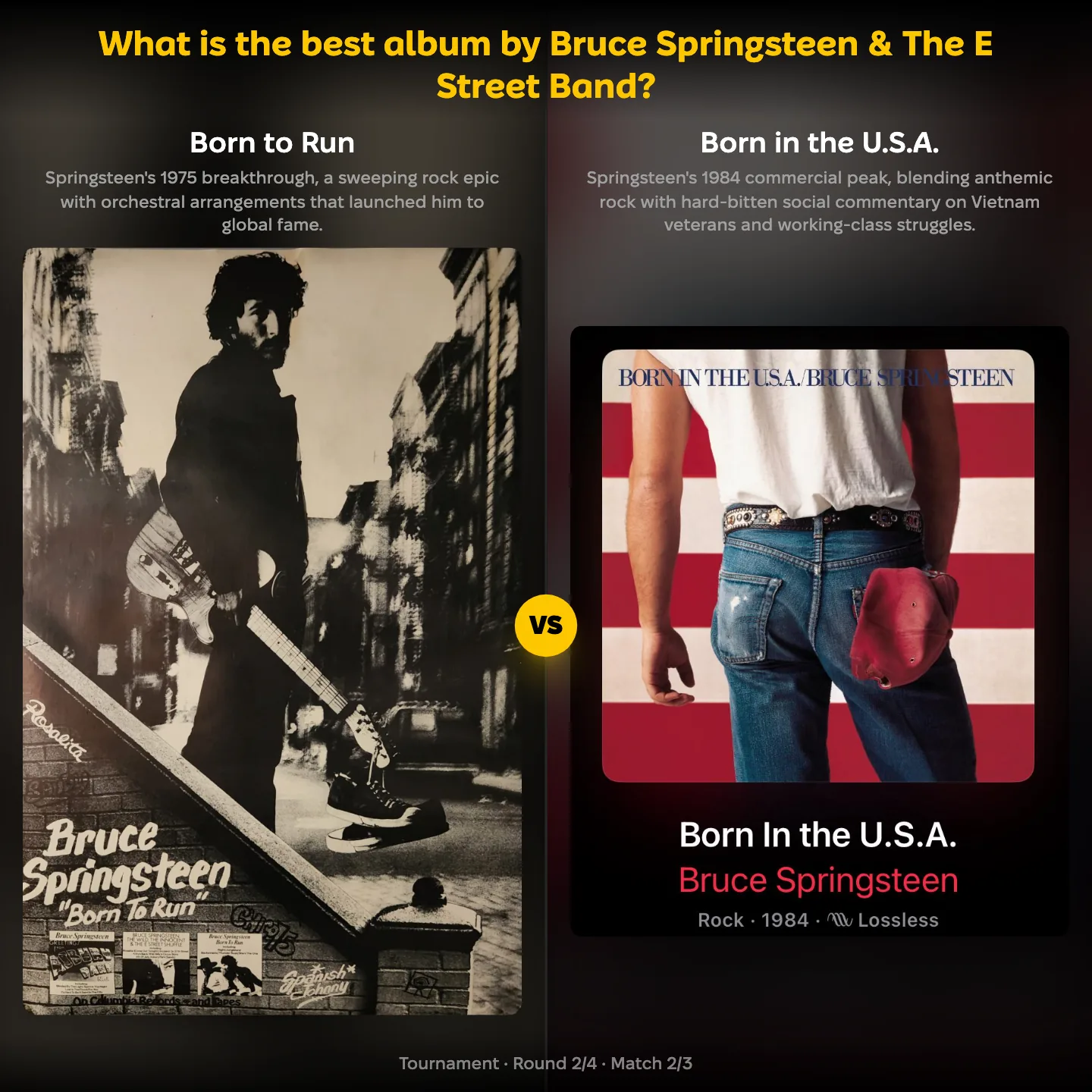
Born in the U.S.A.: The Album Cover in a Pair of 501s
Levi's is not on this ballot as a brand. It is on an album cover. Bruce Springsteen's Born in the U.S.A. (1984) shows the singer from behind, in a white T-shirt and a pair of Levi's 501s against the stripes of the American flag, photographed by Annie Leibovitz.
The ranking asks which Springsteen and E Street Band album is best, and Born in the U.S.A. is the biggest seller of the twelve. Its title track is also his most misread song: a protest about a Vietnam veteran that rallies kept playing as a patriotic anthem.
Born to Run is the critics' answer, the 1975 breakthrough. Darkness on the Edge of Town and Nebraska belong to fans who prefer the darker records.
Levi's Outside the Denim Aisle
On lists about jeans, jackets and workwear, Levi's is the reference every other name is measured against. Everywhere else it arrives by accident: a stadium sponsorship, a pop song's title, the trousers a photographer chose for an album cover.
Every ranking above is decided by head-to-head picks between two options. A brand you keep spotting in odd places deserves the same treatment: build a ranking and see who it ends up beside.
More rankings, more angles
- Is the Air Jordan the Greatest Sneaker of All Time? 15 Lists — the 1985 sneaker and a $2.2 million pair
- Chanel vs Dior: Which Luxury House Is Better? 13 Lists — two Paris houses, bags to perfume
- Nike vs Adidas Rivalry: The Swoosh, the Three Stripes, 16 Lists — World Cup kits to a Run-DMC song
Sources
- Levi Strauss & Co. — third-quarter 2026 results, SEC Form 8-K exhibit 99.1: sec.gov (checked 2026-10-11)
- The Herald (Everett) — Levi's buys 1880s jeans on eBay for $46,532, May 2001: heraldnet.com (checked 2026-10-11)
- Levi Strauss & Co. — Type III Trucker jacket history (Lot 557, 1962; Lot 70505, 1967; Jack Lucier): levistrauss.com (checked 2026-10-11)
- Levi Strauss & Co. — company timeline: founding in 1853, Red Tab in 1936, 2019 IPO: levistrauss.com (checked 2026-10-11)
- The Motley Fool — Levi Strauss sales peak of $7.1 billion in 1996 and 1998 decline (1999): g.foolcdn.com (checked 2026-10-11)
- Levi Strauss & Co. — the 501 and patent #139,121, Jacob Davis's rivets from late 1870: levistrauss.com (checked 2026-10-11)
- Levi Strauss & Co. — the 1985 "Launderette" advert, BBH and the 501 sales lift: levistrauss.com (checked 2026-10-11)
- CBS Sports — Super Bowl LX awarded to Levi's Stadium; stadium opened July 2014; Super Bowl 50 result: cbssports.com (checked 2026-10-11)