
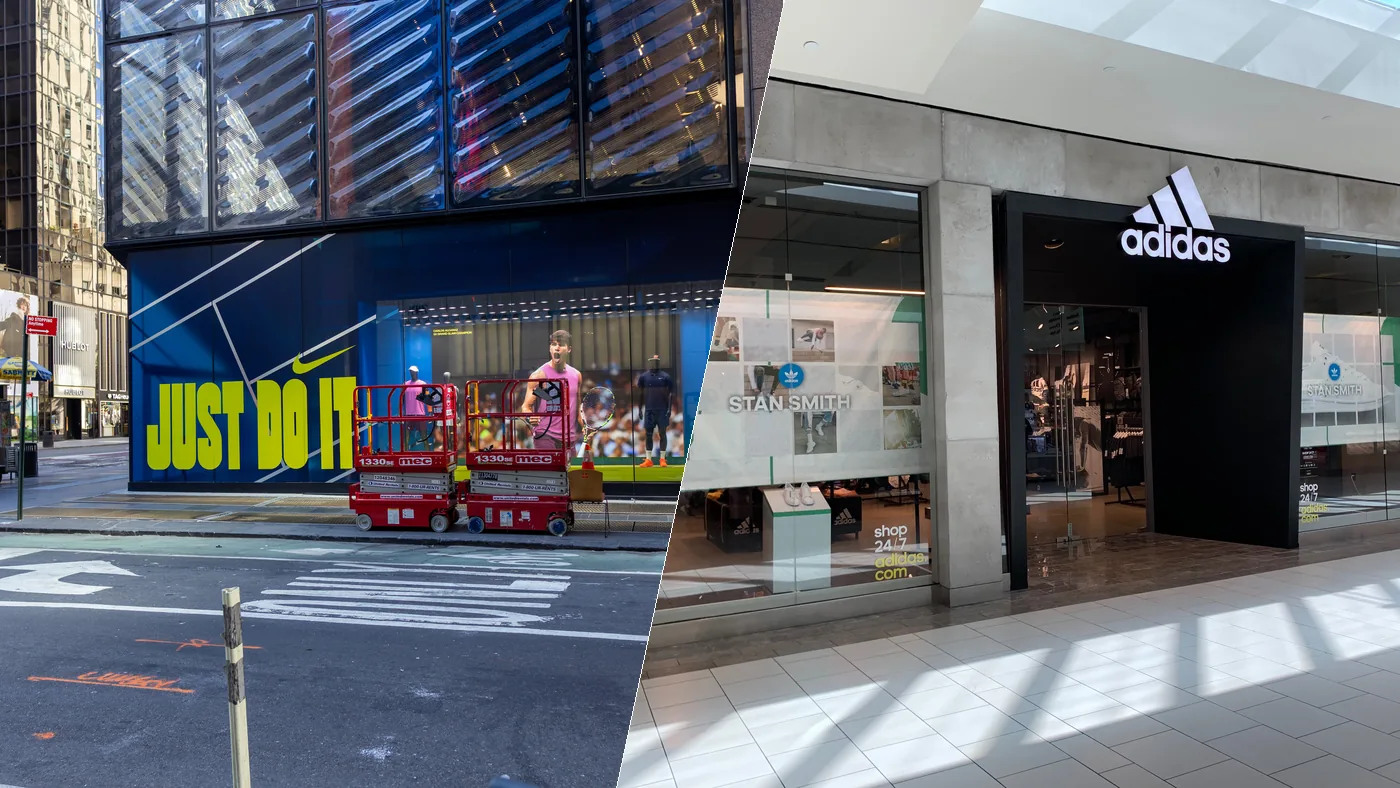
Nike and Adidas sell the same three things: shoes, kit, a logo. 2026 rearranged which of them is having the better year. Nike closed its fiscal year in May on revenues of $46.4 billion, flat in reported terms and down 2% currency-neutral.1 Adidas spent the same months growing 14% to a record €13.3 billion in the first half, off a World Cup its chief executive Bjørn Gulden called "like a fairy tale."2
Momentum is not the same thing as ownership, though, and the 16 rankings below split the two brands by terrain rather than by year.
The hardwood, the track and the American logo wall belong to the Swoosh; the pitch, the terraces and the ball itself belong to the Three Stripes. Nothing on the shoe rack belongs to both.
Nike and Adidas on a list with Shein and Gucci
Gen Z shops sportswear next to fast fashion and luxury, so the two sports brands land on a 32-name ranking that also holds Shein, Zara, Gucci and Balenciaga.
Nike arrives as the streetwear default, the brand whose tracksuits and Dunks read as basic rather than as sportswear.
Adidas arrives older than almost anything else on the list. Adi Dassler registered the company in Herzogenaurach on 18 August 1949, aged 49, after a bitter split from his brother Rudolf, who set up Puma across the river.3
The complication is that Vans, Converse and New Balance are on the same list, and so are Carhartt and Stüssy. A brand can be the most-worn thing in a school corridor and still lose a fashion ranking to a label with a fraction of its revenue.
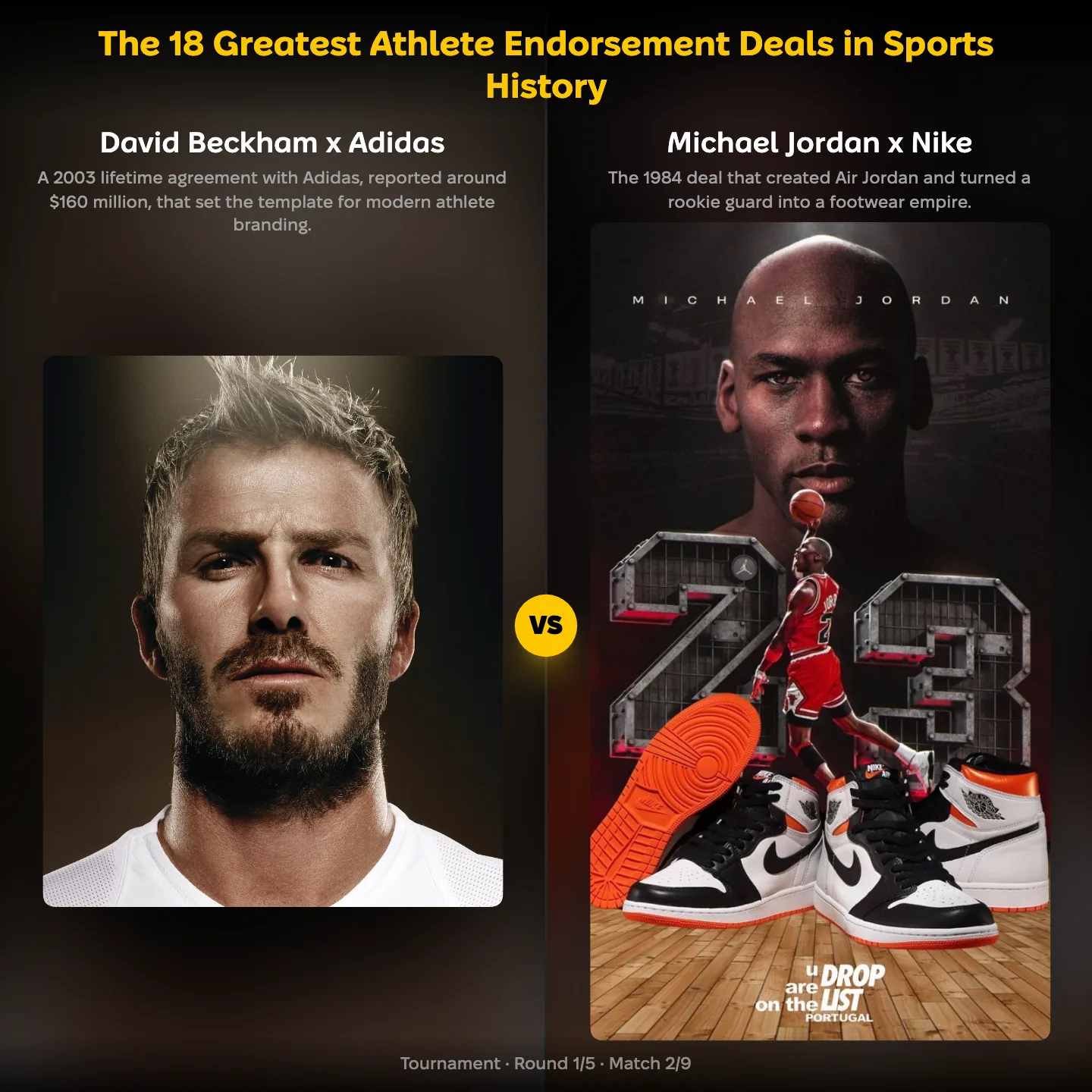
Michael Jordan vs David Beckham: the two deals that built two brands
Sportswear history is a history of contracts, and this ranking puts 18 of them in one field.
Nike's entry is the one everybody knows. The 1984 agreement with a rookie Chicago Bulls guard produced Air Jordan, and Jordan Brand is now a business large enough that Nike reports it separately.
Adidas answers with David Beckham, signed to a lifetime deal in 2003 that tied a footballer to a brand for the rest of his career rather than for a contract cycle.
Neither is the newest name here. Nike's Caitlin Clark deal produces her first signature shoe, the Nike Caitlin 1, on 1 October 2026 at $140, the same machine that made Jordan, pointed at the WNBA.4 Reebok's Allen Iverson contract and Under Armour's Stephen Curry deal are on the list too, both of them brands that beat the giants to a generation.
World Cup 26: Adidas dressed 14 teams, Nike 12
Football is the category where Adidas has the receipts, and the 2026 World Cup handed over most of them.
Adidas supplied the kits of 14 of the 48 nations, among them Argentina, Spain, Germany, Mexico and Japan, against 12 for Nike, including the United States, Brazil, England and France, and 11 for Puma.5 The final was an all-Adidas fixture: Spain beat Argentina 1–0 in East Rutherford on 19 July 2026, Ferran Torres scoring in the 106th minute.6 On Nike's home soil, in Nike's biggest market.
Nike's counter is the club game, where it dresses Barcelona, Chelsea and Paris Saint-Germain, and where a kit deal is worth more per season than most federations pay.
The ranking itself is 14 brands deep, which is the part neither giant controls. Umbro, Hummel, Kappa, Castore and Joma all have supporters who will argue that a national shirt should look like the country rather than like a global template.
The NBA switched from Adidas to Nike in 2017
Basketball is the mirror image of football, and one contract explains most of it.
Nike took over as the NBA's official on-court apparel provider in 2017, replacing Adidas, and became the first company allowed to put its own logo on league jerseys.7 Adidas had held the deal since 2006 and chose not to renew.
Nike also enters this ranking twice, because Jordan Brand is a separate option from Nike Basketball. Adidas Basketball gets one entry and a roster it has rebuilt around Anthony Edwards.
Under Armour, Puma Hoops and Li-Ning are the interesting part of the list. Each one exists because a player signed somewhere unfashionable and won there, which is how Adidas landed James Harden in 2015 after he had spent his early career in Nike.
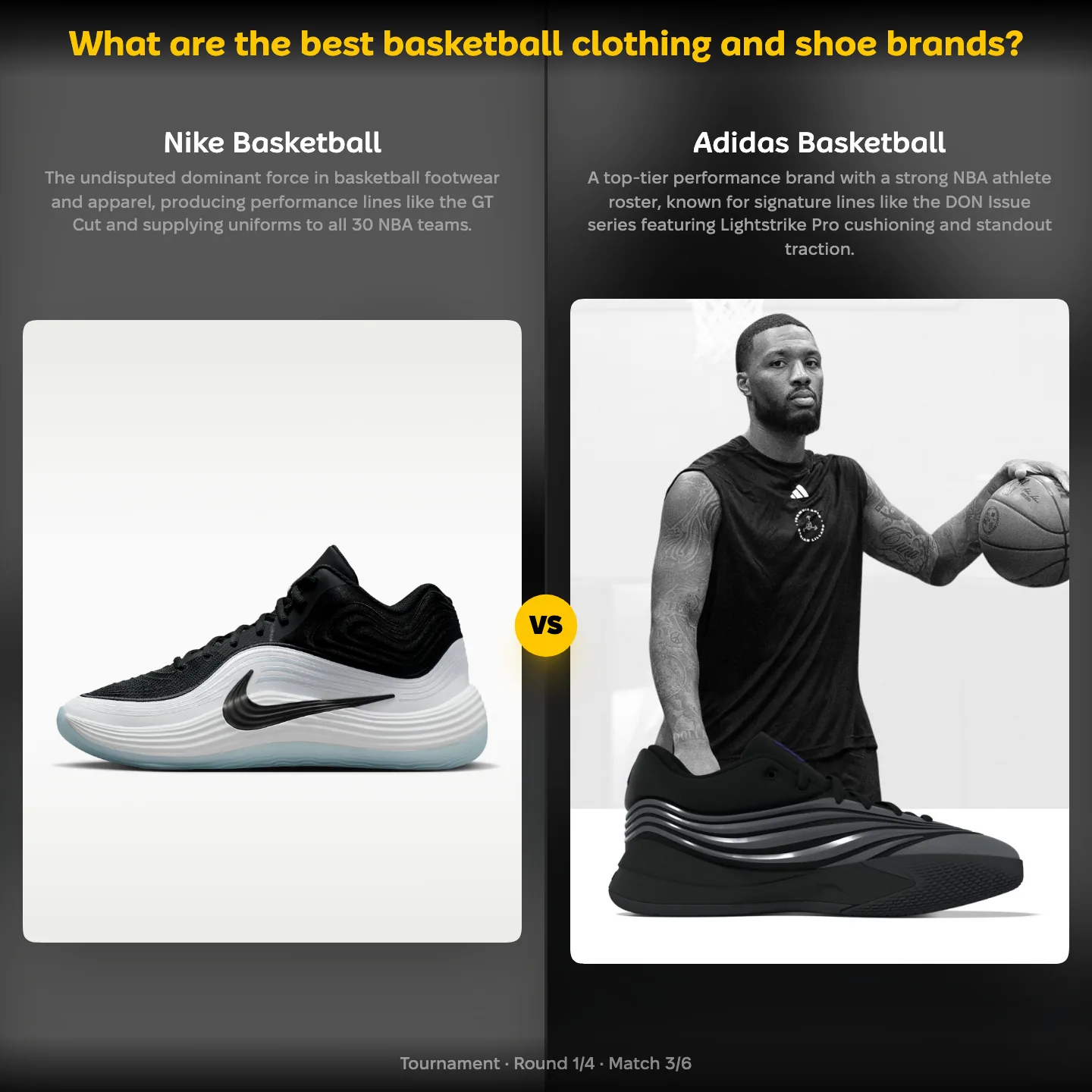
Air Jordan vs Adidas Harden: the signature-line gap
A signature line is a brand's most expensive bet: one athlete, one silhouette, years of production.
Nike has more of them than anyone. Air Jordan, Kobe, LeBron, KD, Kyrie, Zoom Freak and Sabrina all sit in this ranking of 18 lines.
Adidas has four: Harden, Dame, Rose and T-Mac. The Harden Vol. 1 is the one sneaker people still defend on design rather than on nostalgia.
The oddities are what make the ranking readable. Reebok's Question, Converse's Weapon and Puma's Clyde are all older than most of the Nike entries, and Li-Ning's Way of Wade exists because Dwyane Wade left Jordan Brand for a Chinese company nobody in the US had heard of.
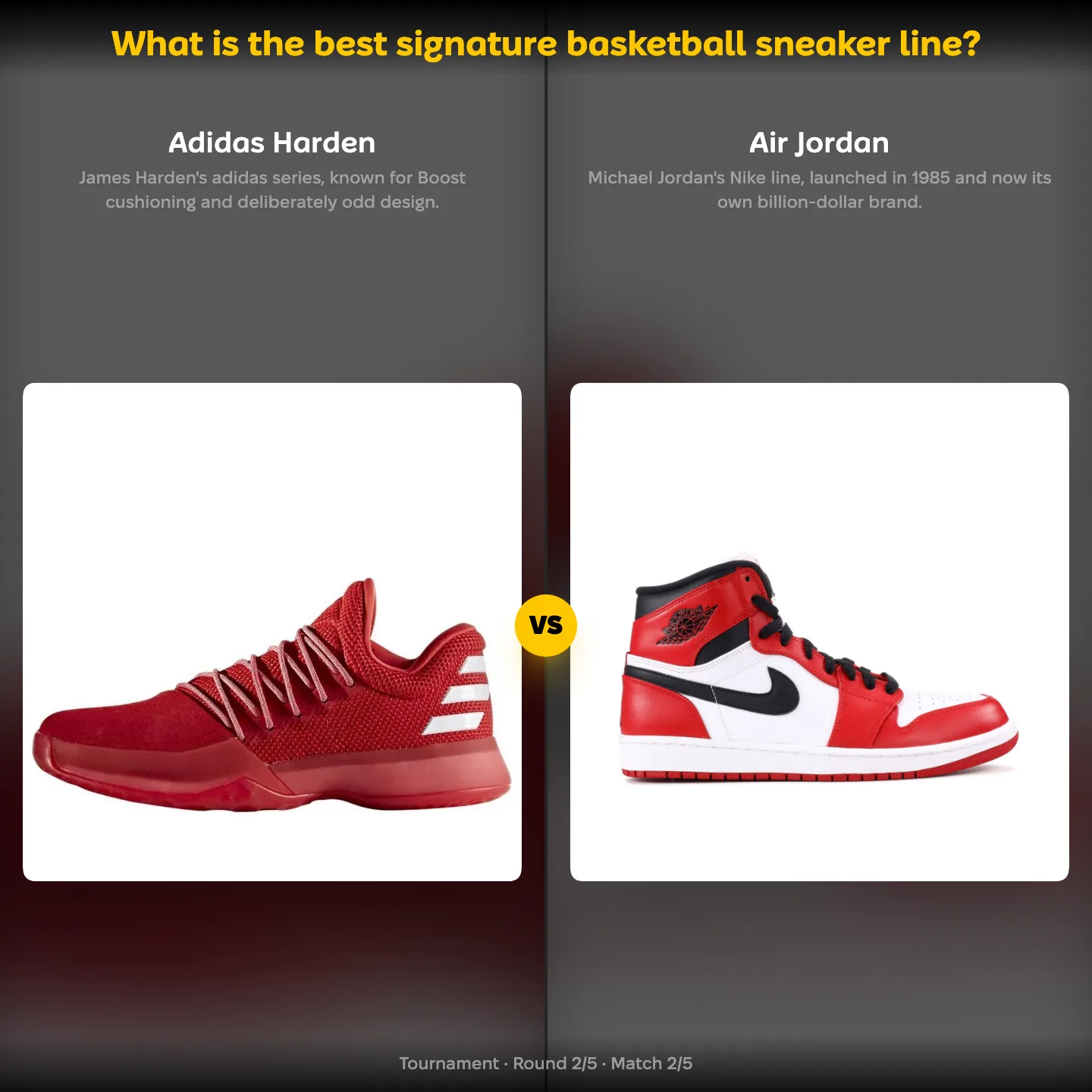
Mercurial vs Predator: the boot fight that predates both
Football boots are where the two brands stopped selling shoes and started selling identities.
Adidas built the Predator around the idea that rubber elements on the instep let a player bend the ball, and the Copa Mundial next to it has been in production since 1979 with almost no changes.
Nike came late and went fast. The Mercurial arrived in 1998 on Ronaldo's feet and turned lightness into the entire pitch: speed, colour, and a boot you were supposed to notice from the stands.
Puma's King and Mizuno's Morelia are the quiet answer to both, and they are on this list of 12 for the same reason a leather boot still sells: some players want their feet to feel like feet.
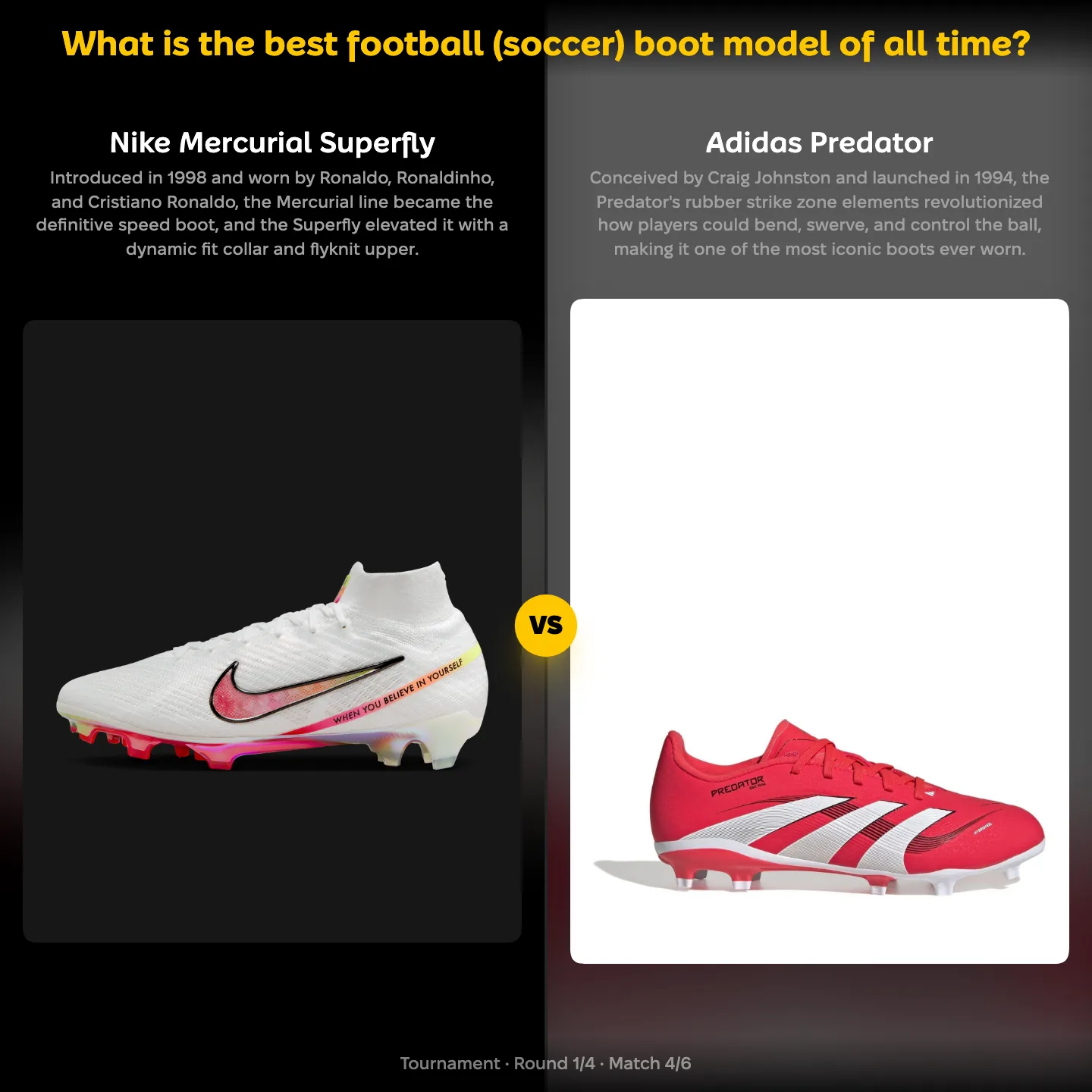
Vaporfly vs Adizero Adios Pro: the carbon-plate race
Distance running measures its winners in seconds, not in taste.
Nike started the current era with the Vaporfly, the shoe that put a curved carbon plate inside a thick foam midsole and made every rival redesign its racing line.
Adidas answered with the Adizero Adios Pro, which uses carbon rods instead of a single plate and has carried marathon major winners since.
Fifteen models make this field, and the majority carry neither a Swoosh nor three stripes: Asics, Brooks, Hoka, Saucony, On and New Balance all have entries. Running is a sport where the specialist shop, not the billboard, decides what people buy.
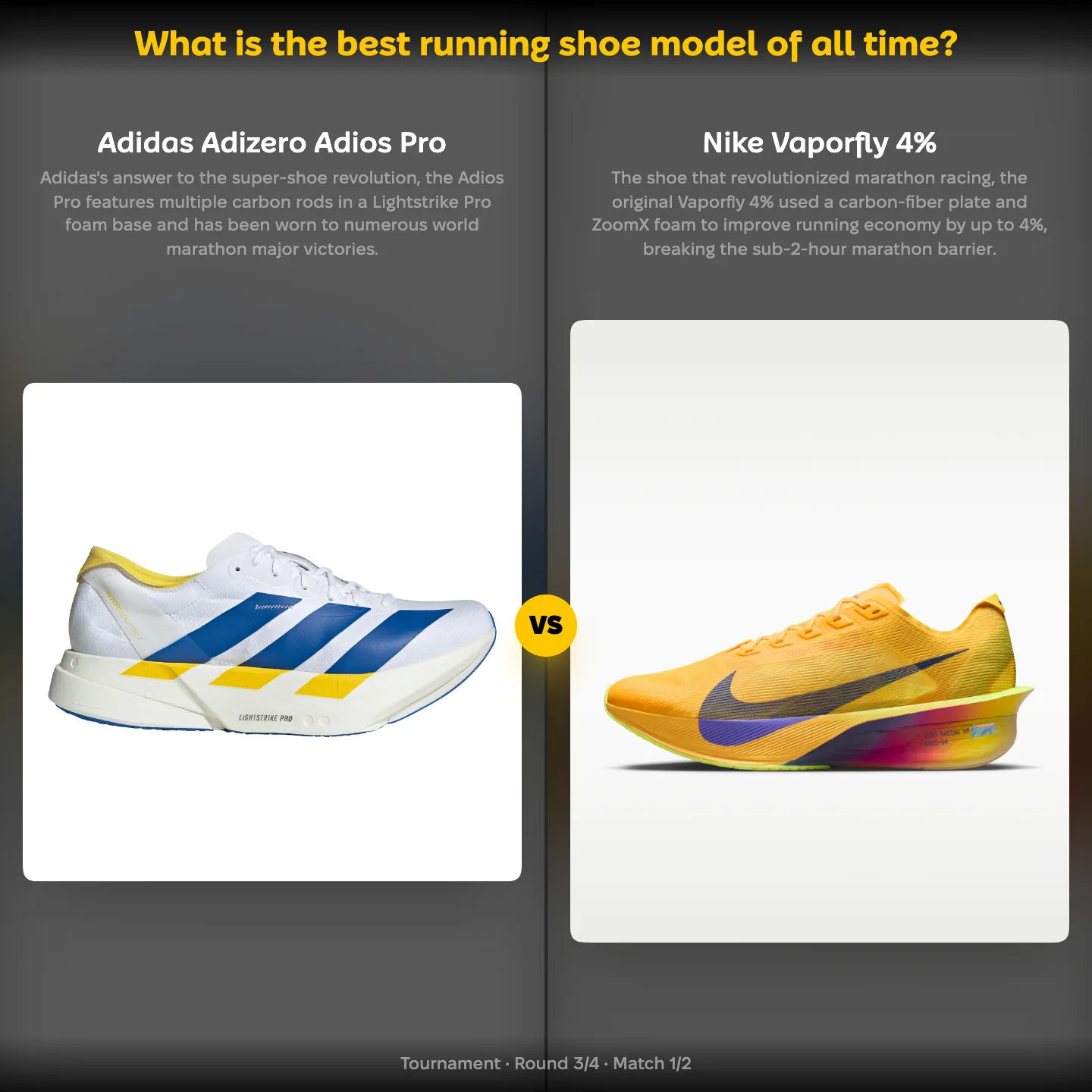
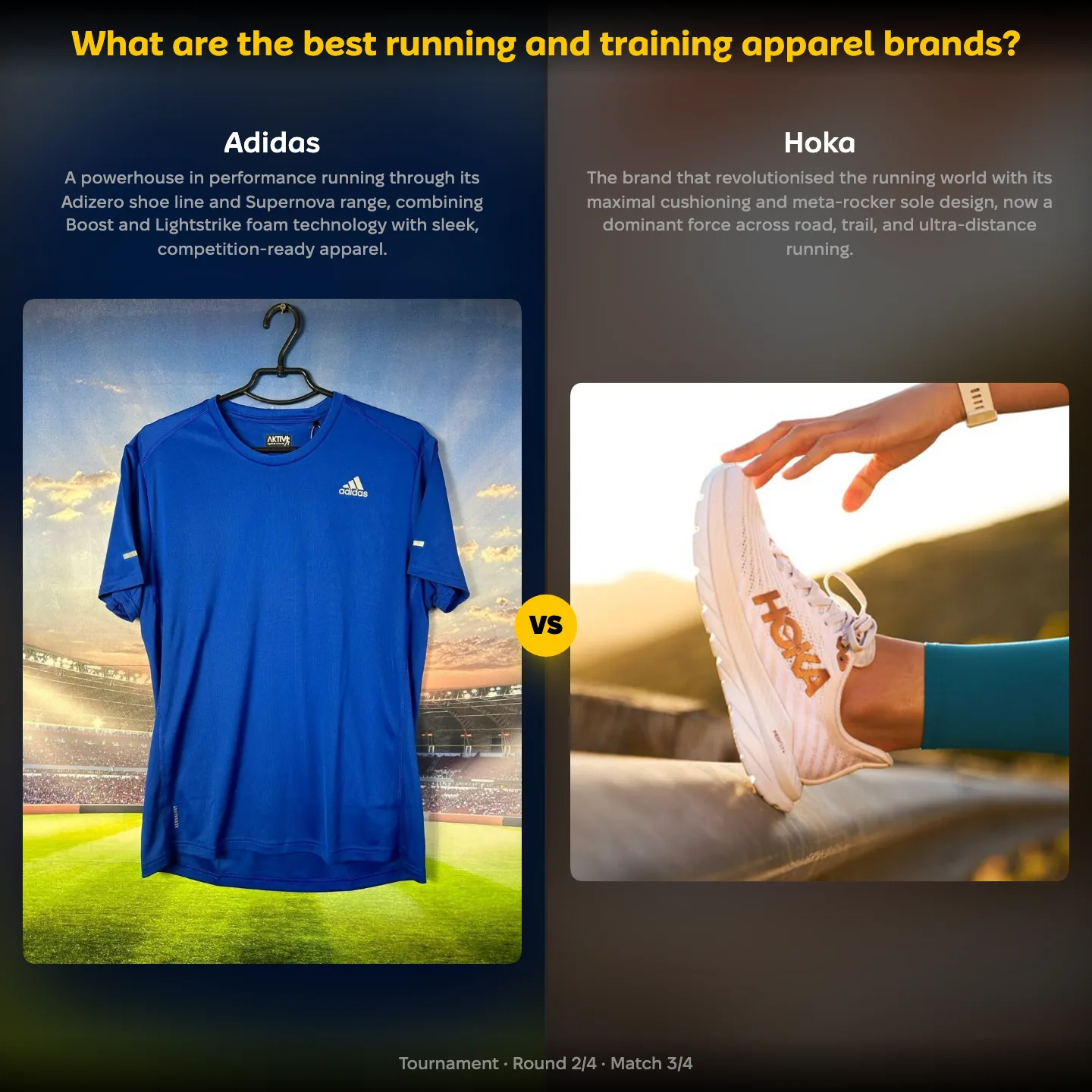
Hoka, On and Lululemon crowd the middle
Apparel is thinner ground for both giants than footwear, and this ranking of 14 brands shows why.
Nike and Adidas are both here, and so is every brand that took a slice of their gym: Lululemon out of yoga, Gymshark out of Instagram, On and Hoka out of running shops, Tracksmith out of the club scene.
Adidas has the deepest performance-running range of the two, built around Adizero and Supernova.
The counter-argument for the specialists is simple. A brand that makes one category well can charge more for it, which is why a Lululemon tank costs what it costs and why neither giant has managed to price like that.
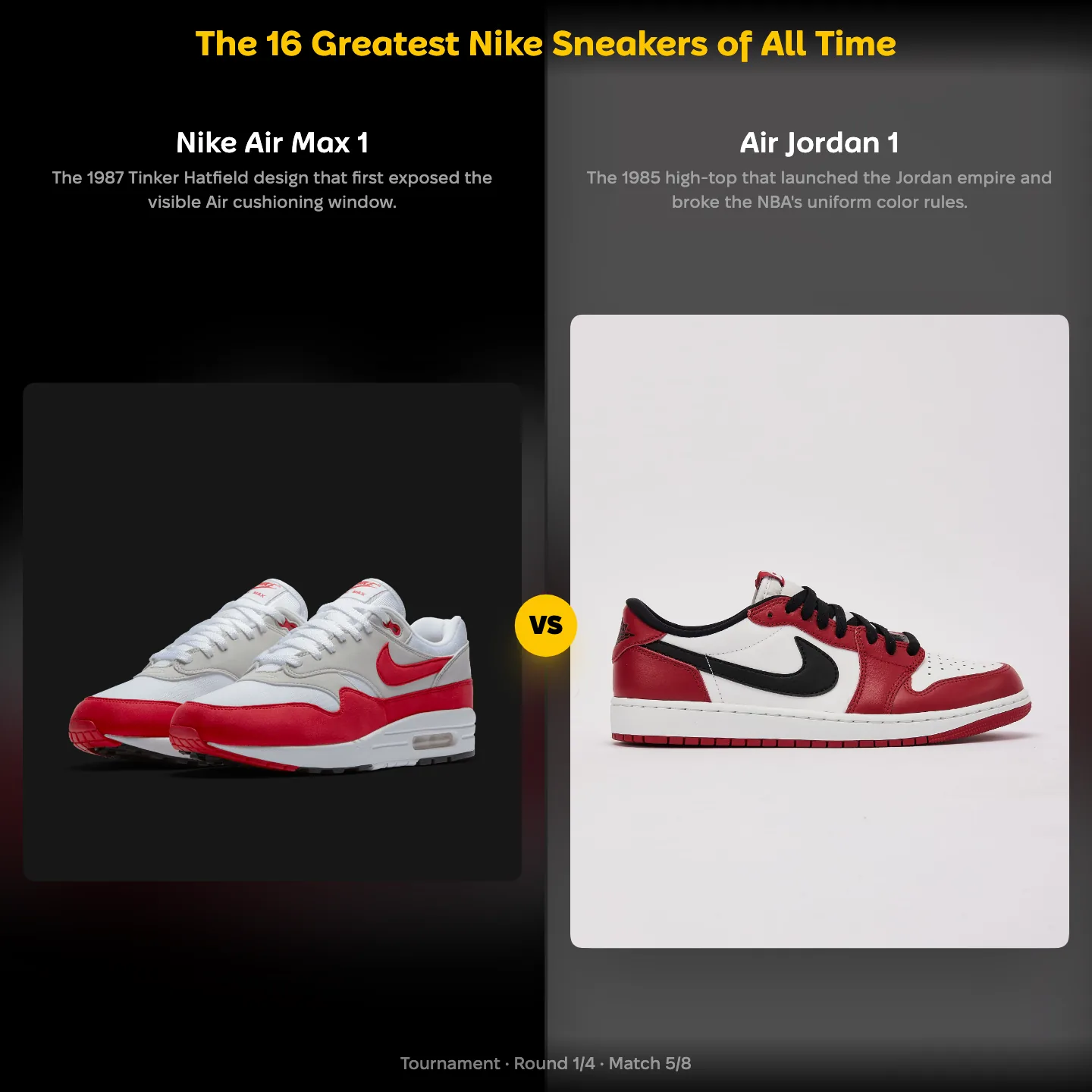
Sixteen Nike sneakers, no Adidas entry
Some rankings are a brand's private museum, and Adidas cannot enter this one.
Sixteen Nike models are on it: the Air Jordan 1 from 1985, the Air Max 1 that first showed the air bubble in 1987, the Air Force 1, the Cortez, the Blazer, the Dunk.
Adidas would need a parallel list of its own: Superstar, Samba, Stan Smith, Gazelle. It would run to the same length.
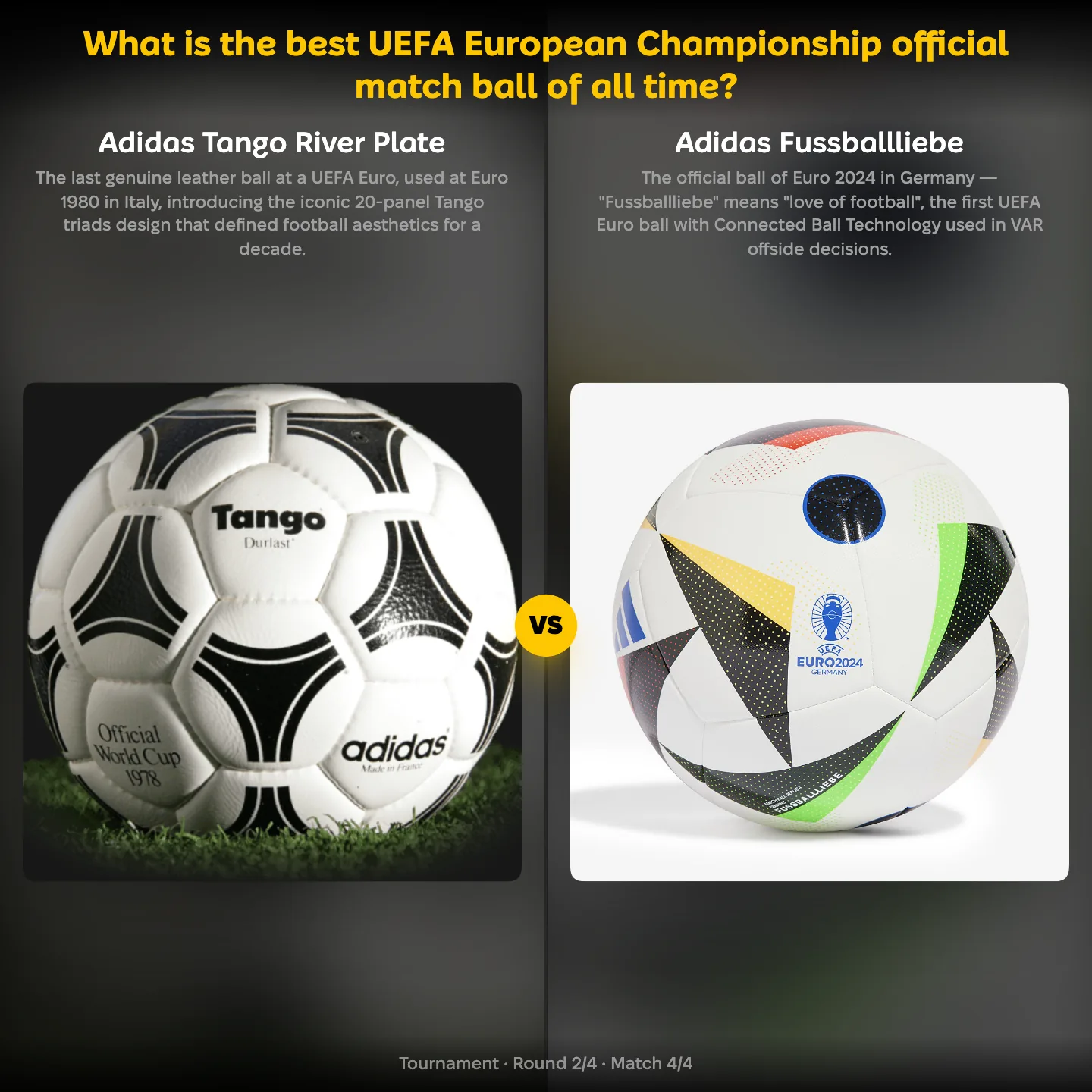
Every European Championship ball has been an Adidas
The mirror of the Nike-only ranking is this one, and it is Adidas all the way down.
The ranking holds 16 European Championship match balls, opening with the leather Telstar of 1980 and closing with Euro 2024's Fussballliebe, and every one of them carries the Three Stripes. Nike has never made one.
Adidas extended the same run through the last World Cup with the Trionda, unveiled in October 2025, and for the first time in the tournament's history it made a separate ball, the Trionda Final, for the semi-finals and the final.8
The Swoosh against the Coca-Cola script
American brand logos are their own category, and Nike has one of the few marks that works with no words next to it.
The Swoosh is on this list of 18 alongside the Golden Arches, the Coca-Cola script, the Apple silhouette and the Ford oval.
Adidas is absent, and not because its Three Stripes are weaker. The ranking asks for American logos, and Adidas has been a Bavarian company since Herzogenaurach.
That is the quiet cost of being the challenger from abroad: a whole class of "most iconic in America" rankings that a German brand cannot appear on, however many Sambas it sells in Brooklyn.
Vans got to skateboarding first
Skateboarding is the category both giants arrived at late, and where being late still costs them.
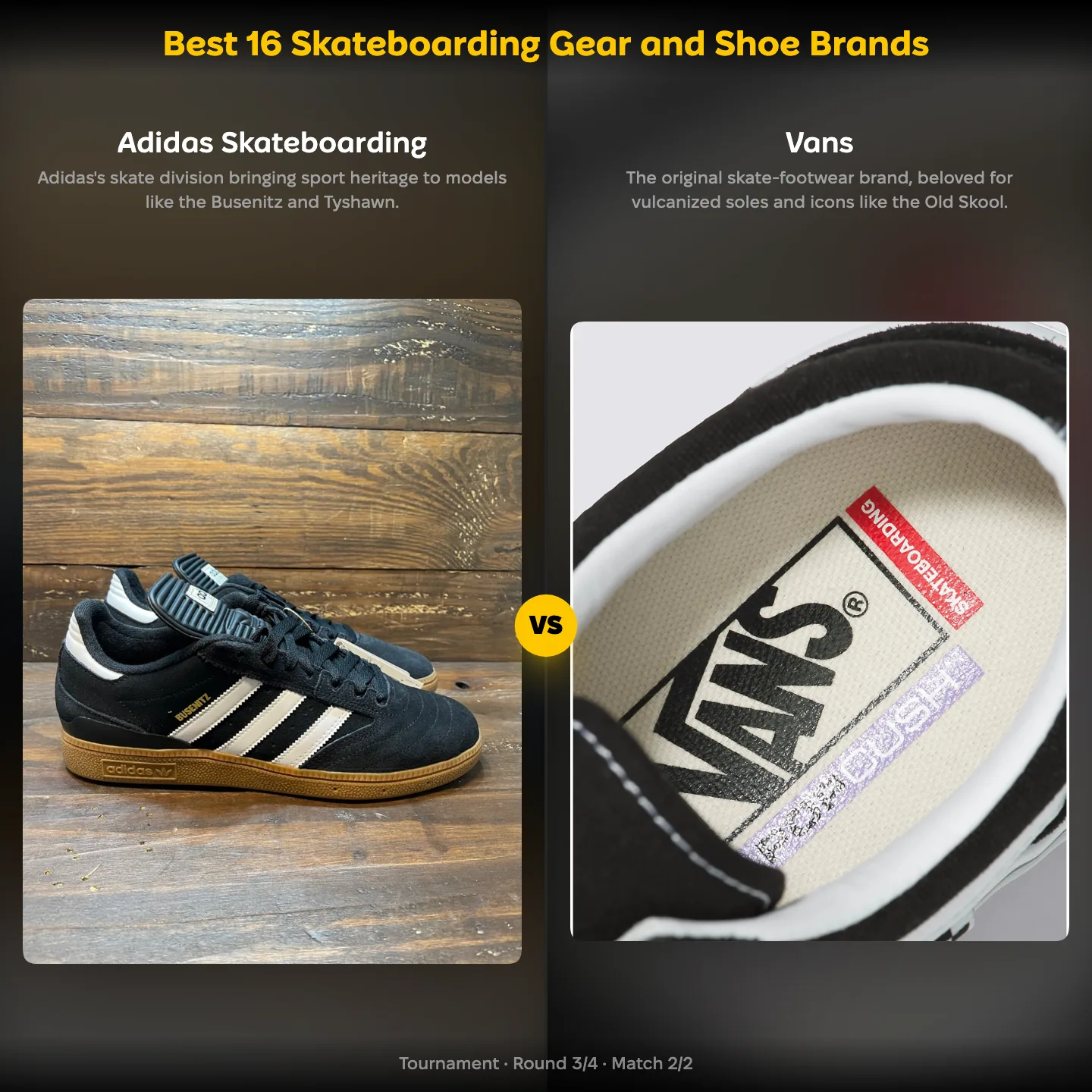
Nike SB and Adidas Skateboarding are both on this ranking of 16, both with credible teams and both with pro models people actually skate in.
Vans is also on it, and Vans has been making skate shoes since the 1960s, which in a sport built on who was there first is worth more than any marketing budget.
Etnies, Emerica, DC and Lakai fill out the list. Skaters have a long memory for brands that showed up when the sport was still illegal in most cities.
Riddell, Schutt and the helmet makers that outrank both
American football equipment is the ranking where both brands become small names.
Nike has supplied the NFL's on-field uniforms since 2012 and signed an extension in December 2024 that runs through the 2038 season.9 Adidas has a college presence and a cleat line.
Neither of them makes the thing this sport is judged on. Helmets and pads come from Riddell, Schutt, VICIS, Xenith and Douglas, companies whose products go through the league's annual safety testing.
So a list of 12 equipment brands puts the two biggest sportswear companies on earth somewhere below a helmet manufacturer from Illinois founded in 1929. Fabric is not protection, and this is one of the few sports where the difference is the whole product.
The most overrated sneaker: Samba or Air Force 1
One ranking inverts the question, and both brands have plenty to answer for.
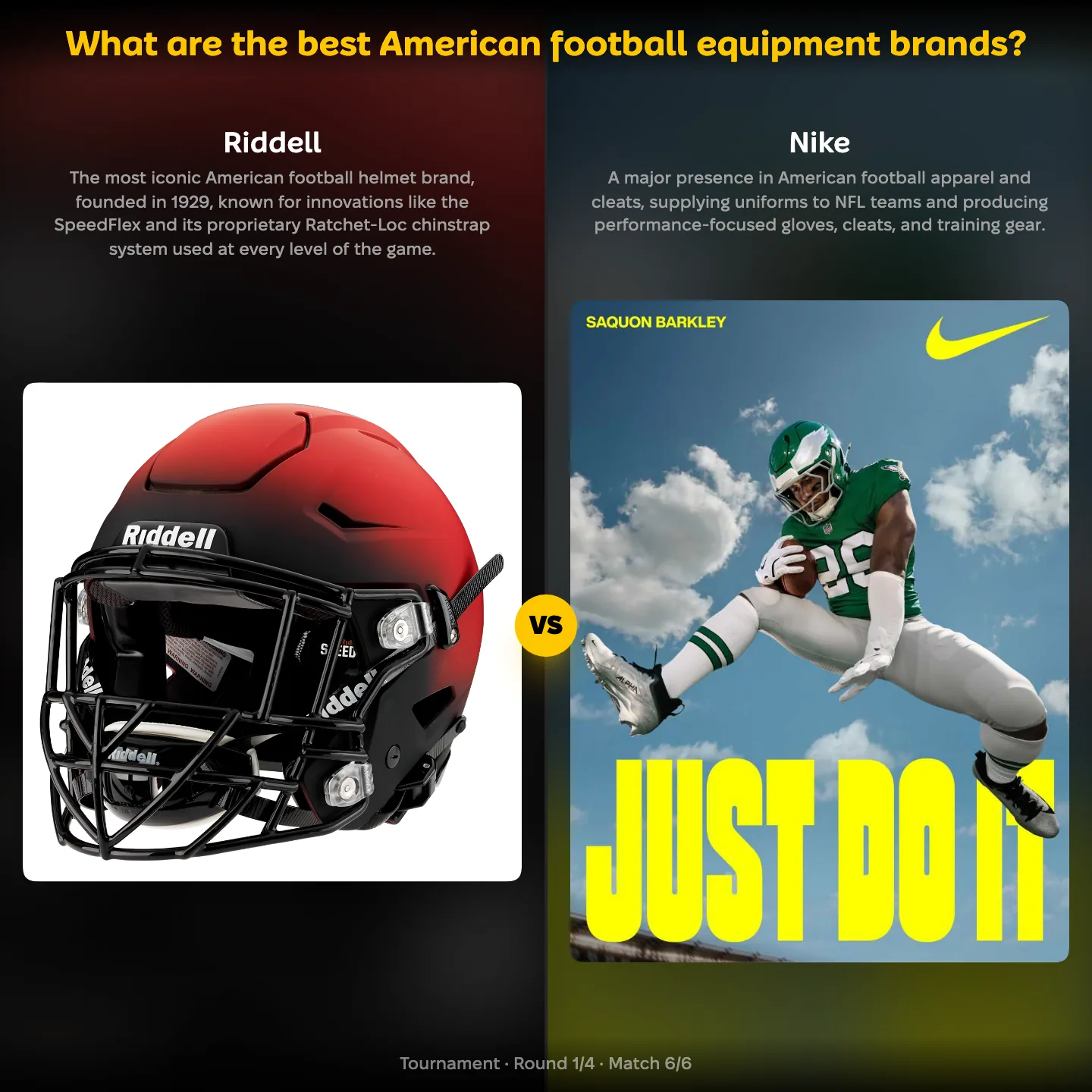
Adidas contributes the Samba, an indoor football trainer from the 1950s that became the most photographed shoe of the 2020s and then became a punchline about people who dress the same.
Nike contributes the Air Force 1, the best-selling sneaker ever made, which is exactly the case against it: a shoe bought by the tens of millions is nobody's personal taste.
Eighteen models made this field, among them the four-figure Balenciaga Triple S and the Nike Air Monarch off the discount rack. Being overrated takes a big audience first, which is why almost every option here is a shoe that sold spectacularly well.
My Adidas: the shoe with its own hit record
Here is a ranking of Run-DMC songs, and one of these two brands is in the track list.
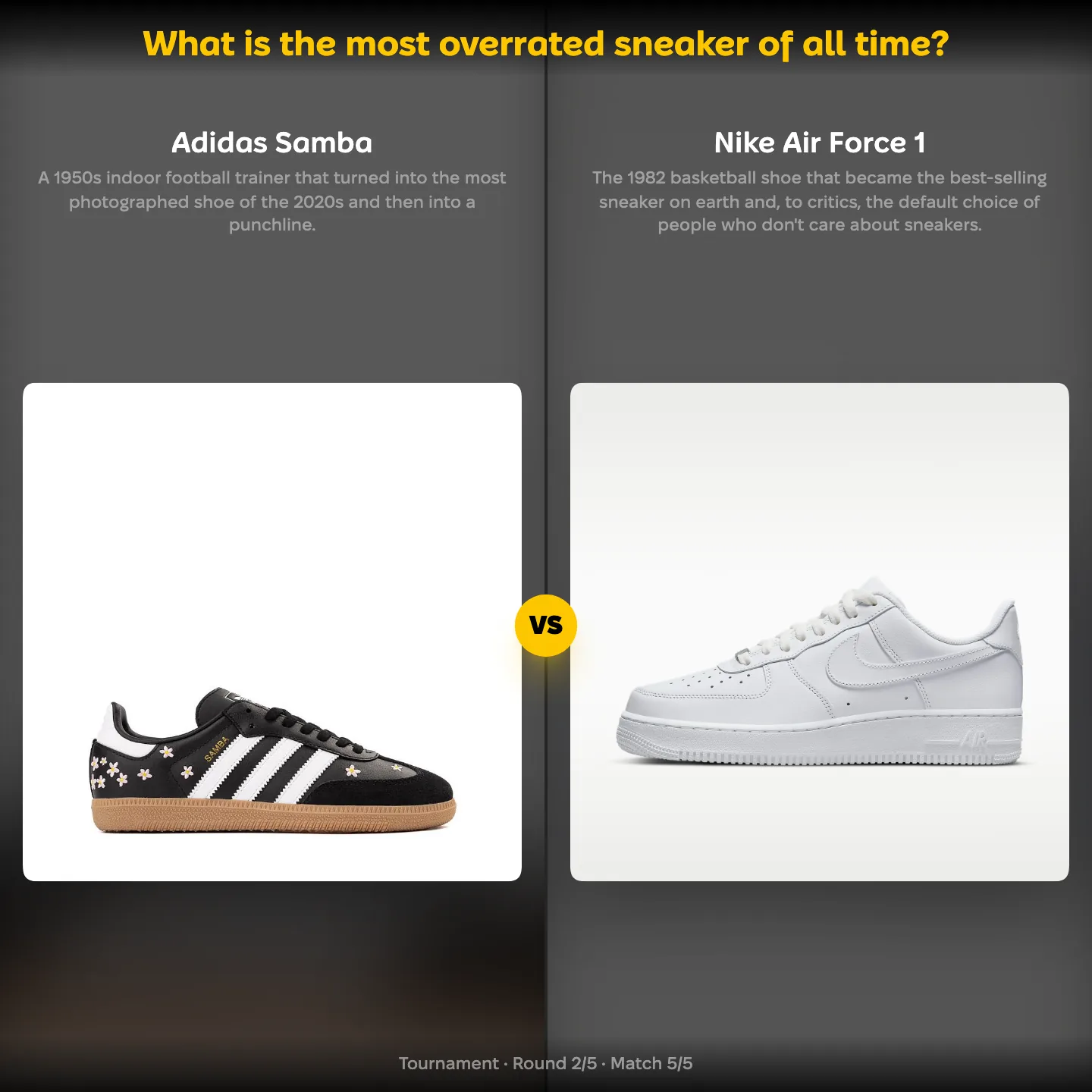
"My Adidas" came out in 1986, an ode to the group's Superstars, and it led to something no shoe company had tried: Guinness World Records logs the $1.6 million contract Run-DMC signed with Adidas that year as the first sneaker endorsement given to people outside sport.10
Nike has no equivalent. It has soundtracked its ads with other people's music for four decades, and no rap group ever wrote it a single.
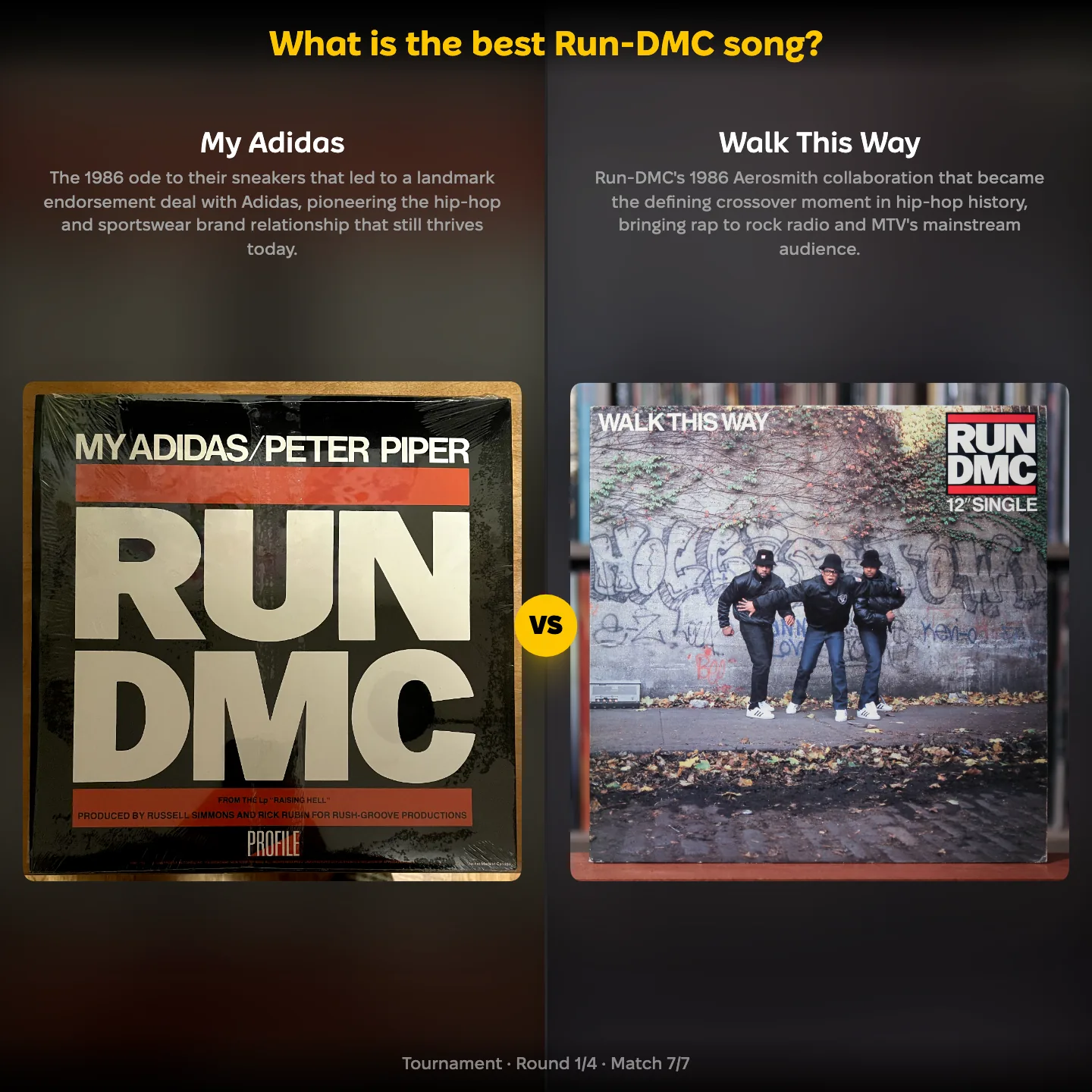
The 13 songs here are the wider point: "Walk This Way" changed what rap could sell to rock radio, and "It's Tricky" and "Peter Piper" are the ones DJs still reach for. A brand getting a hit written about it is an accident of culture, not a campaign.
Nike was a goddess before she was a shoe
The strangest ranking either brand appears in belongs to mythology, not to sport.
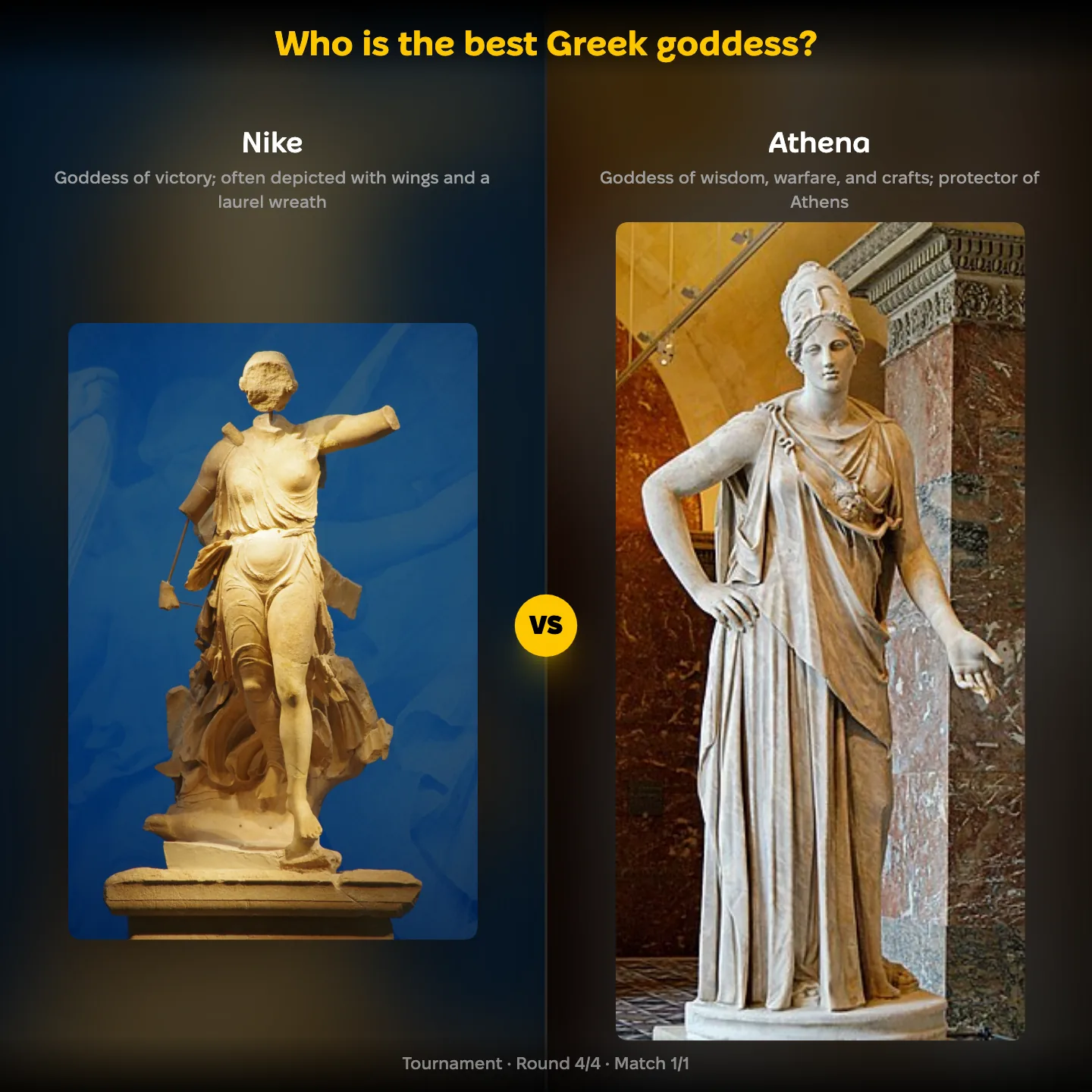
Nike is the Greek goddess of victory, the winged figure whose most famous statue stands at the top of the Louvre's staircase, and she is one of 16 names on this list of goddesses next to Athena, Aphrodite and Artemis.
The company took the name in 1971 and the Swoosh is often described as her wing. Adidas, named from Adi Dassler's own first and last name, has no mythology to trade on at all.
Sixteen rankings, sixteen different fights
Put Nike and Adidas on the same shelf and they look like substitutes. Sort them by surface and they stop being comparable: one owns the hardwood, the American logo wall and the mythology of its own name, the other owns the ball, the tournament and a hit single. Adidas has told investors it expects currency-neutral revenue growth of 9–10% and around €2.3 billion of operating profit for the full year, so the terrain is still moving.2
Every ranking above works by the head-to-head method: pick between two options, repeat, and let the results do the sorting.
Think the sneaker war has a category nobody has ranked yet? Make the ranking and see which side the field takes.
More rankings, more angles
- Apple vs Samsung: 14 Categories, 14 Arguments — the other brand rivalry, phone by phone
- Chanel vs Dior, Ranked Side by Side — two Paris houses, thirteen shared lists
- Nobody Ranks McDonald's the Same Way Twice — the Golden Arches, from fries to logos
- Coca-Cola vs Pepsi: The Cola Wars, Ranked 15 Ways — 140 years of the same shelf argument
Sources
- NIKE, Inc. — fiscal 2026 fourth quarter and full year results: about.nike.com (checked 2026-08-12)
- adidas — Q2 and first-half 2026 results, record sales, Bjørn Gulden quote and full-year outlook, as reported from the company release: pulse2.com (checked 2026-08-12)
- HISTORY — the Dassler brothers' split and the registration of adidas in Herzogenaurach on 18 August 1949: history.com (checked 2026-08-12)
- Fox News — Nike Caitlin 1 release date and price: foxnews.com (checked 2026-08-12)
- Footy Headlines — 2026 World Cup kit suppliers by brand and nation: footyheadlines.com (checked 2026-08-12)
- ESPN — Spain 1–0 Argentina, 2026 World Cup final match report: espn.com (checked 2026-08-12)
- OPB — Nike becomes the NBA's official on-court apparel provider and the first company with its logo on league jerseys: opb.org (checked 2026-08-12)
- adidas — Trionda, the official match ball of the FIFA World Cup 26, and the separate Trionda Final: news.adidas.com (checked 2026-08-12)
- Front Office Sports — Nike's NFL uniform partnership, held since 2012 and extended through 2038: frontofficesports.com (checked 2026-08-12)
- Guinness World Records — first non-sporting sneaker endorsement, Run-DMC and adidas, 1986: guinnessworldrecords.com (checked 2026-08-12)