
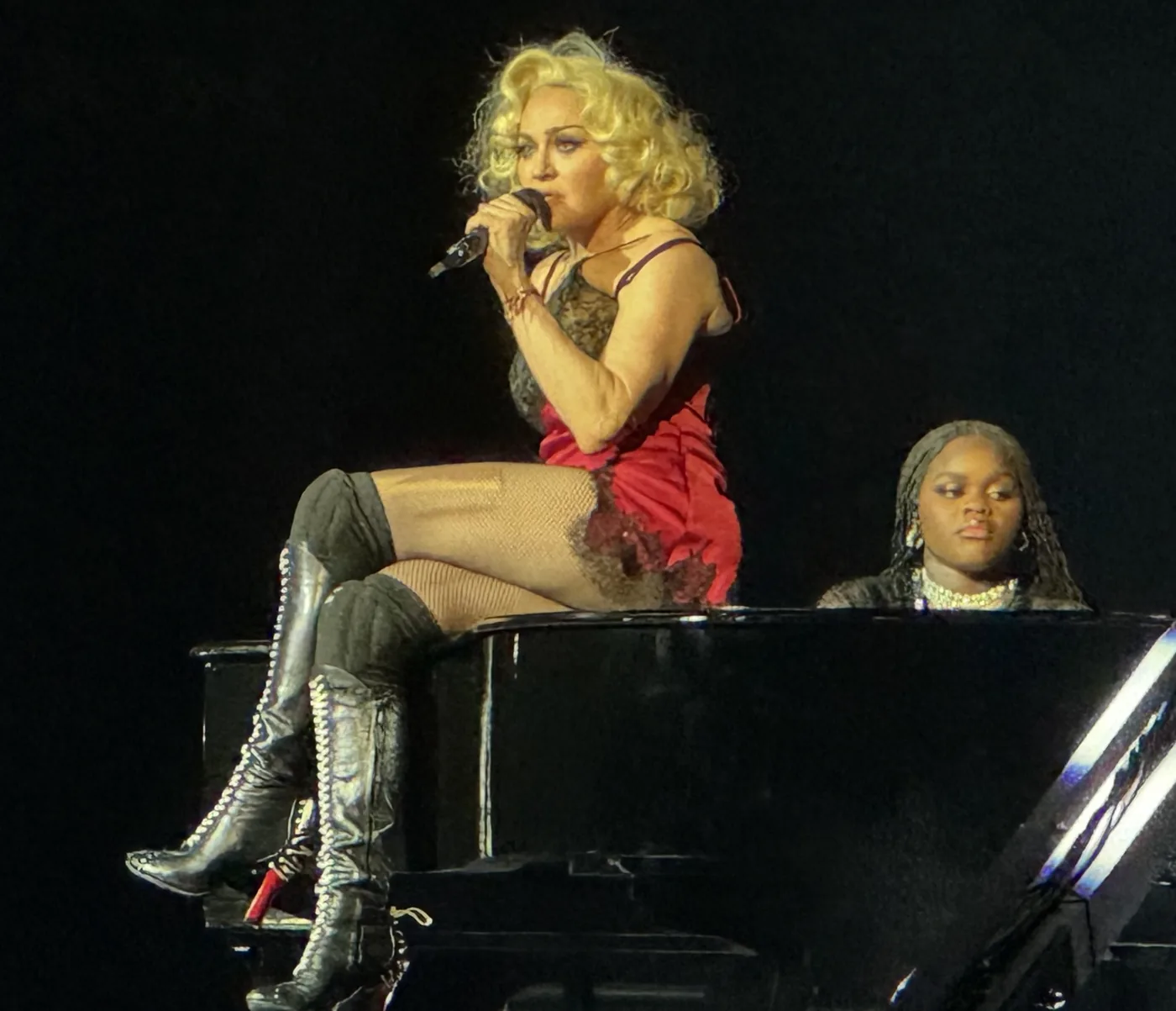
Madonna reached No. 1 in Britain on 10 July 2026 with Confessions II, her thirteenth chart-topping album and the one that made her the first American woman to place albums at the top across five decades.1
Guinness World Records renewed her sales entry in September 2023 at 400 million units.2 The film shelf reads nothing like that, which is the second half of why she keeps appearing on lists this far apart.
Thirteen rankings below run the whole spread: three decades of pop, one halftime show, a Met Gala staircase, the videos, and the acting.
Madonna has been a dance-floor act, a video star, a film lead and a comeback artist, and each of these thirteen lists grades only the one it was built for.
Madonna, Beyoncé and the widest question in pop
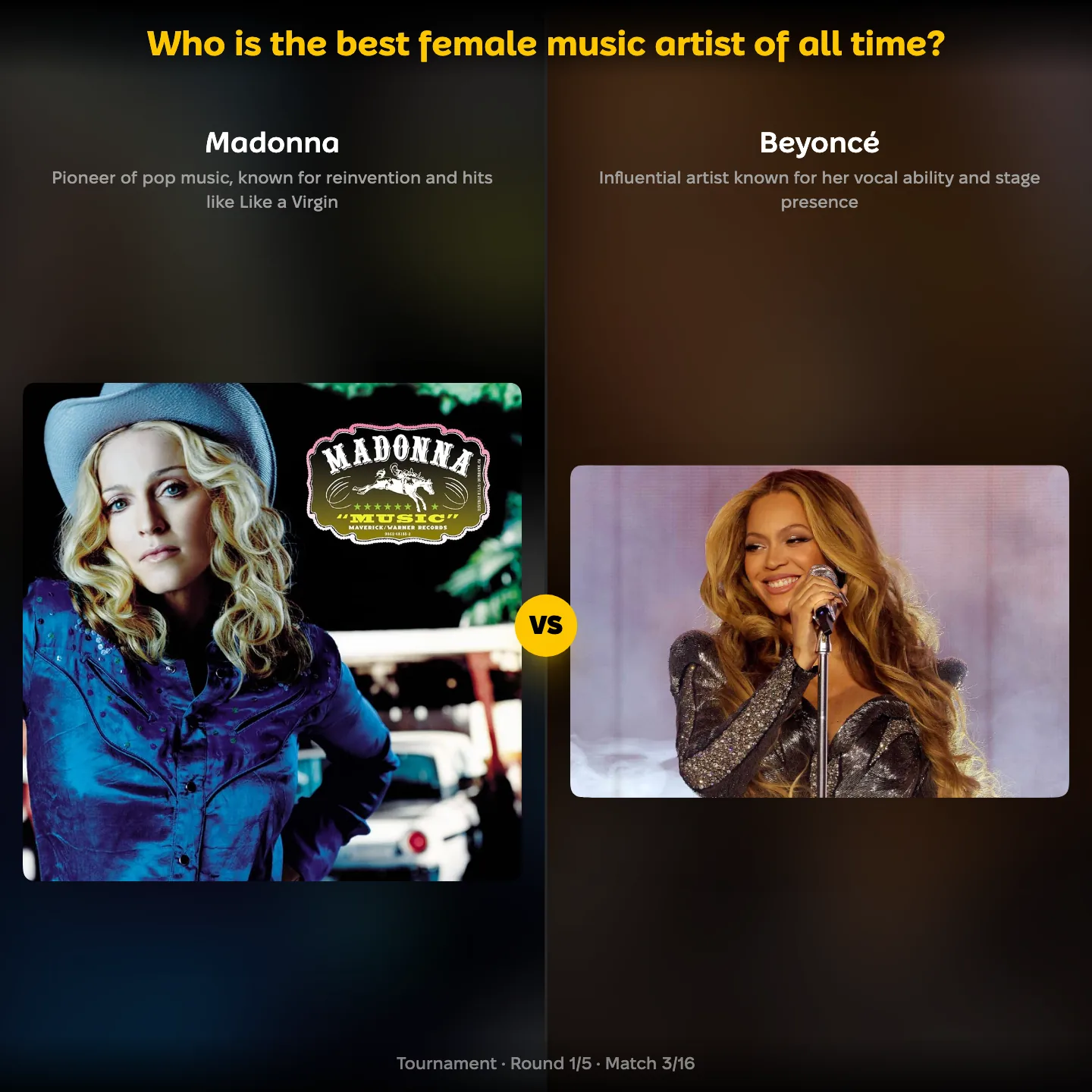
"Best female music artist of all time" is the broadest question anyone asks about popular music, and it drops Madonna into a room with everyone who ever sold a record.
Her case here is commercial before it is anything else. No award shelf she owns matches the size of the sales entry, and that entry is why she turns up near the front of a question this wide.
Beyoncé arrives with the opposite kind of evidence. The Recording Academy has nominated her 99 times and she has won more often than any artist in its history.3
Aretha Franklin, Whitney Houston and Taylor Swift each move what the word "best" is measuring: voice, chart run, songwriting. Madonna is the only one of the four whose reputation rests on none of those three.
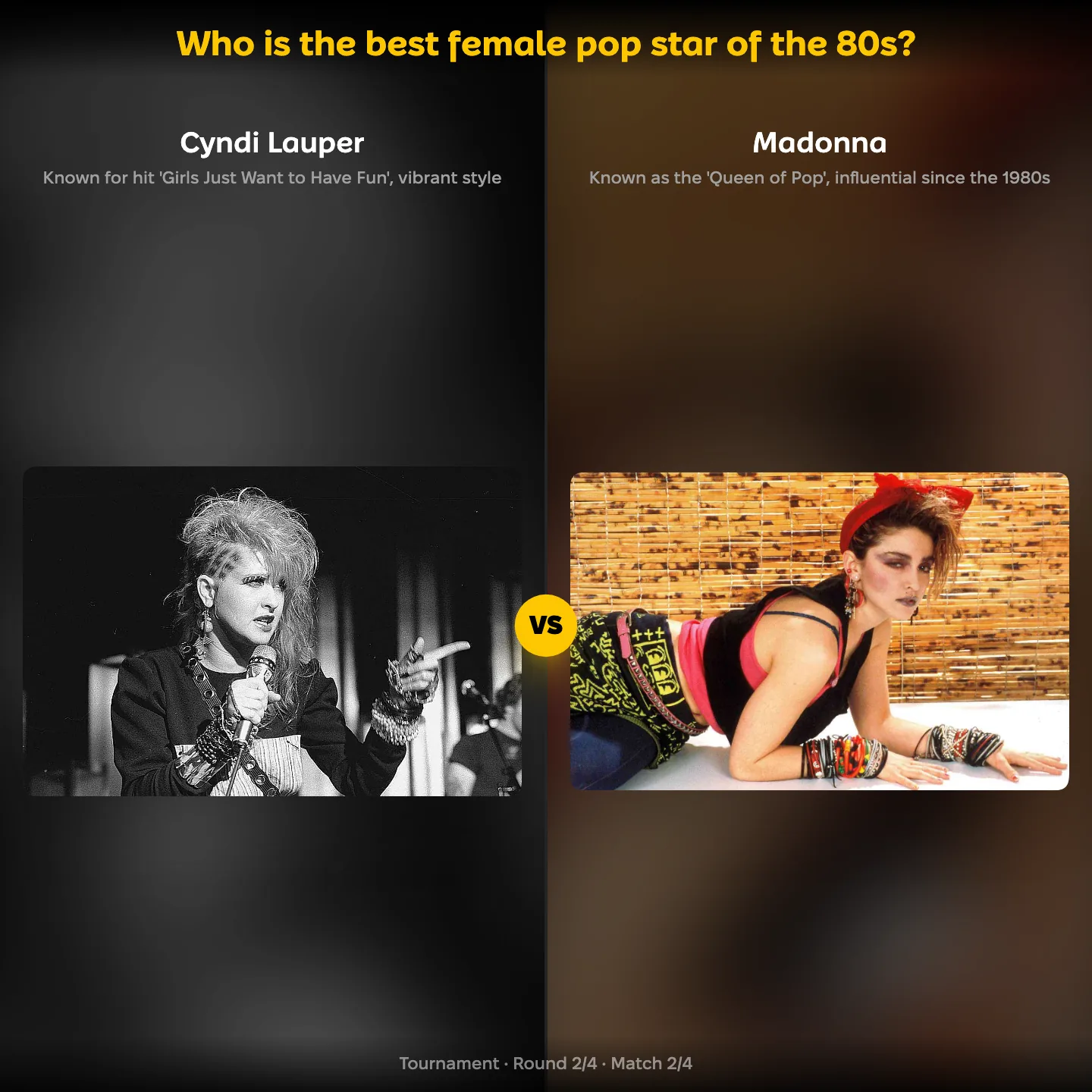
Cyndi Lauper, and the most crowded decade in pop
Narrow the question to the 1980s and Madonna stops being one candidate among several dozen. This is the decade she was built for.
Three of her singles went to No. 1 in Britain inside ten months: "Papa Don't Preach" in June 1986, the True Blue title track that October, and "La Isla Bonita" the following April.4
Cyndi Lauper is the name this list pairs her with, and the case is real. The Rock and Roll Hall of Fame, which inducted Lauper in 2025, credits She's So Unusual with four Top 5 hits.5
Whitney Houston, Tina Turner and Janet Jackson belong on the same list. What sets Madonna apart in that company is that her singles arrived with films and videos bolted to them, and the chart moved with the whole package.
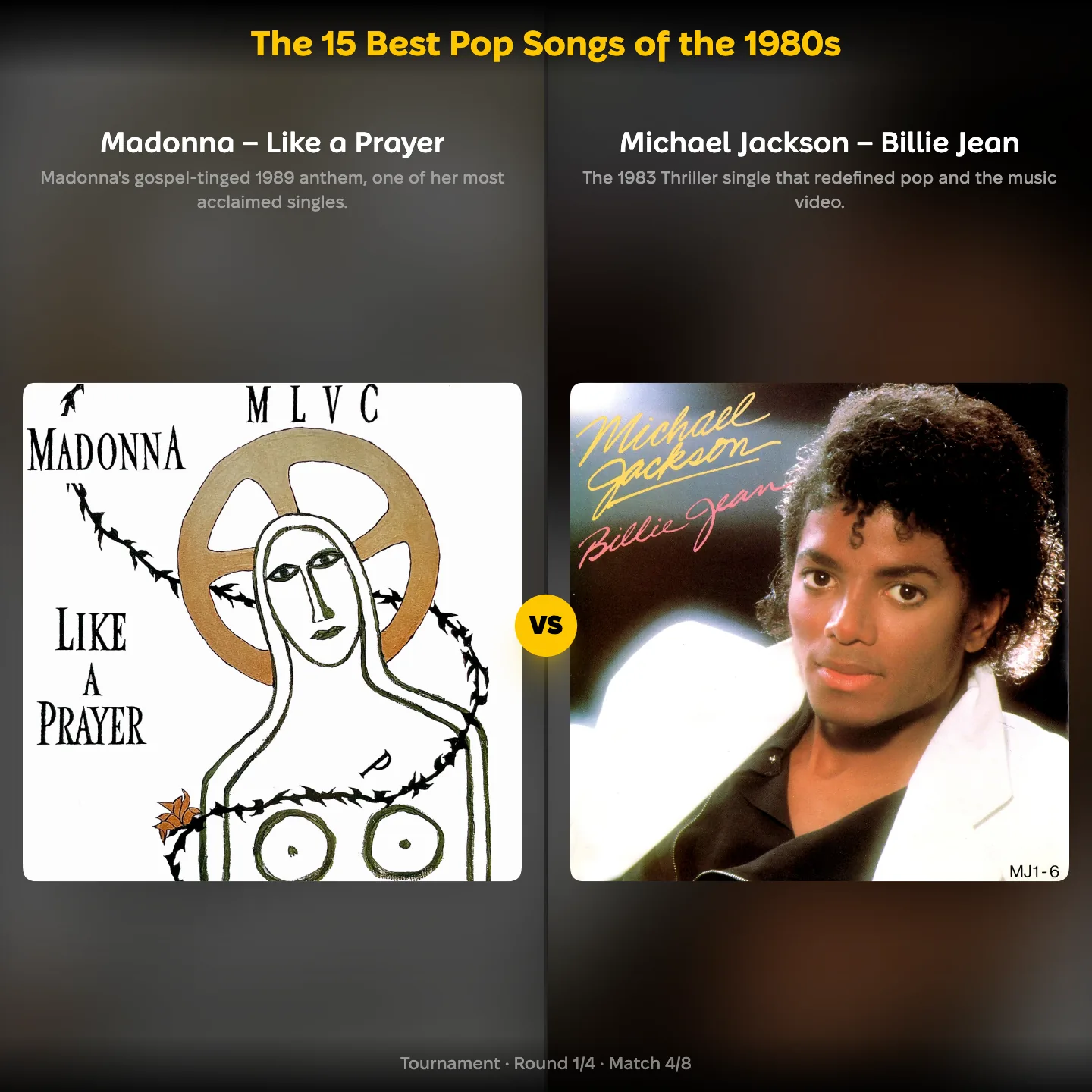
"Like a Prayer" up against "Billie Jean"
Shrink the unit from a career to a single song and Madonna's footing changes immediately.
"Like a Prayer" is her entry, three weeks at No. 1 in Britain from 18 March 1989.4 Michael Jackson's "Billie Jean" is the wall it meets.
Prince, Whitney Houston, Cyndi Lauper and a-ha each bring one song apiece. Forty years of records buy nothing in a format that lasts three minutes.
The 1990s belong to Kurt Cobain
The question of who shaped the 1990s sends the answer towards guitars, and Madonna spent the first half of the decade being written off.
Erotica and the Sex book, both 1992, drew the worst press of her career.
Ray of Light undid it. The 1998 album she made with William Orbit took four awards at the 1999 Grammys, including Best Pop Vocal Album, Best Dance Recording and Best Album Package, on a night when Lauryn Hill carried off Album of the Year.6
Kurt Cobain, Dr. Dre, Lauryn Hill and Radiohead each built something that had not existed before. Madonna's claim is repair work, and it is the only claim on this list that needs the artist to have been discarded first.
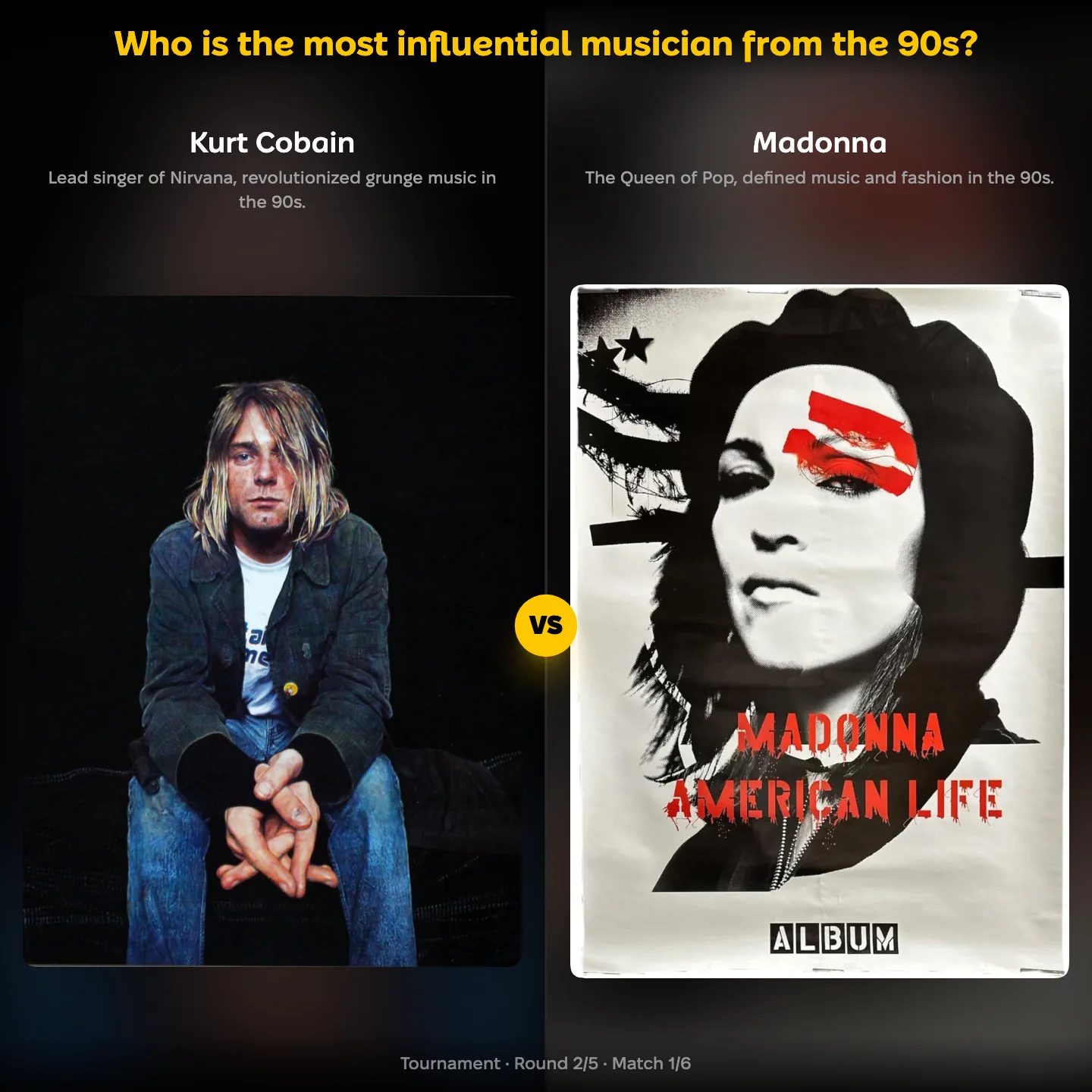
Madonna 1983 against Taylor Swift 2006: debuts only
This ranking judges first albums and nothing that came after, which puts Madonna's 1983 debut against records made by artists who grew up on it.
Madonna was assembled in New York clubs and produced "Holiday", "Lucky Star" and "Borderline". None of them went near the top in Britain: "Lucky Star" reached No. 14 and "Borderline" stopped at No. 56.4
Taylor Swift's self-titled 2006 record is the direct challenger, a country album written largely by a teenager.
Whitney Houston's 1985 debut, Alicia Keys' Songs in A Minor and Britney Spears' …Baby One More Time fill out the rest. Madonna's first British No. 1 came two years after the debut, with "Into the Groove", a song attached to a film instead of an album.
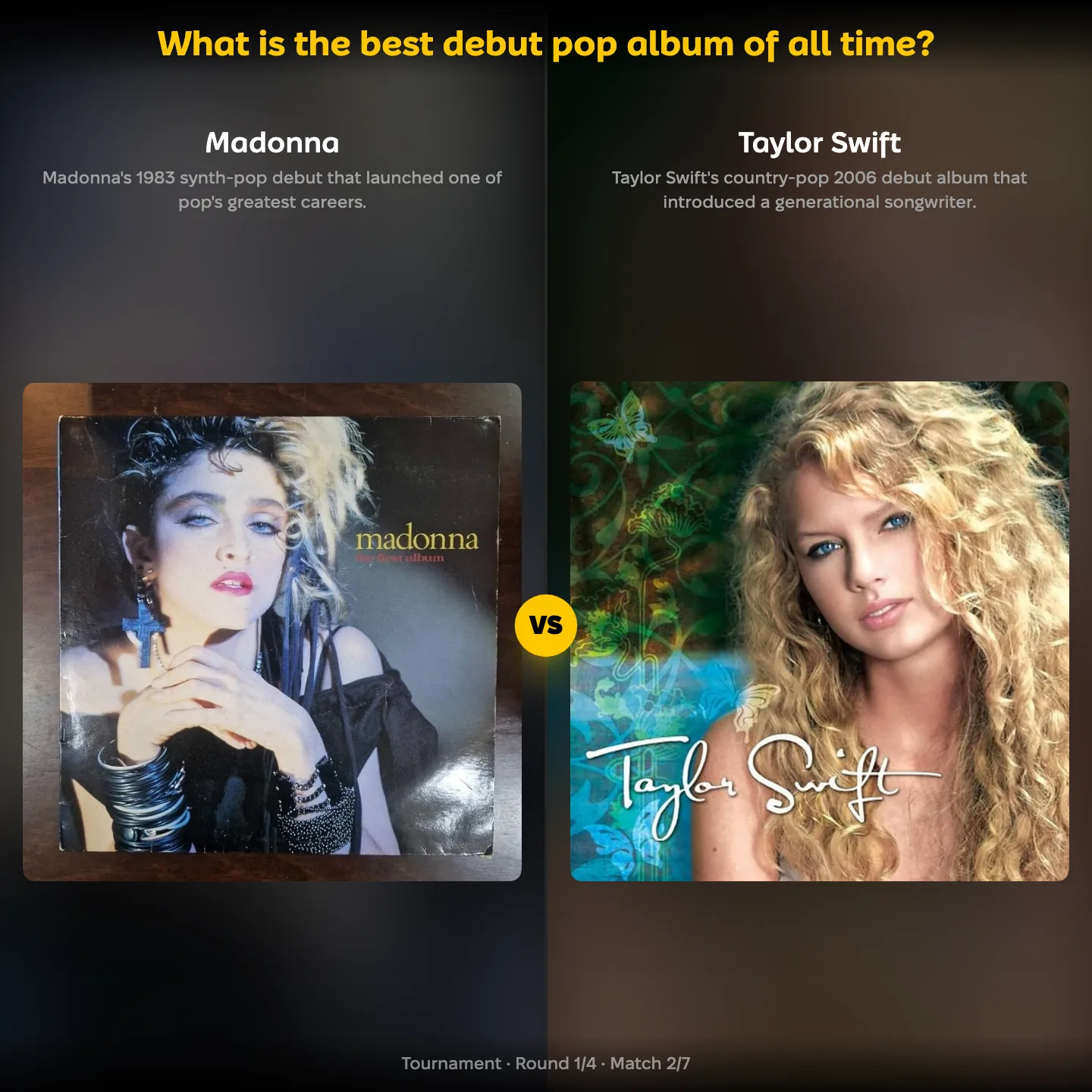
Super Bowl XLVI: twelve minutes in Indianapolis
The Super Bowl halftime show is the largest single audience in music, and Madonna took it at Lucas Oil Stadium on 5 February 2012.
Nielsen counted 114 million viewers for the show. That was the biggest audience any halftime performance had drawn, and about three million more than the average for the game it interrupted, which sat at 111.3 million.7
The twelve minutes were staged as Roman spectacle, with M.I.A., Nicki Minaj, LMFAO and Cee Lo Green passing through in sequence.
Prince's 2007 set is the one this ranking exists to argue with. He played "Purple Rain" in real rain, on a stage shaped like his own symbol. Madonna's case is the audience; Prince's is the weather.
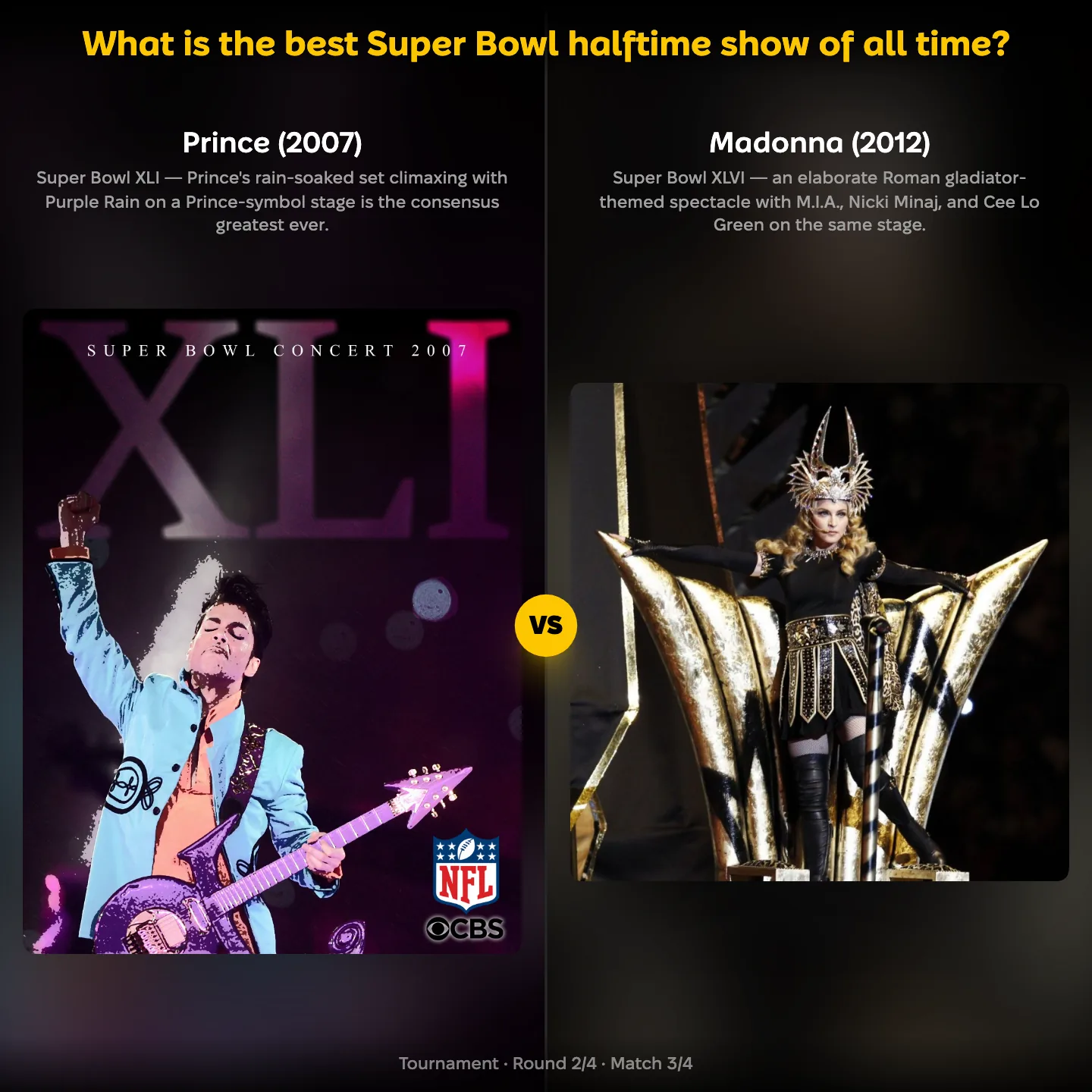
Confessions II against Tina Turner's Private Dancer
The comeback ranking is the only one here holding a record from this summer. Confessions II came out on 3 July 2026 through Warner, built with Stuart Price as a direct sequel to the 2005 album he produced with her.8
Any comeback record has to survive Private Dancer. The Rock and Roll Hall of Fame, which inducted Tina Turner in 2021, notes that the album's biggest single went to No. 1 worldwide and took three Grammys, and that Turner was 44 when it happened.9
Cher's Believe, ABBA's Voyage and Johnny Cash's American Recordings each solved the same problem another way.
The sequel is what makes Madonna's entry odd in this company. The other records return an artist to the charts. Hers returns her to one album out of her own catalogue.
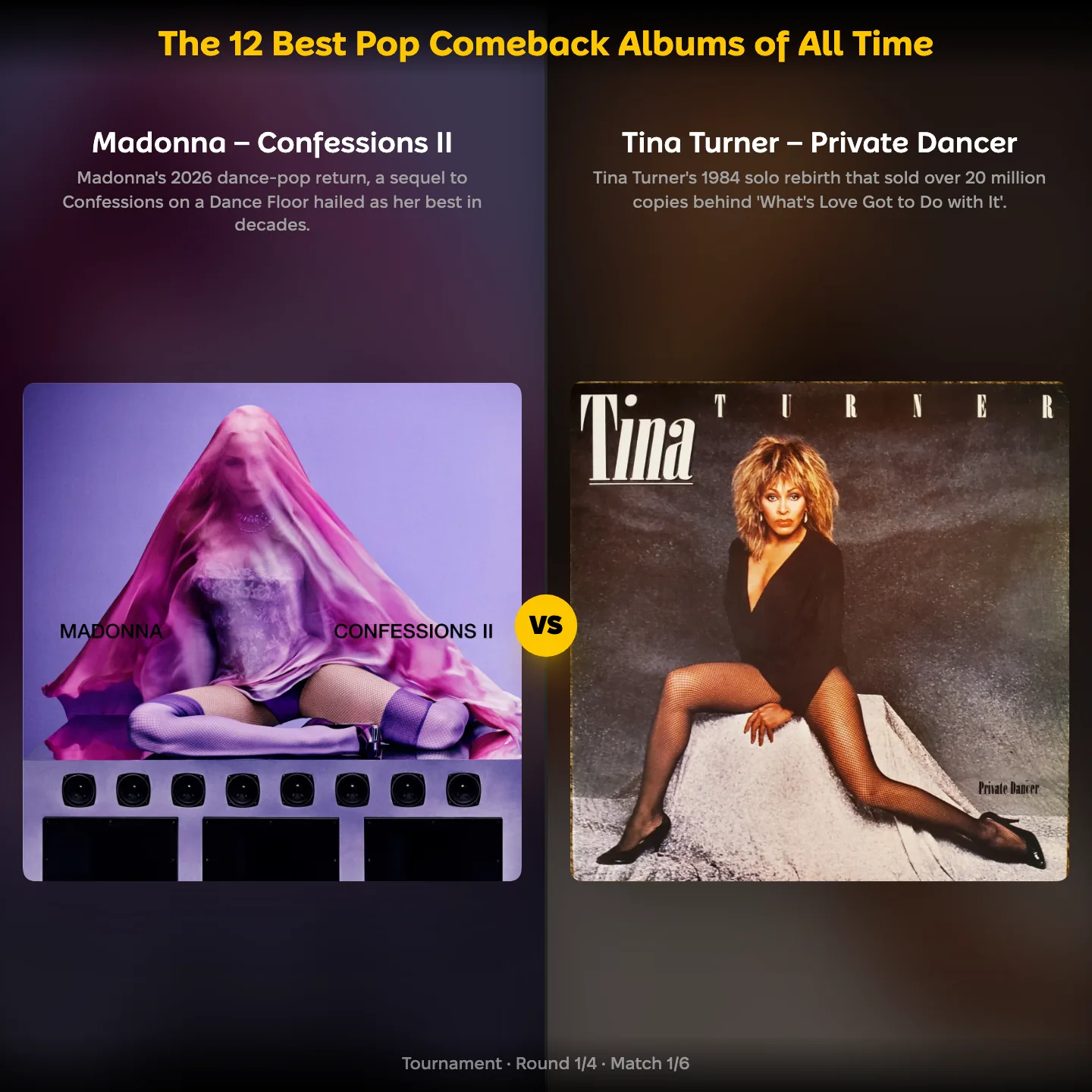
Ray of Light or Confessions on a Dance Floor
Every option in this ranking is a Madonna album, so the only thing under test is which version of her a listener keeps.
Ray of Light changed what a Madonna record could sound like, and the electronica on it arrived four years before the rest of pop went looking for the same producers.
Confessions on a Dance Floor is the dance-floor answer. When it and "Hung Up" held the top of the British album and singles charts in the same week of November 2005, Madonna became, at 47, the oldest artist to occupy both at once.10
Like a Virgin, True Blue and Erotica pull three more ways. This deep into the catalogue, the question stops being about quality and starts being about which decade the listener arrived in.
David Fincher shot "Vogue" in black and white
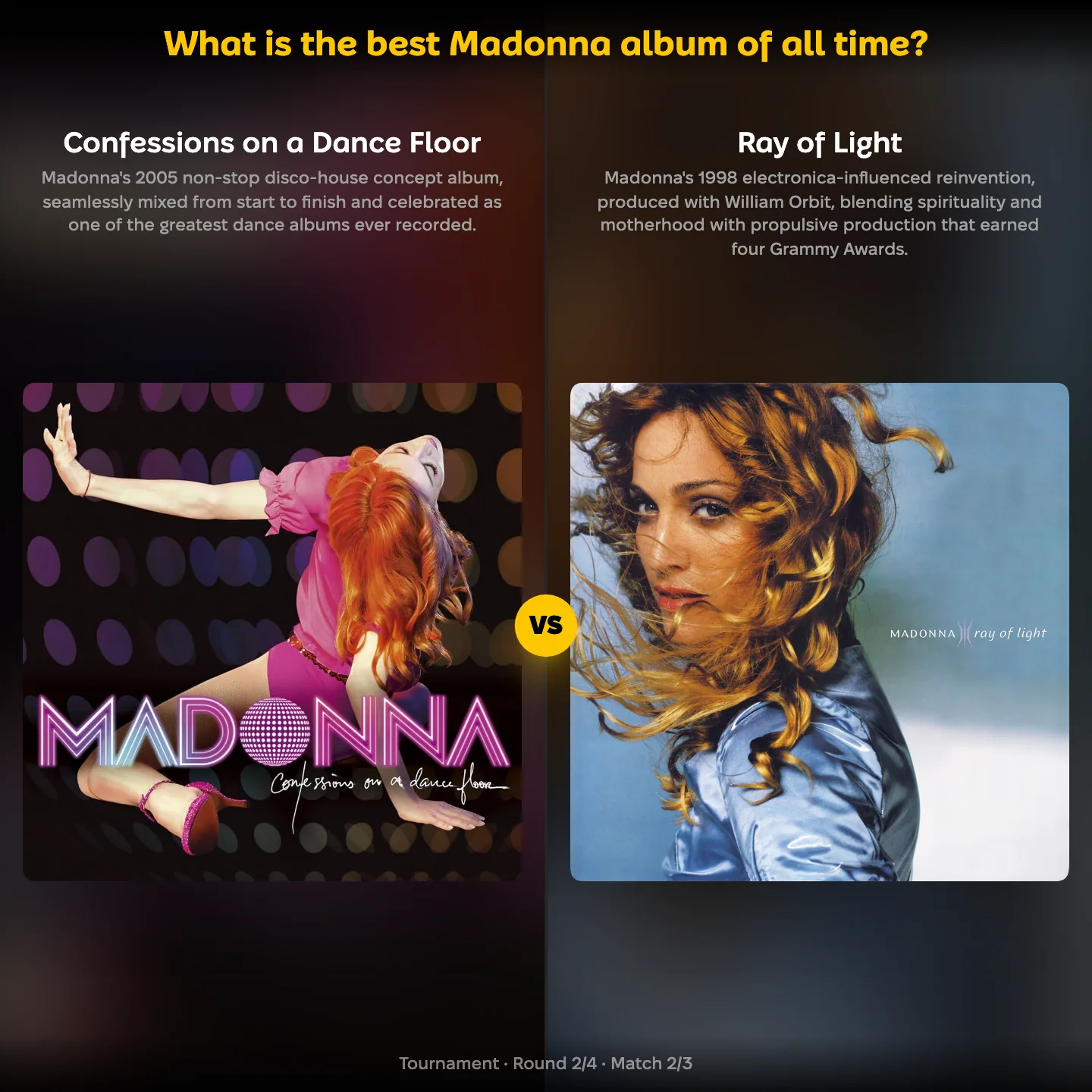
Madonna's videos are ranked apart from her songs because through the 1980s and 1990s she treated MTV as a room to build in.
"Vogue" is the entry with the chart run behind it: four weeks at No. 1 in Britain from 7 April 1990.4 David Fincher directed it in black and white, lifting Old Hollywood portraiture and Harlem ballroom voguing in the same three minutes.
"Material Girl", "Like a Prayer" and "Justify My Love" complete a run MTV built its first decade around.
Evita, and the one acting award that stuck
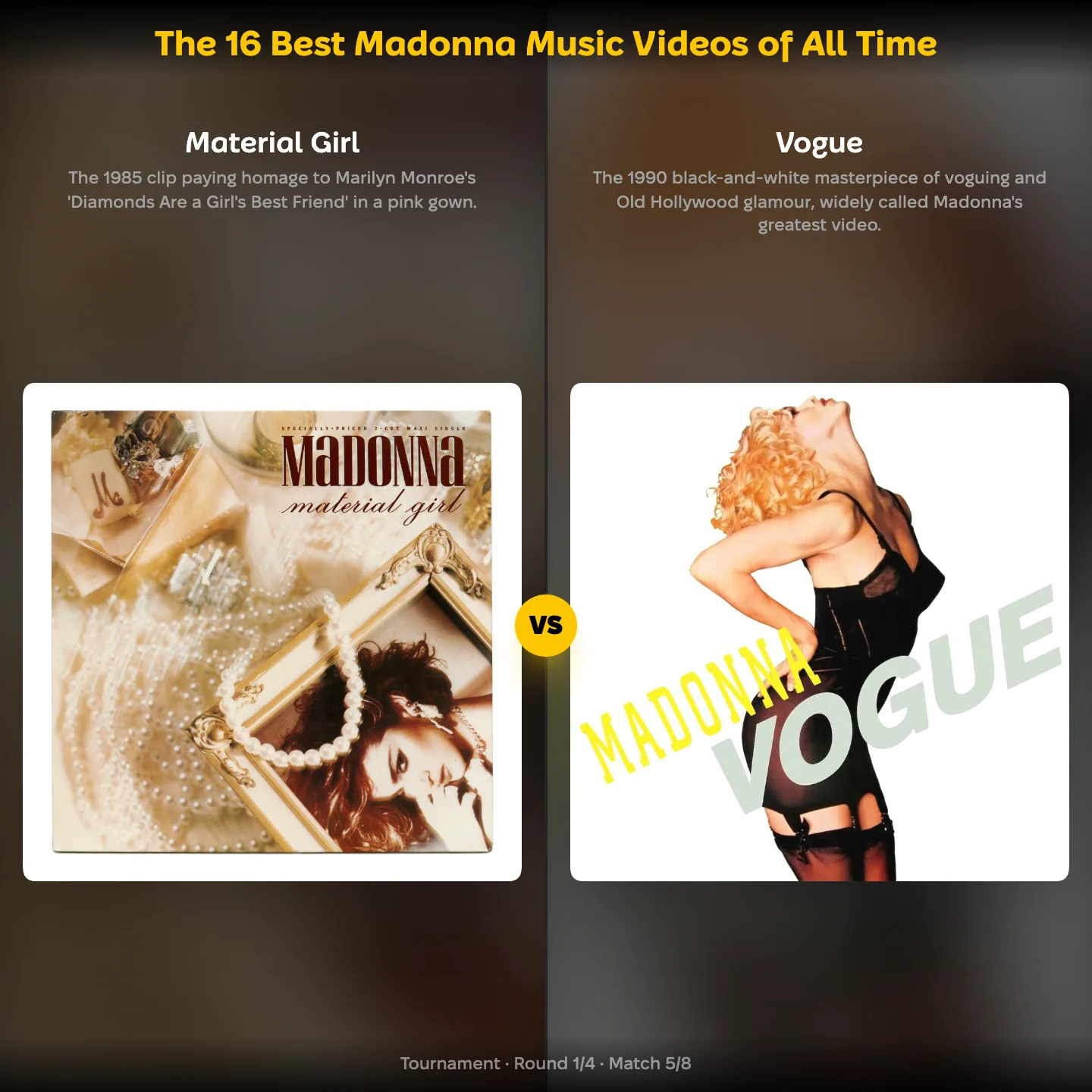
Madonna spent a decade being told she could not act, and then took the lead in Evita.
Alan Parker's 1996 adaptation had her sing the whole score, and the wardrobe ran to 85 costume changes, which Guinness World Records still lists as the most any single film character has needed.10
The Golden Globes gave her Best Actress in a Musical or Comedy for it in 1997. That is one of two Globes she has won from seven nominations, and the only one for acting; the other, in 2012, came for writing a song.11
Judy Garland, Liza Minnelli, Barbra Streisand and Julie Andrews fill out a list where the singing and the acting have to arrive in the same performance. Of the thirteen rankings here, this is the one where Madonna's presence needs no explaining.
The Met Gala, 2009: one evening on a staircase
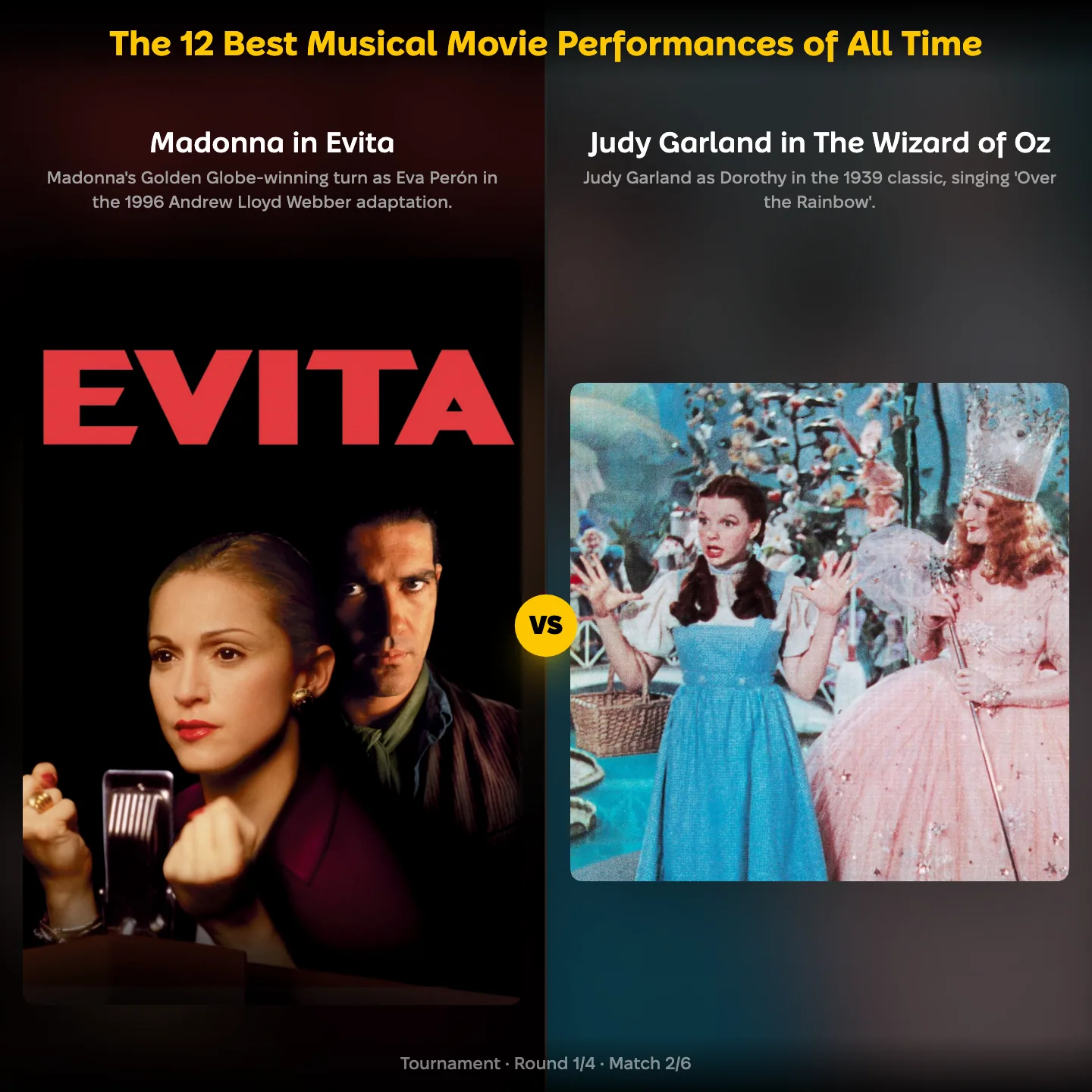
This ranking has nothing to do with music, which is why Madonna belongs in it. Her 2009 arrival, in Louis Vuitton tartan, is the entry.
Princess Diana's 1996 Dior slip dress is the other look everybody remembers. Career length counts for nothing on a red carpet, and career length is Madonna's advantage everywhere else in this article.
Coachella, and the 1.6 million who came to Copacabana
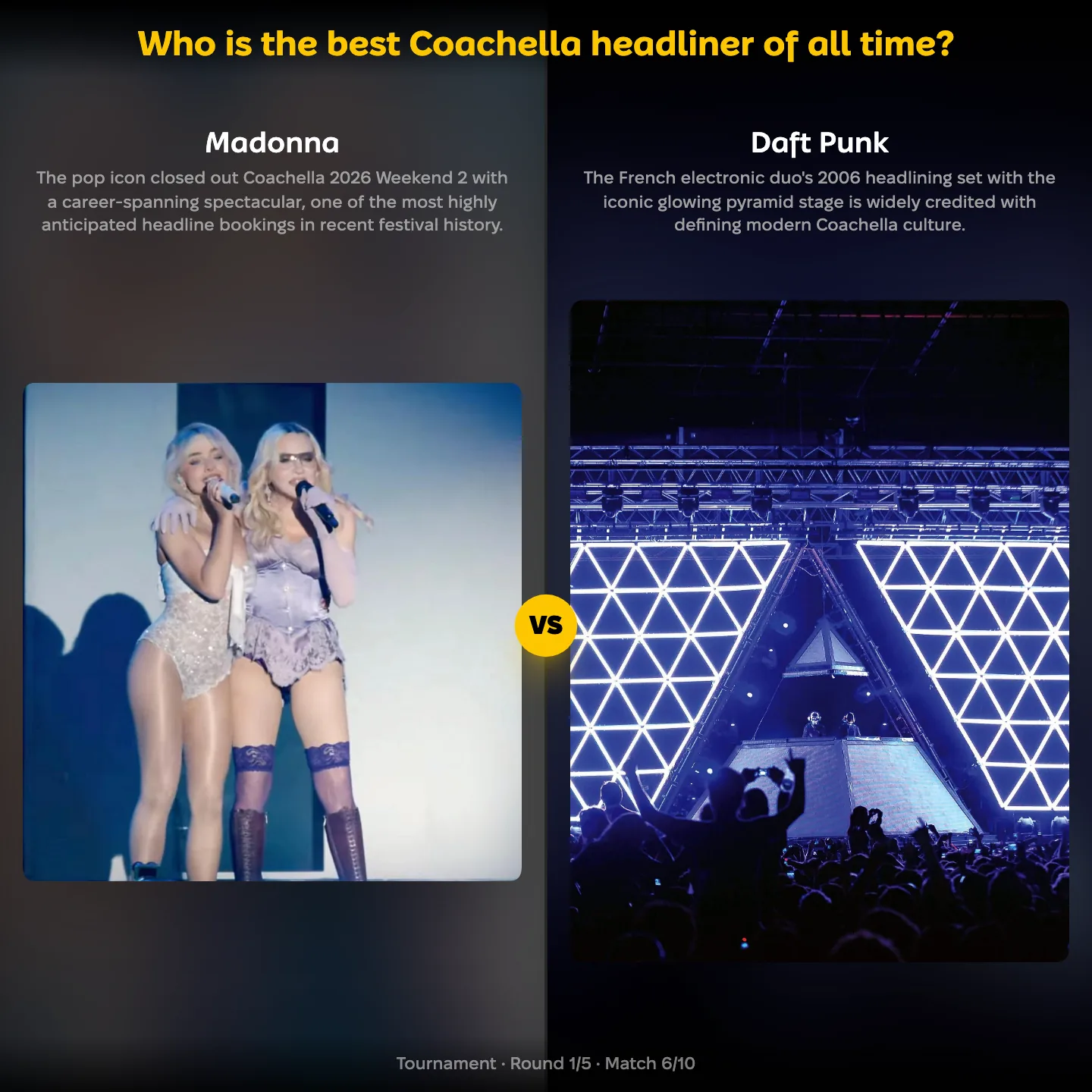
Coachella asks for ninety minutes in a field at dusk, which is a job Madonna has never had to learn.
Her own scale is documented on paper. Pollstar put the Celebration Tour at 80 shows, $227.2 million and 1.1 million tickets, and the free finale on Copacabana beach drew 1.6 million people, the largest standalone concert audience it has recorded.12
Her 2026 appearance in this conversation comes through Sabrina Carpenter. Their duet "Bring Your Love" entered the British singles chart on 14 May and peaked at No. 29.13
Daft Punk's 2006 set, Beyoncé in 2018, Radiohead and Kendrick Lamar are the company on this list. All four of them went to the desert to be the main event, and Copacabana was never a slot anybody gave her.
The Razzies, and the list where leading is the insult
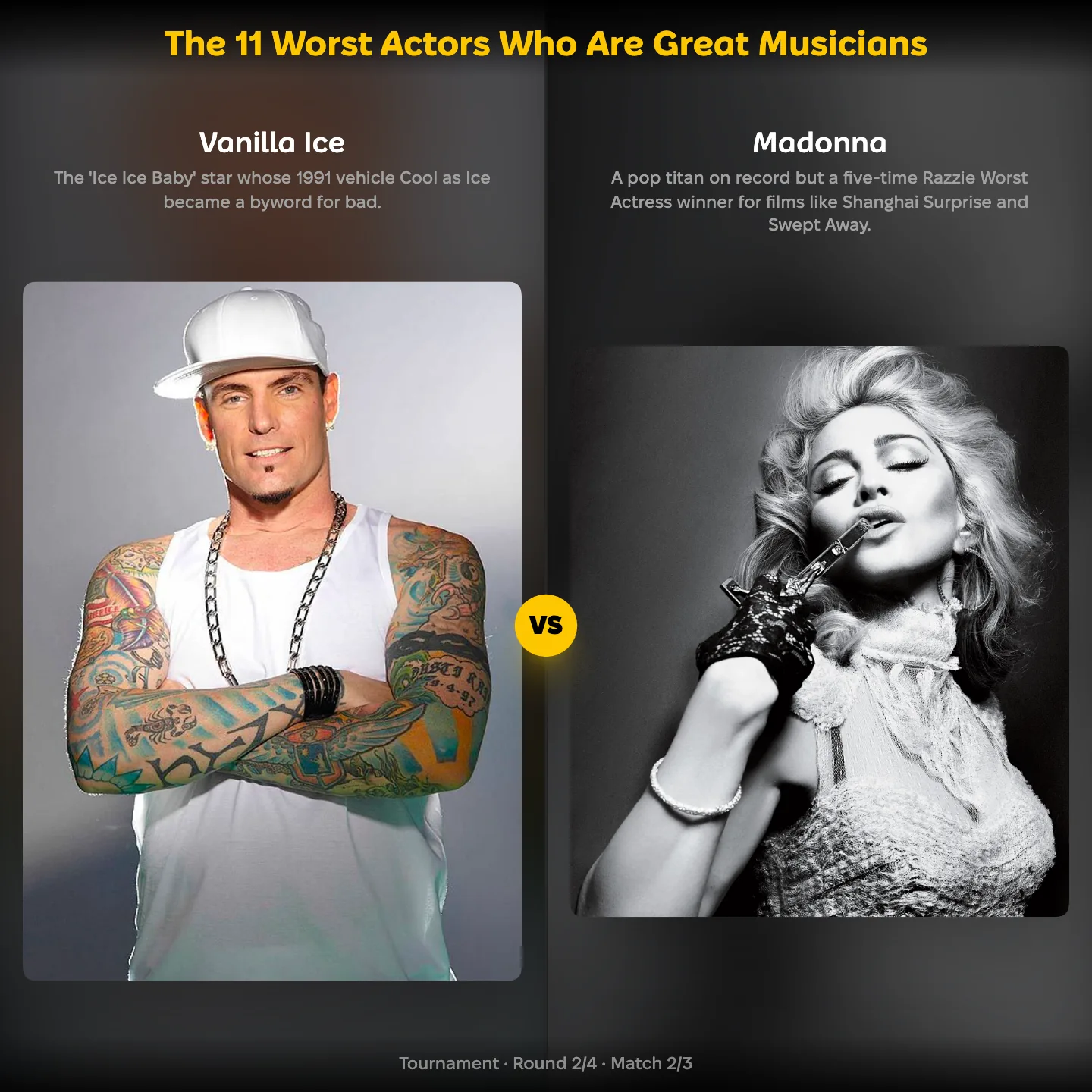
Every article like this carries one ranking the subject would rather sit out. Madonna's is the list of musicians who cannot act, and she supplied the filmography that put her on it.
Shanghai Surprise, Who's That Girl and Swept Away are the three titles that made her a Golden Raspberry regular. She carried all three alone.
Vanilla Ice is the nearest competition, on the back of Cool as Ice, his 1991 starring vehicle. Mariah Carey's Glitter, Britney Spears in Crossroads and Prince's Under the Cherry Moon keep the standard up.
The joke only lands because everyone here is genuinely good at the other thing. Madonna is the one entrant who also walked off a film set with a Golden Globe.
Thirteen questions, thirteen Madonnas
Thirteen lists, and the same woman qualifies for all of them: the sales entry, the halftime audience, a staircase in Manhattan, the videos, and the films she was mocked for. Confessions II is the newest arrival, and it is the only record here that is a sequel to another record on the same page.
Every list here is settled two records at a time, which is why the answer moves when the question does.
And if your Madonna is Erotica while everyone else's is Ray of Light, that ranking is one you can build yourself.
More rankings, more angles
- Beyoncé Doesn't Rank the Same Way Twice — Destiny's Child, Coachella and Album of the Year
- Is Taylor Swift the Greatest Songwriter of All Time? 15 Lists — teen pop, the move out of Nashville and Bad Blood
- The Beatles vs The Rolling Stones: 16 Lists That Can't Agree — two catalogues, level on UK Number 1s
- What Kind of Best Is Michael Jackson? — pop, Motown, the moonwalk and a billion-dollar biopic
Sources
- Official Charts Company — CONFESSIONS II debuting at Number 1 on the Official Albums Chart dated 10 July 2026, Madonna's 13th UK Number 1 album and the first by an American woman to top the chart in five separate decades: officialcharts.com (checked 2026-08-03)
- Guinness World Records — Madonna as the best-selling female recording artist, 400,000,000 units, record dated 15 September 2023: guinnessworldrecords.com (checked 2026-08-03)
- Recording Academy — Beyoncé's 35 GRAMMY wins from 99 nominations, the most-awarded and most-nominated artist in the awards' history: grammy.com (checked 2026-08-03)
- Official Charts Company — Madonna's full UK chart history: "Papa Don't Preach" at No. 1 from 28 June 1986, "True Blue" from 4 October 1986 and "La Isla Bonita" from 4 April 1987; "Like a Prayer" three weeks at No. 1 from 18 March 1989; "Vogue" four weeks from 7 April 1990; "Lucky Star" peaking at 14 and "Borderline" at 56 in 1984; "Into the Groove" her first Number 1 and best-selling UK single: officialcharts.com (checked 2026-08-03)
- Rock & Roll Hall of Fame — Cyndi Lauper inducted in 2025, with SHE'S SO UNUSUAL credited with four Top 5 hits: rockhall.com (checked 2026-08-03)
- Recording Academy — 41st GRAMMY Awards (1999): RAY OF LIGHT winning Best Pop Vocal Album, Best Dance Recording, Best Music Video and Best Album Package, with Album Of The Year going to Lauryn Hill: grammy.com (checked 2026-08-03)
- National Football League, citing Nielsen — Madonna's Super Bowl XLVI halftime show seen by an estimated 114 million people, the most-watched halftime entertainment show on record, against an average game audience of 111.3 million: nfl.com (checked 2026-08-03)
- Official Charts Company — CONFESSIONS II released 3 July 2026 through Warner, produced with Stuart Price as a sequel to 2005's CONFESSIONS ON A DANCE FLOOR: officialcharts.com (checked 2026-08-03)
- Rock & Roll Hall of Fame — Tina Turner inducted as a solo artist in 2021, with PRIVATE DANCER's biggest single a global No. 1 that took three GRAMMYs when she was 44: rockhall.com (checked 2026-08-03)
- Guinness World Records — Madonna's records including 85 costume changes in EVITA, the most for one film character, and the oldest artist to top the UK singles and albums charts simultaneously, aged 47 in November 2005: guinnessworldrecords.com (checked 2026-08-03)
- Golden Globes — Madonna's two wins from seven nominations: Best Actress in a Motion Picture, Musical or Comedy for EVITA in 1997, and Best Original Song for "Masterpiece" in 2012: goldenglobes.com (checked 2026-08-03)
- Pollstar — the Celebration Tour's final figures: 80 shows, $227.2 million and 1.1 million tickets, plus the free Rio de Janeiro finale drawing 1.6 million to Copacabana beach, the highest attendance recorded for a standalone concert: news.pollstar.com (checked 2026-08-03)
- Official Charts Company — "Bring Your Love" by Madonna and Sabrina Carpenter, first charted 14 May 2026, peak position 29 on the Official Singles Chart: officialcharts.com (checked 2026-08-03)