
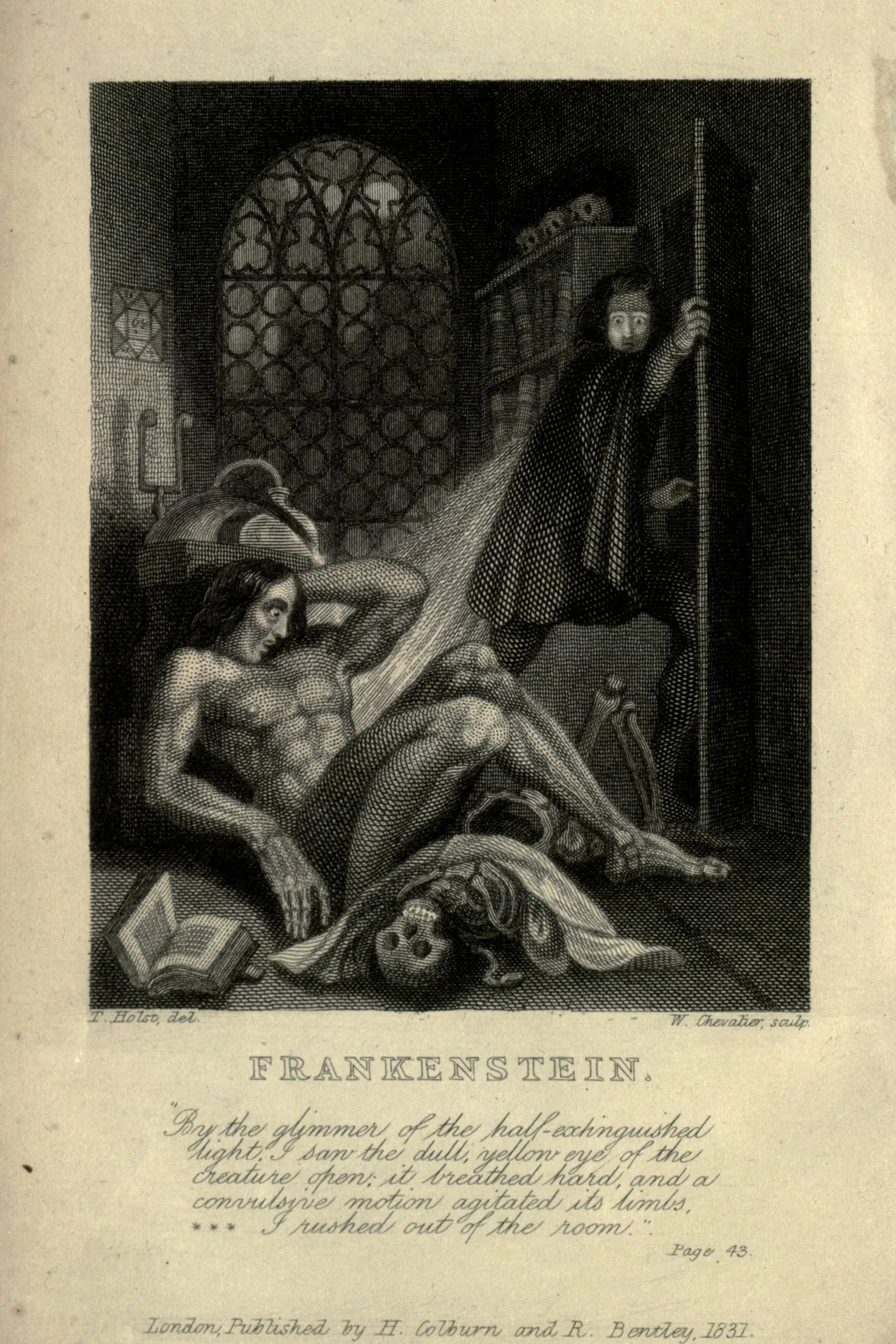
On 15 March 2026 Guillermo del Toro's Frankenstein won three Oscars, for production design, costume design and makeup, from nine nominations.1 Nine days earlier Warner Bros. had opened The Bride!, Maggie Gyllenhaal's version of the same story, and watched it collect about $24 million worldwide on a budget of $80 to 90 million.2
Both films come from a novel that Mary Shelley began at 18, during a wet Swiss summer, and published anonymously in January 1818. Two hundred and eight years later the book, the scientist and the Creature sit on lists about horror, comedy, streaming, makeup, manga and box-office disasters.
This page collects fourteen of those rankings.
Frankenstein has been rebuilt by every studio that wanted a monster, and each list here ranks a different set of spare parts: the novel, the doctor, Karloff's flat head or a Netflix Oscar winner.
Universal Monsters: Frankenstein's Monster vs Dracula
Universal Pictures released Dracula in February 1931 and Frankenstein that November, and the two films built the studio's monster business. This ranking asks which of the creatures it produced between the 1920s and the 1950s is the greatest.
Frankenstein's Monster has the face the category is drawn from. Jack Pierce designed the flat skull, the neck bolts and the heavy eyelids for Boris Karloff, who was billed in the opening credits with a question mark instead of his name.3
Bela Lugosi's Count Dracula has the older claim and the better lines. The Wolf Man, the Mummy, the Invisible Man, the Gill-man and Lon Chaney's silent Phantom complete a field drawn entirely from Universal's own catalogue.
Frankenstein vs Wuthering Heights: the Gothic shelf
The Gothic novel began in 1764 with Horace Walpole's The Castle of Otranto, and the newest book in this ranking is Silvia Moreno-Garcia's Mexican Gothic, published in 2020.
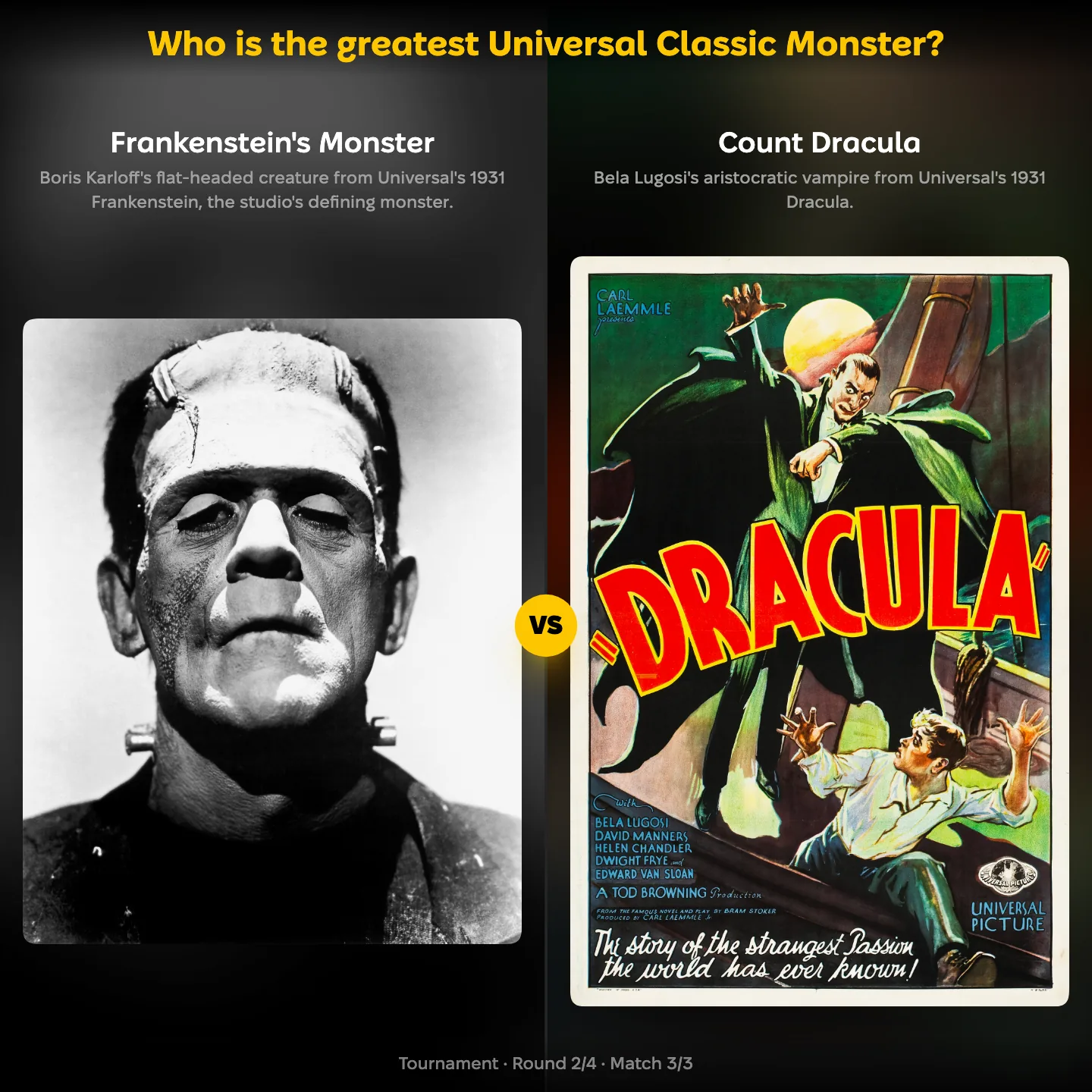
Frankenstein was first printed in London on 1 January 1818 in three volumes, with a print run of 500 copies.4 It took the haunted-castle genre into the laboratory, and its horror comes from a university student's experiment, with no ghost or curse involved.
Emily Brontë's Wuthering Heights, published in 1847 under the name Ellis Bell, makes the case for the moors instead. Jane Eyre, Rebecca, The Picture of Dorian Gray, Carmilla and Dracula share the list, so Frankenstein meets Dracula here too, its Universal stablemate of 1931.
Mary Shelley vs S.E. Hinton: novels finished before 20
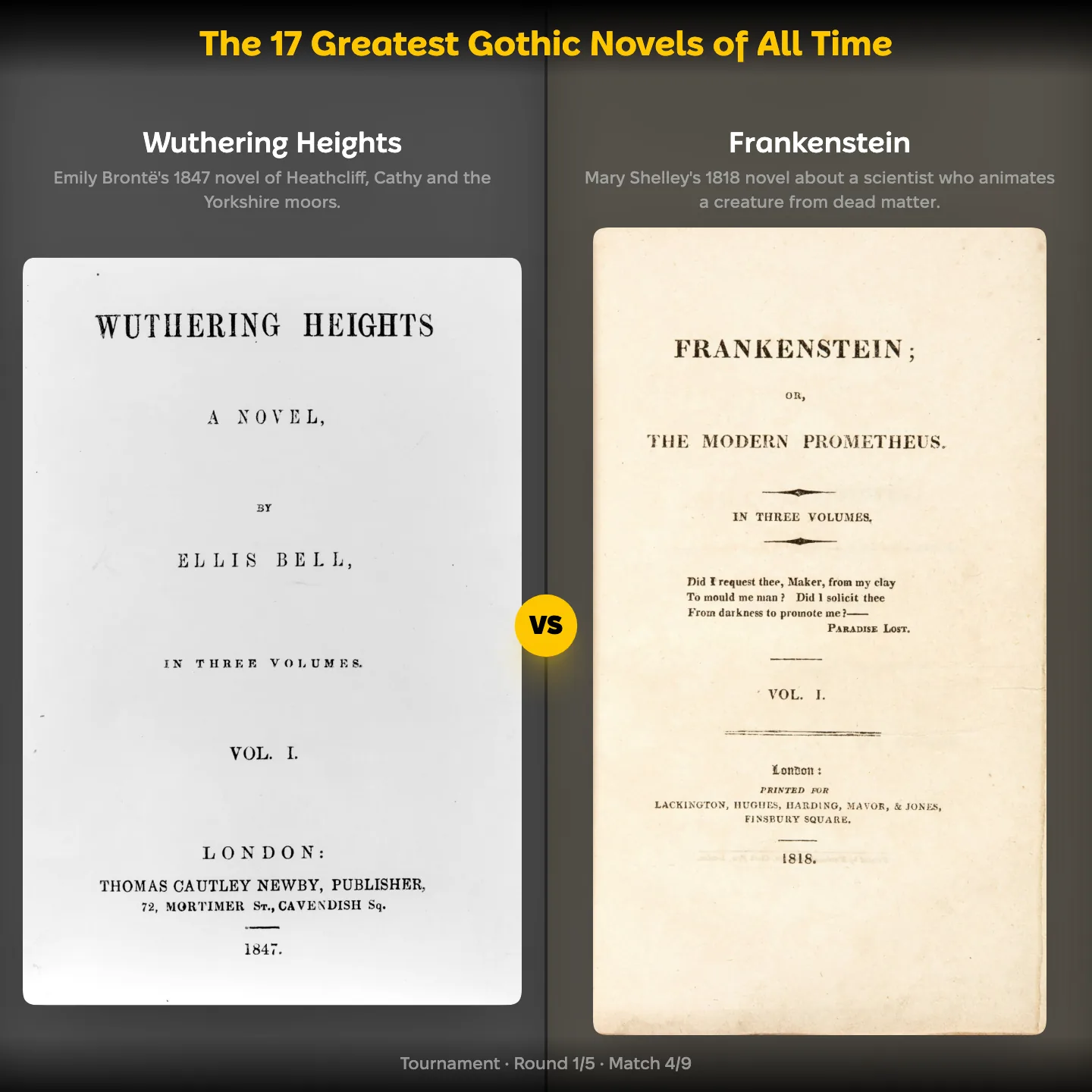
Mary Shelley started Frankenstein at 18 at the Villa Diodati on Lake Geneva, after Lord Byron proposed that everyone in the house write a ghost story. The eruption of Mount Tambora in 1815 had made 1816 a year without a summer, and the cold kept the group indoors.4
Byron's physician John Polidori wrote The Vampyre after the same challenge, so one wet week at the villa produced the first modern vampire story and the first great novel of science gone wrong.
This ranking asks which novel written by a teenager is the greatest.
S.E. Hinton began The Outsiders at 15 and wrote most of it at 16, as a high-school junior in Tulsa; Viking published it in April 1967, when she was 18.5 She used her initials so male reviewers would not dismiss the book as a girl's.
Françoise Sagan's Bonjour Tristesse, Christopher Paolini's Eragon and Daisy Ashford's The Young Visiters, written at nine, fill out the list. Frankenstein alone went on to found a genre.
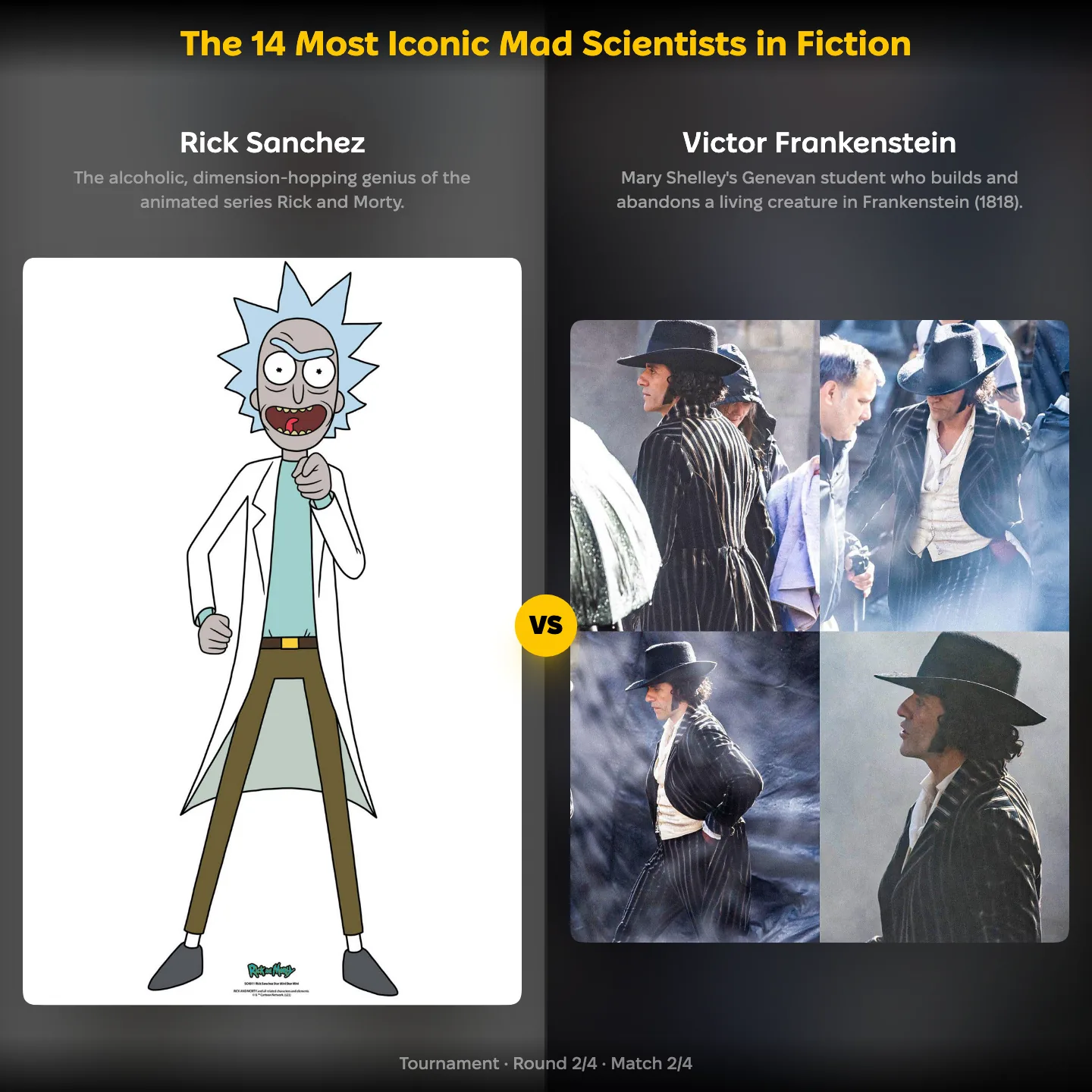
Victor Frankenstein vs Rick Sanchez
Victor Frankenstein is the model for every lab-coated overreacher on this list of fictional mad scientists. In the novel he is a student at Ingolstadt who builds a man, runs from him the moment he opens his eyes, and spends the rest of the book losing everyone he loves.
Hollywood could not even keep his first name. The 1931 Universal film calls him Henry and gives the name Victor to his friend.
Rick Sanchez of Rick and Morty is his opposite in one respect: Rick never regrets anything. Dr. Jekyll, Seth Brundle of The Fly, Doctor Octopus, Dr. Strangelove and the Futurama professor round out a field of men who should have stopped at the first experiment.
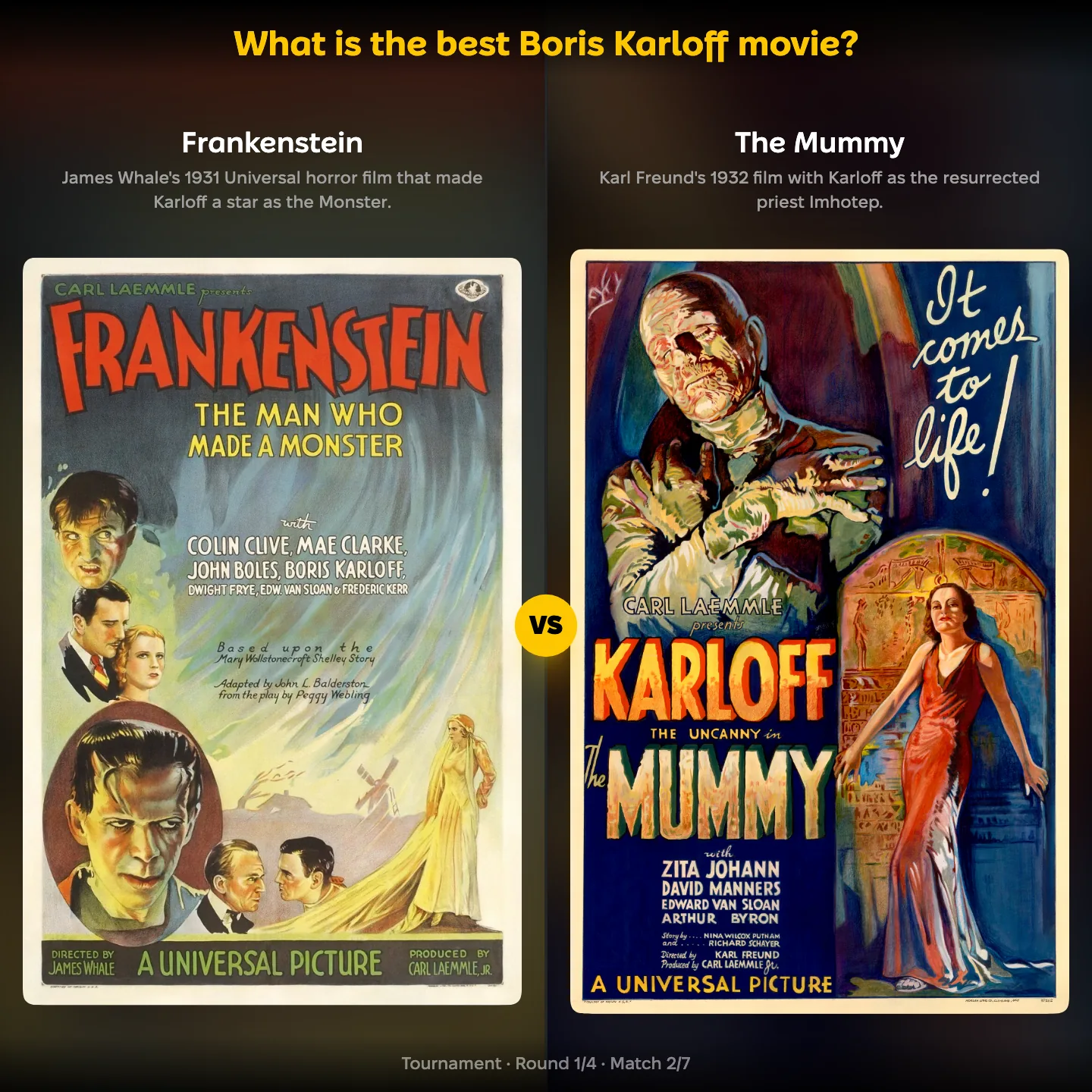
Boris Karloff, beyond the neck bolts
This ranking sorts Boris Karloff's films. He played the Monster three times, in Frankenstein (1931), Bride of Frankenstein (1935) and Son of Frankenstein (1939), and the Library of Congress chose the first of those for preservation in 1991.3
The Mummy, a year after Frankenstein, gave him a second Universal monster.
The rest of the list shows how far he travelled from the neck bolts: Howard Hawks' Scarface, the Val Lewton thrillers The Body Snatcher and Isle of the Dead, Roger Corman's The Raven and Peter Bogdanovich's Targets, where he plays an ageing horror star.
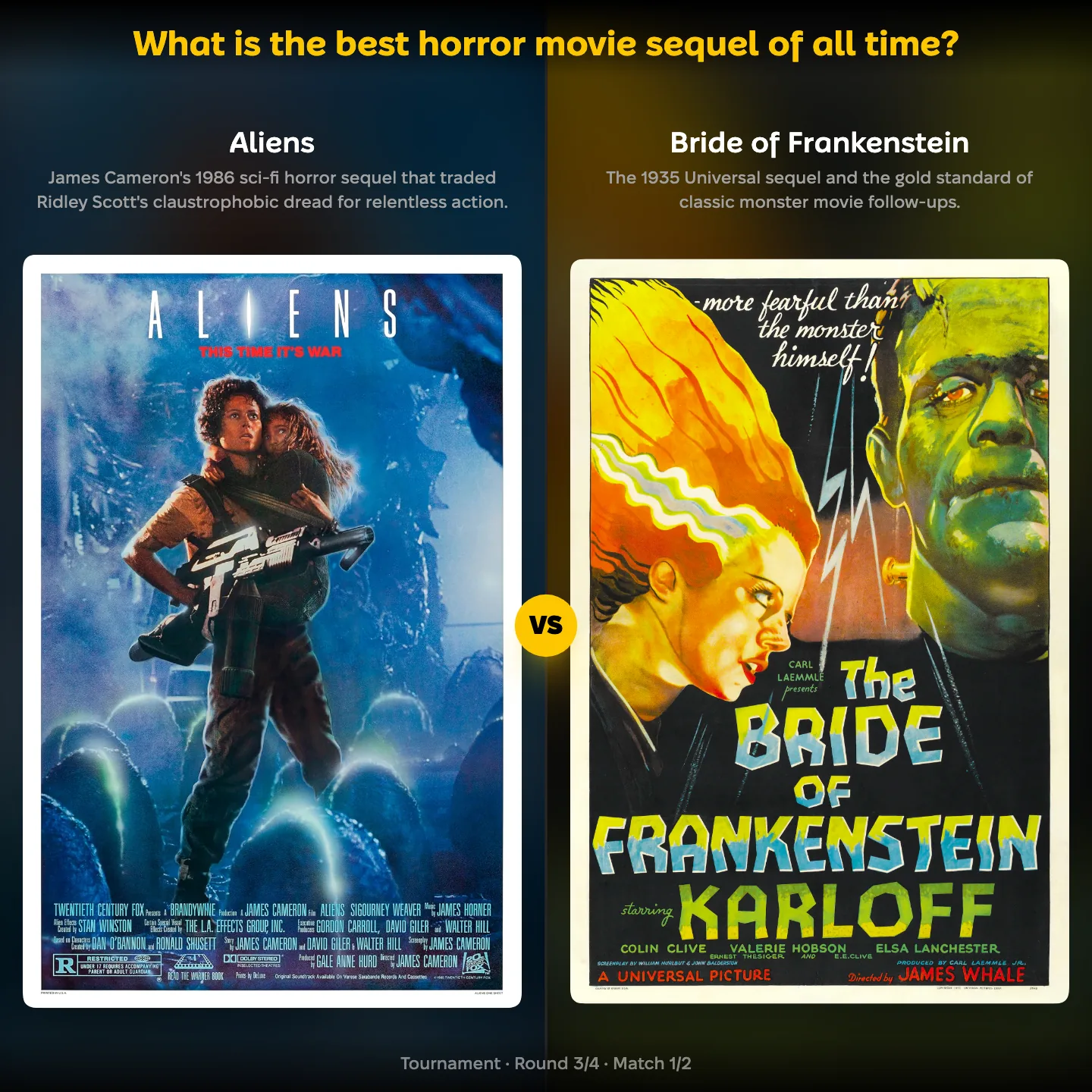
Bride of Frankenstein vs Aliens
Bride of Frankenstein opened in April 1935, and this ranking of horror sequels puts it against half a century of follow-ups.
James Whale's film opens with a prologue in which Elsa Lanchester plays Mary Shelley, telling Byron and Percy Shelley the rest of her story. Lanchester then plays the Bride herself, with the lightning-streaked hair. The Library of Congress selected it for preservation in 1998.6
James Cameron's Aliens is the rival that turned a haunted-house film into a war film. Evil Dead II, Dawn of the Dead and Dream Warriors complete the list.
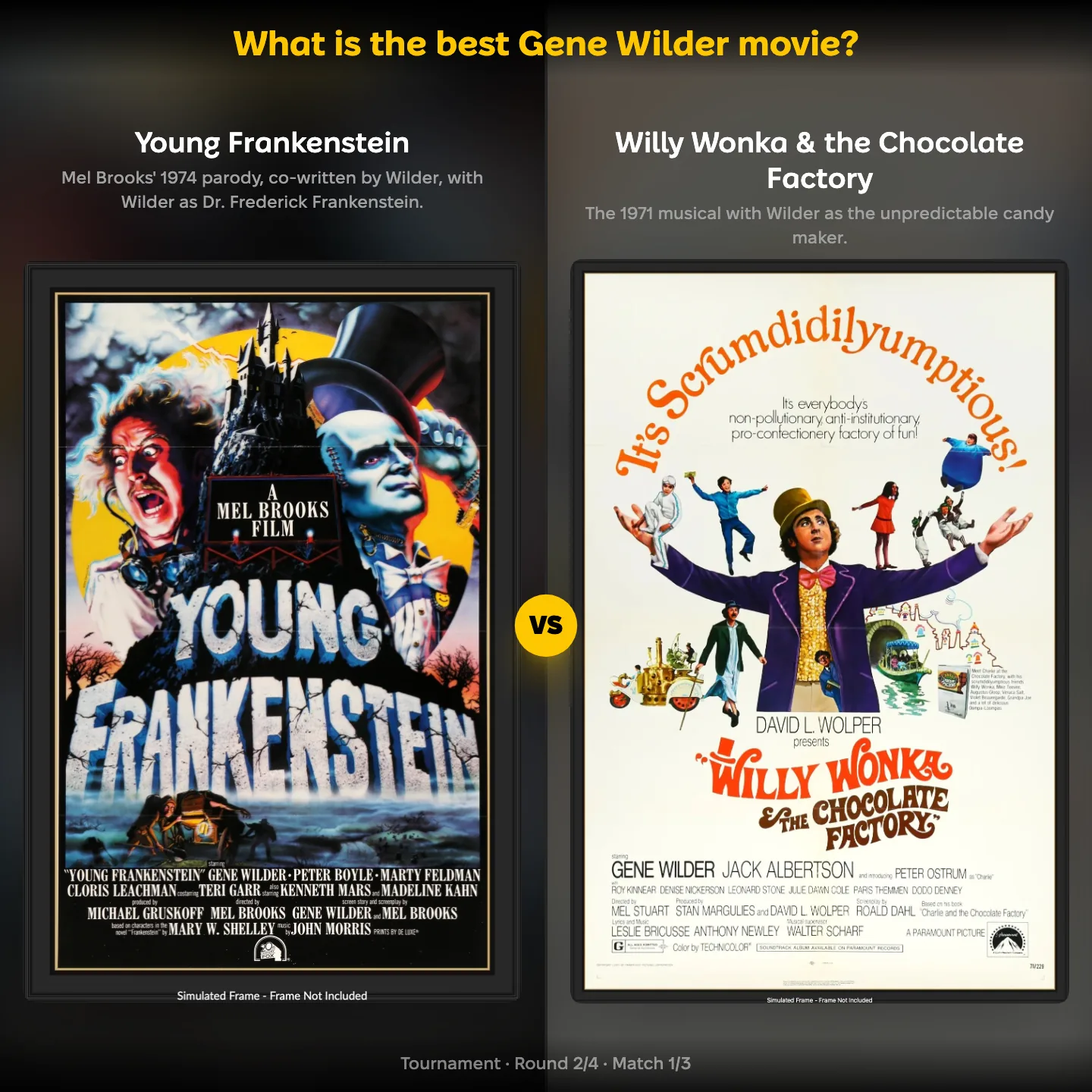
Gene Wilder's Young Frankenstein, pitched over coffee
Young Frankenstein was Gene Wilder's idea. According to Mel Brooks, Wilder pitched it over coffee on the set of Blazing Saddles: a grandson of Dr. Frankenstein who wants nothing to do with the family business.
The two men wrote the screenplay together and were nominated for the adapted-screenplay Oscar. Released in December 1974, the film grossed $86.2 million on a $2.78 million budget.7
Willy Wonka & the Chocolate Factory is the other Wilder performance people quote from memory. The Producers, Blazing Saddles and the Richard Pryor comedies complete a ranking of the best Gene Wilder movies.
The creature nobody named
In Mary Shelley's novel the Creature has no name. Victor calls him a wretch, a fiend and a daemon, and audiences have called him Frankenstein since the 1931 film.4
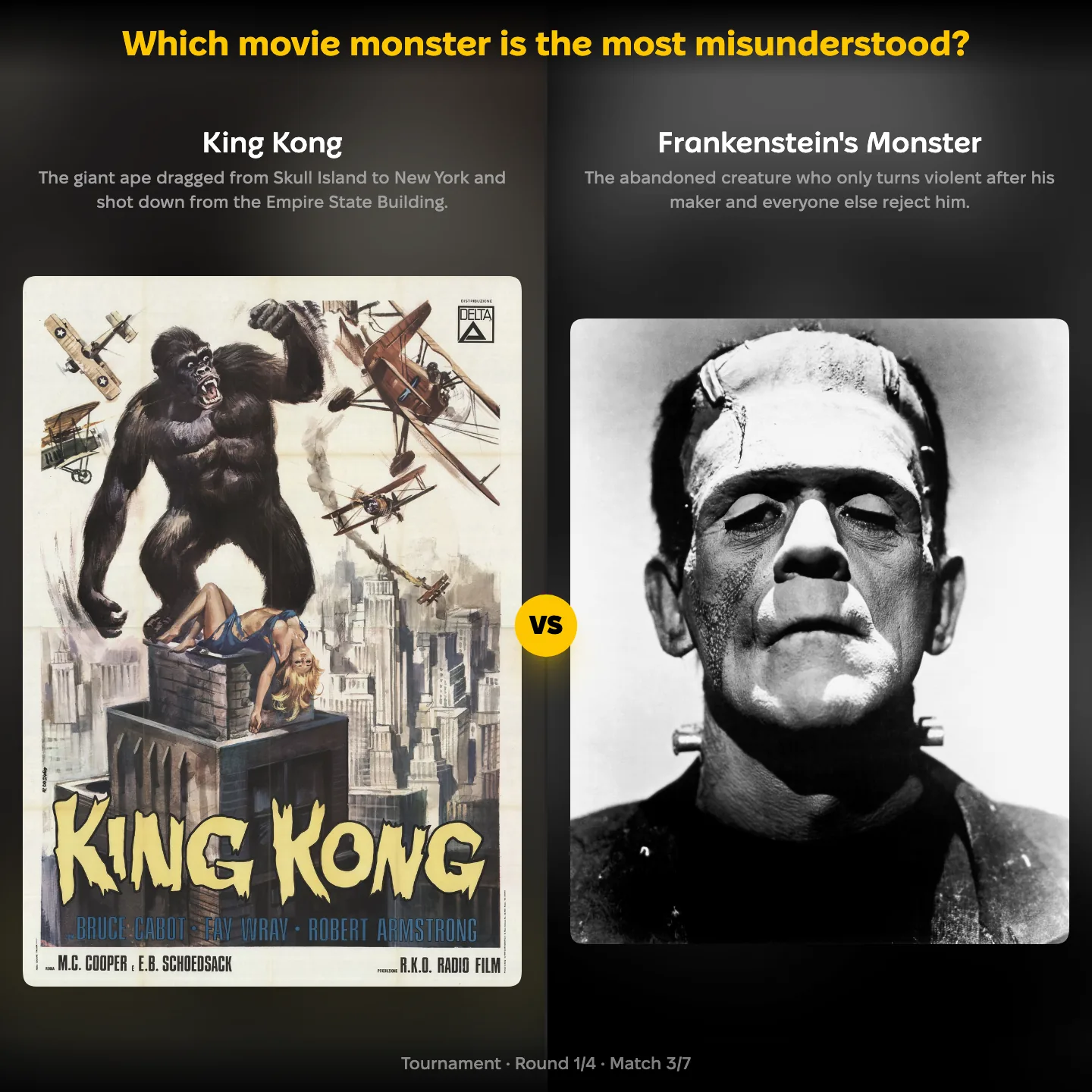
This ranking asks which movie monster is the most misunderstood, and the novel's Creature is a strong candidate. He teaches himself to read from Paradise Lost and Plutarch, asks his maker for a companion, and turns to murder only after every person he meets drives him away.
In the book he argues in long, articulate speeches; Karloff's version grunts. The films kept the killings and cut most of the pleading, which is where the reader's sympathy comes from.
King Kong, the Iron Giant, Edward Scissorhands, the Elephant Man and del Toro's amphibian man from The Shape of Water all compete for the same sympathy.
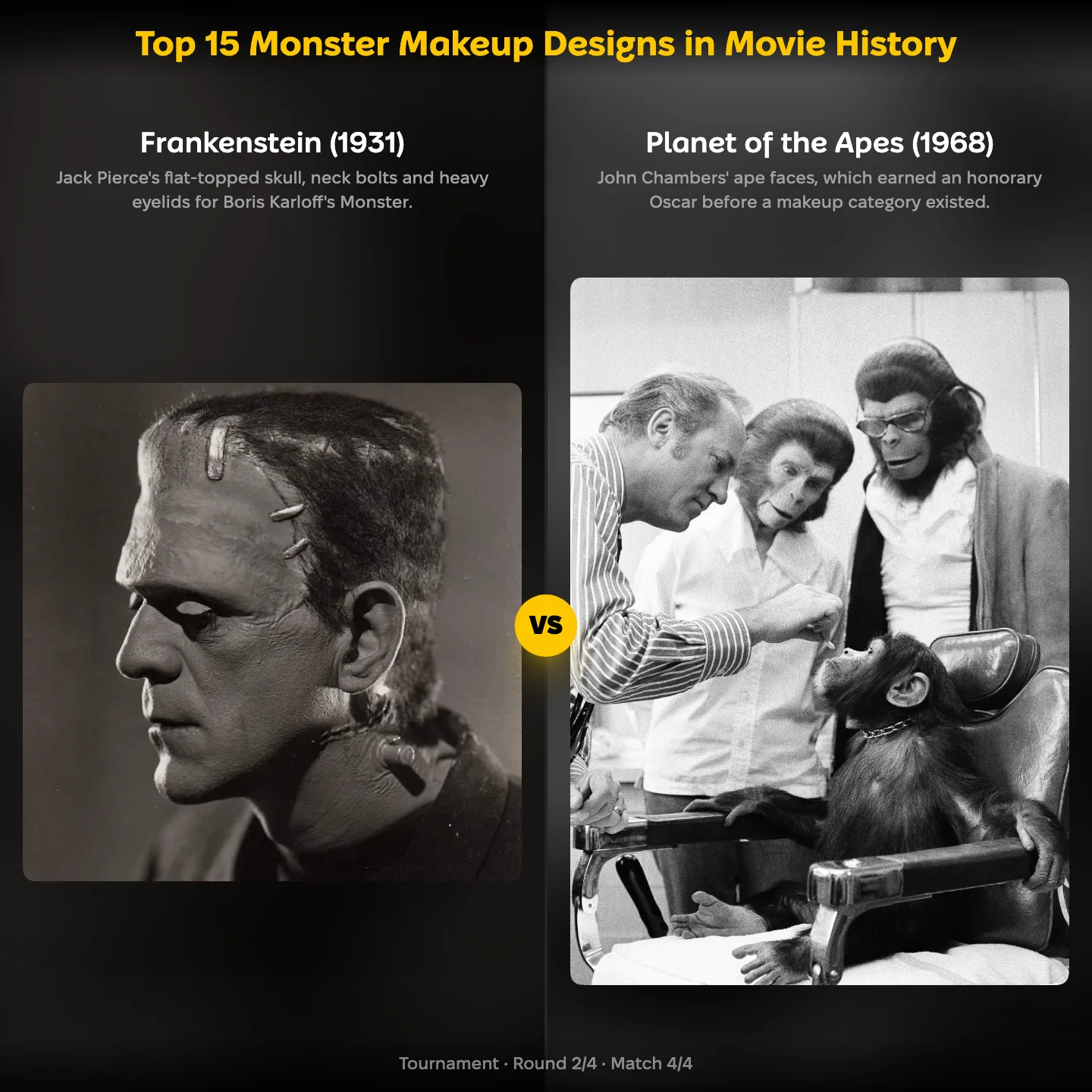
Jack Pierce to Mike Hill: two Frankensteins in one makeup ranking
Frankenstein is the only film that appears twice in this ranking of monster makeup designs, 94 years apart.
The 1931 version is Jack Pierce's: a flat-topped skull, bolts at the neck and eyelids weighted to droop. The 2025 version won the Oscar for makeup and hairstyling for Mike Hill, Jordan Samuel and Cliona Furey.
That award has its own history. The Academy created a competitive makeup category in 1981, after complaints that The Elephant Man's makeup had gone unrecognised, and gave the first one to Rick Baker for An American Werewolf in London.8
John Chambers' apes for Planet of the Apes were honoured before the category existed. The Exorcist, The Thing, The Fly and Pan's Labyrinth complete the list.
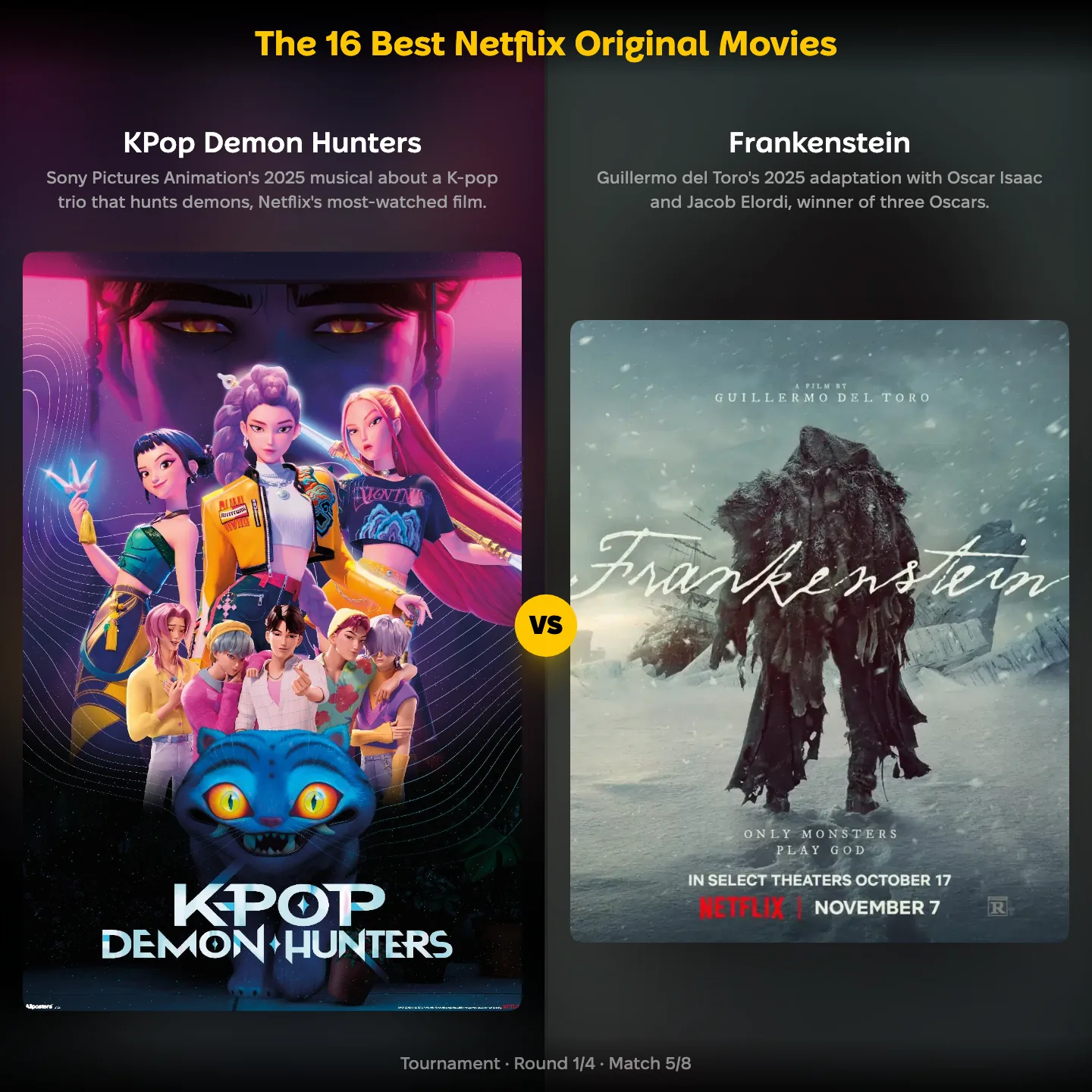
Netflix's two 2026 Oscar winners: Frankenstein vs KPop Demon Hunters
Del Toro's Frankenstein premiered at Venice on 30 August 2025, played in selected cinemas from 17 October and reached Netflix on 7 November. It cost a reported $120 million.9
This ranking of Netflix original movies holds both of the service's winners from the 98th Academy Awards. KPop Demon Hunters took animated feature and original song, for "Golden", the same night Frankenstein took its three.1
The Irishman, Roma, Edward Berger's German war film and del Toro's own stop-motion Pinocchio keep them company.
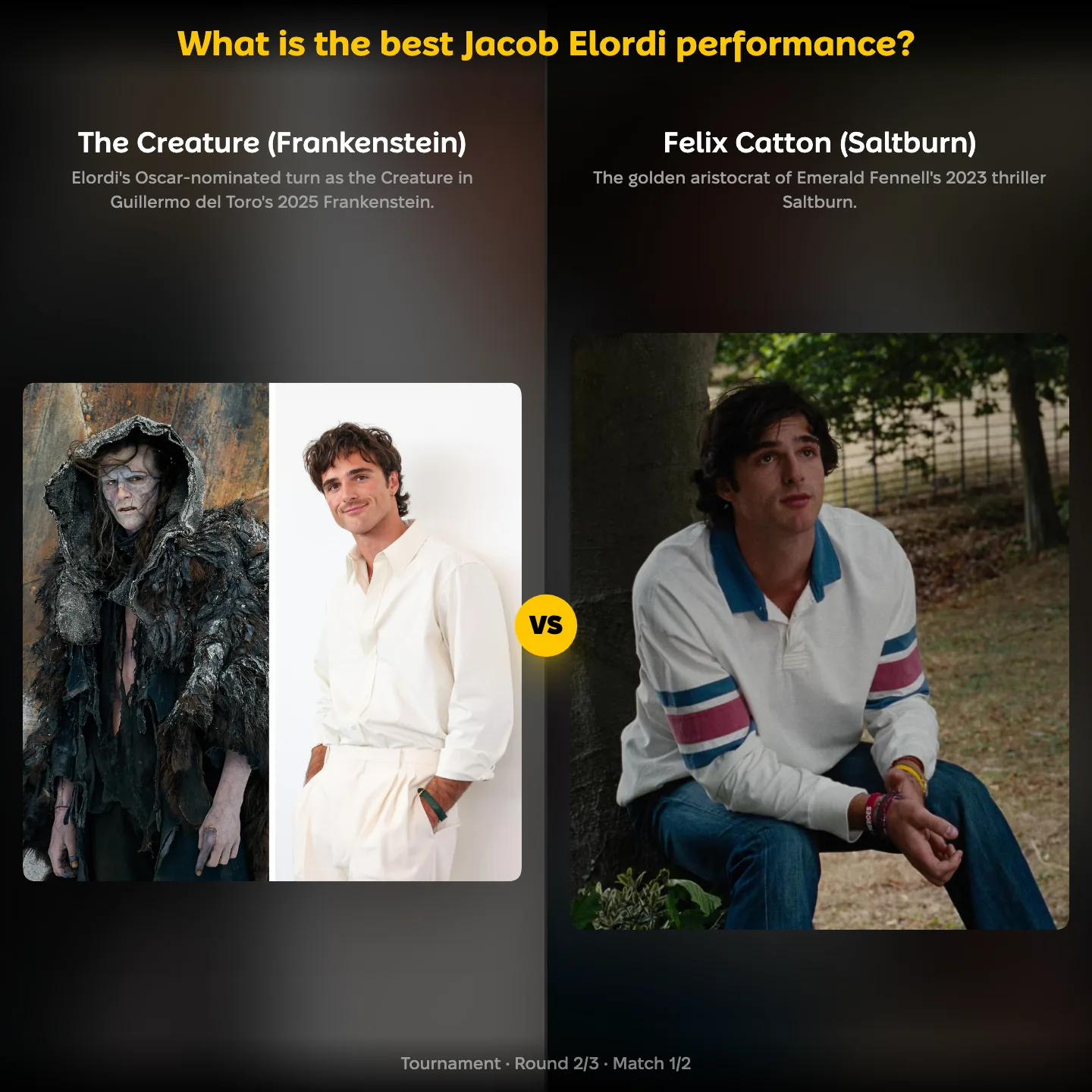
Jacob Elordi: the Creature vs Saltburn
Jacob Elordi played the Creature in del Toro's Frankenstein, opposite Oscar Isaac's Victor, and it brought him his first Oscar nomination, for supporting actor. Sean Penn won the award for One Battle After Another.
This ranking sorts his performances, and the list covers eight years of work. It opens with Netflix's The Kissing Booth and HBO's Euphoria, then moves to Emerald Fennell's Saltburn, Sofia Coppola's Priscilla and Heathcliff in Fennell's 2026 Wuthering Heights.
Saltburn's Felix Catton is the role that made him famous outside teen television.
Jessie Buckley's March 2026: The Bride! vs Hamnet
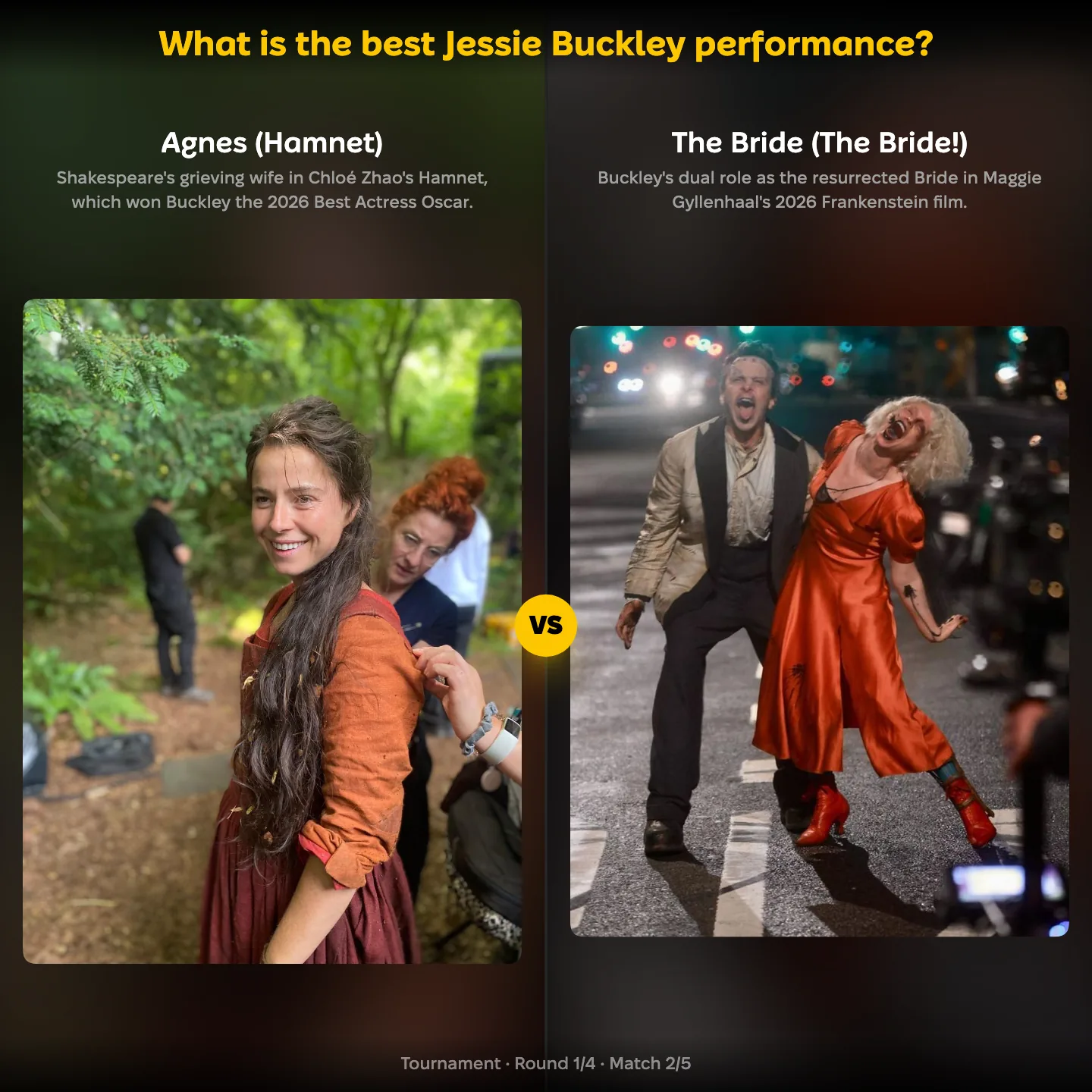
Jessie Buckley's March 2026 held both ends of this story. On 6 March 2026 she opened in The Bride!, playing the resurrected mate of Christian Bale's Frank. On 15 March she won the Oscar for best actress as Agnes Shakespeare in Chloé Zhao's Hamnet.1
This ranking sorts her performances. Critics who disliked The Bride! still tended to praise her in it.
The Lost Daughter, also directed by Gyllenhaal, earned her an earlier nomination. Wild Rose, Chernobyl, Beast, Men and Women Talking complete the list.
The Bride! vs The Marvels: the decade's box-office bombs
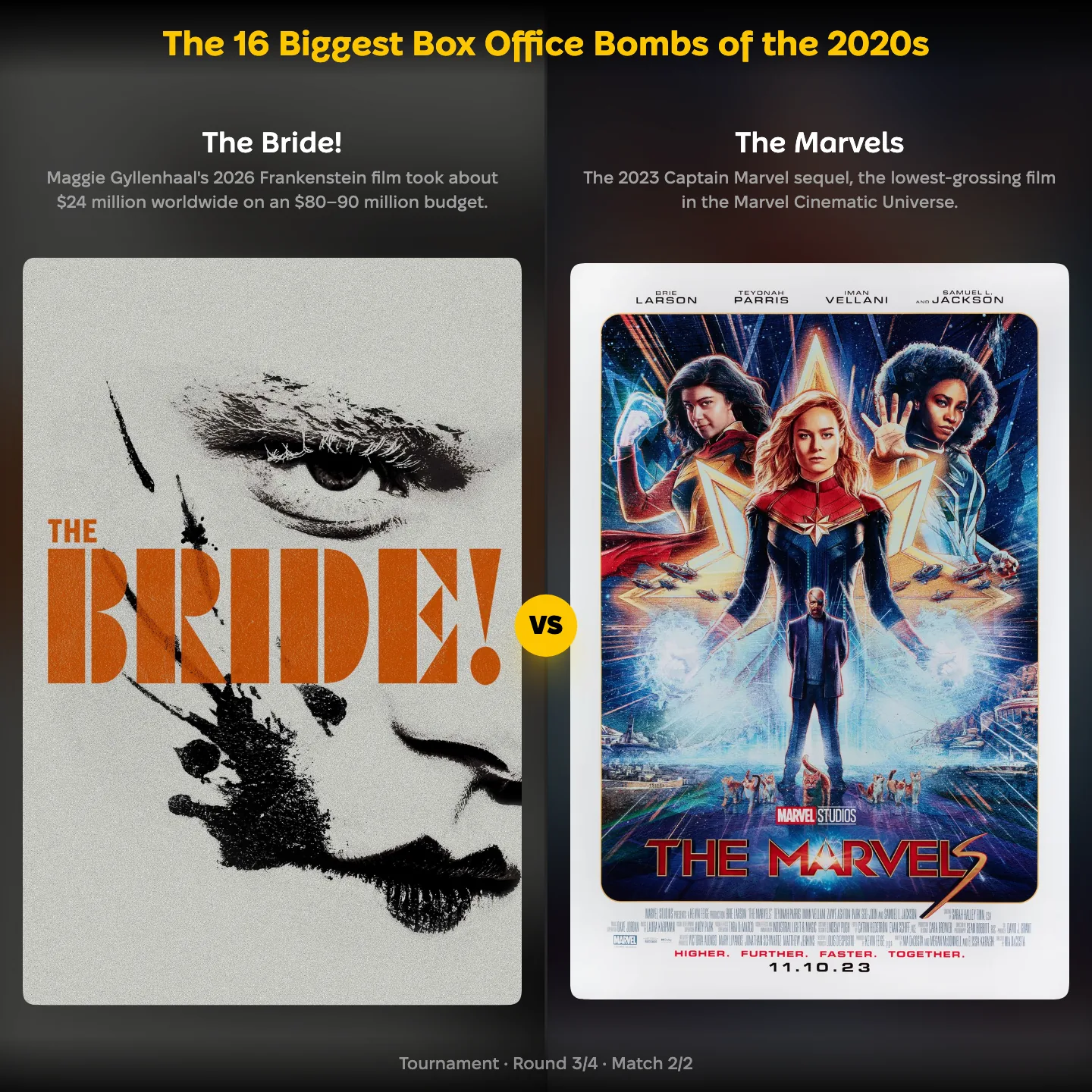
The Bride! is the 2026 entry among the 2020s' costliest box-office failures. Warner Bros. spent $80 to 90 million making it, before marketing, and Deadline, citing industry sources rather than the studio, put the likely loss at close to $90 million.10
Maggie Gyllenhaal set it in the 1930s and played it as an outlaw romance, with Christian Bale as Frank and Jessie Buckley as the Bride.
The Marvels, the lowest-grossing film in the Marvel Cinematic Universe, heads a field of expensive sequels: The Flash, Indiana Jones and the Dial of Destiny, Joker: Folie à Deux. Megalopolis and Strange World represent the self-funded and the animated.
Junji Ito's Frankenstein, an Eisner winner
Junji Ito, the Japanese horror artist, drew a faithful manga adaptation of Mary Shelley's novel, and the English collection built around it won him his first Eisner Award in 2019, for best adaptation from another medium.11
This ranking of his manga puts it against his own originals. Uzumaki, about a town consumed by spirals, is the book most readers start with. Tomie, Gyo and the cat diary he drew about his own pets complete the list.

Two hundred years of spare parts
Mary Shelley's book gets fourteen different answers here because every adapter kept a different piece of it. Universal kept the laboratory and dropped the Creature's voice; Brooks and Wilder kept the family name; del Toro kept the Arctic and won three craft Oscars; Gyllenhaal kept the Bride and lost the audience.
The 1931 film turns 95 on 21 November 2026.3 Every list above gets decided by pitting two options against each other, again and again.
If one version of the story matters more to you than the rest, build a ranking around it.
More rankings, more angles
- Dracula: 538 Films, and Stoker Never Saw Transylvania — the other Universal monster of 1931, and its novel
- Stephen King Wrote Horror. The Lists Keep Filing Him Elsewhere — horror's modern bestseller, sorted by adaptations
- Dune: A Flop, a Masterpiece, and 15 Lists in Between — another novel that science fiction keeps readapting
Sources
- Wikipedia — 98th Academy Awards, 15 March 2026: Frankenstein's nine nominations and three wins, KPop Demon Hunters' animated feature and original song, Jacob Elordi's nomination and Sean Penn's win, Jessie Buckley's best actress award for Hamnet: en.wikipedia.org (checked 2026-09-23)
- Wikipedia — The Bride! (2026): US release on 6 March 2026, budget of $80–90 million, about $24 million worldwide, cast: en.wikipedia.org (checked 2026-09-23)
- Wikipedia — Frankenstein (1931 film): release on 21 November 1931, Jack Pierce's makeup, Karloff credited as "?", National Film Registry 1991: en.wikipedia.org (checked 2026-09-23)
- Wikipedia — Frankenstein (novel): publication on 1 January 1818 in three volumes and 500 copies, Mary Shelley's age, the Villa Diodati ghost-story contest, the Year Without a Summer, and the unnamed Creature: en.wikipedia.org (checked 2026-09-23)
- Wikipedia — The Outsiders (novel): S.E. Hinton's age while writing, Viking publication on 24 April 1967, and her use of initials: en.wikipedia.org (checked 2026-09-23)
- Wikipedia — Bride of Frankenstein: April 1935 release, Elsa Lanchester as both Mary Shelley and the Bride, National Film Registry 1998: en.wikipedia.org (checked 2026-09-23)
- Wikipedia — Young Frankenstein: Wilder's pitch on the Blazing Saddles set, the Wilder–Brooks screenplay and its Oscar nomination, $86.2 million gross on a $2.78 million budget: en.wikipedia.org (checked 2026-09-23)
- Wikipedia — Academy Award for Best Makeup and Hairstyling: the category created in 1981 after The Elephant Man, Rick Baker's first win, and the 2026 award to Mike Hill, Jordan Samuel and Cliona Furey: en.wikipedia.org (checked 2026-09-23)
- Wikipedia — Frankenstein (2025 film): Venice premiere on 30 August 2025, cinemas from 17 October, Netflix from 7 November, $120 million budget, Oscar Isaac and Jacob Elordi: en.wikipedia.org (checked 2026-09-23)
- Deadline — The Bride! could lose close to $90 million, according to industry sources, 8 March 2026: deadline.com (checked 2026-09-23)
- Wikipedia — Junji Ito: his manga adaptation of Frankenstein and the 2019 Eisner Award for best adaptation from another medium: en.wikipedia.org (checked 2026-09-23)