

This article sits in the fortnight between International Cat Day on 8 August and National Dog Day on 26 August, which is roughly how the year treats the two of them: separate holidays, one long argument. The argument is also moving. The American Pet Products Association counted 49 million US households with a cat in its 2025 Dog & Cat Report, up from 40 million two years earlier, and households keeping three or more cats have grown by 36% since 2018.1
So we built fifteen rankings that hold both animals, and gave each one a different job to measure.
Dogs and cats answer to two completely different job descriptions, which makes every list holding both of them a vote on what a pet is actually for.
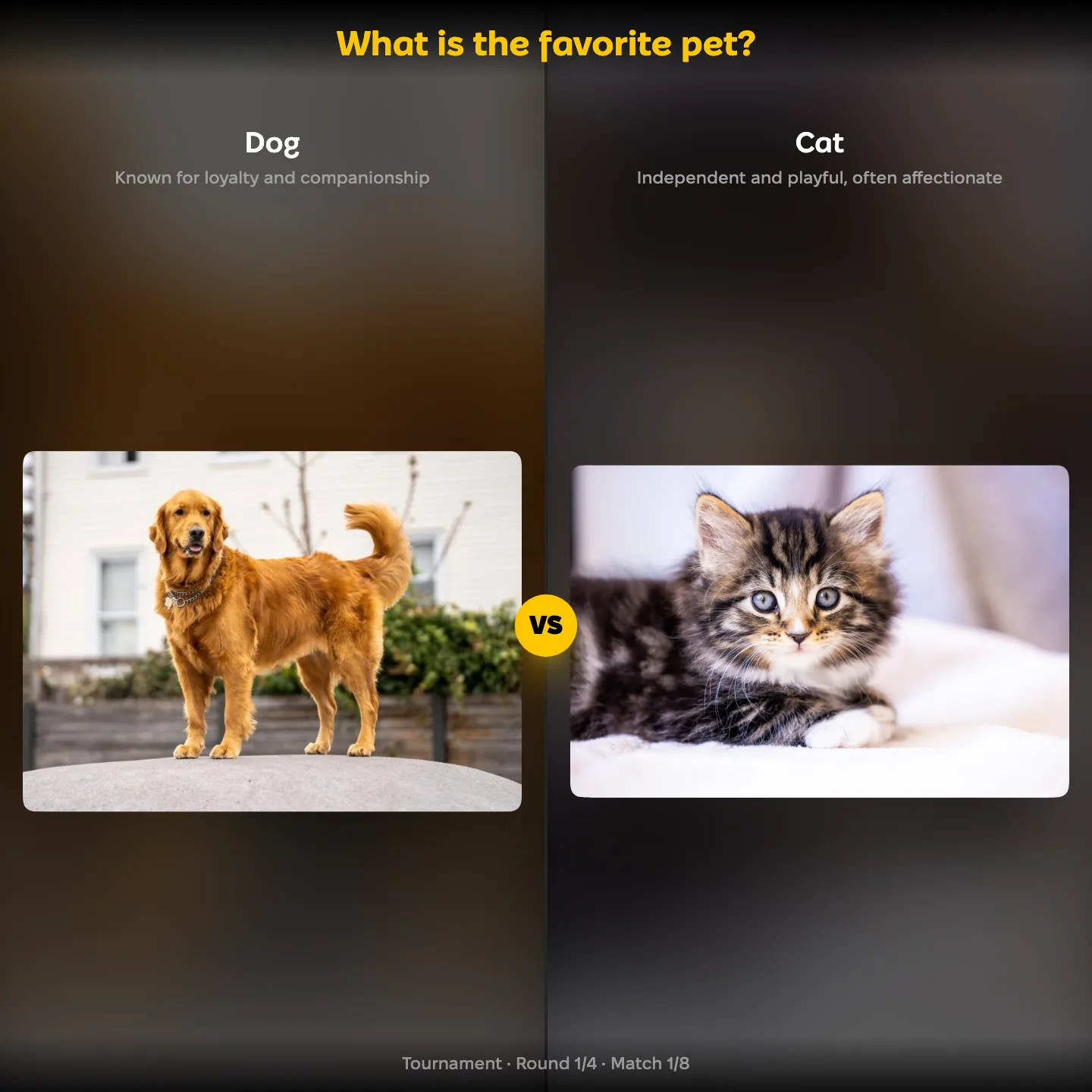
Dogs vs Cats: the plainest version of the question
The first ranking asks it without conditions. No apartment, no children, no budget: just which animal you would rather live with.
The American Veterinary Medical Association's 2024 survey puts dogs in 45.5% of US households and cats in 32.1%, with a national population of 89.7 million dogs against 73.8 million cats.2 Dogs are in more homes.
Cats close most of that gap by arriving in twos and threes. The species gap is 16 million animals; the household gap is much wider.
Fourteen other candidates share the page, and the fish, the rabbit and the parrot each have a constituency. The two at the top of the page are the ones people have opinions about before they read the question.
Dogs vs Cats with a toddler in the house
Add small children and the criteria change. Tolerance for noise, tolerance for being grabbed, and how the animal behaves when it has had enough all start to matter more than companionship in the abstract.
A dog grows up alongside the children, absorbs a fair amount of chaos, and gives a family a reason to leave the house twice a day.
A cat sets its own limits and enforces them, which is a lesson of a different kind: affection here has to be earned and can be withdrawn. Parents split on whether that is a feature.
Most families actually start further down the list. Guinea pigs are sturdy enough to be held and vocal enough to seem pleased about it, goldfish ask for almost nothing, and the pony is the one every child requests and every parent prices out.

700 square feet: the apartment test for dogs and cats
Floor plan is the variable here, and no other question flips people so reliably. The same two animals, judged on whether they fit inside a one-bedroom flat.
A cat exercises vertically. It needs a window, a shelf and a litter tray, and it sleeps through most of a working day without noticing that the day happened.
A dog in a flat is entirely workable and entirely dependent on someone being home. The walks are not optional and the neighbours have opinions about the barking.
Twelve other animals compete on the same terms, and several beat both: a betta lives in a heated tank on a side table, a leopard gecko eats twice a week, and a corn snake occupies one shelf.

The ant farm beats both: dogs, cats and the cost of care
Effort is measurable, and the AVMA measured it. American dog owners spend above $1,700 a year on their animal and cat owners below $1,350, with the veterinary share running $580 against $433.2
Money is only part of the job list. A cat buries its own mess and needs no walking in the rain; a dog needs two outings a day whatever the weather is doing.
Neither of them wins a ranking that includes a corn snake fed once a week and an ant farm that runs itself behind glass.
Ease of care is the one measure in this article where the two most popular pets in the country are both outclassed by animals nobody argues about.

Dogs, cats and what "affectionate" is measuring
Affection has two definitions and the ranking does not choose between them.
Measured as enthusiasm, the dog is unbeatable. The same greeting at the door, from the same animal, for the same person, every day for a decade.
Measured as choice, the cat has the stronger claim. Nothing obliges it to sit on anybody, so the lap it picks means something the dog's does not.
The list runs well past the household. Bonobos settle almost every social dispute by touch, rats seek out hands and groom fingers, and cows form lasting friendships and sulk when they are separated from them.

Crows, octopuses, dogs and cats: the intelligence list
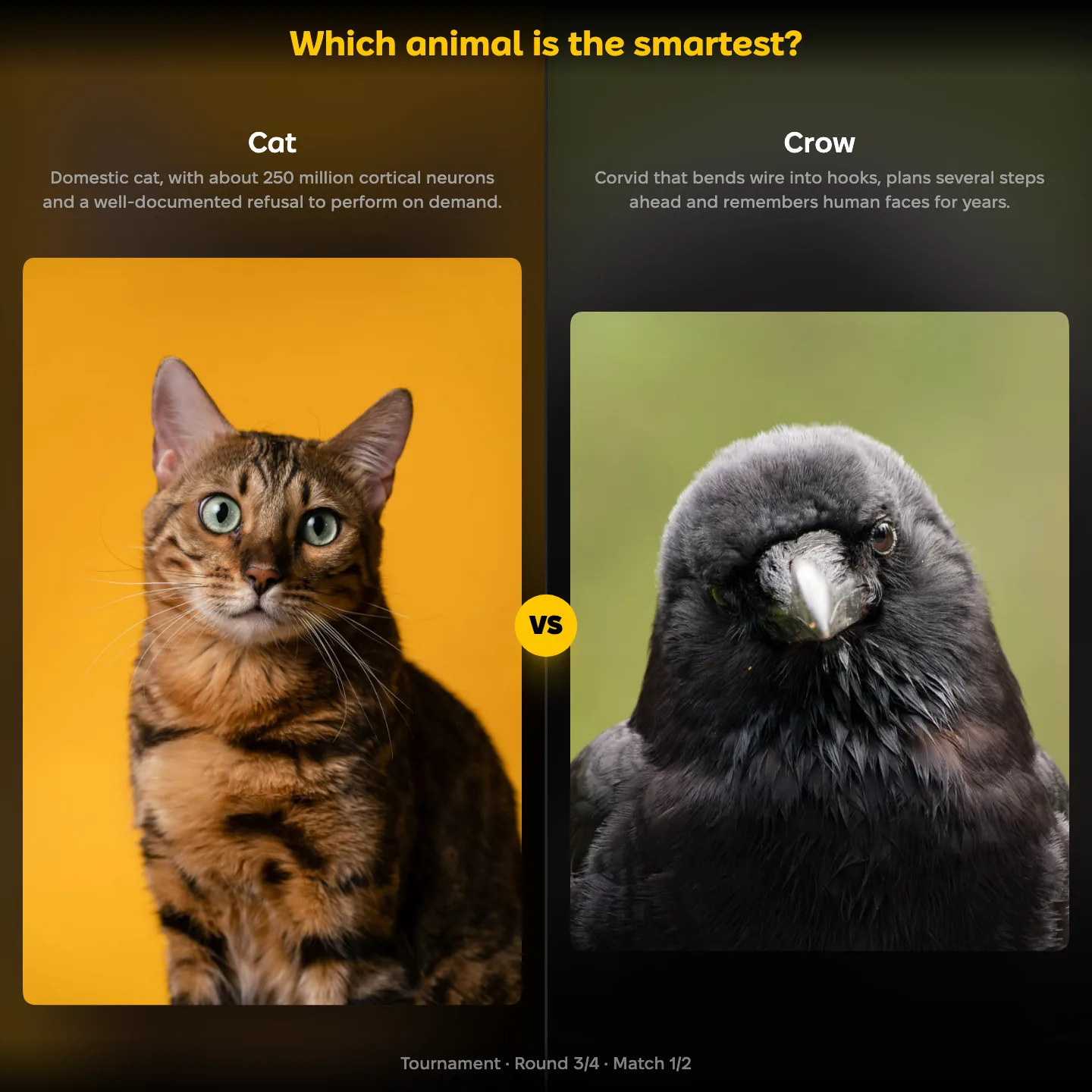
This is the one question in the article with a number attached to it. Suzana Herculano-Houzel's team at Vanderbilt counted cortical neurons across eight carnivoran species and published the results in Frontiers in Neuroanatomy in 2017: roughly 530 million in the dog, roughly 250 million in the cat.3
Dog owners quote that figure a lot. It measures the hardware, not what anybody does with it, and cats are famously unwilling to demonstrate anything on request — which is a measurement problem before it is an intelligence one.
Both of them are also on a list where the household is not the interesting part. A crow bends wire into a hook and plans several steps ahead. An octopus opens jars with neurons distributed through its arms. A chimpanzee beats most humans at short-term memory tasks.
Fourteen species, and the two asleep on the sofa sit in the middle of that company.
Therapy dogs, therapy cats and the miniature horse
Animal-assisted therapy has an obvious default. Dogs work hospital wards, courthouses and airport terminals, trained to stay flat calm in rooms designed to unsettle people.
Cats do the same job by a different method. No obedience, no commands, just weight and a purr, which suits patients who find a large enthusiastic dog too much to handle.
The field is stranger than either. Miniature horses are small enough for a hospital corridor and steady enough to guide a blind handler, alpacas are novel enough to start a conversation in a care home, and a chicken gets picked up by residents who grew up on farms.
Dolphin-assisted therapy is the famous entry on this list and the contested one, because its welfare cost falls entirely on the animal.

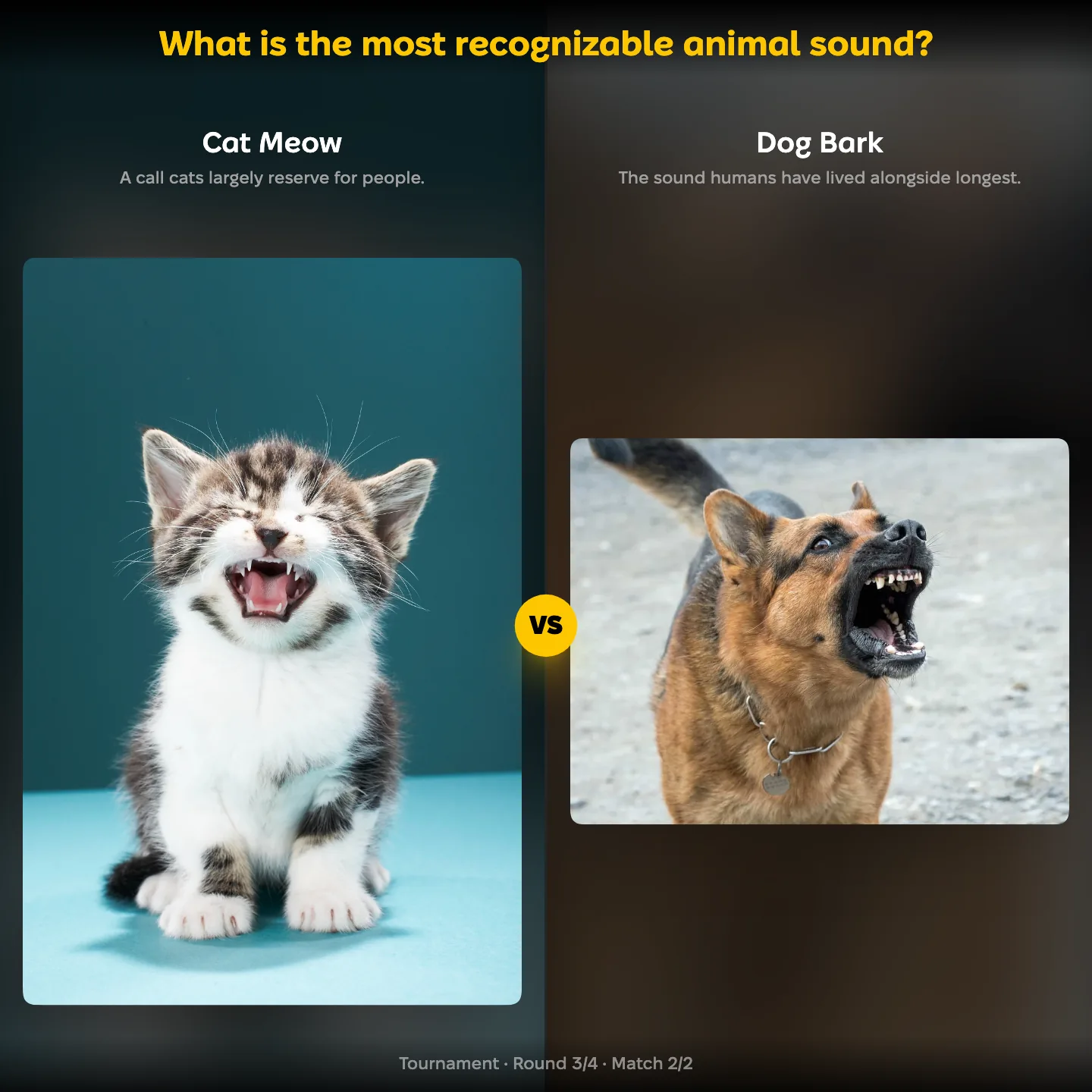
The bark and the meow: a sound cats invented for us
Fourteen animal sounds compete here. Two of them come from the living room.
The meow is the interesting one. Cats were domesticated around 9,500 years ago, on the evidence of a cat buried beside a human at Shillourokambos in Cyprus, some 3,000 years after dogs.4 Adult cats barely meow at each other. They meow at people, and they have had nine and a half millennia to work out that it functions.
The bark needs no such explanation. It carries, it means several things, and every dog owner claims to distinguish them.
Against a lion's roar, a wolf howl and a whale song, both household noises are small. They are also the two on the list that most people hear every day.
Puppies vs kittens vs a panda cub
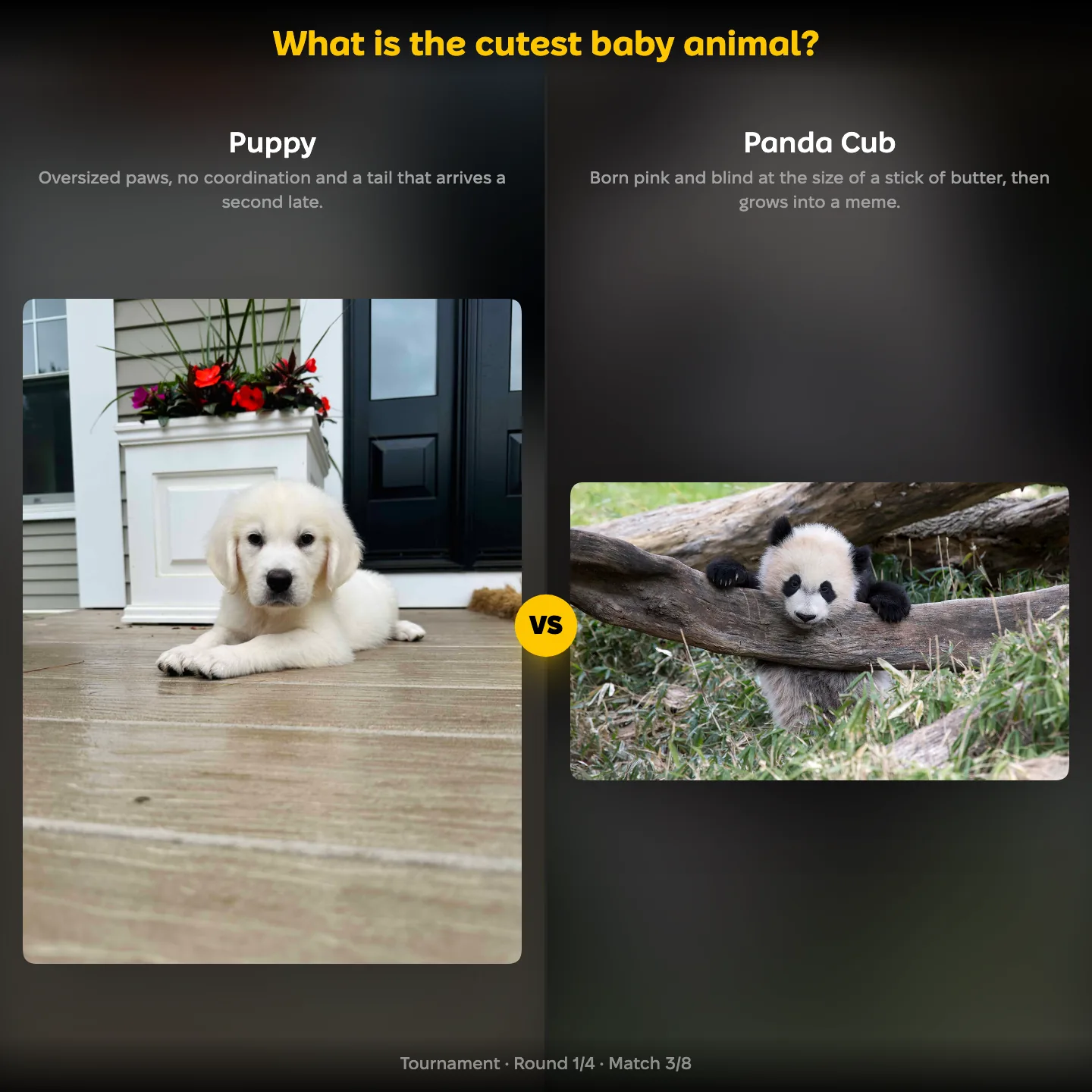
Both animals enter this one in their strongest form: a puppy with oversized paws and no coordination, a kitten that fits in a palm and falls asleep mid-pounce.
Neither is favoured by it. A panda cub is born pink and blind at the size of a stick of butter, and thirteen other newborns are on the list.
Scooby-Doo vs Garfield: the cartoon split
Animation kept the rivalry and handed each side a personality. Scooby-Doo is a Great Dane who has solved mysteries badly since 1969; Garfield is lasagne, Mondays and a refusal to be impressed.
Both are up against a mouse who owns a studio.

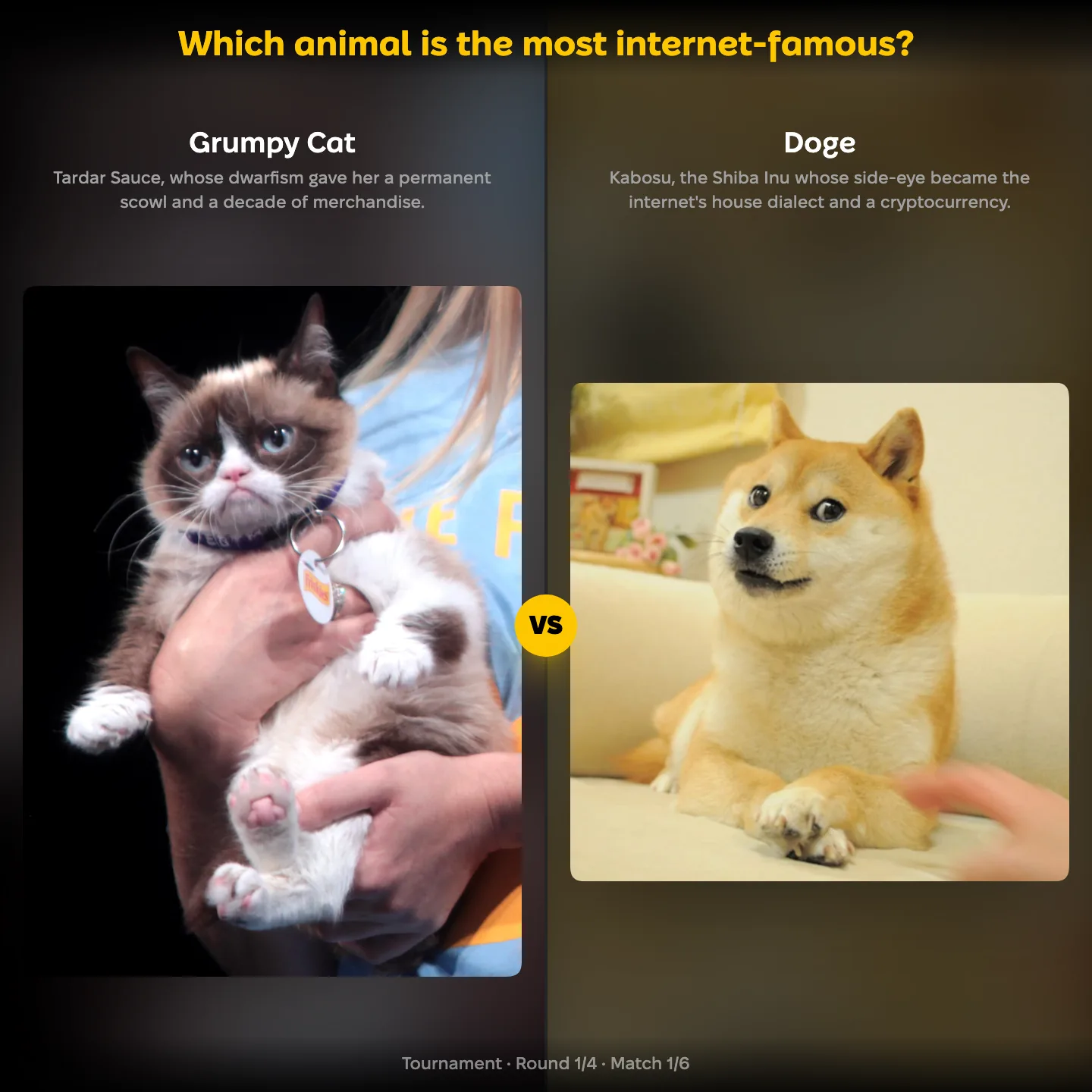
Grumpy Cat vs Doge: the internet years
The internet is the one arena where the cats arrived first and set the tone. Grumpy Cat was Tardar Sauce, a cat whose feline dwarfism produced a permanent scowl and, from that, a decade of merchandise, a film and an appearance schedule.
Keyboard Cat, Lil Bub, Maru and Nyan Cat all belong to the same stretch of internet history, which is why "cat video" became shorthand for the whole medium.
The dogs answered with a currency. Doge was Kabosu, a Japanese Shiba Inu whose side-eye became the internet's house dialect and then the mascot of a cryptocurrency that outlived the joke.
Neither side has this list to itself. Harambe, Pizza Rat, Fiona the hippo and Punxsutawney Phil compete for the same slot. A groundhog whose forecasting record is worse than a coin toss has outlasted every meme here.
The French Bulldog and 31 rivals
Two of the fifteen rankings drop the cross-species question entirely and send each side to argue with itself. This is the dog half: 32 breeds, no cats anywhere on it.
The American Kennel Club has the French Bulldog as America's most popular breed for four years running, which ended the Labrador Retriever's 31-year hold on the position.5 That is the single biggest change in American dog ownership this century, and it happened to a breed bred short-faced enough that its breathing is a veterinary subject.
The list keeps the working dogs, the family dogs and the small ones in the same field: German Shepherd, Border Collie, Chihuahua, Great Dane.

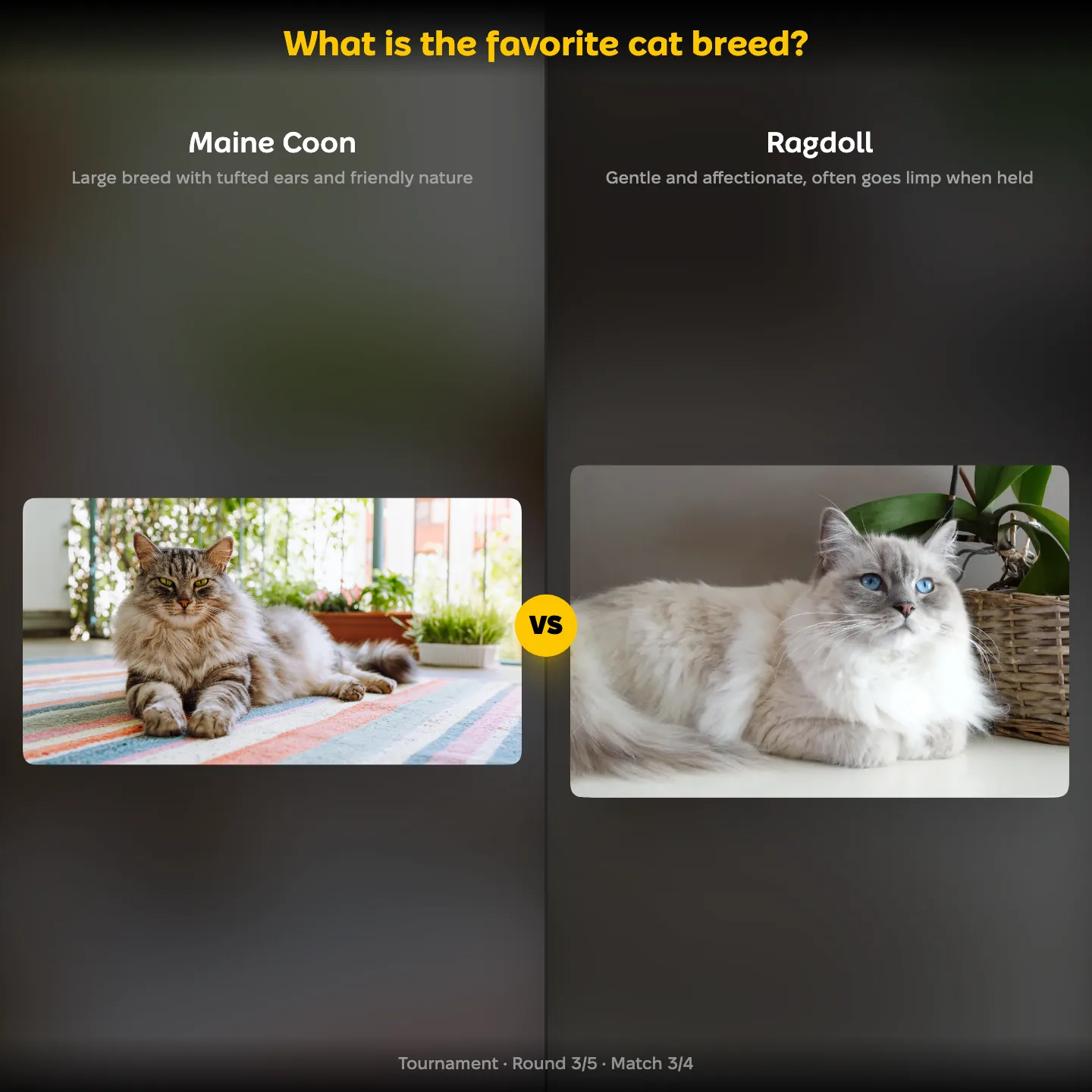
Maine Coon vs Ragdoll: the same list from the cat side
This is the mirror ranking, and no dog appears on it either. Thirty-two cat breeds, judged the same way.
The Cat Fanciers' Association put the Maine Coon first among pedigreed breeds for the second year running in its 2026 list, with the Ragdoll second and the Persian third.6 Both leaders are large, placid, long-haired cats, which is roughly the temperament people say they want from a dog.
Pedigree is a small slice of the picture. Most American cats are domestic shorthairs of no particular breed, so a ranking of registered breeds describes a minority of the animals actually sitting on sofas.
The Chinese zodiac has a Dog and no Cat
Twelve animals hold a year each in the Chinese zodiac. The Dog is the eleventh of them. The Cat is not there at all, and its absence is the most famous omission in the whole system.
The legend explains it as a betrayal: the Rat, sharing a river crossing with the Cat, pushed it into the water and arrived at the Jade Emperor's race without it. Which is why, the story finishes, cats have hunted rats ever since.
The Rat is on this ranking, in first position by year. So is the Dragon, the only mythical sign and the one that produces measurable birth-rate spikes in dragon years.
Here the matchup has nothing to match. A dog holds a year, a cat holds none, and no amount of arguing changes the calendar.

Overrated: the list dogs and cats both land on
The last ranking asks which pet is sold as something it is not, and both of them qualify on the same charge from opposite directions.
The cat is marketed as low-maintenance and independent, then reorganises the household around its preferences. The dog is adored for good reasons and bought constantly by people with no time for two walks a day.
Cats also carry a cost that rarely reaches the sales pitch. Loss, Will and Marra estimated in Nature Communications in 2013 that free-ranging domestic cats kill 1.3 to 4.0 billion birds and 6.3 to 22.3 billion mammals a year in the United States, most of it by un-owned animals rather than pets.7
Neither of them is the worst offender on the page. That belongs to the animals sold as starter pets and quietly needing a decade of care: the goldfish handed over in a bag, the axolotl bought after a video game, the micro pig that grows to eighty kilos.

Fifteen questions, two job descriptions
Dogs and cats have shared human houses for thousands of years without ever competing for the same role, and that is why fifteen rankings produce fifteen different shapes. Ask about a family with toddlers and about a one-bedroom flat and you are not asking a harder and an easier version of one question; you are asking two questions that happen to have the same two candidates.
Every ranking here is decided by two-at-a-time voting. That method is what makes the criteria visible: a pairing cannot be answered without one.
If your own household has settled this, there are fifteen places above to make the case.
More rankings, more angles
- Lion vs Tiger: The Crown Depends on the Category — the same head-to-head, with claws
- The Wolf, Ranked 16 Different Ways — the dog's wild relative, from Fenrir to apex predator
- What Is Pairwise Comparison? The Simple Way to Rank Anything — why two-at-a-time beats a star rating
- Bears Turn Up on Lists About Oscars, Art Auctions and the NFL — Paddington, Fozzie and the 1985 Bears
Sources
- American Pet Products Association — 2025 Dog & Cat Report, US cat-owning households and multi-cat growth: americanpetproducts.org (checked 2026-08-14)
- American Veterinary Medical Association — 2024 pet ownership and demographics survey: household shares, dog and cat populations, annual and veterinary spending: avma.org (checked 2026-08-14)
- Herculano-Houzel et al., Frontiers in Neuroanatomy (2017) — cortical neuron counts in carnivoran species: frontiersin.org (checked 2026-08-14)
- National Geographic — the 9,500-year-old cat burial at Shillourokambos, Cyprus: nationalgeographic.com (checked 2026-08-14)
- American Kennel Club — most popular dog breeds of 2025: akc.org (checked 2026-08-14)
- The Cat Fanciers' Association — most popular pedigreed breeds for 2026: cfa.org (checked 2026-08-14)
- Loss, Will & Marra, Nature Communications 4:1396 (2013) — the impact of free-ranging domestic cats on US wildlife: nature.com (checked 2026-08-14)