
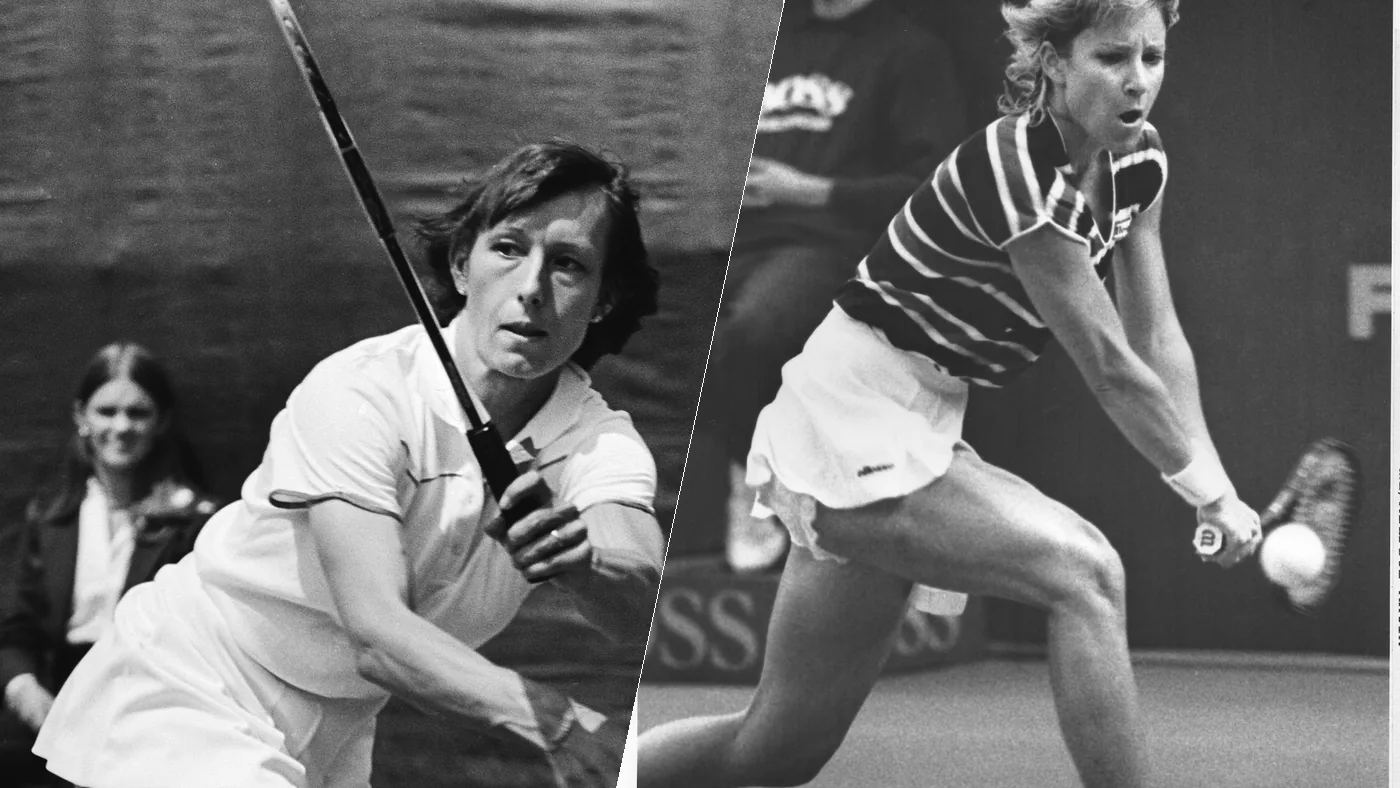
Martina Navratilova and Chris Evert played each other 80 times between 1973 and 1988. Sixty of those meetings were finals, fourteen of them Grand Slam finals, and they retired level on 18 major singles titles apiece.1
Netflix returned to the friendship in June 2026 with Chris & Martina: The Final Set, and the US Open crowns another women's champion on 12 September 2026.15 Both are reasons to go back to a record that is stranger than its summary: Evert won nine of their first ten meetings, then lost ten of their fourteen Grand Slam finals.4
Eighteen majors each and a head-to-head that never opened up, so every list that ranks these two has to choose a tiebreaker, and no two lists choose the same one.
Serena Williams, Steffi Graf, and the two who never separate
The widest question in the women's game puts fourteen names on one list, and Navratilova and Evert are two of them.
Navratilova's case is built on volume across every format. She won 18 major singles titles, 31 women's doubles majors and 10 in mixed doubles, 59 in all, and held the world No. 1 ranking for 332 weeks.3
Evert's case is built on the floor rather than the ceiling. The Tennis Hall of Fame puts her career at 1,309 wins and 146 losses, a rate of 88.52 per cent.2
Neither starts as the obvious answer. Serena Williams won 23 major singles titles and Steffi Graf 22, and Graf's 1988 season remains the only calendar Golden Slam anyone has managed. Widen the frame this far and the pair end up among players they never faced.
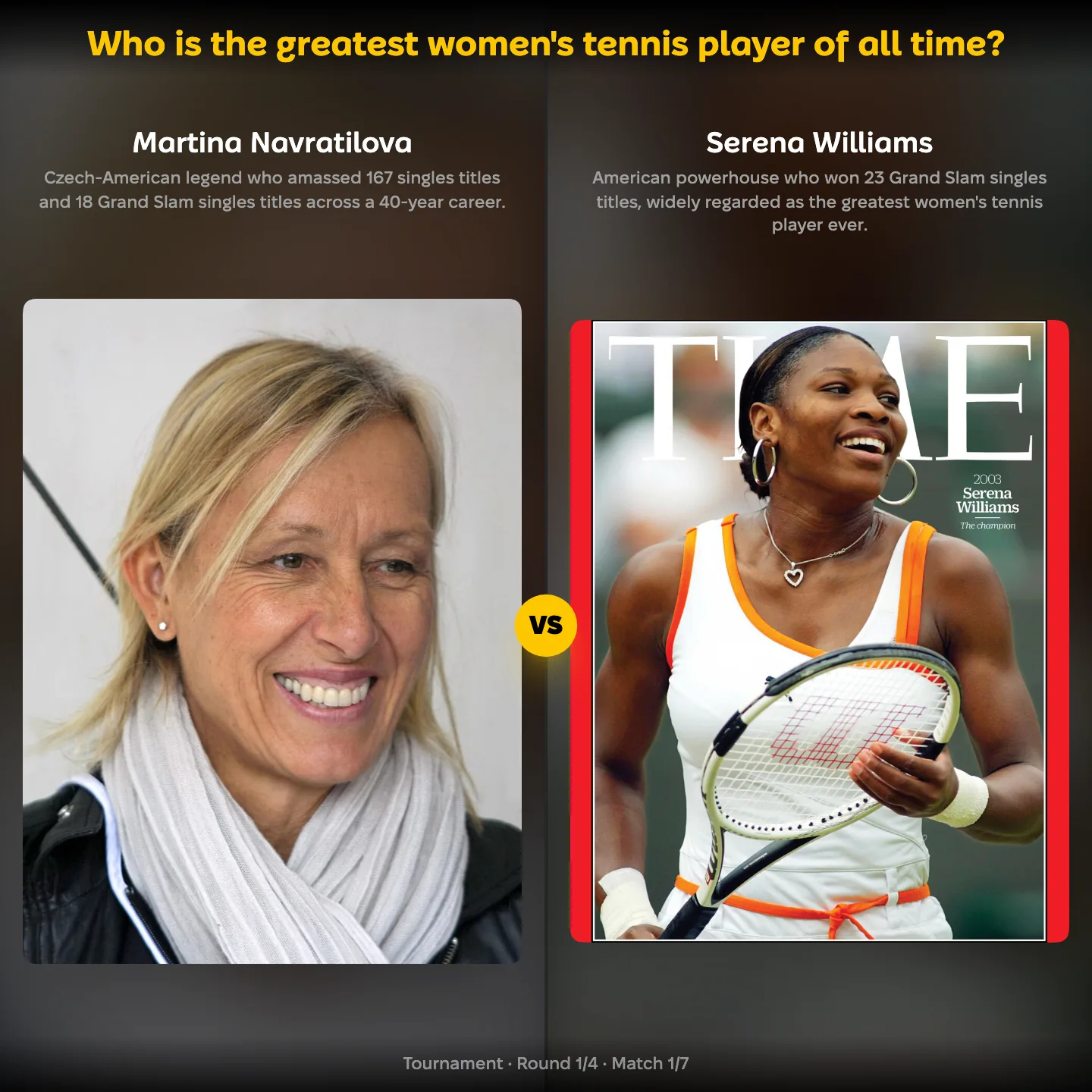
Wimbledon: nine titles against three
Grass is the surface that stops them being level.
Navratilova won the Wimbledon singles title nine times: 1978, 1979, six in a row from 1982 to 1987, and again in 1990.3
Evert won it three times, in 1974, 1976 and 1981.2 Their head-to-head on grass runs 10-5 to Navratilova.4
This particular list mixes the men's and women's champions, which changes the shape of it. Roger Federer, Pete Sampras, Björn Borg and Novak Djokovic are all in the field, and so is Billie Jean King, who won six Wimbledon singles titles of her own.
Roland-Garros, where the order reverses
Move the question to clay and the two numbers swap places.
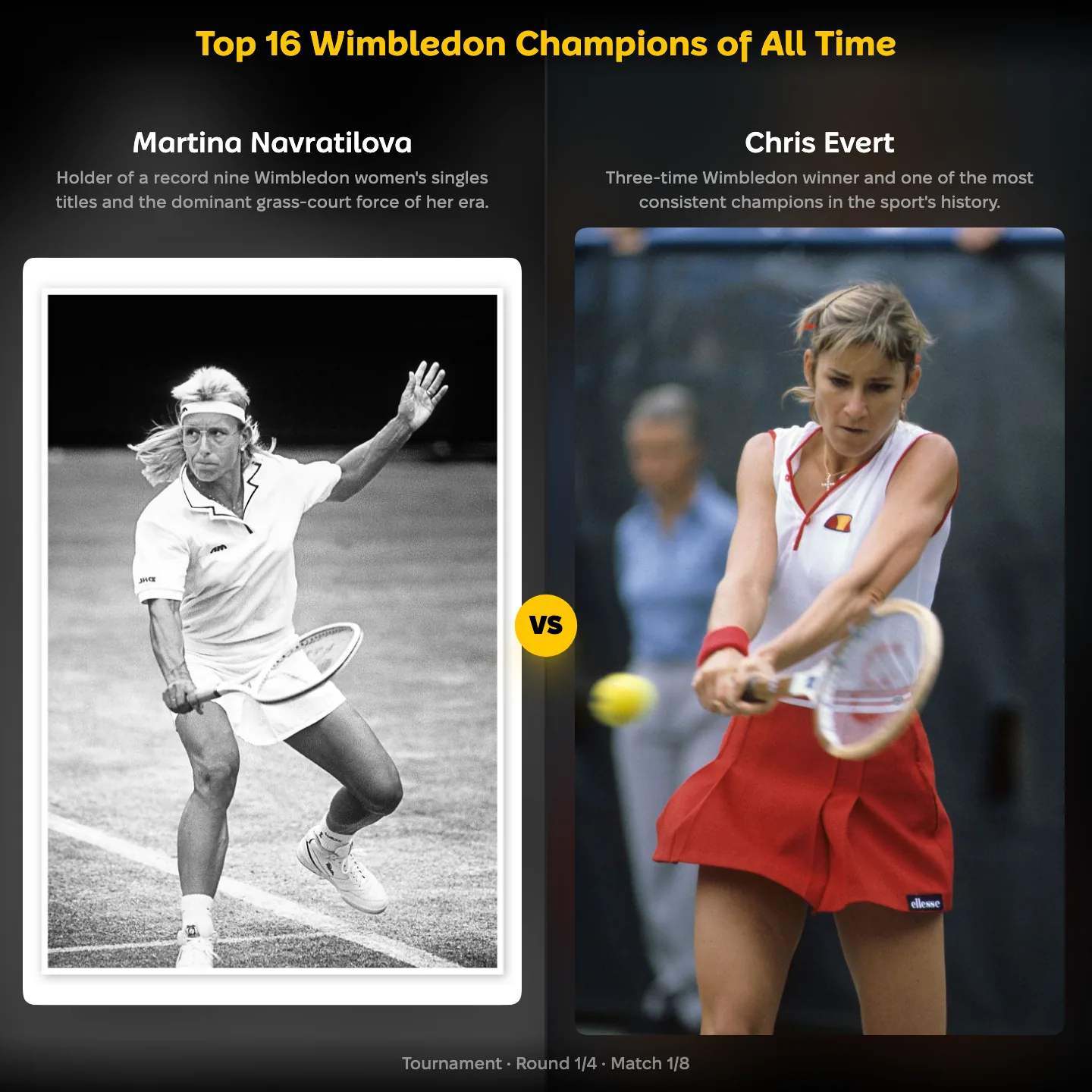
Evert won the French Open seven times between 1974 and 1986.2 Navratilova won it twice, in 1982 and 1984.3
Their head-to-head on clay is 11-3 to Evert, an almost exact mirror of the grass number.4 Two surfaces, two opposite answers, one pair of players.
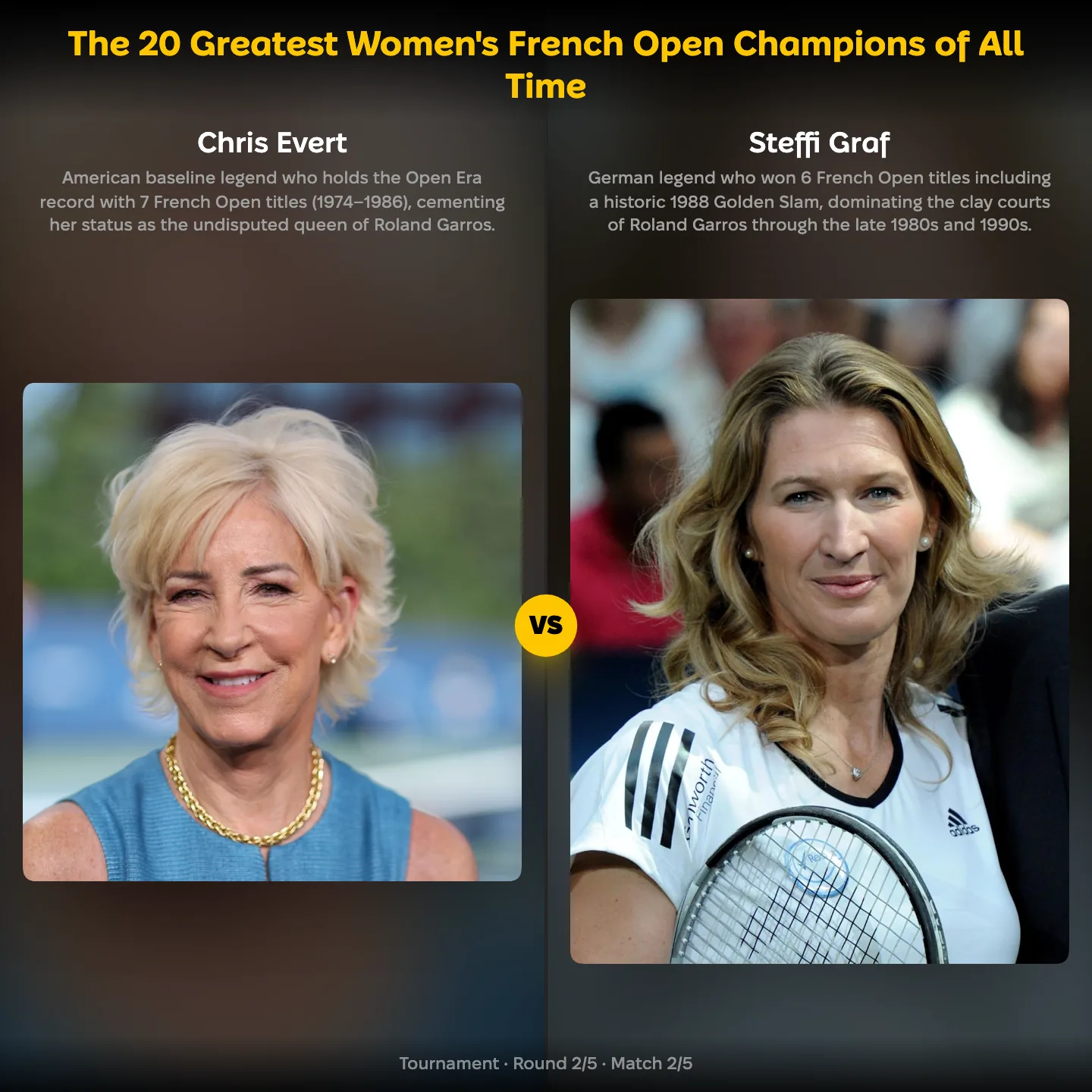
Steffi Graf, who won six titles in Paris, is the name that complicates this one, and Justine Henin's four are not far behind. On a women-only Roland-Garros list Evert has the strongest case she has anywhere.
The US Open: six titles to four
Flushing Meadows is the major both of them treated as home ground, Evert as a Floridian and Navratilova as a naturalised American from 1981.3
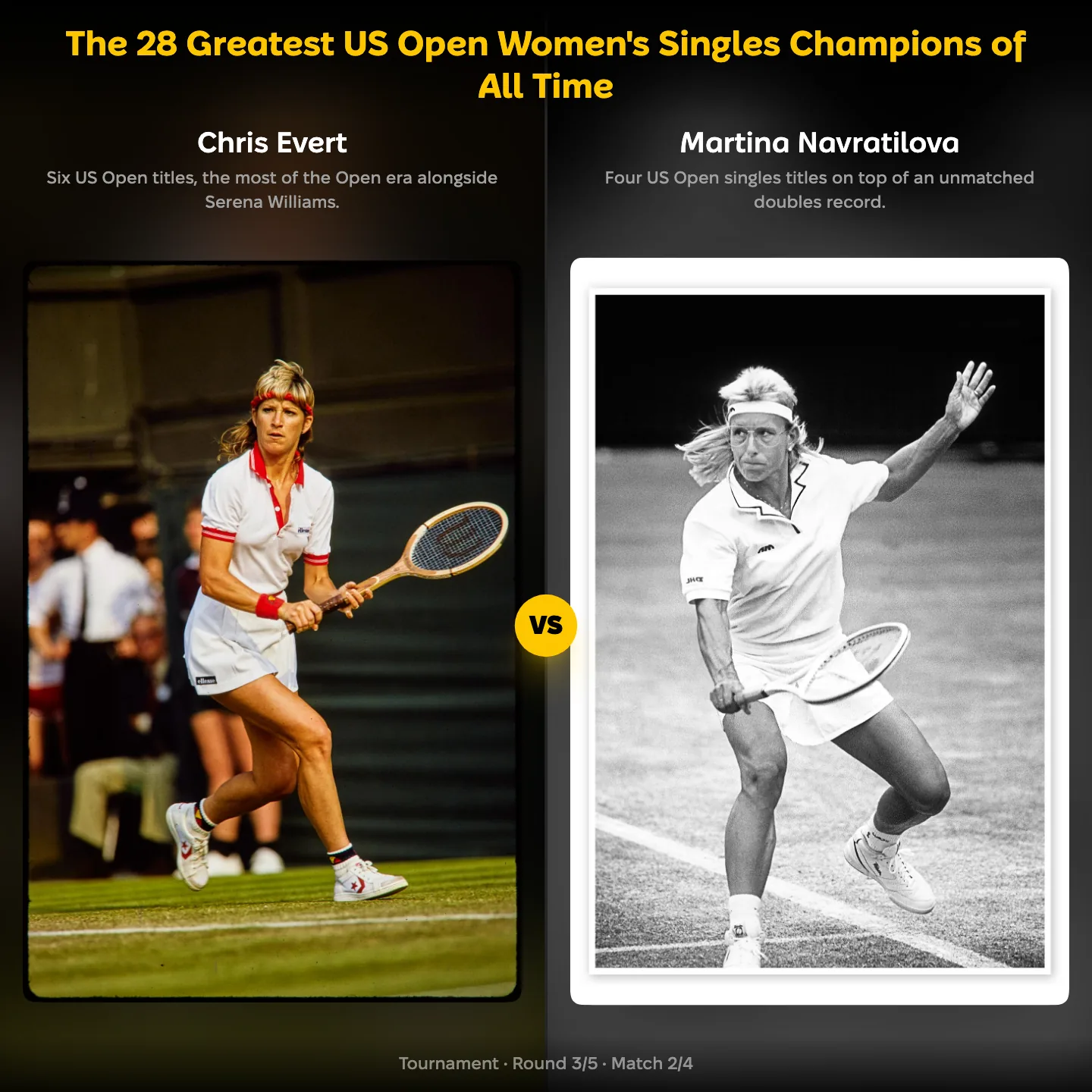
Evert won six US Open singles titles, a total matched only by Serena Williams.2 Navratilova won four, in 1983, 1984, 1986 and 1987.3
Twenty-eight champions are on this list, which stretches back to Molla Mallory and Helen Wills Moody and forward to Coco Gauff and Aryna Sabalenka. The two of them are a chapter in it rather than the whole book.
Melbourne belonged to Margaret Court
The Australian Open is the major that fits neither of their reputations.
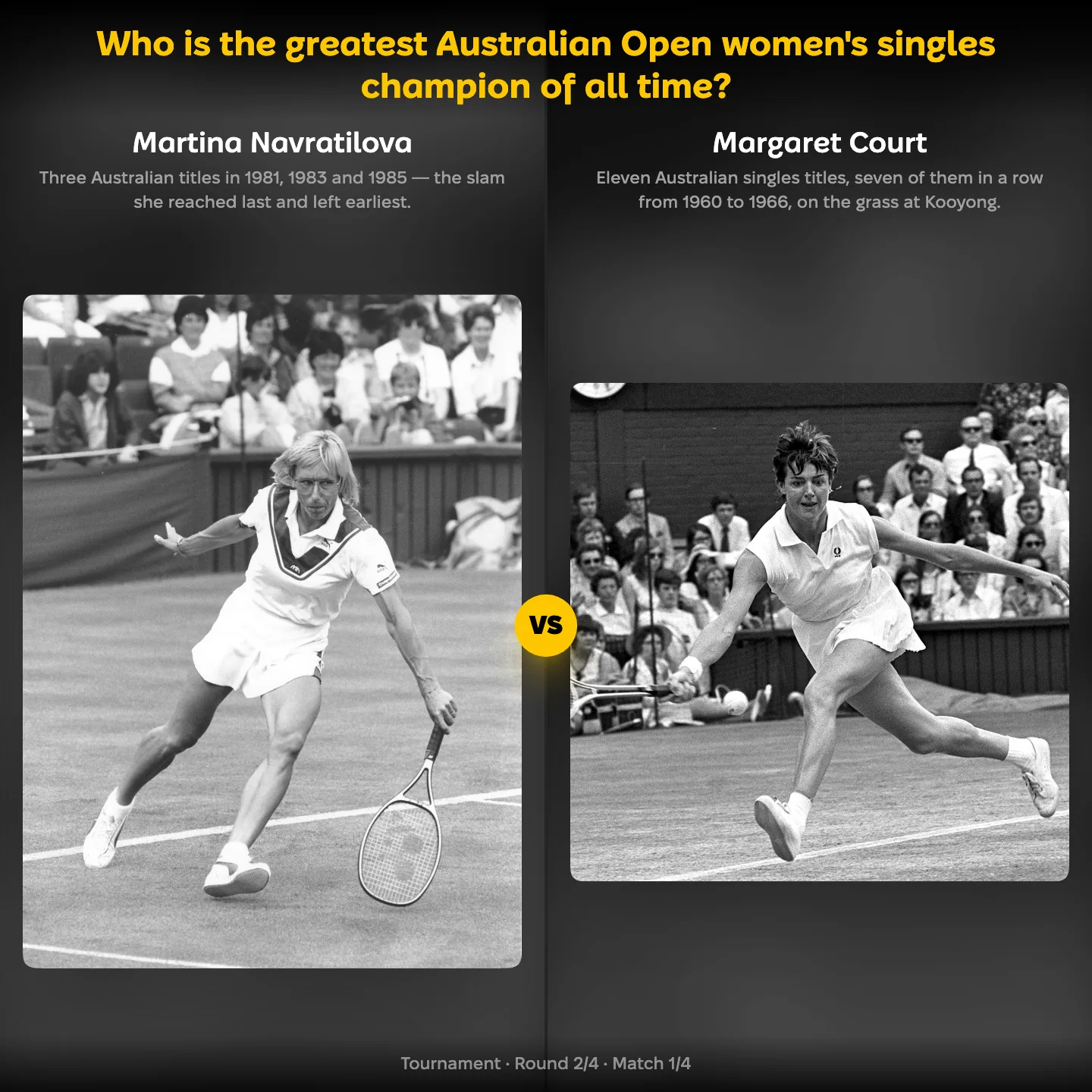
Navratilova won it three times, in 1981, 1983 and 1985.3 Evert took the Australian title in 1982 and 1984.2 For most of their careers the tournament sat at the wrong end of the calendar and the wrong end of a long flight, and the best players in the world often skipped it.
Margaret Court owns this list regardless. She won eleven Australian singles titles, seven of them consecutively from 1960 to 1966.
The 1980s, before Steffi Graf arrived
Narrow the window to the decade the two of them shared and the field thins out immediately.
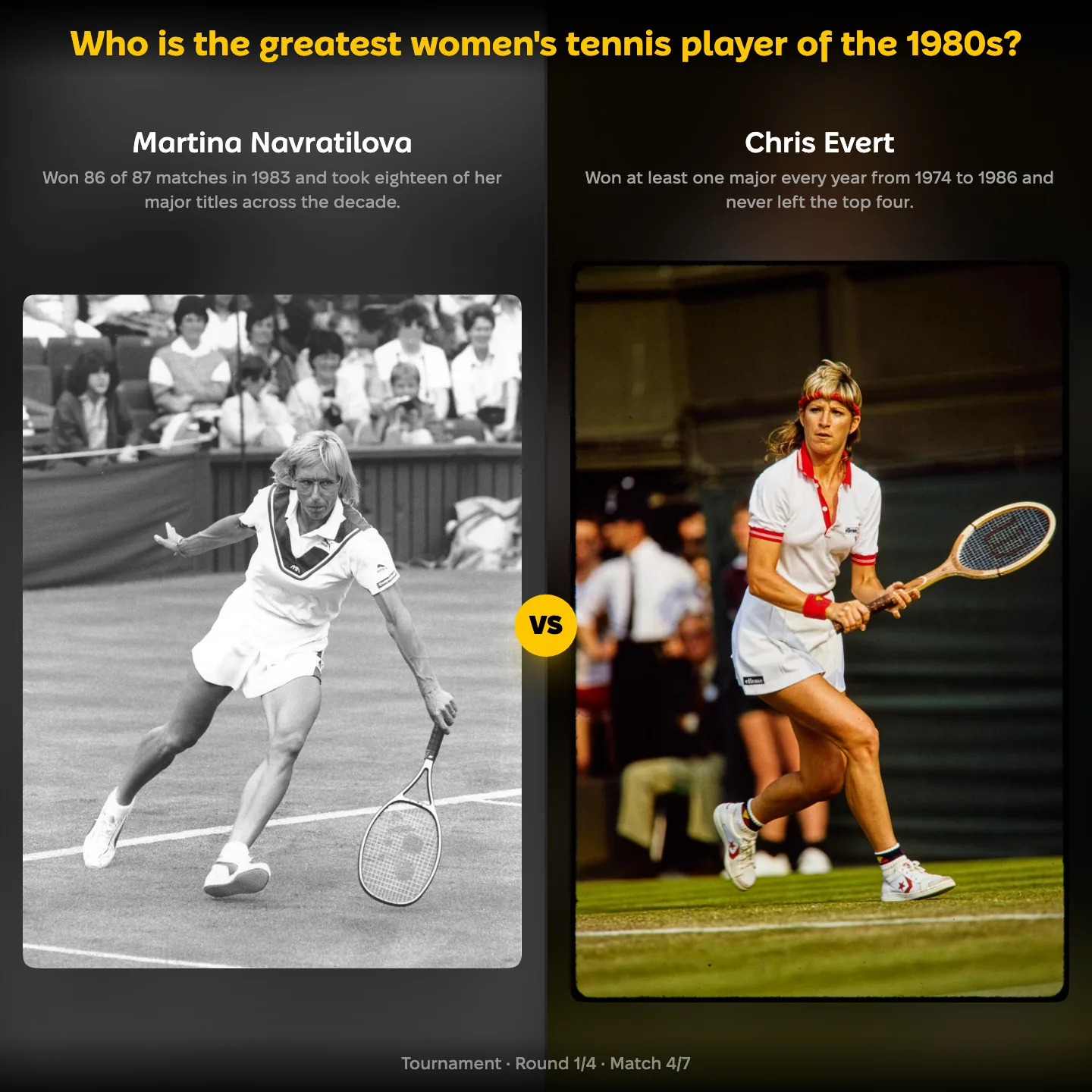
Navratilova's 1983 was the most extreme season either of them produced: 86 wins, one loss, a 98.9 per cent rate. The following year she won 74 consecutive matches and took six major singles titles in a row across the two seasons.3
Evert's decade was quieter and longer. She won at least one major every year from 1974 to 1986, thirteen seasons in succession, and stayed in the top four throughout.2 Her two Australian titles and three of her seven Roland-Garros titles came inside these ten years.
Everyone else on the list was competing for third. Hana Mandlíková won four majors, Tracy Austin two US Opens before injuries ended her career at twenty-one, and Gabriela Sabatini reached finals at Wimbledon and Flushing Meadows without winning either in the decade.
The interesting name is at the end of it. Arantxa Sánchez Vicario beat Steffi Graf to win Roland-Garros in 1989 at seventeen, which is the moment the decade stops belonging to anyone in this article.
Chris Evert's 52 semi-finals from 56 majors
Consistency is a different measurement from dominance, and it is where Evert has her strongest single number.
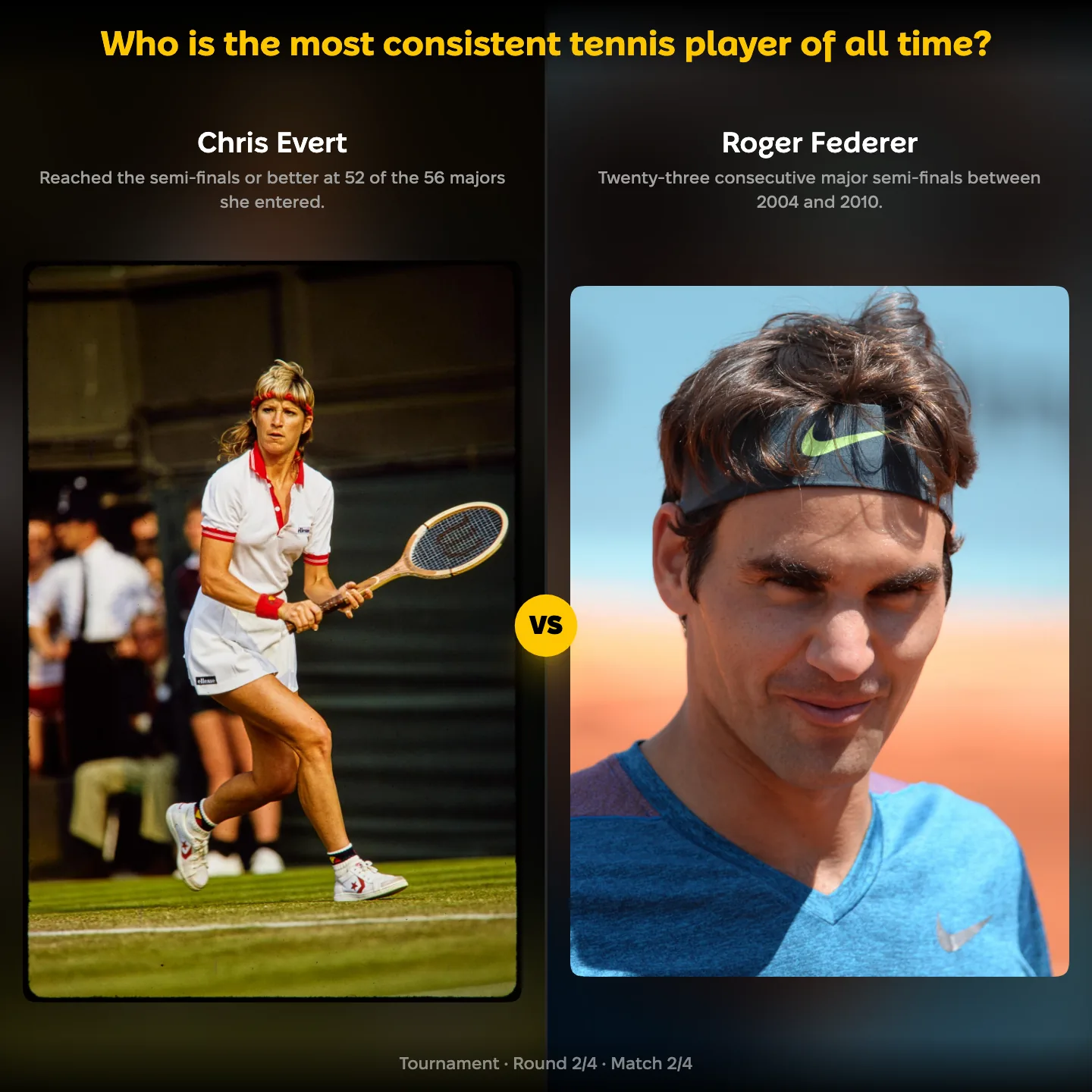
She entered 56 major championships and reached the semi-finals or better at 52 of them, and she played 34 major finals, more than any other player in the sport's history.6 Four early exits across a nineteen-year career is a rate nobody has matched.
Navratilova answers on duration instead. She held a top-ten ranking for close to two decades and won her last major, a US Open mixed doubles title, at forty-nine.3
The men on this list have their own version of the claim. Roger Federer reached twenty-three consecutive major semi-finals between 2004 and 2010, and Rafael Nadal won fourteen French Open titles across eighteen years. Consistency is one of the few questions where the women's and men's records can be laid side by side without an asterisk.
The calendar Grand Slam that escaped them both
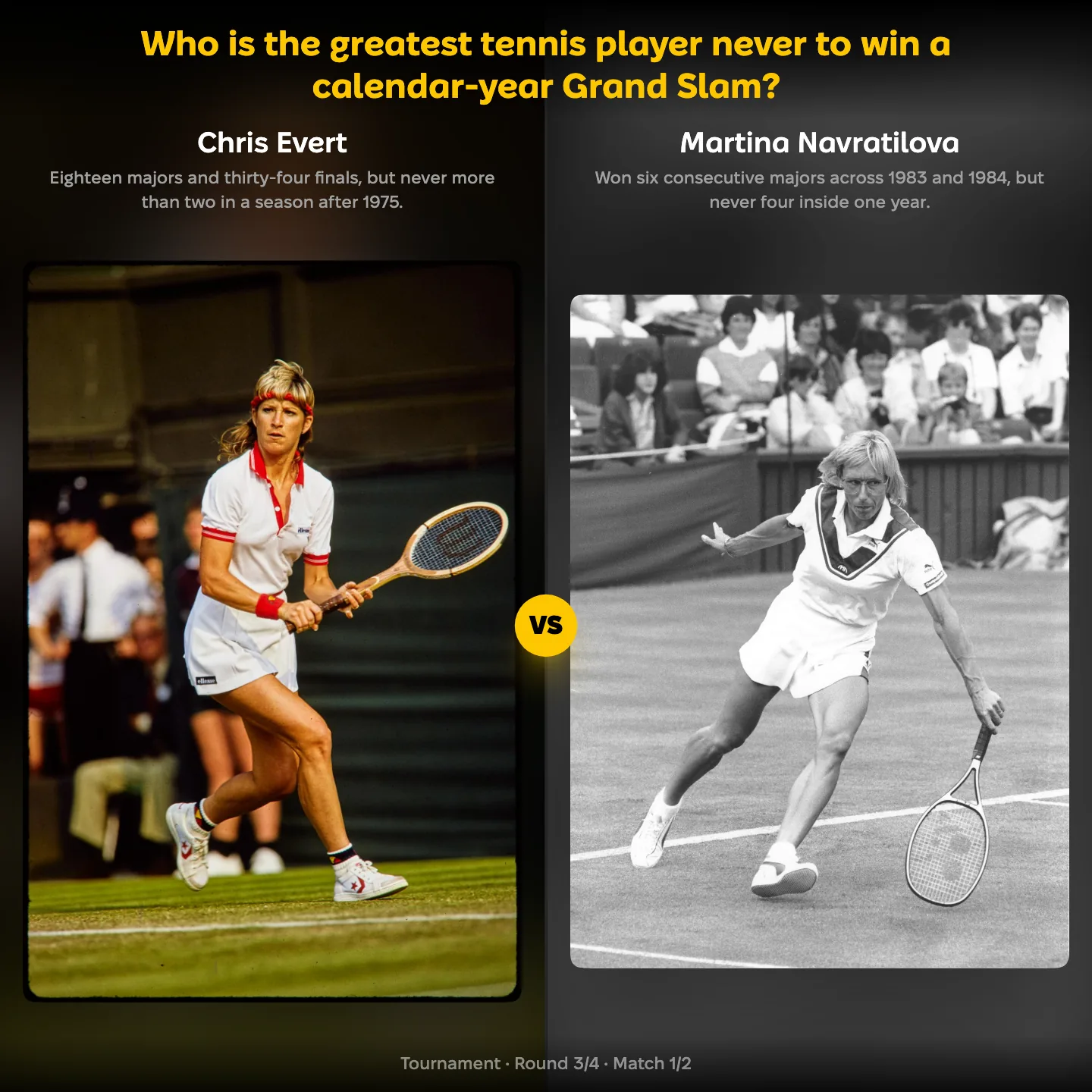
Five players have won all four majors inside a single calendar year. Neither Navratilova nor Evert is among them, and this is the list where that absence is the whole point.
Navratilova came closest of anyone here. She won six consecutive major singles titles across 1983 and 1984, which is more majors in a row than the calendar slam requires, and none of the runs fitted inside one year.3
Evert never won more than two majors in a season after 1975, despite winning at least one in thirteen straight years.2 Consistency and the calendar slam turn out to reward different things.
The company is good. Serena Williams held all four titles at once twice without doing it inside a year, Novak Djokovic lost the 2021 US Open final one match short, and Pete Sampras never won a French Open at all.
Roland-Garros 1985, as one line on somebody else's list
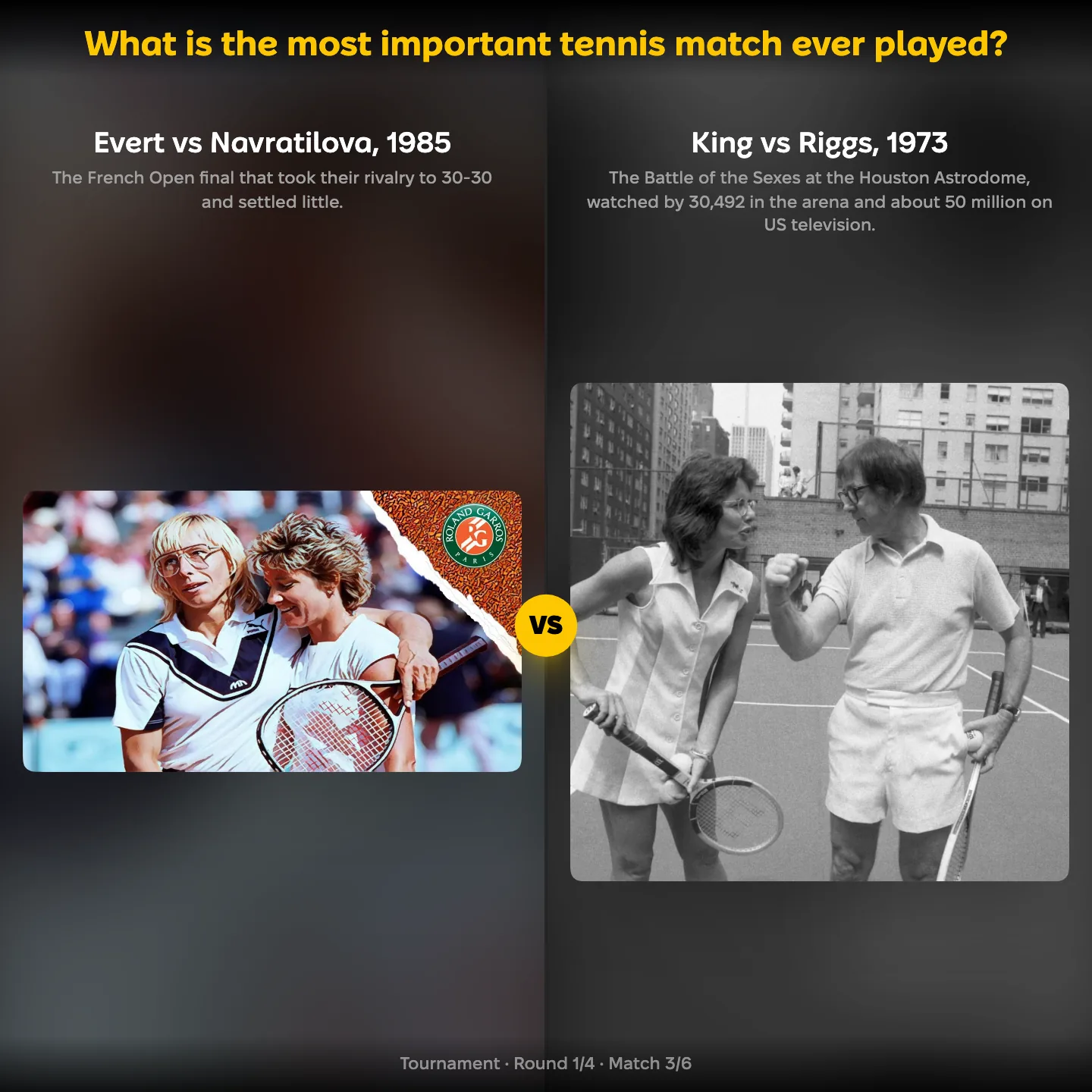
Here the rivalry stops being two names and becomes a single entry.
Their 1985 French Open final is among eleven entries in a ranking that asks which tennis match mattered most, alongside Billie Jean King against Bobby Riggs in 1973 and Roger Federer against Rafael Nadal at Wimbledon in 2008.
That is a strange kind of promotion. Navratilova and Evert played 80 matches, and the sport has decided that one of them, on clay, near the end, stands for all of it.1
The competition is heavy. King beating Riggs in front of a stadium crowd and a national television audience changed what women's tennis was worth commercially, which is a claim about the world rather than about tennis.
Their Wimbledon final, next to Borg and McEnroe's
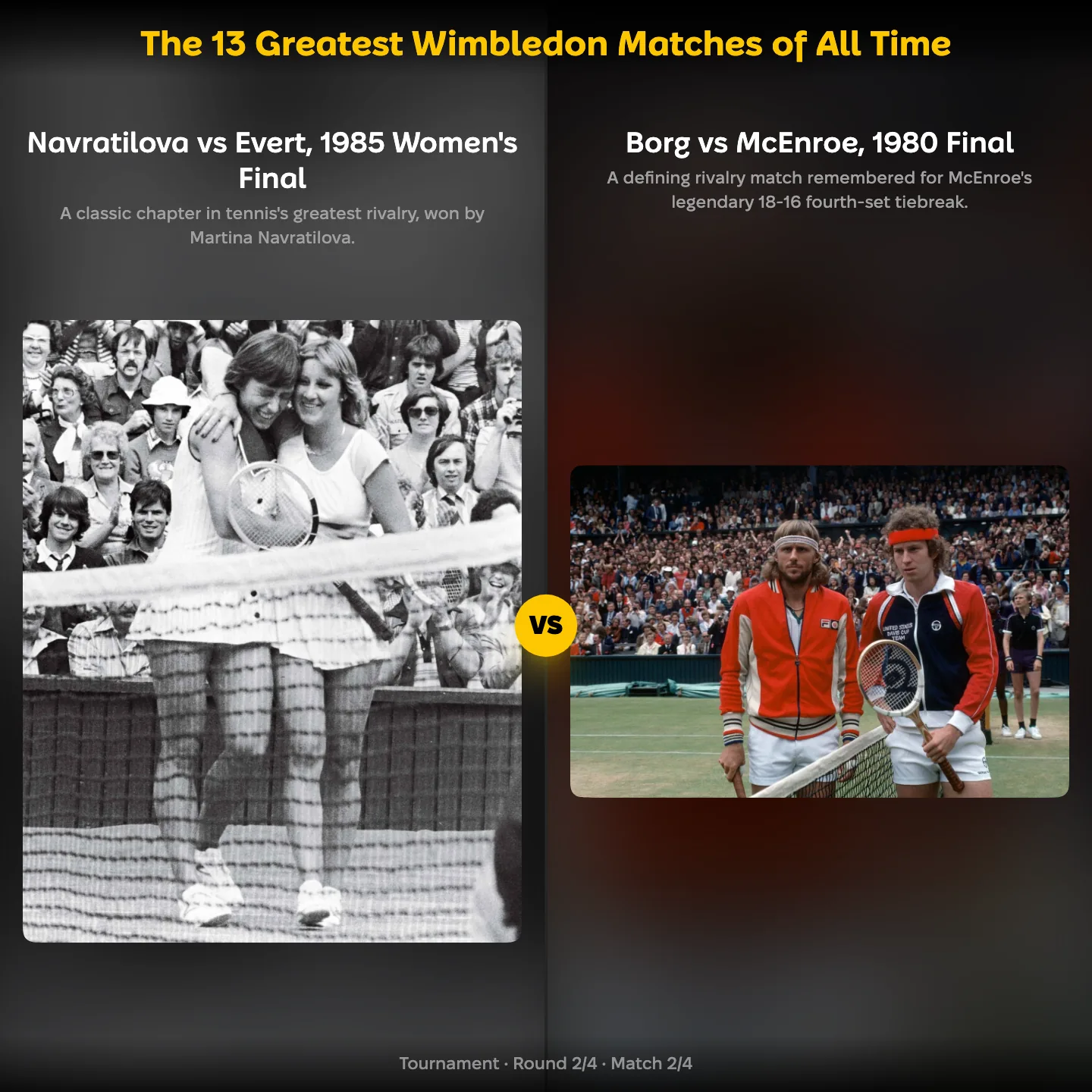
Wimbledon keeps its own list of great matches, and the two of them appear on it twice over.
The 1985 women's final between Navratilova and Evert is one entry. The 1980 final between Evonne Goolagong and Evert is another, which means Evert is in two of the thirteen and Navratilova in one.
Everything around them is men's tennis. Björn Borg against John McEnroe in 1980, with its 18-16 fourth-set tiebreak, is the match most people name first, and Federer against Nadal in 2008 is the one most people alive remember watching.
The asymmetry is worth stating plainly: a women's final has to be extraordinary to make a list like this, and two of theirs did.
Ali and Frazier, Magic and Bird, and these two
Take the question out of tennis entirely and the pair are still on the list.
Eighty meetings across fifteen years, sixty of them finals, is a volume of head-to-head competition that almost no rivalry in sport can match.1 Muhammad Ali met Joe Frazier three times. Magic Johnson and Larry Bird met in three NBA Finals.
What Navratilova and Evert have instead of scarcity is repetition, and the fact that the record barely moved. Forty-three to thirty-seven across fifteen years is as close as a rivalry that long can stay.
The field here is crowded with names that carry whole sports: Senna and Prost, Messi and Ronaldo, the Yankees and the Red Sox, Real Madrid and Barcelona.

Clay: Evert against Justine Henin
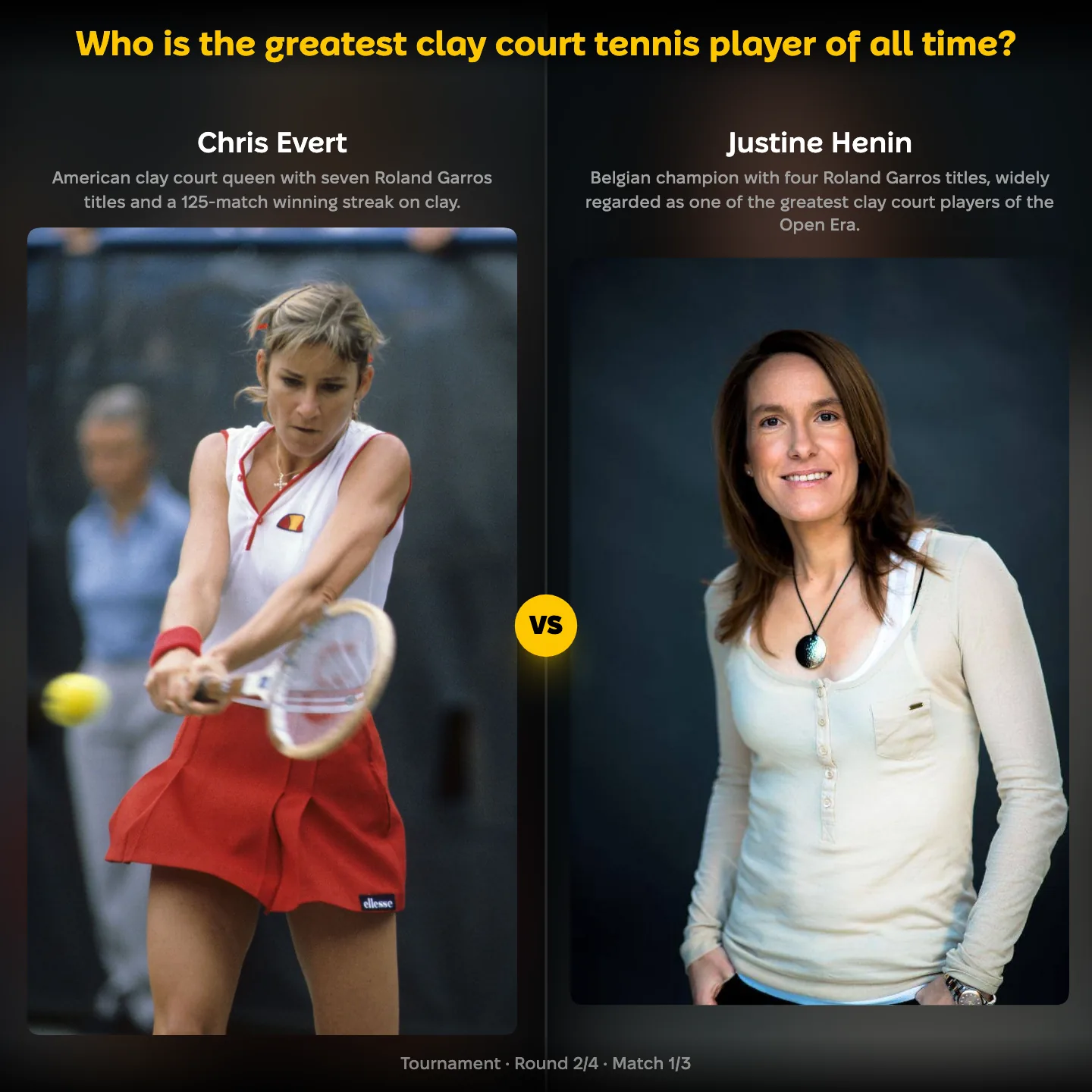
This is a list Evert belongs on and Navratilova does not, and the reason is a single streak.
Between August 1973 and May 1979 Evert won 125 consecutive matches on clay across 24 tournaments, and her career winning rate on the surface was 94.55 per cent.2 Nearly six years without losing on a surface is not a record anyone is threatening.
Navratilova's two Roland-Garros titles are a real achievement for a serve-and-volley player, and they are not enough to put her in a top ten of clay-courters.3
The list itself is mostly men, because Rafael Nadal's fourteen French Open titles have made this a question with a settled answer at the top. Björn Borg, Justine Henin and Steffi Graf fill in behind him.
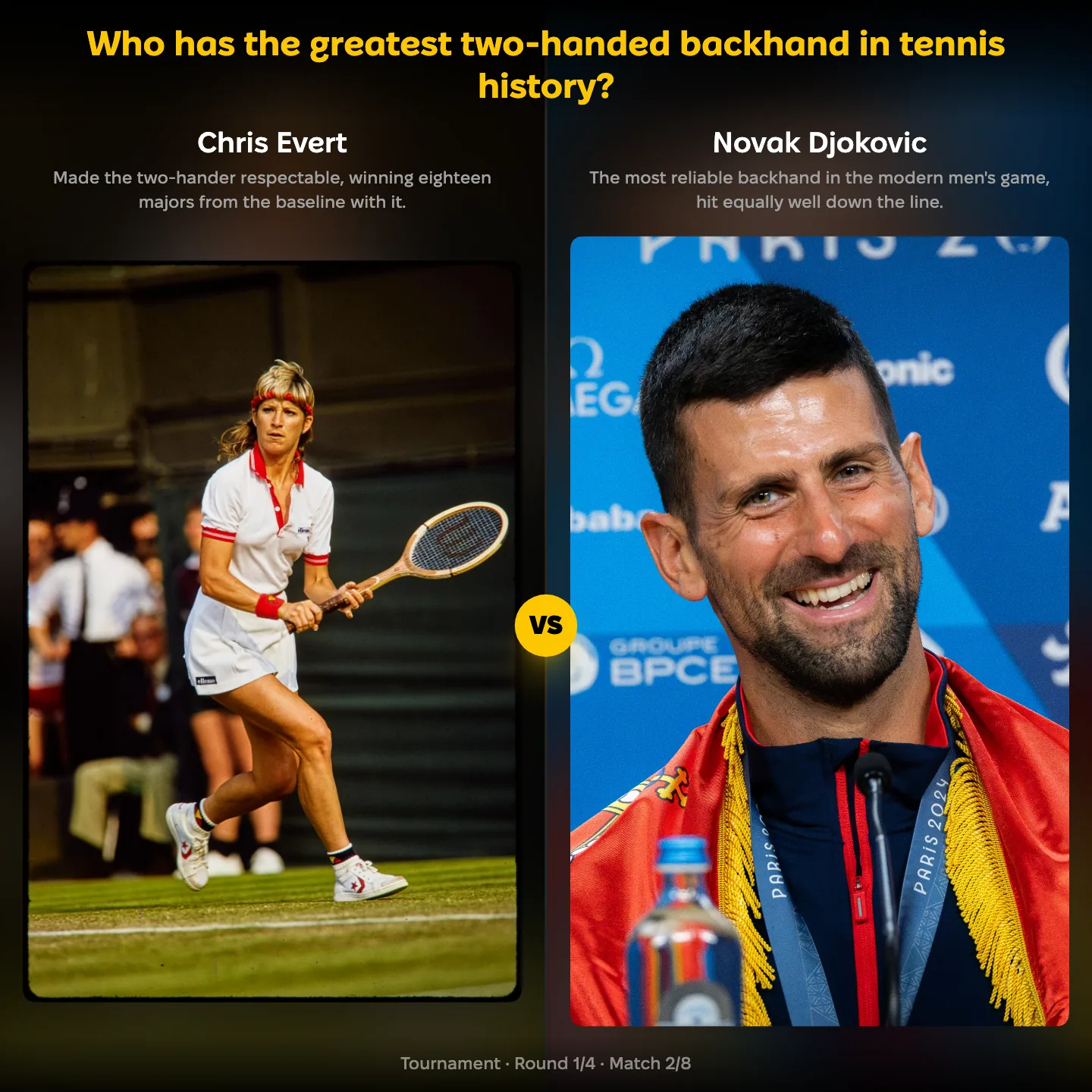
The two-handed backhand Evert made respectable
Navratilova cannot enter this one. She played a one-handed backhand, so the list is closed to her before it starts.
Evert qualifies because of what the shot meant when she started using it. The two-hander was treated as a junior's compromise, something a small player used until they grew into a proper stroke, and she won 18 majors hitting it from the baseline.
The modern game agrees with her rather than with her critics. Novak Djokovic, Andre Agassi, Monica Seles, Serena Williams and Iga Świątek all built careers on the shot, and the one-hander is now the exception.
That inversion is the honest way to read this list. Evert is not the best two-hander in the field on technique alone, and she is the reason the field exists.
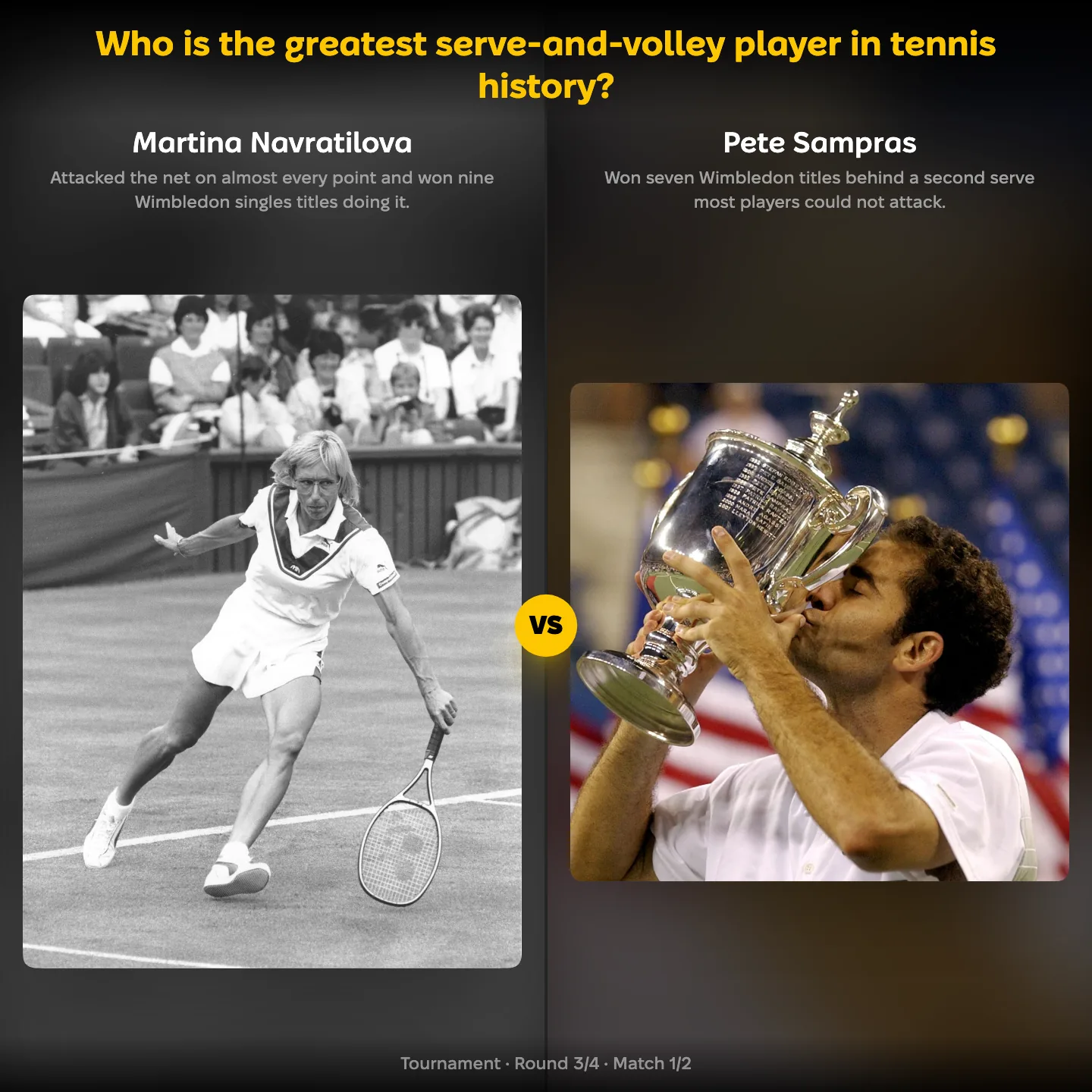
Serve and volley: Navratilova against Pete Sampras
Reverse the previous question and the exclusion reverses with it.
Navratilova attacked the net on almost every point, and she won nine Wimbledon singles titles doing it.3 The style is what made the grass numbers between the two of them so lopsided, and it is also why she kept winning doubles long after the singles record closed.
Evert is missing from this one entirely. She played from the baseline, and the whole point of their fifteen years was that the two styles were opposites which happened to be equally good.
Pete Sampras, John McEnroe, Stefan Edberg and Billie Jean King are the company. Serve and volley is now close to extinct in professional tennis, which turns this list into a historical record rather than a live question.
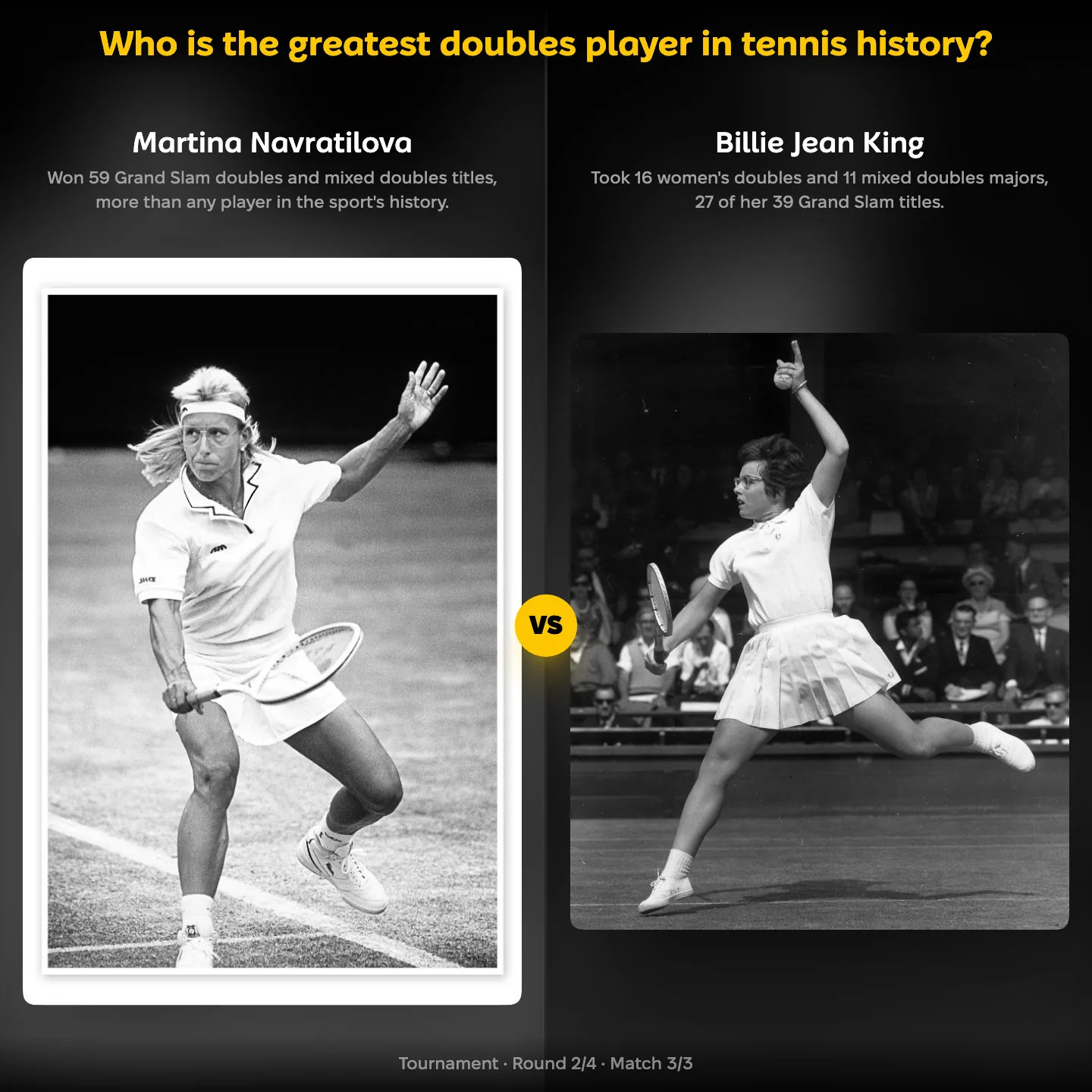
Doubles, where Navratilova kept going
The singles argument stops in 1988. The doubles one runs another eighteen years.
Navratilova won 41 major doubles titles across the women's and mixed events, on top of the 18 in singles, and 177 doubles titles overall, an Open Era record.3 With Pam Shriver she won a calendar Grand Slam in doubles in 1984.
Evert is absent from this list, and not because she was bad at doubles. She played it far less, and the singles schedule she kept for nineteen years left little room for anything else.
Billie Jean King keeps this one competitive. She took 16 women's doubles majors and 11 in mixed, 27 of her 39 Grand Slam titles.
Eighty matches, and no tiebreaker
Fifteen questions, and the two of them change places in nearly all of them. Grass says Navratilova, clay says Evert, doubles says Navratilova again, and the two lists about their own matches say neither, because a third name is usually carrying those. The majors stay level at eighteen apiece no matter which way the question is put, which is why every ranking that includes both has to reach past the trophy count for something else to measure.
That reaching is the interesting part, and it is what comparing them two by two does: each pairing forces one small decision instead of one large one.
Disagree with any of the fifteen? All of them are open to vote on, and making a new one takes about a minute.
More rankings, more angles
- Borg vs McEnroe Rivalry: Tied 7–7, Ranked on 14 Lists — the Wimbledon rivalry of the same years, level at seven wins each
- Billie Jean King Won 39 Majors. One Exhibition Made Her Famous — the player who turns up in both of these careers
- Serena Williams Won 23 Majors. The Lists Still Can't Place Her — the one who broke the eighteen-major ceiling
- Federer vs Nadal vs Djokovic — 16 Lists That Split Them — the men's version of a record that will not separate
Sources
- WTA — "Chris & Martina: The Final Set is honest, raw and remarkably powerful": the Netflix release date of 26 June 2026, the 80 meetings, Navratilova's 43 wins and the 18 major singles titles each: wtatennis.com (checked 2026-09-05)
- International Tennis Hall of Fame — Chris Evert: the major breakdown (7 French Open, 6 US Open, 3 Wimbledon, 2 Australian Open), the 1,309–146 career record and 88.52 per cent rate, the 94.55 per cent clay rate and the 125-match clay streak from August 1973 to May 1979: tennisfame.com (checked 2026-09-05)
- International Tennis Hall of Fame — Martina Navratilova: the nine Wimbledon titles and the rest of the major breakdown, 31 women's doubles and 10 mixed doubles majors, 332 weeks at No. 1, the 86–1 record in 1983 and the 74-match winning streak in 1984: tennisfame.com (checked 2026-09-05)
- Wikipedia — Evert–Navratilova rivalry: the 14 Grand Slam final meetings won 10–4 by Navratilova, and the surface splits of 11–3 to Evert on clay and 10–5 to Navratilova on grass: wikipedia.org (checked 2026-09-05)
- WTA — US Open 2026 dates and schedule, including the women's singles final on 12 September 2026: wtatennis.com (checked 2026-09-05)
- Wikipedia — Chris Evert: the 52 semi-finals or better from 56 major appearances and the record 34 major singles finals: wikipedia.org (checked 2026-09-05)