


YouTube sits inside four unrelated arguments at once: what counts as television, what counts as a music service, where people go to learn something, and which comment section is the worst on the internet.
Nielsen measured it at a platform-best 13.8% of all US TV watch-time in May 2026.1 In February, Alphabet broke out the platform's revenue for the first time: more than $60 billion across advertising and subscriptions in 2025.2
Neither figure settles which category it belongs to.
No two of these sixteen lists agree on what YouTube even is, let alone where it belongs.
YouTube vs Wikipedia: the two sites nobody replaced
The widest possible question about the internet is which sites on it mattered. Google, Amazon, Facebook and Wikipedia are the obvious answers, and YouTube belongs on any honest version of the list.
What separates it from most of the field is that it never got replaced. Craigslist survived by refusing to change; MySpace did not survive at all. YouTube absorbed every format that came for it, including the fifteen-second one.
Wikipedia is the closest thing to a peer here. Both launched in the early 2000s, both run on unpaid contributions, and both became infrastructure that other products quietly depend on.
The counter-argument is that Google Search is the door everyone walks through first, and a door is worth more than a room.
Filed as social media, next to TikTok and Instagram
Put YouTube on a social media list and it stops looking like a video service. The field becomes TikTok, Instagram, Reddit, Snapchat and Discord, all of them built around posting rather than watching.
It fits awkwardly, because most people who use it never post anything. The follower count that matters on Instagram is a subscriber count here, and the subscriber count is not what decides whether a video spreads.
It also breaks the flattering assumption behind these lists. The most-viewed thing ever uploaded is "Baby Shark Dance", a Korean children's song that has passed 16 billion views.3 That is the platform's actual centre of gravity, not the creator economy.
Google Maps, WhatsApp, YouTube: nothing here costs anything
Strip out price and the comparison changes shape. Google Maps replaced an entire industry of dedicated devices, WhatsApp became the phone network across much of the world, and YouTube gave away effectively unlimited video.
All three are free because someone else is paying. That is the quiet condition on this whole category, and it is why the question is really about which free thing you would miss first.
Netflix, HBO Max, and a subscription that only removes ads
On a streaming list YouTube appears under a different name and a different premise. Netflix, Disney+ and HBO Max sell you things to watch. YouTube Premium sells you the absence of interruptions on things you could already watch for nothing.
That makes it the odd entry in a category defined by libraries. There is no Premium-exclusive drama anyone can name, and nobody subscribes for the catalogue.
Advertising is the reason the free tier exists at all. Alphabet reported $11.38 billion in YouTube ad revenue for the fourth quarter of 2025 alone.2 The subscription is a way to opt out of the actual business.
Against that, the streaming services are all converging on ad-supported tiers of their own, which makes YouTube less of an outlier every year.
Nielsen counts it as television
The smart-TV question is the one where the outside evidence is strongest, because a ratings body that exists to measure television now measures YouTube inside it.
Nielsen's May 2026 Gauge report gives it "the largest share of television among all distributors" for a third consecutive month.1 Not the largest share among free apps. Ahead of Disney, ahead of Netflix, ahead of the broadcast networks.
The living room was also the hardest place for it to reach. For most of its life this was a laptop product, watched in a browser tab in twenty-minute stretches, and the leap to the biggest screen in the house took a decade of set-top boxes, games consoles and dedicated buttons on remote controls.
What arrived with it was a different kind of programming. Long-form video essays, repair channels, cooking shows and live sport now play on televisions in slots that used to belong to networks, which is why advertisers stopped treating the platform as a place for pre-roll and started buying it the way they buy broadcast.
Netflix, Disney+ and Prime Video still make the case that a smart TV is for watching finished films rather than clips. That case has been getting quieter every quarter.
Spotify vs YouTube Music: the category it entered last
Music is where the incumbent becomes the challenger. Spotify defined what a music subscription feels like, and Apple Music arrived with a catalogue and a billing relationship already in place.
YouTube Music came third to a category its parent platform had been informally serving for years. Anyone who ever left a live version or a lyric video playing was already using YouTube as a music service without paying for one.
The paid business is no longer small. Google put YouTube Music and Premium past 125 million subscribers, trials included, in 2025.4
Spotify's defence is that nobody switches services for the catalogue, because everyone has the same catalogue. People switch for the recommendations, and that is the thing Spotify built first.
TikTok, radio and the fifteen-second hook
Discovery is a different question from playback, and it brings in options that are not apps at all. Radio, record shops, live support acts and a friend with strong opinions all belong on this list.
YouTube's claim is breadth of format. A song can reach someone as a live clip, a lyric video, a game soundtrack or an autoplay accident nobody chose.
TikTok's claim is speed. Fifteen seconds of a chorus, repeated enough times, now moves songs onto national charts faster than radio ever did.
The oldest options still have the thing the algorithms do not: a human being who is prepared to vouch for the recommendation.
Apple Podcasts vs YouTube: the podcasts people watch
Podcasting was built on open RSS, and Apple Podcasts is the directory that made it work. Pocket Casts, Overcast and AntennaPod are all still playing by those rules.
YouTube arrived late and ignored them. It offered video for a medium defined by audio, which sounded like a category error until the biggest shows started shooting themselves in studios.
That is now the format a large share of listeners actually meet a podcast in: a face on a screen, watched in a browser tab or on a television.
Spotify took the other route and bought its way in with exclusives. Between the two of them, the open directory that started the medium is the one under pressure.
Facebook vs YouTube: what "social network" is supposed to mean
Narrow the word from "social media" to "social network" and the field tightens around Facebook, LinkedIn and the friend graph. YouTube has never really had one of those.
There is no mutual-follow relationship on it, no feed built from people you know, and no expectation that anyone you have met in person is on the other end.
What it has instead is a comment section under a billion videos and a subscription button, which is enough to keep it on the list without ever making it a natural answer.
Facebook's case is the plain one. It connected roughly half the planet to people they already knew, which is exactly what the phrase was invented to describe.
Twitch vs YouTube Live: the room it never took
Live is the one video category YouTube never owned. Twitch turned watching someone else play into a full-time job, and it did so with a culture, a vocabulary and a chat window that people came for as much as the stream.
YouTube Live has better search, a larger archive and a payment system already attached to every account. It has still spent a decade as the alternative rather than the default.
Kick arrived by paying creators a 95/5 revenue split, which tells you where the competitive pressure actually is. The social apps bolted live video onto products people were already opening.
Khan Academy, Coursera, and a tutorial from a stranger
Online learning is where the comparison gets uncomfortable for the institutions. Coursera carries university courses, edX was founded by MIT and Harvard, and Khan Academy is a free nonprofit curriculum that runs school maths end to end.
YouTube has none of that structure. No syllabus, no assessment, no way of knowing whether the person explaining a gearbox has ever opened one.
It is also where most people go first, because the answer arrives in ninety seconds and somebody has already filmed the exact step you are stuck on.
Gmail vs YouTube: the best thing Google ever made
Inside its own parent company YouTube stops being the giant and becomes one product among several. Gmail, Google Maps, Chrome, Translate and Google Earth all changed a category on their own.
The strange part of this list is that YouTube is the only major entry Google did not build. Everything else here started inside the company.
Gmail is the strongest rival on it. It launched in 2004 with a gigabyte of free storage at a time when rivals offered a few megabytes, and it made deleting email pointless.
Maps has the better claim to daily necessity. Chrome has the better claim to shaping the web itself.
$1.65bn, October 2006
Here the entry is not the platform at all, but the cheque somebody signed for it. Google announced the purchase of YouTube on 9 October 2006, an all-stock deal worth $1.65 billion, and closed it that November.5
At the time it read as reckless. YouTube was twenty months old, unprofitable, and facing enough copyright exposure that Viacom sued for a billion dollars the following spring.
Two decades later it is the deal every "best acquisition" list opens with, on a simple ratio: the price against what the asset now earns in a single quarter.
Facebook's $1 billion for Instagram and Google's roughly $50 million for Android are the only comparable bets, and both of them faced a friendlier legal picture on the day they were signed.
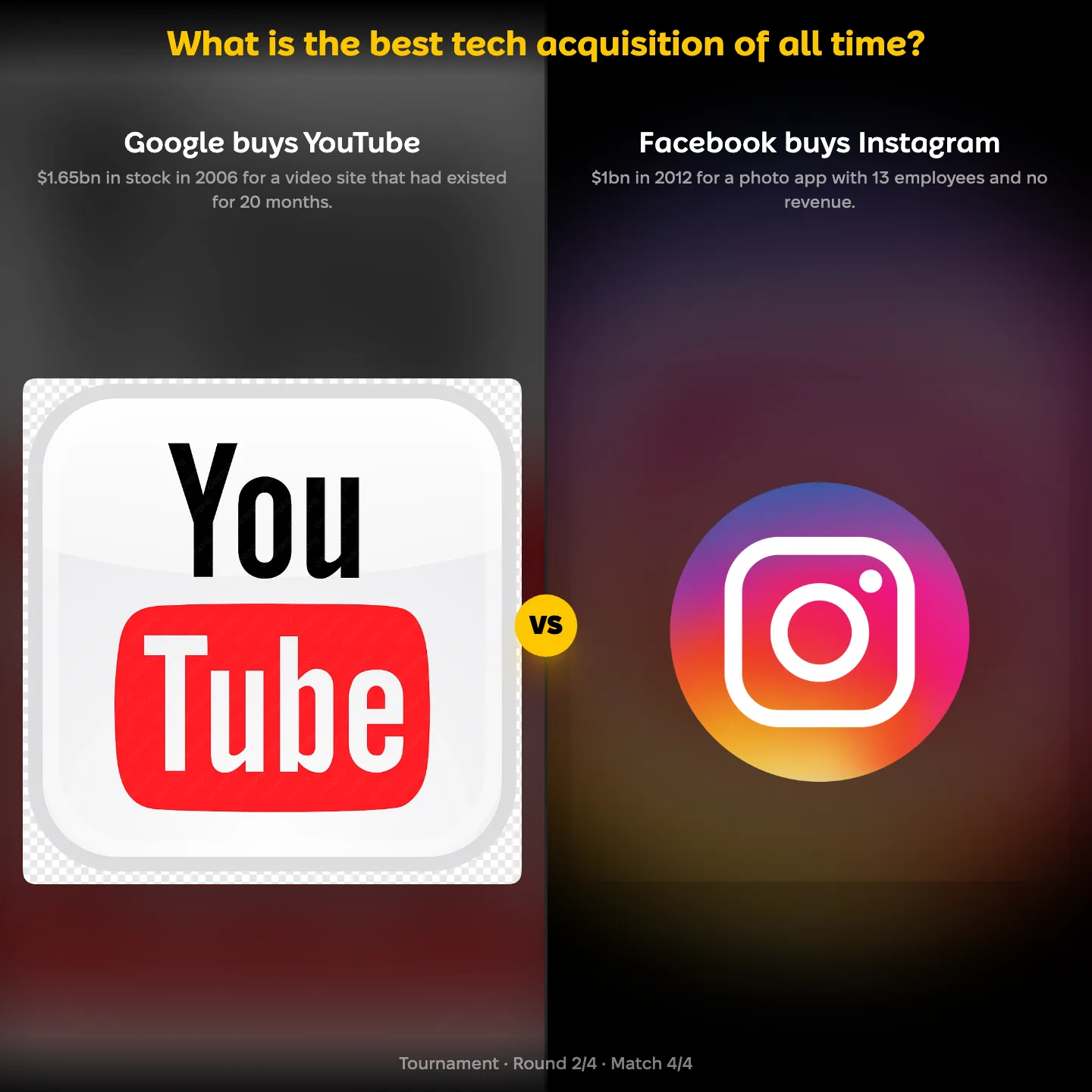
MrBeast vs PewDiePie: when YouTube is the question
On this list YouTube is not competing with anything. It is the category, and the contenders are the channels inside it.
MrBeast became the first creator to pass 500 million subscribers, in June 2026.6 PewDiePie held the crown for most of the previous decade and got there with a webcam and a microphone.
Underneath them the list stops being about scale. Kurzgesagt, Veritasium, 3Blue1Brown and Tom Scott built audiences on explanation, and Binging with Babish built one on cooking food that only exists in films.
Cocomelon is the reminder that none of this is the real centre. Nursery rhymes for toddlers sit near the top of every subscriber table, watched by an audience too young to have chosen anything.
Candy Crush, Clash of Clans, and the evening that disappears
Invert the question and doing well stops being a compliment. This list asks which app takes the most of your time without ever asking for it.
YouTube's mechanism is autoplay. One clip becomes four hours because the next one starts on its own, and nothing on the screen ever marks a stopping point.
TikTok does it faster and Candy Crush does it in five-minute instalments designed to end just short of satisfying. Clash of Clans does it with timers that call people back three times a day for years.
Duolingo is the odd entry, because the streak eventually becomes the point long after the learning has stopped.
4chan, Twitch chat, and the comment section people skip
The second inverted list is the one YouTube's own users complain about most. "Don't read the comments" became a piece of general internet advice largely because of this platform.
The reasons are structural. Comments sit under a video watched by strangers with nothing in common except the click, the author is rarely reading, and the volume makes real moderation a machine problem.
4chan is the extreme case, with no accounts and no memory. Twitch chat runs at thousands of messages a minute, which is a different failure: not hostility so much as noise.
Newspapers ran the experiment properly and lost. Most of them switched their comment sections off, which is the strongest evidence anyone has that the format was never going to work at scale.
Sixteen categories, sixteen different companies
Read the sixteen lists together and the pattern is that YouTube has no natural peer group. It is measured against Netflix, then against Spotify, then against Coursera, then against 4chan, and each set of neighbours describes a product the others would not recognise.
That is what happens to something that grew by absorbing formats instead of choosing one. The categories were built first, and it does not fit any of them cleanly.
Every question above gets settled the same way here: one matchup at a time, two options on screen until an order emerges.
Have a subject that keeps showing up in unrelated places? Build the rankings and see how differently each one treats it.
More rankings, more angles
- Apple vs Samsung: 14 Categories, 14 Arguments — the same two companies, judged fourteen ways
- PlayStation vs Xbox vs Nintendo, Ranked Side by Side — three consoles, and no category they all win
- TikTok vs Instagram: The For You Page Meets the Grid — the For You page against the grid
- Google Won Search. It Also Built Glass and Stadia. — the company that paid $1.65bn for YouTube
Sources
- Nielsen — The Gauge / Media Distributor Gauge, May 2026 reports (YouTube at 13.8% of US TV watch-time, largest distributor for a third consecutive month): nielsen.com (checked 2026-08-06)
- Alphabet Inc. — Q4 and fiscal year 2025 earnings release (YouTube revenue above $60bn for 2025; YouTube ads $11,383m in Q4 2025): sec.gov (checked 2026-08-06)
- YouTube Blog — "A decade of doo doo doo: How Baby Shark swam across the globe on YouTube" (most-viewed video, past 16 billion views): blog.youtube (checked 2026-08-06)
- Google — "A new milestone for YouTube Music and Premium" (over 125 million subscribers including trials): blog.google (checked 2026-08-06)
- Google and YouTube — joint press release, 9 October 2006, filed with the SEC ($1.65 billion all-stock acquisition): sec.gov (checked 2026-08-06)
- YouTube Blog — "500 million and counting! MrBeast makes history as the first individual creator to hit half a billion subscribers": blog.youtube (checked 2026-08-06)