
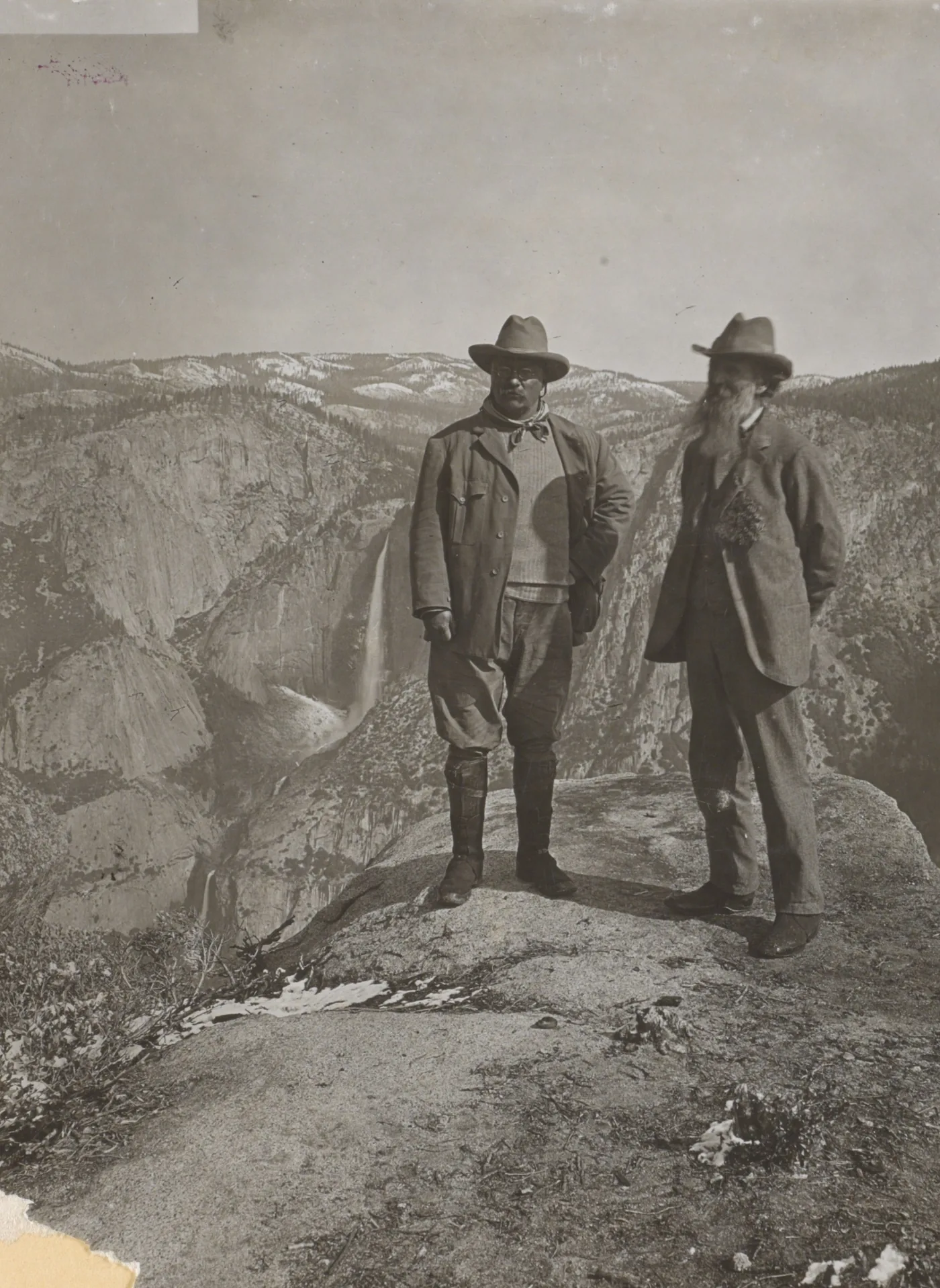
The National Park Service turns 110 on 25 August 2026, and the week of celebrations around it runs from the 22nd to the 30th.2 The man that anniversary keeps circling back to was never in charge of it: the Park Service was created in 1916, seven years after Theodore Roosevelt left office. What he did instead was put some 230 million acres of the country beyond the reach of anyone who wanted to sell it.1
That is one Roosevelt. There are several more: the cavalry officer, the Nobel mediator, the man who took a bullet in the chest and finished his speech, the accidental origin of a stuffed toy.
Roosevelt collected so many separate careers that the lists he qualifies for barely share an audience: the Rough Rider, the Nobel laureate and the man behind a stuffed toy are the same person.
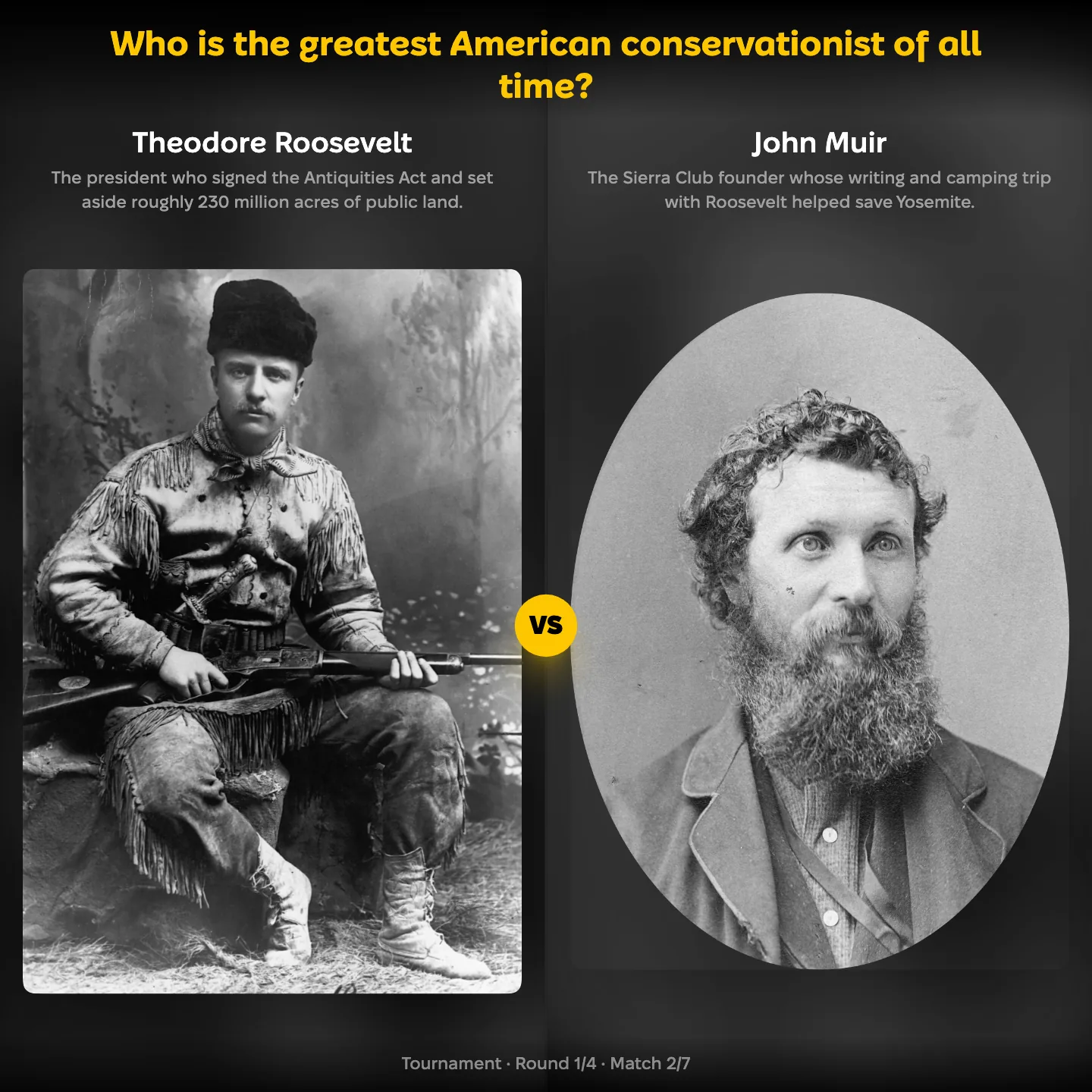
Lincoln, Washington and the sixteen-name argument
Start with the list Roosevelt is most obviously on. Every survey of American presidents is a fight over the same handful of names, and he is always among them.
His case rests on what the office became under him rather than on a war or a founding. He broke up the Northern Securities railroad trust, pushed through federal meat and drug inspection, and used the Antiquities Act, signed on 8 June 1906, to create eighteen national monuments without asking Congress for any of them.1
He also got there by accident. McKinley's assassination made him president in September 1901 at 42, still the youngest person ever to hold the job.9
Against Lincoln and Washington that is a thinner claim, and most historians say so. The reply is that both of those men are graded on holding the country together, and Roosevelt on what he did with it once it was held.
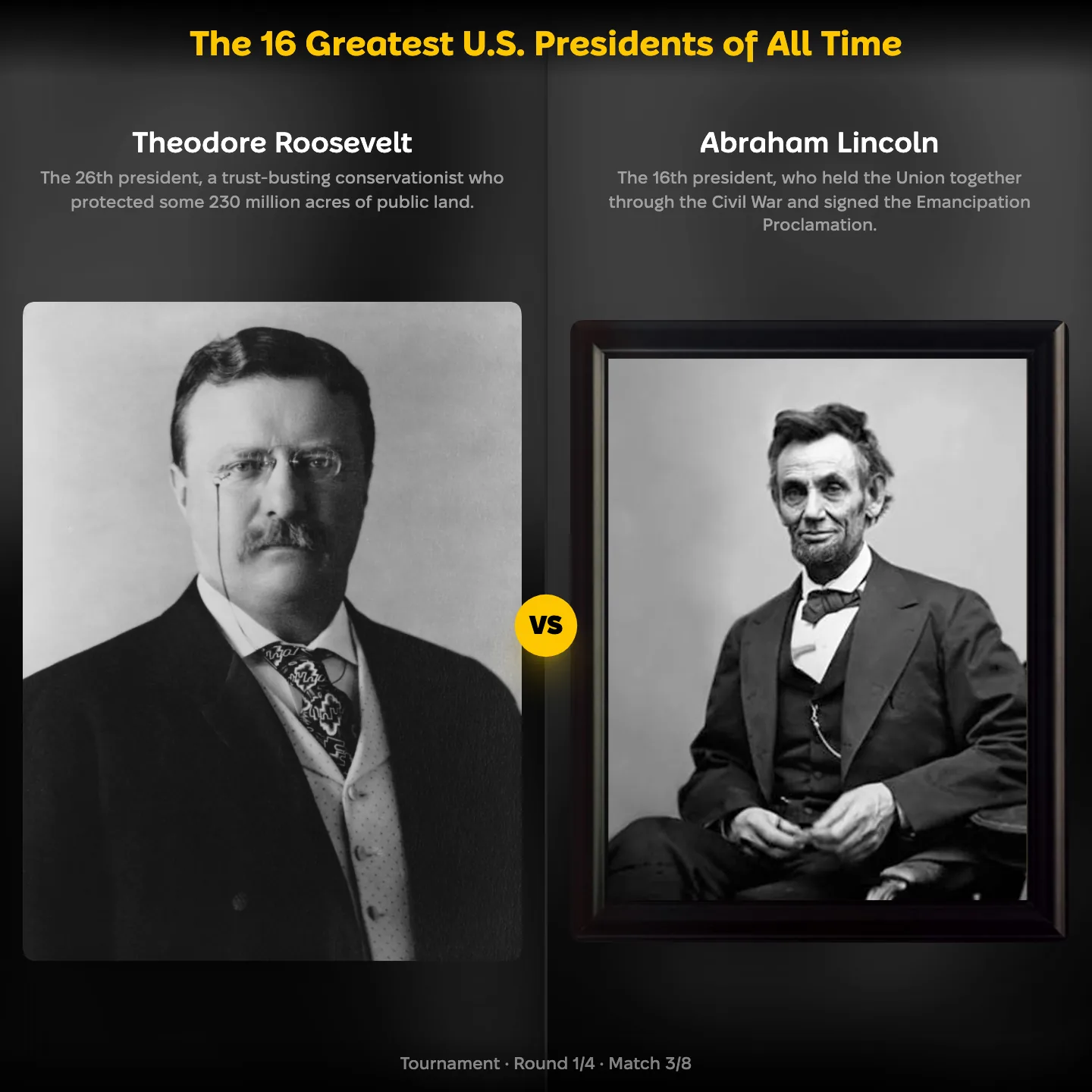
One century, from Rosa Parks to Neil Armstrong
Widen the question from the presidency to the whole American twentieth century and Roosevelt stops being a politician on a list of politicians.
He is now up against Martin Luther King Jr., Rosa Parks, Jonas Salk, Henry Ford and the first man to walk on the Moon. Those are people who changed what Americans could do, not who governed them, and the comparison is genuinely awkward.
Roosevelt's claim is that he set the century's terms early. Federal power over business, national parks as a public inheritance, and the United States acting as a broker between other people's empires all date from his eight years.
The case against him is chronological. He was president for the century's first decade and dead by 1919, so most of what the list celebrates happened without him.
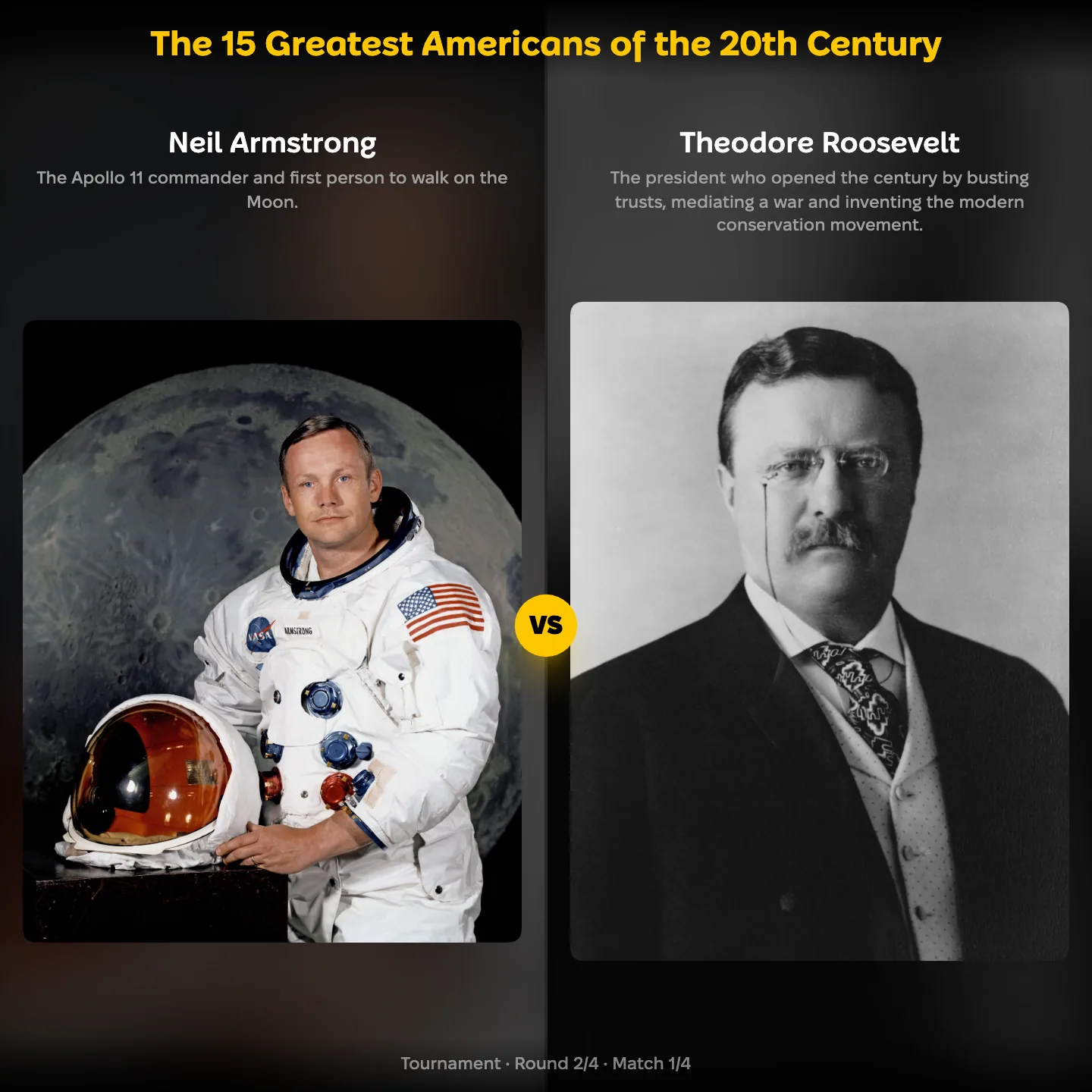
John Muir, Glacier Point, and 230 million acres
This is the ranking where Roosevelt's presidency is the footnote and the acreage is the argument.
The components are unusual for any one administration: 150 national forests, 51 federal bird reserves, four national game preserves, five national parks and eighteen national monuments, all between 1901 and 1909. Of the 35 park sites in existence when the National Park Service was founded in 1916, he had a hand in 23 of them.1
John Muir is the reason anyone argues about this one. The two men camped together at Glacier Point in 1903, the trip that produced the picture heading this page. Muir's writing and Muir's Sierra Club made the case; Roosevelt had the power to sign it.
Gifford Pinchot belongs here too, and he wanted something different: forests as a working crop, managed and cut on a rotation, rather than scenery held in trust for the view. Rachel Carson arrived half a century later and changed the subject from land to poison.
The first of those 51 bird reserves was Pelican Island in Florida, signed into existence in March 1903 after Roosevelt reportedly asked whether any law prevented him from doing it and was told there was none.
Four people, four definitions of the word, and one of them happened to control the federal government.
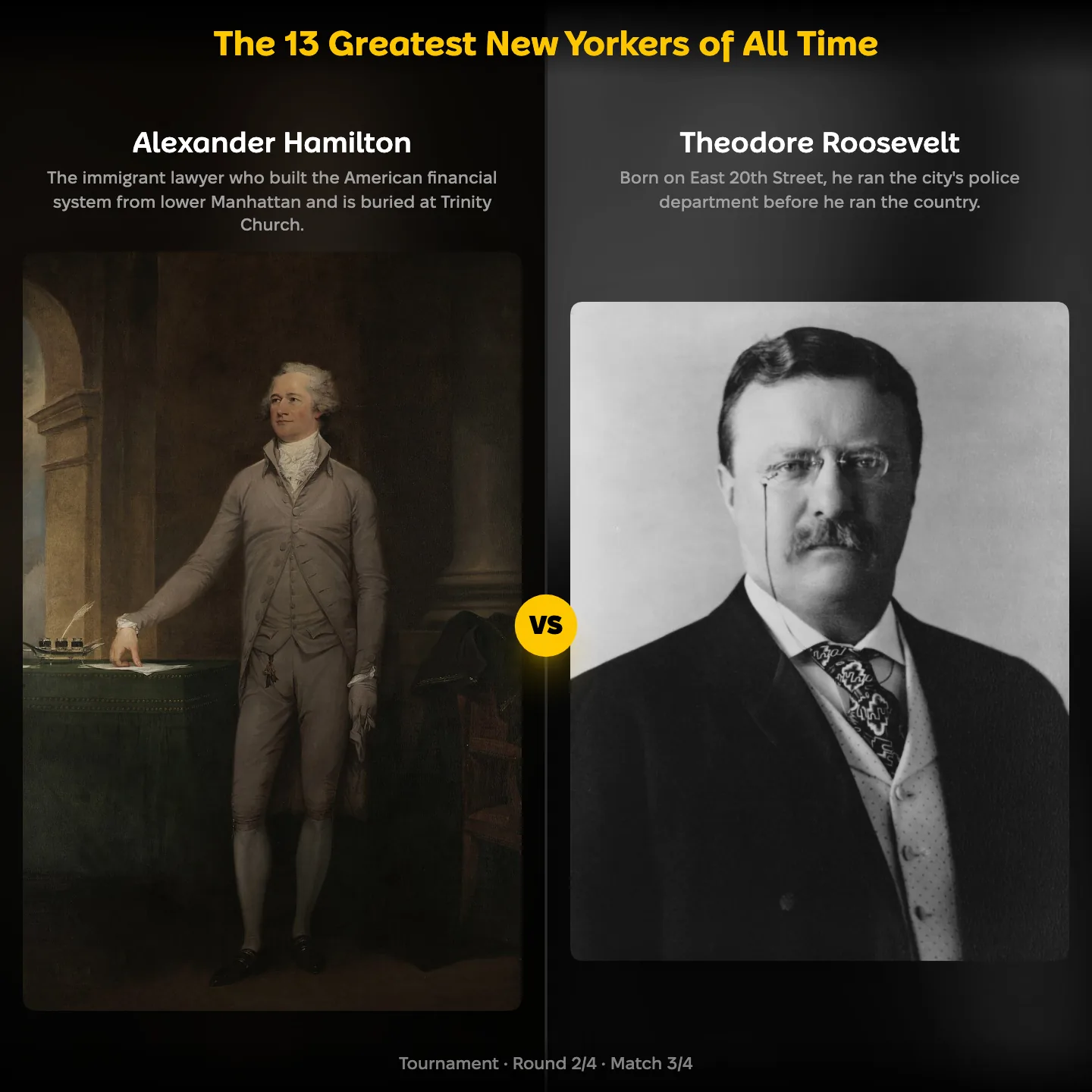
Alexander Hamilton vs Roosevelt: the New Yorker question
Roosevelt was born at 28 East 20th Street in Manhattan, which makes him eligible for a list with no bearing on the presidency at all.
Before Washington he ran the city itself, or parts of it: New York City police commissioner in the mid-1890s, walking the beats at night to catch officers asleep on duty, then governor of the state.
Alexander Hamilton is the harder opponent here, and not only because of the musical. He built the American financial system out of an office in lower Manhattan and is buried in the Trinity Church graveyard on Broadway.
What makes the list strange for a president is the company. Duke Ellington, Jane Jacobs, Andy Warhol and Jay-Z all shaped the city without ever standing for office.
The Nobel Peace Prize was not built for a president
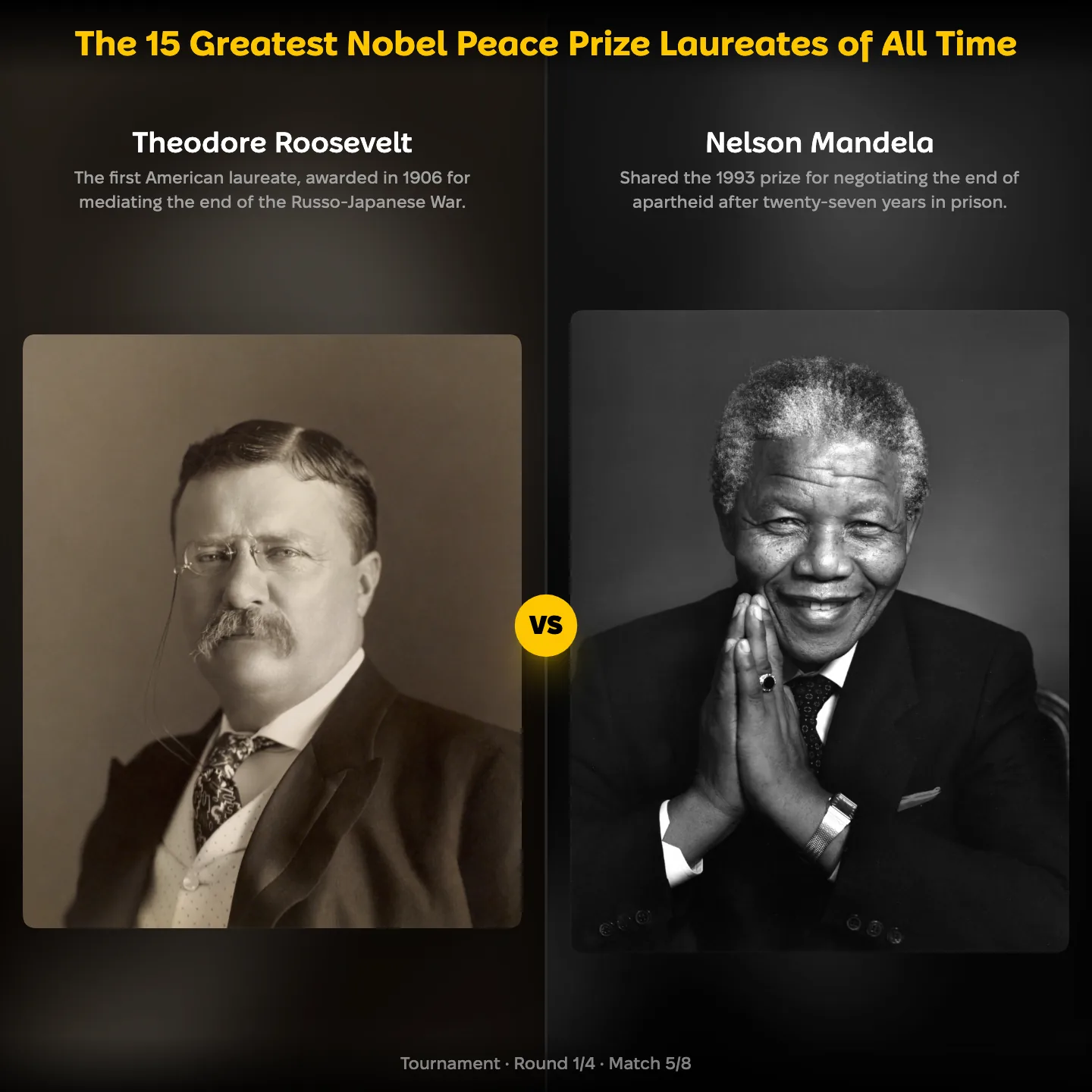
In 1906 Roosevelt became the first American of any kind to win a Nobel Prize, awarded for mediating the end of the Russo-Japanese War at Portsmouth, New Hampshire.3
He was also the first serving statesman to win the peace prize, and the award was contested at the time. Critics in Norway and Sweden argued that a man who had just finished a war in the Philippines was an odd choice for a prize about peace.
The company on this list makes the discomfort obvious. Nelson Mandela spent 27 years in prison, Malala Yousafzai was shot for going to school, Mother Teresa worked in Calcutta for four decades. Roosevelt chaired a negotiation.
Stated plainly, his entry is the thinnest kind of peace work and it still counts. The Treaty of Portsmouth ended the war in September 1905, and nobody else was going to broker it.
Speak softly, and carry the better line
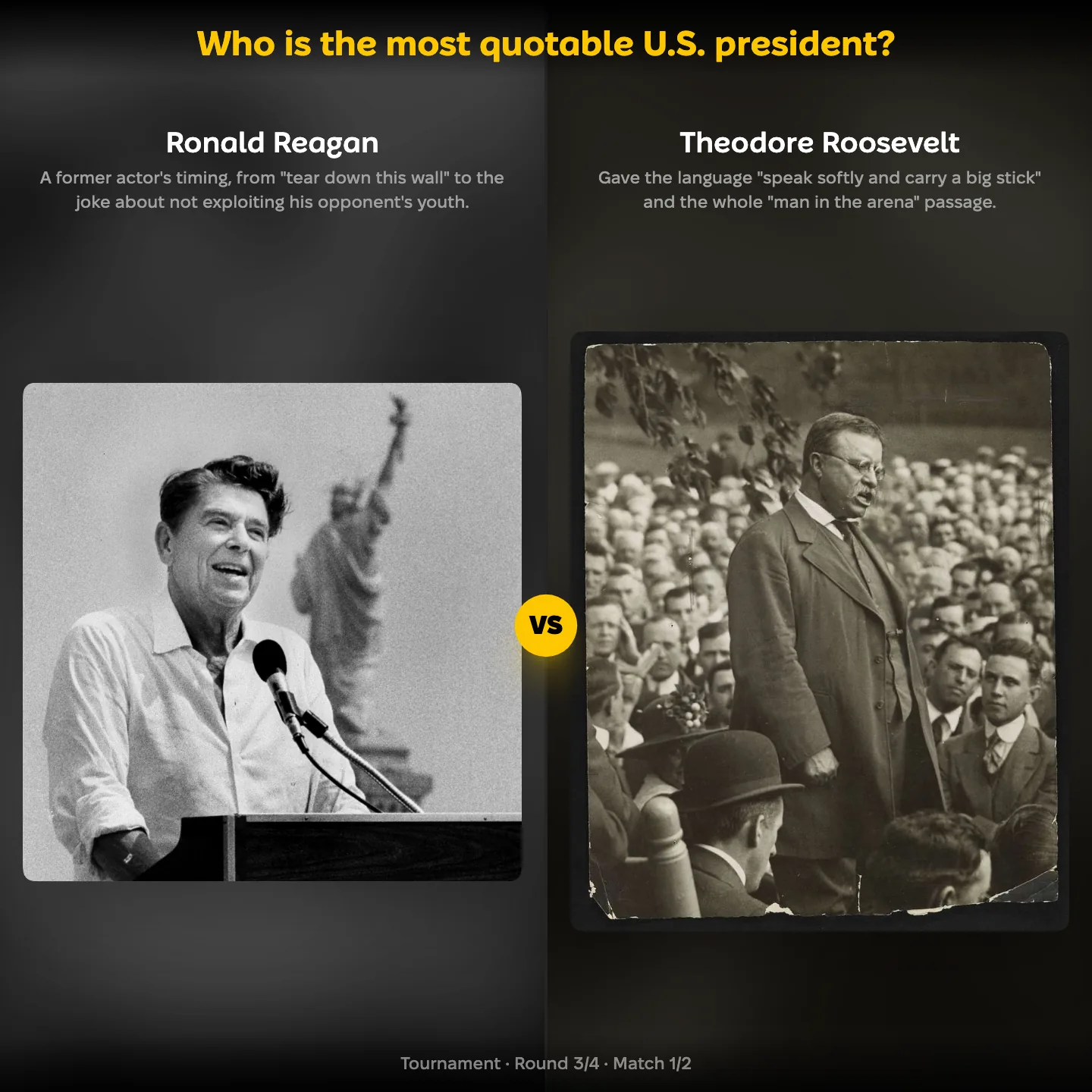
Two Roosevelt phrases outlived everything else he said. "Speak softly and carry a big stick" was a West African proverb he borrowed and made American foreign policy. The other is the passage from a 1910 lecture in Paris about the man in the arena, whose face is marred by dust and sweat and blood.
Against Lincoln that is a hard sell, since the Gettysburg Address does the same job in 272 words.
Ronald Reagan had an actor's timing, and Truman had the opposite gift, a plainness so blunt it quoted itself.
Jimmy Carter vs Roosevelt: the second career
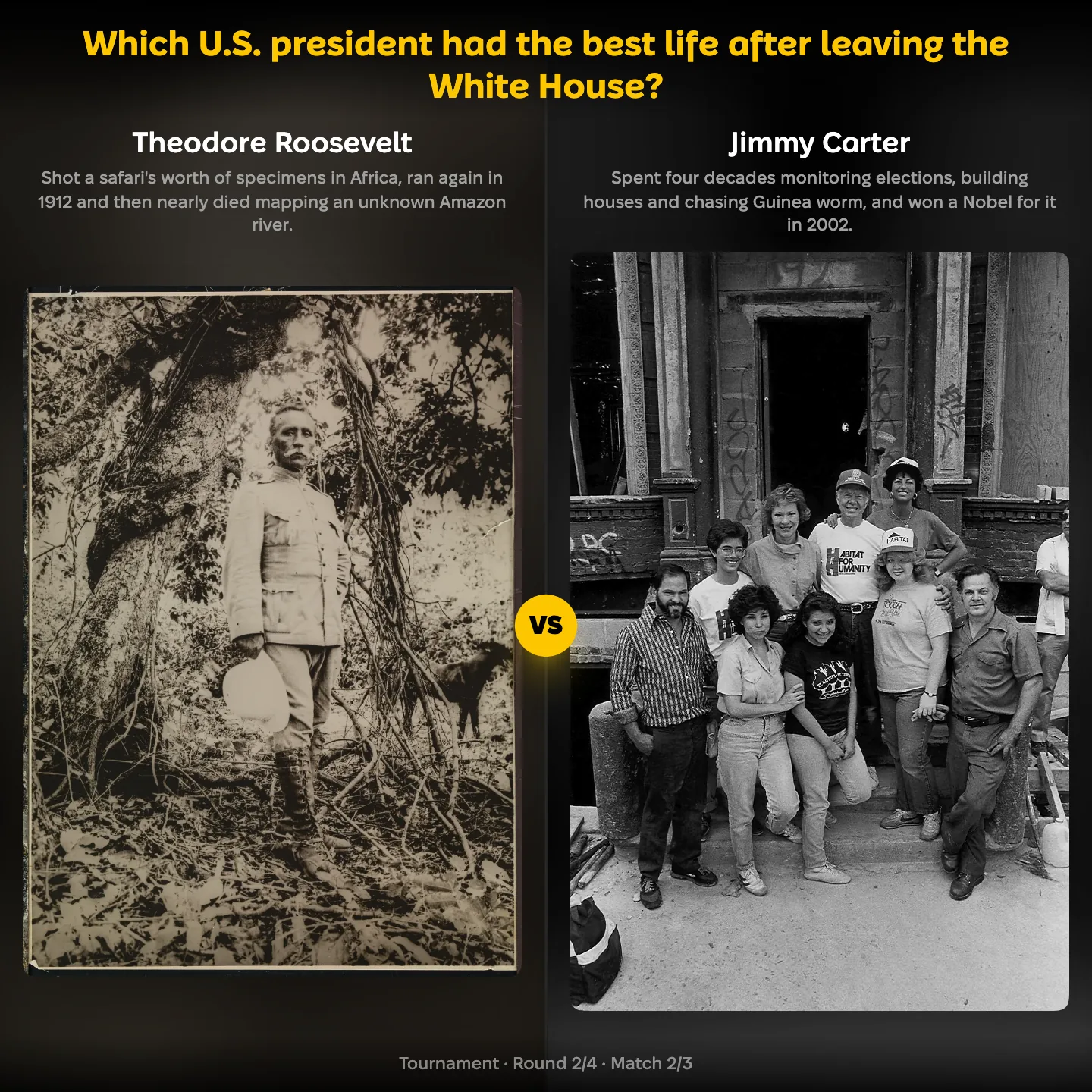
Roosevelt left the White House in March 1909 at 50. This ranking is about the problem that creates: what does a man do with the thirty years after the biggest job in the country?
His answer was a year-long collecting expedition in East Africa for the Smithsonian, a return to politics in 1912, and then the descent of an uncharted Amazon tributary called the River of Doubt, now the Rio Roosevelt, on which he took a leg wound, a fever and very nearly died.9
Jimmy Carter's post-presidency ran the other way and lasted four decades: election monitoring, Habitat for Humanity houses, a campaign that has all but eradicated Guinea worm disease, and a Nobel Peace Prize in 2002 for the lot of it.
The dark horse is William Howard Taft, the man Roosevelt hand-picked and then ran against. Taft became Chief Justice of the United States in 1921 and said openly that he liked it far better than being president.
The Bull Moose run of 1912
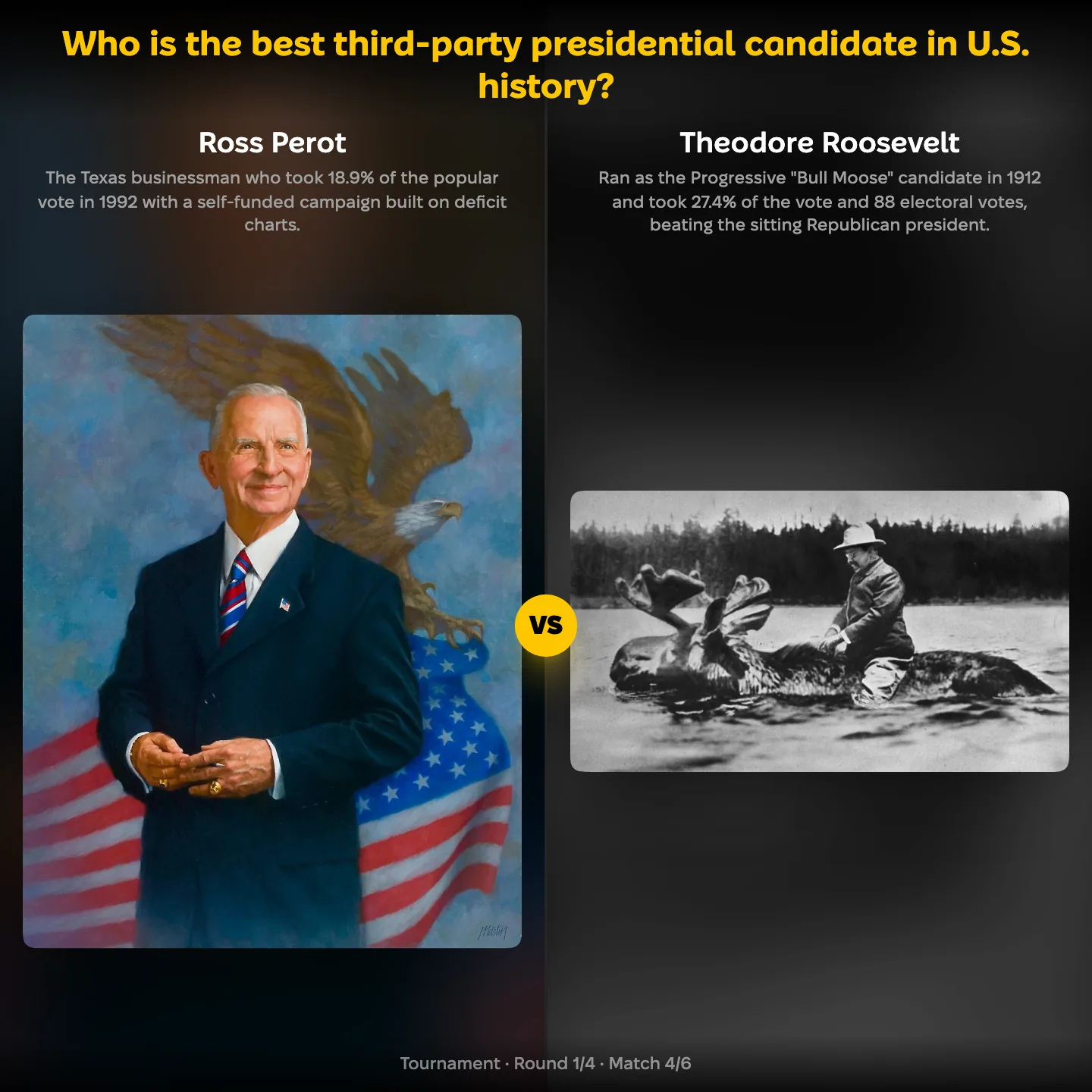
The most famous number of Roosevelt's career came from a defeat. Denied the Republican nomination in 1912, he ran anyway as the Progressive candidate and took 27.4% of the popular vote and 88 electoral votes, ahead of the sitting Republican president, William Howard Taft, who managed 23.1% and eight.4
No third-party candidate before or since has come close to that. The split also handed the presidency to Woodrow Wilson, which is the part Roosevelt's admirers tend to skip.
The campaign produced the other story people know. On 14 October 1912, outside a hotel in Milwaukee, a saloonkeeper shot him in the chest; the bullet was slowed by his folded fifty-page speech and a steel glasses case, and he delivered the speech anyway, for about ninety minutes, before going to hospital.5
Ross Perot is the only modern name that belongs in the same conversation, with 18.9% in 1992 and no electoral votes at all. Eugene V. Debs ran five times and polled nearly a million votes in 1920 from a federal prison cell.
Amelia Earhart's ocean, Roosevelt's river
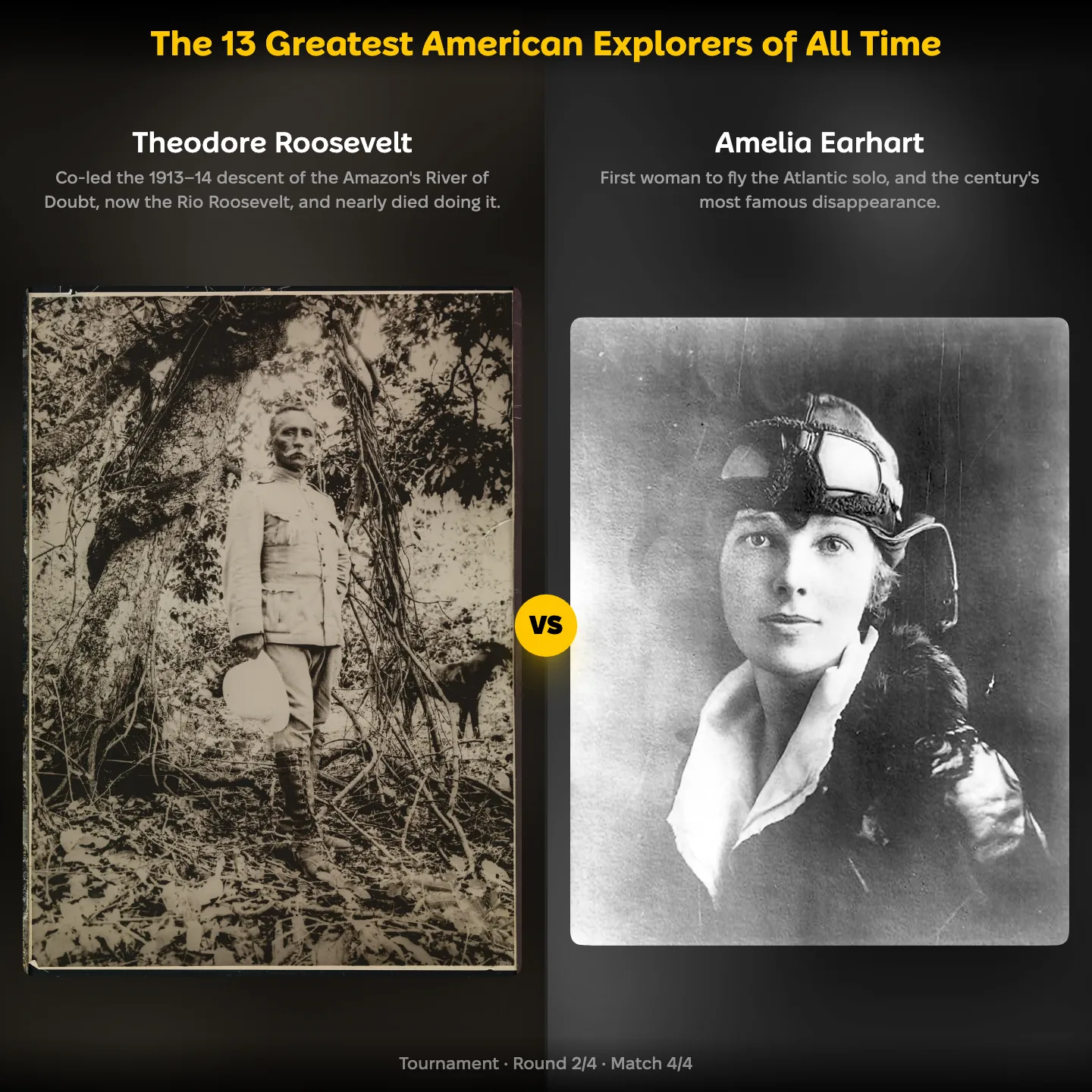
The River of Doubt expedition of 1913–14 is what puts a president on a list of explorers, and it is the list where his name looks most out of place.
Lewis and Clark crossed a continent that had not been mapped. Neil Armstrong left the planet. Matthew Henson made eight Arctic voyages and, by several accounts, stood at the North Pole before anyone else. Amelia Earhart flew the Atlantic alone.
Roosevelt was 55, a former head of state, and a guest of the Brazilian government on a river his co-leader Cândido Rondon already knew existed. He came home with a leg infection that troubled him for the rest of his life and a tributary named after him.
That is a real expedition and a slightly ridiculous entry, both at once, which is roughly the shape of his whole résumé.
Churchill, Havel and the writer-politicians
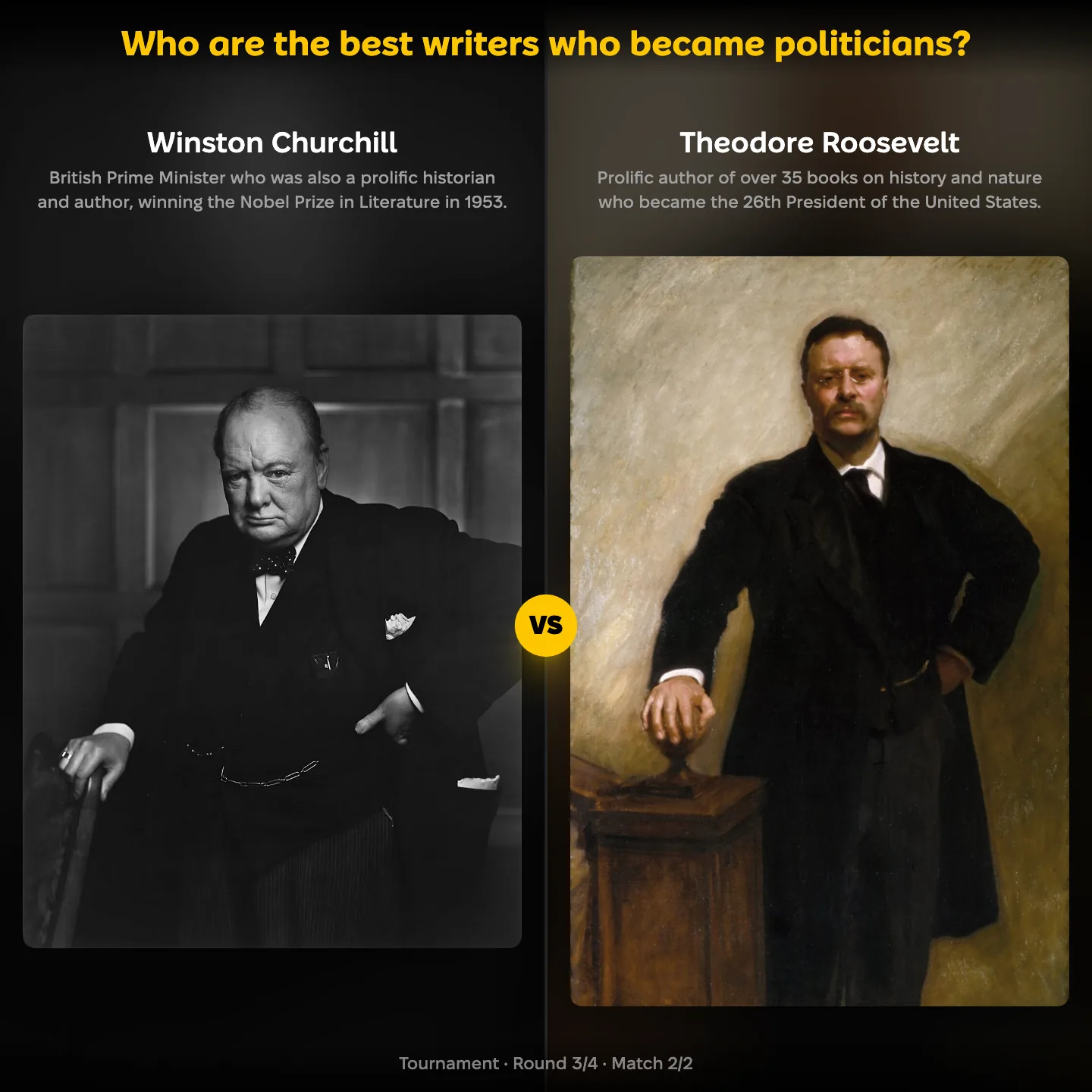
Roosevelt published The Naval War of 1812 in 1882, at 23, and it was taken seriously enough that the US Navy put copies on its ships. He wrote dozens more after it, across history, memoir, natural history and hunting narrative, alongside more than 150,000 letters.8
Winston Churchill is the opponent nobody beats on this list: he took the 1953 Nobel Prize in Literature, which no other head of government has managed.
Václav Havel arguably has the purer claim. He was a playwright first and a president second, and he went to prison for the plays.
Roosevelt is the middle case: a serious writer who happened to be extremely busy, which is the most common shape on this list and the least dramatic.
The teddy bear is on the LEGO brick's list
Roosevelt is not an option in this ranking. A stuffed animal named after him is.
In November 1902 he was hunting near Onward, Mississippi, and his hosts, embarrassed by a bad day, cornered and tied a bear for him to shoot. He refused. Clifford Berryman drew the refusal for the Washington Post, a Brooklyn shopkeeper named Morris Michtom put two hand-sewn bears in his window and asked permission to call them "Teddy's bears", and the permission was granted.7
The competition is LEGO, Barbie, the Rubik's Cube and the Slinky, all of them objects with patents, factories and marketing departments behind them.
The teddy bear had a cartoon and a nickname. It is also the oldest survivor here still sold in something close to its original form, and the only entry that began as a political story.

The list nobody volunteers for
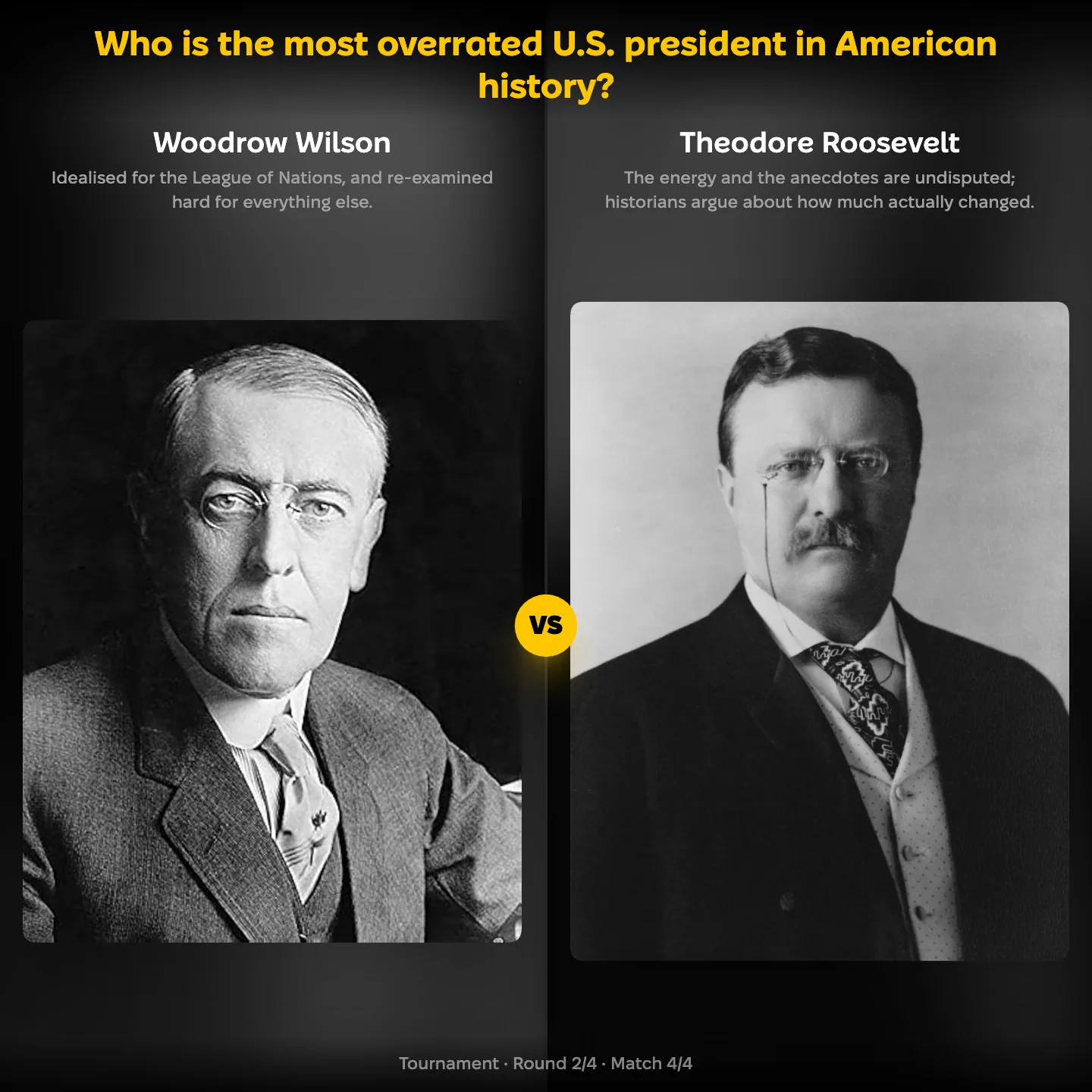
An honest article about Roosevelt has to include the list where being famous is the charge against him.
The case for the prosecution is that the anecdotes have done the work for him: the bear, the bullet, the safari, the river. Energy is easy to remember and hard to measure, and the presidency that produced it was eight fairly conventional years of regulation and arbitration.
There is a harder charge underneath it. His foreign policy took the Panama Canal Zone out of a Colombian province in 1903 by recognising a revolution the United States had encouraged, and his admirers rarely dwell on it.
Woodrow Wilson, Andrew Jackson and John F. Kennedy face similar reassessments on this list, and Ulysses S. Grant is there because his reputation moved so far in the opposite direction that the correction may have overshot.
Twelve lists, twelve different men
The reason Roosevelt turns up in a toy ranking and an explorers ranking and a Nobel ranking is not that he was good at twelve things. It is that he refused to stop starting over, and each fresh start left behind a different kind of evidence: an acreage, a treaty, a book, a bullet, a bear.
The army agreed with the last of those readings very late. On 16 January 2001, 103 years after the charge at San Juan Heights and 82 years after his death, he was awarded the Medal of Honor, the only president who holds one.6
Each of these twelve questions gets decided by putting two names side by side and choosing, then doing it again, until the order stops moving. If you want a thirteenth Roosevelt, write the question yourself and see who else belongs in it.
More rankings, more angles
- Amelia Earhart Crossed the Atlantic as Baggage, Then Flew It Alone — the other explorer on his lists
- 15 Rankings, One Benjamin Franklin — the founding-era polymath, sorted by inventor, writer and diplomat
- Washington vs Lincoln: Who Wins Which List? — the two presidents every American list starts with
- Leonardo da Vinci Is on Every List. Never in the Same Place — the polymath who finished almost nothing
Sources
- National Park Service — Theodore Roosevelt and conservation: 230 million acres, 150 national forests, 51 bird reserves, 18 national monuments, the Antiquities Act of 8 June 1906, and 23 of the 35 park sites existing in 1916: nps.gov (checked 2026-08-13)
- National Park Service — National Park Week 2026, 22–30 August, and the Park Service's 110th birthday on 25 August: nps.gov (checked 2026-08-13)
- The Nobel Prize — Theodore Roosevelt, Peace Prize 1906, the first American laureate, for mediating the Russo-Japanese War: nobelprize.org (checked 2026-08-13)
- Miller Center, University of Virginia — the 1912 election: Roosevelt 27.4% and 88 electoral votes, Taft 23.1% and 8: millercenter.org (checked 2026-08-13)
- Wisconsin Public Radio — the shooting outside the Gilpatrick Hotel in Milwaukee on 14 October 1912 and the ninety-minute speech that followed: wpr.org (checked 2026-08-13)
- Theodore Roosevelt Center, Dickinson State University — the Medal of Honor awarded to Roosevelt at a White House ceremony on 16 January 2001, for the Battle of San Juan on 1 July 1898: theodorerooseveltcenter.org (checked 2026-08-13)
- National Park Service — the origin of the teddy bear: the November 1902 hunt near Onward, Mississippi, Clifford Berryman's cartoon and Morris Michtom's shop: nps.gov (checked 2026-08-13)
- Theodore Roosevelt Presidential Library — books written by Roosevelt, including The Naval War of 1812 (1882), published when he was 23: trlibrary.com (checked 2026-08-13)
- National Park Service — the life of Theodore Roosevelt: president in September 1901 at 42, and the River of Doubt expedition after the 1912 election: nps.gov (checked 2026-08-13)