
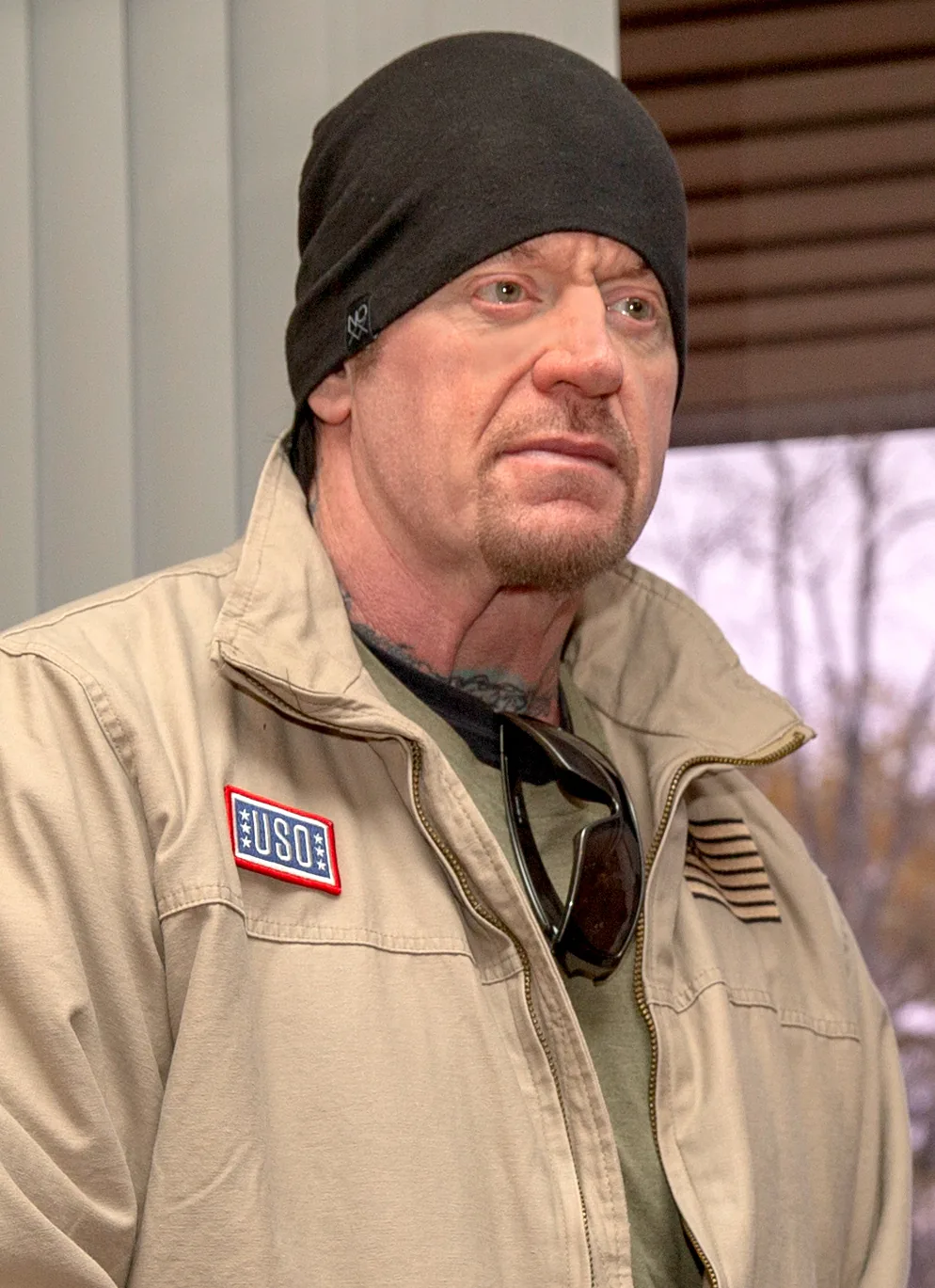
The Undertaker debuted at Survivor Series on 22 November 1990 and retired at the same event exactly thirty years later, on 22 November 2020.1 In between he won twenty-one consecutive WrestleMania matches, lost the twenty-second to Brock Lesnar in 2014, and closed with a WrestleMania record of 25-2. He is back on WWE television through 2026 as the man who delivers Hall of Fame news, most recently telling Demolition they were going in at WrestleMania 42.4
Sixteen of the site's rankings contain him. Several have nothing to do with wrestling.
Four WWE Championships is a modest haul for the most recognisable wrestler alive. His placings climb wherever atmosphere counts and stall wherever trophies do.
Stone Cold, Hogan, Flair: the whole roster in one list
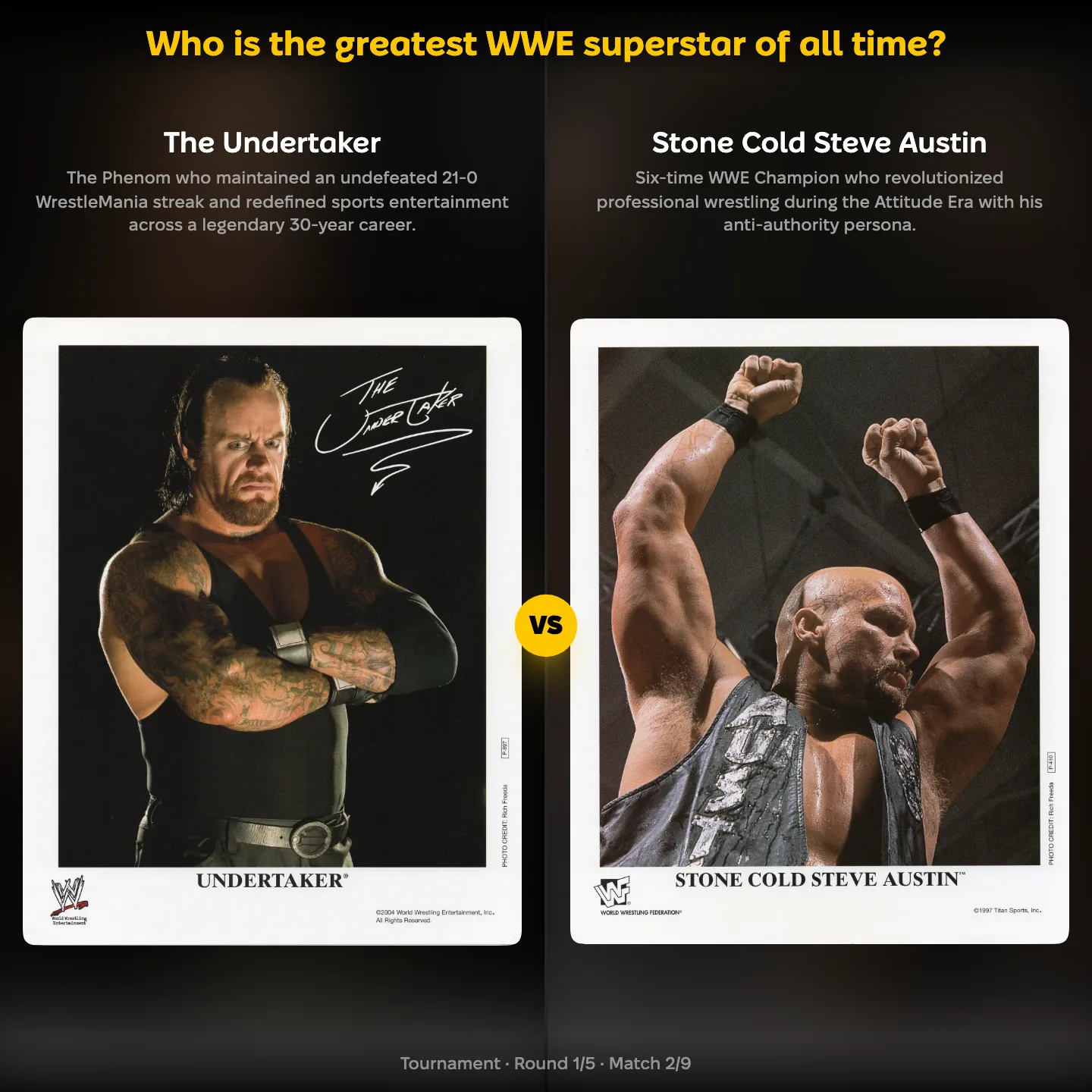
Every wrestling argument eventually collapses into this one. The list holds Stone Cold Steve Austin, Hulk Hogan, Ric Flair, The Rock, Shawn Michaels and The Undertaker, and asks a single question about all of them.
Calaway's case is length. He worked for one company from November 1990 to November 2020 and played the same character the whole way through, which nobody else on the list can claim.
Austin and Hogan have the business case instead. Austin sold the Attitude Era to a mainstream audience; Hogan carried the company through the 1980s and onto network television.
Flair has the trophies, and this is where the Deadman's file thins. Four WWE Championships and three World Heavyweight titles is a serious career and a small number beside Flair's sixteen recognised world reigns.2
The gong, the darkness, and a walk that took five minutes
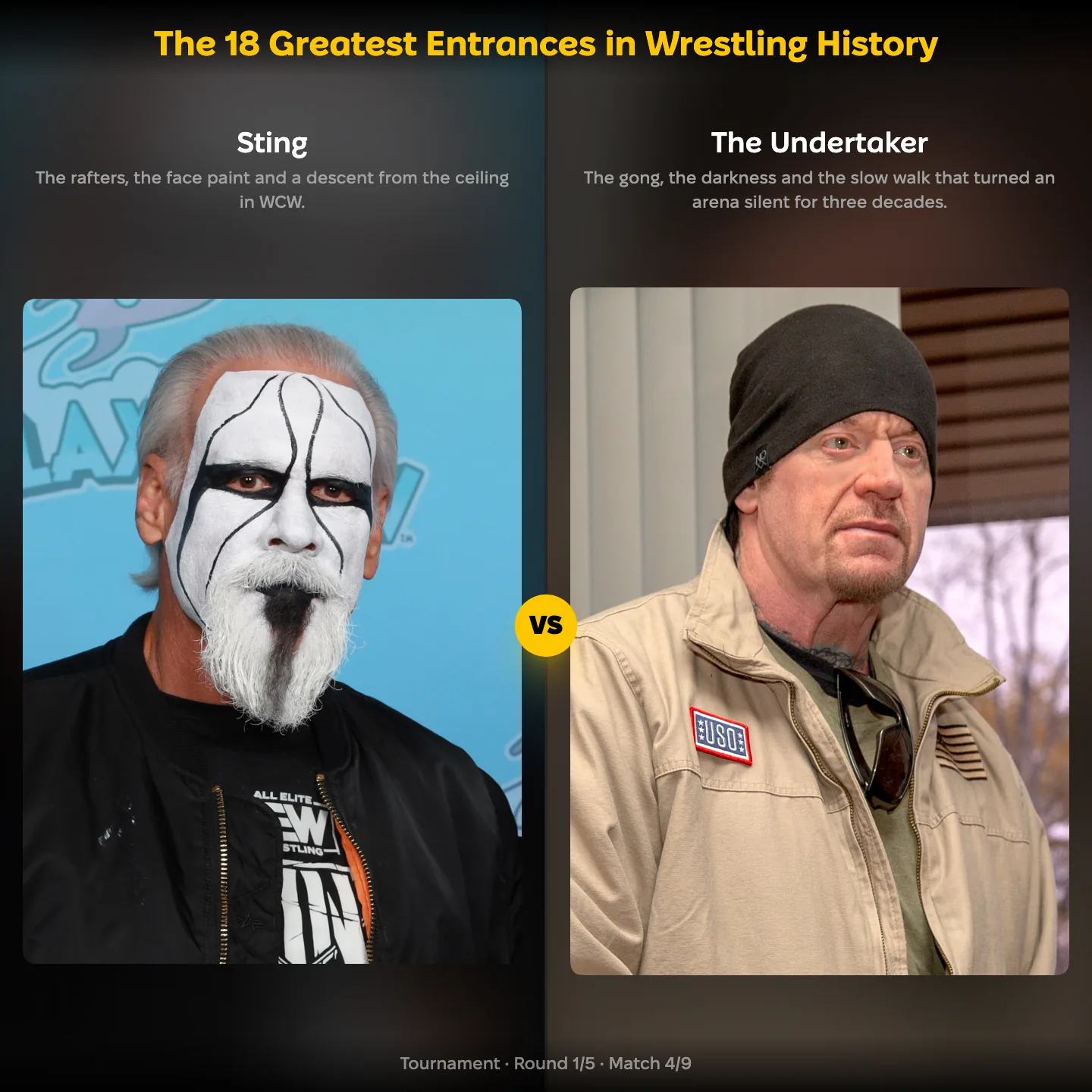
Entrance rankings reward theatre over athletics, which is why The Undertaker leads most versions of them. His took four to five minutes: one bell, the house lights killed, purple light, and a man walking at funeral pace towards a ring nobody in the building was looking away from.
Sting has the strongest counter-claim, and it came from the other company. Through most of 1996 he watched WCW from the rafters in white face paint and descended on a wire.
Triple H spat water into the lights. Bray Wyatt turned arenas into a field of phone torches. Finn Bálor spends hours in body paint before the Demon reaches the ramp.
None of them asked twenty thousand people to be silent for five minutes and got it.
The Deadman: one costume, thirty years
Wrestling gimmicks have a half-life of about two years. A mortician from Death Valley who never spoke, never smiled and never acknowledged the joke ran for three decades.
It nearly ended in the middle. From 2000 to 2003 Calaway dropped the character entirely and rode to the ring as the American Badass, a biker in sunglasses with his own name on the tights.2 Then the gong came back and stayed until 2020.
Stone Cold, Ric Flair and Hulk Hogan all appear here with characters made from a real personality turned up loud. The Undertaker's had no relationship to the man at all, which is the harder trick and the reason the character outlived the era that produced it.
Sgt. Slaughter, the Iron Sheik and the Million Dollar Man are here too, and all three date instantly to the decade that made them.

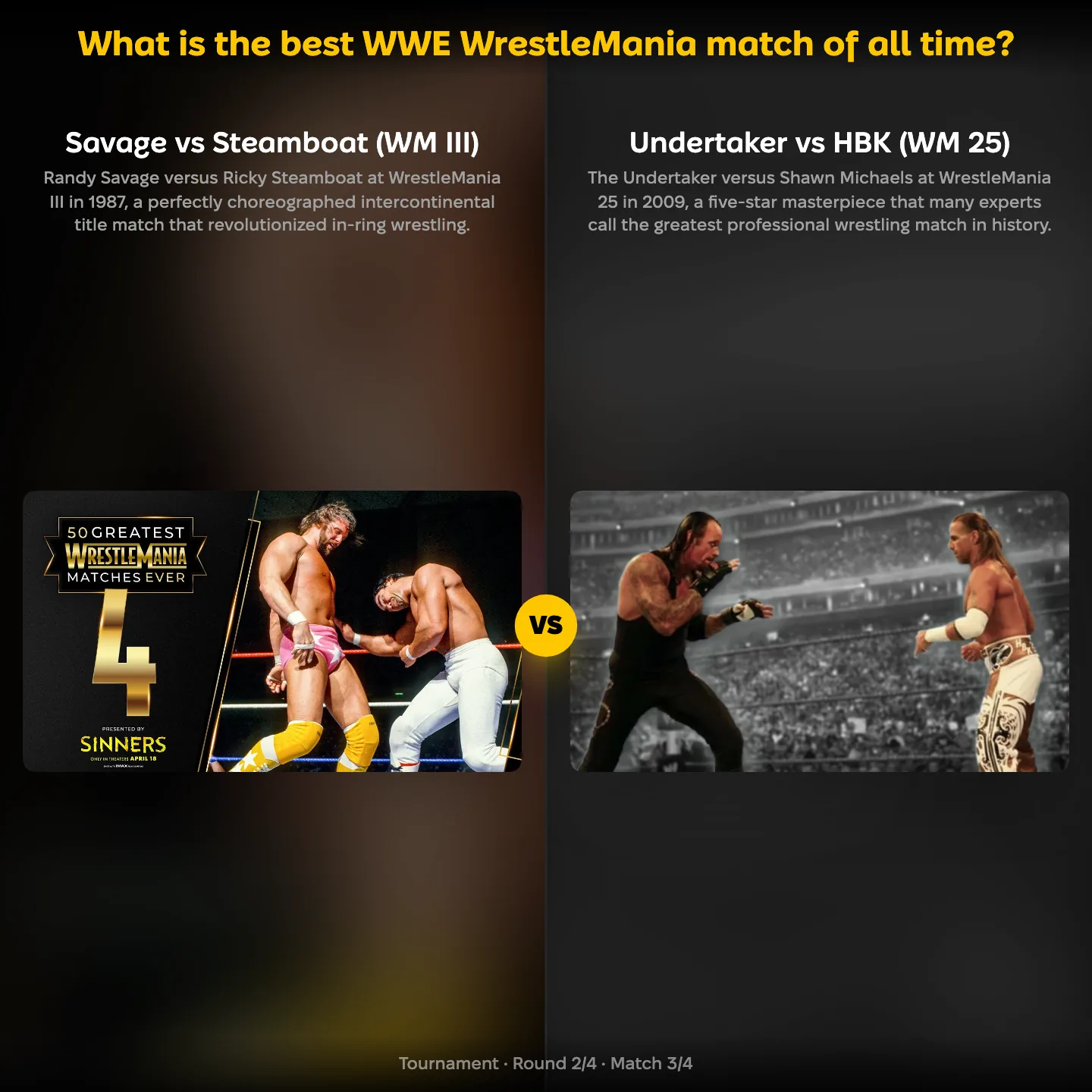
Undertaker vs Shawn Michaels, WrestleMania 25
Four of the fifteen matches on this list involve The Undertaker, which is the single clearest measure of what WrestleMania meant to his career.
The 2009 match against Shawn Michaels is the one usually named first. Michaels was 43, Calaway was 44, and the two of them spent half an hour building to near-falls that a stadium believed.
They did it again a year later with Michaels' career on the line, and he lost and retired.
Everything else here is canon: Austin against The Rock, Savage against Steamboat, Hogan against André the Giant. Appearing four times in that company measures something other than winning once.
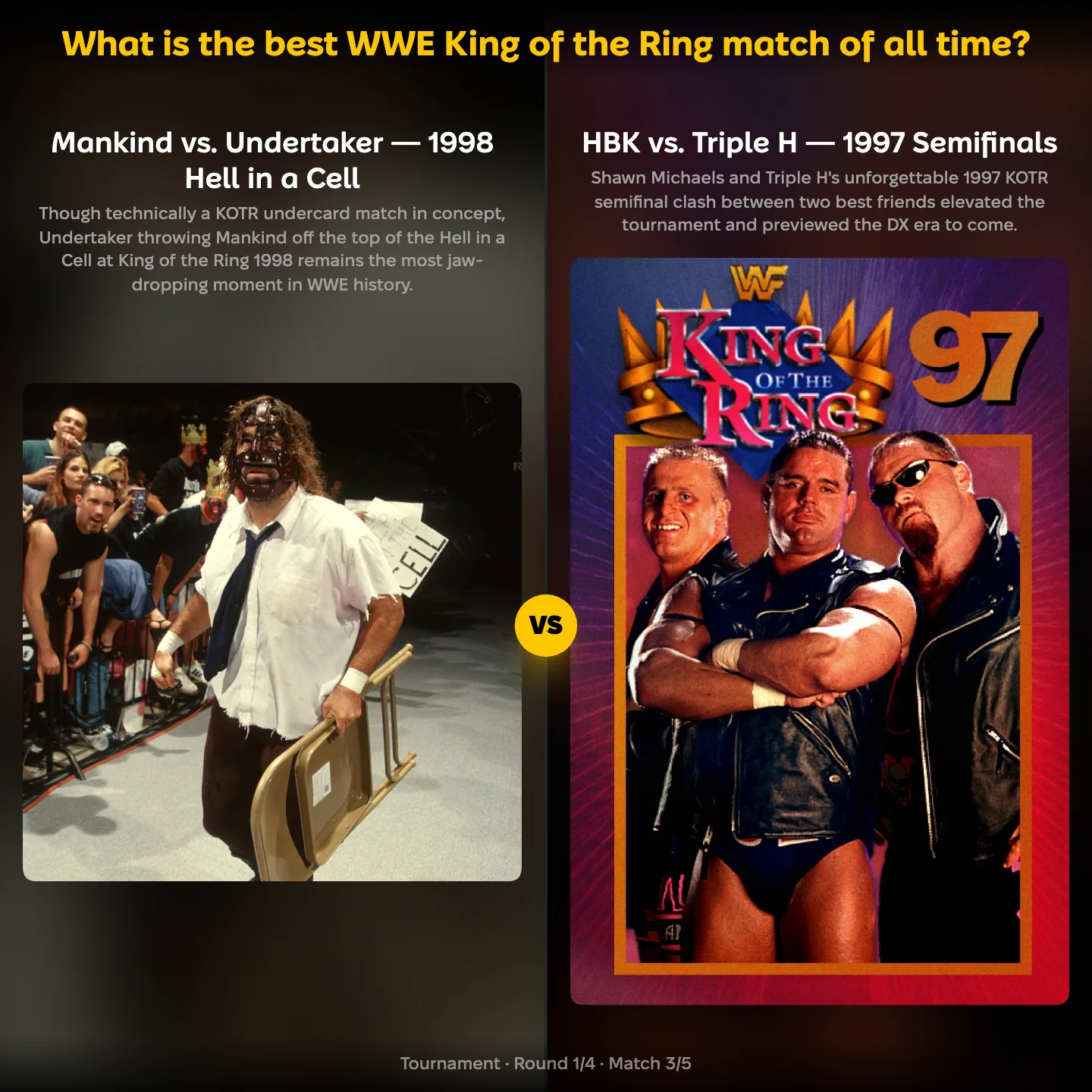
King of the Ring 1998: sixteen feet onto an announce table
On 28 June 1998 in Pittsburgh, The Undertaker threw Mick Foley off the top of a sixteen-foot steel cell onto the Spanish announce table.3 Foley climbed back up. A few minutes later a chokeslam put him through the roof of the cell and knocked him unconscious.
The clip is one of the most viewed pieces of footage wrestling has produced, and it belongs to a match on the undercard of a tournament final nobody remembers.
This ranking has an odd shape because of it. King of the Ring exists to crown a winner, and its most famous night was a match with no bearing on the bracket.
The list holds real tournament finals against it: Austin beating Jake Roberts in 1996 and cutting the promo that created Stone Cold, Bret Hart against Bam Bam Bigelow in 1993, Shawn Michaels against Triple H in the 1997 semifinals.
Foley is the reason the 1998 match is remembered the way it is: the second fall knocked him genuinely unconscious, on camera, and he carried on.
Edge vs Undertaker, SummerSlam 2008
SummerSlam is the second-biggest show of the WWE year, and The Undertaker has exactly one entry on this fifteen-match list.
It is the 2008 Hell in a Cell match against Edge, which he won with a Tombstone and then finished by chokeslamming Edge off a ladder through the centre of the ring.
Everything around it belongs to other people. Bret Hart against his brother Owen in a cage, Hogan against the Ultimate Warrior, CM Punk against Brock Lesnar, Seth Rollins cashing in on John Cena.

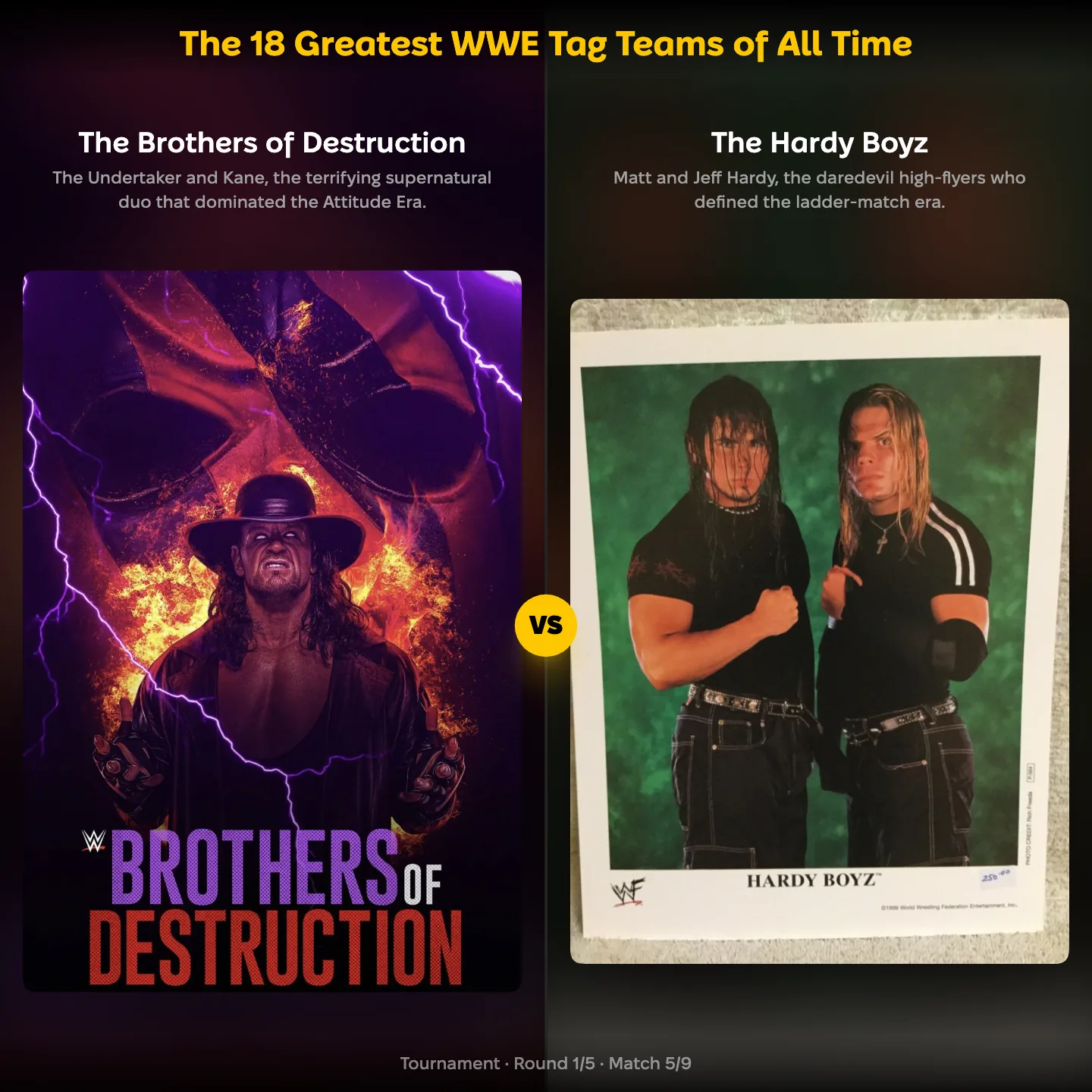
The Brothers of Destruction: half of a tag team
The Undertaker's entry on this list is not him. It is the Brothers of Destruction, the on-and-off team he formed with Kane from 1997 onwards, after three years of storyline in which Kane was introduced as the brother he had supposedly burned alive.2
As a tag team they were an event rather than a division act. They held the WWE tag titles briefly and spent far more nights headlining as a spectacle.
That is what the ranking exposes. The Hardy Boyz, the Dudley Boyz, Edge and Christian and the Hart Foundation built their careers inside tag wrestling and have the match catalogue to show for it.
Demolition, on the same list, held the record for the longest tag-title reign for 28 years, until The New Day passed it in 2016.4
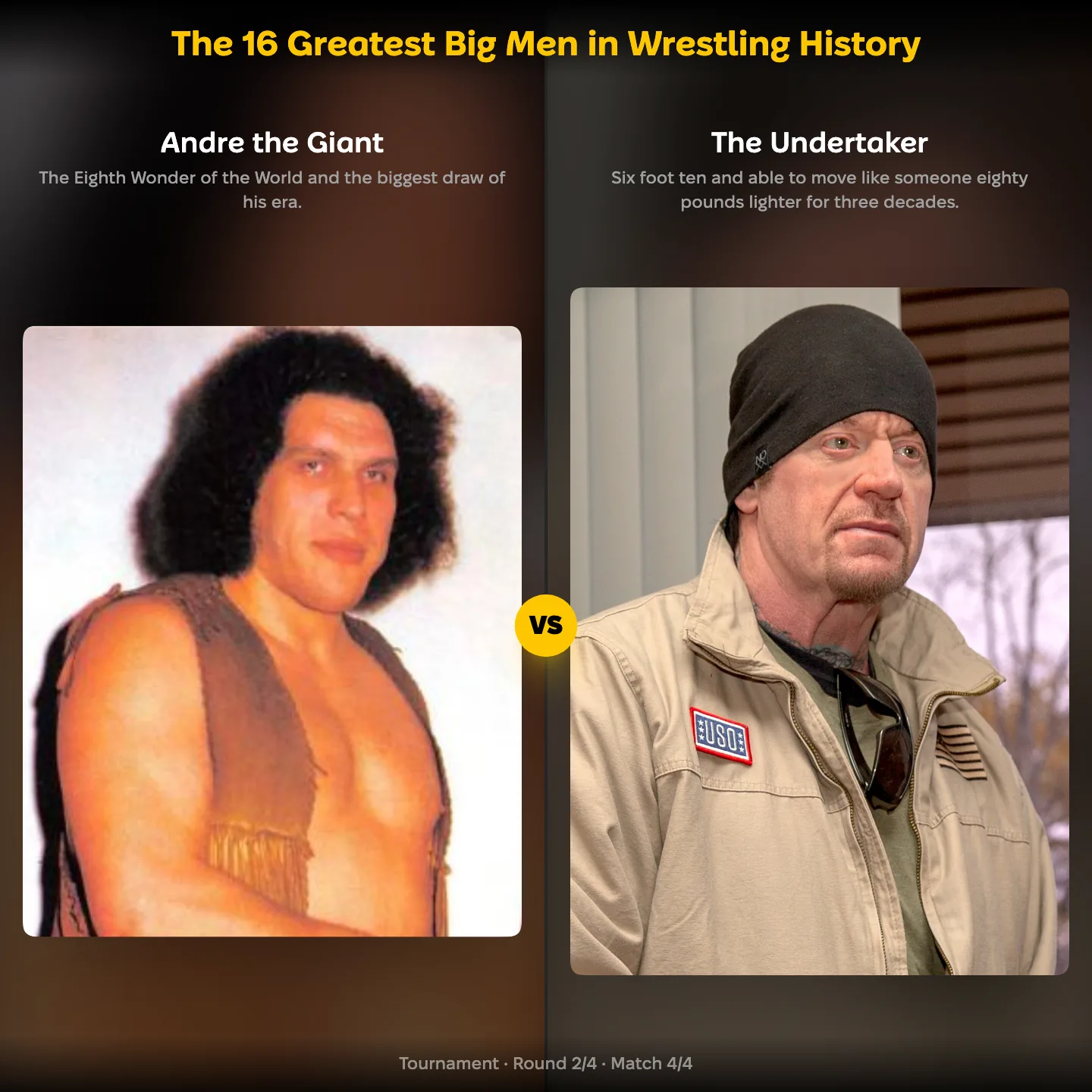
André the Giant and the other big men
The Undertaker was billed at six foot ten and 309 pounds.2 On most lists that is the headline. On this one it is the entry requirement.
His case here is movement. Very few wrestlers of that size worked a full thirty-year schedule, and fewer still finished it doing a dive over the top rope.
André the Giant is the ceiling nobody reaches. Billed at seven foot four, he drew for fifteen years without needing to lose, and every modern comparison runs through him.
Vader moonsaulted at four hundred pounds. Yokozuna beat Bret Hart and Hulk Hogan on the same night. Brock Lesnar was an NCAA champion. Big men rankings are the one category where The Undertaker's size stops being remarkable.
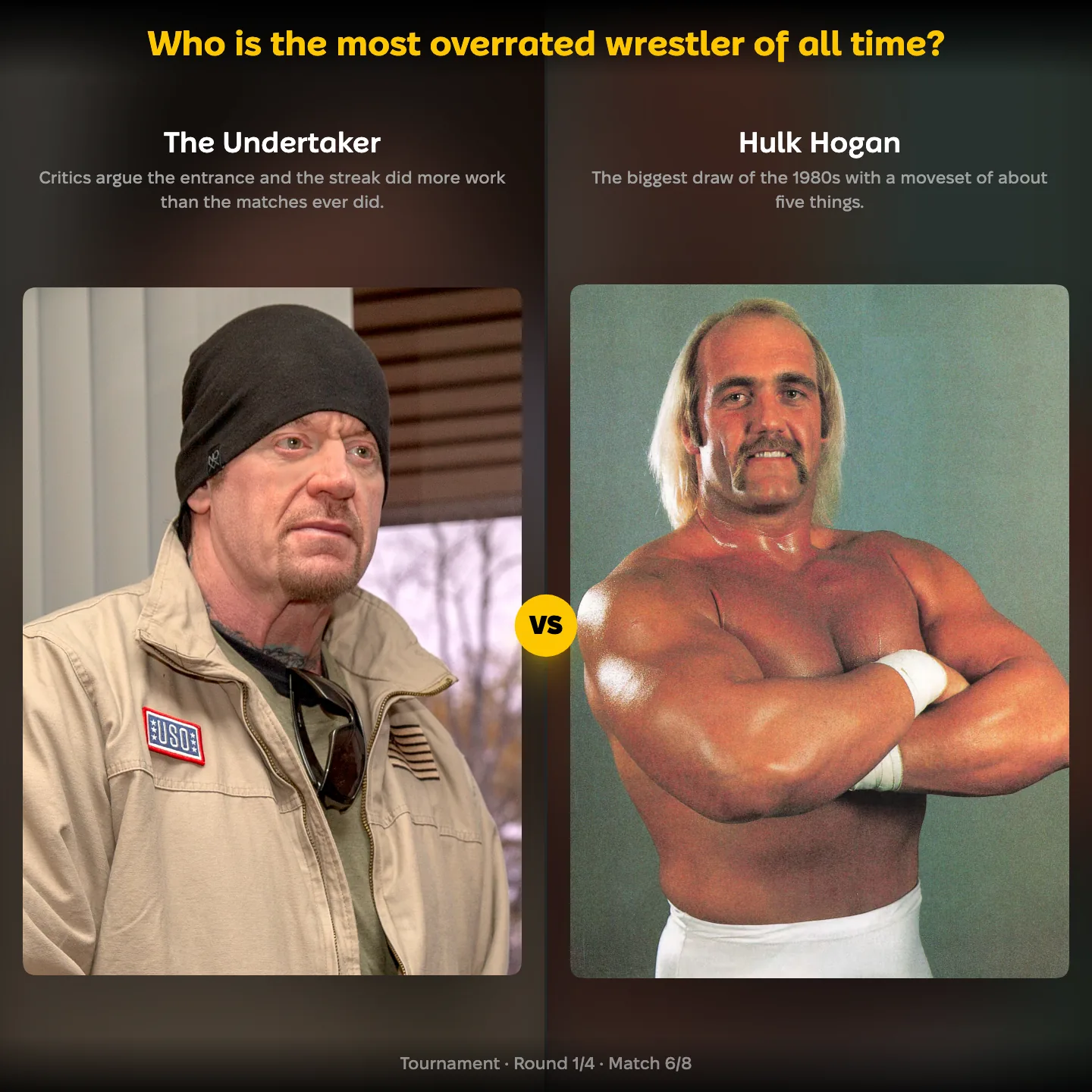
Hulk Hogan and the overrated argument
Every wrestler famous enough to be called great is famous enough to be called overrated, and The Undertaker qualifies on both counts.
The case against him is the moveset. For long stretches of the 1990s an Undertaker match was a chokeslam, a Tombstone, the sit-up, and very little in between, carried by a crowd that had already decided to be scared.
The case for him is that the crowd deciding to be scared was the job, and he did it for thirty years without a single week where the character stopped working.
Hulk Hogan, John Cena, Goldberg, Roman Reigns and Batista qualify for the same reason: enormous drawing power attached to a limited match. The Great Khali and Sid Vicious are here on presence alone. On this list, appearing is the criticism.
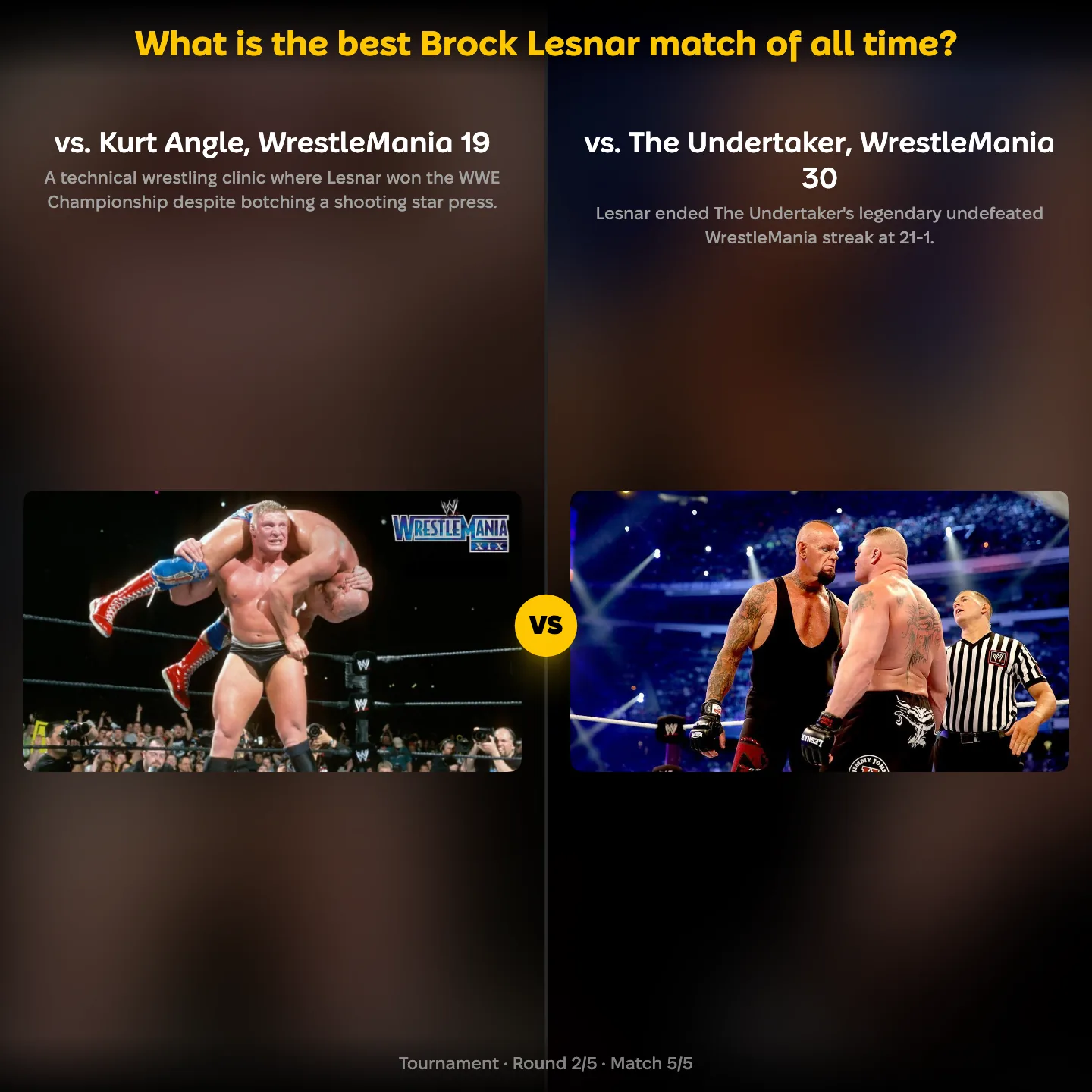
Brock Lesnar, WrestleMania 30: the night 21-0 ended
This is a ranking of Brock Lesnar's best matches, and The Undertaker appears on it twice: the Hell in a Cell match from 2002 and WrestleMania 30 in 2014.
The 2014 match is the one that matters to both careers. Lesnar won, ending twenty-one consecutive WrestleMania victories built up since 1991, in front of a New Orleans crowd that went silent for the wrong reason.1
Calaway finished the match and left the Superdome in an ambulance; WWE later confirmed a severe concussion and he was discharged the next day.8
Lesnar's list also holds Kurt Angle, Eddie Guerrero, John Cena and three UFC heavyweight fights. Being the man Lesnar beat on the biggest night of his career is a strange kind of credit, and the end of the streak is the rare Undertaker moment that belongs to somebody else.
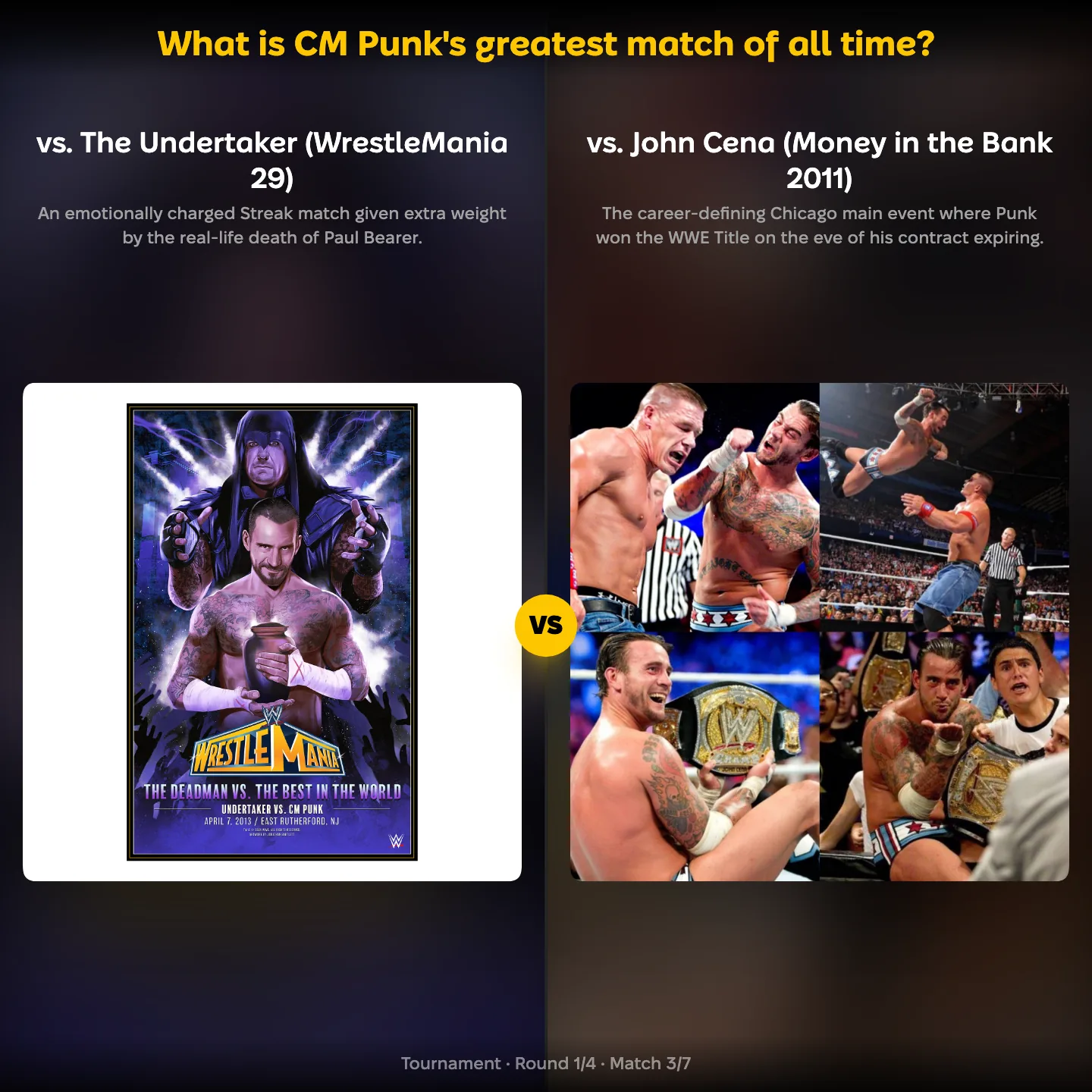
CM Punk vs The Undertaker, WrestleMania 29
CM Punk's career runs from the indies through a 434-day WWE title reign, a walkout, a UFC detour and a return, and this list sorts the matches that came out of it.
The Undertaker is on it once, for WrestleMania 29 in 2013, a match Punk spent weeks building by mocking the recent death of Calaway's manager Paul Bearer.
Punk's own peak is elsewhere: Money in the Bank 2011 against John Cena, in his home city, with his contract expiring that night.
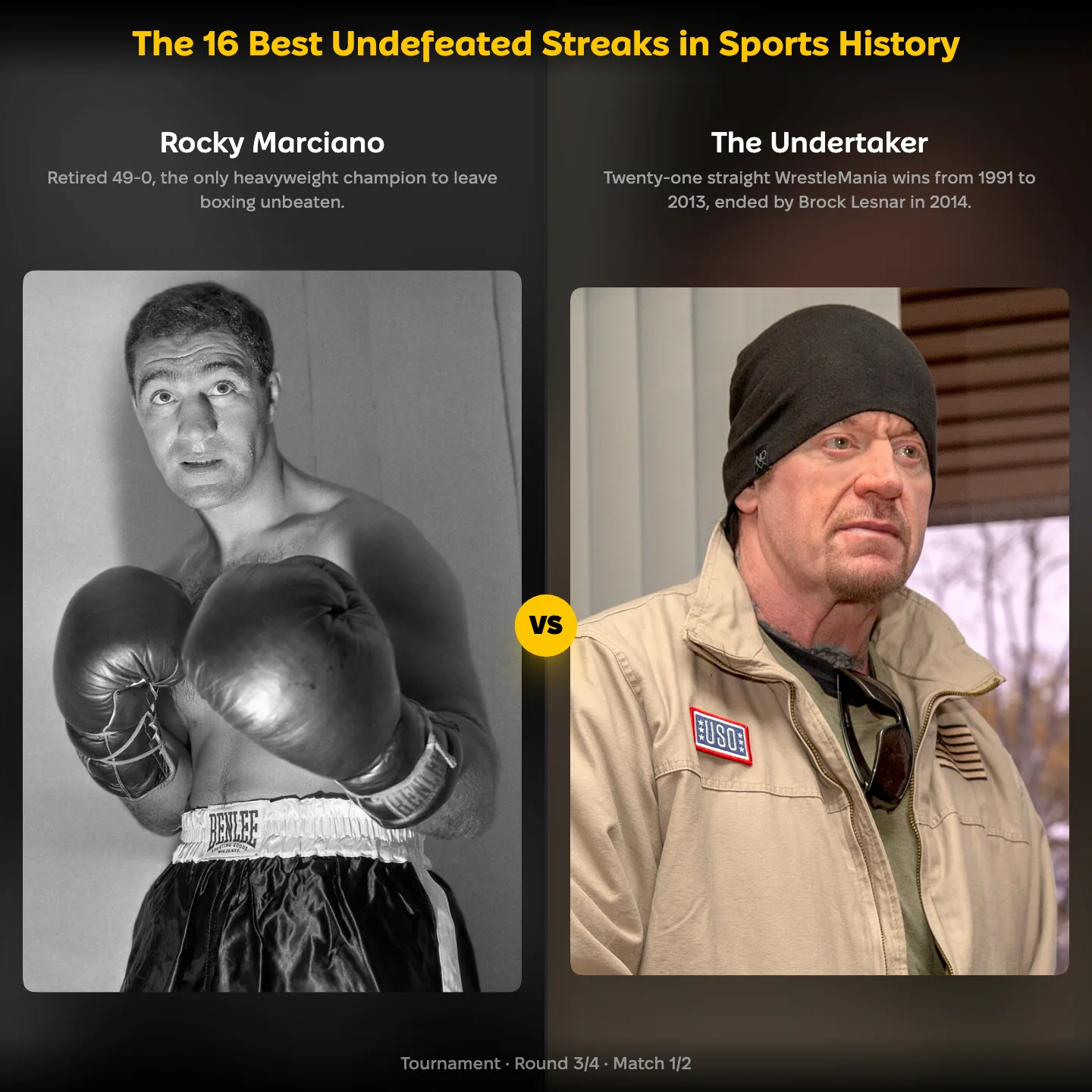
Rocky Marciano, Edwin Moses and a wrestling streak
Wrestling is one line on this list. The rest is boxing, athletics, chess, squash and tennis, and it asks which unbeaten run in sport was the most impressive.
Rocky Marciano retired 49-0 and is still the only heavyweight champion to leave boxing undefeated. Edwin Moses won 122 consecutive races in the 400-metre hurdles between 1977 and 1987, a stretch of nine years, nine months and nine days.5
The obvious objection is that wrestling decides its own results. Fair enough. What it misses is that WWE chose to protect a single record for twenty-three years across changes of era, ownership focus and roster, which is its own kind of discipline.
Bobby Fischer, Jahangir Khan, Cael Sanderson and Esther Vergeer also feature, and several of their streaks make Marciano's forty-nine look brief.
Mike Tyson vs The Undertaker: intimidation without a fight
Intimidation rankings are usually settled by people who have actually hurt someone. Mike Tyson beat opponents in the dressing room in the late 1980s. Sonny Liston had a stare Muhammad Ali needed a whole persona to survive.
The Undertaker never hurt anyone who had not agreed to it, and he is still a reasonable entry, because the effect was the same and the audience was much larger.
Zdeno Chára is six foot nine on skates. Ray Lewis built a pre-game routine designed to unsettle a stadium. Dick Butkus and Ronnie Lott made hitting people look like a personal grievance.
The counter-argument writes itself: everyone else on this list was frightening because of what might happen next, and The Undertaker was frightening because of what had already been decided.

Jaromír Jágr, Gordie Howe and thirty years in one job
Thirty years is the number that gets The Undertaker onto a list of the longest careers in professional sport, and it is exact: November 1990 to November 2020.
The company he keeps here is unforgiving. Gordie Howe played in five decades and skated in the NHL at 52. Jaromír Jágr was still playing professionally in Czechia more than thirty-five years after his first season. Martina Navratilova turned professional in 1975 and played her last match in 2006.
The wrestling objection applies again, and it cuts the other way this time. A wrestler cannot be dropped for form, but he also has no off-season, no substitutions and no league minimum: the schedule is roughly three hundred nights a year of physical work, most of it in a different city.
Ric Flair is on the same list, having wrestled across five decades and retired more than once.

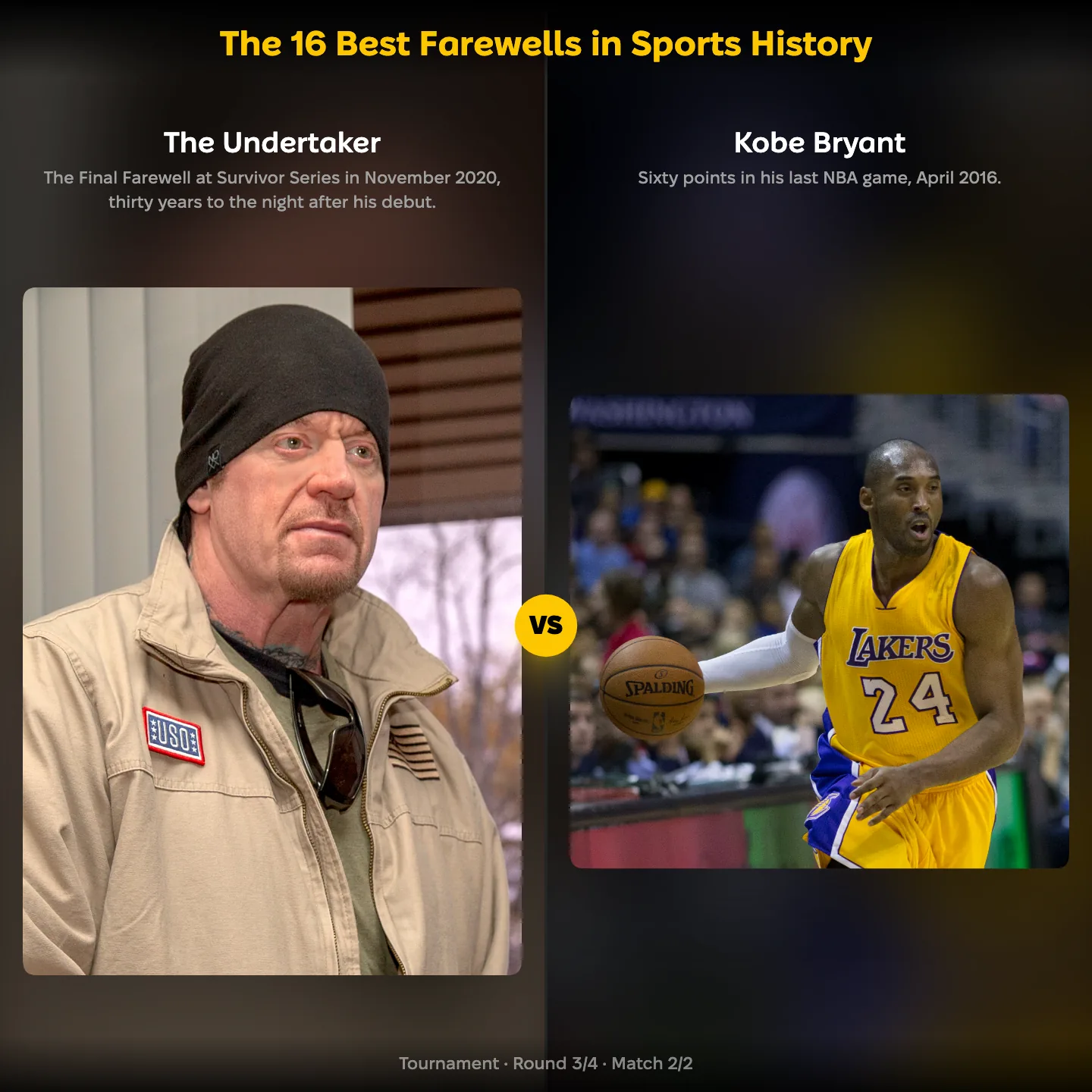
Kobe Bryant's 60 points and the Final Farewell
Athletes rarely get to choose the last scene. The Undertaker chose his to the calendar day, taking the Final Farewell at the same November event where he had first walked out thirty years earlier.
Kobe Bryant's exit is the one that beats it on pure performance. He scored 60 points against the Utah Jazz on 13 April 2016, the highest total anyone has posted in a final NBA game.6
Lou Gehrig's 1939 speech at Yankee Stadium is the one that outlives everybody's. Ray Bourque was traded at 39, won the Stanley Cup in his last game, and was handed it first. John Elway retired straight after a second consecutive Super Bowl.
Shawn Michaels appears here too, and The Undertaker arranged his exit: Michaels put his career against the streak at WrestleMania 26, lost, and stayed retired for eight years.
Simone Biles, Hakeem Olajuwon and a Houston mortician
Mark Calaway was born in Houston on 24 March 1965 and played basketball at Texas Wesleyan before he ever put on face paint.2 That qualifies him for a list where every other name earned the place in a stadium or an arena.
The city's roster is absurd. Simone Biles grew up in Spring, just north of Houston, with 11 Olympic medals and 30 from the World Championships, a record for the sport.7 Hakeem Olajuwon came to the University of Houston from Lagos and won two NBA titles for the Rockets. George Foreman grew up in the Fifth Ward and won a world heavyweight title at 45.
Nolan Ryan, Carl Lewis, Earl Campbell, Craig Biggio and Sheryl Swoopes share the ranking with him.
Against that, a man who spent thirty years pretending to be dead is the strangest name on a Houston sports list, and among the handful a global audience would recognise instantly.

Sixteen lists, one man in a beanie
Put the sixteen side by side and a shape appears. Wherever a list rewards atmosphere, presence, longevity or the ability to make twenty thousand people hold their breath, Mark Calaway is near the front of it. Wherever a list counts championships, the four WWE titles do the talking and the answer changes.
That is a career with an unusual centre of gravity, and it explains why he ends up on rankings about Houston gymnasts and Czech hockey players as easily as on rankings about WrestleMania.
If you want to know how the site turns any of these into an order, the explainer on settling questions one matchup at a time covers the method.
Or take a subject of your own who lands in categories with nothing in common, and build the list nobody else has made.
More rankings, more angles
- How Many Ways Can You Rank Dwayne "The Rock" Johnson? — the other WWE champion, judged as an actor
- Where Does Mike Tyson Actually Rank? — boxing's most feared name, re-sorted
- Anderson Silva: Six Years Champion, One Left Hook — the UFC's longest middleweight reign
- John Cena vs Brock Lesnar, Ranked Side by Side — 17 world titles against one UFC belt
Sources
- WWE — The Undertaker superstar profile (debut 22 November 1990, retirement 22 November 2020, the 21-0 WrestleMania streak ended by Brock Lesnar, Hall of Fame 2022): wwe.com (checked 2026-08-26)
- Wikipedia — The Undertaker (born Mark William Calaway, 24 March 1965, Houston; four WWF/E Championships and three World Heavyweight Championships; billed 6 ft 10 in, 309 lb; the American Badass years 2000–2003; the Brothers of Destruction with Kane): en.wikipedia.org (checked 2026-08-26)
- Wikipedia — King of the Ring (1998), 28 June 1998, Pittsburgh: the throw from the top of the cell onto the announce table and the chokeslam through the roof: en.wikipedia.org (checked 2026-08-26)
- Sports Illustrated — The Undertaker announcing Demolition for the WWE Hall of Fame class of 2026 and their 28-year tag-title record: si.com (checked 2026-08-26)
- World Athletics — Hall of Fame profile, Edwin Moses: 122 consecutive races between 1977 and 1987: worldathletics.org (checked 2026-08-26)
- Wikipedia — List of career achievements by Kobe Bryant: 60 points on 13 April 2016 against the Utah Jazz, the most in a final career game: en.wikipedia.org (checked 2026-08-26)
- Wikipedia — WrestleMania XXX: The Undertaker left the Superdome in an ambulance and WWE confirmed a severe concussion: en.wikipedia.org (checked 2026-08-26)
- Wikipedia — Simone Biles: 11 Olympic and 30 World Championship medals, the most decorated gymnast in history, raised in Spring, Texas: en.wikipedia.org (checked 2026-08-26)