
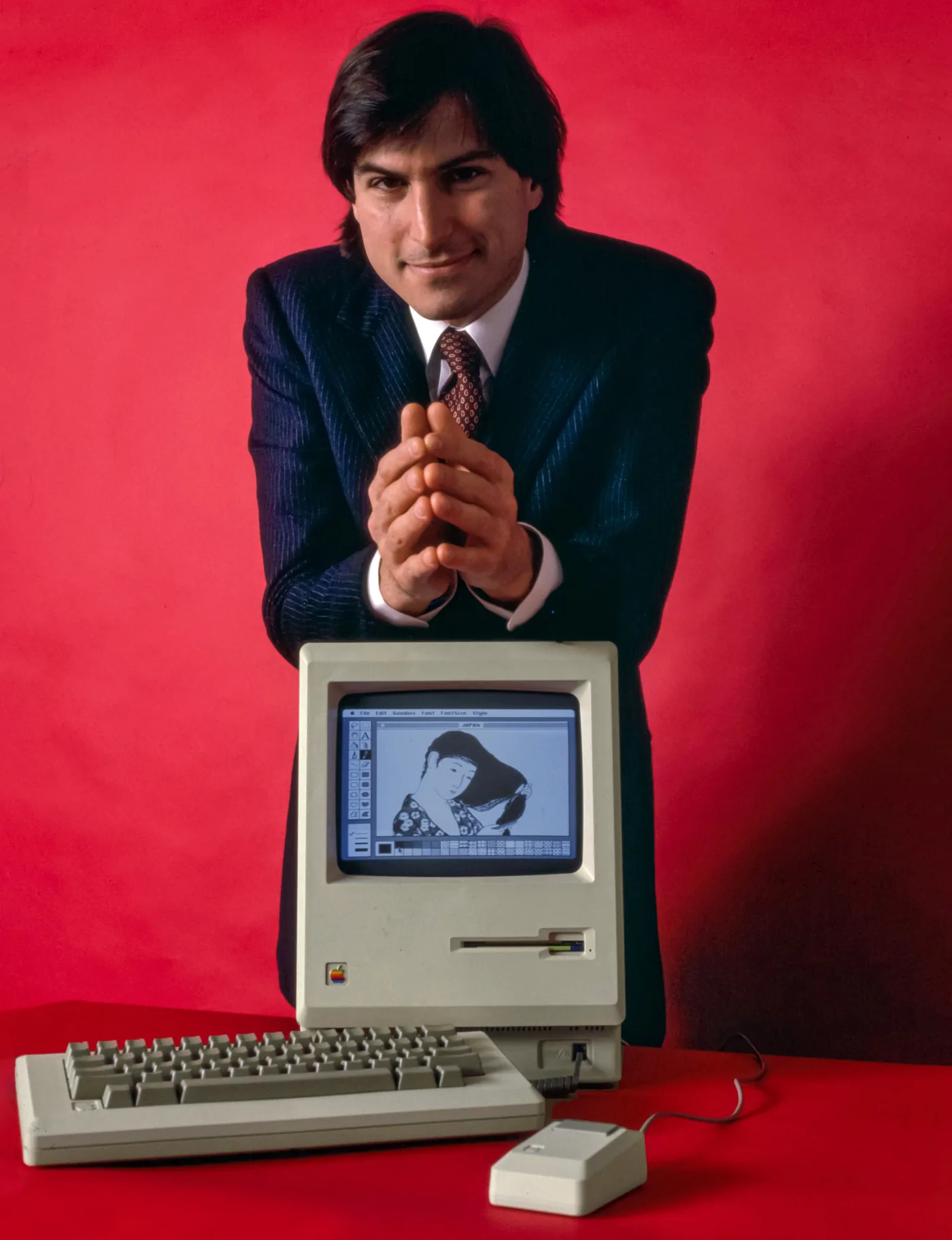
Steve Jobs died on 5 October 2011, a day after Apple showed the iPhone 4S, and the board's statement that afternoon said the world was "immeasurably better because of Steve."1 This October marks fifteen years since then.
He is still one of the few business figures whose name shows up on rankings far outside business. Below are 14 rankings that hold Steve Jobs or something he made: entrepreneurs and computer scientists, a commencement speech, a Super Bowl advert, a biopic, a sweater, and the case that he is overrated.
Most of these lists rank Steve Jobs for how he sold the machines, not for the machines: a speech, an advert, a film, a sweater, a temper.
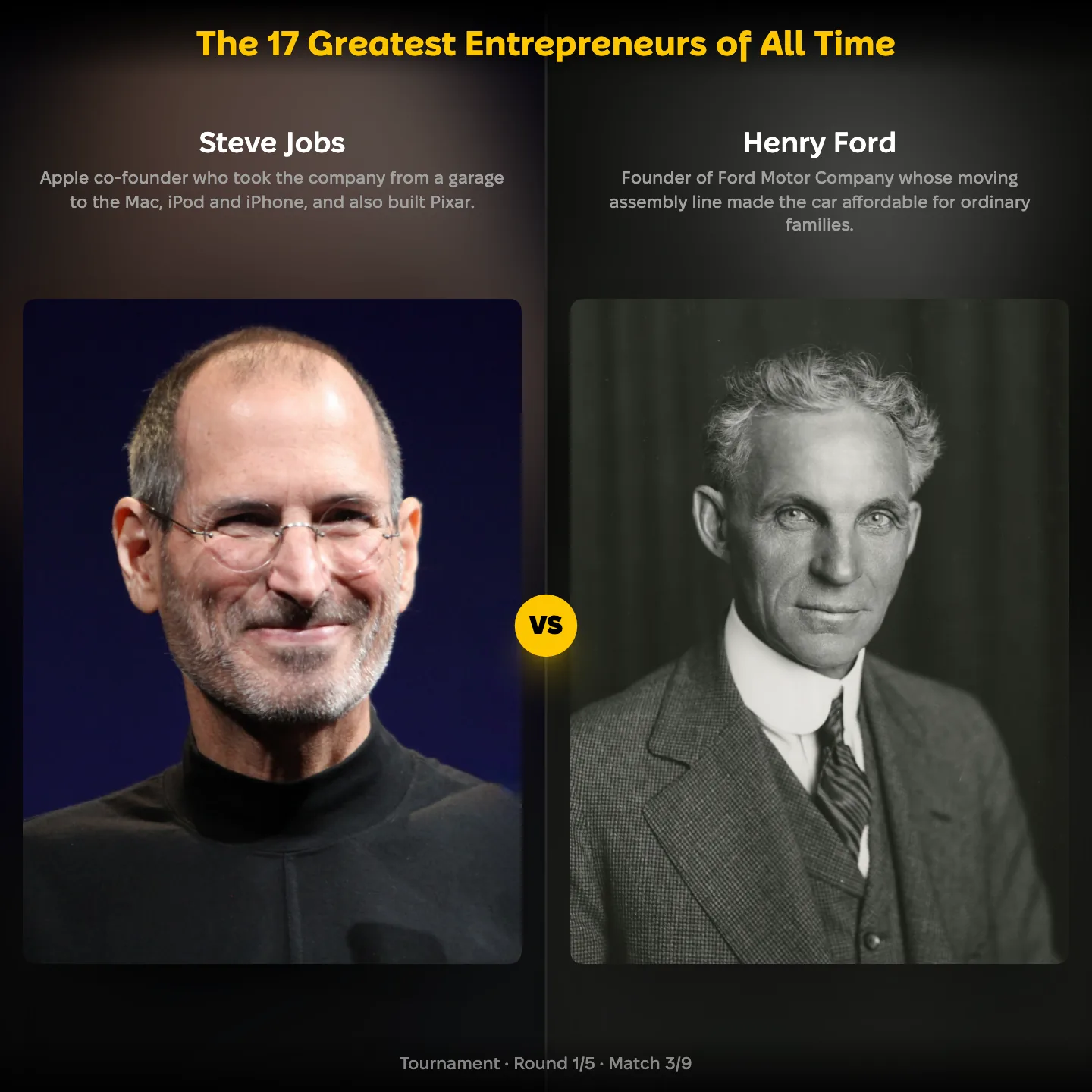
Steve Jobs vs Henry Ford: two ways to build a company
The greatest-entrepreneur list puts Steve Jobs next to the people who built the American economy: Henry Ford, John D. Rockefeller, Andrew Carnegie and Thomas Edison, plus Bill Gates, Jeff Bezos and Oprah Winfrey from his own era.
Henry Ford is the cleanest comparison. Ford took one product, the Model T of 1908, and changed how everything else was made with the moving assembly line. His genius was the factory.
Jobs worked the other way round. He co-founded Apple in 1976, lost it, then bought a small graphics company from Lucasfilm and turned it into Pixar. In January 2006 Disney agreed to buy Pixar for $7.4 billion in stock and put Jobs on its board of directors.2 He ran two companies in two industries at once, and both ended up with his taste stamped on them.
The Ford side of the case is scale. Millions of people owned a car because of him.
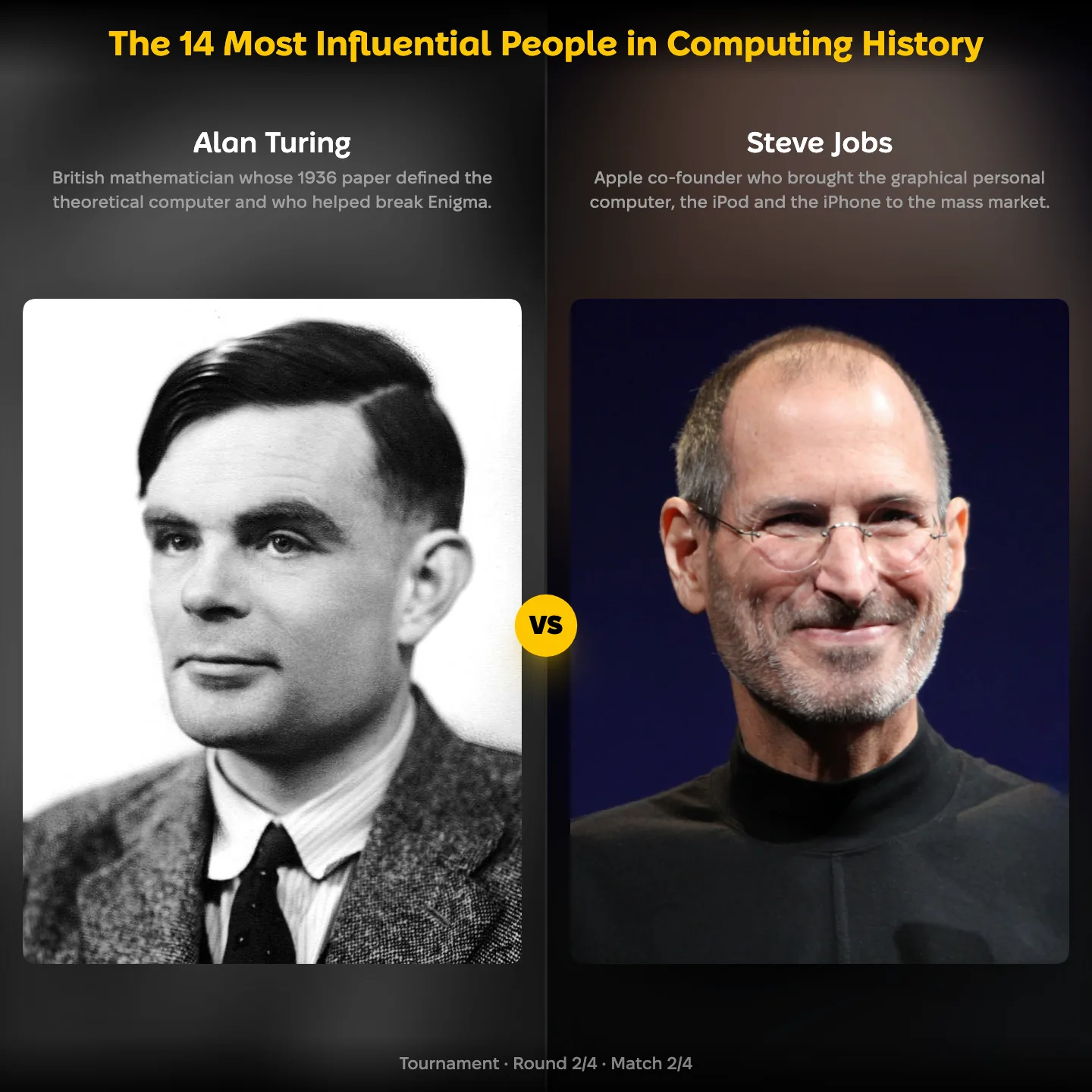
Alan Turing vs Steve Jobs: inventing the computer or selling it
The ranking of the most influential people in computing history is a tougher room for Steve Jobs. Alan Turing, Ada Lovelace, Charles Babbage, Grace Hopper, Dennis Ritchie and Tim Berners-Lee are on it for ideas every computer still runs on.
Turing's 1936 paper defined what a computer is before one existed. Berners-Lee gave the world the web and never patented it.
Jobs wrote no compiler and designed no circuit. Steve Wozniak, who is on the same list, built the Apple I and Apple II. The Jobs case rests on the graphical interface reaching ordinary people: the Macintosh in 1984, then the iPod and the iPhone. Influence counts reach as well as invention, and few people in this field reached as many hands.
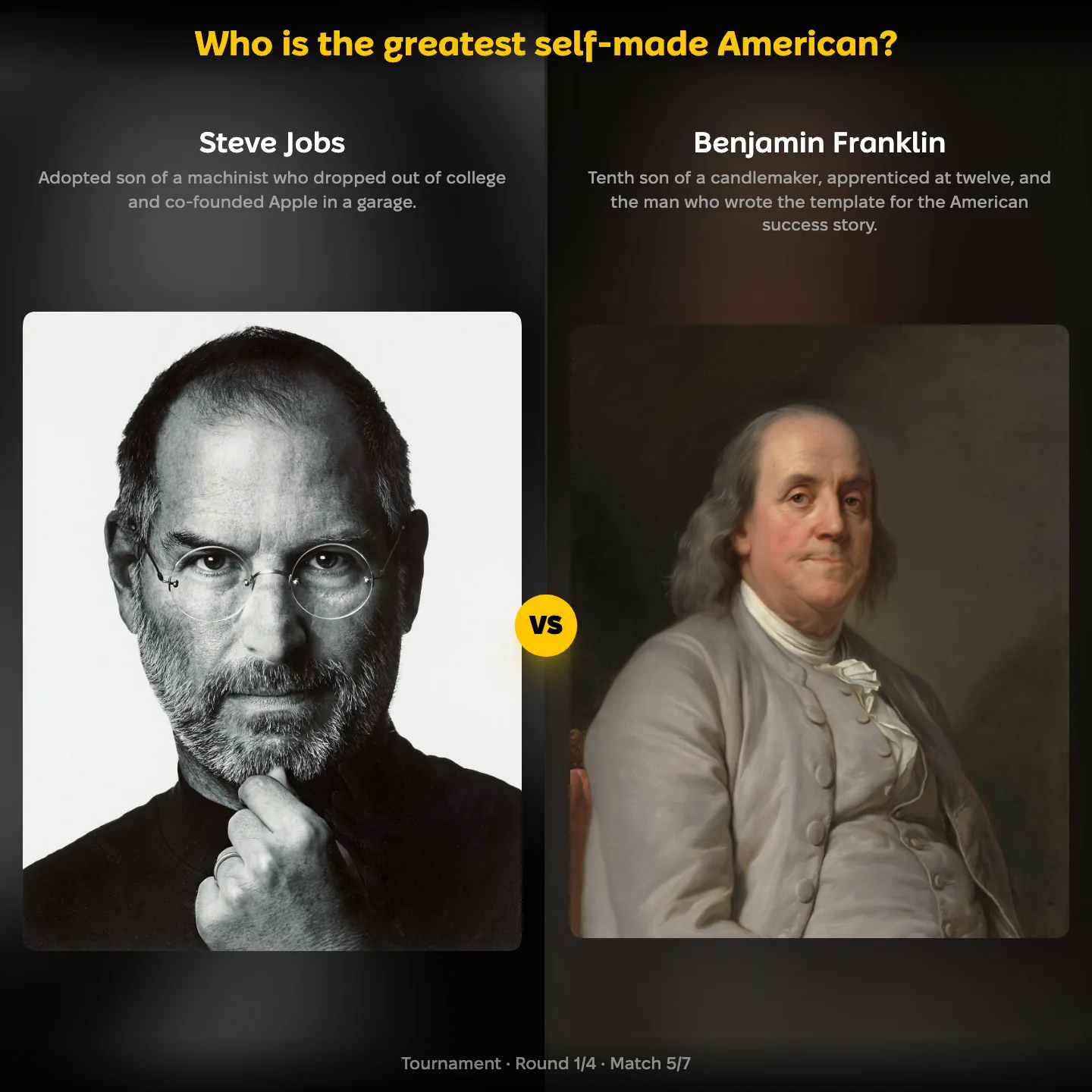
Benjamin Franklin and the greatest self-made American
This ranking asks who rose furthest from where they started. Steve Jobs shares it with Benjamin Franklin, Abraham Lincoln, Frederick Douglass, Madam C.J. Walker, Oprah Winfrey and Dolly Parton.
Jobs qualifies on the facts of his start: born in San Francisco in 1955, adopted by a machinist and his wife, a college dropout building circuit boards in the family garage. Franklin, a Boston candlemaker's son apprenticed in a print shop at twelve, and ended up on the hundred-dollar bill.
Beside Douglass, who escaped slavery, a middle-class California childhood looks like a head start.
iPhone vs Windows 95: the product launch as theatre
The ranking of the greatest product launches in tech history holds four other launches Steve Jobs led: the Apple II, the original Macintosh, the iPod and the iPad. The one it was built around is the iPhone.
On 9 January 2007 at Macworld in San Francisco, Jobs introduced "three revolutionary products" and then admitted they were one device. Apple's press release that day quoted him calling the iPhone "literally five years ahead of any other mobile phone."3 The phone did not go on sale for another five months.
Windows 95 is the launch that beat Apple at its own game. Microsoft bought the Rolling Stones' "Start Me Up" for the campaign, and on 24 August 1995 people queued outside computer shops at midnight to buy an operating system.
The Nintendo Wii, the Sony Walkman and the Game Boy are on the list too, a reminder that some launches are remembered for the queue and some for the stage.
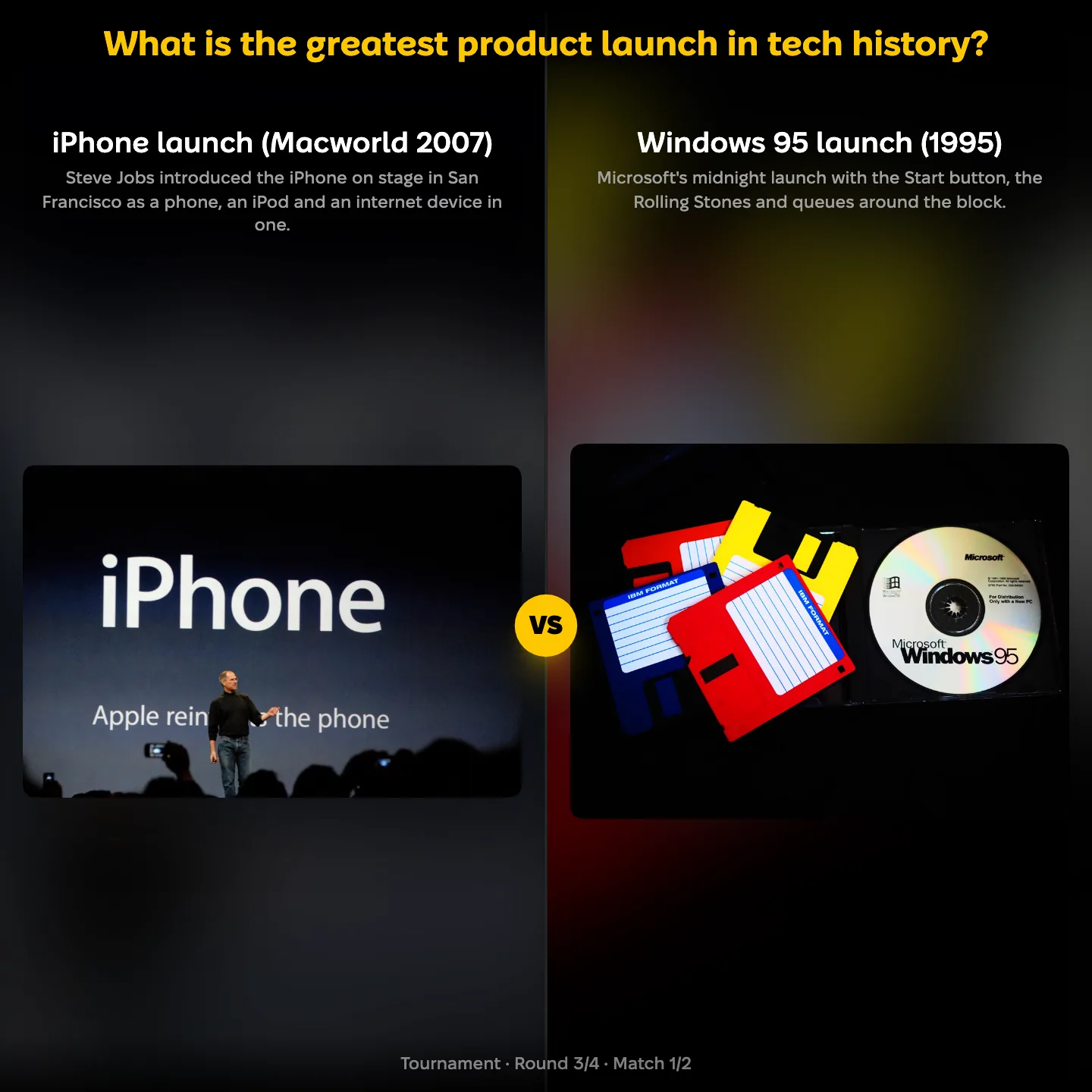
Stanford, 2005: "Stay hungry, stay foolish" next to "I Have a Dream"
Steve Jobs gave the commencement address at Stanford on 12 June 2005, and the university still publishes the text.4 He told three stories: dropping out of college, being fired from Apple, and his cancer diagnosis a year earlier. He closed on the farewell line of the Whole Earth Catalog: "Stay hungry. Stay foolish."
The ranking of the best motivational speeches sets that address against Martin Luther King Jr. at the Lincoln Memorial in 1963, John F. Kennedy's moon speech and Randy Pausch's last lecture. J.K. Rowling's Harvard commencement and David Foster Wallace's "This Is Water" are the two other graduation speeches in the field.
King's speech changed a country. The Stanford address is the one people send each other every June.
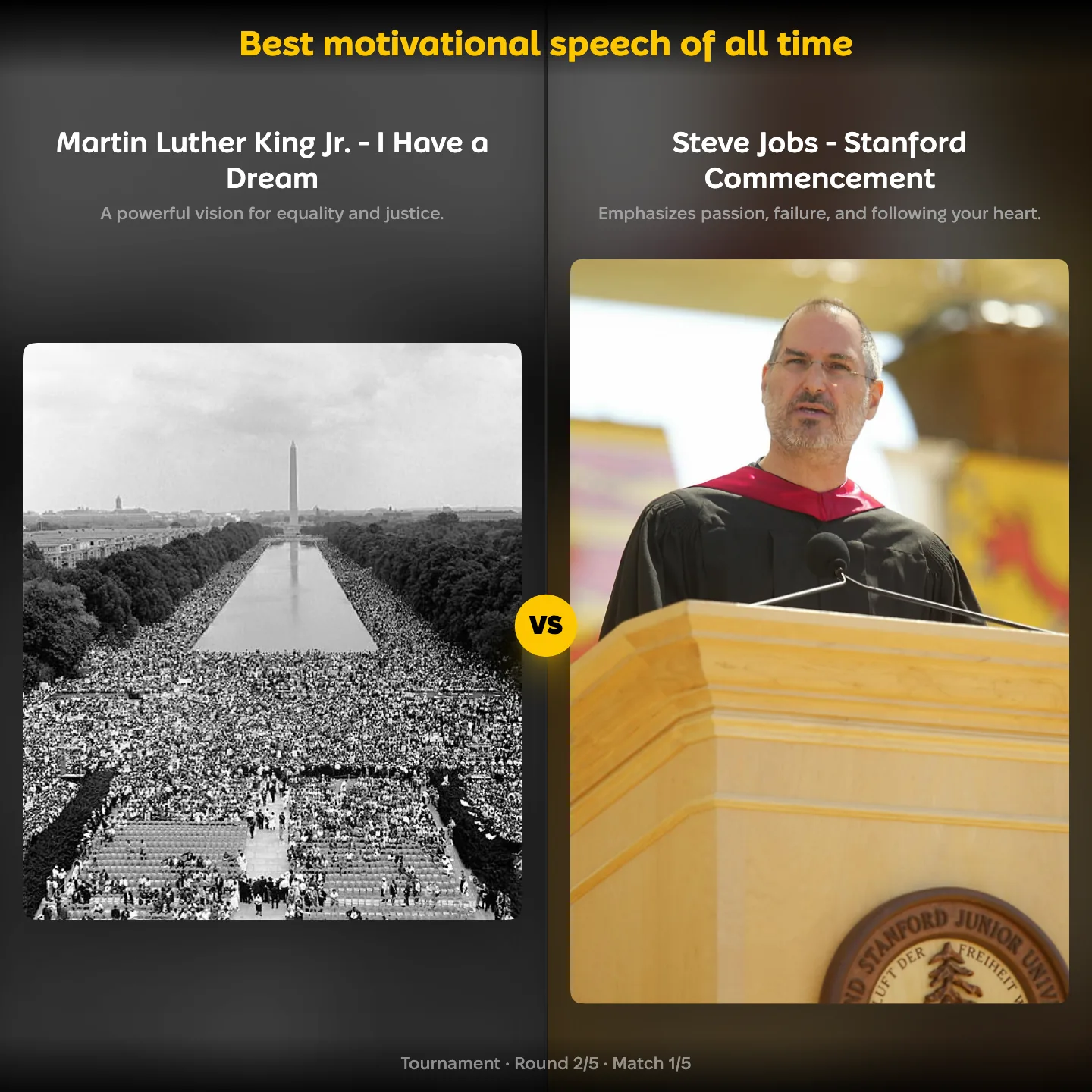
Macintosh vs the Coca-Cola bottle: the most iconic American products
Two Steve Jobs products appear among the most iconic American products: the Apple Macintosh of 1984 and the iPhone. They share it with the Ford Model T, Levi's 501 jeans, the Fender Stratocaster, the Zippo lighter and the Coca-Cola contour bottle.
The bottle, designed in 1915 to be recognised in the dark, is the standard every object on this list is measured against. The Macintosh is the only desktop computer here, a beige box with a mouse and a handle on top so it could be carried like a bag.
The iPhone has the stronger claim on sales. The Macintosh has the stronger claim on design: it is the reason the iPhone looked the way it did.
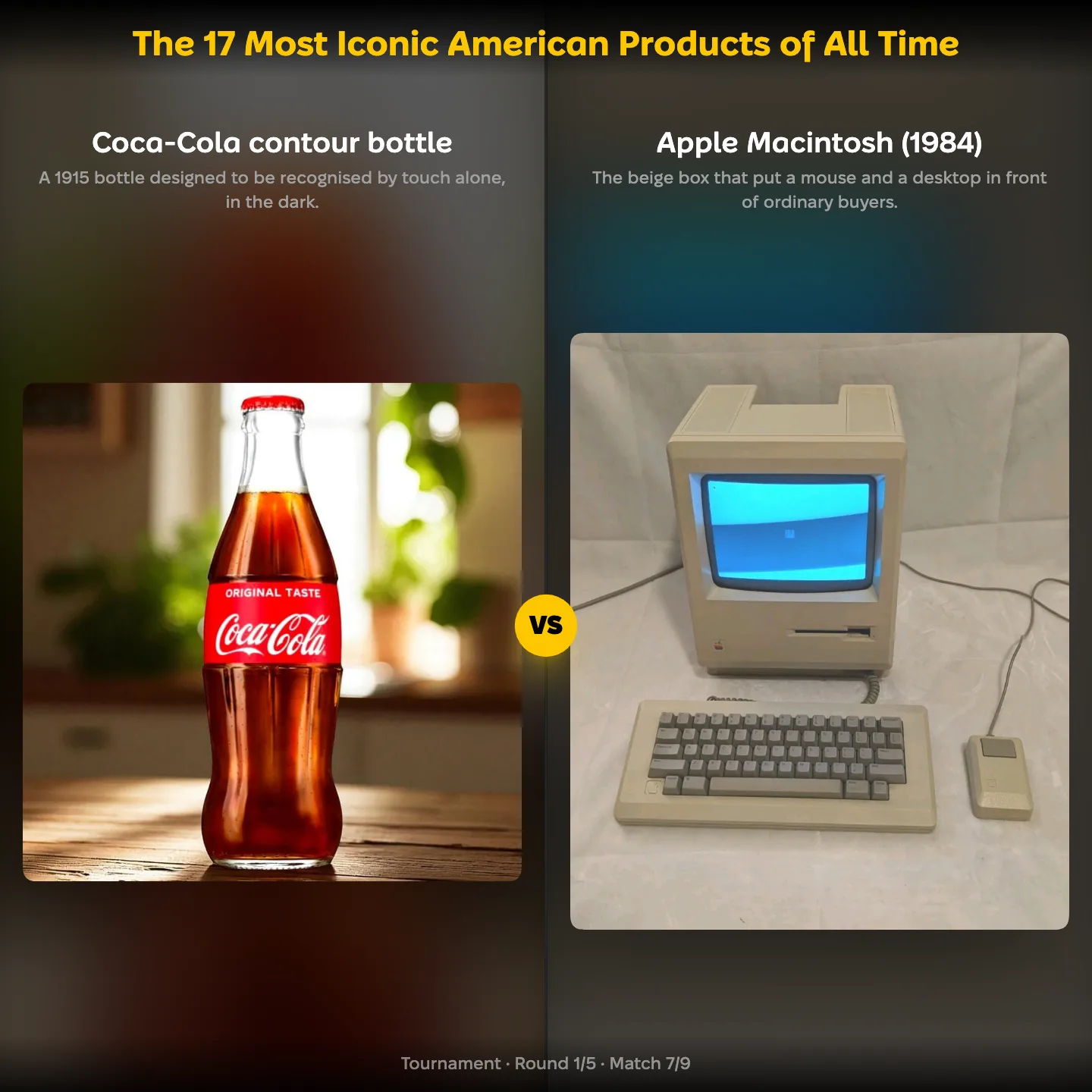
Apple's "1984" at Super Bowl XVIII
Apple introduced the Macintosh with a Ridley Scott advert that aired nationally once, during Super Bowl XVIII on 22 January 1984. It never shows the computer.
The ranking of the best Super Bowl commercials sets "1984" against Coca-Cola's "Mean Joe Greene", Budweiser's "Whassup" and Volkswagen's small Darth Vader from 2011. It is the only advert on the list that sold a computer by casting its rival, IBM, as Big Brother without naming it.
LEGO vs Apple: the greatest business comebacks
The ranking of the greatest business comebacks is full of companies that nearly ended: LEGO in 2004, Marvel after its 1996 bankruptcy, IBM, Harley-Davidson and Domino's. Apple is on it, and Steve Jobs is the reason.
The return started with a purchase. On 20 December 1996 Apple announced it would buy NeXT, the company Jobs founded after being pushed out, for $400 million, and Jobs came back with it.5
The rescue needed an old enemy. On 6 August 1997 at Macworld Boston, Jobs announced a $150 million Microsoft investment in Apple and a promise to keep Office on the Mac.6 Bill Gates appeared on the giant screen behind him, and the audience booed.
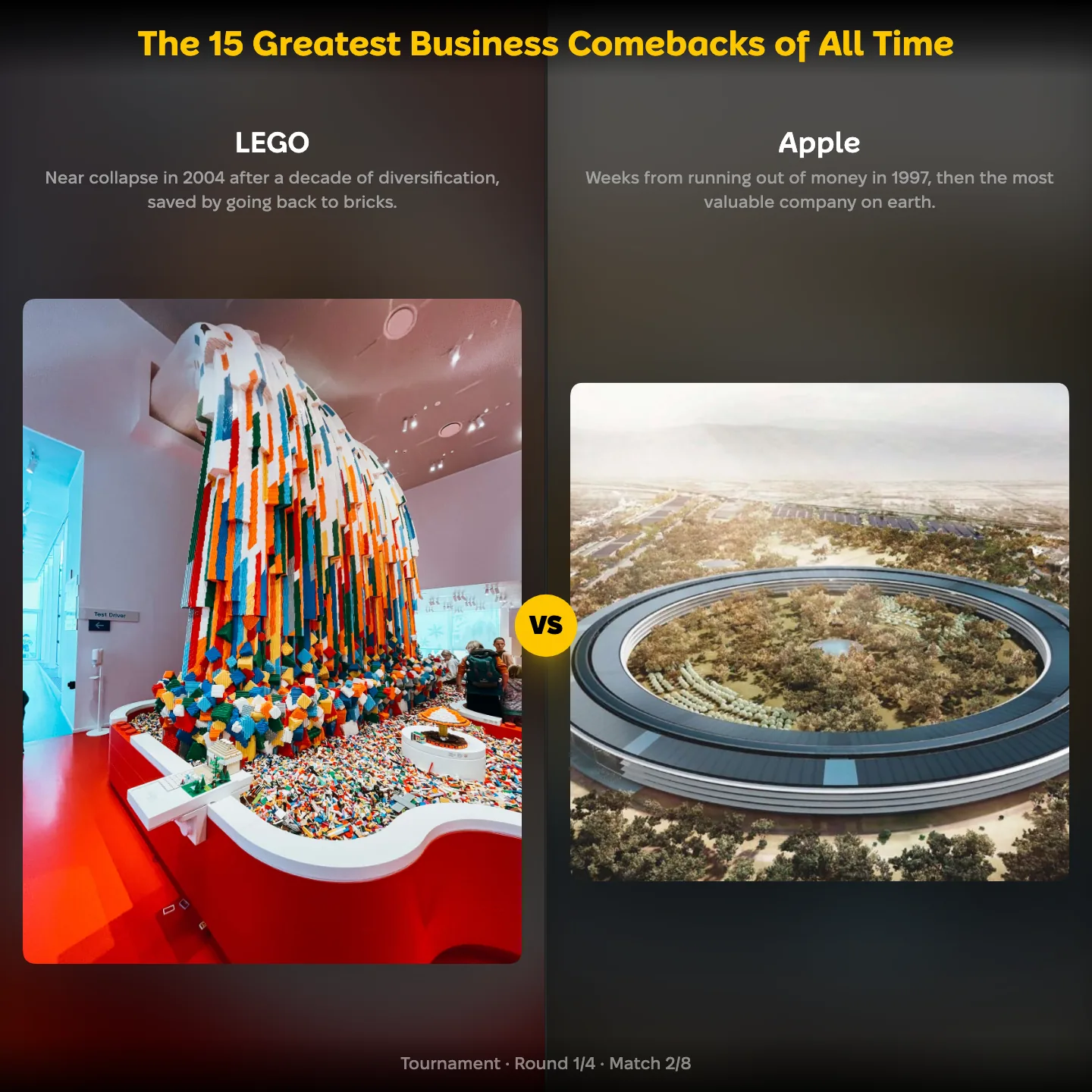
LEGO's case is quieter and just as complete. It shed theme parks, clothing and video games, went back to the brick, and became the largest toymaker in the world.
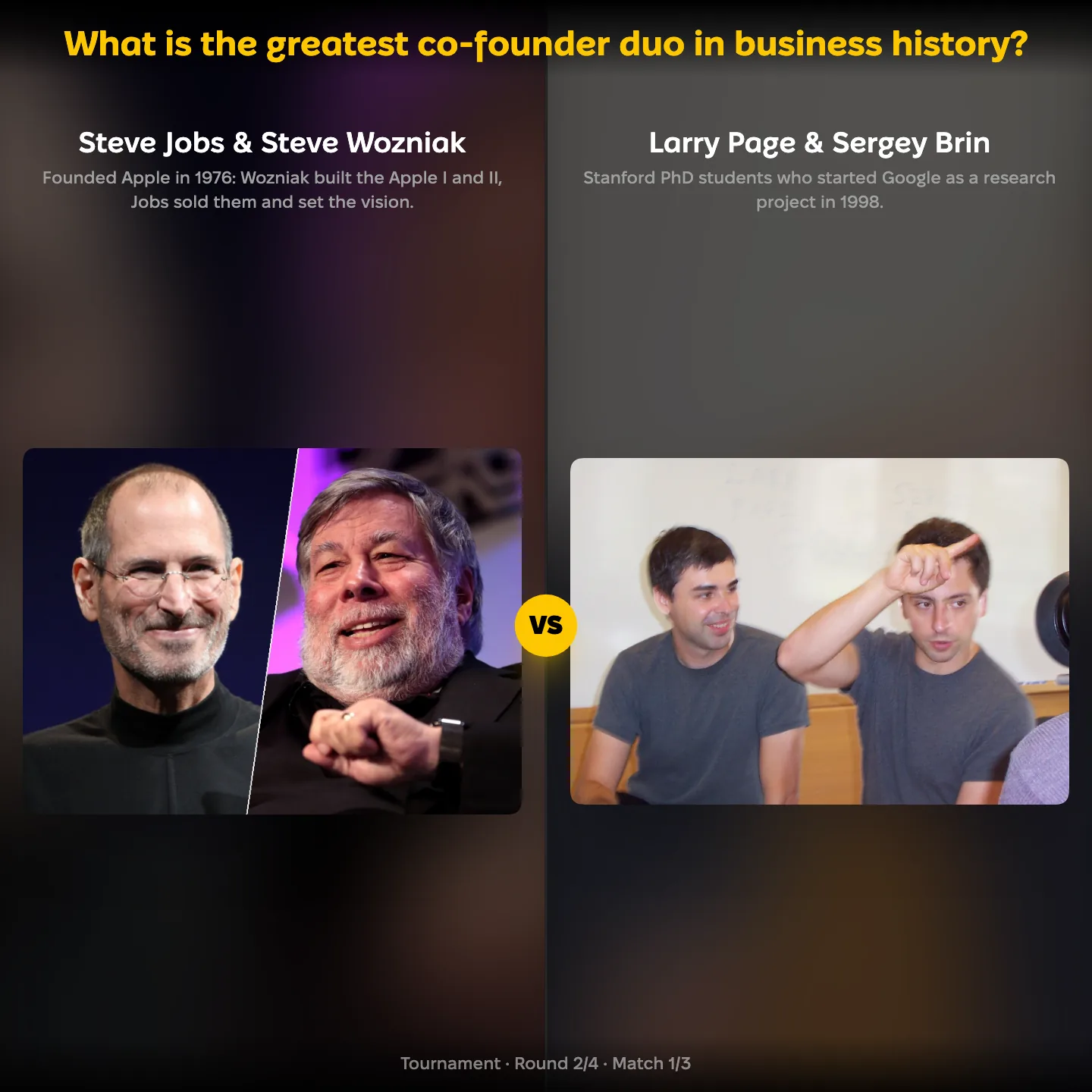
Jobs and Wozniak vs Page and Brin: the greatest co-founder duos
The ranking of co-founder duos pairs Steve Jobs with the partner who could do what he could not. Steve Wozniak designed the Apple I by hand; Jobs found the buyers and the money.
Larry Page and Sergey Brin are the obvious rival: two Stanford PhD students whose research project became Google in 1998. Bill Gates and Paul Allen, Warren Buffett and Charlie Munger, and Ben Cohen with Jerry Greenfield complete the field.
The Apple partnership is the one that split early. Wozniak stopped working full-time at Apple in 1985, and the duo is remembered for its first nine years.
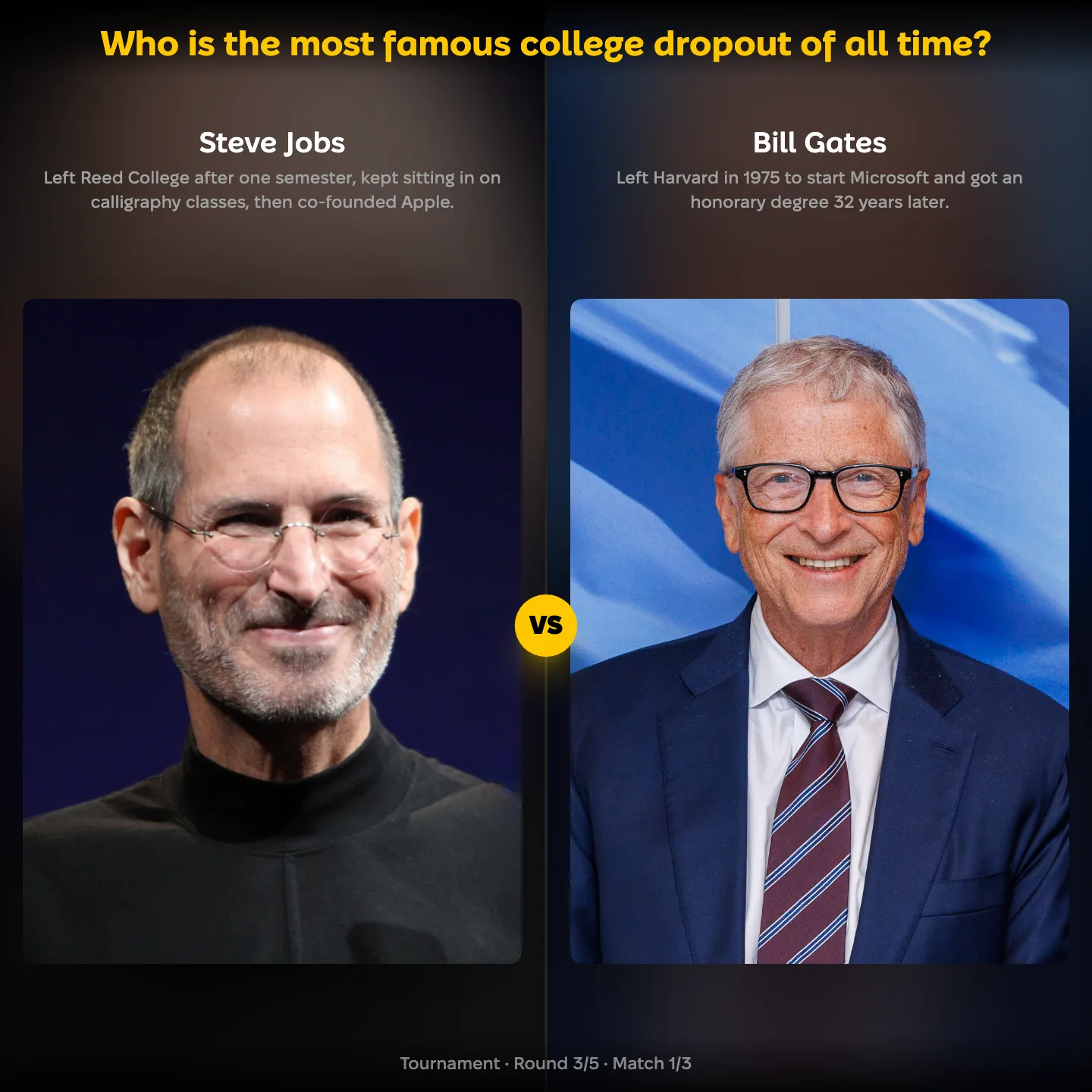
Steve Jobs vs Bill Gates: the most famous college dropouts
The college-dropout ranking is where Steve Jobs finally meets Bill Gates on equal terms. Both were born in 1955, and both left university to start a company.
Jobs left Reed College in Portland after six months and stayed on for a while to sit in on classes. In the Stanford address he said a calligraphy course there was the reason the Macintosh shipped with proportionally spaced fonts.
Gates left Harvard in 1975 to start Microsoft with Paul Allen. Harvard gave him an honorary degree in 2007, and he opened his speech with "Dad, I always told you I'd come back and get my degree."7
Mark Zuckerberg, Michael Dell, Larry Ellison, Lady Gaga, Tom Hanks and Frank Lloyd Wright are the rest of the field. Only two of them left school and changed how the world uses a computer.
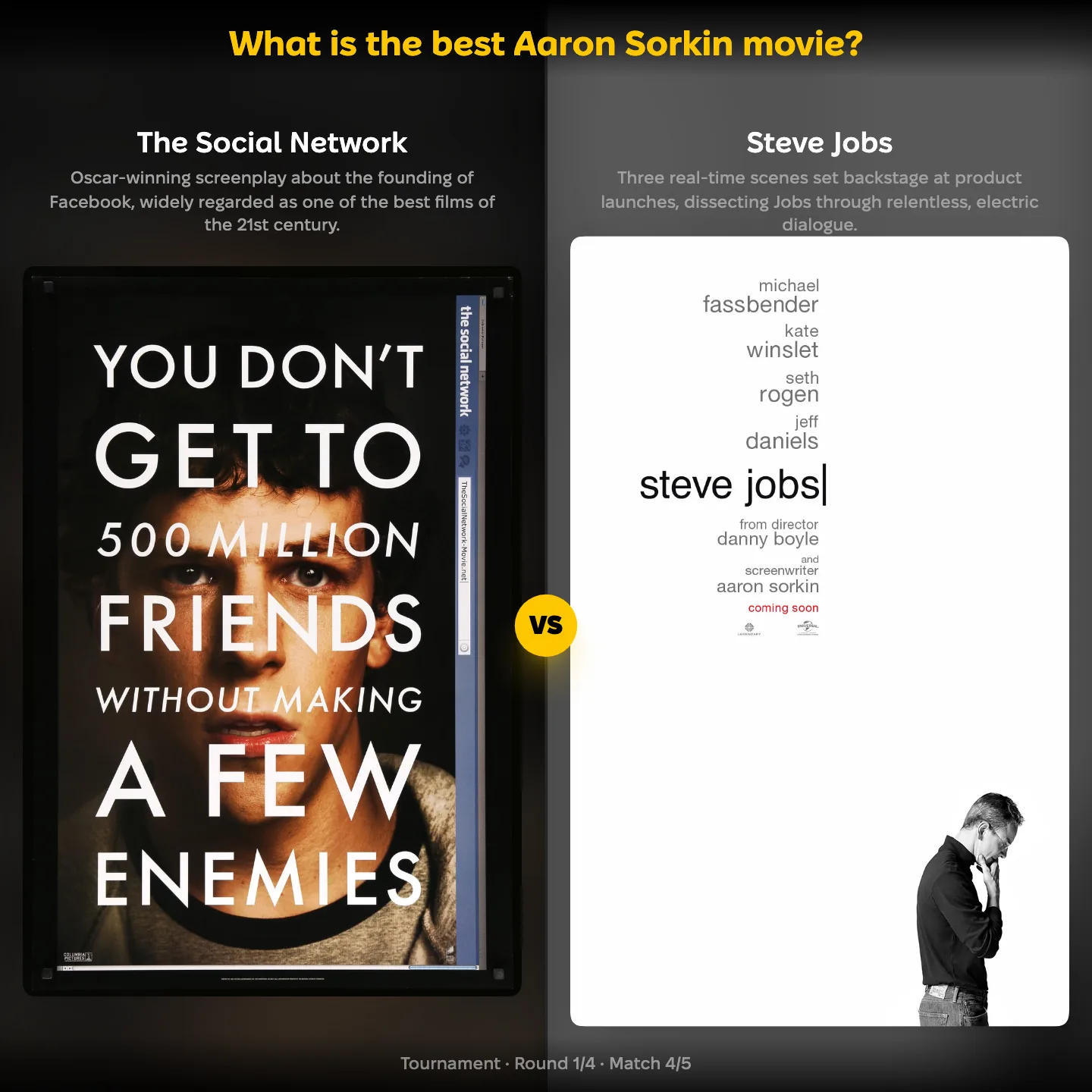
Aaron Sorkin's Steve Jobs vs The Social Network
Aaron Sorkin wrote two films about tech founders, and both are on the ranking of his best films. The Social Network, about Mark Zuckerberg, won him the Oscar for adapted screenplay in 2011.
Steve Jobs (2015), directed by Danny Boyle, takes place almost entirely backstage in the minutes before three launches: the Macintosh in 1984, the NeXT Computer in 1988 and the iMac in 1998. Michael Fassbender and Kate Winslet were both nominated for Oscars.
A Few Good Men and Moneyball are on the same list. This is the only entry in the article where Jobs appears as a character written by someone else.
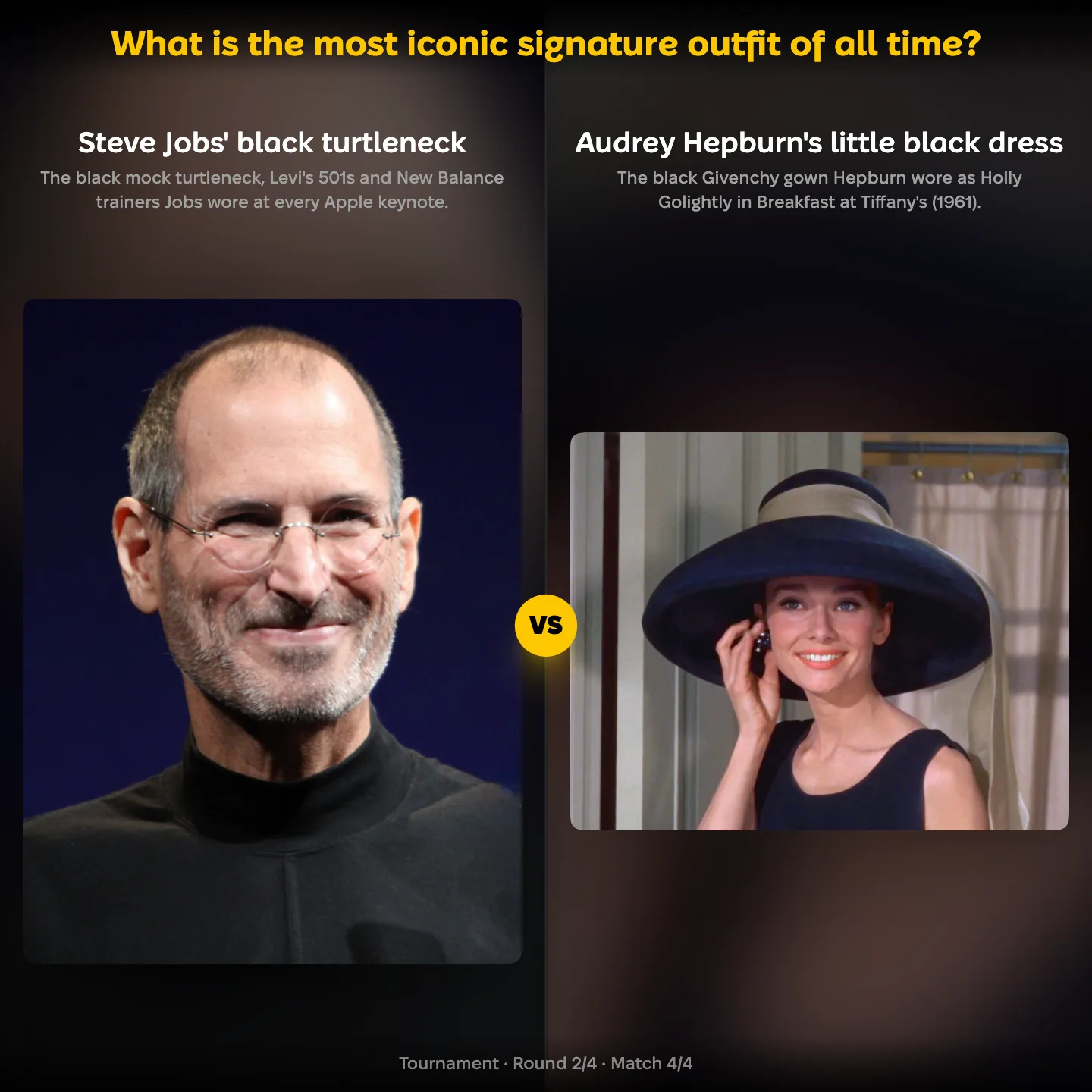
The black turtleneck: a uniform Apple staff refused
Steve Jobs' black turtleneck competes for the most iconic signature outfit beside Audrey Hepburn's little black dress from Breakfast at Tiffany's, Charlie Chaplin's Tramp, Johnny Cash in black and Michael Jackson's single glove.
It began as a failed uniform. Jobs admired the jackets Issey Miyake designed for Sony and asked him for an Apple version; he told his biographer he was "booed off the stage" when he pitched it to staff. So he asked Miyake for black turtlenecks instead, and "he made me like a hundred of them."8
Levi's 501s and New Balance trainers finished the look. Colonel Sanders' white suit is the only other outfit here that was worn to sell something.
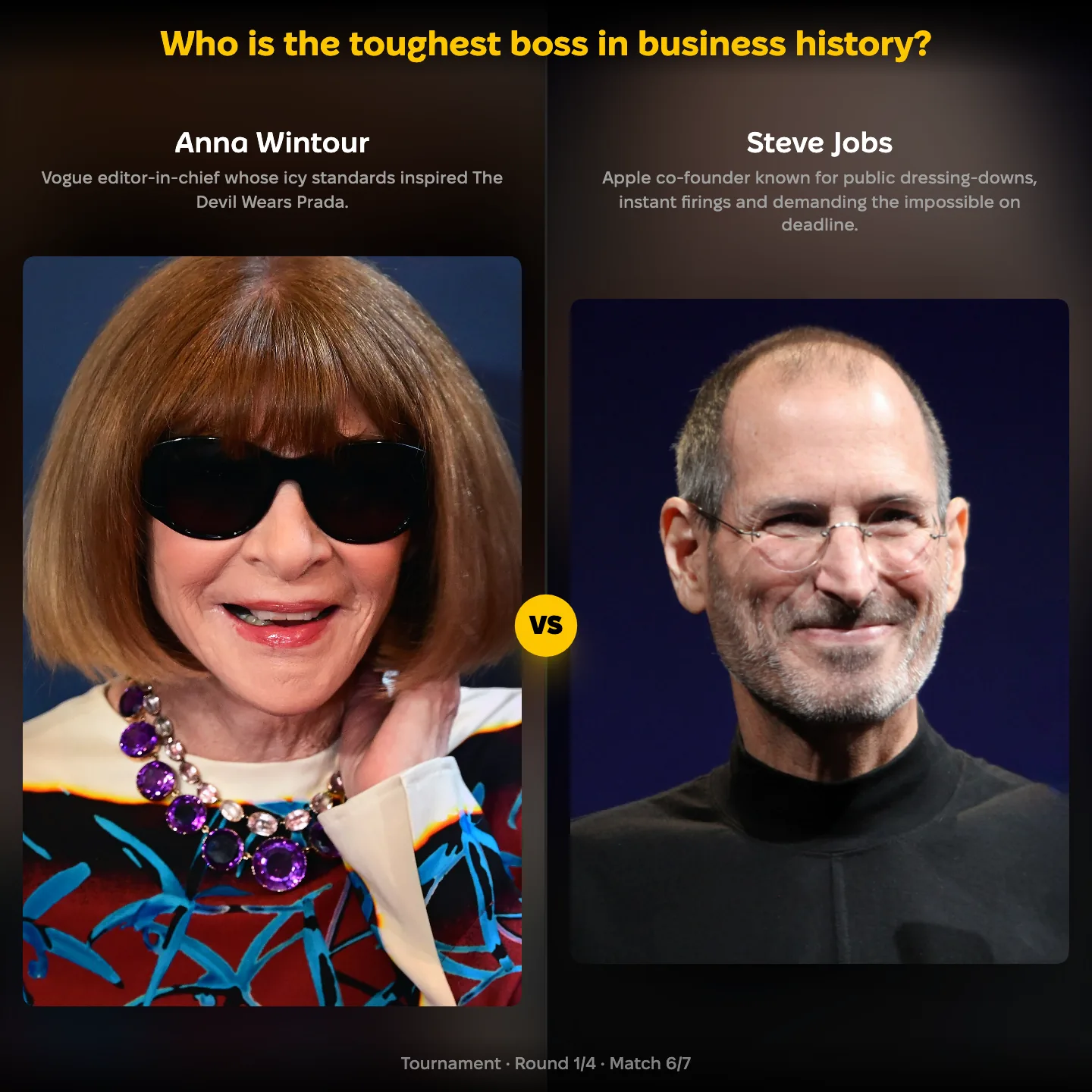
Anna Wintour vs Steve Jobs: the toughest boss in business
The ranking of the toughest bosses in business history holds Jack Welch, Larry Ellison, Elon Musk, Jeff Bezos and Anna Wintour, whose Vogue inspired The Devil Wears Prada. Steve Jobs is on it for good reason.
Early Apple engineers named his effect on deadlines the "reality distortion field". He rejected work in a word and demanded the impossible on a schedule. In 1985 Apple's board sided with the chief executive he had hired, John Sculley, and Jobs left the company he had founded.
The counter-case is what the pressure produced. The same engineers who described the temper built the Macintosh.
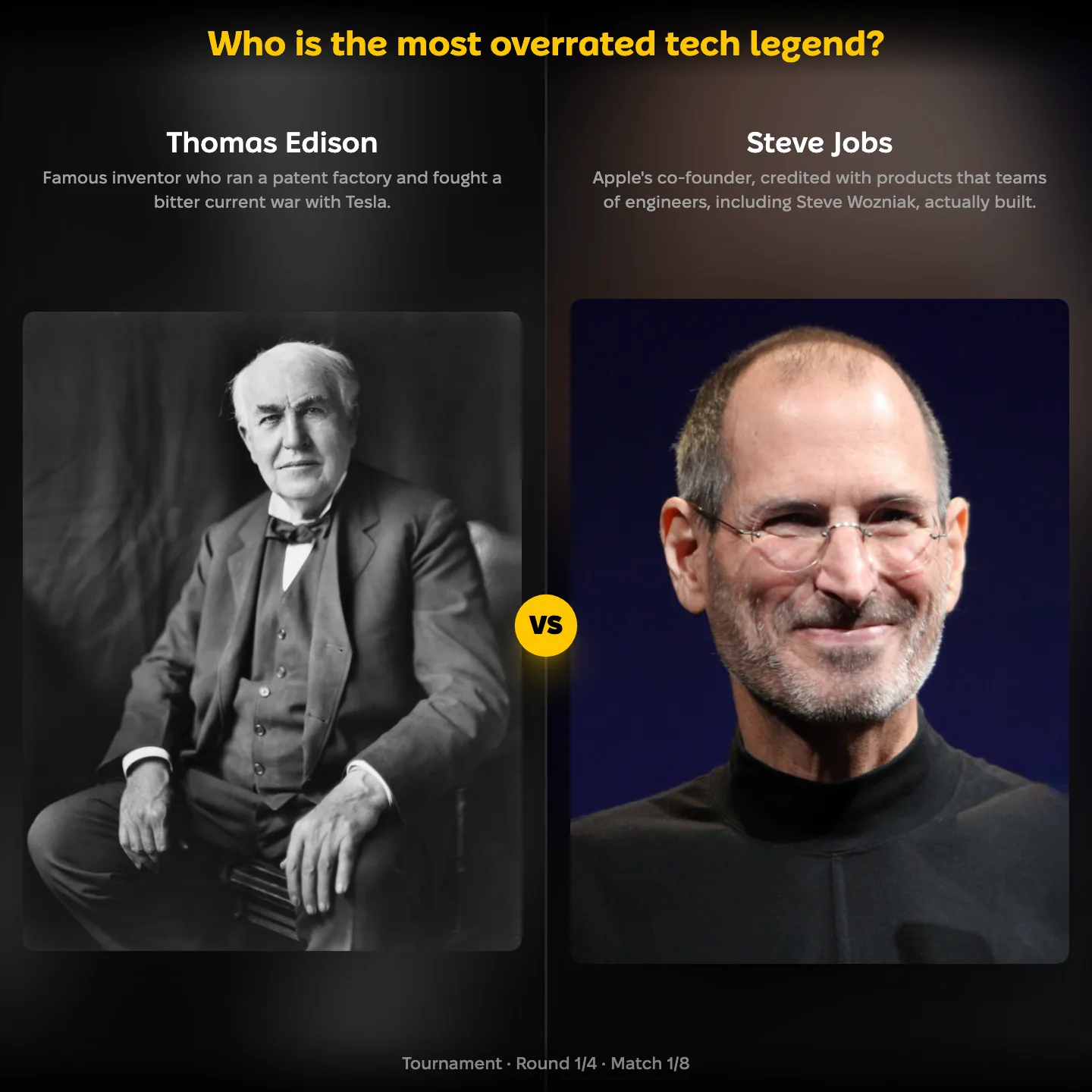
Thomas Edison and the most overrated tech legend
The ranking of the most overrated tech legends is the inverted version of the entrepreneurs list, and Steve Jobs is on it with Thomas Edison, Elon Musk, Mark Zuckerberg and Bill Gates.
Edison is the model for the charge. He ran a patent factory at Menlo Park, took credit for the work of his staff and fought Nikola Tesla over alternating current.
The case against Jobs is similar. Wozniak engineered the first Apples, Jony Ive designed the iMac and the iPhone, and the prosecution rests on the fact that both of them are also candidates here. The defence is a pattern no one else here has: the Macintosh, Toy Story at Pixar, the iPod and the iPhone, four hits in four industries.
The salesman and the engineer
Read the fourteen rankings together and Steve Jobs keeps coming up as the man next to the inventor: next to Wozniak, next to Turing, next to Edison on the overrated list. On the lists about stagecraft he stands alone: the keynote, the Stanford address, "1984", the turtleneck.
Each order above comes from one head-to-head pick after another, so start with the pairing you feel strongest about. If a founder of your own deserves a ranking, build one and see who they end up beside.
More rankings, more angles
- Apple vs Samsung Compared: 14 Categories, 14 Arguments — the company Jobs left behind, against its biggest rival
- Is Google the Best Search Engine? Where It Lands on 16 Lists — Page and Brin's company on 16 lists
- Apollo Moon Landing: Greatest Human Achievement? 16 Lists — the other American engineering legend of the century
Sources
- Apple — Statement by Apple's Board of Directors, 5 October 2011: apple.com (checked 2026-09-29)
- The Walt Disney Company and Pixar — joint press release on the $7.4 billion acquisition and Jobs joining Disney's board, 24 January 2006: sec.gov (checked 2026-09-29)
- Apple — "Apple Reinvents the Phone with iPhone", 9 January 2007: apple.com (checked 2026-09-29)
- Stanford Report — text of Steve Jobs' commencement address, 12 June 2005: news.stanford.edu (checked 2026-09-29)
- MacTech — Apple's announcement of the $400 million NeXT acquisition, 20 December 1996: mactech.com (checked 2026-09-29)
- Microsoft — Microsoft and Apple announcement at Macworld Boston, including the $150 million investment, 6 August 1997: news.microsoft.com (checked 2026-09-29)
- Harvard Gazette — remarks of Bill Gates at Harvard Commencement, 7 June 2007: news.harvard.edu (checked 2026-09-29)
- NPR — Steve Jobs, Issey Miyake and the Apple uniform that never happened, 10 August 2022: npr.org (checked 2026-09-29)