
In April 2026 four astronauts flew around the far side of the Moon and came home without landing on it. Artemis II reached 252,756 miles from Earth on 6 April, which took the record for the greatest distance humans have ever travelled away from Apollo 13.4 Apollo 13 had held it since April 1970. The mark was set by a crew whose spacecraft was broken and who were only that far out because the landing had already been abandoned.3
Fifty-six years is a long time for a record to stand. It is also long enough for a space programme to stop being a space programme and become something else: a film, a wristwatch, a speech, a photograph, a documentary, an argument about engineering.
Sixteen lists reach for Apollo and only two of them are about spaceflight. The rest file it under photographs, wristwatches, speeches and somebody's third-best film.
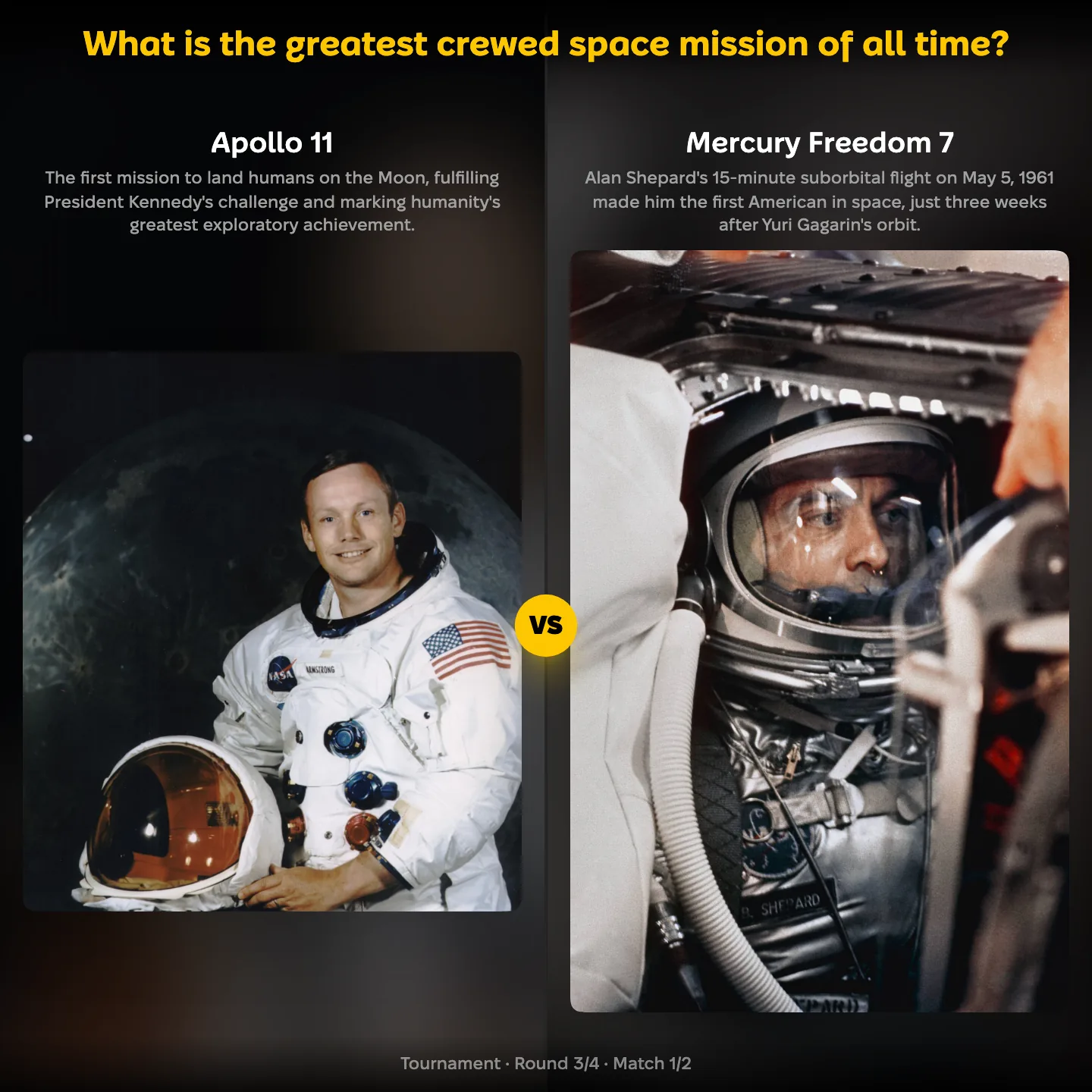
Apollo 11 vs Mercury Freedom 7: fifteen minutes against eight days
Crewed spaceflight has produced maybe a dozen missions that a general reader can name, and this ranking holds twelve of them.
Apollo 11 launched on 16 July 1969 and landed four days later. Armstrong and Aldrin spent about two and a half hours outside the lunar module and collected 21.5 kg of rock and soil.2
Mercury Freedom 7 sits at the far end of the same era. Alan Shepard's flight lasted a quarter of an hour and never reached orbit, and it happened eight years before Apollo 11, which is why they belong next to each other. Everything the later mission did was built on the earlier one being survivable.
Three Apollo flights are here, more than any other programme managed, alongside Vostok 1, Gemini 4, the first Shuttle flight and Crew Dragon Demo-2. Apollo has never had an easier room than this, and it does not get another one.
The landing or the rescue
Twelve flights carried the Apollo name and only six of them put anyone on the Moon.1 That leaves a field where the missions are not competing on the same thing at all.
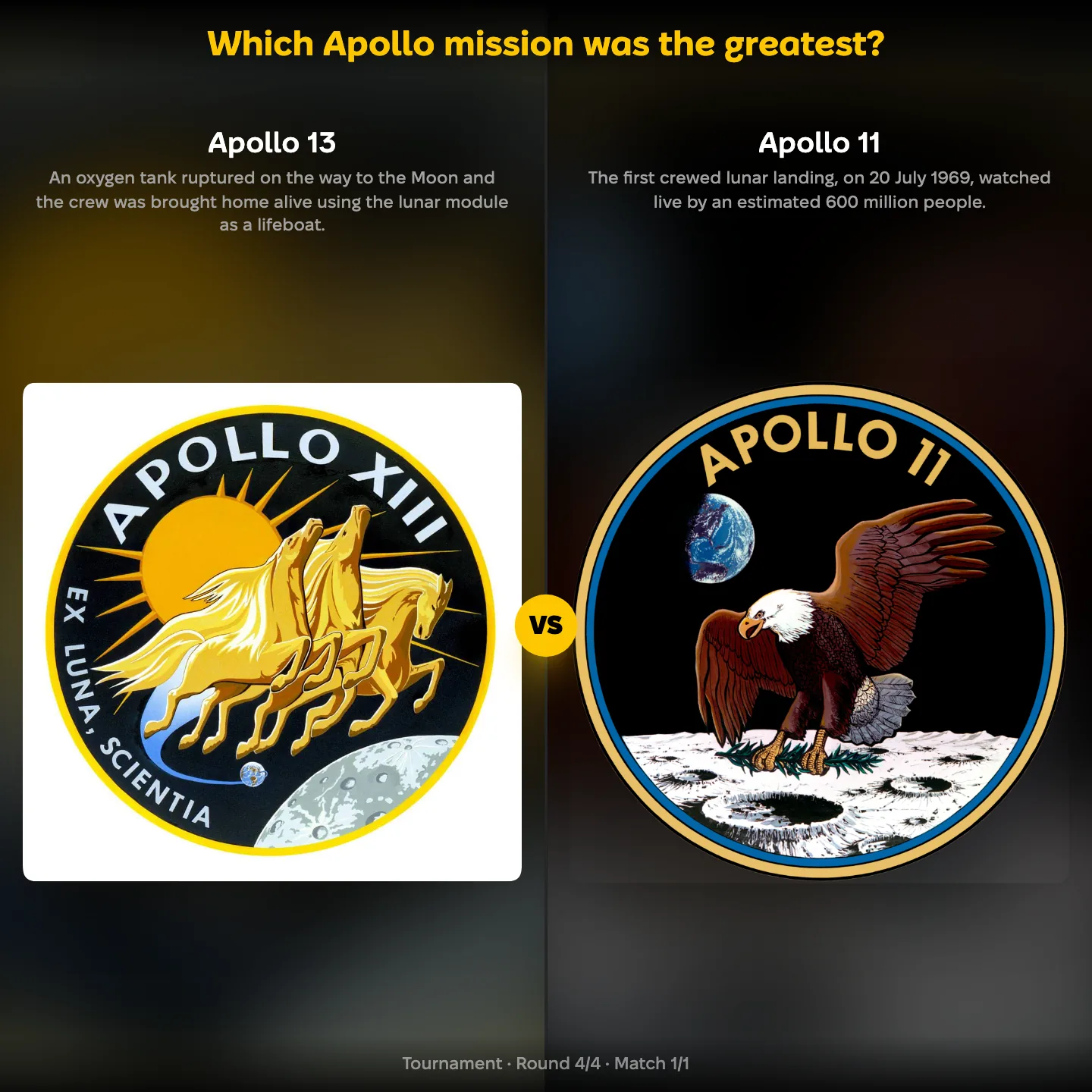
Apollo 11 has the first landing, and the first of anything is hard to argue with.
Apollo 13 has the better story. An oxygen tank ruptured on the way out, the landing was abandoned, and the crew was brought back using the lunar module as a lifeboat: a mission that failed at its stated objective and is studied more closely than the ones that succeeded.
Apollo 8 has a third kind of claim: it left Earth orbit first, circled the Moon at Christmas 1968, and did it without a lunar module aboard, because the schedule had been rewritten months before launch.
The rest divide by what they were for. Apollo 15 brought the rover, Apollo 12 proved a pinpoint landing was possible, Apollo 17 stayed longest and carried the only professional geologist to walk on the Moon, and Apollo 7, 9 and 10 were the rehearsals that made all of it routine enough to try. Twelve of the twelve are Apollo, so this is the one list in the article where the programme cannot lose and cannot win.
Voyager has been going since 1977
NASA's best mission is a different question from its best crewed mission, and the field changes completely once robots are allowed in.
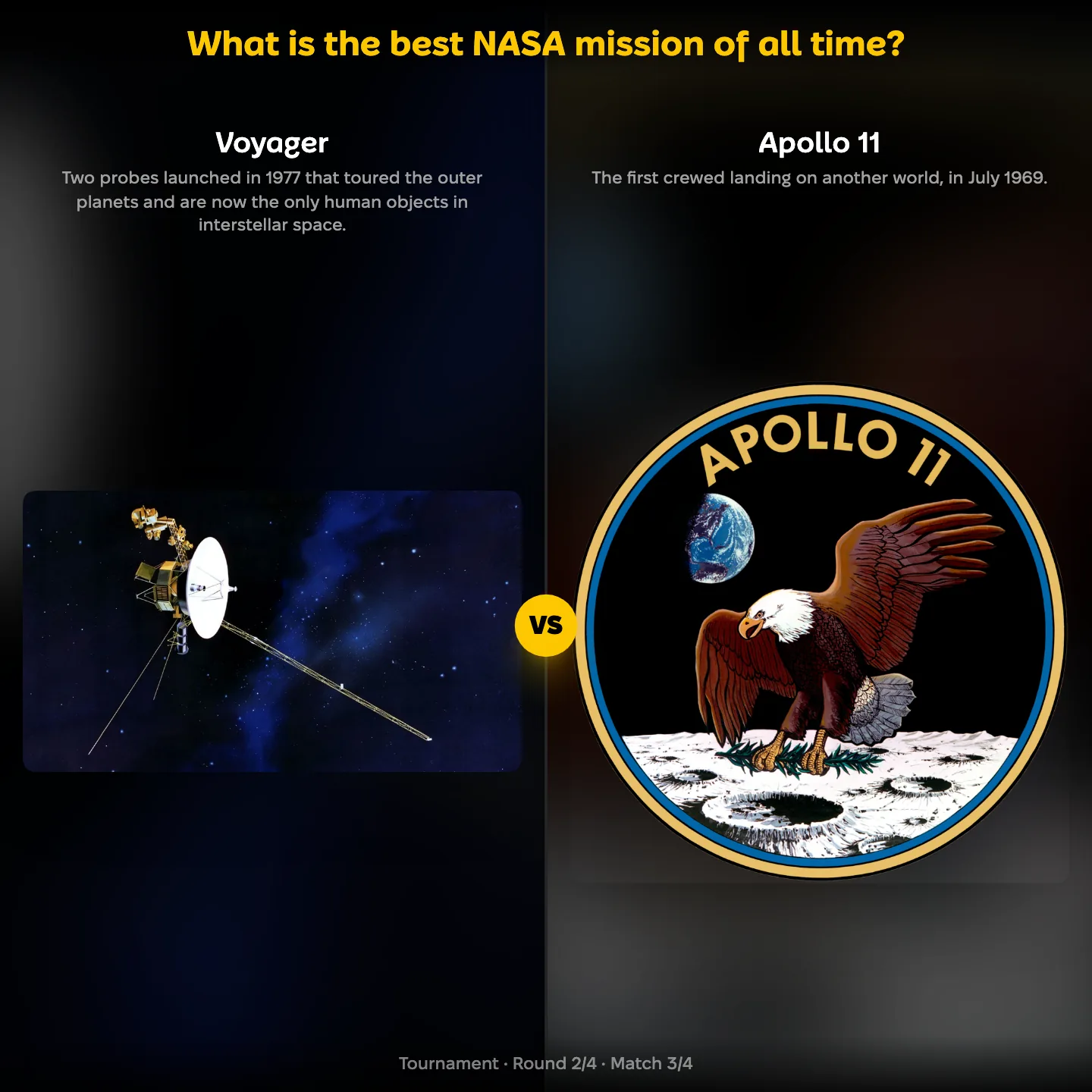
Apollo 11 is the crewed entry that everyone knows, and it lasted eight days.
Voyager launched in 1977, toured the outer planets and is now the only human-made object in interstellar space, still transmitting decades after the engineers who built it retired. Hubble was launched with a flawed mirror, repaired in orbit, and is still returning science more than thirty years on. Cassini spent thirteen years at Saturn and ended by flying into the planet on purpose.
Duration is the axis where Apollo is weakest. Nothing the programme flew stayed useful for longer than a fortnight, because nothing it flew was designed to; the whole architecture was built to go once and come back. Set against a probe that has been working for nearly fifty years, eight days is a rounding error. Duration is also the only axis on which a Moon-mission ballot would never test the programme at all.
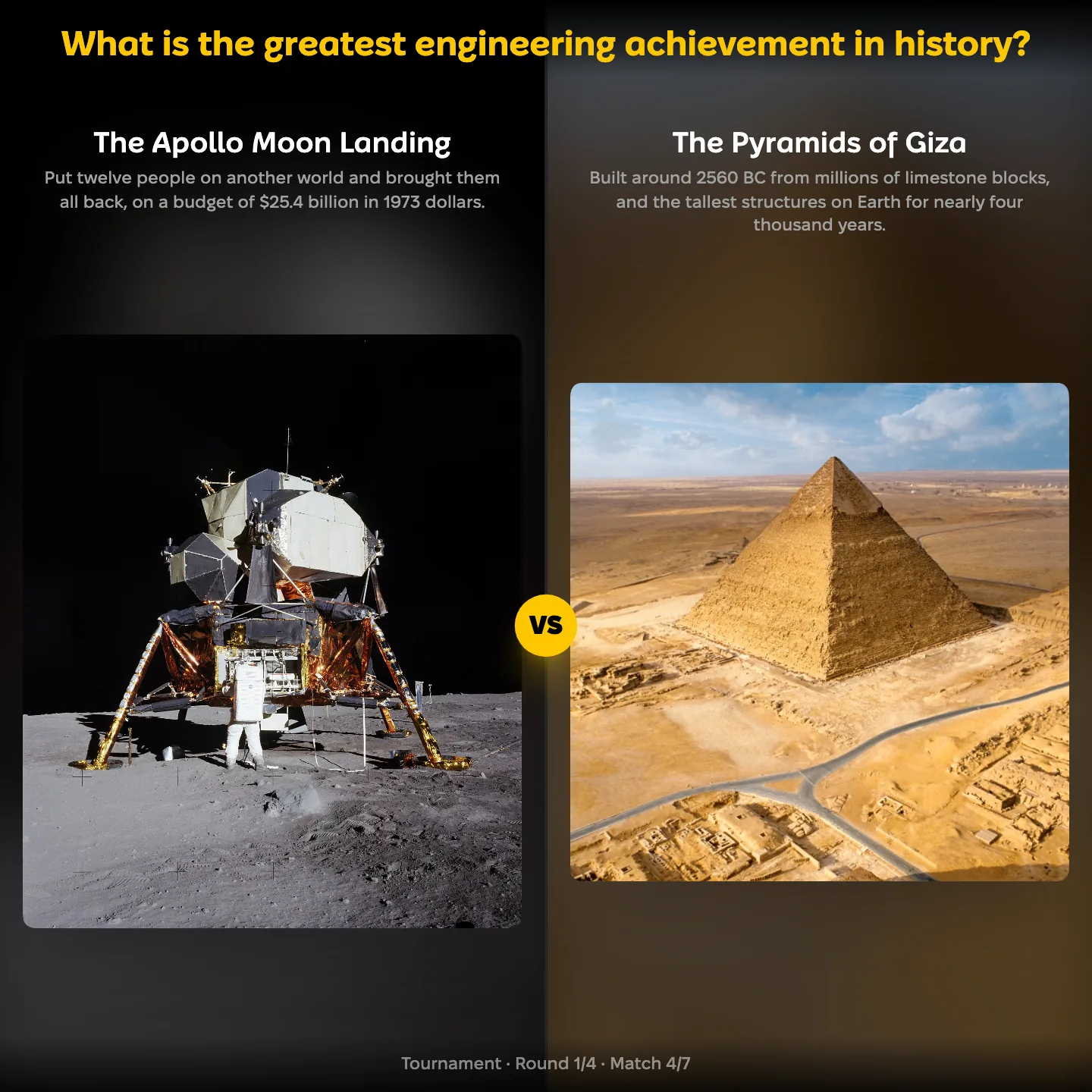
The Pyramids of Giza and a $25.4 billion budget
Engineering rankings are where Apollo stops being about space and starts being about money and organisation.
The programme cost $25.4 billion in 1973 dollars, put twelve people on another world and brought every one of them back.1 That combination — an unprecedented objective, achieved on a deadline, with no fatalities in flight — is the case for it as the hardest thing anyone has built.
The Pyramids of Giza make their case by having stood still for four thousand years. The Roman aqueducts moved water hundreds of kilometres on gravity alone with gradients accurate to centimetres per kilometre. The transistor is a component you cannot see that every other item on the list now depends on.
Scale and difficulty pull in different directions here, and Apollo is unusual in that it is not the largest thing on the list, nor the oldest, nor the most widely used. It is only the one with the shortest deadline.
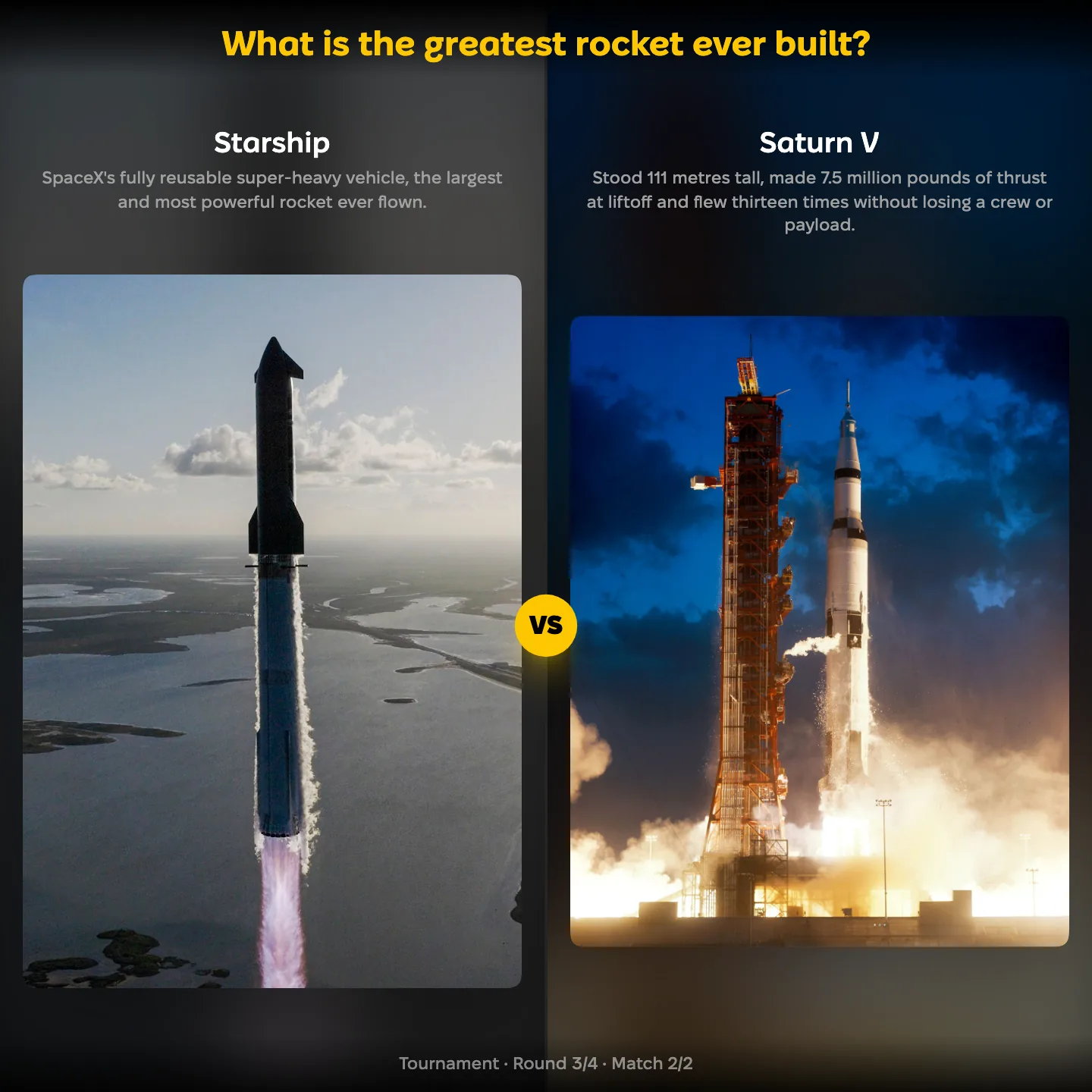
Saturn V vs Starship
Rocket rankings are the one place where Apollo's hardware is the specification everything else is measured against.
The Saturn V stood 111 metres tall, made 7.5 million pounds of thrust from five engines at liftoff, lifted 140,000 kg to low Earth orbit, and flew thirteen times between 1967 and 1973 without losing a crew or a payload.6 Nine of those flights carried people, and it took 24 astronauts toward the Moon.
Starship is larger and more powerful, and it is meant to be reused rather than thrown away, the axis the Saturn V never competed on, because throwing the whole thing away was the plan. Falcon 9 has flown more times than any launch vehicle in history by landing its first stage instead of dropping it in the sea.
Soyuz beats both of them on a different measure. It first flew in 1966, it is still carrying crews, and no other launcher has stayed in service for anything close to that long.
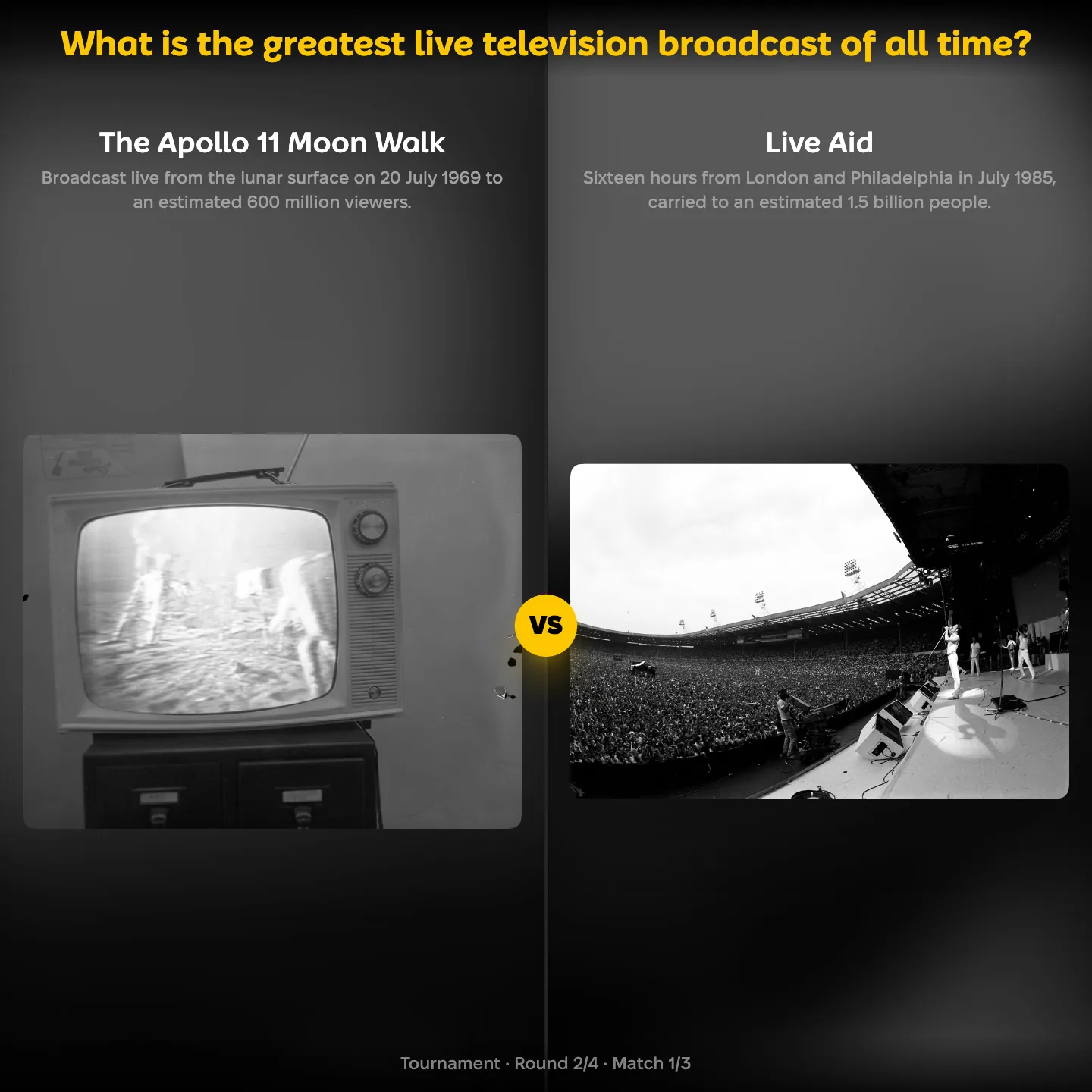
Six hundred million people watched it live
Television rankings ask a question Apollo answers unusually well: what did the largest number of people ever watch at the same moment?
The moonwalk was broadcast live from the lunar surface on 20 July 1969 to an estimated 600 million viewers, roughly a fifth of everyone alive.2 The pictures were grainy, monochrome and shot by a camera bolted to a spacecraft, and none of that mattered.
Live Aid is the counter-argument. Two stadiums on two continents, sixteen hours, an audience assembled deliberately for the broadcast rather than one that happened to be pointed at the same event.
The remaining entries divide into news that arrived unannounced — the Berlin Wall coming down, Mandela walking free — and events staged for the camera, like the wedding of Charles and Diana or the Beijing opening ceremony. Apollo belongs to a third category that barely exists any more: an engineering operation that the whole planet watched in real time, knowing it might fail.
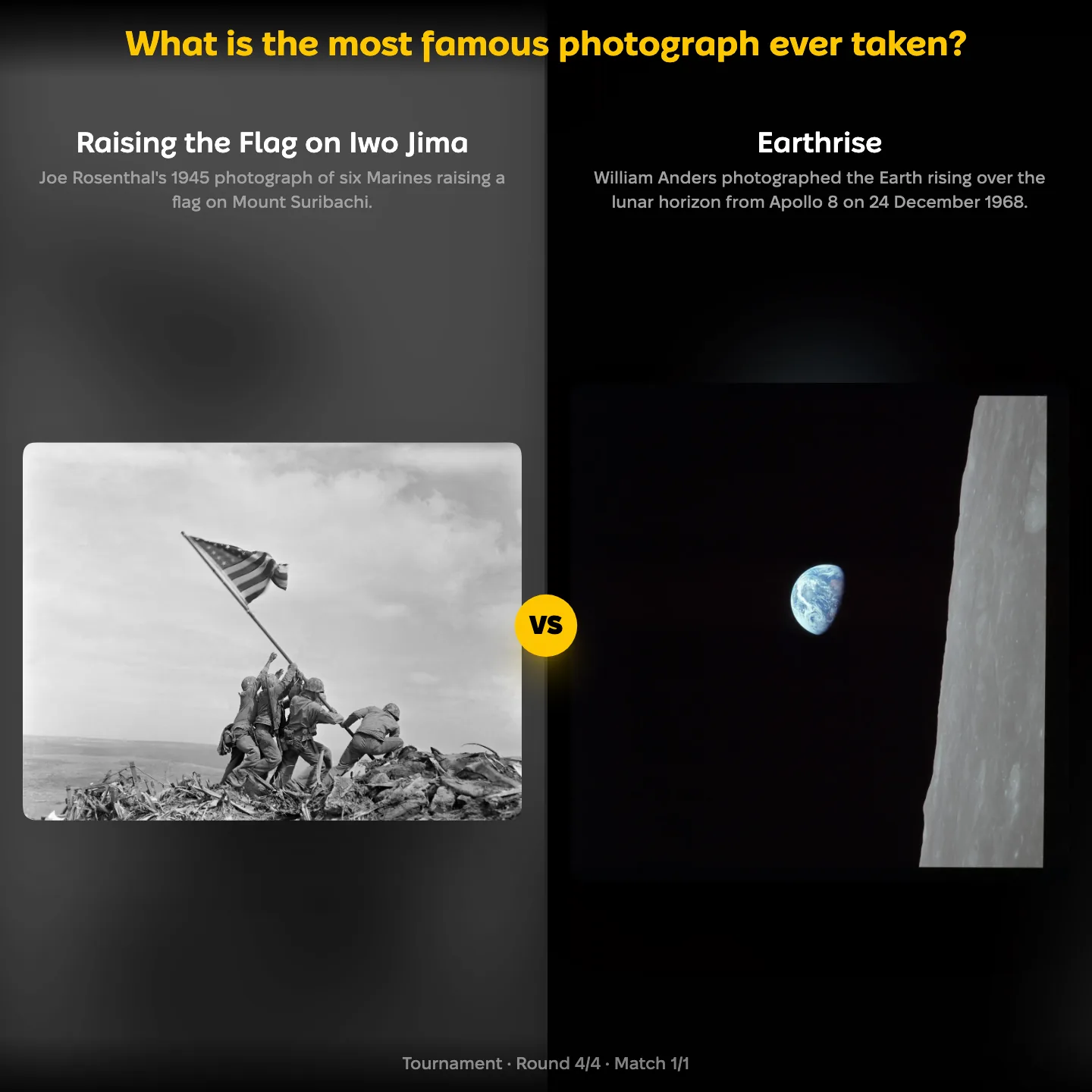
Earthrise: the photograph nobody was sent to take
Three of the fourteen entries in this ranking were taken by astronauts on Apollo flights, an odd result for a programme that carried no photographic objective.
Earthrise was shot by William Anders from Apollo 8 on 24 December 1968.1 Nothing in the flight plan asked for it. The crew were photographing the lunar surface for landing-site studies when the Earth came up over the horizon, and Anders turned the camera away from the thing he had been sent to document.
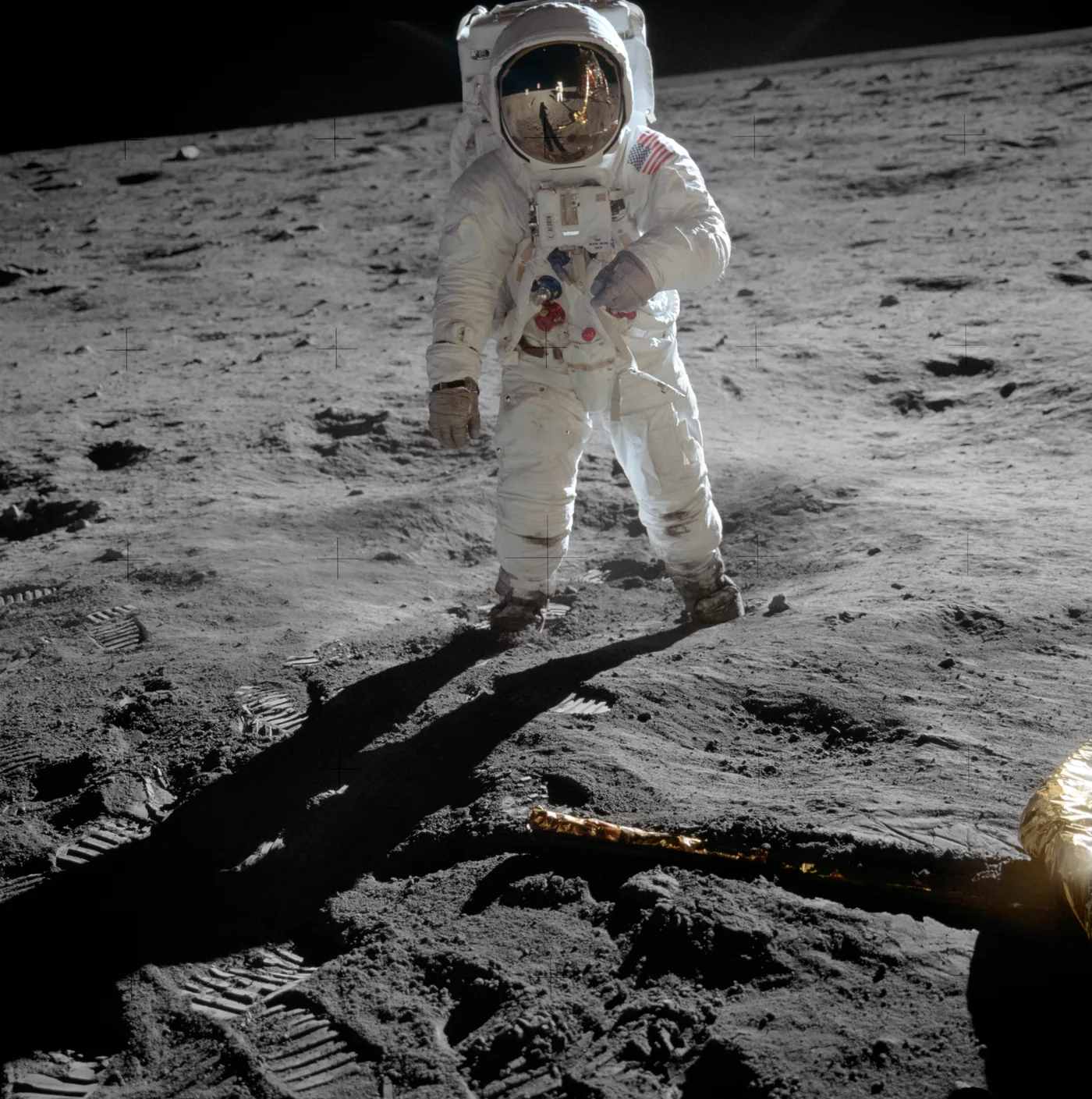
The Blue Marble came four years later from Apollo 17, and it is the whole planet lit face-on rather than a crescent over a grey foreground. Armstrong's photograph of Aldrin on the surface is the third, with the photographer himself visible in the visor reflection.
Iwo Jima, Migrant Mother, the Times Square kiss and the Afghan Girl are the competition, and they were all made by professionals who were sent to make photographs. Apollo's images were made by test pilots with a Hasselblad and a checklist.
That cuts both ways. The most reproduced pictures of the twentieth century include several that were, in the strictest sense, a side effect.
Kennedy at Rice, September 1962
Apollo exists here as a sentence rather than a spacecraft: the programme's founding document, filed under oratory.
Kennedy's speech at Rice University committed a country to a destination and a deadline before anyone knew how to get there. That is the rhetorical trick worth noticing: the most quoted line is an admission that the thing is hard and the choice to do it anyway.
Steve Jobs at Stanford is the modern shape of the same genre, and it is a very different product: personal, retrospective, addressed to individuals rather than to a nation.
Most of the eighteen speeches here are about how to live. Kennedy's is the only one that functioned as a project brief, and everything else in this article is downstream of it.
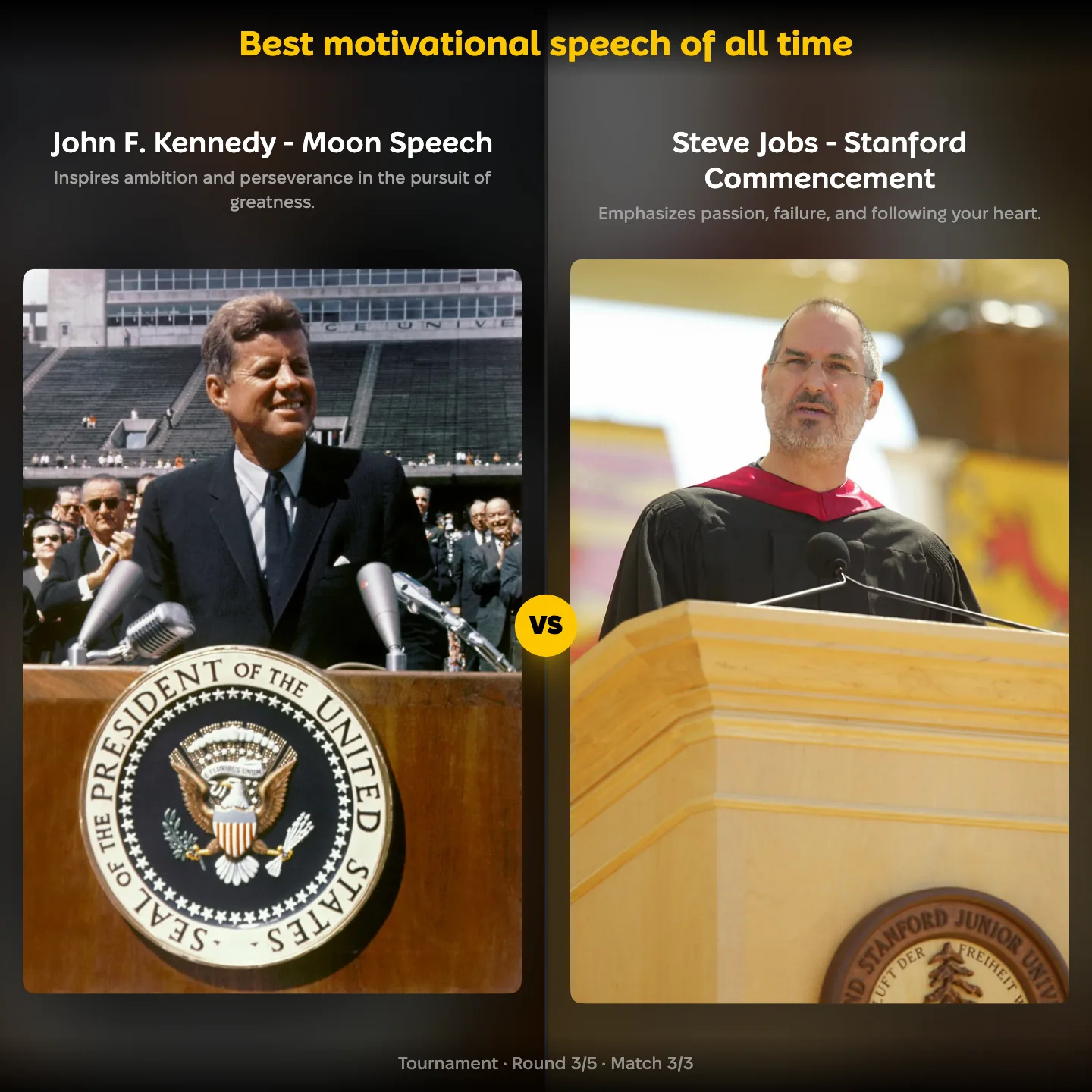
Neil Armstrong vs Gene Cernan: first man, last man
Nineteen Apollo astronauts appear here, and the disagreement is about what an Apollo astronaut was for.
Armstrong commanded Apollo 11 and took the first step, which is the single most repeated fact about the entire programme.
Cernan commanded Apollo 17 and was the last person to walk on the Moon, in December 1972.1 Nobody has been back since, so his footprints are the most recent ones there, a distinction he never wanted and one that has outlasted him.
Jim Lovell flew four missions and never landed. Alan Shepard flew the first American suborbital flight and then walked on the Moon a decade later. Harrison Schmitt was a geologist rather than a pilot, and John Young flew Gemini, Apollo and the first Space Shuttle.
Nineteen names for a programme that only put twelve people on the surface means seven of the options never got there at all, which is the honest shape of the thing: most of Apollo was flown by people who orbited, tested and came home.
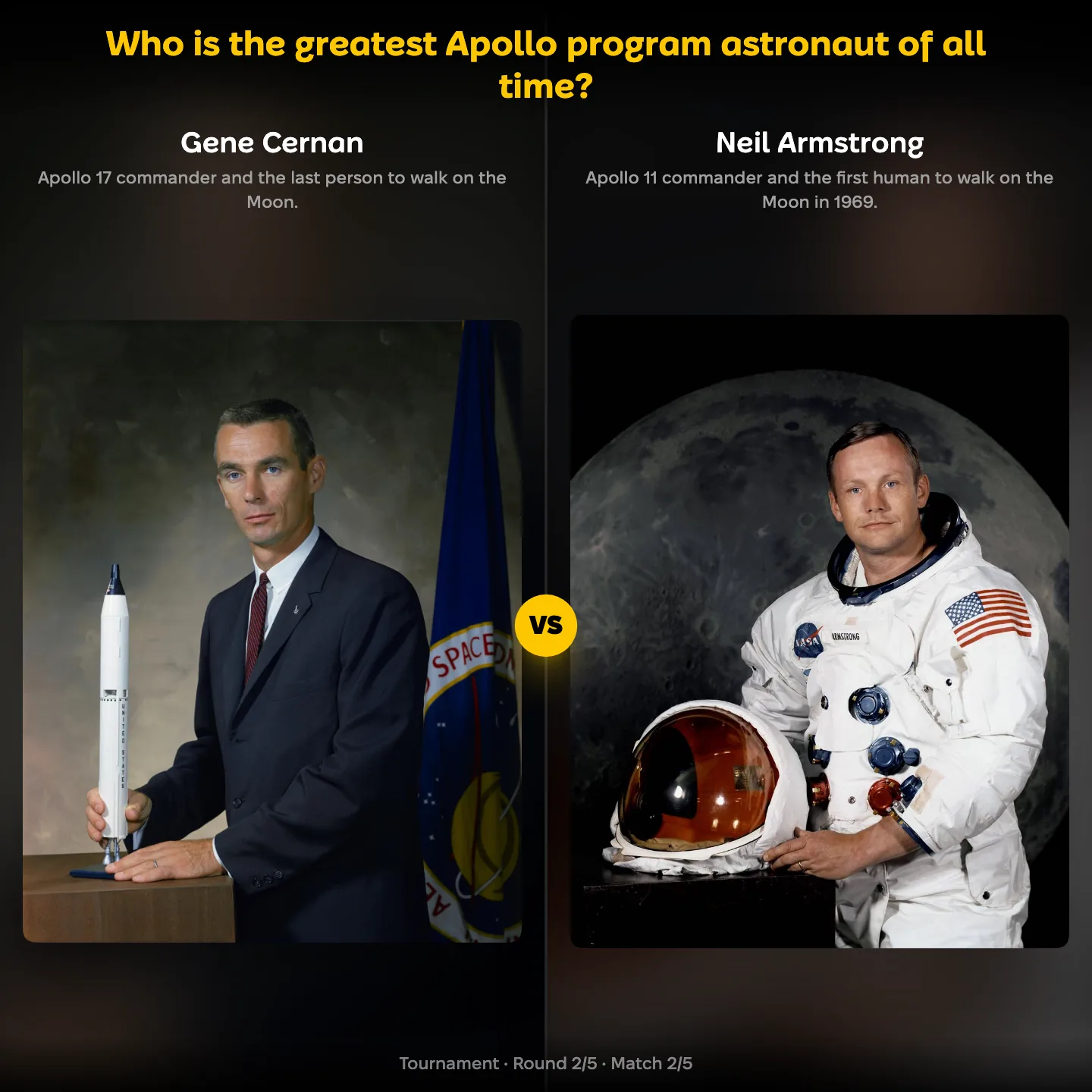
Michael Collins stayed in the car
Being on Apollo 11 is an argument for having been overlooked, which is the sort of sentence only this ranking makes possible.
Collins flew to the Moon and did not land on it. He stayed in the command module Columbia while Armstrong and Aldrin went down, and he was the one who had to inspect the lunar module for damage before the descent began.2 Two names from that crew are common knowledge and the third is a trivia question.
Margaret Hamilton led the team that wrote Apollo's onboard flight software and coined the term software engineering for what they were doing, at a point when nobody agreed it was engineering.
Katherine Johnson calculated trajectories for the first American crewed flights and was asked to check the computer's arithmetic before John Glenn would fly on it. Sergei Korolev designed the rockets that started the race and was kept anonymous by his own government until he was dead. Frances Northcutt was the first woman engineer in Mission Control and worked the return-to-Earth trajectories that Apollo 13 ended up needing.
The list also holds the people who are structurally invisible: John Houbolt, who argued his own agency into lunar orbit rendezvous, and the garment workers who hand-stitched the pressure suits. Apollo needed roughly 400,000 people, and twelve of them are famous.
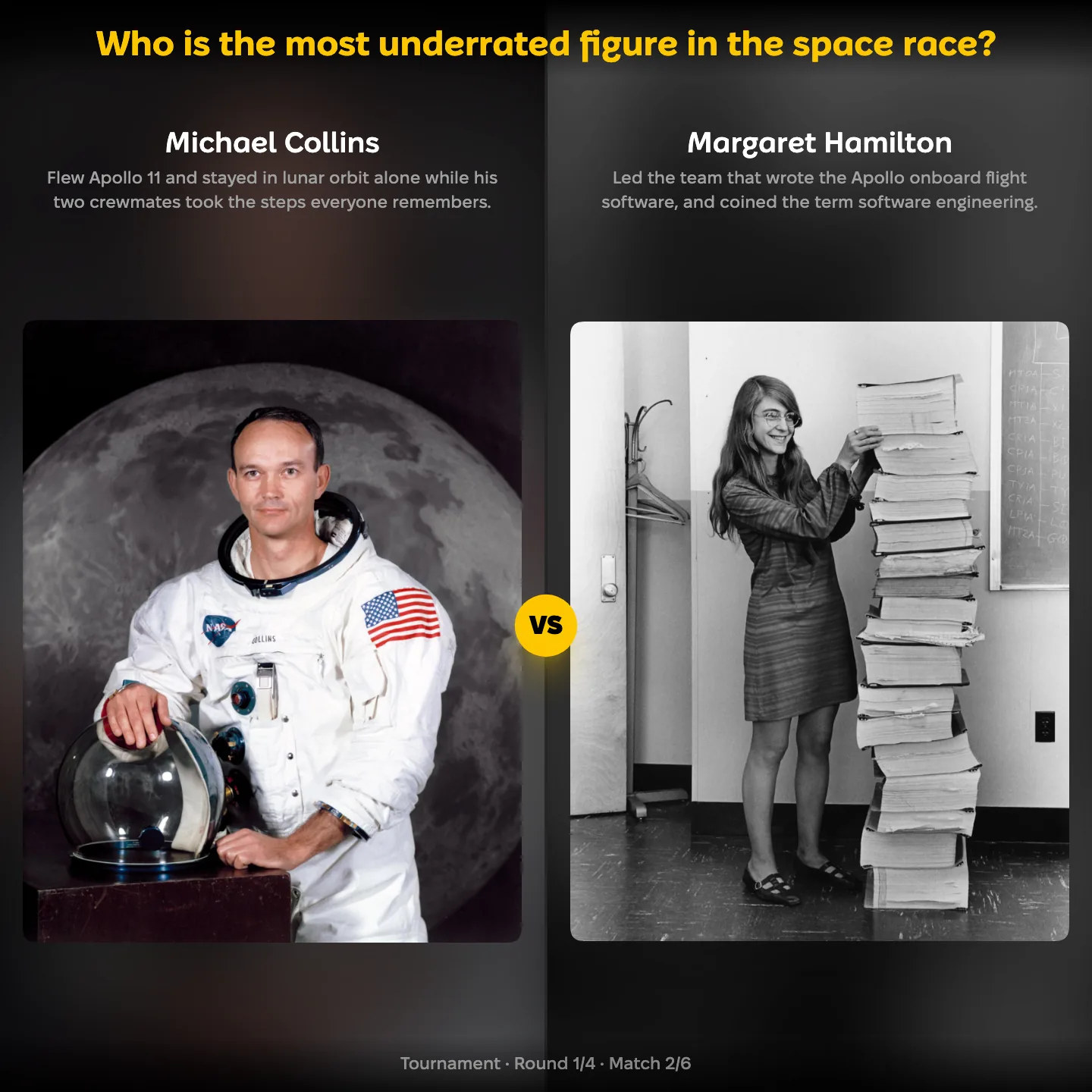
Korolev died in 1966 and the race ended there
Four of the eleven entries on this list are Apollo's own, which is the least flattering count in the article and the most honest one.
The Apollo 1 fire came first. On 27 January 1967 a cabin fire during an unfuelled launch rehearsal on pad 34 killed Gus Grissom, Ed White and Roger Chaffee, and the programme spent twenty months redesigning the spacecraft before flying anyone again.5
Apollo 18, 19 and 20 are the other end of it. Three landings were funded, planned and then scrapped, and the hardware went to museums. That is why the Saturn V you can walk around is a flight article that never flew.
Korolev's death is the Soviet mirror of all this. The chief designer died during routine surgery in 1966, his N1 rocket failed on all four launch attempts, and the lunar programme he was holding together did not survive him.
The pattern across the list is that almost nothing here was a technical dead end. The Shuttle was chosen over a Moon base, Constellation was cancelled, Skylab was allowed to burn up with no replacement ready, and von Braun's Mars plan was never funded. Apollo did not stop because it stopped working.
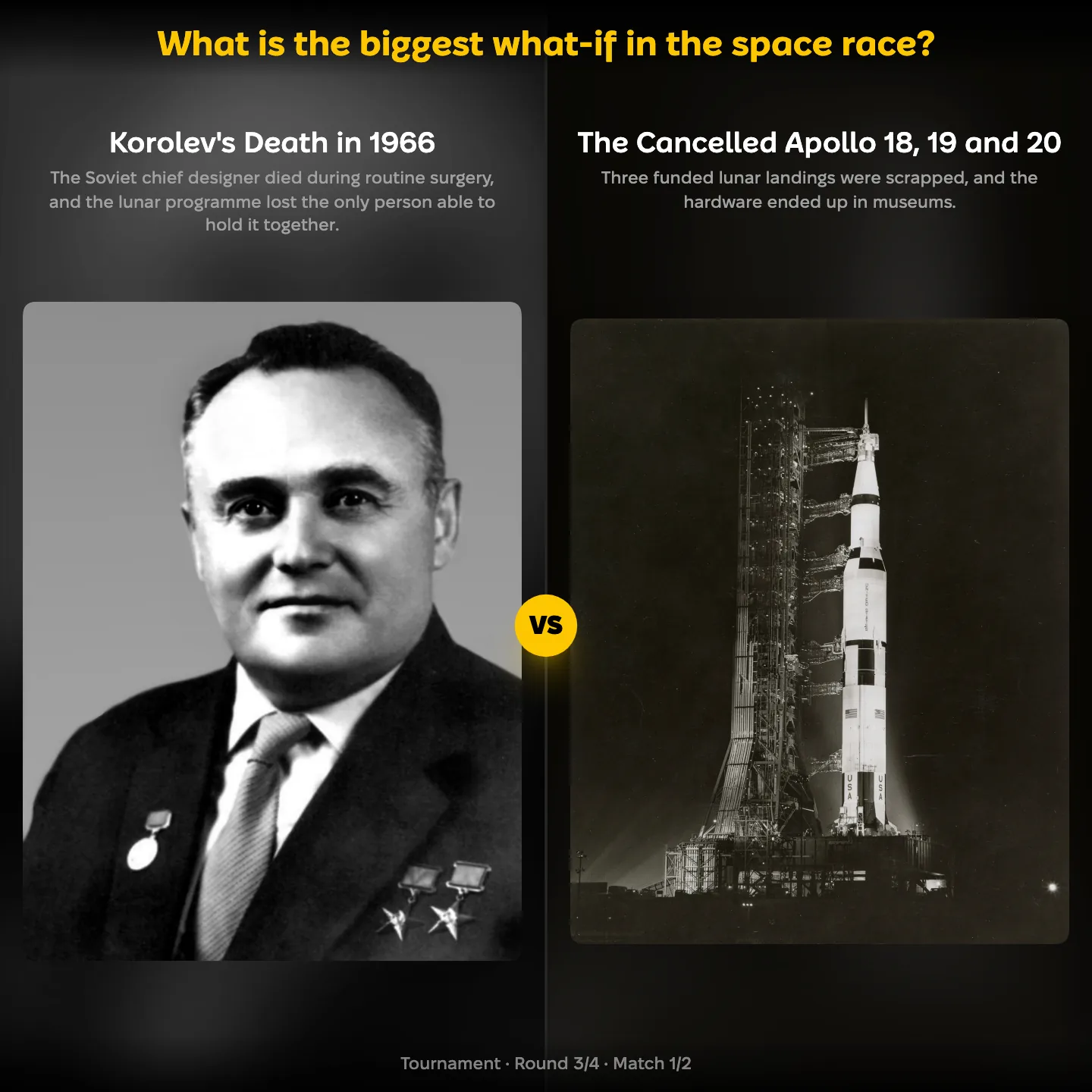
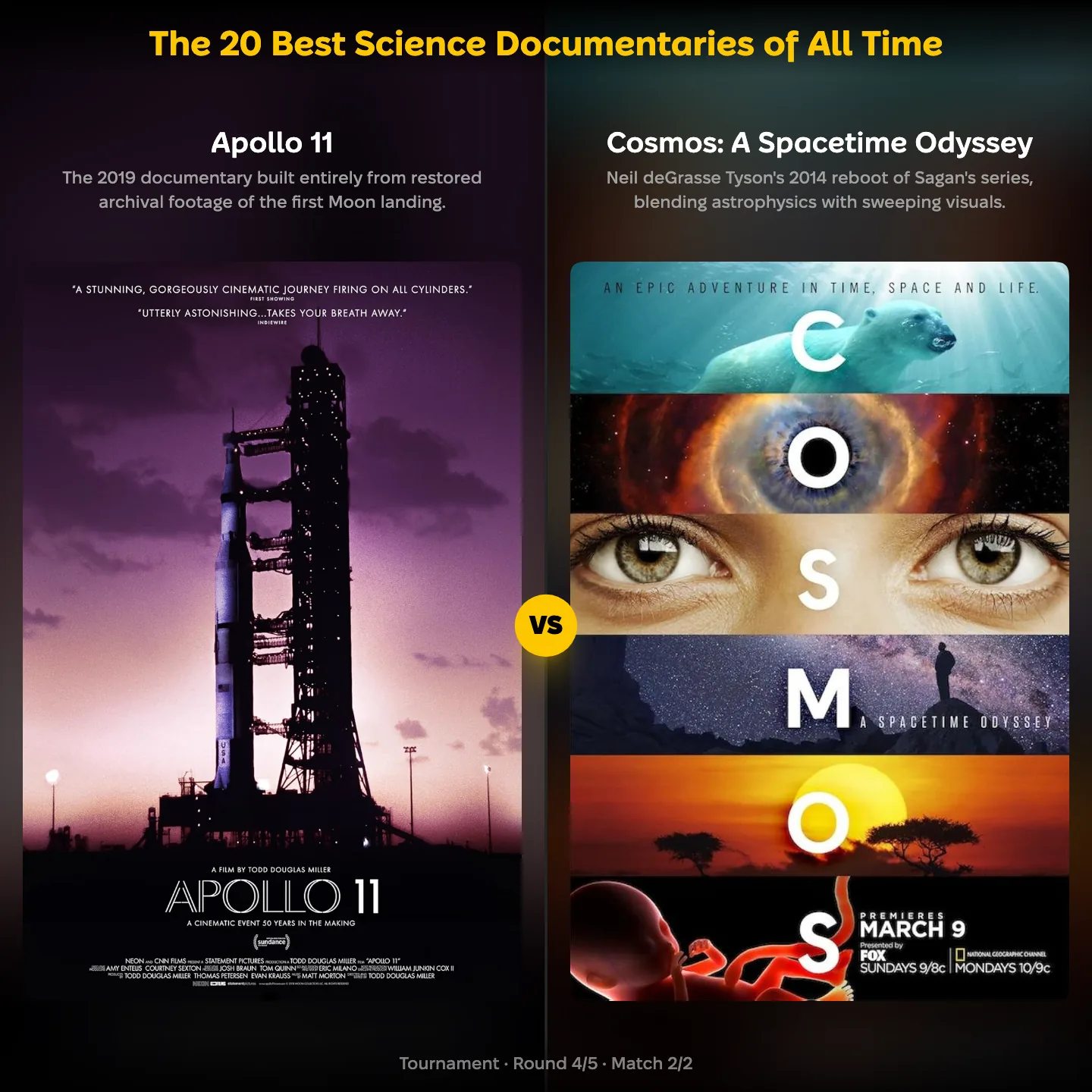
Apollo 11 is also a film made entirely of found footage
By this point in the article Apollo has stopped being a programme and started being content, and the science-documentary list is where the shift happens.
Apollo 11, released in 2019, was assembled from restored archival footage and mission audio with no presenter, no interviews and no reconstruction. The material had been sitting in storage for fifty years.
Cosmos is the opposite method: a presenter, a script and effects built to explain things the camera cannot show.
Most of the twenty documentaries here are natural history or physics with a narrator. The Apollo entry is the only one whose footage was shot by the people it is about, for operational reasons, decades before anyone thought of cutting it into a film.
Apollo as a Tom Hanks picture
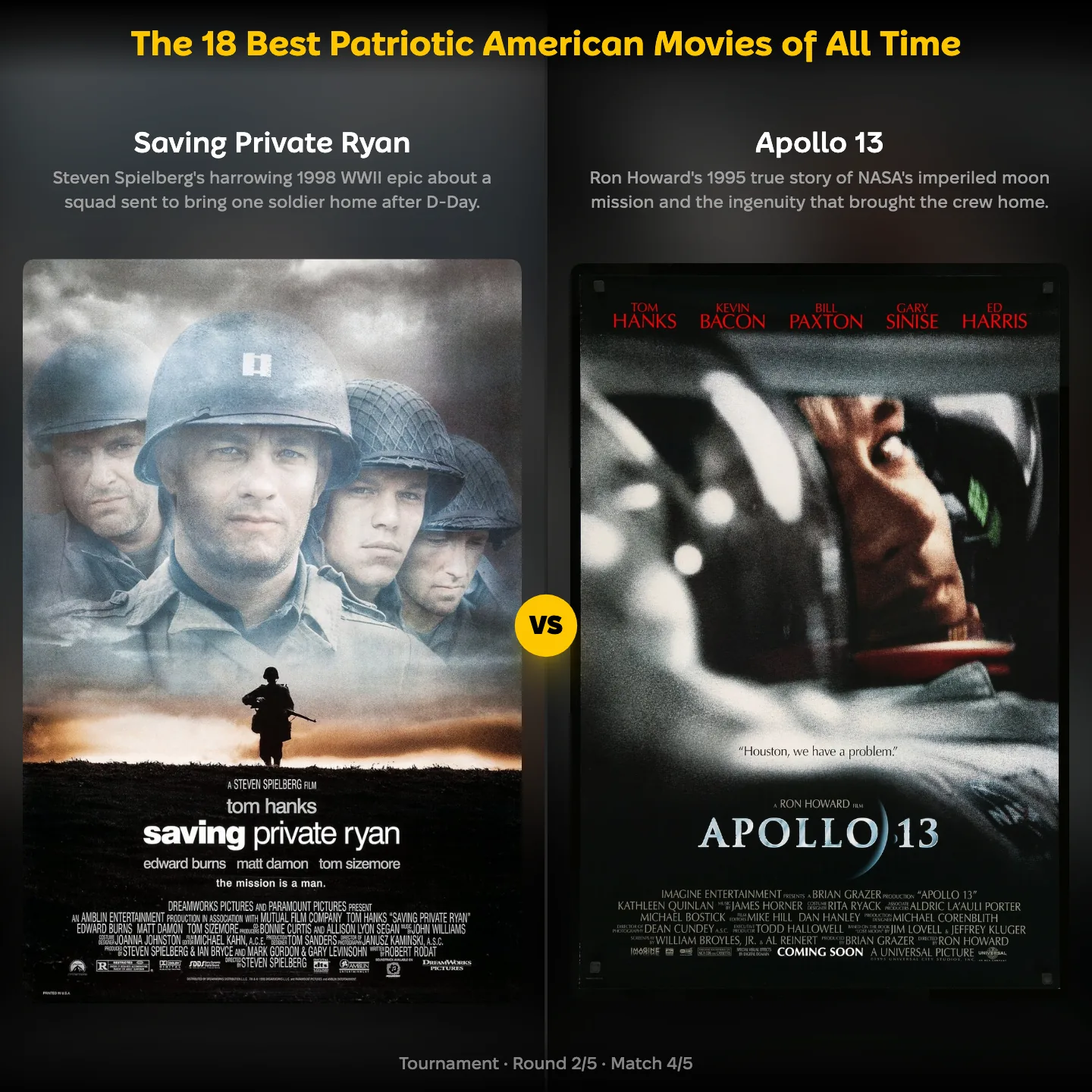
Patriotic-movie rankings do not contain space programmes. They contain films, and Apollo has one.
Apollo 13 is a 1995 Ron Howard picture about the mission that failed, and it qualifies here for the same reason Saving Private Ryan and Glory do: competence under pressure, filmed sympathetically.
The oddity is what the list is measuring. Every other entry was written as a film; this one is a reconstruction of an event that a third of the planet had already watched live.
Interstellar, Alien and one true story
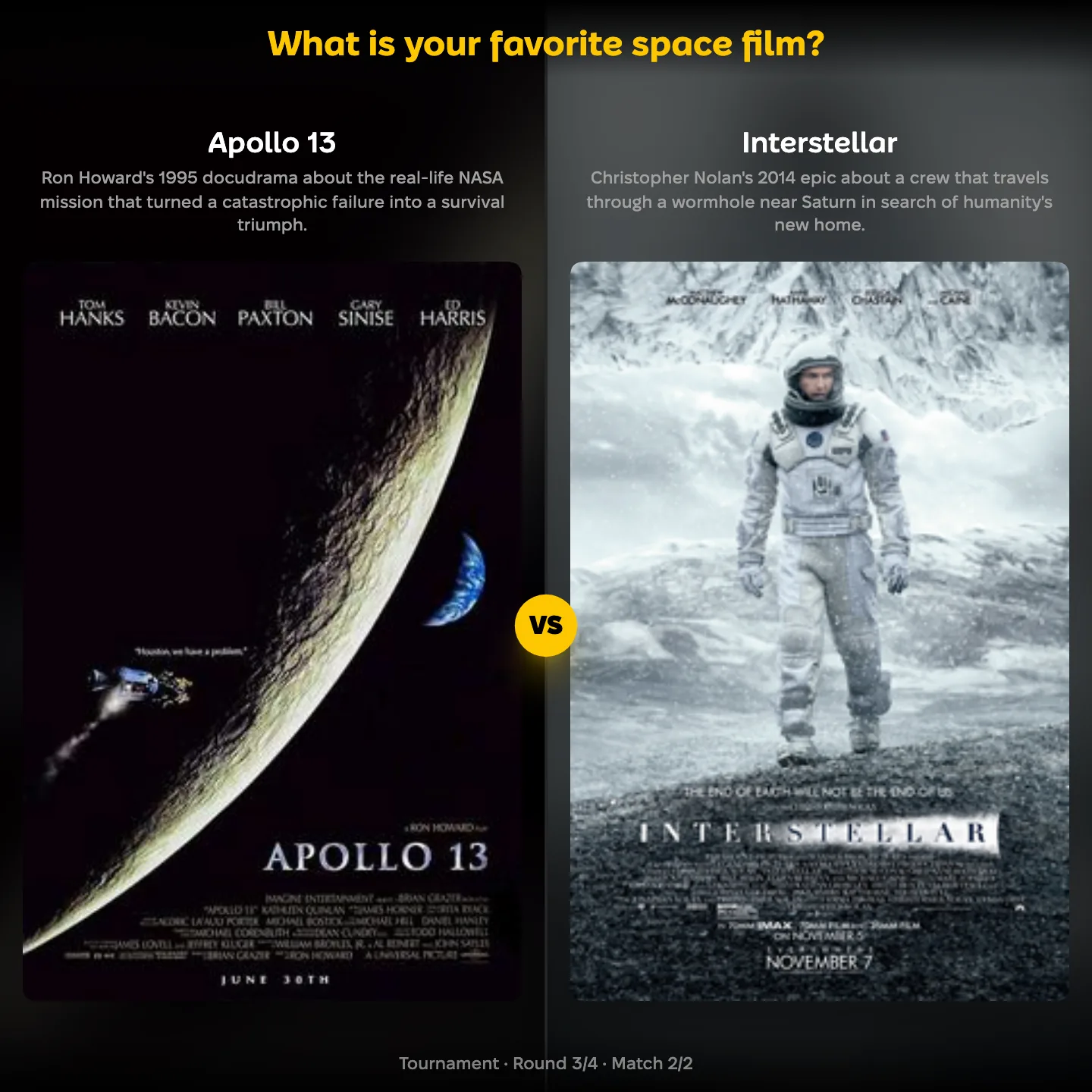
Space films are a genre where being true is a disadvantage.
Apollo 13 is the one entry that actually happened. Everything around it — 2001, Interstellar, Alien, Gravity, Arrival — was free to invent a threat, a scale and an ending, and most of them invented bigger ones than a damaged service module.
A crew getting home in a cold spacecraft is a smaller story than a wormhole near Saturn. It is also the only story whose ending the audience already knew going in.
The Speedmaster is the only Apollo hardware you can wear
Watch rankings are the furthest thing from spaceflight that still contains genuine Apollo flight equipment.
NASA qualified the Omega Speedmaster for crewed missions in March 1965 after testing it to destruction alongside other chronographs, and Aldrin strapped one outside the sleeve of his pressure suit on the lunar surface.7
The other fifteen Omega models here are dive watches, dress watches and Bond props. One was specified for leaving the planet, and that is most of why it is here. A strange kind of endorsement for a piece of engineering.

Apollo 10½: the furthest Apollo gets from the launch pad
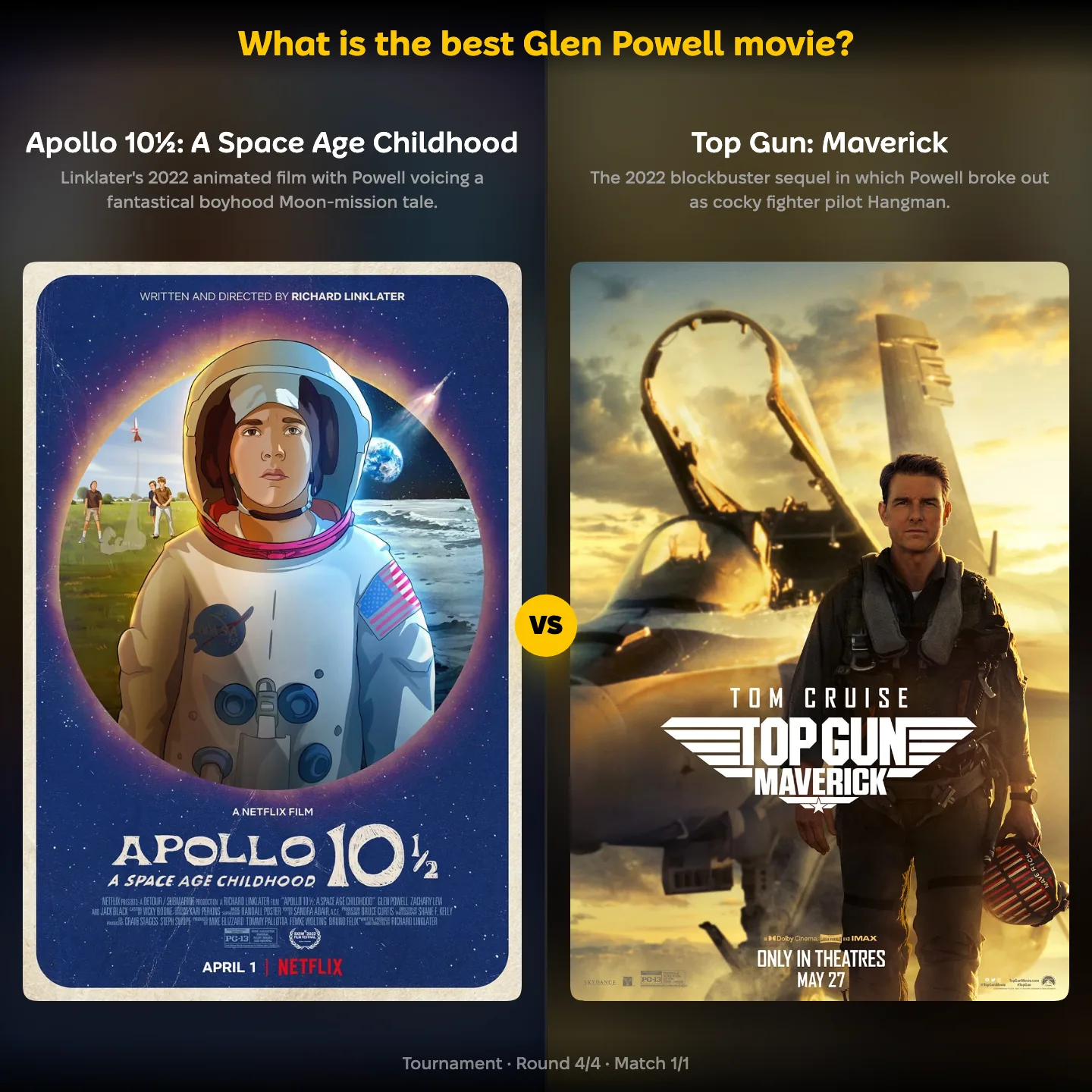
This is where the trail ends: an actor's filmography.
Apollo 10½: A Space Age Childhood is Richard Linklater's animated film about a boy who is secretly recruited to fly a Moon mission, and Glen Powell voices a character in it. The programme is not the subject of the ranking, the setting, or even the reason anyone opens the list. It is a title in a career that also holds Top Gun: Maverick and Hidden Figures.
Twelve films, and Apollo is one word in one title.
Sixteen lists, two of them about spaceflight
Fourteen of the sixteen have nothing to do with going to the Moon. They are about photographs, wristwatches, speeches, rockets, television, documentaries, films and the people nobody names, and Apollo has a legitimate entry in every one. That is the residue of a decade spent pointing an entire industrial base at one deadline.
The programme's own records are the part that turned out to be temporary. What has lasted is everything it produced by accident on the way: a picture of the Earth that nobody asked for, a chronograph, a phrase from a speech, twelve sets of footprints that nobody has been back to photograph.
The mechanism underneath every one of them is the head-to-head method: two options at a time, with the order falling out of the comparisons rather than out of anyone's opinion.
Pick the question that annoys you most in this article and go argue with it.
More rankings, more angles
- Google Won Search. It Also Built Glass and Stadia. — one company, sixteen unrelated verdicts
- Washington vs Lincoln: Who Wins Which List? — the American-greats lists Neil Armstrong keeps turning up on
- What Is Pairwise Comparison? The Simple Way to Rank Anything — why two at a time beats a top-ten list
- Is Mark Rober the Best Science YouTuber? Where He Lands on 14 Lists — a JPL engineer on the NASA engineers list
Sources
- Wikipedia — Apollo program: six landings and twelve moonwalkers, Apollo 17 as the last landing in December 1972, the $25.4 billion (1973) programme cost, and William Anders photographing Earthrise from Apollo 8 on 24 December 1968: en.wikipedia.org (checked 2026-08-23)
- Wikipedia — Apollo 11: launch on 16 July 1969, landing on 20 July 1969, about two and a half hours on the surface, 21.5 kg of samples, the estimated 600 million live viewers, and Michael Collins remaining in the command module Columbia: en.wikipedia.org (checked 2026-08-23)
- Wikipedia — Apollo 13: the 11–17 April 1970 mission and the 400,171 km (248,655 mi) record for the farthest humans have travelled from Earth: en.wikipedia.org (checked 2026-08-23)
- NASA — Artemis II: the April 2026 crewed lunar flyby, the 6 April flyby and the 252,756-mile distance record: nasa.gov (checked 2026-08-23)
- Wikipedia — Apollo 1: the cabin fire on 27 January 1967 during an unfuelled plugs-out test on pad 34, which killed Gus Grissom, Ed White and Roger Chaffee: en.wikipedia.org (checked 2026-08-23)
- Wikipedia — Saturn V: 111 m height, 7.5 million lbf of thrust at liftoff, 140,000 kg to low Earth orbit, thirteen launches between 1967 and 1973, nine crewed flights carrying 24 astronauts toward the Moon, and no crew or payload lost: en.wikipedia.org (checked 2026-08-23)
- Wikipedia — Omega Speedmaster: NASA's flight qualification of the Speedmaster in March 1965 and Buzz Aldrin wearing one over his suit sleeve on the lunar surface: en.wikipedia.org (checked 2026-08-23)