
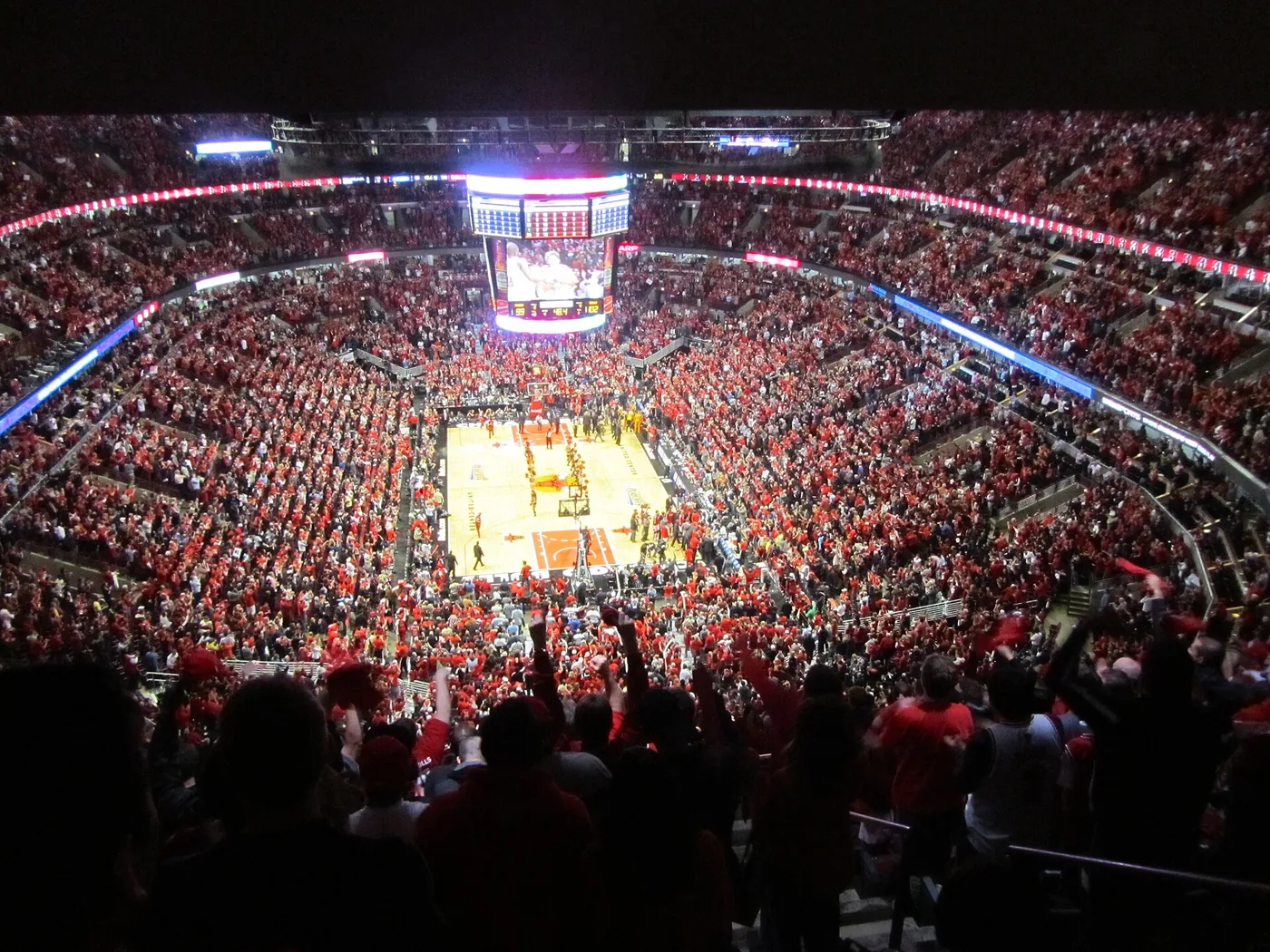
The Chicago Bulls won 72 games in 1995-96, the first team in NBA history to reach 70, then beat Seattle 4-2 for the title.1 Thirty years on, the same franchise finished 31-51, missed the play-in, and lost eleven straight in February, the worst winless month in club history.2
Both of those are the Chicago Bulls. So are six championships in eight years, a bull's head nobody has redrawn since 1966, the biggest arena in the league, and a documentary that outdrew everything ESPN had ever made.
The Bulls are an option in sixteen rankings here. What follows is what each one asks, and why a team from Chicago is standing in it.
The Bulls own the best season anyone has ever played and a decade with nothing to show for it, and every list they land on sits on one side of that line or the other.
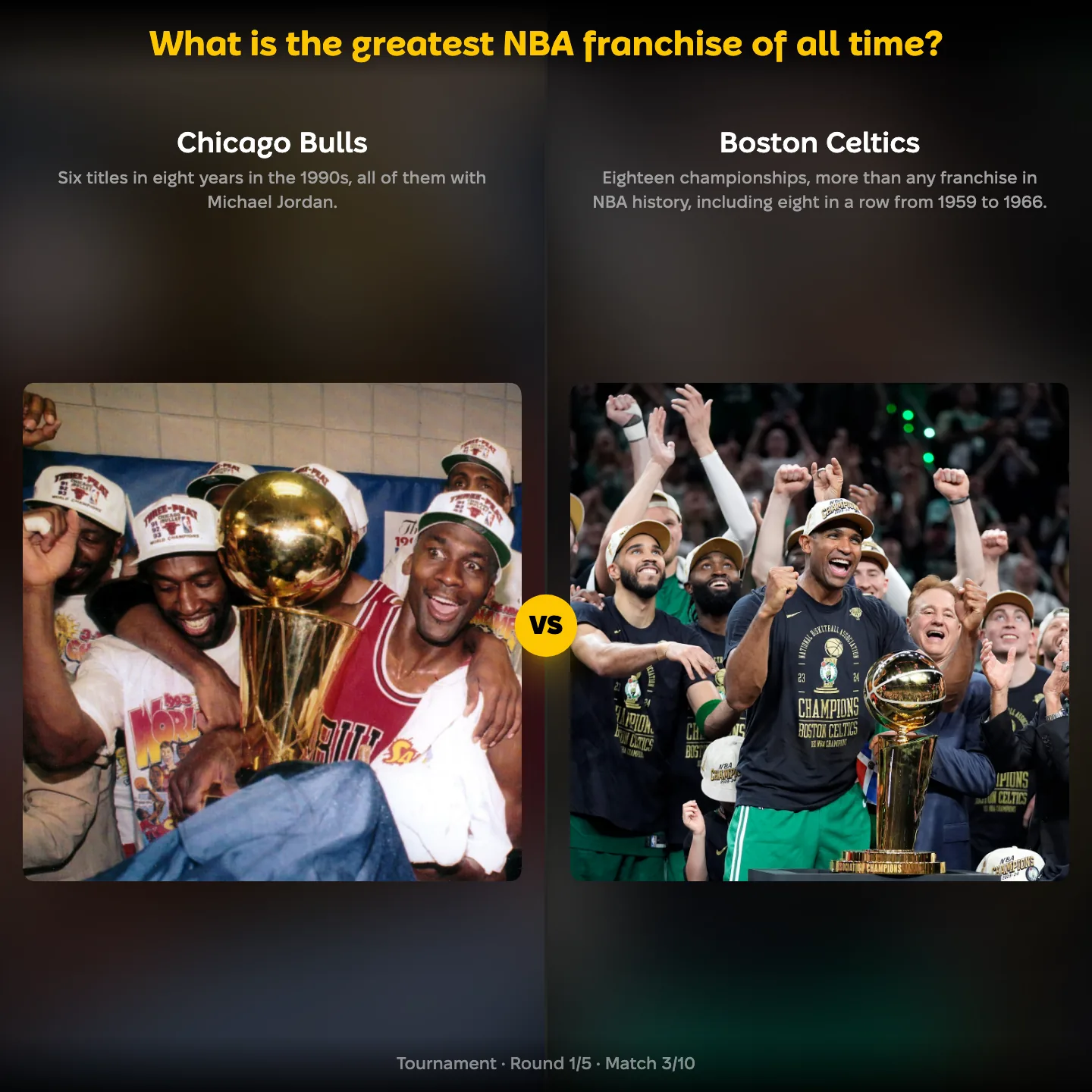
Chicago Bulls vs Boston Celtics: six rings against eighteen
Twenty franchises sit in this one, and only three or four get named whenever the question is asked seriously.
Chicago's case is compressed. Six championships between 1991 and 1998, arranged as two three-peats, with no Finals appearance before them and none since.3 Nothing else in the league has that shape.
Boston's case is volume. Eighteen titles, a league record, the most recent of them in 2024, with the Lakers one behind on seventeen.4
So the vote comes down to counting banners or measuring altitude. Chicago has the shorter history and the better eight years, and that trade is what people are actually choosing between.
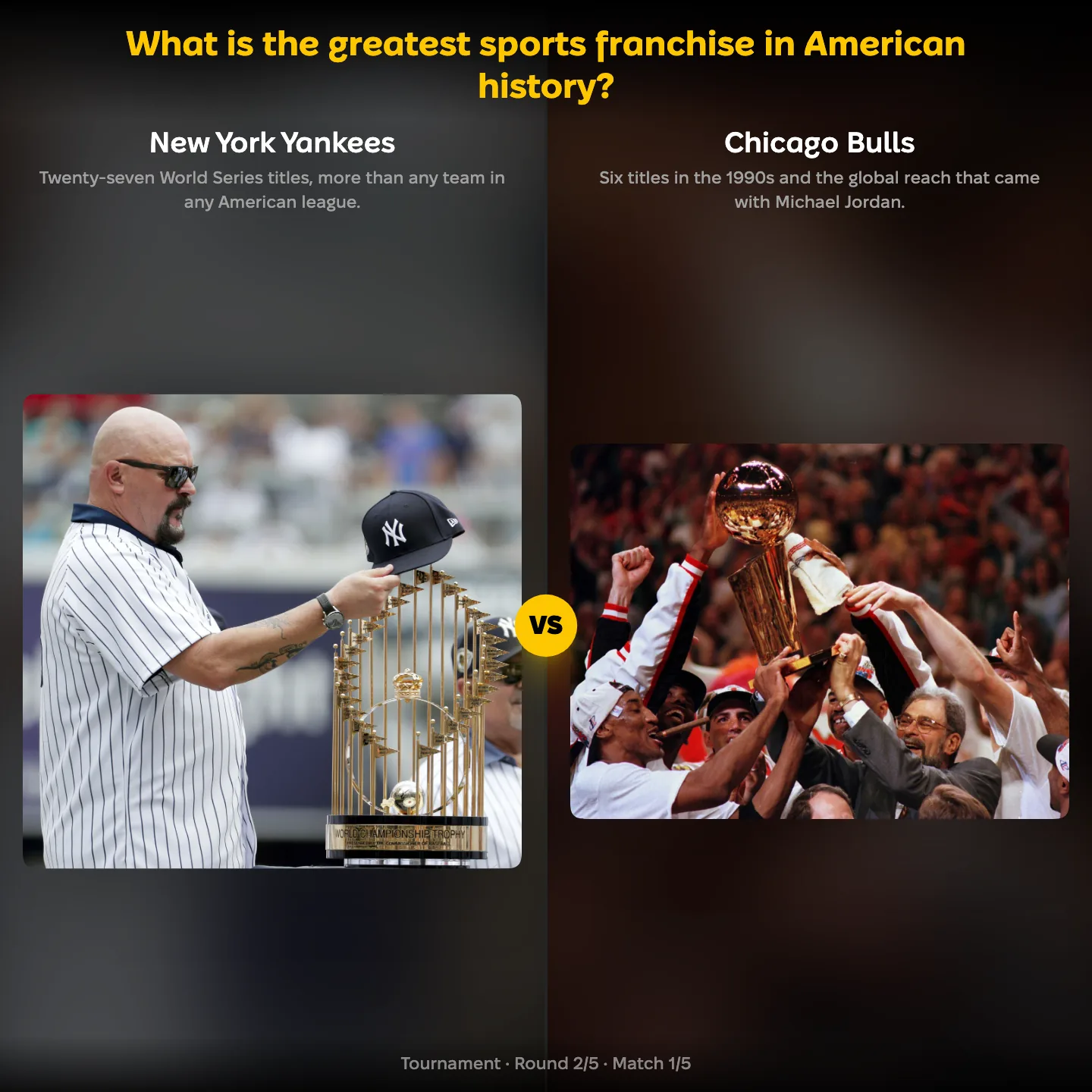
Bulls vs Yankees: a basketball team on a baseball list
Once every American sport is in play, the Bulls are no longer a basketball answer. They become a cultural one.
The Yankees have 27 World Series titles. The Canadiens have 24 Stanley Cups. Alabama football and UCLA basketball also appear here, each with more championships than Chicago.
What the Bulls have instead is reach. Six titles inside one television decade put the team in living rooms in countries with no basketball league at all, and that is a different kind of claim from a trophy count.
It is also the weaker kind, on a list where the Steelers, the Packers and the Red Sox all show up with a century of receipts.
72-10: the record Golden State broke and could not take
This is the one ranking built around a single Bulls season, and it is the strongest ground the franchise has.
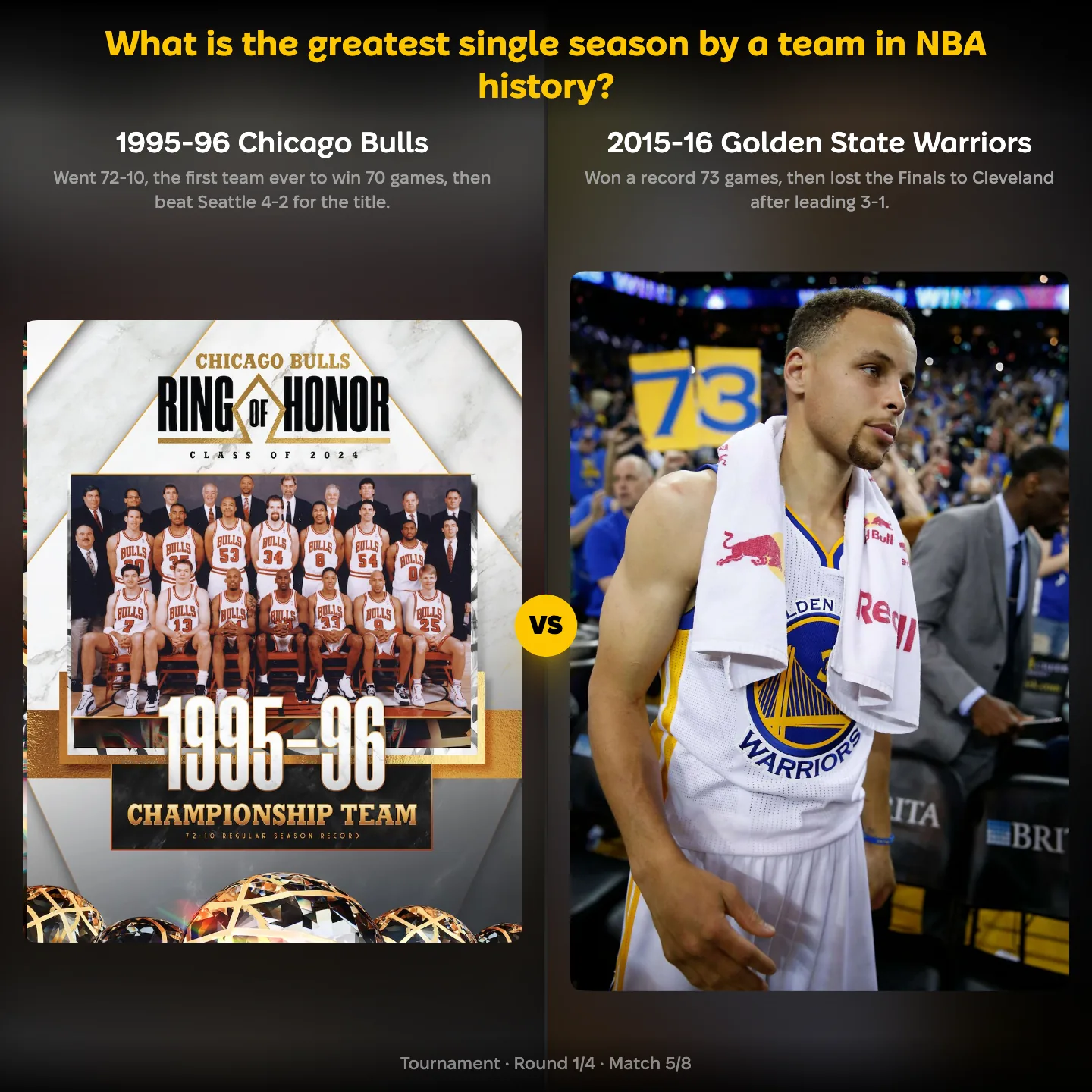
The 1995-96 team went 72-10 and became the first in league history to win 70 games. It then went 15-3 through the playoffs and beat the Seattle SuperSonics 4-2. Michael Jordan was MVP, Phil Jackson was Coach of the Year, and Toni Kukoč was Sixth Man of the Year, all in the same season.1
Twenty years later Golden State won 73 and took the number away. Then they lost the Finals to Cleveland in seven games after leading the series 3-1, the first team ever to give up that lead in a Finals.5
That is the whole reason this stays a real question. The Warriors hold the record; the Bulls hold the season, because the 72 games came with a trophy and the 73 did not.
Behind both sit the 1971-72 Lakers and their 33-game winning streak, the 1985-86 Celtics, and the 1966-67 Philadelphia team that broke Boston's run of eight straight titles.
The strangest entry is also Chicago's. The 1996-97 Bulls won 69 games and a second consecutive championship, and almost nobody names them, because the team that did slightly better was the same team a year earlier.
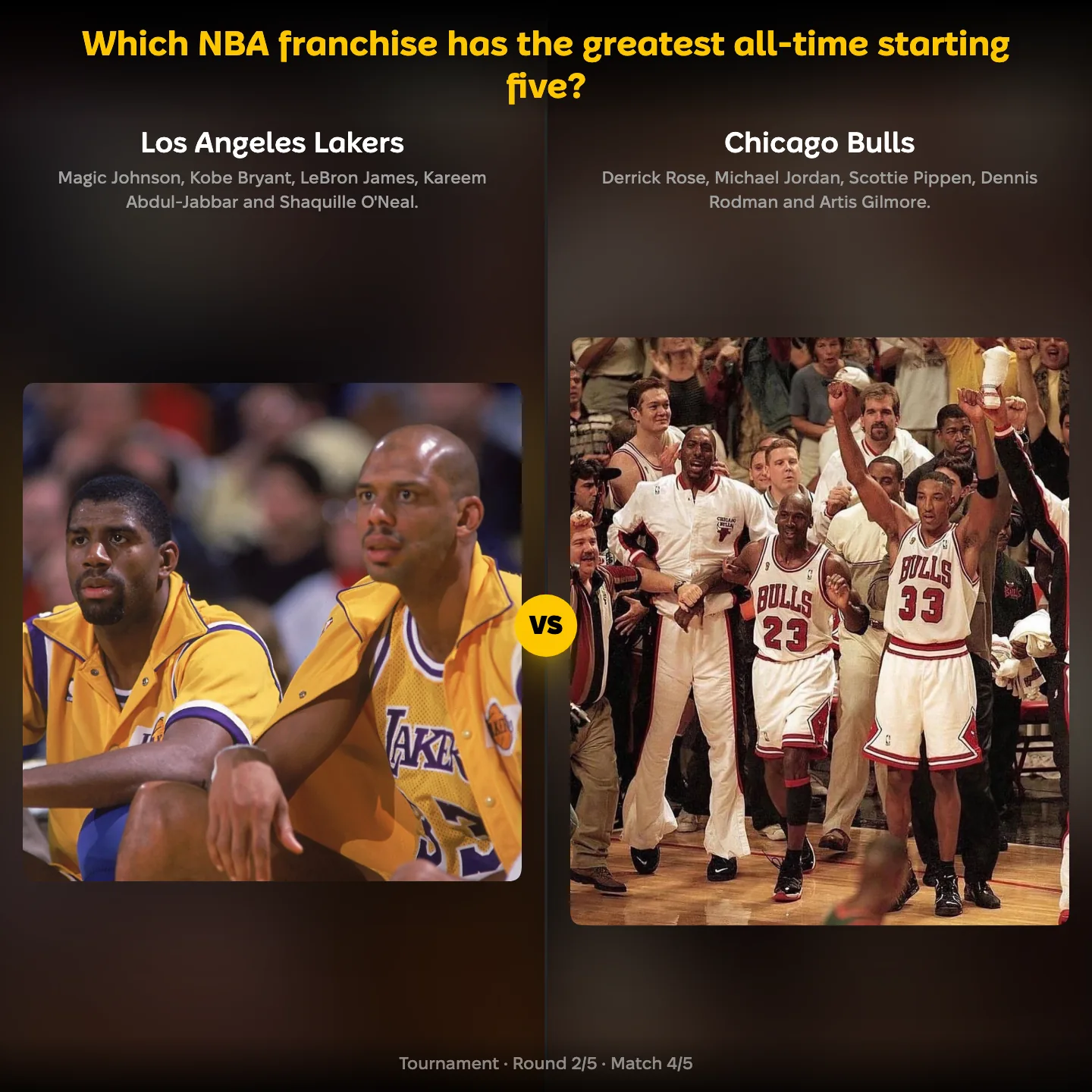
Jordan and Pippen against the Lakers' five
Every franchise gets one all-time five here, which rewards depth over peak and immediately puts Chicago at a disadvantage.
The Bulls open with Michael Jordan and Scottie Pippen, and after that the roster thins fast: Derrick Rose, Dennis Rodman for three seasons, Artis Gilmore from the 1970s.
Los Angeles answers with Magic Johnson, Kobe Bryant, LeBron James, Kareem Abdul-Jabbar and Shaquille O'Neal, five players who would each headline most franchises on the list.
Chicago's counter is that the top of the lineup card decides games, and no franchise has a better top two. It works better as a bar argument than as a five-man team.
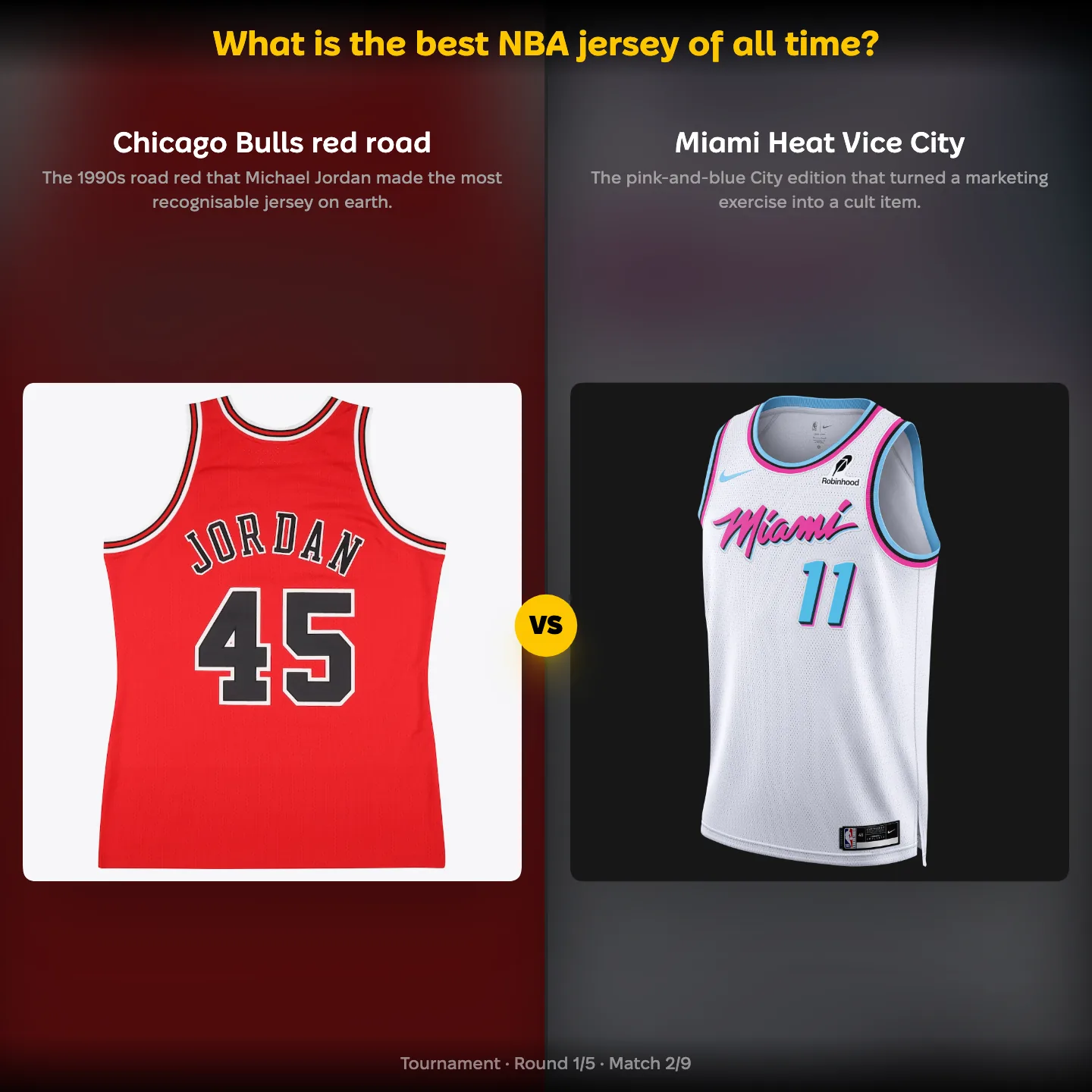
The red road jersey vs Miami's Vice City
Here the Bulls are a garment, and the garment is probably the most-worn piece of sportswear ever made.
The 1990s red road jersey travelled further than the team did. It became the shorthand for basketball itself in places that never watched a game, which is why it still sells decades after the last player who mattered wore it.
Miami's Vice City edition is the modern counter-argument: a marketing exercise from 2017 that fans adopted so completely the league kept bringing it back.
Most of the field is nostalgia by design: Seattle's green and gold, the Vancouver Grizzlies teal, the Phoenix sunburst, the Toronto purple dinosaur. Only Chicago's became a global default.
Chicago's bull vs Toronto's raptor: the mark nobody redrew
The Bulls have used the same logo since the franchise was founded in 1966.3 Most teams on this ranking have cycled through four or five identities in that time.
Toronto is the opposite case and a good one. The purple dinosaur dribbling a basketball has outlived two rebrands.
Seattle, Milwaukee and Utah are loved for looking like their decade. Chicago is loved for looking like nothing in particular and never changing.
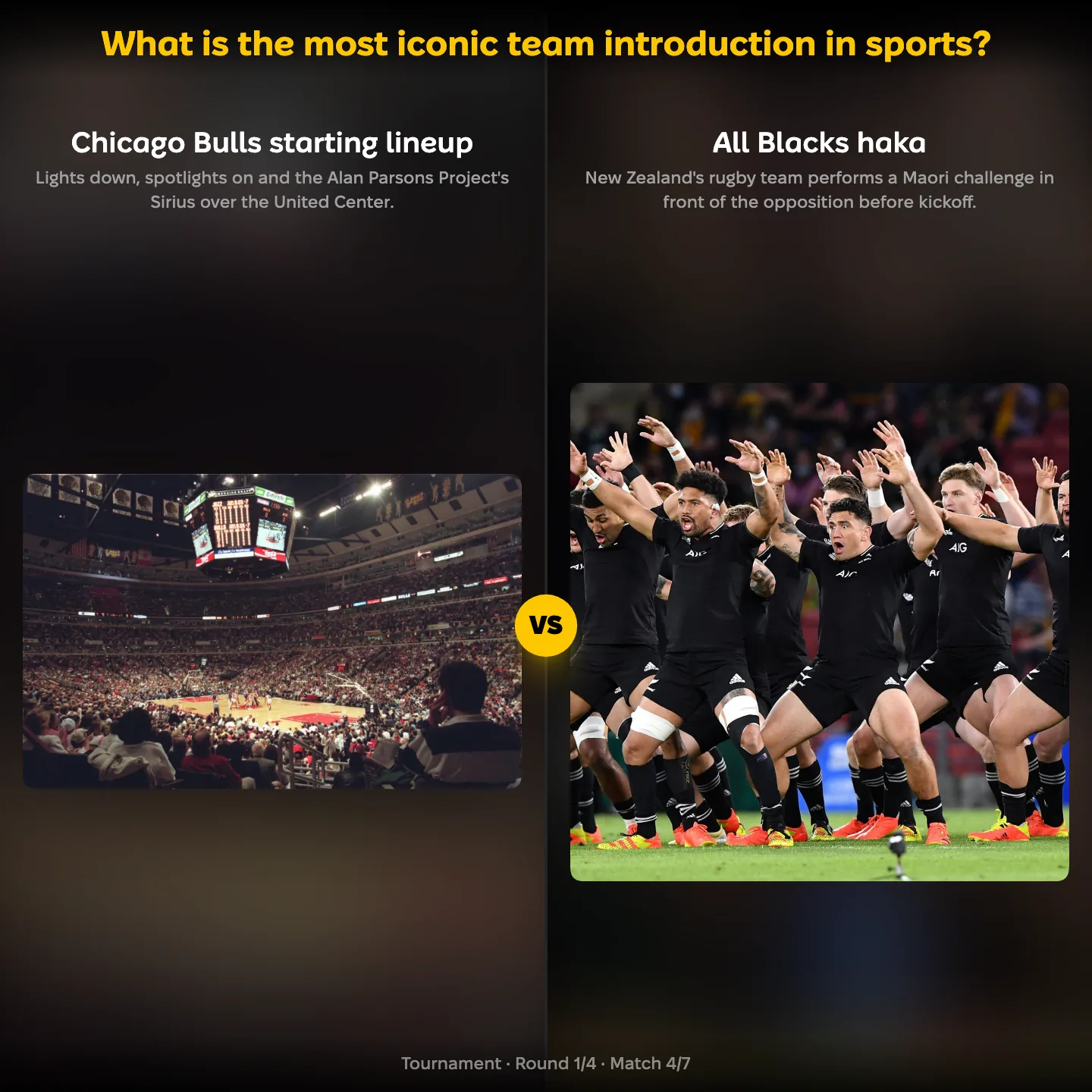
Sirius, the haka, and Notre Dame's tunnel
This ranking leaves basketball entirely and asks which team walks out best, anywhere in sport.
The Bulls entry is a lighting cue and a piece of instrumental rock. The house goes dark, spotlights find each starter, and the Alan Parsons Project's Sirius plays over the top. It has been copied by teams in sports that have nothing else in common with basketball.
The competition is older and stranger. New Zealand's rugby team performs a Māori challenge directly in front of the opposition. Clemson's players touch a rock and run down a hill. Notre Dame's players slap a sign as they leave the tunnel.
A production company designed Chicago's. Nothing else here was, and whether that counts as craft or as cheating decides the whole vote.
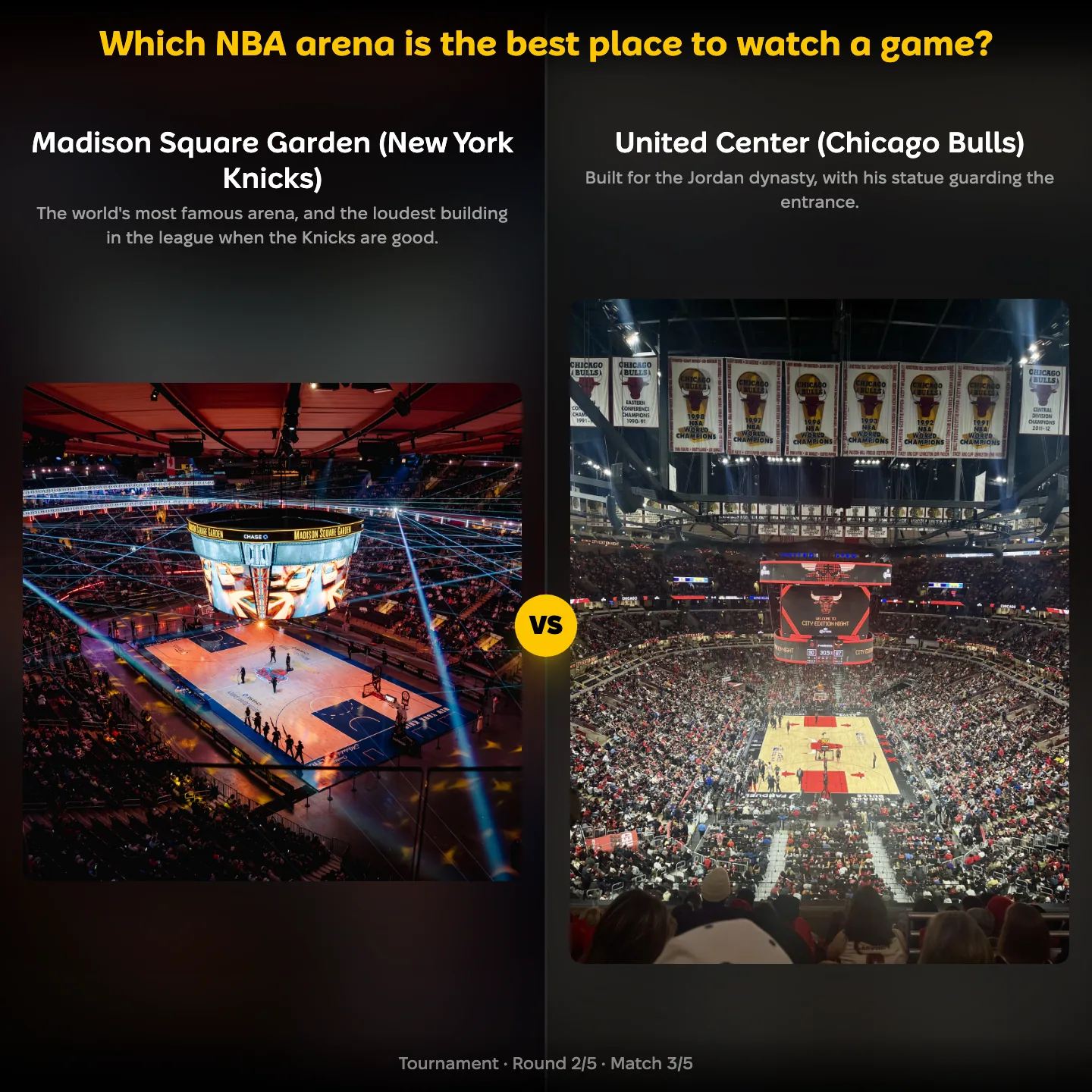
United Center vs Madison Square Garden: 20,917 seats
The United Center opened in August 1994, seats 20,917 for basketball, and is the largest arena in the NBA. Michael Jordan's statue went up the same year and now stands in the atrium.6
Size is the Bulls' entire case here, and size is not what this ranking rewards. Madison Square Garden is smaller, older and louder, and it carries a century of things that happened in it.
Boston's TD Garden has the banners. Oklahoma City's building is the loudest per seat in the league. Chicago has the most seats and, for most of the last decade, the least reason to fill them.
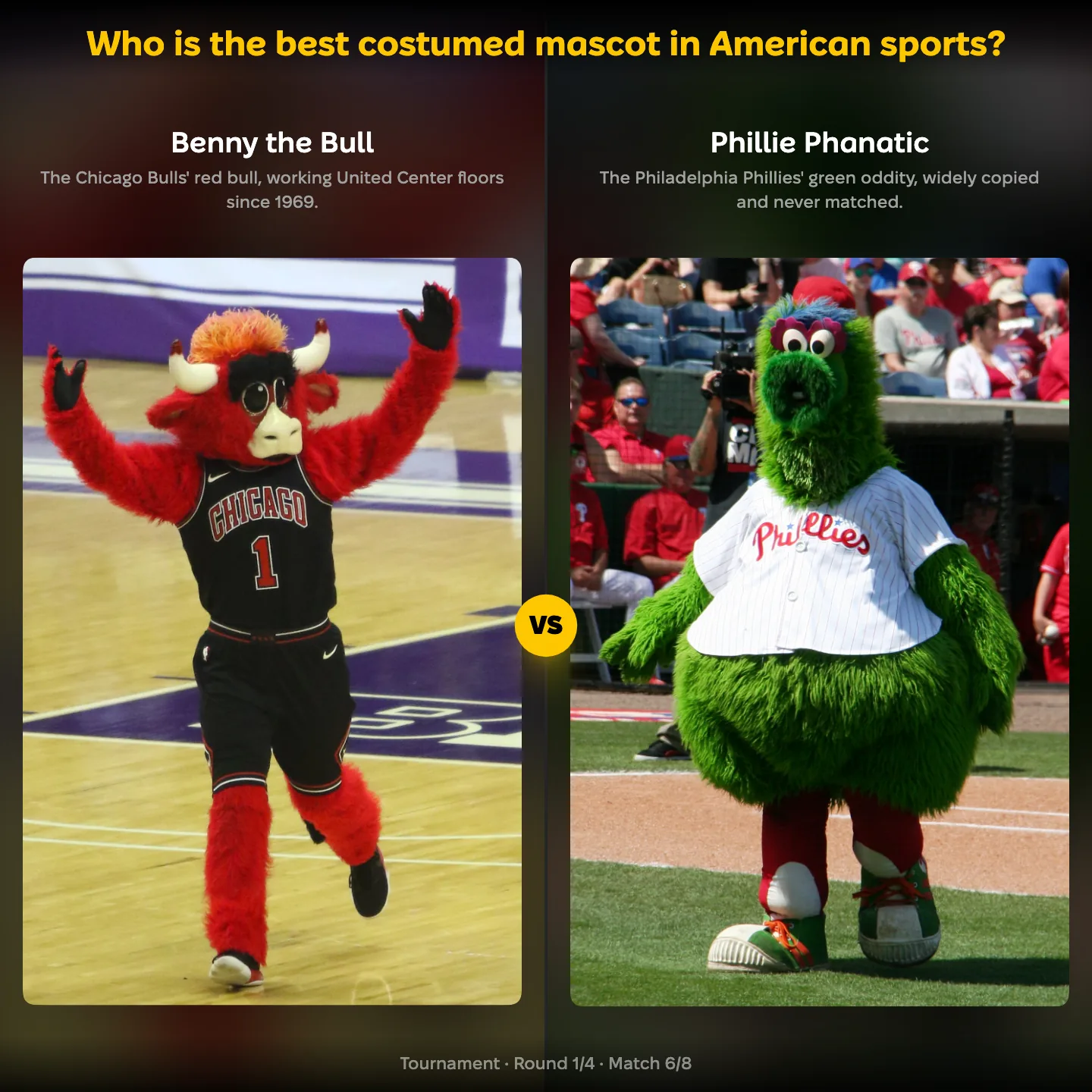
Benny the Bull vs the Phillie Phanatic
Benny the Bull started work in 1969, three years after the franchise did, which makes him one of the longest-serving mascots in American sport. He was voted NBA Mascot of the Year in 2015.7
Philadelphia's Phanatic is the higher bar. It is the costume every other team copied, the reason mascots stopped being men in team caps and started being creatures.
Below those two the ranking gets regional fast: Gritty, Mr. Met, Bucky Badger, a shapeless red blob from Western Kentucky. Benny is the only one who has worked the same floor for fifty-six years.
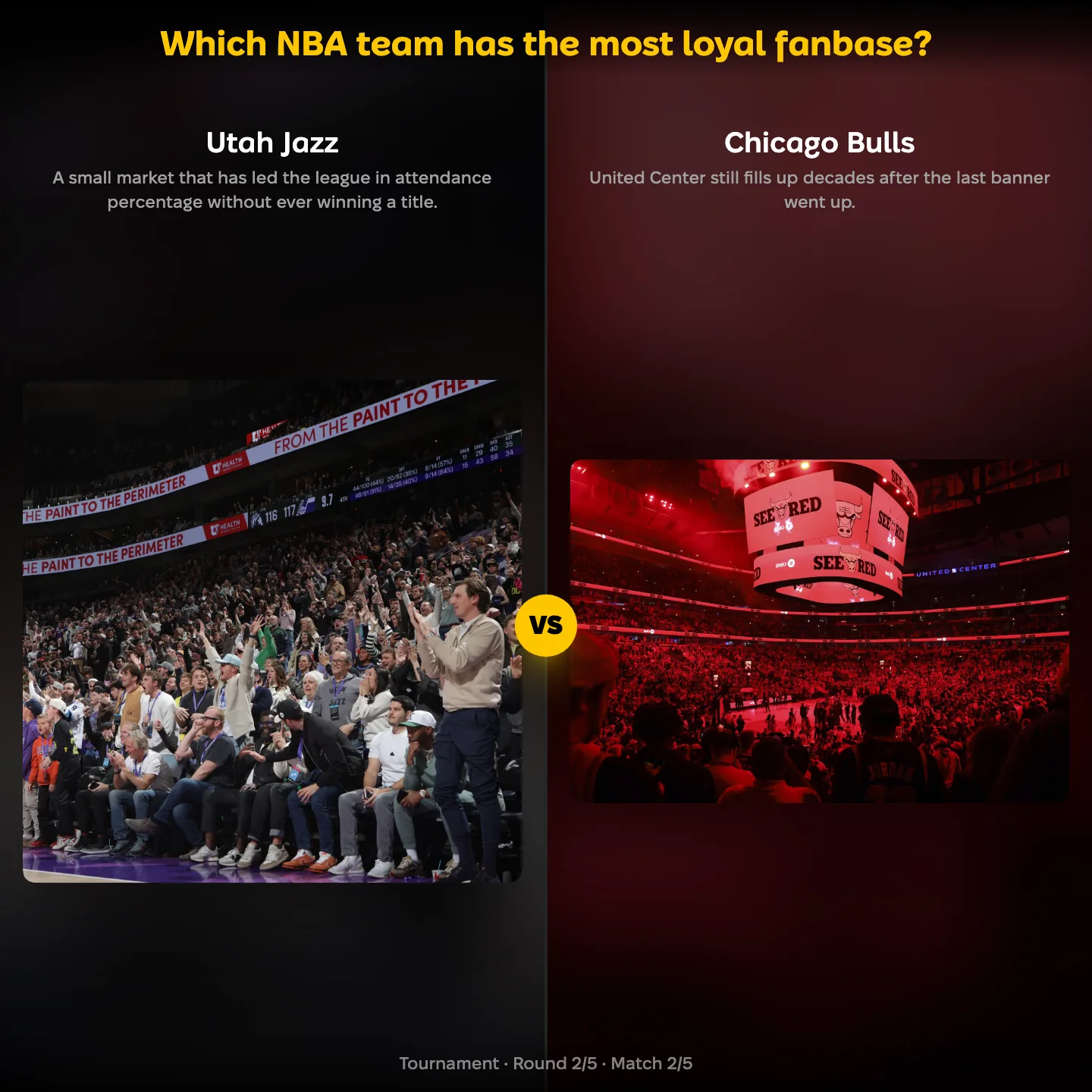
Utah, Sacramento and the loyalty that losing buys
Loyalty is the one category where winning six titles counts against you.
The Bulls sold out the United Center through the Jordan years and kept filling a very large building long after the banners stopped arriving, which is a real claim. It is also a claim helped by being the third-largest market in the country.
Utah and Sacramento are the purer version. Small cities, no championship between them, and buildings that stay full anyway. Portland belongs in the same group.
That is the tension this ranking runs on: whether loyalty means turning up, or turning up when there is no reason to.
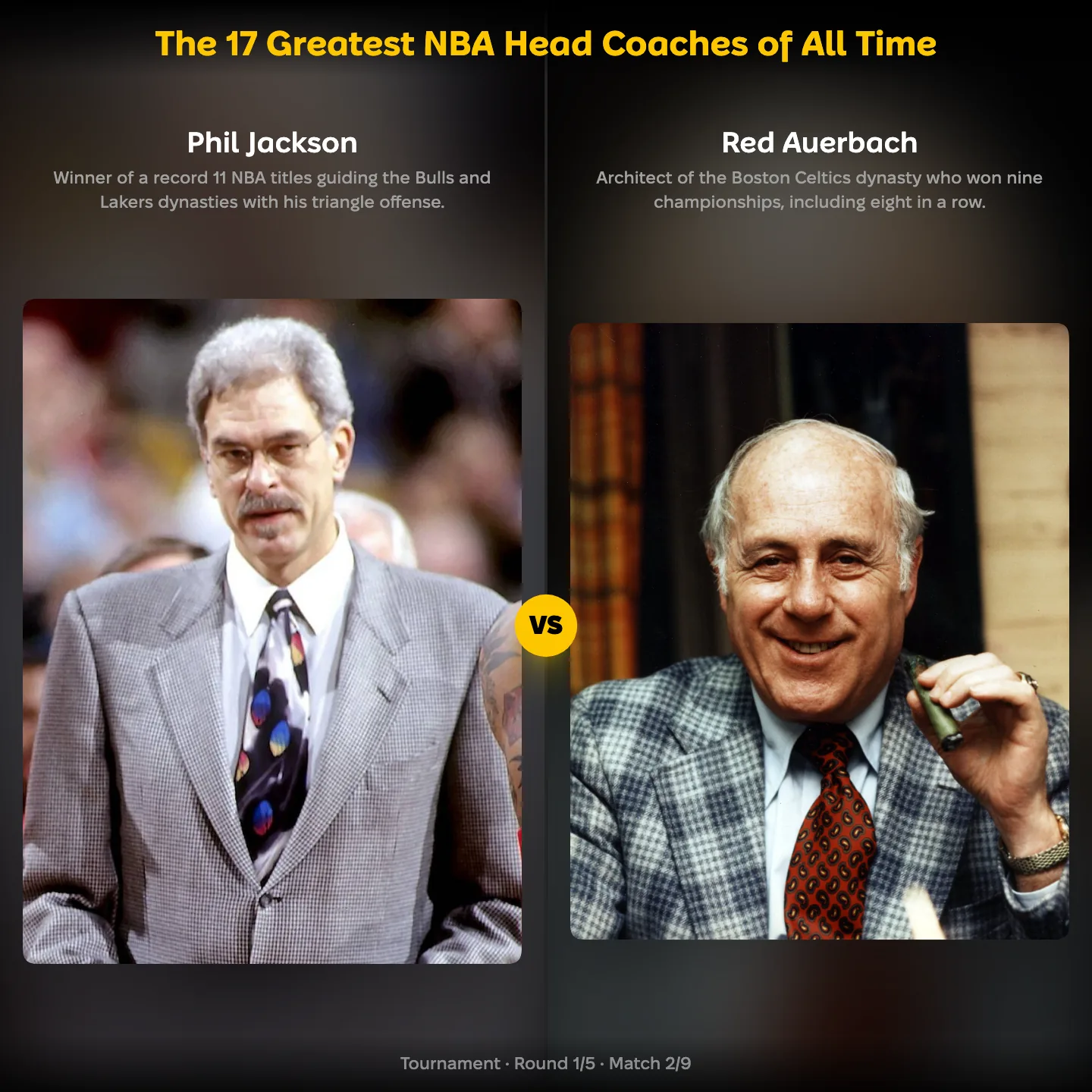
Phil Jackson vs Red Auerbach: eleven rings against nine
The Bulls appear on this ranking through the man on the sideline. Phil Jackson won eleven championships as a head coach, more than anyone in NBA history: six in Chicago, five in Los Angeles.8
Red Auerbach makes the harder case against him. Nine titles in Boston, eight of them consecutive, plus the front-office decades that produced several more.
The objection to Jackson is permanent and unanswerable: he coached Michael Jordan, then Shaquille O'Neal and Kobe Bryant. Gregg Popovich, twenty-two seats down the same list, built his own.
Chicago's stake in the question is narrower than it looks. Jackson won six here, then won five somewhere else, which is the strongest evidence that the triangle offence was not simply a Jordan delivery system.
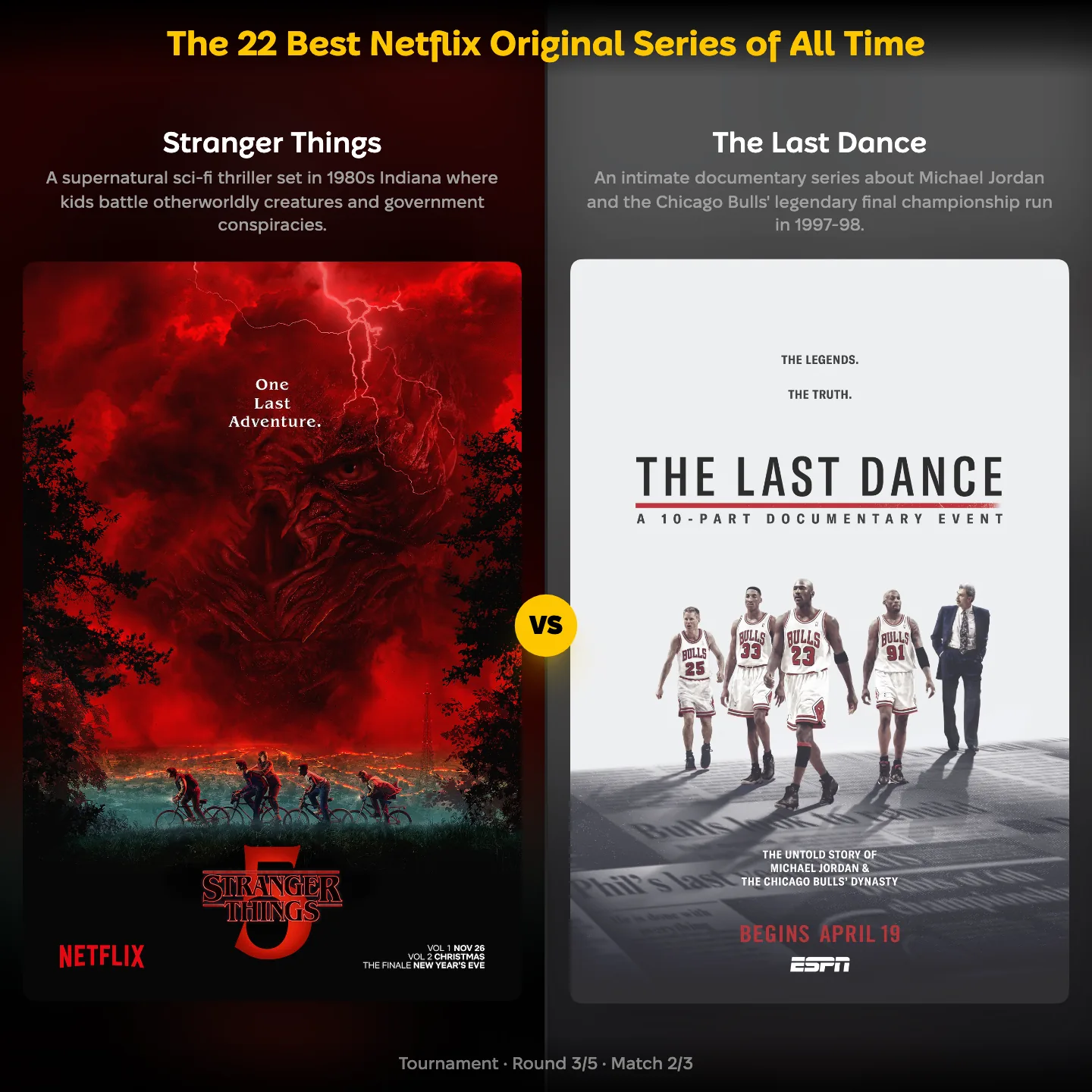
The Last Dance next to Stranger Things
Here the Bulls are not a team at all. They are a television show.
The Last Dance ran for ten episodes on ESPN in April and May 2020, averaged 6.71 million US viewers across the season, became the most-watched documentary the network had made, and won the Primetime Emmy for Outstanding Documentary or Nonfiction Series.9
On this list none of that is enough on its own. Stranger Things, Squid Game and The Crown are scripted global properties with several seasons each, and the field is stacked with them.
What the Bulls have is timing. The series landed during the first weeks of lockdown, when there was no live sport anywhere on earth, and it is fair to ask how much of its audience was the story and how much was the calendar.
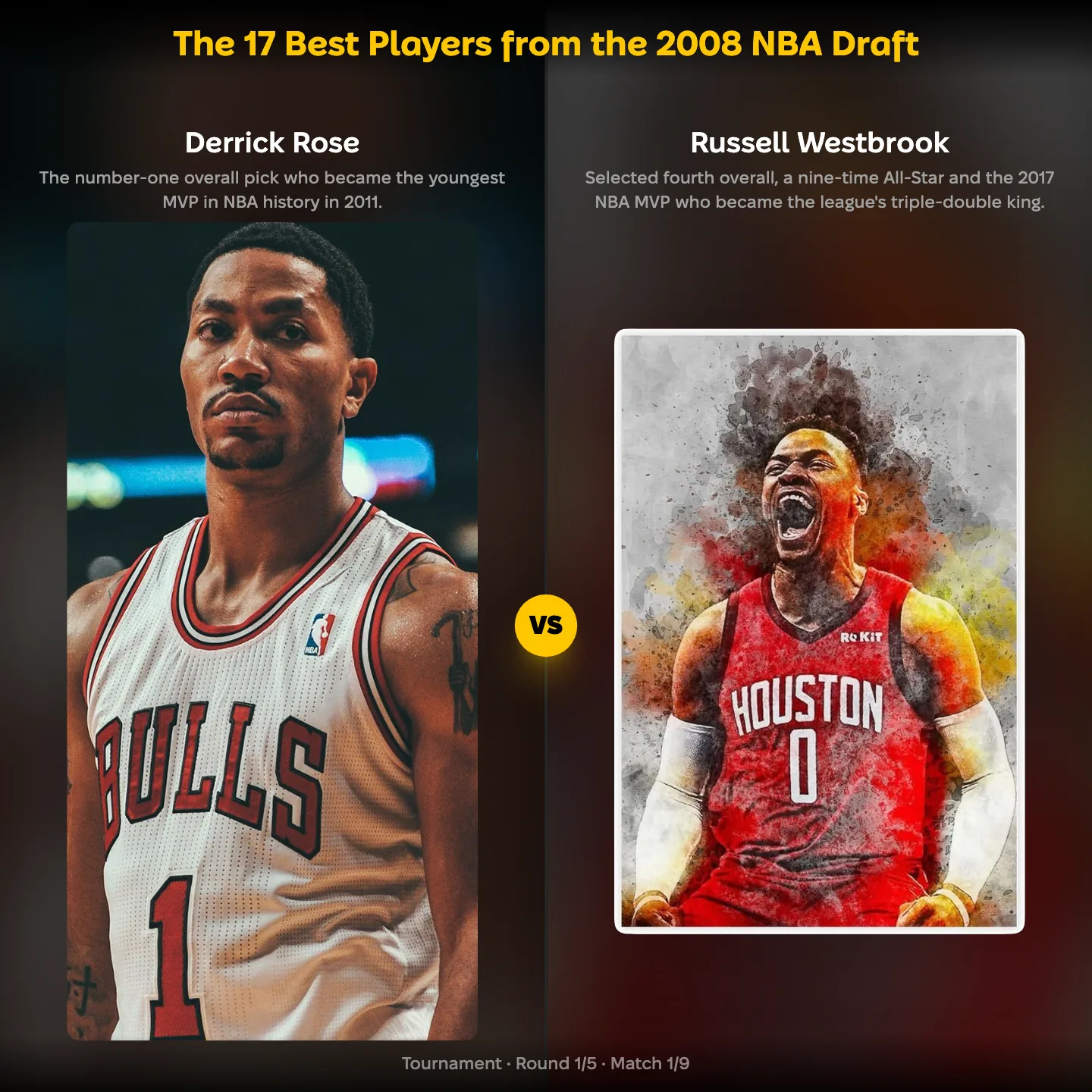
Derrick Rose vs Russell Westbrook: the 2008 draft
Chicago took Derrick Rose first overall in 2008, a point guard from the city itself. Three years later he was MVP at 22, the youngest in the award's history. On 30 April 2012, in the first game of the playoffs, he tore the ACL in his left knee.10
Russell Westbrook went fourth in the same draft and played nineteen seasons. Kevin Love went fifth. Serge Ibaka, Brook Lopez and DeAndre Jordan all had longer primes than the man taken first.
Rose is the reason this class is remembered as a warning rather than a haul. He was the best player in it for about two years and never the same after.
For Chicago the 2008 draft is also the last time the franchise held the first pick, which is why the section after this one exists.
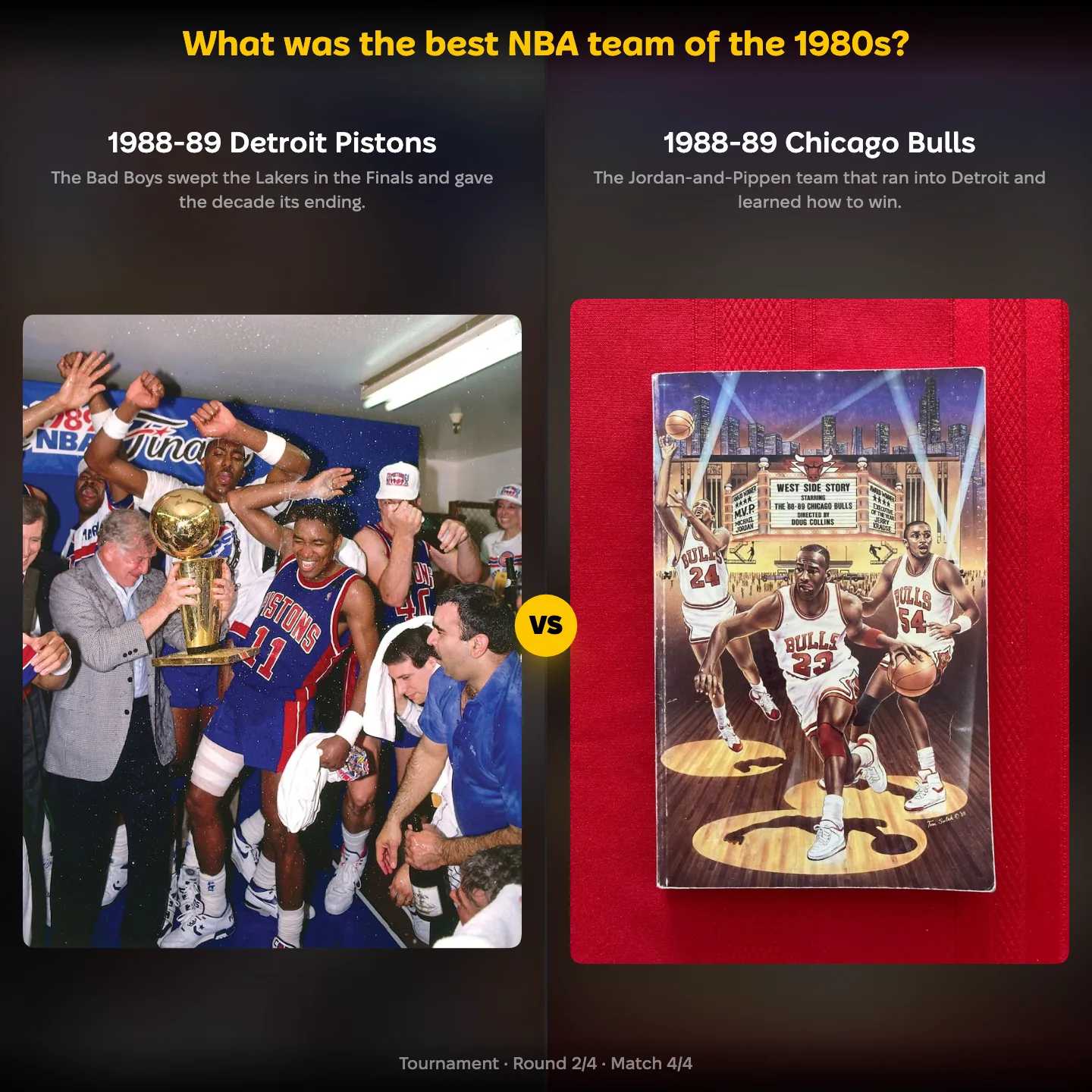
The 1988-89 Bulls, behind the Bad Boys and Showtime
Fifteen teams are on this ranking and fourteen of them won something. The Bulls entry did not.
That Chicago side already had Jordan and Pippen, and it finished the decade with no championship at all; the first arrived in 1991.3 Detroit's Bad Boys knocked them out that spring and again the year after.
Around them sit the 1985-86 Celtics, three separate Showtime Lakers teams and two Pistons sides. Every one of those has a trophy the Bulls entry does not.
This is the section where being the Chicago Bulls stops helping. On a list about the 1980s, the most famous franchise of the 1990s is a team that had not worked out how to win yet.
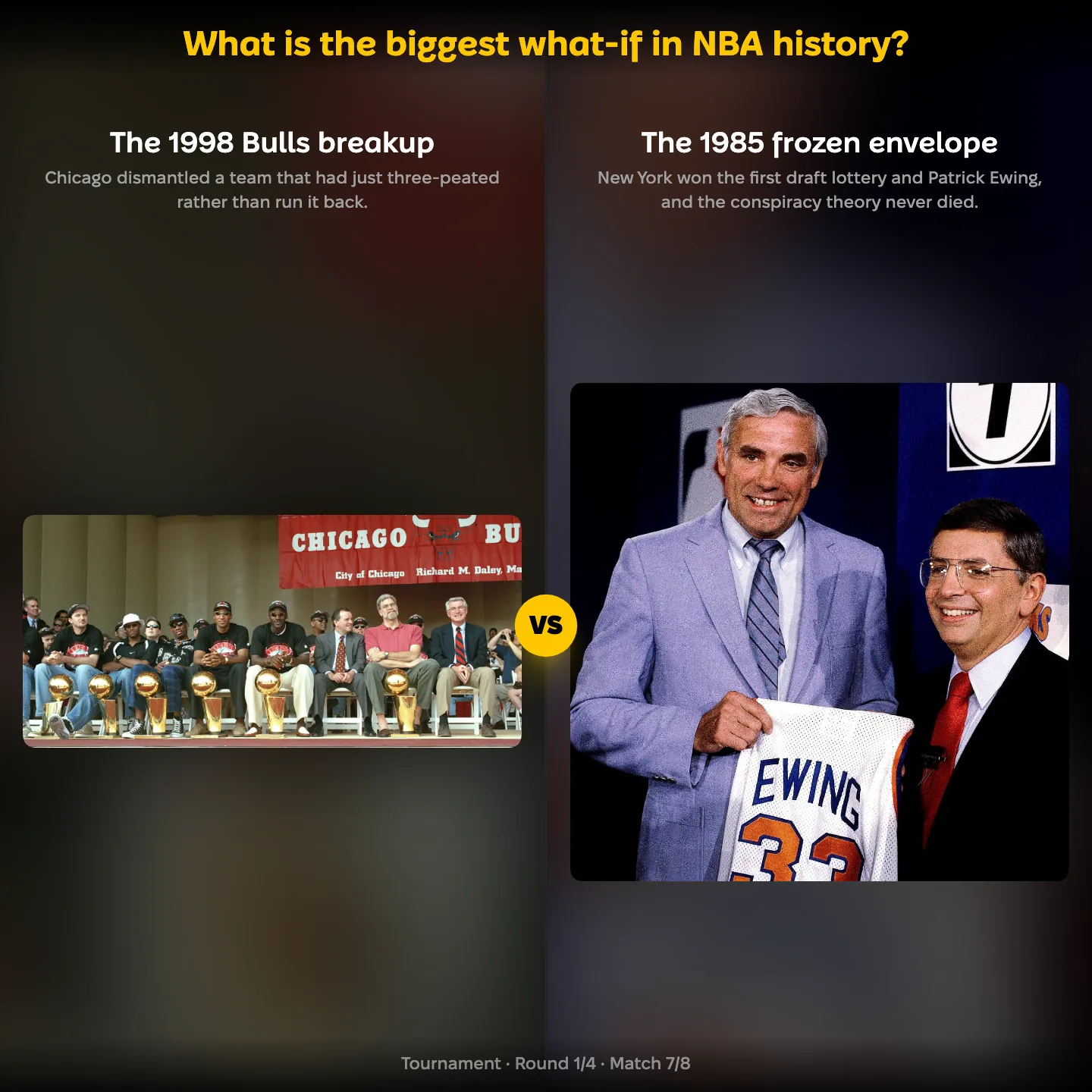
1998: the year Chicago took the team apart
Most entries on this ranking are accidents. Chicago's is a decision.
The 1997-98 Bulls went 62-20 and beat Utah 4-2 for a sixth title. Within months Phil Jackson had resigned, Michael Jordan had retired for the second time, Scottie Pippen had been traded to Houston, Dennis Rodman had signed with the Lakers, and Steve Kerr and Luc Longley were gone too.11
The team that had just won the championship was dismantled on purpose, and the franchise did not reach the playoffs again until 2005.11
Against that sit injuries: Bill Walton's feet, Greg Oden's knees, Kevin Durant's Achilles in the 2019 Finals, Yao Ming retiring at 30. Portland taking Sam Bowie one pick before Jordan is the version everyone knows.
What separates the Bulls entry is that nobody got hurt and nothing went wrong. A defending champion was ended by choice, and that is a rarer thing than bad luck.
Brooklyn, Sacramento and Chicago's decade since 2015
On the final list, six banners become evidence for the prosecution.
Chicago's most recent playoff series win came in April 2015, against Milwaukee in the first round, before Cleveland removed them in the next.12 The 2025-26 season ended 31-51 and twelfth in the East, with an eleven-game February losing run that no previous Bulls team had matched.2
Brooklyn has the loudest competing case. Three superstars arrived together and left without reaching a conference final, which is a faster and more expensive failure than anything Chicago managed.
Sacramento went sixteen straight years without a playoff appearance. Charlotte has never won a series under the Hornets name. Measured on raw futility, several teams have been worse than the Bulls.
Measured on distance fallen, none of them have. Sacramento never promised anything; Chicago spent the 1990s promising everything, and the banners are still hanging in the building while the team underneath them misses the play-in.
That is what makes this the honest section. The same six championships that put Chicago near the top of every ranking above are exactly what put the franchise on this one.
Sixteen questions, one bull's head
Nothing on this page contradicts anything else on it. A franchise can hold the best season ever played and the least interesting decade in its own conference at the same time, and the Bulls have spent thirty years proving it.
Sixteen questions, one badge. The variable is what each question chooses to measure, which is why sorting anything one matchup at a time produces sixteen different orders instead of a single verdict.
Pick a subject you know better than we do, and make the ranking that does not exist yet.
More rankings, more angles
- Are the Yankees the Greatest Sports Franchise of All Time? 13 Lists — 27 titles and a spot on the most-hated list
- Magic Johnson vs Larry Bird — the rivalry the 1980s Bulls were stuck behind
- Chicago Is on Every List. Never in the Same Place — the city that owns this team, measured elsewhere
- Lakers vs Celtics: 12 Finals, 35 Titles — the pair Chicago's 72-win season interrupted
Sources
- Wikipedia — 1995–96 Chicago Bulls season (72–10 record, first team to 70 wins, 4–2 Finals win over Seattle, Jordan MVP, Jackson Coach of the Year, Kukoč Sixth Man): en.wikipedia.org (checked 2026-08-25)
- Wikipedia — 2025–26 Chicago Bulls season (31–51, 12th in the Eastern Conference, franchise-record eleven-game February losing run): en.wikipedia.org (checked 2026-08-25)
- Wikipedia — Chicago Bulls (six championships in 1991–93 and 1996–98, franchise founded 16 January 1966): en.wikipedia.org (checked 2026-08-25)
- Wikipedia — Boston Celtics (18 championships, most in NBA history, most recent in 2024; Lakers second on 17): en.wikipedia.org (checked 2026-08-25)
- Wikipedia — 2015–16 Golden State Warriors season (73–9 record, Finals loss to Cleveland in seven after leading 3–1): en.wikipedia.org (checked 2026-08-25)
- Wikipedia — United Center (opened August 1994, 20,917 basketball capacity, largest arena in the NBA, Jordan statue erected 1994 and moved to the atrium in 2017): en.wikipedia.org (checked 2026-08-25)
- Wikipedia — Benny the Bull (introduced 1969, one of the longest-tenured mascots in professional sport, NBA Mascot of the Year 2015): en.wikipedia.org (checked 2026-08-25)
- Wikipedia — Phil Jackson (eleven championships as head coach, the most in NBA history; six with Chicago, five with the Lakers): en.wikipedia.org (checked 2026-08-25)
- Wikipedia — The Last Dance (ten episodes on ESPN, 19 April to 17 May 2020, 6.71m average US viewers, ESPN's most-watched documentary, Primetime Emmy for Outstanding Documentary or Nonfiction Series): en.wikipedia.org (checked 2026-08-25)
- Wikipedia — Derrick Rose (first overall pick in the 2008 draft by Chicago, 2011 MVP at 22 years and 6 months, torn left ACL on 30 April 2012): en.wikipedia.org (checked 2026-08-25)
- Wikipedia — 1997–98 Chicago Bulls season (62–20, 4–2 Finals win over Utah, and the departures of Jackson, Jordan, Pippen, Rodman, Kerr and Longley; no playoff appearance again until 2004–05): en.wikipedia.org (checked 2026-08-25)
- Wikipedia — 2014–15 Chicago Bulls season (4–2 first-round win over Milwaukee, then a 2–4 loss to Cleveland): en.wikipedia.org (checked 2026-08-25)