
Seeding is the practice of placing the strongest entrants in a knockout draw so that they cannot meet each other until the late rounds. The top seed and the second seed start at opposite ends of the bracket and can only meet in the final. Everyone else is placed around them, either by rank or by a draw within groups of seeds.
A knockout decides who meets whom by the draw, and a bad draw can send the two best players home in the same half. Seeding is the patch tournaments use for that flaw. It needs a ranking before the tournament starts, and that requirement is where most of the arguments about seeding begin.
How a seeded draw is built
The simplest version pairs the best with the worst. In the NCAA men's basketball tournament each region pairs its No. 1 seed with its No. 16, its No. 2 with its No. 15, and so on, as a reward for the better teams.1 If every favourite wins, the 1 meets the 8 or 9 next, then the 4 or 5, and the 2 only in the regional final.
Tennis places seeds by position and fills the rest at random. The 2026 Grand Slam rule book puts seed 1 on the first line of the draw and seed 2 on the last. Seeds 3 and 4 are drawn as a pair, then seeds 5 to 8, 9 to 12 and 13 to 16 are drawn in groups of four, and seeds 17 to 32 in groups of eight.2 At the 2025 Australian Open the 32 seeds went into those fixed lines and a computer filled the other 96 lines at random.3
Grand Slams: from 16 seeds to 32
Wimbledon first seeded in 1924, by nationality, and began seeding by ability in 1927; the story is told in bracket vs pairwise voting. Before 2001 the Grand Slams seeded 16 players. In June 2001 they doubled the number to 32, partly because clay-court players wanted more protection at Wimbledon, and in 2018 they dropped a plan to go back to 16.4
More seeds means fewer early meetings between ranked players.
March Madness: what 1 against 16 has produced
The NCAA men's tournament first seeded its whole field in 1979, the only year it had 40 teams. The field was 16 teams in 1951, 32 in 1975, 64 in 1985 and 68 from 2011.5 From 2027 it grows to 76 teams, with 24 of them playing 12 opening-round games to reach a bracket of 64.1
The seeds mostly hold. No. 1 seeds are 162–2 against No. 16 seeds. The first loss came in 2018, when UMBC beat Virginia 74–54; Virginia won the title the following year. The second came in 2023, when Fairleigh Dickinson beat Purdue 63–58.6 The women's tournament got there first: Harvard beat Stanford 71–67 in 1998, the first No. 16 seed to beat a No. 1 in college basketball.7
Lower down, seeding says less. From 1985 to 2025, No. 1 seeds won 26 of the 40 titles, but No. 8 seeds were 77–83 against No. 9 seeds in first-round games, so the 9 won more often.8 Players from those brackets meet in the top NCAA basketball players of the 2000s ranking, and the schools in the greatest college basketball program ranking.
Byes, pots and the World Cup draw
A bye is the reward seeding hands out when a field falls short of 16, 32 or 64. In the 14-team NFL playoffs only the No. 1 seed in each conference skips the first round.9 In tennis qualifying draws, byes go to the highest seeds first.2
Football's World Cup seeds by pots. For the 2026 draw, the three hosts went into pot 1 and the other teams were placed by the FIFA ranking of 19 November 2025. FIFA put Spain and Argentina in opposite halves of the knockout bracket and did the same with France and England, so that the two top-ranked teams could not meet before the final if both won their groups.10
What mathematicians say about seeding
Standard seeding does not guarantee that the top seed has the best chance. In a review of knockout design, Mark Glickman describes Frank Hwang's 1982 result that the standard bracket can leave the top seed with a worse chance of winning than the second seed, and that reseeding after every round fixes it. He also describes Allen Schwenk's 2000 proposal to shuffle seeds at random within their groups before building the bracket, which Schwenk argued is the fairest method on average.11
The best draw depends on the goal. Jeffrey Horen and Raymond Riezman showed in 1985 that with four players a single draw maximises the best player's chance of winning under any set of match odds, but with eight players eight different draws can be optimal.12 Christian Groh and colleagues found the best four-player seedings for three different aims in 2012: the most total effort, the likeliest final between the two best, and the best chance for the top player.13 Éric Marchand compared seeded and random draws in 2002 and found that the top seed's chances may not vary as much as one might expect.14
Why YouPickBest draws at random
Seeding needs a prior ranking, and a new ranking on YouPickBest has none. So every bracket is drawn at random: the options are shuffled for each play, and when the option count falls between two bracket sizes, the byes go to whichever options the shuffle puts first.
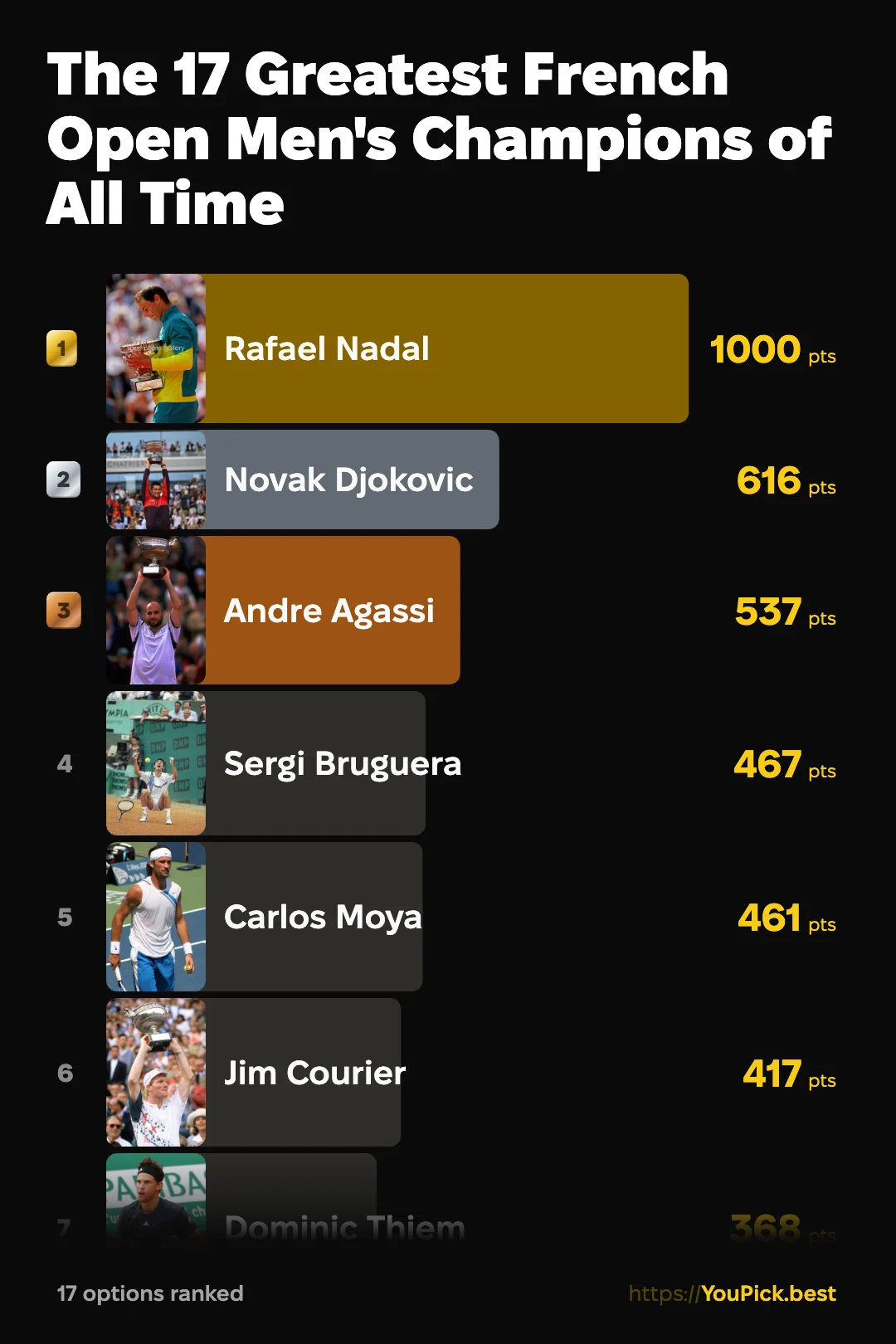
Take a ranking of 17 French Open champions. The bracket needs 32 lines, so 15 champions get a bye, and the remaining 2 play the opening match; after that, 16 champions are left for a round of 16, and the whole play takes 16 picks. A different player gets a different draw, so no champion keeps an easy path, and every matchup from every play goes into the same results.
Common questions
What does seeding mean in a tournament?
Arranging the draw by strength, so that the favourites are kept apart in the early rounds and the top two can collide no earlier than the final.
Why is the No. 1 seed paired with the No. 16?
To reward the best team with the weakest first opponent. If the favourites keep winning, the strongest teams meet only near the end.
How many seeds are there at a Grand Slam?
Thirty-two in each singles draw, a number set in June 2001. Before that the Grand Slams seeded 16.
Who gets a bye in a seeded tournament?
The top seeds. When the field leaves empty lines in the bracket, the highest-ranked entrants skip the first round.
More on how voting works
- Bracket vs Pairwise Voting: Which Finds the True Favourite? — the draw, the runner-up and a better way to count
- What Is an Ideal Type World Cup? Korea's Bracket for Picking a Favourite — a knockout decided by one player's taste
- King of the Hill Voting: How Winner-Stays Ranking Works — a format with no draw at all
Sources
- NCAA.com, 7 May 2026 — first-round pairings by seed and the 76-team field from 2027: ncaa.com (checked 2026-09-23)
- Official Grand Slam Rule Book 2026 — placement of seeds and byes: itftennis.com (checked 2026-09-23)
- Australian Open, "How Grand Slam tournament draws are made": ausopen.com (checked 2026-09-23)
- Associated Press via Tennis.com, 13 September 2018 — Grand Slams keep 32 seeds: tennis.com (checked 2026-09-23)
- NCAA.com — the 1979 tournament and the history of the field's size: ncaa.com and ncaa.com (checked 2026-09-23)
- NCAA.com, 21 March 2026 — No. 1 seeds against No. 16 seeds: ncaa.com (checked 2026-09-23)
- NCAA.com, 2019 — Harvard's women beat Stanford in 1998: ncaa.com (checked 2026-09-23)
- NCAA.com, 16 April 2025 — records for every seed, 1985–2025: ncaa.com (checked 2026-09-23)
- NBC Sports, January 2026 — how the NFL playoffs and byes work: nbcsports.com (checked 2026-09-23)
- FIFA, 25 November 2025 — procedures for the final draw of the 2026 World Cup: inside.fifa.com (checked 2026-09-23)
- Mark E. Glickman, paper on knockout tournament design, reviewing Hwang (American Mathematical Monthly, 1982) and Schwenk (American Mathematical Monthly, 2000): glicko.net (checked 2026-09-23)
- Jeffrey Horen and Raymond Riezman, "Comparing Draws for Single Elimination Tournaments", Operations Research 33(2), 1985: doi.org (checked 2026-09-23)
- Christian Groh, Benny Moldovanu, Aner Sela and Uwe Sunde, "Optimal seedings in elimination tournaments", Economic Theory 49(1), 2012: ideas.repec.org (checked 2026-09-23)
- Éric Marchand, "On the comparison between standard and random knockout tournaments", The Statistician 51, 2002: doi.org (checked 2026-09-23)