
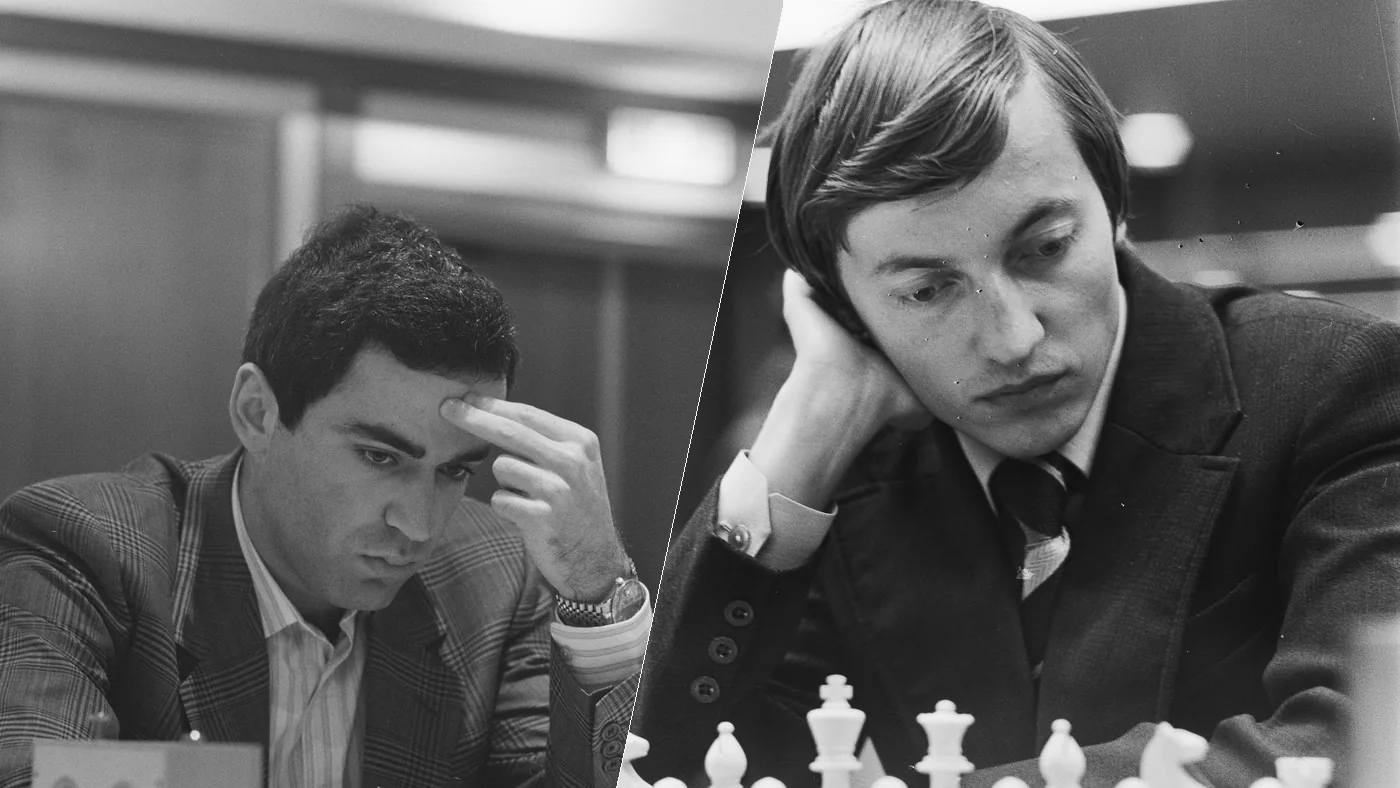
Garry Kasparov and Anatoly Karpov played five world championship matches between 1984 and 1990 and 144 games of chess to decide one title. The first of those matches was stopped after 48 games with nothing decided at all. The second ended in Leningrad on 8 October 1986, forty years ago next month.4
Chess has been arguing about them ever since, and the sport is about to hand the stage to two players born long after the last Kasparov–Karpov game: Gukesh Dommaraju defends the title against Javokhir Sindarov in Geneva from 22 November, both of them twenty years old.8 Four decades on, their own question has moved hardly at all.
Five matches settled which of them was world champion. Nothing else about Kasparov and Karpov has been settled since.
Kasparov vs Karpov: the widest question in chess
The broadest ranking chess has is also the one where the two of them have the least control over the outcome. Sixteen players are on it, Wilhelm Steinitz and Magnus Carlsen among them, and the two Soviets take up two of the sixteen places.
Kasparov's case is the rating list. He reached 2851 in 1999, a record that stood until Carlsen passed it, and he spent more months at world number one than any player before him.3
Karpov's case is volume. Ten years as undisputed champion, then three more title reigns under FIDE in the 1990s, and a tournament record nobody in the game has matched.2
Neither of those arguments is decisive here, because the field contains Bobby Fischer, José Raúl Capablanca and Carlsen, and each of them is somebody's answer. Starting this wide does one useful thing: it puts Kasparov and Karpov in a room where being the strongest player of your own generation only gets you through the door.
Karpov vs Gukesh: one took the title without playing, one took it at 18
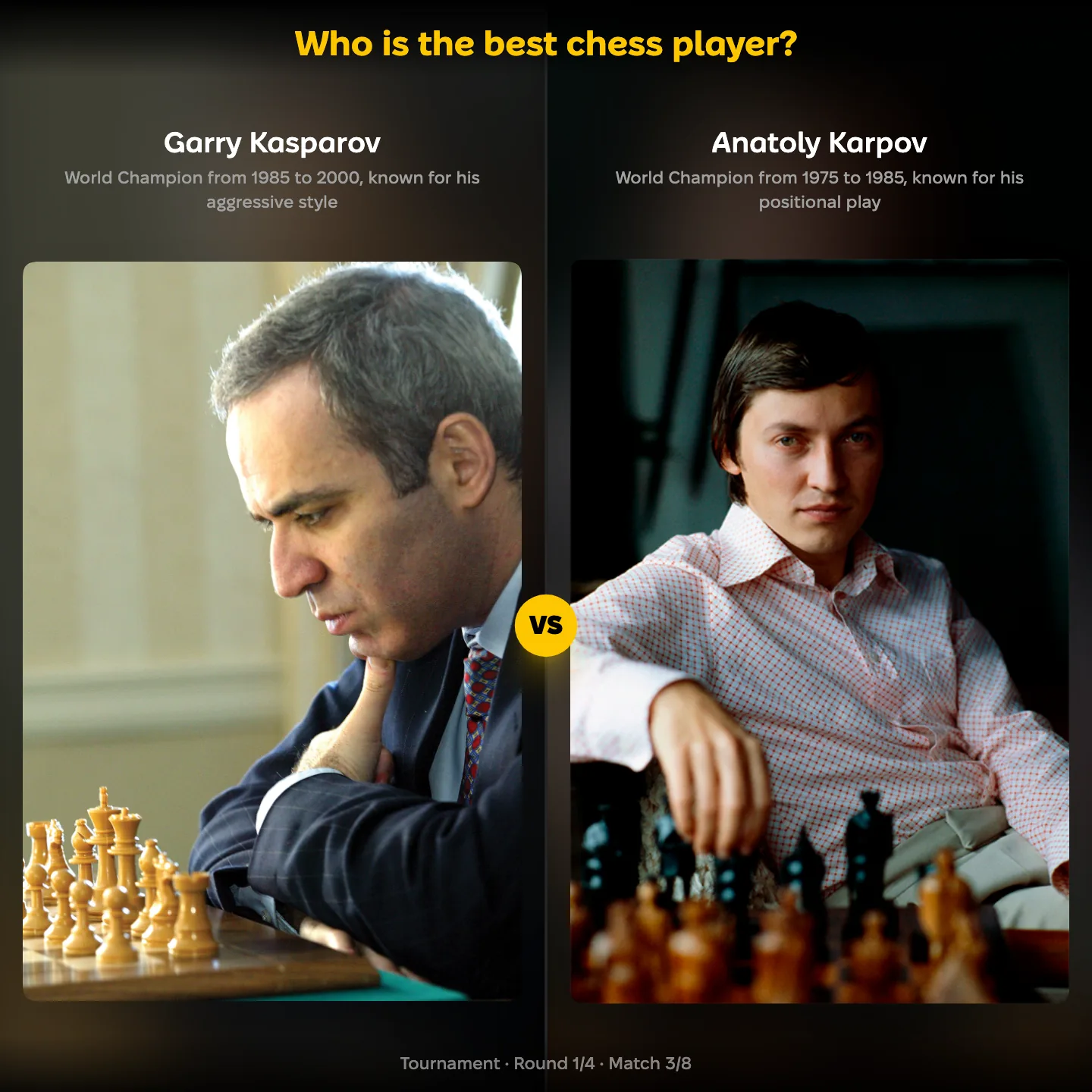
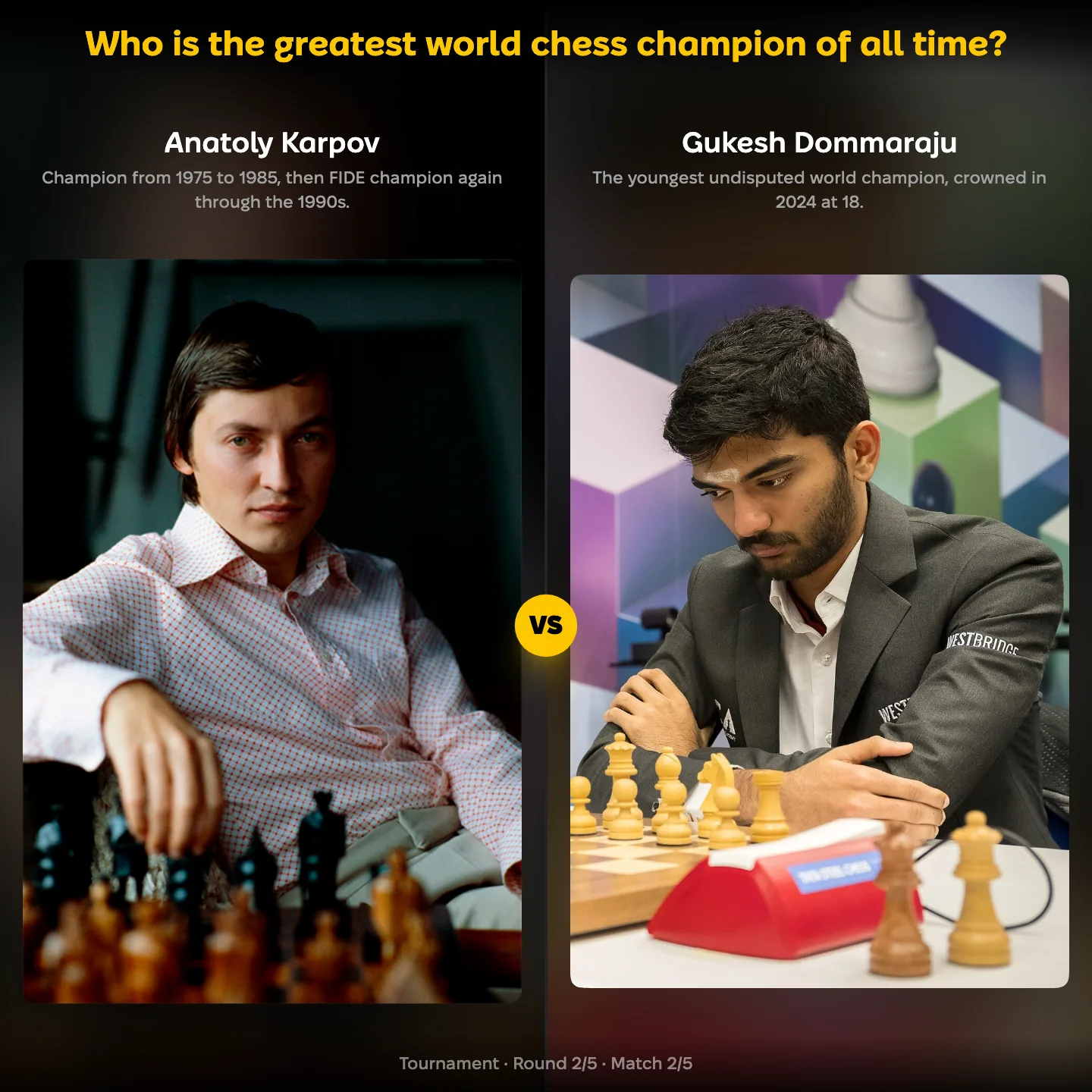
Narrow the field to world champions and the list becomes a closed set of eighteen names. Kasparov and Karpov are both on it, and they arrived by routes so different that comparing the two is most of the fun.
Karpov became champion in April 1975 without sitting down at a board. Fischer would not accept FIDE's conditions for the match, FIDE would not move, and the title was handed to the challenger.2 He then spent a decade proving it had been handed to the right man.
Kasparov arrived the hard way, on 9 November 1985, after a first match that had run five months and been abandoned, and a second one he won on the final day. He was 22.1
The newest name on the list did it faster than either. Gukesh Dommaraju was 18 when he won the title in Singapore in 2024, and he is defending it this November. Against Steinitz, Emanuel Lasker and Carlsen, the two Soviets are in the middle of a very long queue.
Botvinnik's school: Kasparov, Karpov and the Soviet production line
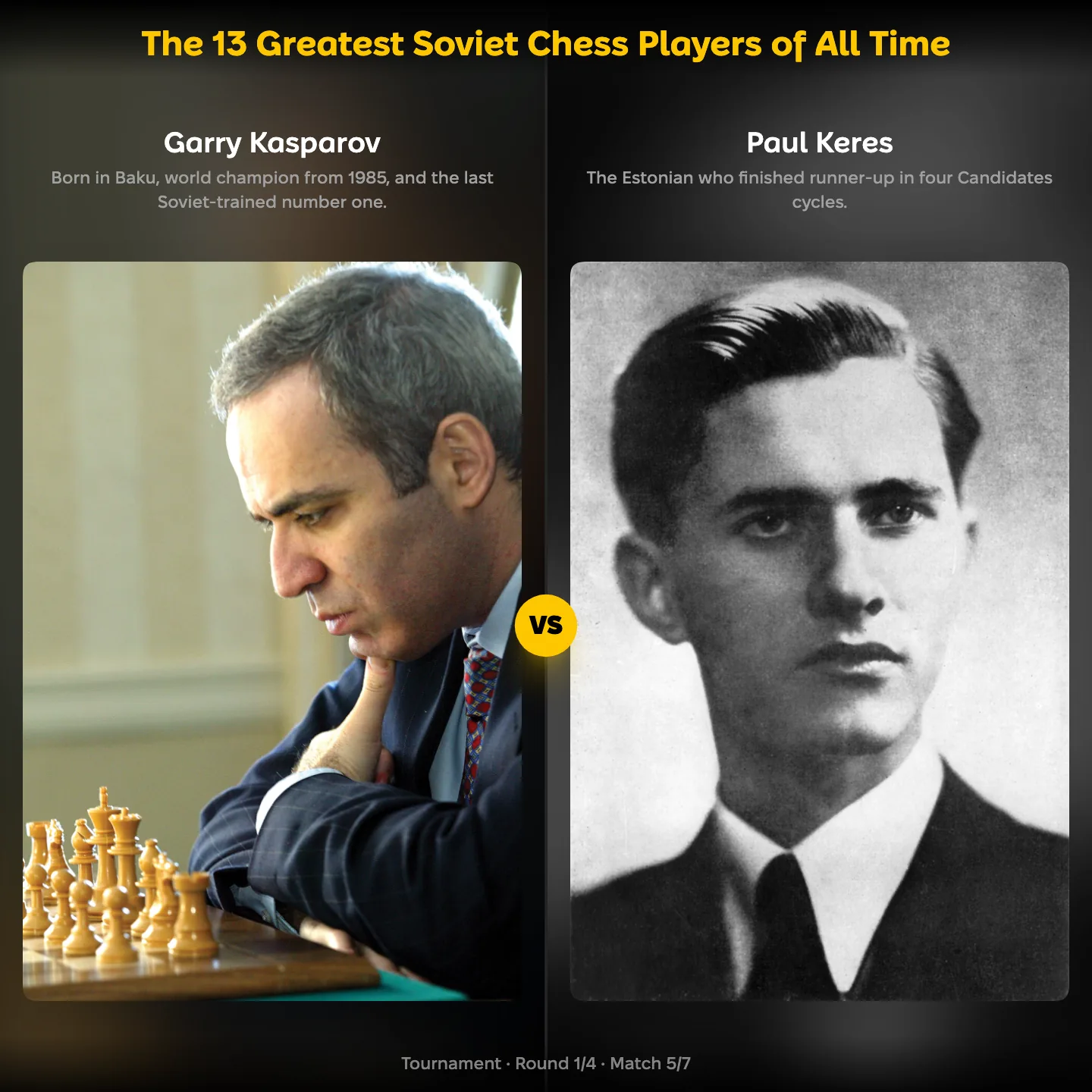
Both men came out of the same machine. Mikhail Botvinnik ran a chess school outside Moscow that taught Karpov in the 1960s and Kasparov in the 1970s, and the state that paid for it expected exactly what it got: a Soviet world champion, followed by another one.
Karpov was the model product. Born in Zlatoust in the Urals in 1951, he was the establishment's man through the 1970s, and the federation treated his title as national property.2
Kasparov, born in Baku in 1963, was the one the machine had trouble holding. He fought the federation over the abandoned match, over match conditions, and eventually over the whole structure of the world championship.
The list they share is deeper than either of them. Mikhail Tal, Tigran Petrosian, Vasily Smyslov and Boris Spassky all held the title. Viktor Korchnoi and Paul Keres are on it without ever having done so, and Keres finished runner-up in four Candidates cycles without ever being given a match.
Two of the thirteen names are women, and neither was a passenger. Nona Gaprindashvili held the women's world title for sixteen years and was the first woman awarded the grandmaster title; Maia Chiburdanidze took the title off her at seventeen and kept it for thirteen years.
Being the strongest Soviet player of your decade did not make you champion, and the title did not always go to the best player in the hall.
160 first places: Karpov's tournament record
Title matches are a two-man skill. Tournaments are the other job: nine or thirteen rounds against everybody at once, twice a month, for thirty years. It is the question where Karpov stops being the runner-up in his own story.
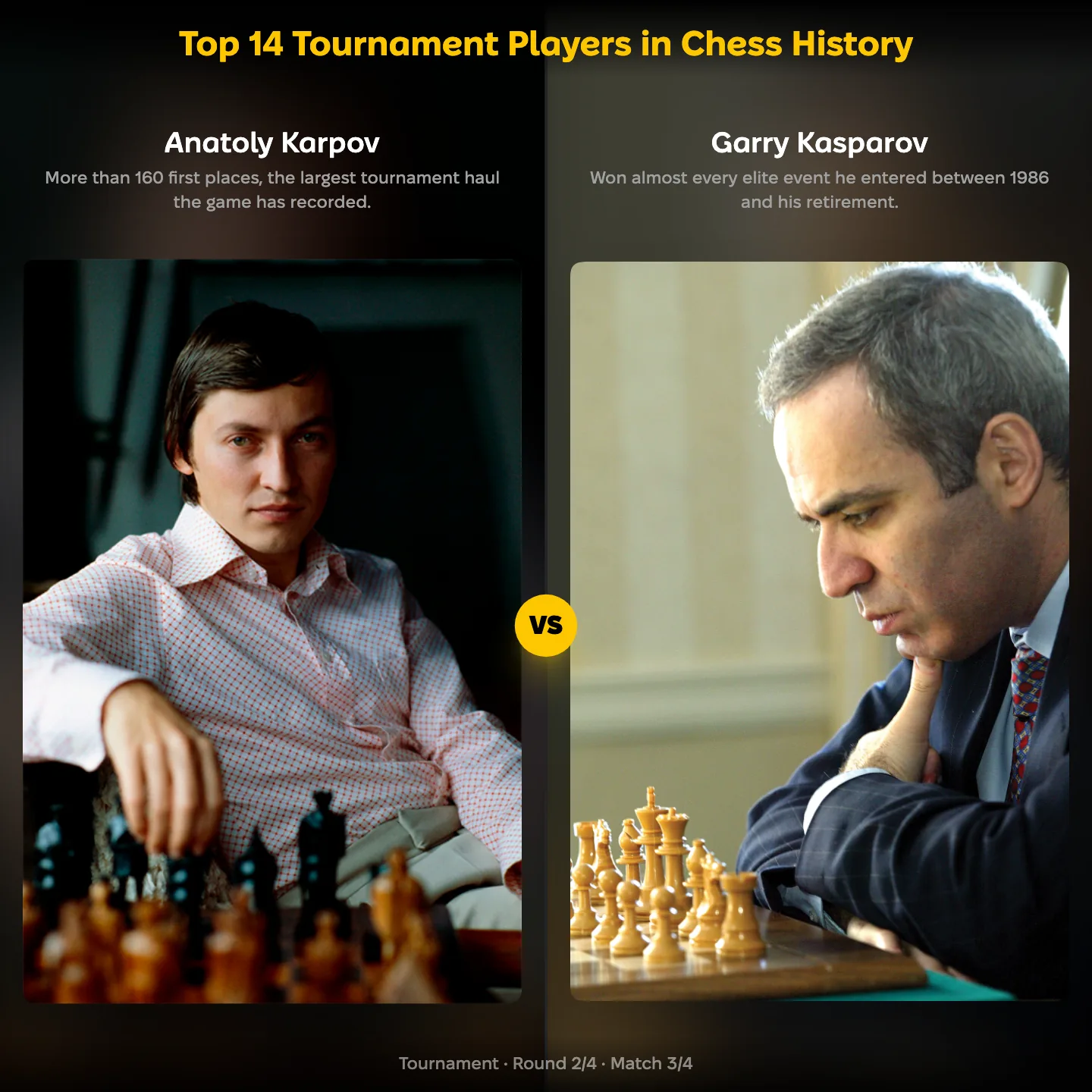
ChessBase puts it plainly: "His tournament successes include over 160 first-place finishes."2 No other player in the game's history is close to that number.
His best single event came when the rivalry was already over. At Linares in 1994 he scored 11 points from 13 games against a field that included Kasparov, Vladimir Kramnik and Viswanathan Anand, finished two and a half points clear, and produced a performance rating of 2985, the highest anyone had managed until 2009.2
Kasparov's reply is the twenty years of elite events he won either side of that week, and the detail that it was him Karpov had left behind in Spain. Capablanca, Lasker and Carlsen crowd the same question, and Capablanca went eight years without losing a single tournament game.
Capablanca, Karpov and the dead position
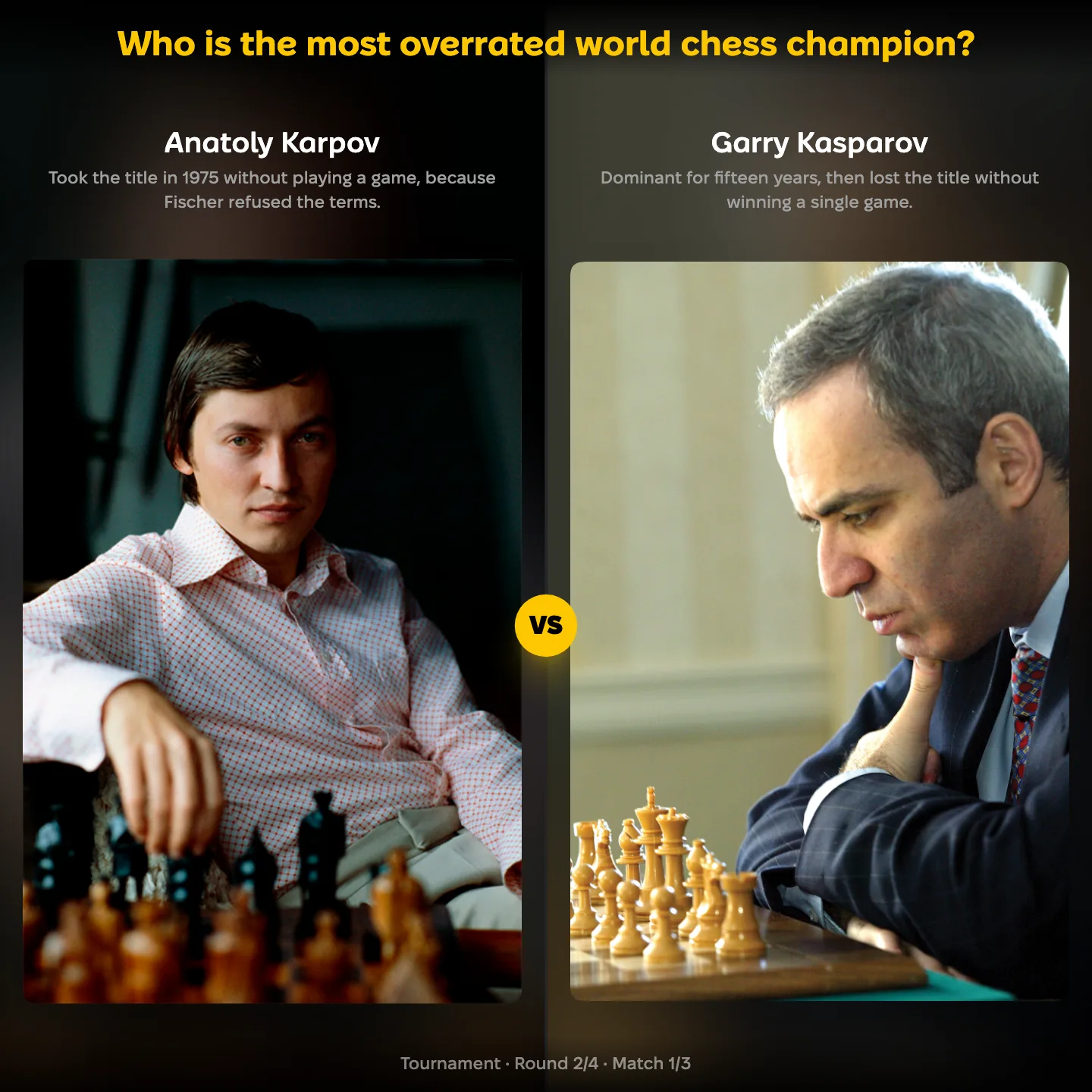
Endgame technique is the part of chess that spectators leave before. Most pieces are gone, the position looks drawn, and the win has to be manufactured from almost nothing. Karpov built a career there.
He is the modern name in every list of great endgame players, for a style that never looks like it is doing anything: small improvements, no risk, and an opponent who discovers at move 60 that the position has been lost for twenty moves.
Kasparov belongs here too, for a reason that runs against his reputation. The player famous for attacking preparation also had to hold and win endings across 144 championship games against the best technician of the era, and he did.
The field above both of them is old. Capablanca is the name every endgame manual opens with, Akiba Rubinstein is the one rook endings are named after, and Vasily Smyslov's endings are still taught move by move. Carlsen, who wins positions engines call level, is the one modern player who makes the historical case look unsettled.
Seville 1987 vs Reykjavik 1972
Three of the fifteen entries here are Kasparov against Karpov, which is what a rivalry looks like when the same two men contest the title five times in six years.
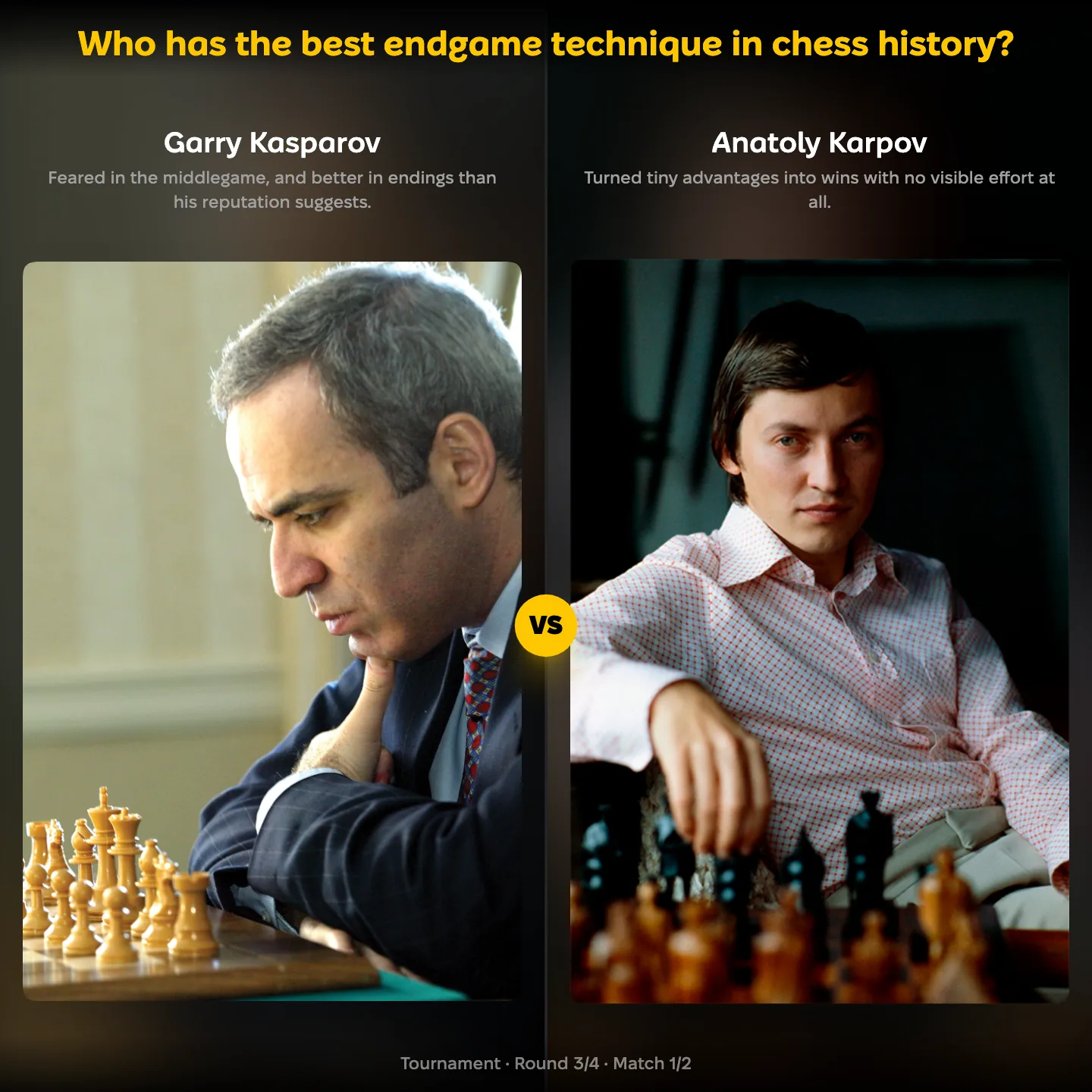
Seville 1987 is the one to know. Karpov won game 23 to lead 12–11 with a single game left, which meant Kasparov had to win on demand or lose the title. He did: Karpov, short of time, went wrong in the last game and resigned on move 64, the match finished 12–12, and the champion kept the title on the tie.5
The 1984–85 match earns its place the other way round. Five months, 48 games, and FIDE's president stopped it in February 1985 with no result and no winner, citing the players' health.1 Nothing like it has happened before or since.
Reykjavik 1972 is the match that outranks them both in every telling. Fischer against Spassky at the height of the Cold War, one forfeited game, and a television audience chess has never had again.
Their 1990 match, split between New York and Lyon, was the fifth and last time the pair played for the title.6 Six years after the first one started, they stopped needing each other: Kasparov left FIDE in 1993, Karpov stayed, and the title split in two.
The 1975 walkover and the Berlin Defence
Every champion picks up an asterisk somewhere, and this ranking collects them. Both men are on it, with the two most-cited asterisks in the game.
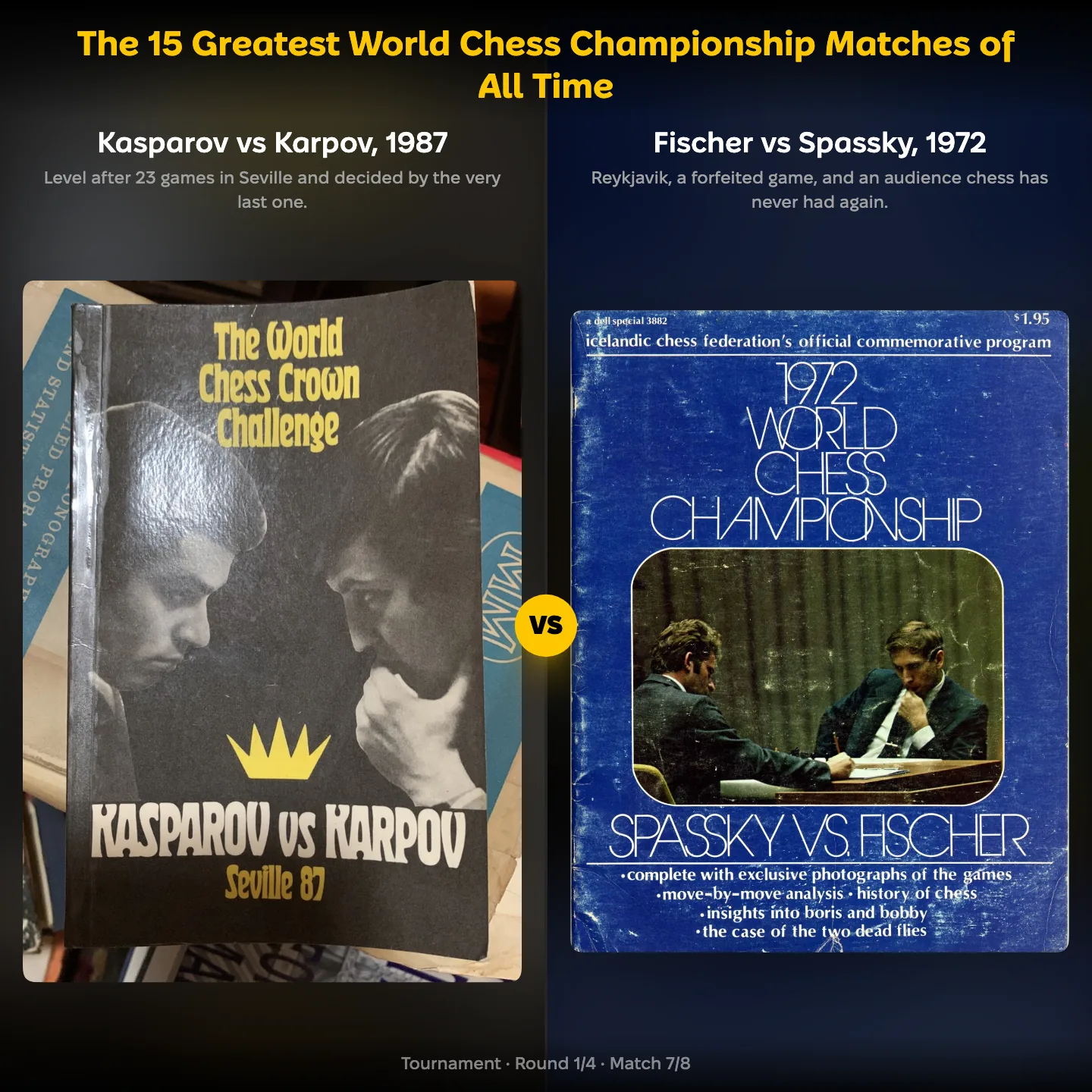
Karpov's is the first line of his record. He is the only champion of the modern era to receive the title rather than win it, and he knows it: the decade of results that followed reads like a man answering a charge.2
Kasparov's came at the other end. In 2000 he defended against Vladimir Kramnik, could not break the Berlin Defence, and lost the title across fifteen games without winning any of them. Fifteen years of dominance ended without a single win on the board.
The rest of the list makes both of them look robust. Max Euwe held the title for two years; Mikhail Botvinnik twice kept his through rematch clauses he had helped write; and Alexander Khalifman, Ruslan Ponomariov and Rustam Kasimdzhanov each won a FIDE knockout that several of the world's best players skipped.
Deep Blue, 1997: the list Karpov never made
Here the pair stop being a pair. Karpov does not qualify at all; Kasparov qualifies twice. Nothing else in this article separates them so cleanly.
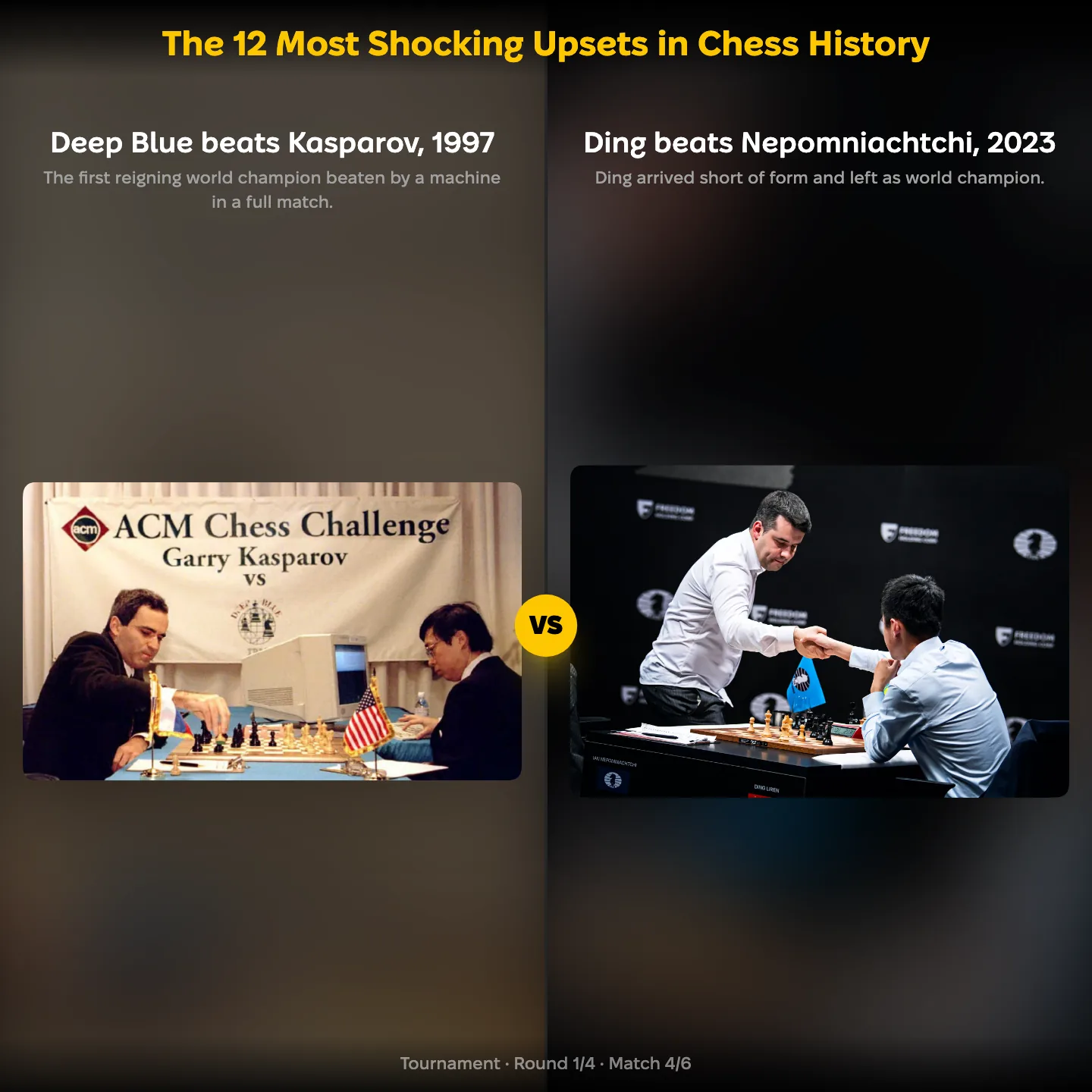
In May 1997, at the Equitable Center in New York, IBM's Deep Blue beat him 3½–2½, the first time a reigning world champion lost a match to a machine under tournament conditions. Kasparov had won the first meeting in Philadelphia the year before, 4–2.7 His second entry is the 2000 loss to Kramnik.
Being on a list of upsets is a backhanded honour: it requires that everyone expected you to win. Karpov's career, for all its length, produced no defeat the sport found this hard to believe.
The company is good. Max Euwe took the title from Alexander Alekhine in 1935, Richard Réti ended Capablanca's eight-year unbeaten run in one afternoon in 1924, and Ding Liren arrived at the 2023 championship short of form and left as champion.
Forty years, no verdict
Karpov is 75 now and the oldest living world champion; Kasparov is 63 and has not played competitively since 2005. The matches are history, and chess still cannot agree on more than the scoreline of the five it has.
Eight questions, eight different shapes of answer, each of them decided the way the five matches were: one pair at a time, for as long as it takes.
If the pair you keep arguing about is missing from all of this, the ranking that settles it does not exist yet. Make it.
More rankings, more angles
- Senna vs Prost: 14 Rankings, One Argument — teammates who stopped speaking
- Federer vs Nadal vs Djokovic — 16 Lists That Split Them — three men, one era, no consensus
- How Head-to-Head Voting Works (and Why It Beats Polls) — why one matchup at a time
Sources
- ChessBase — the 1984–85 match abandoned after 48 games on 8 February 1985 at 5–3, and Kasparov winning the title on 9 November 1985: en.chessbase.com (checked 2026-09-17)
- ChessBase — Anatoly Karpov: born 23 May 1951 in Zlatoust; awarded the 1975 title after FIDE refused Fischer's conditions; "over 160 first-place finishes"; Linares 1994, 11 points from 13, two and a half points clear, a 2985 performance rating: en.chessbase.com (checked 2026-09-17)
- ChessBase — Kasparov's peak rating of 2851 in 1999 and his record run of months as world number one: en.chessbase.com (checked 2026-09-17)
- Mark Weeks, World Chess Championship archive — the 1986 rematch played in London and Leningrad, ending 8 October 1986, 12½–11½ to Kasparov: mark-weeks.com (checked 2026-09-17)
- Mark Weeks, World Chess Championship archive — Seville 1987: Karpov won game 23 to lead 12–11, resigned game 24 on move 64, final score 12–12, Kasparov retained the title: mark-weeks.com (checked 2026-09-17)
- Mark Weeks, World Chess Championship archive — the 1990 match, twelve games in New York and twelve in Lyon, the pair's fifth title match: mark-weeks.com (checked 2026-09-17)
- IBM — Deep Blue: Kasparov won 4–2 in Philadelphia in February 1996; Deep Blue won the May 1997 rematch at the Equitable Center in New York 3½–2½: ibm.com (checked 2026-09-17)
- World Chess (FIDE) — the 2026 World Chess Championship: Gukesh Dommaraju against Javokhir Sindarov in Geneva, 22 November to 13 December 2026, both players 20, 14 classical games: worldchess.com (checked 2026-09-17)