

On 28 July 2026 Halo: Campaign Evolved launched on PlayStation 5, Xbox Series X|S and Steam.1 It is the first mainline Halo campaign to run on a Sony console, and it landed in the year Halo: Combat Evolved turns twenty-five.2
Twenty-five years is long enough for one word to stop meaning one thing. Halo is a 2001 shooter, a console-selling brand, five games Bungie made before it walked away, a soldier whose face has never been shown, ten orchestral scores, and a Paramount+ series that lasted two seasons.
Halo shows up in fourteen separate rankings on this site. Each one has already decided which Halo it means before the first vote is cast.
Halo lands somewhere different on every list because each list means a different Halo: Bungie's shooter, the machine it sold, or the brand that outlived both.
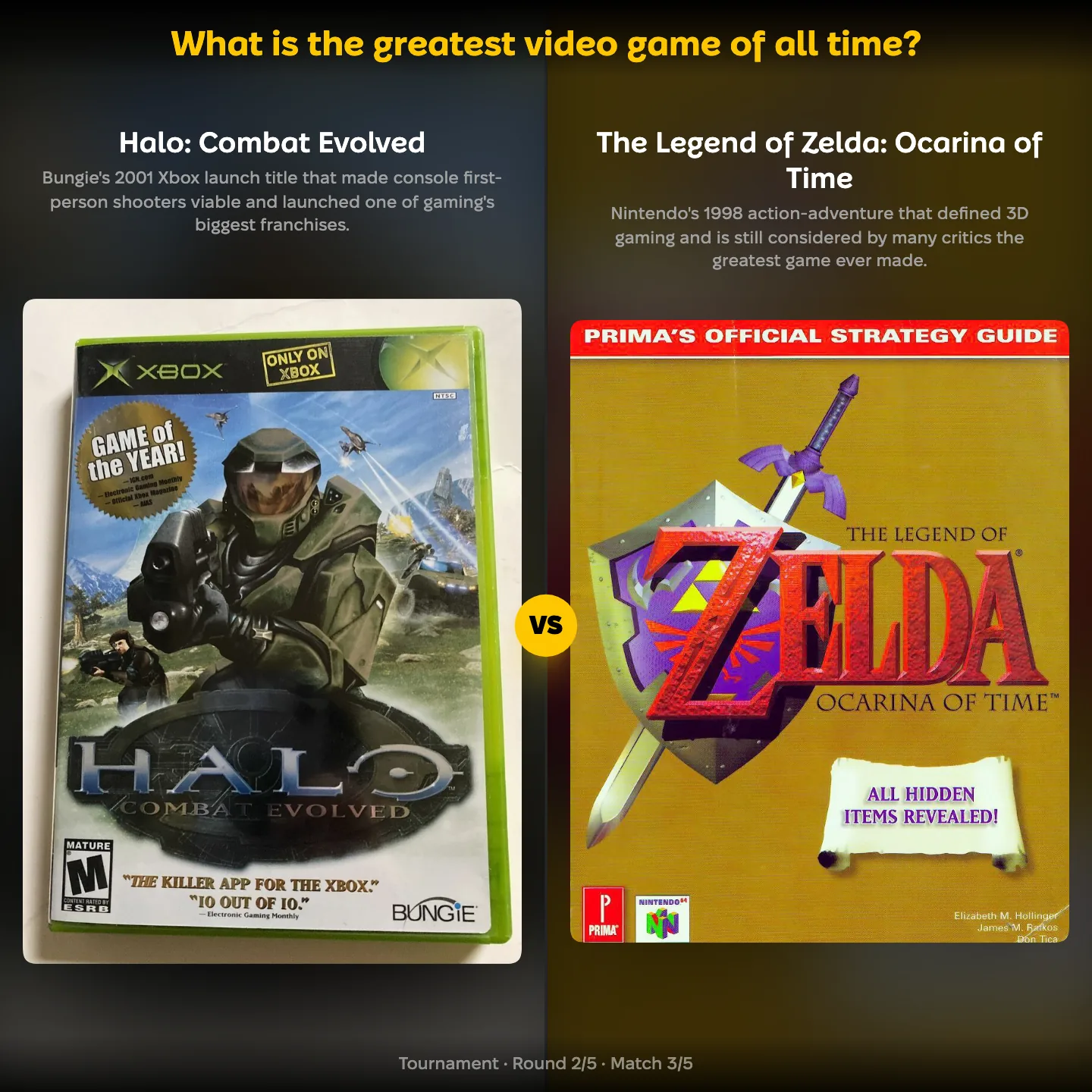
Halo vs Ocarina of Time: a launch title on an all-time list
This ranking asks the question with no qualifier attached — the twenty games people name when nobody has narrowed the field to a genre, a decade or a platform. Halo: Combat Evolved is one of the twenty.
Its case is unusually literal. It came out on 15 November 2001, the same day as the Xbox itself, scored 97/100 on Metacritic from 68 critics, and in the two months after launch it sold alongside more than half the consoles Microsoft shipped.3
Ocarina of Time earned its place a different way. Nintendo's 1998 adventure is remembered for inventing conventions rather than for shifting hardware, and the same goes for Super Mario Bros., Tetris and Minecraft.
The counter-argument against Halo is scope. It solved how a shooter feels on two thumbsticks, which is a narrower achievement than reinventing what a game can be.
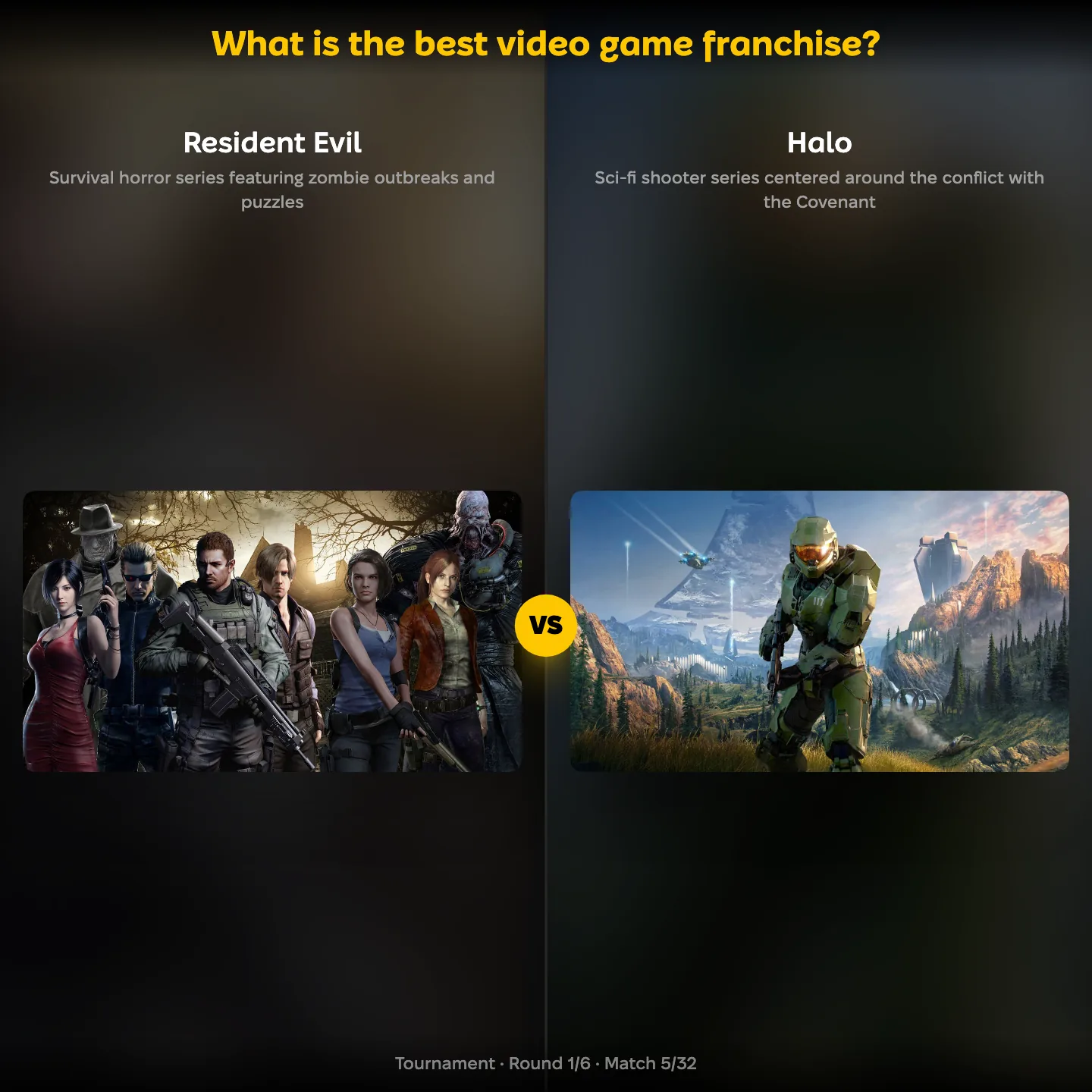
Halo vs Resident Evil: one of them stayed on one console
Sixty-four franchises compete here, the widest field Halo enters anywhere on the site.
Halo brings real weight to it. The games had sold more than 81 million copies and grossed $6 billion by 2021, $1.8 billion of that from merchandise rather than software.4
Resident Evil got there by the opposite route. Capcom's series has shipped on PlayStation, Nintendo, Xbox and PC hardware since the 1990s, and its remakes keep finding new buyers on hardware that arrived long after the original.
Grand Theft Auto, Pokémon, Call of Duty and Final Fantasy also appear here, every one of them sold across every platform. Halo built its total inside a single hardware family, which is either the achievement or the ceiling depending on who is talking.
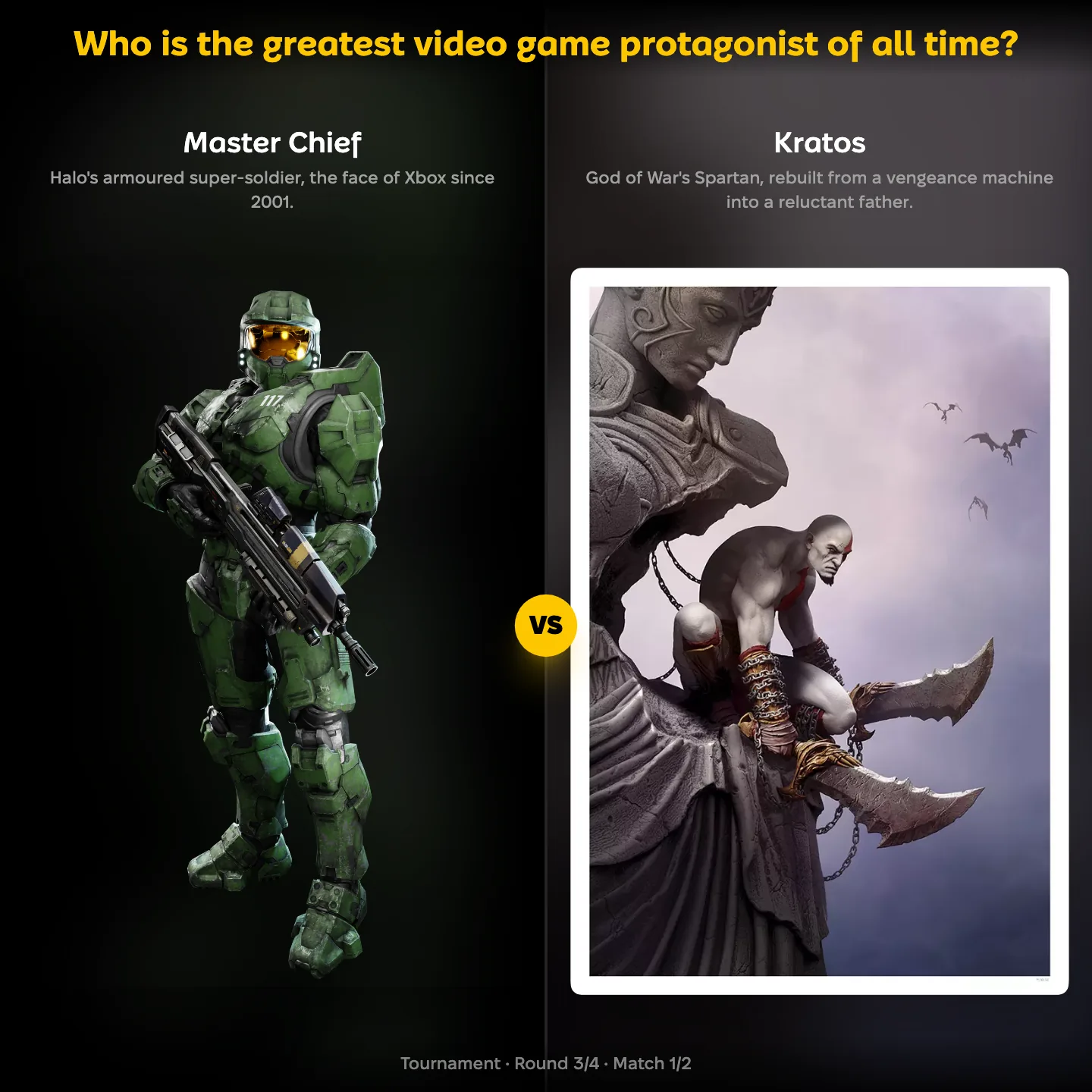
Master Chief vs Kratos: the protagonist who barely speaks
Master Chief is the least-known quantity among sixteen protagonists. The games have never shown his face, and he says very little across six campaigns.
Kratos is the opposite construction. God of War gave him a decade of shouting, then rebuilt him in 2018 as a father who mostly does not, and the change is what people cite when they defend him.
Mario, Link, Lara Croft, Solid Snake and Arthur Morgan fill out the field, three of them from series where the writing carries the character.
Halo went the other way and made the silence the point. A soldier with no visible face is easier for a player to occupy than one carrying a personality around. That was a design decision before it was a characterisation.
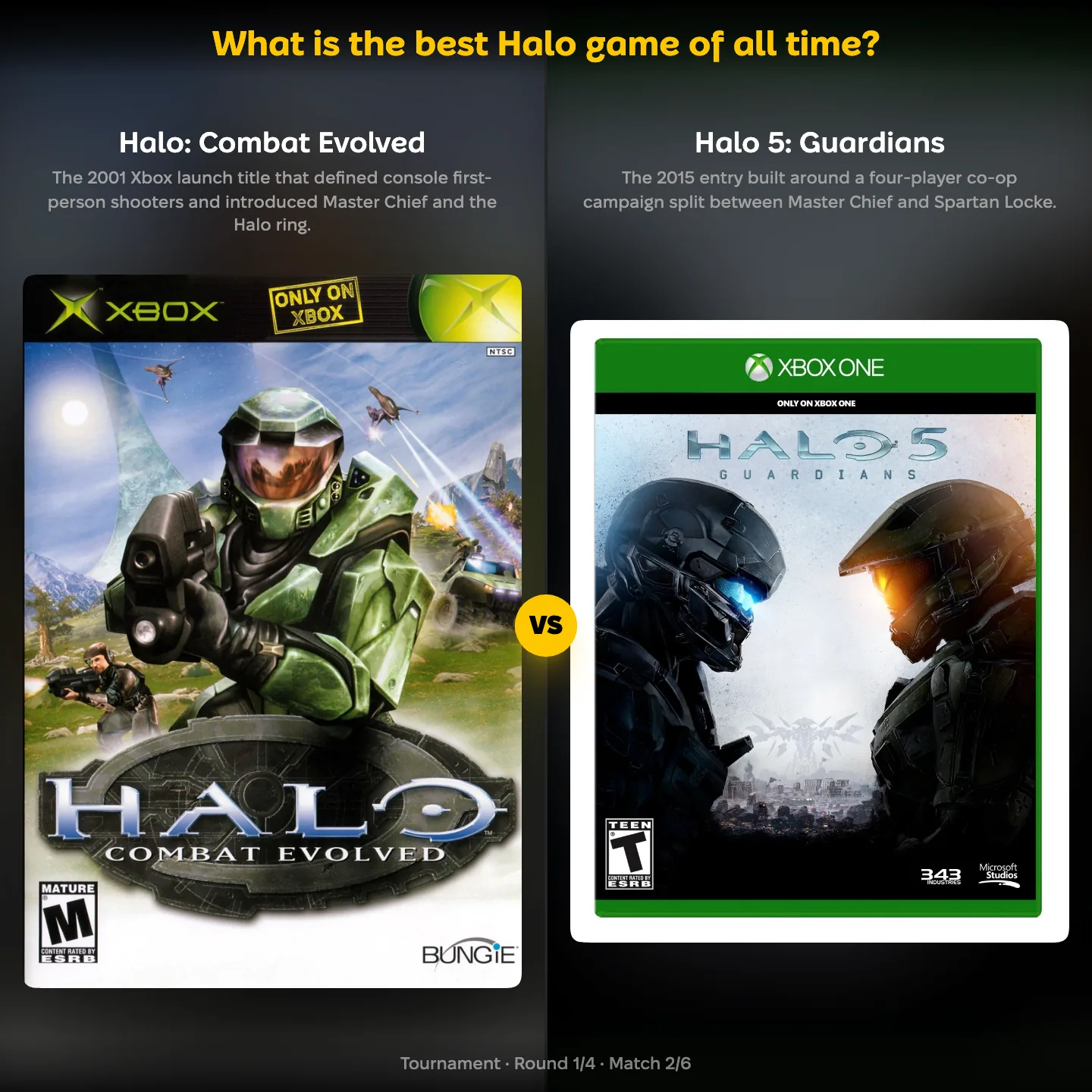
Combat Evolved vs Halo 5: the series against itself
Eleven Halo releases make up the entire field here, so the franchise competes against nobody but itself.
The first four set a standard nobody inside the series has matched since. Halo 2 arrived on 9 November 2004, sold 2.4 million copies and took $125 million in its first 24 hours.5 Halo 3 scored 94 on Metacritic.6 Halo: Reach scored 91.7
Halo 5: Guardians is the entry the fanbase keeps returning to for the wrong reasons. The 2015 game split its campaign between Master Chief and a new Spartan called Locke, and handed long stretches of it to the newcomer.
Two of the eleven are not shooters at all. Halo Wars and Halo Wars 2 are real-time strategy games, and Halo: The Master Chief Collection is a compilation rather than a release of its own, which means three of the contenders are answering a different question from the other eight.
The defence of the later games is that they were made by a studio inheriting someone else's series. Bungie's five are the ones with nothing to inherit.
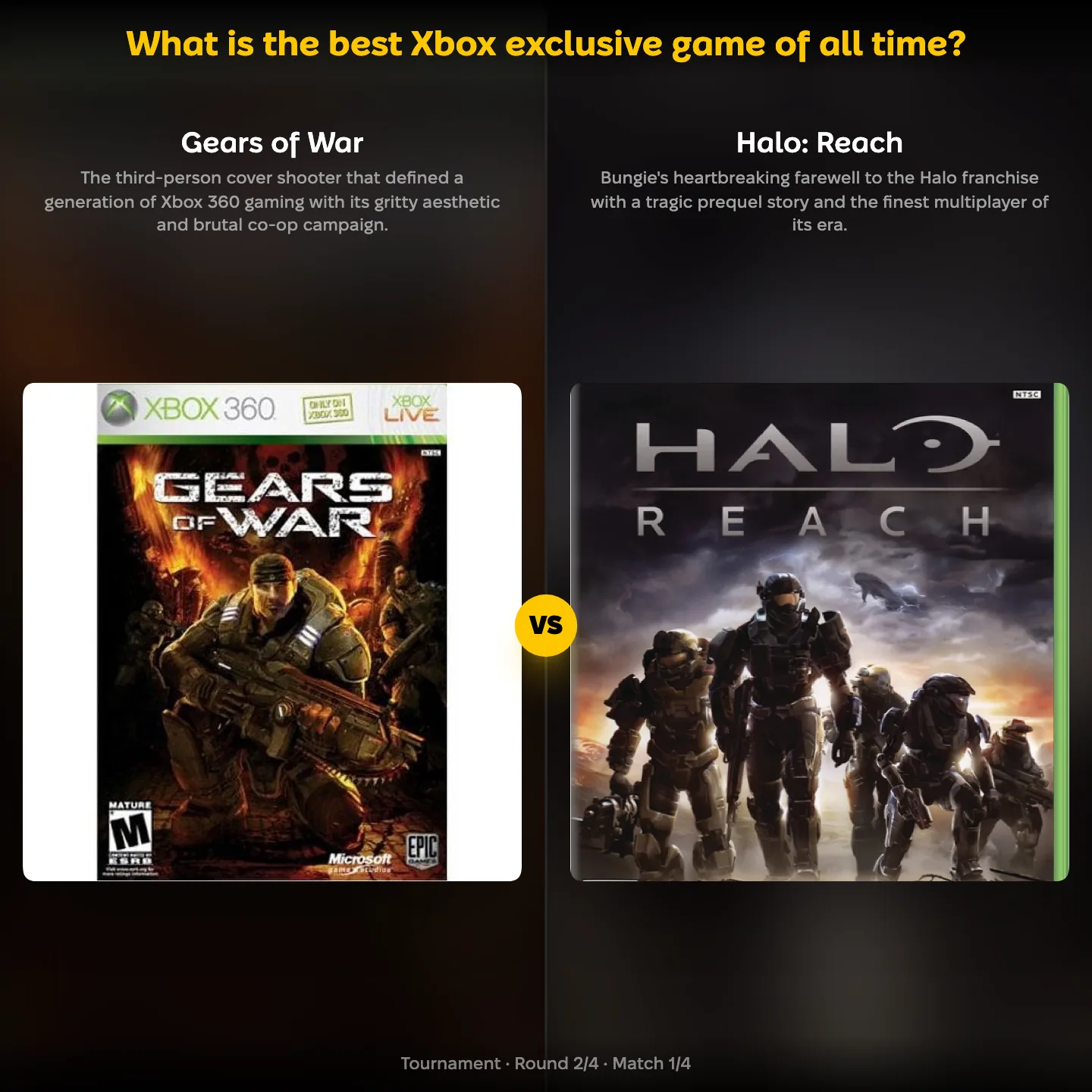
Gears of War and Halo: Reach, the two names Xbox ran on
Four of the fourteen Xbox exclusives here carry the Halo name: Combat Evolved, Halo 2, Halo: Reach and Halo Infinite.
Halo: Reach is the strongest of the four for reasons unrelated to its prequel story. Released on 14 September 2010, it took $200 million on its first day and was the last Halo game Bungie made.7
Gears of War is the other name Microsoft built the Xbox 360 era on, and the two series between them defined what an Xbox game was supposed to feel like for about eight years.
Newer and stranger names fill out the field: Starfield, Sea of Thieves, Avowed, South of Midnight, Forza Horizon 4. Several of those have since appeared on hardware Microsoft does not make, which is what makes a ranking of exclusives harder to compile every year.
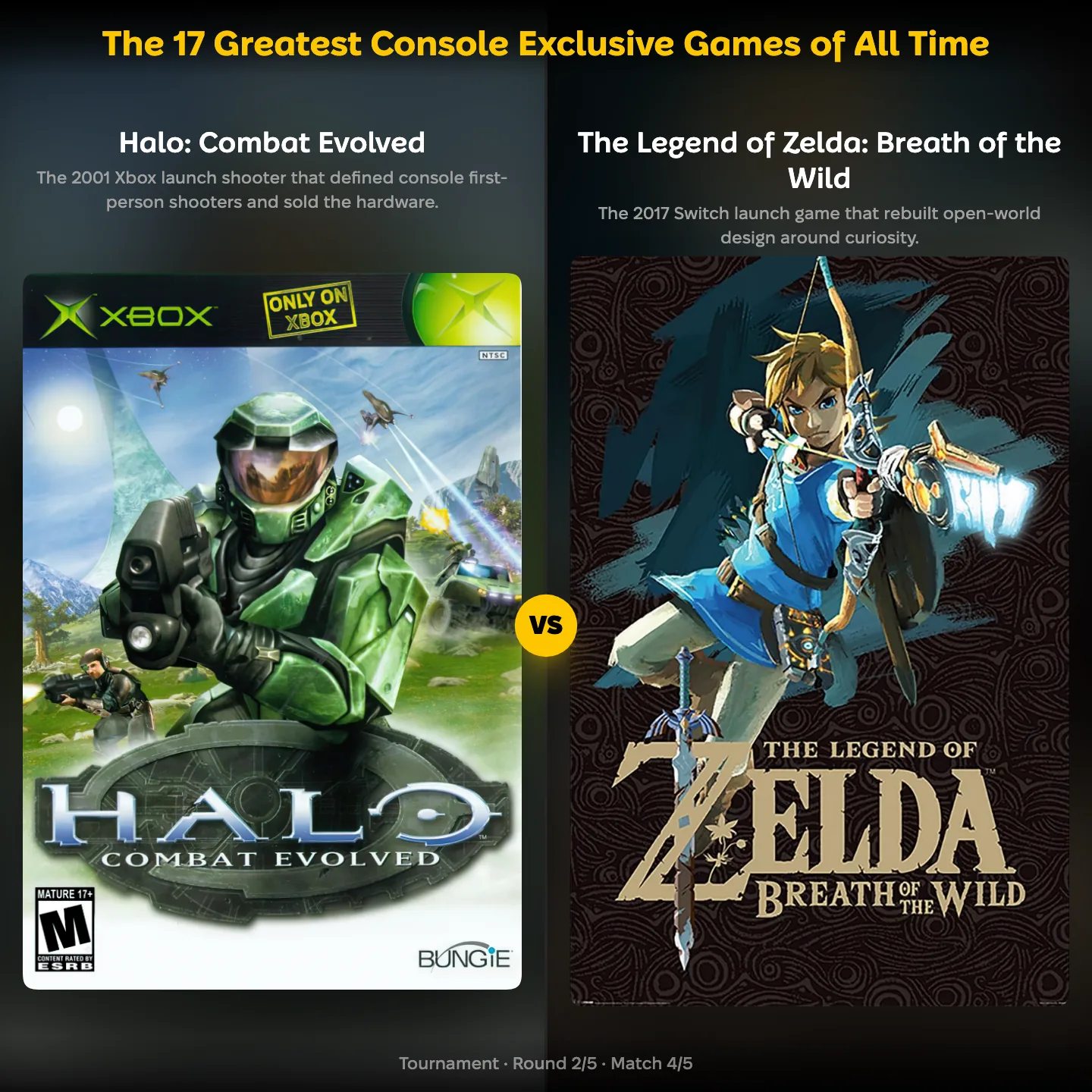
The exclusive that stopped being one
Seventeen exclusives from all three platform holders stand side by side here, with Halo: Combat Evolved representing Xbox.
The company is heavy. Super Mario 64, Metroid Prime, Breath of the Wild and Super Smash Bros. Ultimate carry Nintendo; The Last of Us, Bloodborne, Uncharted 2, Ghost of Tsushima and Gran Turismo 4 carry PlayStation. Microsoft has two names here, and one of them is Halo.
Halo's qualification now has a footnote of its own. The 2026 remake of the same campaign runs on a PlayStation 5, so the game that proved what exclusivity was worth is also the game that ended it for this series.8
That does not disqualify it. Exclusivity is a historical fact about how a game was sold, and for twenty-five years Halo was the clearest example anyone could point to.
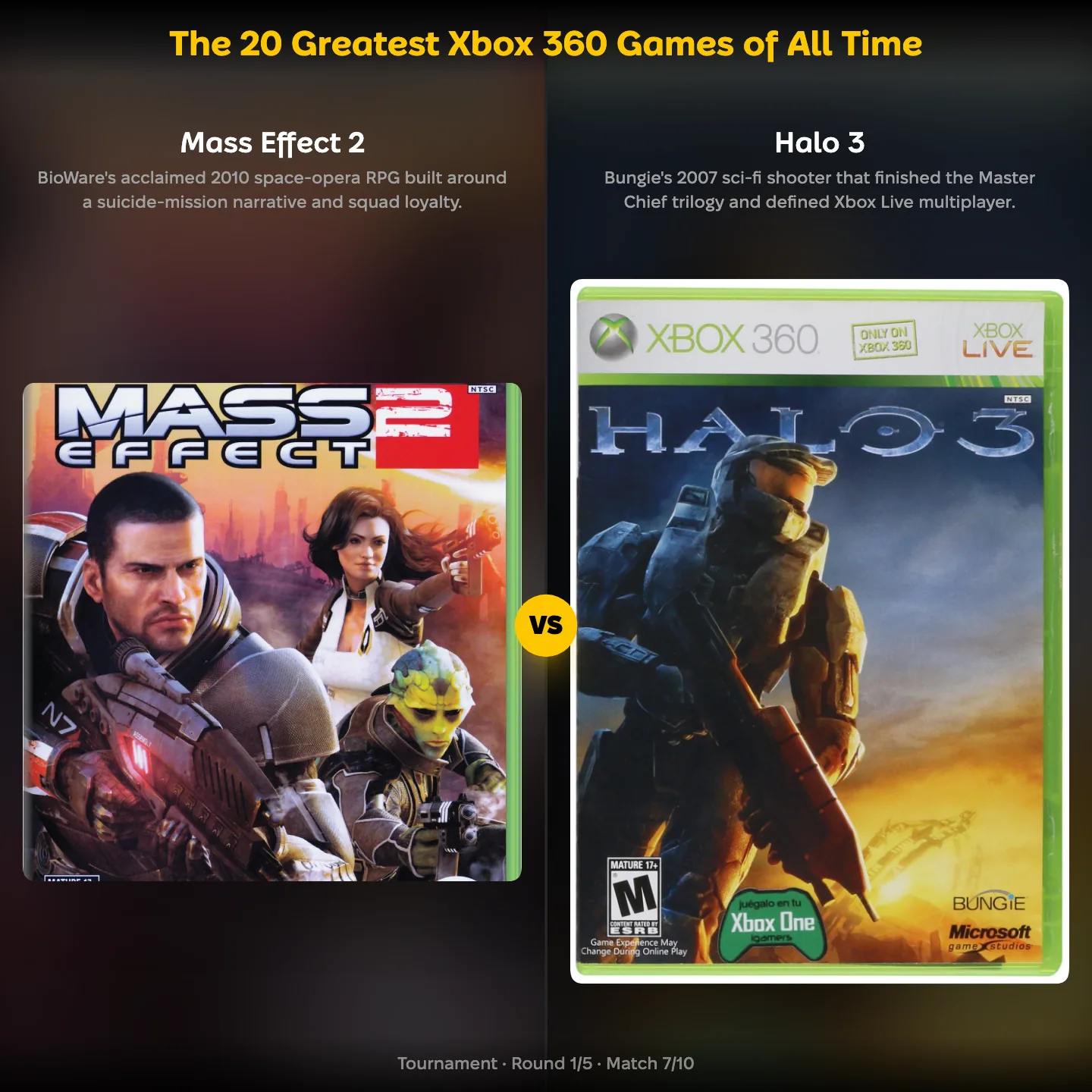
Halo 3 vs Mass Effect 2: $170 million in twenty-four hours
Halo takes two of the twenty slots on this Xbox 360 list: Halo 3 and Halo: Reach.
Halo 3 has the commercial record. It came out on 25 September 2007, took $170 million in the United States in its first 24 hours and $300 million in its first week, and drew over a million players onto Xbox Live within twenty hours.6
Mass Effect 2 has the critical one. BioWare's 2010 space opera is the title cited by anyone making the case that the 360 generation belonged to writing rather than shooting.
This is also the list where Halo stops being the only thing Xbox owners talk about. Red Dead Redemption, Skyrim, BioShock, Portal 2 and Dark Souls all shipped on the same machine, and none of them belonged to Microsoft.
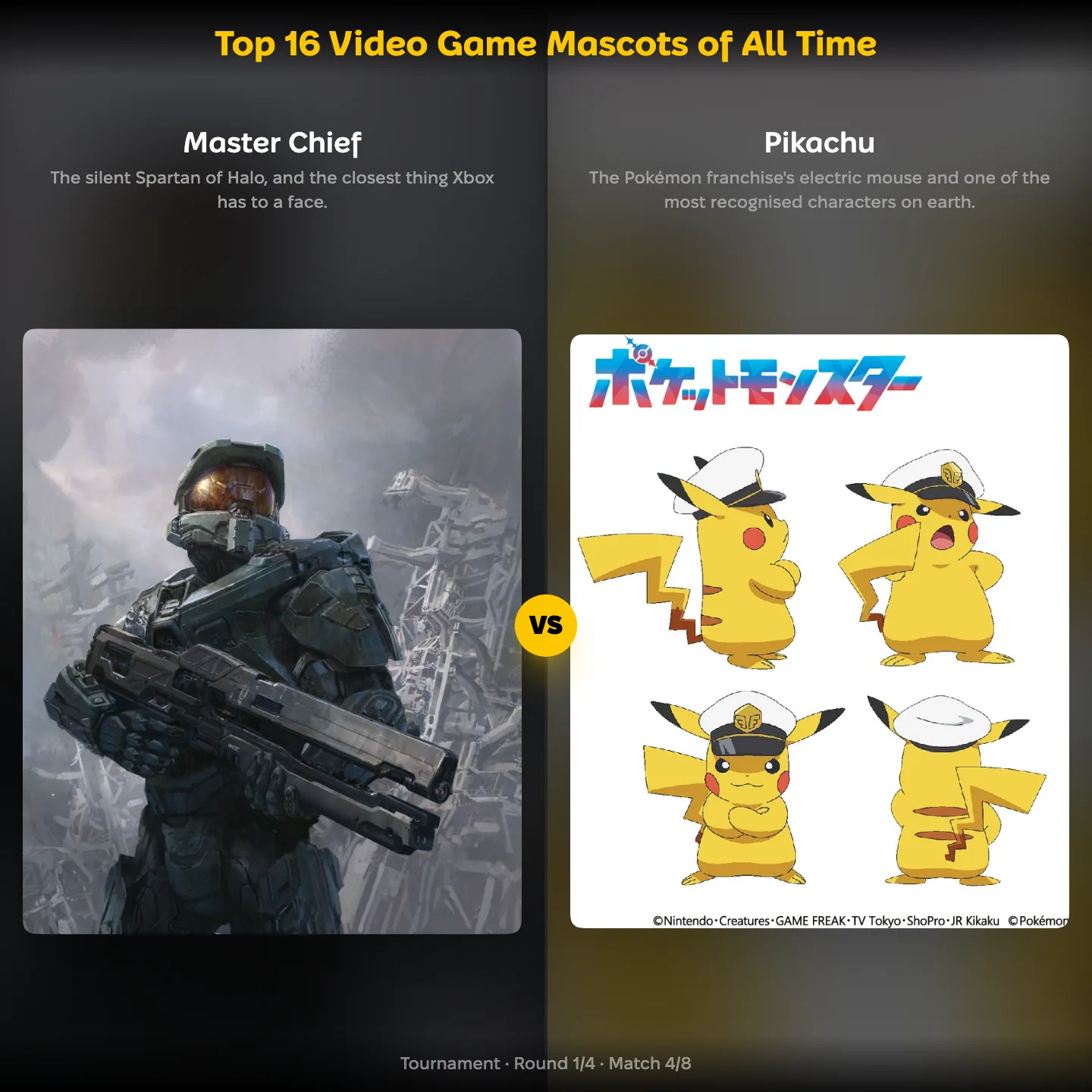
Master Chief vs Pikachu: a mascot in a helmet
Fifteen of the sixteen mascots here have a face.
Mario, Sonic, Pikachu, Pac-Man and Kirby were drawn to be legible at the size of a shop-window sticker. Master Chief was drawn as a soldier, in armour, with a gold visor where the expression should be.
Halo still put him on every Xbox box for two decades, which makes him the closest thing the platform has to a face.
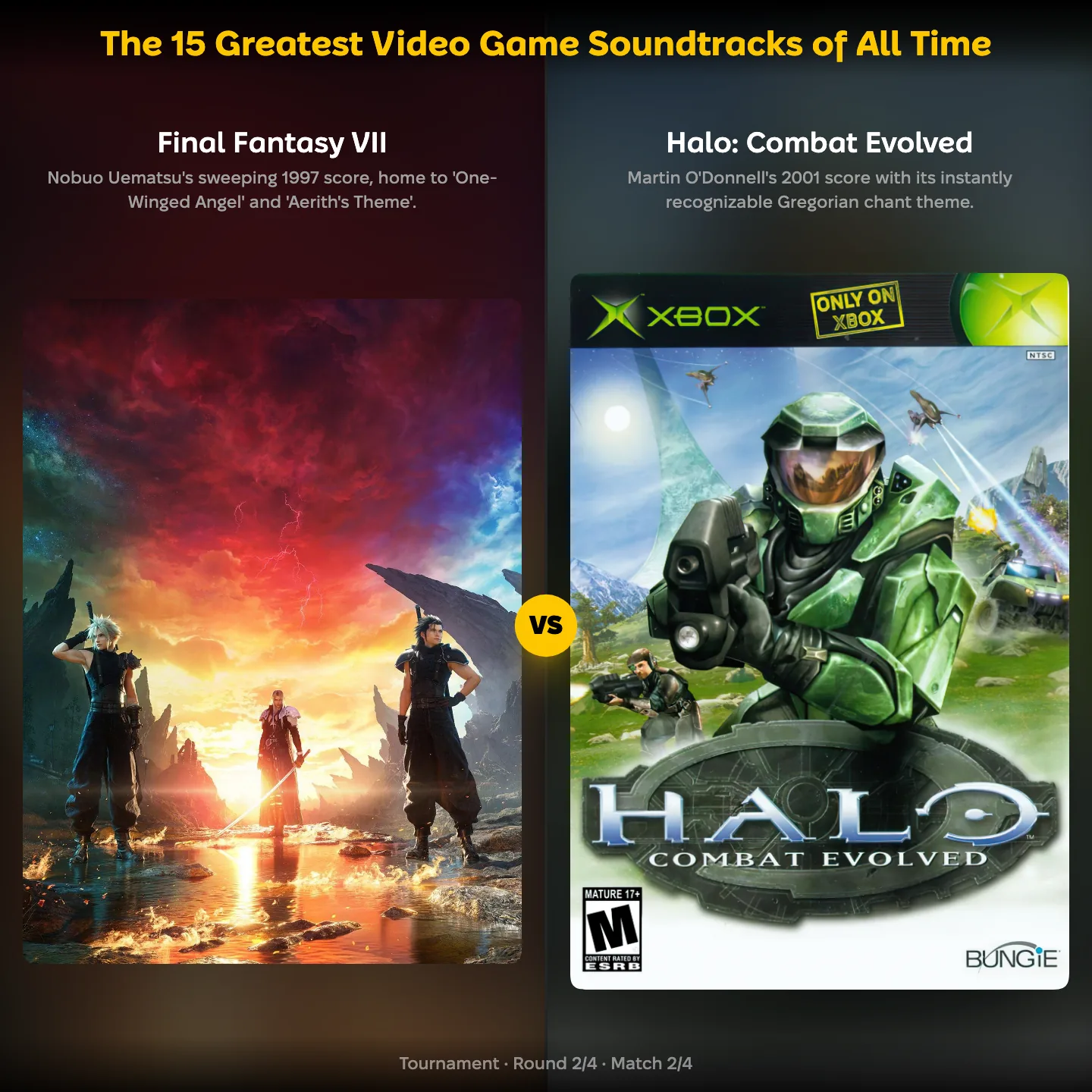
Marty O'Donnell's chant against Nobuo Uematsu
Of the fifteen scores gathered here, the Halo one is from 2001.
Marty O'Donnell wrote its theme after a conversation with Bungie's Joseph Staten about what the game should sound like, decided on a Gregorian chant over an orchestra, and noted the melody down in his car. The Halo 2 soundtrack later became the first video game soundtrack to enter the Billboard 200.9
Nobuo Uematsu's Final Fantasy VII score is the one most often placed against it, and the two represent opposite traditions: a monastic four-bar hook written for a shooter, and a 1997 RPG score with named themes for individual characters.
Ocarina of Time, Chrono Trigger, NieR: Automata, Journey and Undertale are also here, which makes this the ranking where Halo is judged on something other than how it plays.
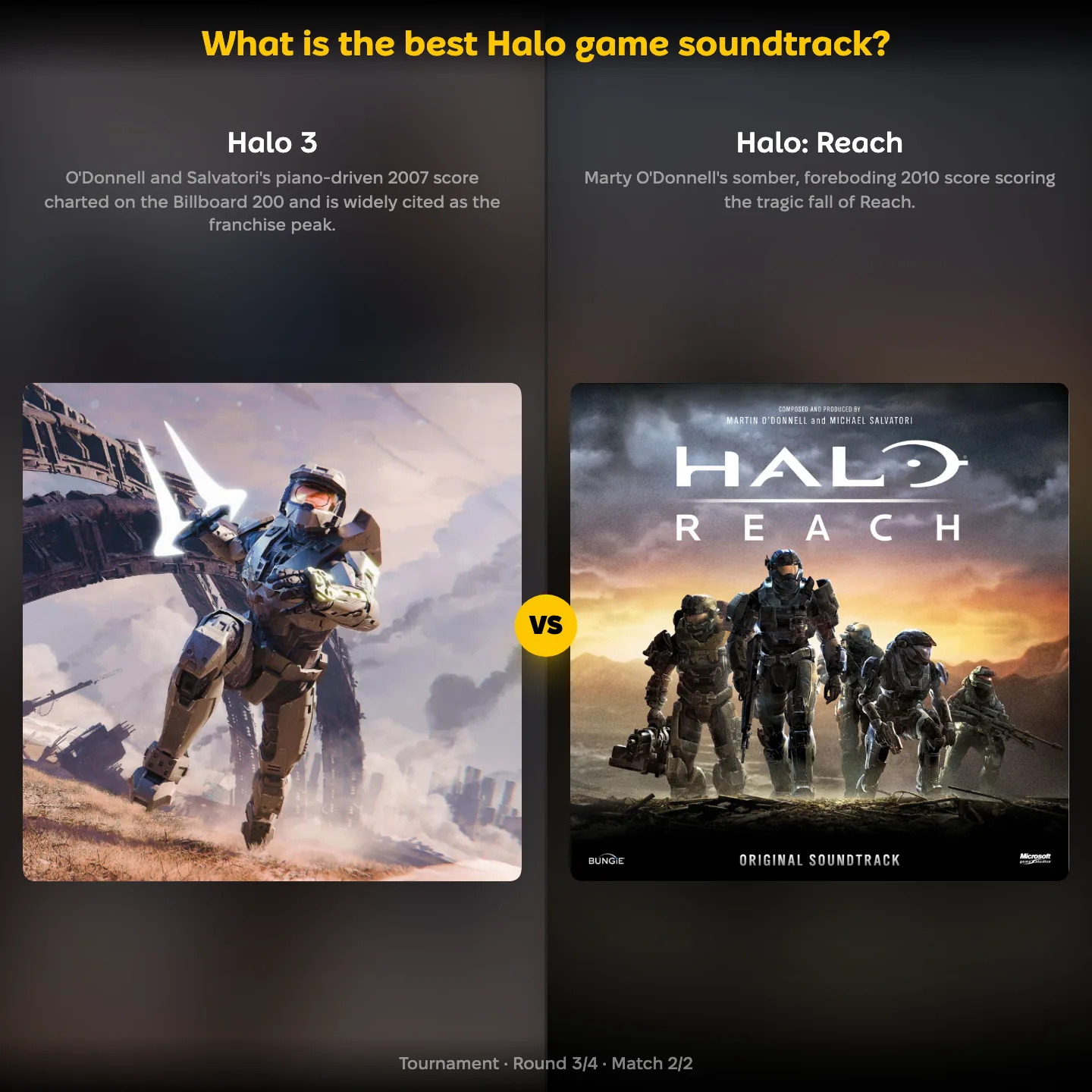
Halo 3 vs Halo: Reach: ten scores, one theme
Ten Halo soundtracks compete here, and the same chant runs through most of them.
That is the difficulty of the question. O'Donnell scored the first five, Reach among them, so the field splits into music written by the person who invented the sound and music written by people working inside it.
Halo 3 is the usual counter-nomination. The two strategy games are also scored here, written for a genre the rest of the field never touches.
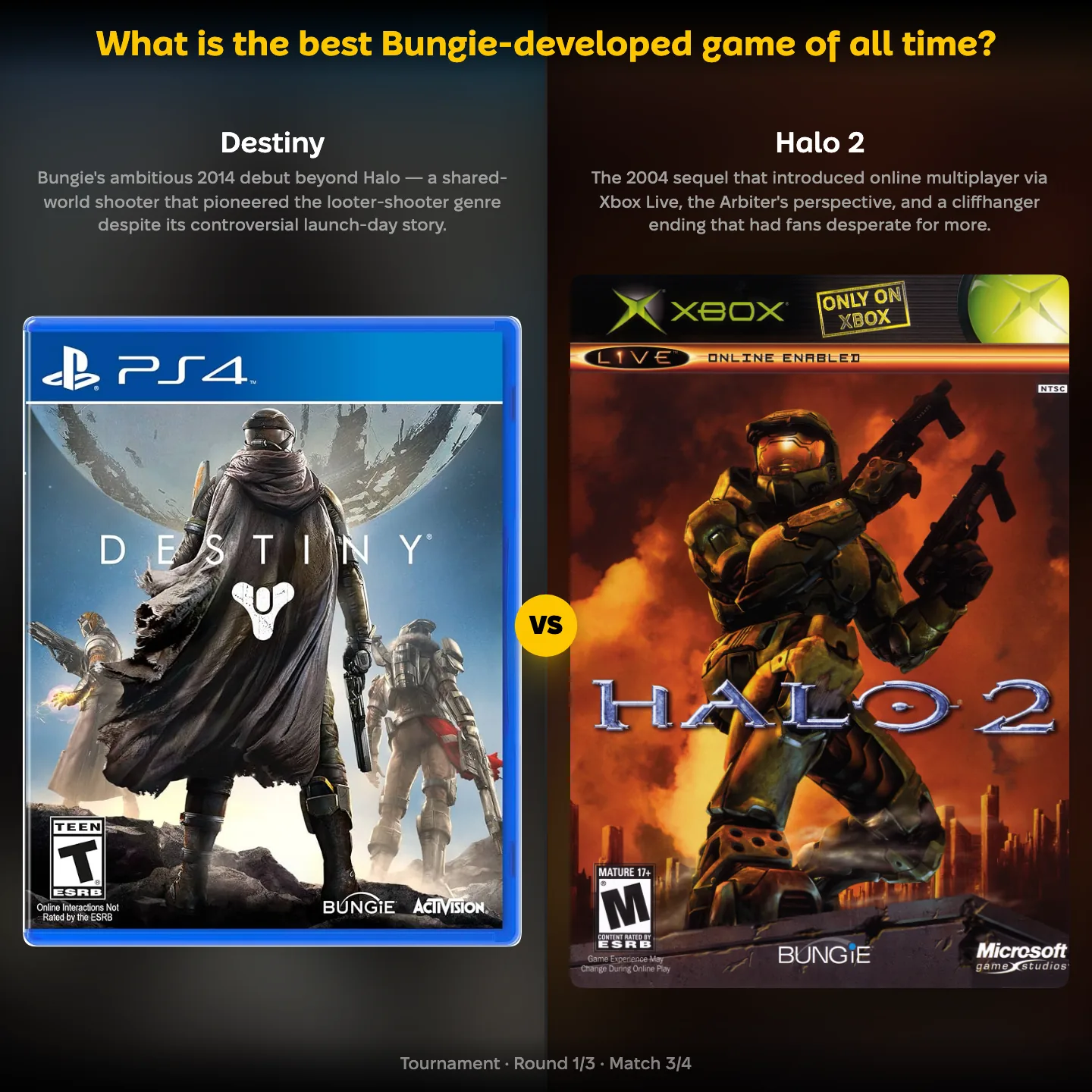
Bungie after Halo: Destiny, Marathon and a Sony badge
Bungie's catalogue comes down to eight titles here, five of them Halo: Halo 2, Halo 3, Halo 3: ODST, Halo: Reach and the original Combat Evolved.
The other three tell the studio's story before and after. Myth: The Fallen Lords is the 1997 strategy game Bungie made when it was a PC developer. Destiny launched on 9 September 2014 as its attempt to build a shooter it actually owned. Marathon is scheduled for 2026.10
The ownership question is what makes this ranking strange. Bungie separated from Microsoft on 1 October 2007 and the Halo intellectual property stayed with Microsoft, so a list of Bungie's best games is mostly a list of games Bungie cannot make any more.10
The studio ended up somewhere stranger still. Sony Interactive Entertainment bought Bungie on 15 July 2022 for $3.6 billion, which puts the five best games in this ranking on one side of the console divide and the company that made them on the other.10
Destiny's supporters would say the sequels and expansions reached more players over more years than any single Halo did. A decade of live service supports that reading.
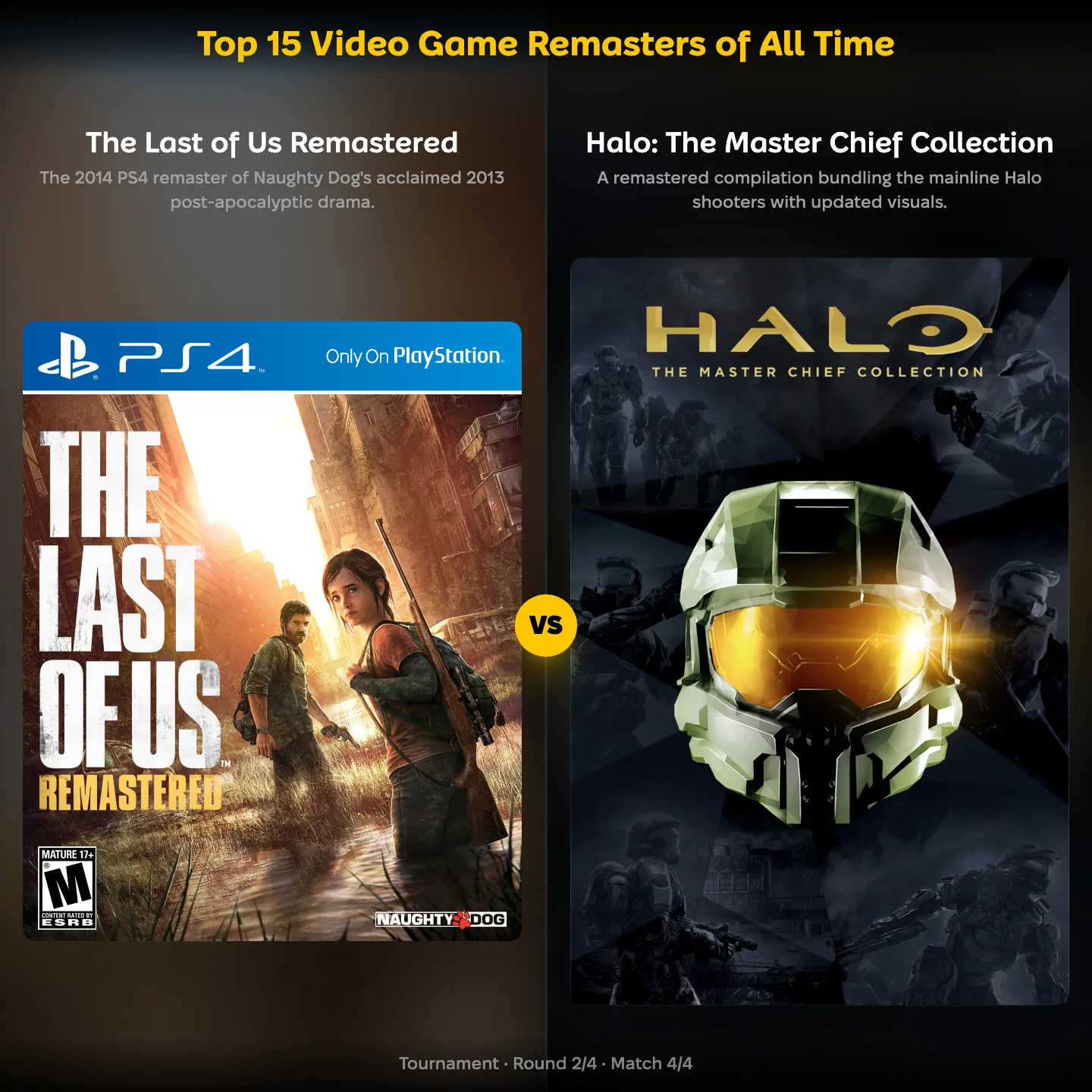
The Master Chief Collection: six games, one broken launch
Fifteen remasters compete here, and the biggest package by volume is Halo: The Master Chief Collection.
It launched on Xbox One on 11 November 2014 with four campaigns and their multiplayer. The online matchmaking did not work. 343 Industries head Bonnie Ross publicly acknowledged the long matchmaking times and low session success rates on 24 November, and Microsoft compensated players with a free month of Xbox Live Gold and the Halo 3: ODST campaign.11
The collection was repaired slowly and in public. ODST joined in May 2015, Halo: Reach arrived with the Windows rollout between December 2019 and November 2020, and the six-game version people recommend today is nothing like the one that shipped.11
The Last of Us Remastered, Metroid Prime Remastered and Mass Effect Legendary Edition shipped without any of that trouble, and it is the fairest objection to placing the Halo package high on a remaster list.
The case for it is volume. No other entry here bundles six campaigns and two decades of multiplayer into one install.
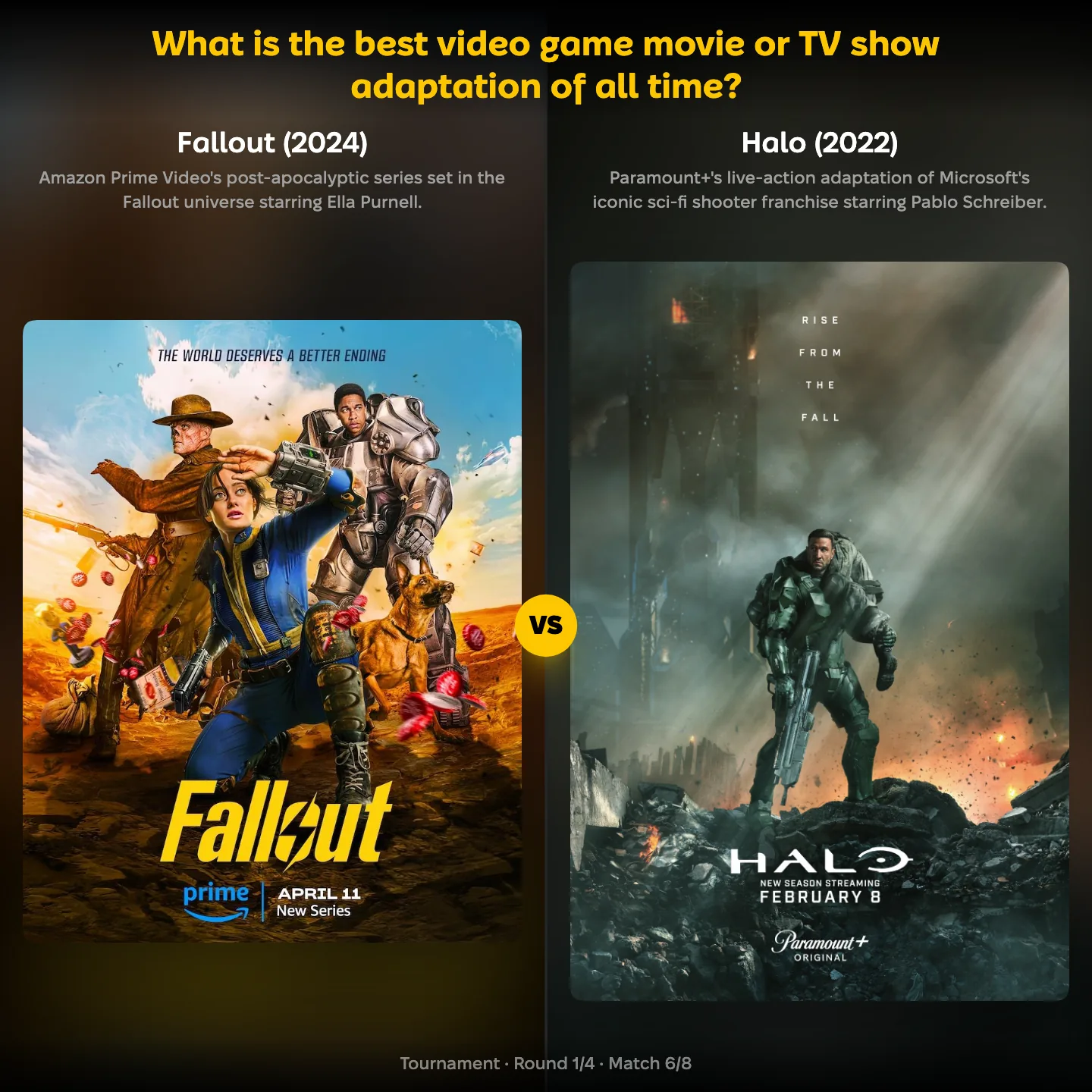
Halo (2022) vs Fallout: the adaptation that took the helmet off
The Halo entry among fifteen adaptations is the Paramount+ series.
It started well. The show premiered on 24 March 2022 and became the most-watched series premiere on Paramount+ globally in its first 24 hours, then drew 61/100 on Metacritic for its first season and 64 for its second.12 Paramount+ cancelled it in July 2024 after two seasons.12
The decision fans keep coming back to is the helmet. The series showed Master Chief's face and gave him a personal life, undoing the one design choice the games had held to since 2001.
The Last of Us, Arcane, Fallout and Cyberpunk: Edgerunners are the recent adaptations that did not have to undo anything. All four kept the source material's shape and let television do the rest.
Halo Infinite on Game Pass: free multiplayer, missing modes
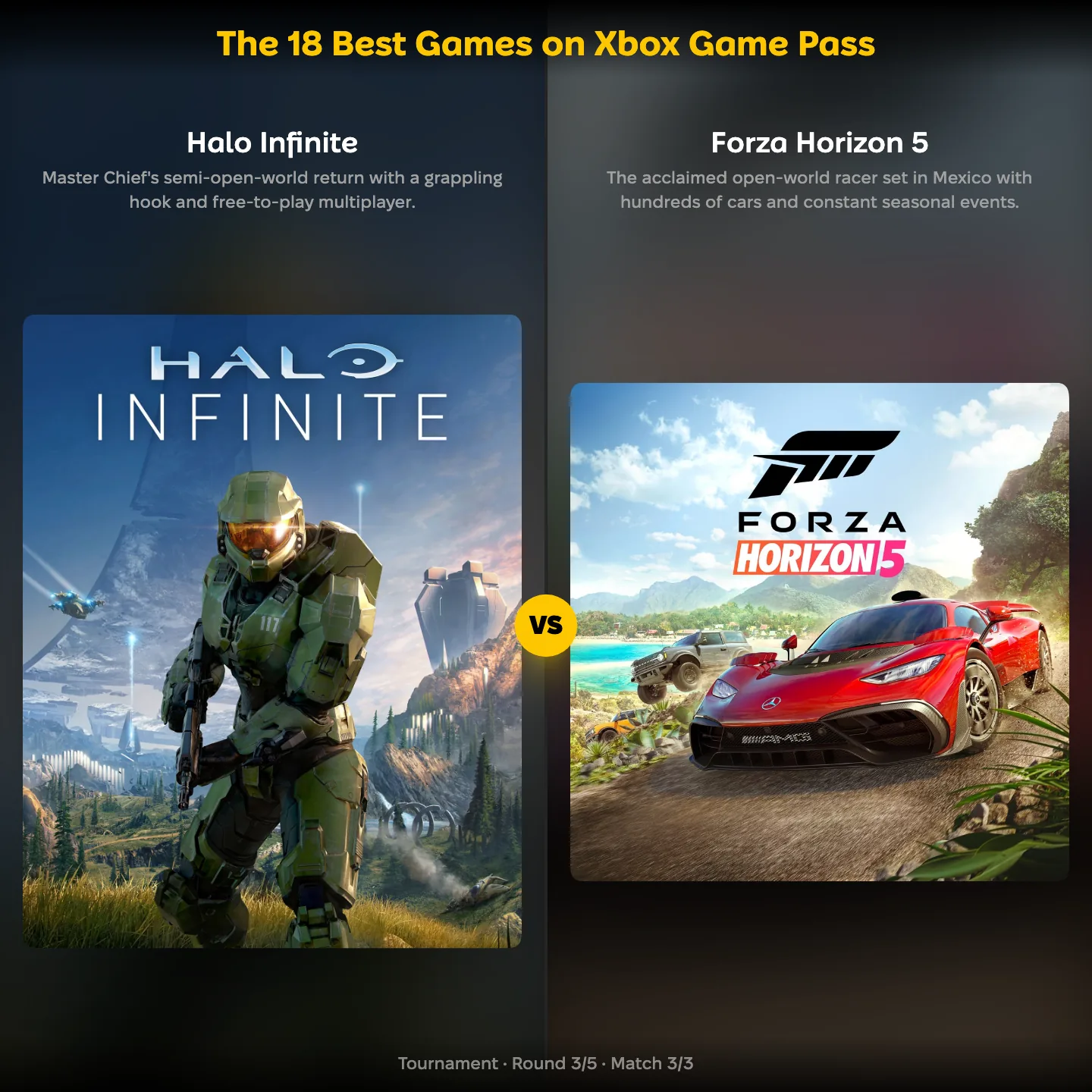
Halo Infinite is the only Halo in an eighteen-game Xbox Game Pass list.
It arrived on 8 December 2021 with its multiplayer free to play, and without campaign co-op or the Forge editor, both of which came later.13
Forza Horizon 5, Hollow Knight: Silksong, Balatro, Stardew Valley and Hades II fill out a list where almost nothing else is a first-party blockbuster. Halo is the flagship in a catalogue that mostly sells itself on breadth.
Fourteen lists, and no two mean the same Halo
A shooter, a console pitch, a studio's back catalogue, a helmet, a choir and a cancelled television show all answer to the same five letters, and each ranking above quietly picks one of them before it starts counting. That is why the same name can be foundational on one list and an also-ran on the next without either result being wrong.
More of it is coming. 343 Industries was renamed Halo Studios on 6 October 2024, and the studio has said its future games are being built in Unreal Engine 5.14
Every one of these orders comes out of choosing between two options, then two more, which means any of them will move once enough people disagree with it. If you think there is a franchise the internet keeps filing under the wrong heading, make the ranking and find out who agrees.
More rankings, more angles
- PlayStation vs Xbox vs Nintendo, Ranked Side by Side — the console war, in fourteen rankings
- Grand Theft Auto Is on Every List. Never in the Same Place — a badge that outgrew its genre
- Pokémon Turns 30 and Still Won't Sit in One Category — Charizard, Tetris and a Ryan Reynolds comedy
Sources
- Halo Waypoint (Halo Studios / Xbox) — Halo: Campaign Evolved release date and platforms: halowaypoint.com (checked 2026-09-06)
- Wikipedia — Halo: Campaign Evolved: release, first mainline Halo on PlayStation, platform review scores: en.wikipedia.org (checked 2026-09-06)
- Wikipedia — Halo: Combat Evolved: 15 November 2001 release, 97/100 Metacritic from 68 critics, console attach rate: en.wikipedia.org (checked 2026-09-06)
- Wikipedia — Halo (franchise): 81 million copies, $6 billion in franchise revenue, $1.8 billion of it merchandise: en.wikipedia.org (checked 2026-09-06)
- Wikipedia — Halo 2: 9 November 2004 release, 2.4 million copies and $125 million in 24 hours: en.wikipedia.org (checked 2026-09-06)
- Wikipedia — Halo 3: 25 September 2007 release, 94/100 Metacritic, $170 million first day, $300 million first week, one million Xbox Live players in 20 hours: en.wikipedia.org (checked 2026-09-06)
- Wikipedia — Halo: Reach: 14 September 2010 release, 91/100 Metacritic, $200 million first day, Bungie's final Halo game: en.wikipedia.org (checked 2026-09-06)
- PlayStation.Blog (Sony Interactive Entertainment) — Halo: Campaign Evolved announced for PlayStation 5: blog.playstation.com (checked 2026-09-06)
- Wikipedia — Martin O'Donnell: the Gregorian-chant theme written after a conversation with Joseph Staten, and the Halo 2 soundtrack as the first video game soundtrack on the Billboard 200: en.wikipedia.org (checked 2026-09-06)
- Wikipedia — Bungie: 1 October 2007 separation from Microsoft with the Halo IP retained by Microsoft, Destiny on 9 September 2014, Marathon scheduled for 2026, and the $3.6 billion Sony acquisition completed 15 July 2022: en.wikipedia.org (checked 2026-09-06)
- Wikipedia — Halo: The Master Chief Collection: 11 November 2014 launch, Bonnie Ross's 24 November acknowledgement of matchmaking failures, the compensation offer, and the later ODST and Reach additions: en.wikipedia.org (checked 2026-09-06)
- Wikipedia — Halo (TV series): 24 March 2022 premiere, Paramount+ global premiere record, Metacritic scores of 61 and 64: en.wikipedia.org (checked 2026-09-06)
- Wikipedia — Halo Infinite: 8 December 2021 release, free-to-play multiplayer, campaign co-op and Forge added after launch: en.wikipedia.org (checked 2026-09-06)
- Wikipedia — Halo Studios: the 6 October 2024 rename from 343 Industries and the move to Unreal Engine 5: en.wikipedia.org (checked 2026-09-06)