
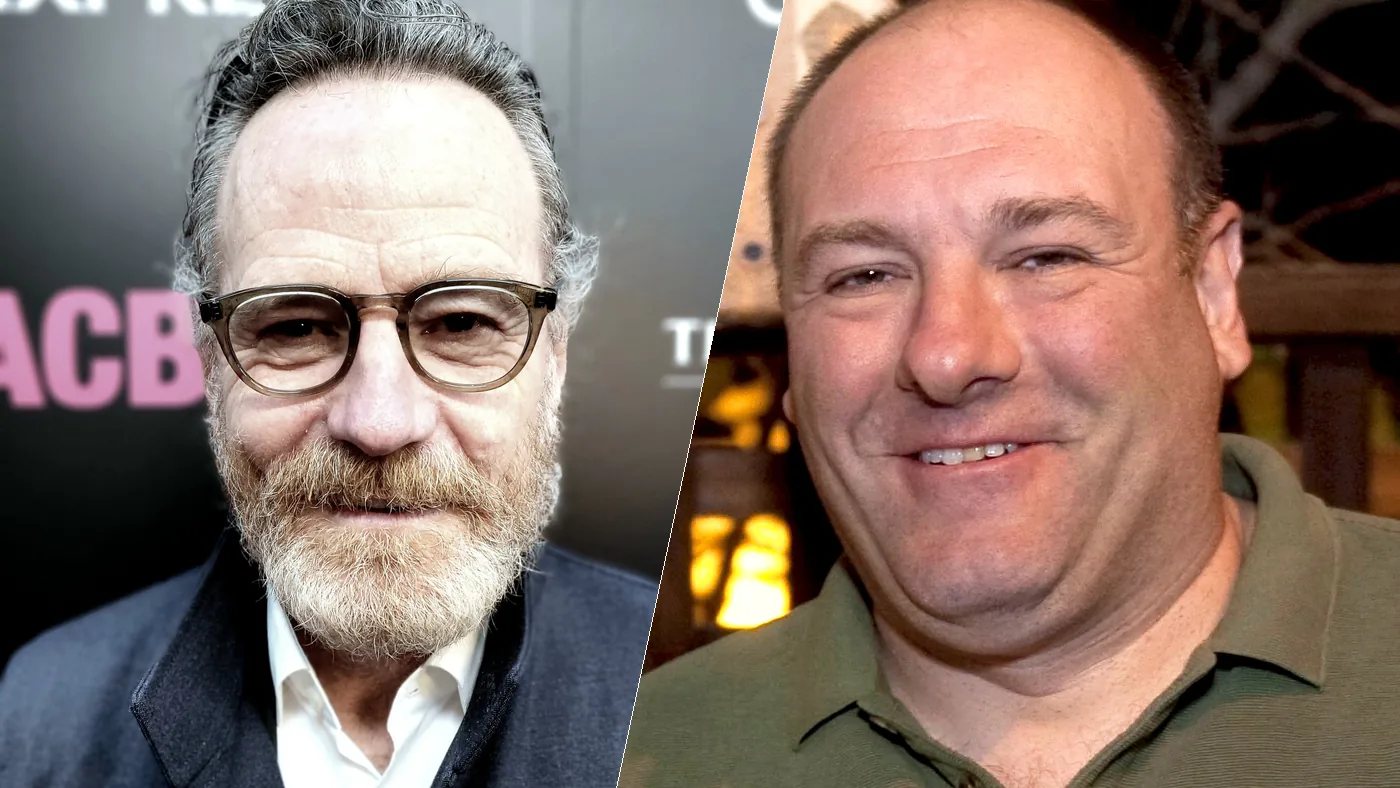
The 78th Primetime Emmy Awards are on 14 September 2026, and the man who made Breaking Bad is back in the drama race: Vince Gilligan's Apple TV series Pluribus collected 18 nominations when the list was read out on 8 July.1 Gilligan has never pretended his show arrived from nowhere. Writing after James Gandolfini died in 2013, he put it plainly: without Tony Soprano, there would be no Walter White.2
Which makes Breaking Bad against The Sopranos a strange fight — a show against its own ancestor. People have it anyway, constantly, and fifteen rankings here hold one of these shows or both.
Walter White spends five seasons becoming someone else and Tony Soprano spends six refusing to, and the lists keep separating the two shows along exactly that seam.
The shortlist: Breaking Bad, The Sopranos and The Wire
The broadest question on the site puts 64 shows in one field, from M*A*S*H to Rick and Morty, and Breaking Bad and The Sopranos both sit near the front of everybody's mental version of it.
Breaking Bad's case is the one with a certificate attached. It entered the Guinness World Records in 2014 as the most critically acclaimed show of all time, a title decided by aggregate review scores rather than by industry voters.3
The Sopranos' case is older and structural. It is the ancestor of most titles underneath it, and several of them would not exist in the shape they took without it.
The Wire is in the same field, which is the useful complication. It gets cited whenever somebody wants to say that acclaim and awards measure the wrong thing entirely.
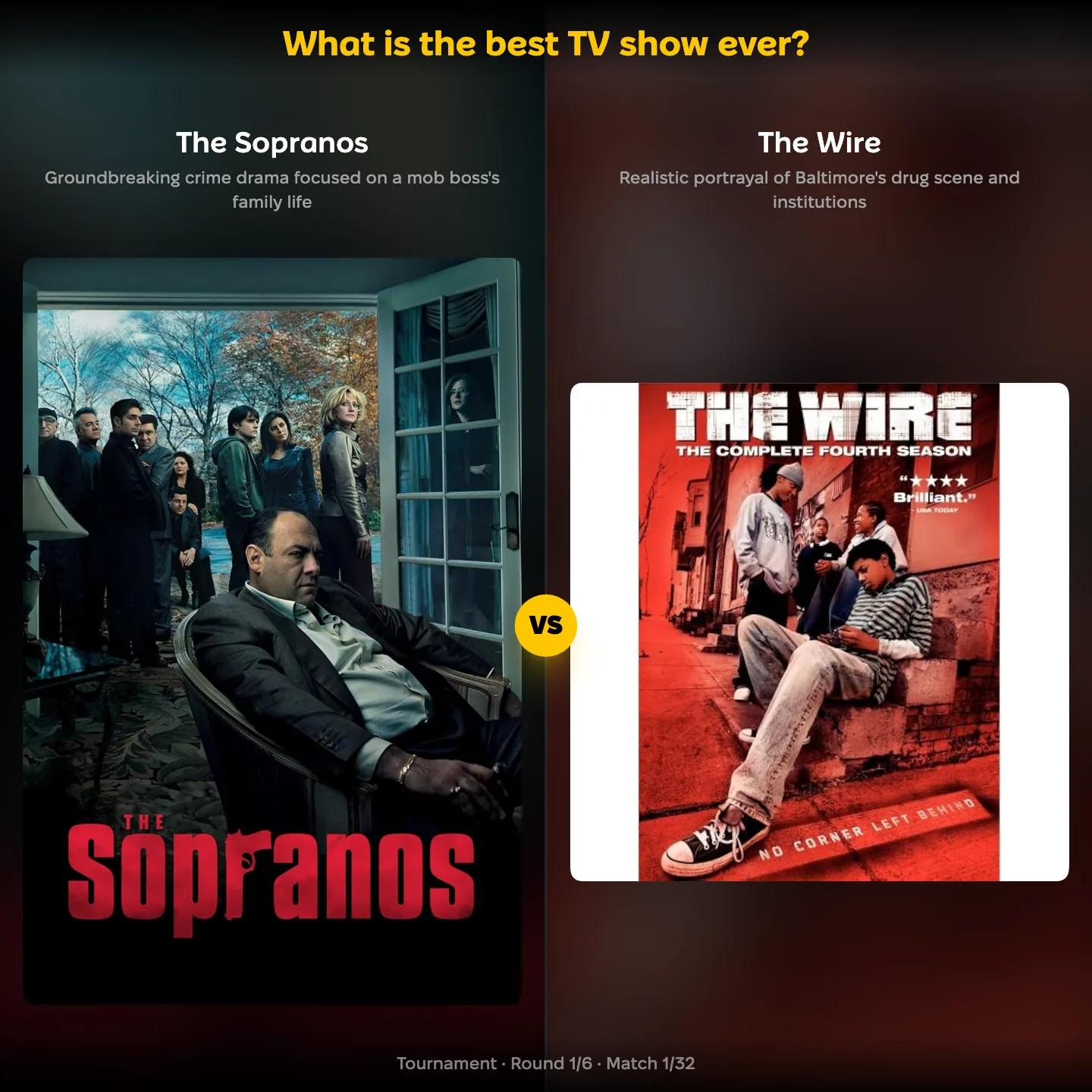
A 21st-century list that clips The Sopranos in half
Add a date filter and the ground shifts under one of them.
Breaking Bad ran from 20 January 2008 to 29 September 2013, every episode of it inside this century.4 Nothing about it needs an asterisk here.
The Sopranos premiered on 10 January 1999.5 Two of its six seasons are 20th-century television, including the run that made its reputation, so a reader applying the question strictly has to decide whether the show is eligible for its own best years.
Mad Men, Succession and Chernobyl share the field, and none of them has that problem. A rule written to sort by decade ends up sorting by luck of the calendar.
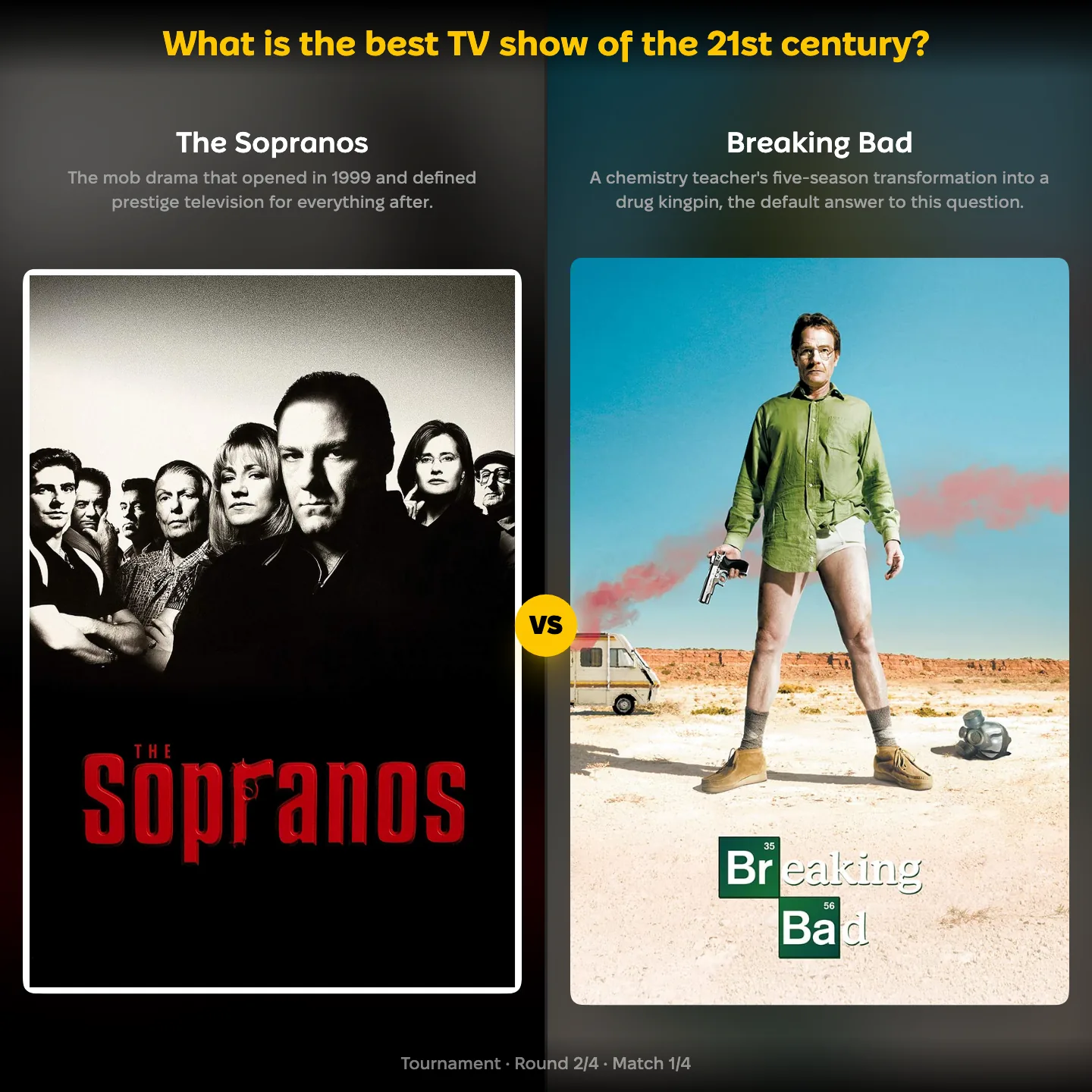
Tony Soprano's genre, and the chemistry teacher who walked into it
This is the shortest list either show appears on, and the one where the category was built around a single title.
The Sopranos is a mob show by construction: 86 episodes about a North Jersey crew, its capos, its wives and its funerals.5 Everything the genre needs is load-bearing.
Breaking Bad is a crime show that keeps failing the gangster test. There is no family in the Cosa Nostra sense, no crew, no consigliere. Walter White is a sole trader in Albuquerque who hires an ex-cop and a former student.4
The Wire, Peaky Blinders and Boardwalk Empire are here too, which makes eight names for a category most people can only think of two answers to.
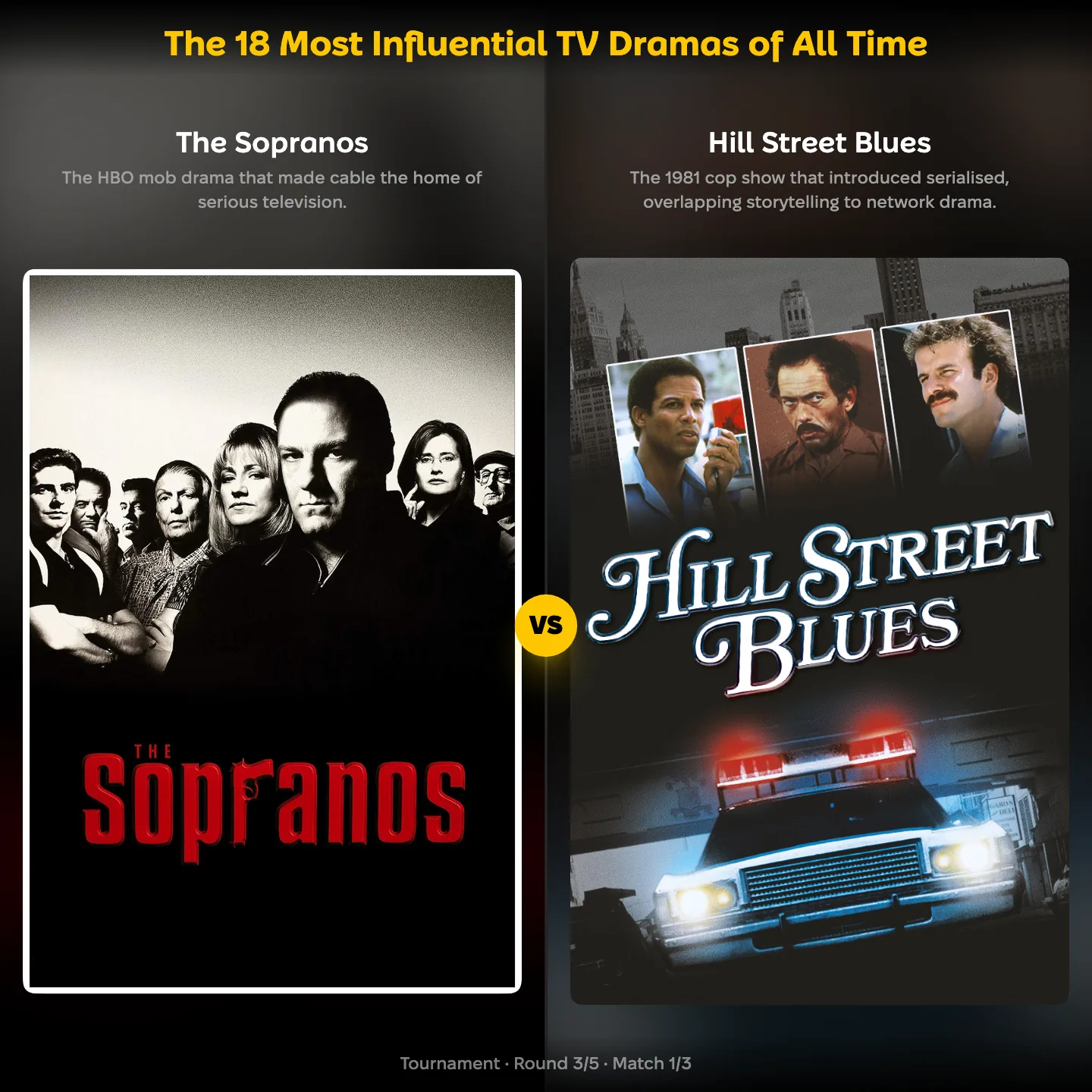
Hill Street Blues came first. The Sopranos got the credit.
Influence is a different measurement from quality, and this list of 18 is where the two shows stop being peers.
The Sopranos won cable television's first Primetime Emmy for Outstanding Drama Series, part of 21 wins from 111 nominations across its run.6 That result is why HBO became the address for serious drama and why every network spent the following decade looking for its own version.
Breaking Bad's contribution is narrower and still large: it showed that a basic-cable channel with a fraction of HBO's budget could out-write the premium networks, and AMC, FX and Netflix all built on that.
Hill Street Blues is on the same list, and it got there in 1981 by introducing serialised, overlapping storytelling to network drama. Oz cleared HBO's ground before Tony Soprano walked onto it. Neither show invented this alone.
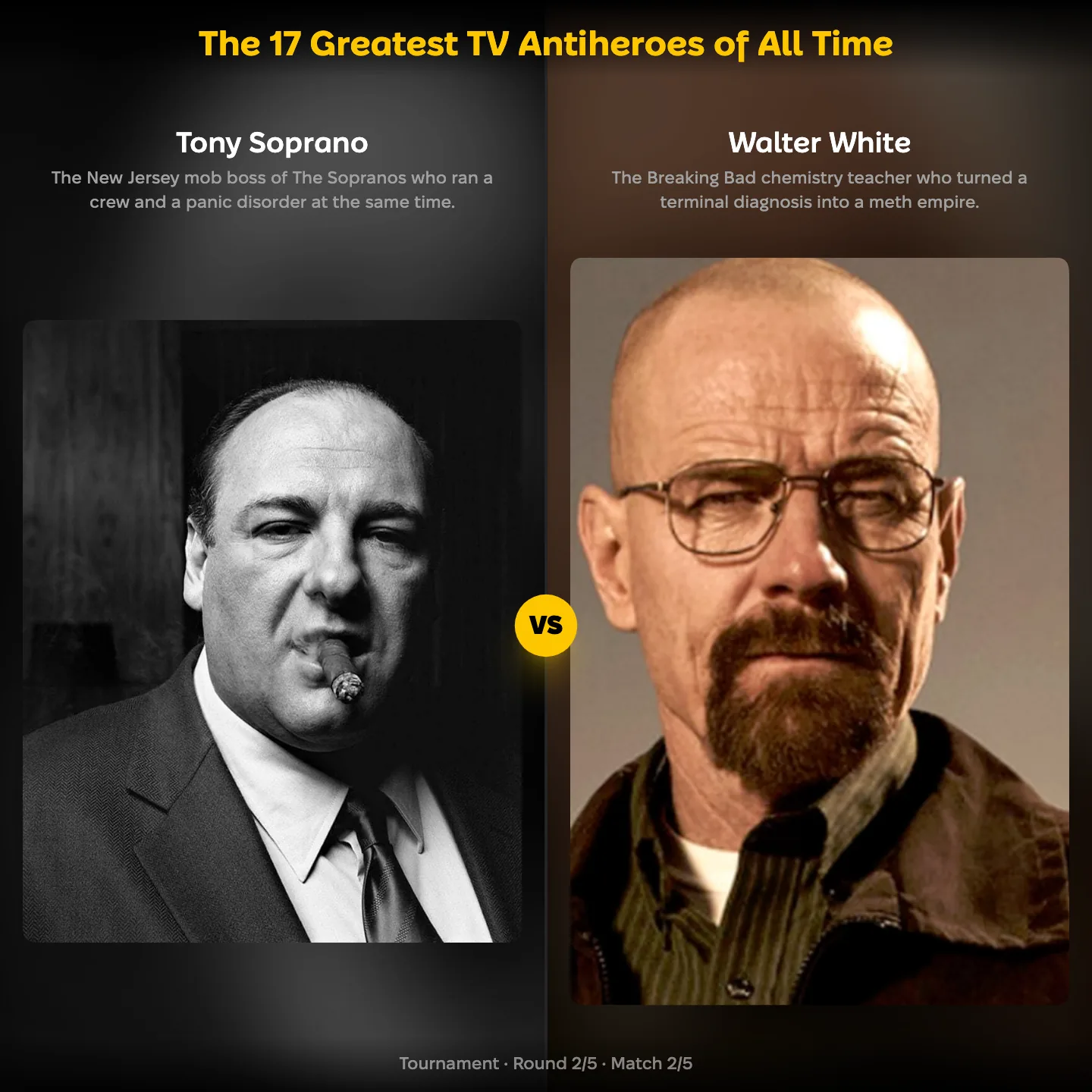
Walter White vs Tony Soprano, on the same list
Strip away the shows and rank the men, and the comparison gets sharper rather than blurrier.
Tony Soprano is the template. He walks into a psychiatrist's waiting room in the first episode and spends the next six seasons explaining himself to a woman who keeps not absolving him, which is the device the whole genre borrowed.
Walter White is the variation. His show runs 62 episodes and spends nearly all of them moving one man out of a high-school classroom, so the interest is in the distance travelled rather than in the standing still.4
Don Draper, Omar Little, Vic Mackey and BoJack Horseman fill out the field. Two of them arrived between these two shows, which is the lineage made visible.
Filed as a villain: Walter White next to Joffrey Baratheon
Call them villains instead of antiheroes and both Walter White and Tony Soprano lose their protection.
An antihero list rewards complication. A villain list rewards effect, and it fills up with characters written for no purpose except to be hated: Joffrey Baratheon, Ramsay Bolton, Negan, Kilgrave.
Walter White and Tony Soprano appear among those 18, competing on a measure neither show was aiming at. Gus Fring is here too, from inside Breaking Bad, which tells you how the category sorts.

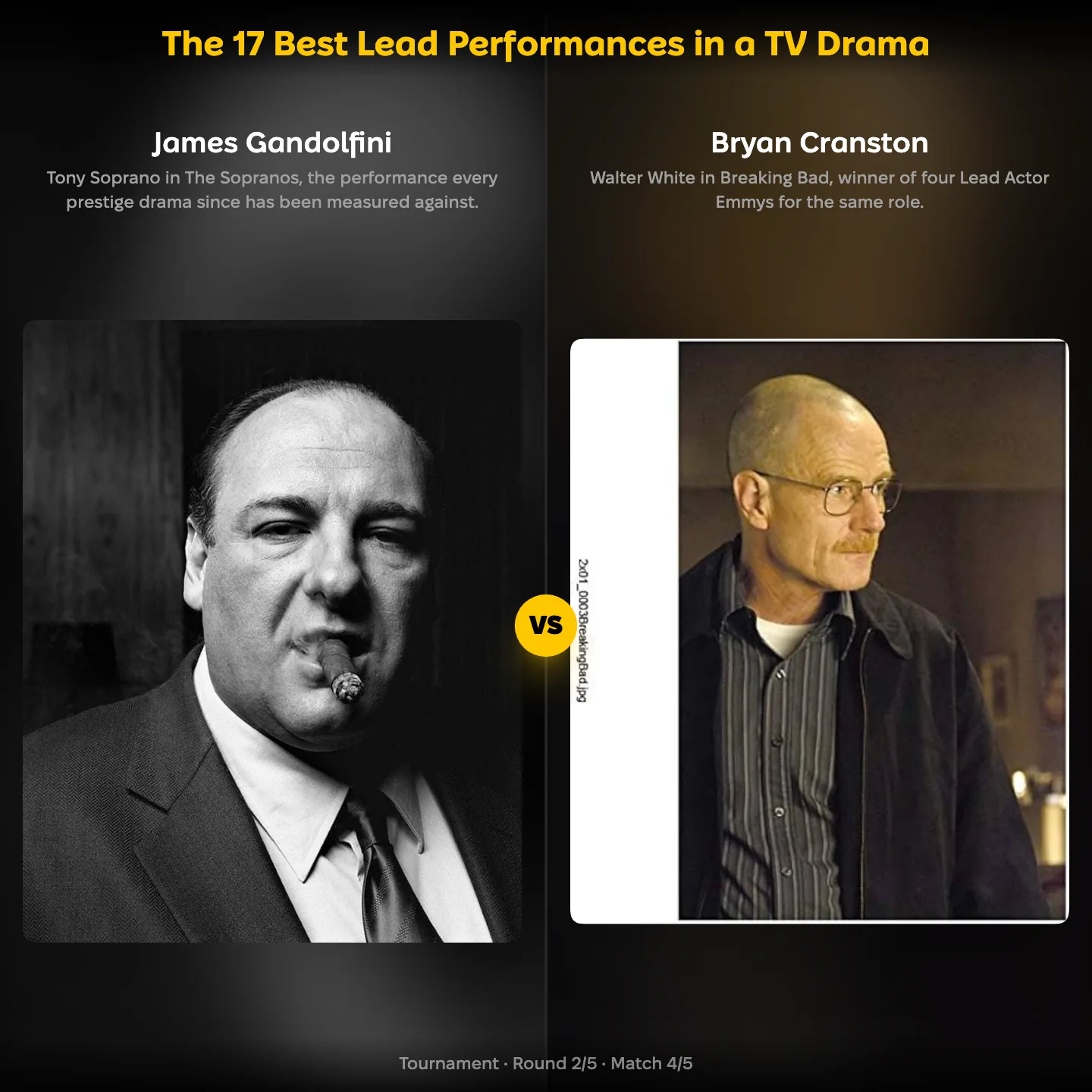
James Gandolfini vs Bryan Cranston: four Emmys against one benchmark
This is where the two shows meet most directly, because both of them rest on one man in almost every scene.
Bryan Cranston won Outstanding Lead Actor in a Drama Series four times for Walter White, in 2008, 2009, 2010 and 2014.3 No performance in the category has been rewarded more consistently, and the fourth win came for the season most viewers describe as the show's hardest to watch.
James Gandolfini's Tony set the standard prestige television has been graded against since, and that is not a figure of speech: Gilligan named the role when he explained where Walter White came from.2
The two are doing opposite jobs. Cranston plays a man performing competence he does not have until he does. Gandolfini plays a man performing calm he never has, in a body that keeps giving him away.
Jon Hamm, Elisabeth Moss, Michael K. Williams and Keri Russell fill out the 17, a reminder that the decade these two bracket was crowded.
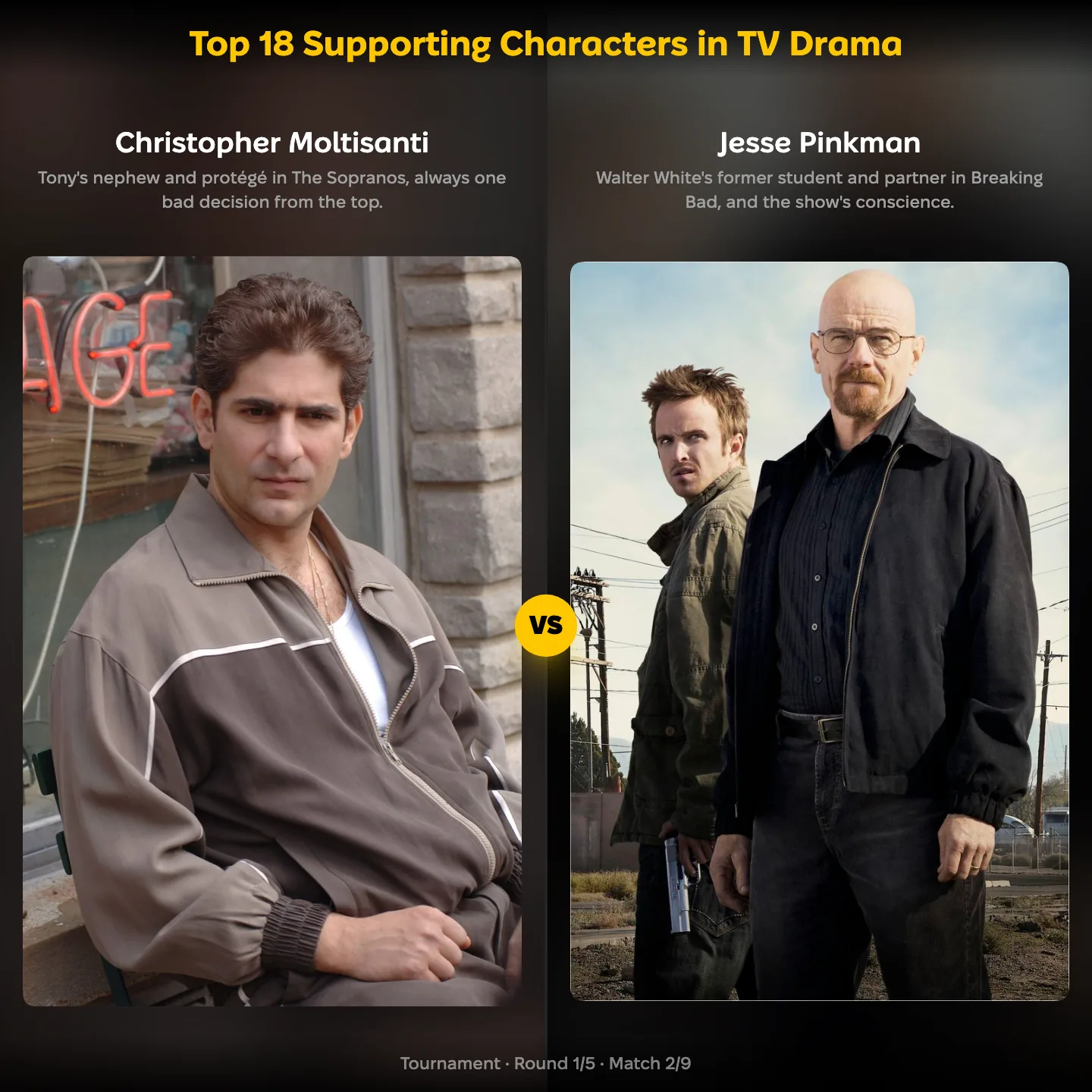
Jesse Pinkman and Christopher Moltisanti: two protégés, one survivor
Both shows do the same structural thing: they put a young man next to the boss who is too soft for the work and too committed to leave it.
Jesse Pinkman is Walter White's former student and the character the audience uses to keep score of how far Walt has gone. Aaron Paul won Outstanding Supporting Actor in a Drama Series three times for the part.3
Christopher Moltisanti is Tony's nephew and named heir, a screenwriter manqué who wants the life and cannot survive it. Michael Imperioli played him for the full run and wrote five of the show's episodes.
Gus Fring, Kim Wexler, Stringer Bell and Paulie Walnuts share this list of 18. Second billing is where both of these shows kept their best writing.
Breaking Bad's RV, The Sopranos' waiting room
A pilot has an hour to build a world and give somebody a reason to come back. The two of them answered that in opposite registers.
Breaking Bad opens on a man in his underwear pointing a gun down a New Mexico road beside a crashed camper van. The whole show is legible from that one image before a word of dialogue explains it.
The Sopranos opens on a heavy-set man sitting in a psychiatrist's waiting room, staring at a statue. The premise arrives quietly and the violence waits.
Lost, Twin Peaks, The West Wing and Six Feet Under round out the 15. Half of television's most-copied first hours are in one place.

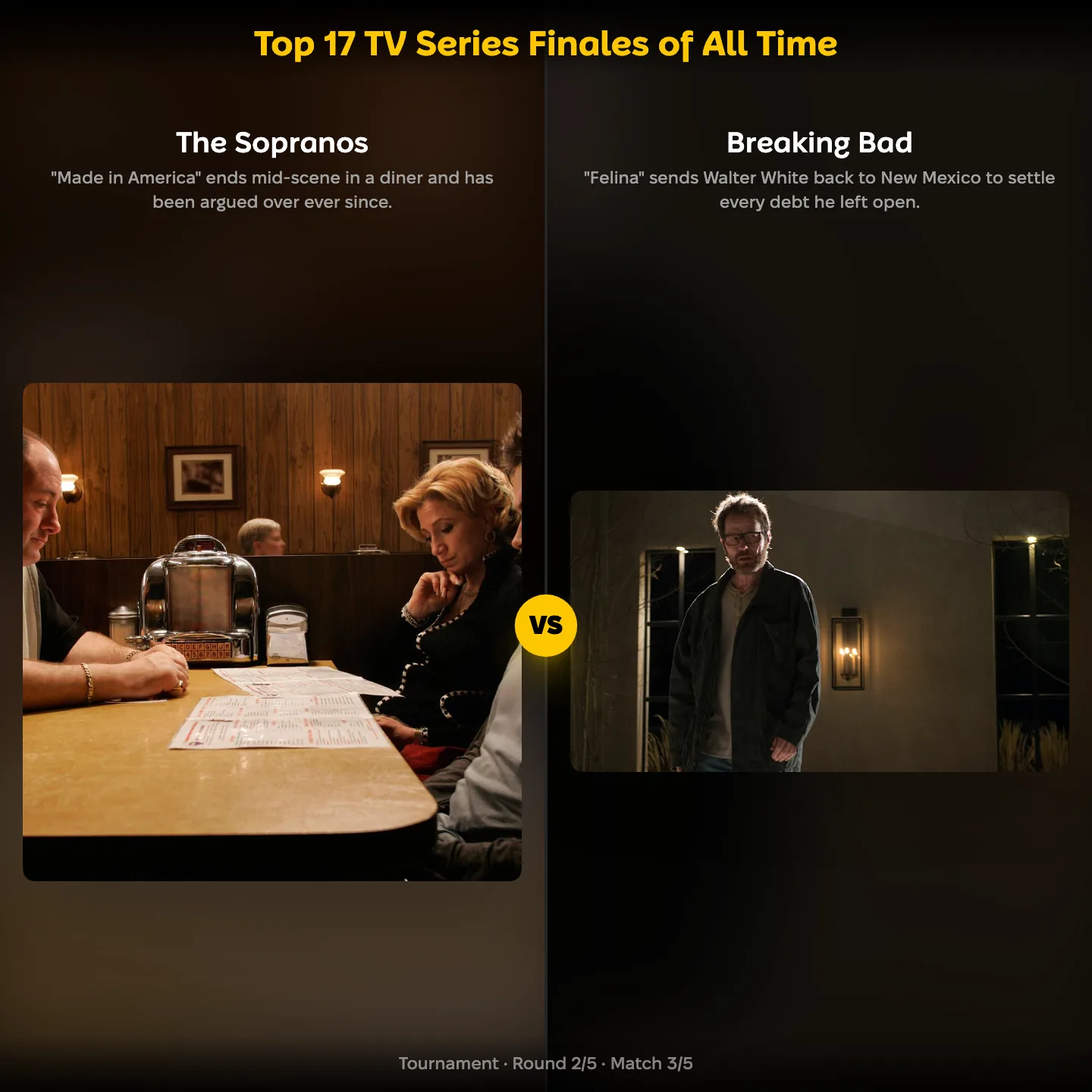
"Felina" and "Made in America": two ways to stop
Endings are where these two shows split most publicly, and where the split has stayed unresolved for the longest.
The Sopranos finished with "Made in America" on 10 June 2007, watched by 11.9 million people, and it stops mid-scene in a diner on a cut to black the show never explains.6 David Chase has spent nearly twenty years declining to settle it, and readers have spent the same twenty years refusing to let him.
"Felina" aired on 29 September 2013 and does the opposite.4 Every debt Walter White left open is closed, in order, with a machine gun in a car boot and one honest sentence to his wife.
The two endings are a straight statement of what each show believed television owed its audience. One says a story should finish; the other says a life just stops.
M*A*S*H, Newhart, Six Feet Under and Better Call Saul complete the 17, and none of them divides a room the way the diner does.
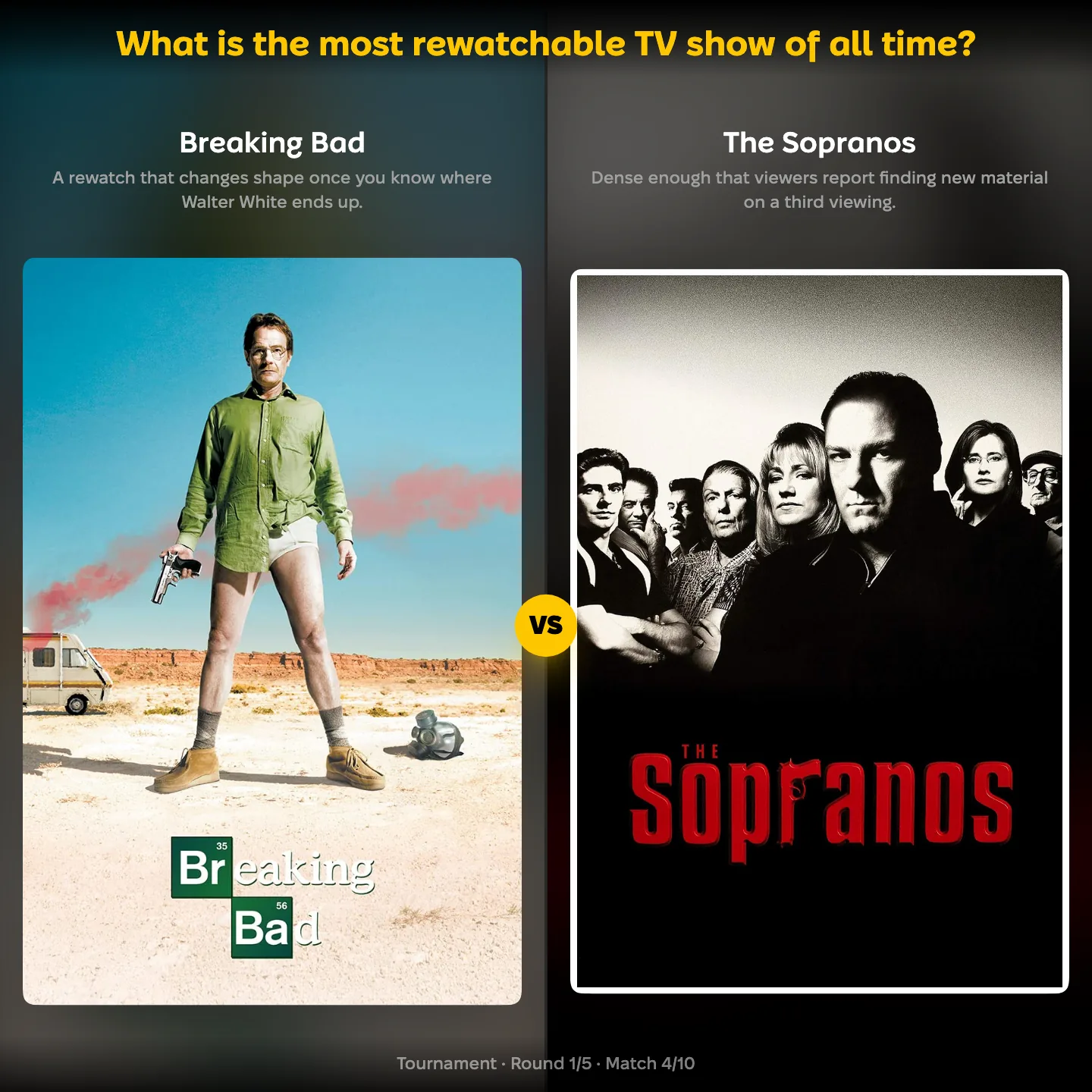
Rewatchability puts Breaking Bad next to Friends
Breaking Bad and The Sopranos turn up here as visitors in somebody else's category.
The rewatch list is built out of comfort television: Friends, Seinfeld, The Office, Parks and Recreation, Gilmore Girls. It rewards shows you can put on while cooking.
Breaking Bad and The Sopranos are the two hour-long dramas in that company, and they get there by a different route — both reward a second pass because you now know what the first one was hiding.
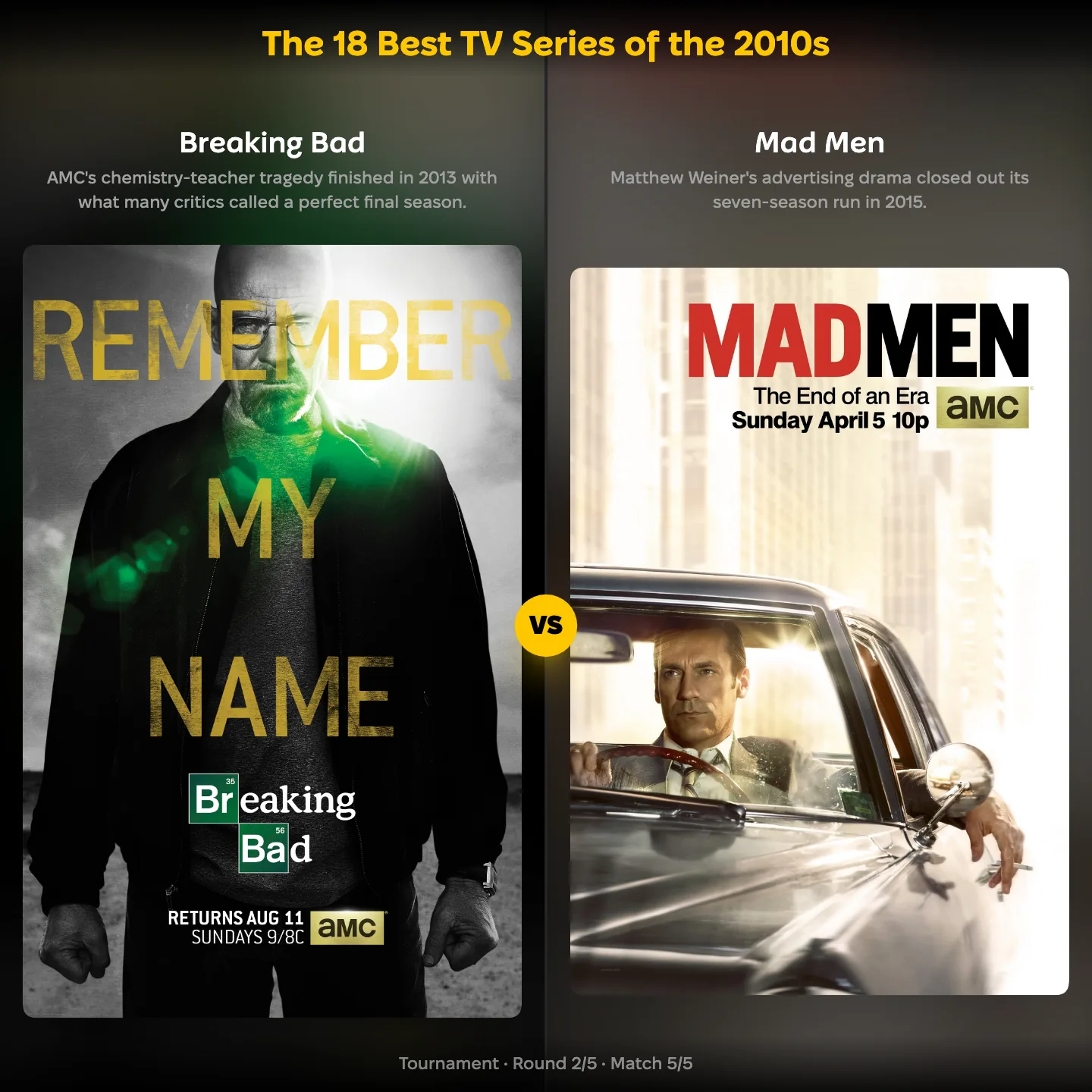
The 2010s: the decade The Sopranos missed by three years
Some lists exclude one of these shows outright, and the exclusions are as informative as the head-to-heads.
Breaking Bad owns this decade on paper. It won Outstanding Drama Series in 2013 and again in 2014, both inside the ten years the list covers.3
The Sopranos finished in 2007 and cannot enter.6 A show that shaped every drama among those 18 is missing from it on a technicality of dates, which is roughly how influence usually gets recorded.
Game of Thrones, Mad Men, Fleabag and The Americans are the real competition. Better Call Saul also qualifies, so Breaking Bad is partly running against its own spin-off.
Gus Fring, Jesse Pinkman and the problem with Walter White
Turn the question inward and Breaking Bad stops being a single-character show.
Fifteen names come from one series here, and the man on the poster is not the automatic answer. Gus Fring runs a distribution network out of a fried-chicken franchise without raising his voice. Mike Ehrmantraut is the only competent adult in the show. Jesse carries the moral weight of the whole thing.
Walter White is in the field, and the objection to him is simple: spending 62 episodes with a man does not make him the best-written person in the room.
The Sopranos gets the same treatment further down this page, and it produces a very different result.

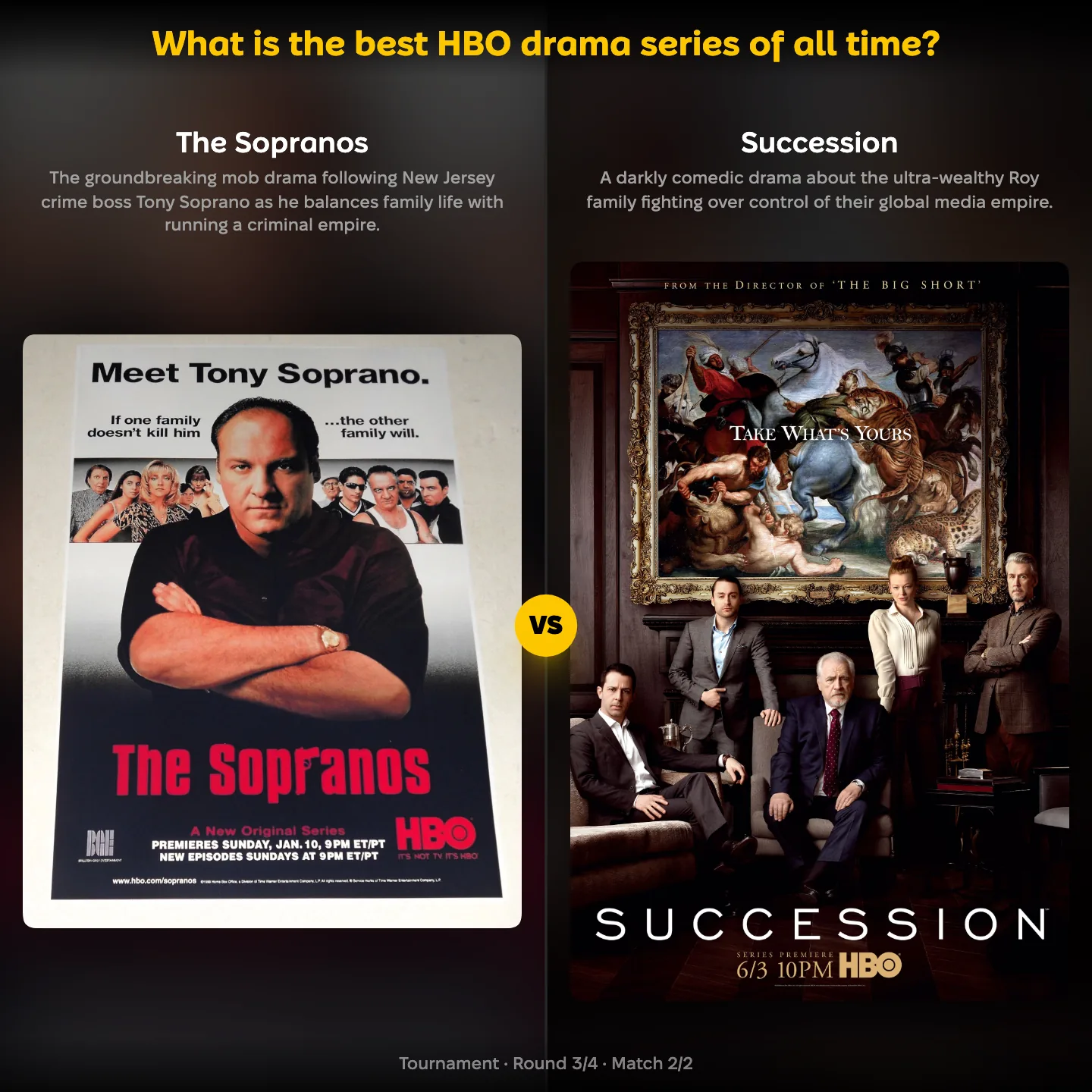
HBO's own house: The Sopranos, The Wire, Succession
This is the list Breaking Bad cannot enter, and the reason is one word long.
Breaking Bad was made for AMC, a basic-cable channel that had never produced an original drama of that scale.4 Its absence from an HBO ranking is a licensing accident rather than a verdict, but it is also the clearest picture of how differently the two shows were born.
The Sopranos is the show that made the category exist. Sixteen HBO dramas appear here, most of them commissioned by executives who had watched what the first one did to the network.6
The Wire, Succession, Deadwood, Six Feet Under and Oz are the competition, and at least two of them have a serious claim. Arriving first does not settle who is best.
Dr. Melfi: the best argument for The Sopranos that isn't Tony
The last list is the mirror of the Breaking Bad one, and it answers differently.
Eighteen characters come out of North Jersey: Carmela, Christopher, Paulie Walnuts, Silvio, Uncle Junior, Adriana. The show ran 86 episodes and gave nearly all of them a private life.5
Dr. Jennifer Melfi is the one that has no equivalent anywhere in Breaking Bad. Walter White never has a room where he tells the truth, or a person paid to notice that he is lying. Tony has both, weekly, for six seasons.
That absence is the sharpest difference between the two shows. One is a confession told to a psychiatrist; the other is a confession nobody hears until the last episode.

The comparison keeps changing rooms
Across fifteen lists Breaking Bad and The Sopranos never lose to each other for the same reason twice. Ask about influence and The Sopranos is the parent; ask about a decade and it is ineligible; ask about a network and one of them is not invited; ask who the best character is and both title roles have to fight their own supporting casts.
Underneath, every one of those lists is settled by the same method: two options, one choice, repeated until the field sorts itself.
If you think another show belongs in this company, build the ranking and let other people disagree with you.
More rankings, more angles
- Friends vs Seinfeld: Who Wins Which List? — the same decade, played for laughs
- Game of Thrones: 59 Emmys, One Ending Nobody Agrees On — another finale that split its audience
- The Simpsons: 800 Episodes, 17 Different Lists — the longest-running argument on television
- Stranger Things Broke Netflix's Record, Then Missed the Emmys — a record premiere week and no drama nomination
Sources
- Wikipedia — 78th Primetime Emmy Awards: ceremony date, 8 July 2026 nominations announcement, and Pluribus's 18 nominations: en.wikipedia.org (checked 2026-08-11)
- The Hollywood Reporter — Vince Gilligan's tribute to James Gandolfini, June 2013, where he wrote that without Tony Soprano there would be no Walter White: hollywoodreporter.com (checked 2026-08-11)
- Wikipedia — awards and nominations received by Breaking Bad: the 2014 Guinness World Records entry as the most critically acclaimed show of all time, Bryan Cranston's four Lead Actor Emmys (2008, 2009, 2010, 2014), Aaron Paul's three Supporting Actor wins, and the 2013 and 2014 Outstanding Drama Series wins: en.wikipedia.org (checked 2026-08-11)
- Wikipedia — Breaking Bad: premiere and finale dates, five seasons and 62 episodes, Albuquerque setting, AMC: en.wikipedia.org (checked 2026-08-11)
- Wikipedia — The Sopranos: 10 January 1999 premiere, six seasons and 86 episodes, North Jersey setting, the "Made in America" cut to black: en.wikipedia.org (checked 2026-08-11)
- Television Academy — "The Sopranos at 25: By the Numbers": 111 Emmy nominations and 21 wins, cable's first Outstanding Drama Series, and the 10 June 2007 finale's 11.9 million viewers: televisionacademy.com (checked 2026-08-11)