
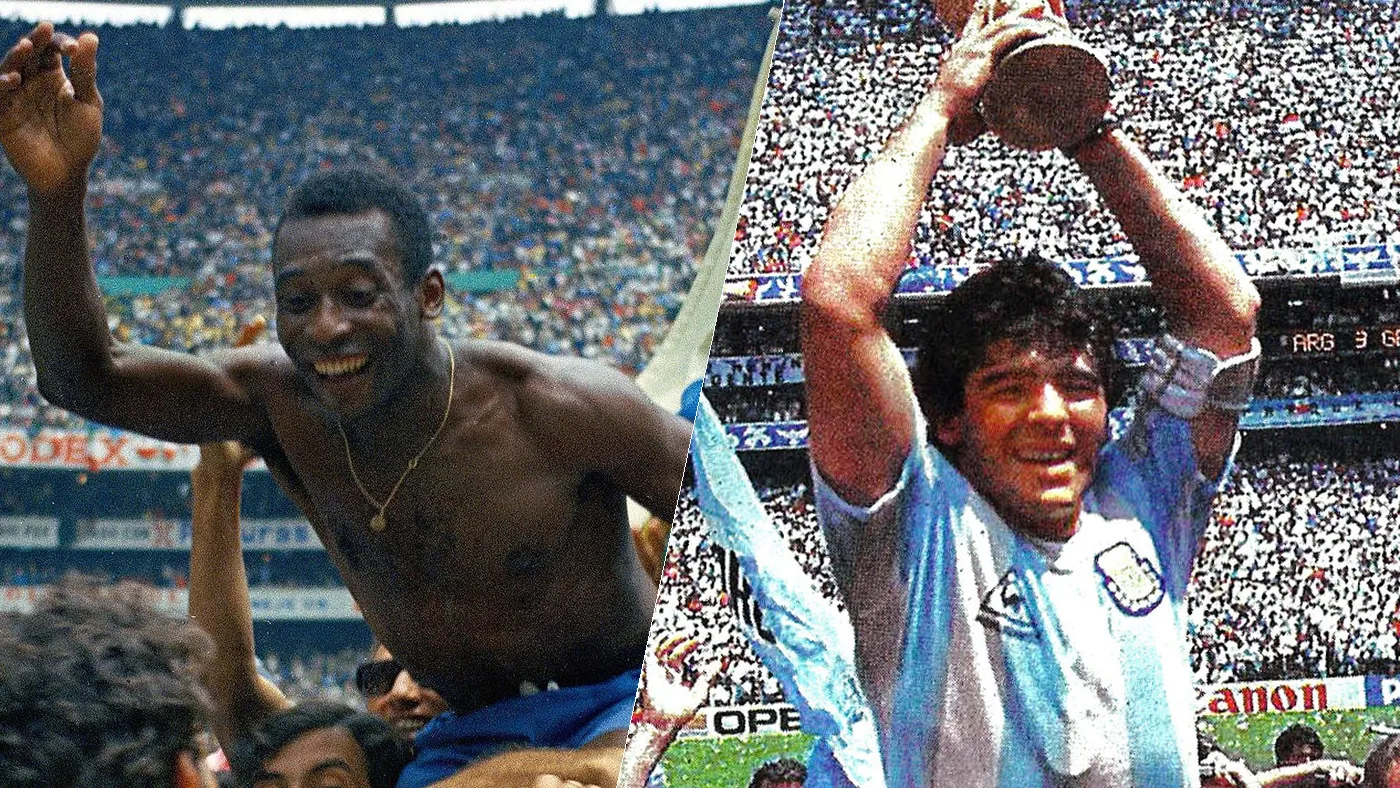
Pelé won three World Cups and Diego Maradona won one. The 2026 tournament left that alone: FIFA noted before a ball was kicked that no active player held two titles, so nobody in Canada, Mexico or the United States could draw level with Pelé.1 Maradona's Argentina got to the final in New Jersey and lost it 1-0 to Spain.2
Thirteen rankings below drop the two of them into the same field: World Cup goals, the No. 10 shirt, dribbling, build, and the two clubs where only one of them is eligible.
The one award that ever set out to rank Pelé against Maradona had to be handed to both.
Maradona v England, 22 June 1986: the goal FIFA voted the best
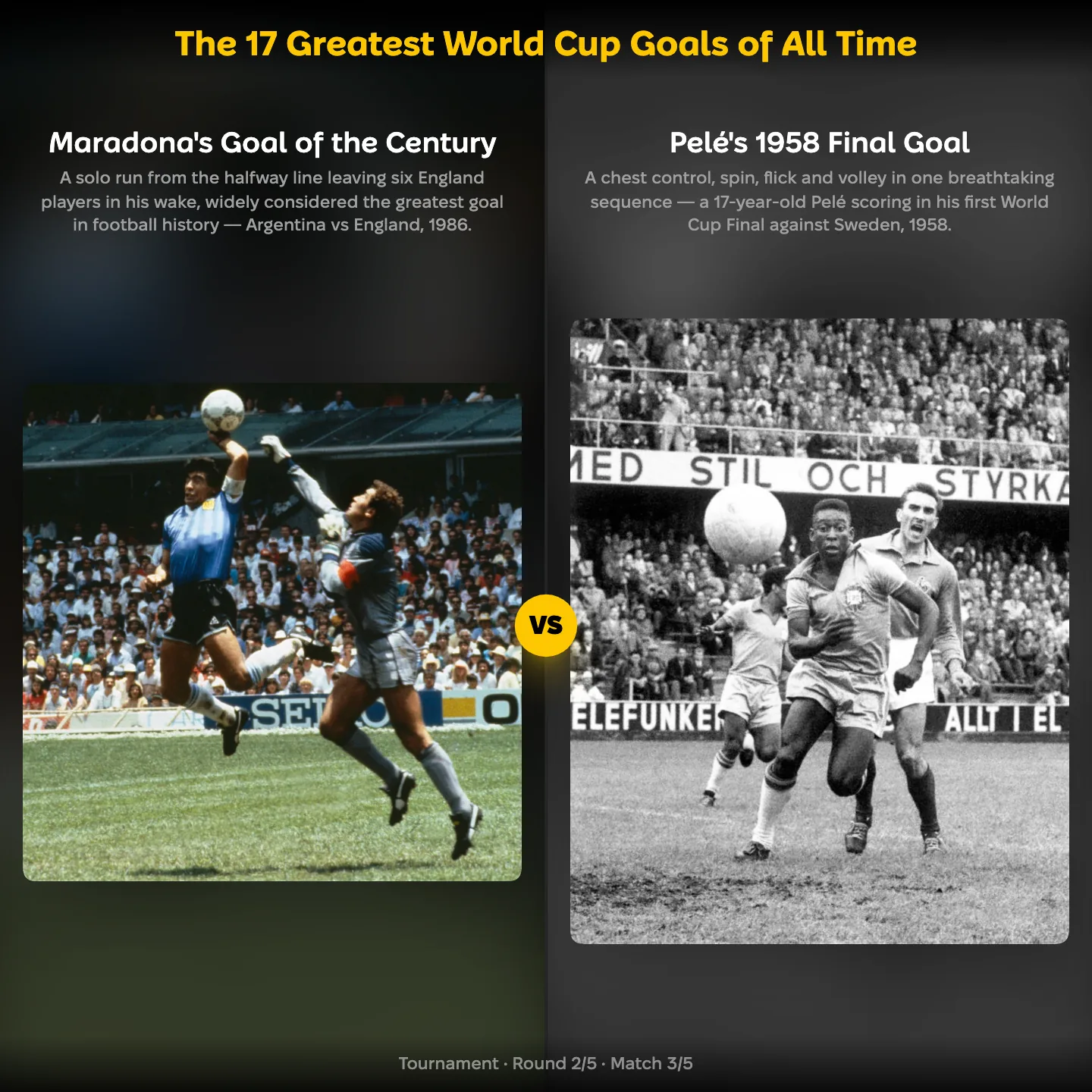
Seventeen World Cup goals are ranked here as moments rather than as careers, and Pelé and Maradona each own one of them.
Maradona's is the second goal against England at the Estadio Azteca on Sunday 22 June 1986. He collected the ball inside his own half, went past Peter Beardsley, Peter Reid, Terry Butcher and Terry Fenwick, then took it round Peter Shilton and finished under pressure. FIFA's own account of the run calls it the World Cup Goal of the Century.3
Pelé's is from Sweden 1958, scored at 17 against the hosts: a chip over the defender, a volley past the goalkeeper. It came in the fourth start of a tournament he had begun on the bench, and he finished that World Cup with six goals.1
Carlos Alberto's finish in the 1970 final is on the list too, and Pelé supplied the pass for it. Dennis Bergkamp against Argentina in 1998 and Archie Gemmill's slalom in 1978 fill in around them. Argentina beat England 2-1 that afternoon, and both goals were Maradona's, the second arriving moments after the Hand of God.
Pelé v Maradona at the World Cup: 1958, 1962 and 1970 against 1986
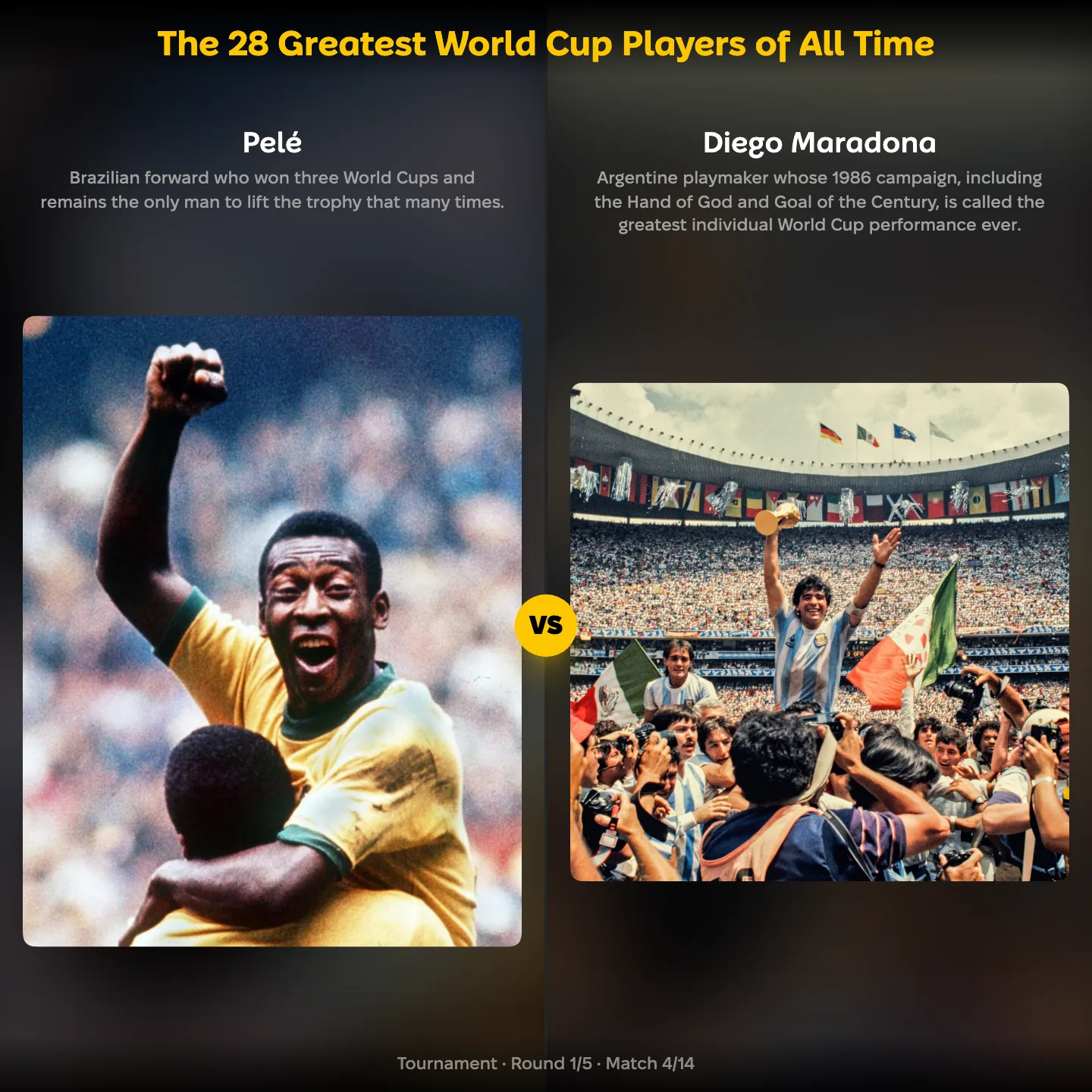
Twenty-eight players are ranked here on what they did at World Cups, which is the comparison these two get dragged into most often.
Pelé won the trophy in 1958, 1962 and 1970 and no man has matched that since, with four of his goals arriving at Mexico 1970.
Maradona won it once, and Mexico 1986 is the tournament nobody has matched for individual weight. He is the only player ever to register five goals and five assists in a single World Cup, and he split the West Germany defence for Jorge Burruchaga to score the winner in a 3-2 final.4
Franz Beckenbauer, Johan Cruyff and Ferenc Puskás are in the same twenty-eight. Beckenbauer lifted the trophy in 1974, Cruyff and Puskás never did, and no single tournament of theirs gets described the way Maradona's June in Mexico does.
Copa América: the continental trophy neither man won
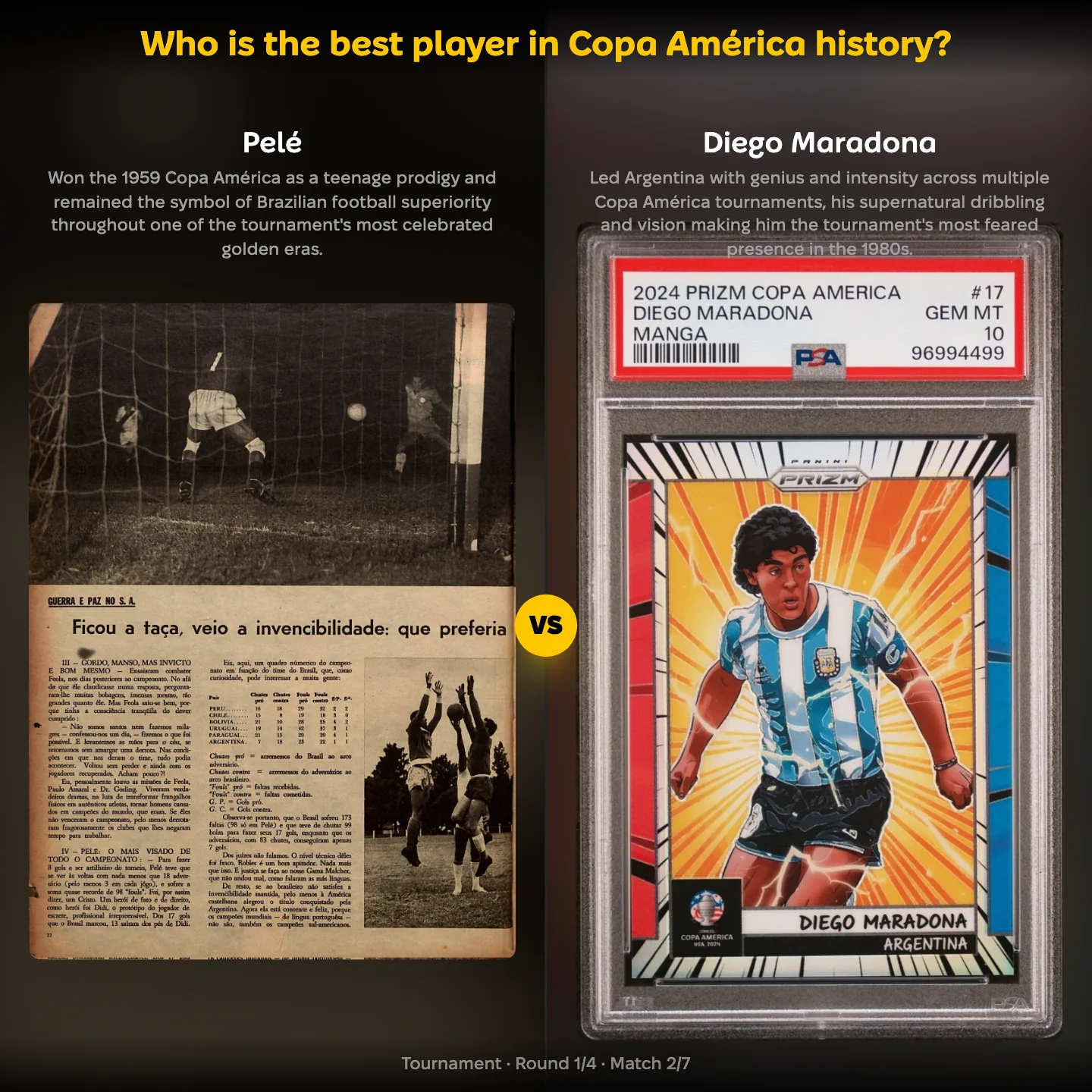
Copa América is where both careers show a hole. Neither Pelé nor Maradona ever won it.
Pelé played one edition, in Argentina in 1959, and finished as its top scorer with eight goals in six matches at 18. CONMEBOL logs it as his first and last Copa América: Argentina took the title, Brazil came second.5
Maradona never got there either — Argentina kept winning it without him. Their 2024 victory made them back-to-back champions and their sixteenth in total, more than any other country, with Lionel Messi starting that final at 37 years and 20 days.6
So the list belongs to other people. Messi alone holds two Copa Américas, which is two more than Pelé and Maradona managed between them across four attempts.
Player of the Century: the honour football had to award twice
This ranking runs to 32 options with no boundary conditions: no era, no country, no position. Pelé and Maradona are both in it, and so is nearly everyone else with a claim.
The question has been put formally once. In 2000 two men were jointly recognised as Player of the Century, Pelé and Maradona, and the FIFA Museum records that Maradona's share of it was settled by a public poll in which most votes went his way.7
Pelé kept his half regardless, so football's one formal verdict on the pair came back as a tie.
Widen the field this far and Johan Cruyff, Alfredo Di Stéfano and Lev Yashin walk in with cases that need neither Brazilian nor Argentine to make sense.
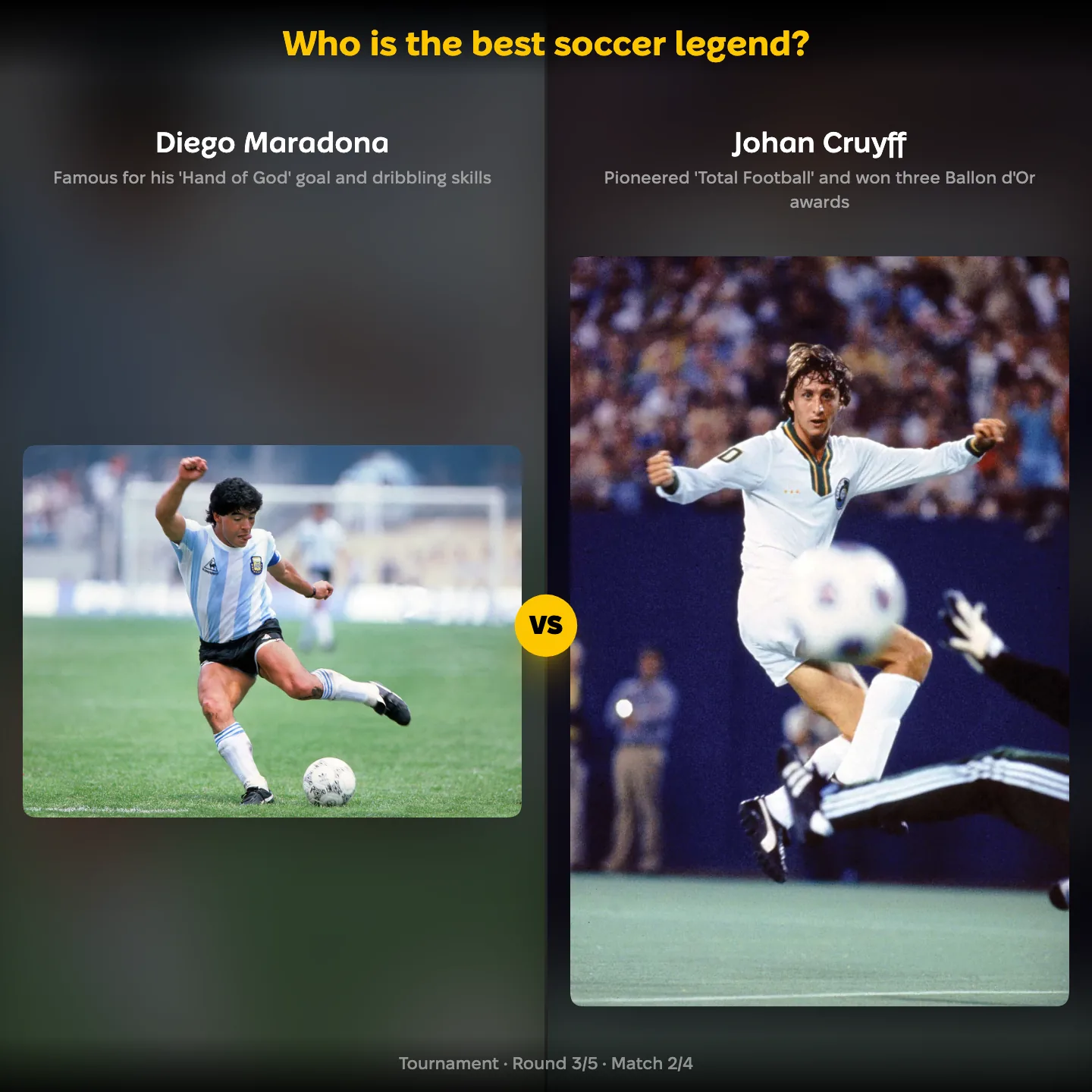
The No. 10 shirt: Pelé got the number by clerical accident
Twelve players are ranked here on how they wore the number 10 at a World Cup, and Pelé and Maradona are the first two names most people reach for.
Pelé was handed the shirt by mistake. Brazil forgot to send FIFA their squad numbers before Sweden 1958, so the numbers went out at random: the goalkeeper got 3, a centre-back got 9, and a 17-year-old reserve got the 10 he spent the next twelve years making famous.8
Maradona wore it for Argentina at four World Cups between 1982 and 1994, and wearing it cost him. He was fouled 23 times in one match against Italy in 1982 and 53 times across Mexico 1986, and both are still competition records.4
Zinedine Zidane has a claim the number alone does not carry: France's 10 in the 1998 win and again in the 2006 run to the final. Michel Platini, Rivaldo, Roberto Baggio and Rivelino fill out the rest, and not one of them acquired the number through a paperwork failure.
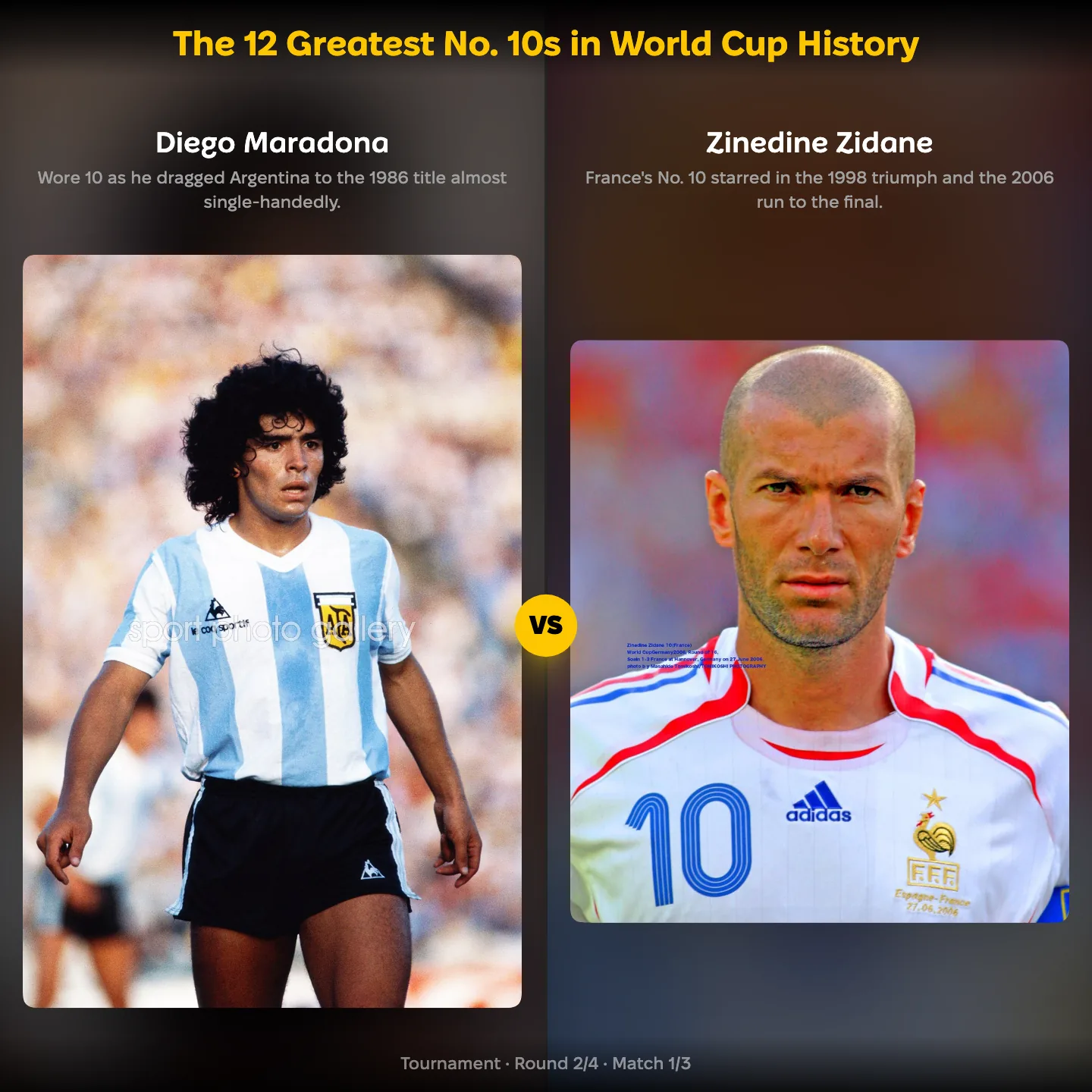
Pelé #10 v Maradona #10: two entries, one number
This ranking asks which player-and-number pairing is the most iconic in football, across 23 options. Two of those options are the same number: Pelé #10 and Maradona #10.
The collision is the point. Both men made two digits stand for the best player in the team, in different decades and on different continents, and neither had to share the meaning with the other while he played.
Every other number on the list belongs to one man: Cruyff's 14, Ronaldo's 9, Beckenbauer's 5, Paolo Maldini's 3, Gianluigi Buffon's 1.
Five more 10s are here as well: Messi, Zidane, Ronaldinho, Platini and Baggio. All five inherited a shirt whose meaning was set by a Brazilian teenager and an Argentine captain.
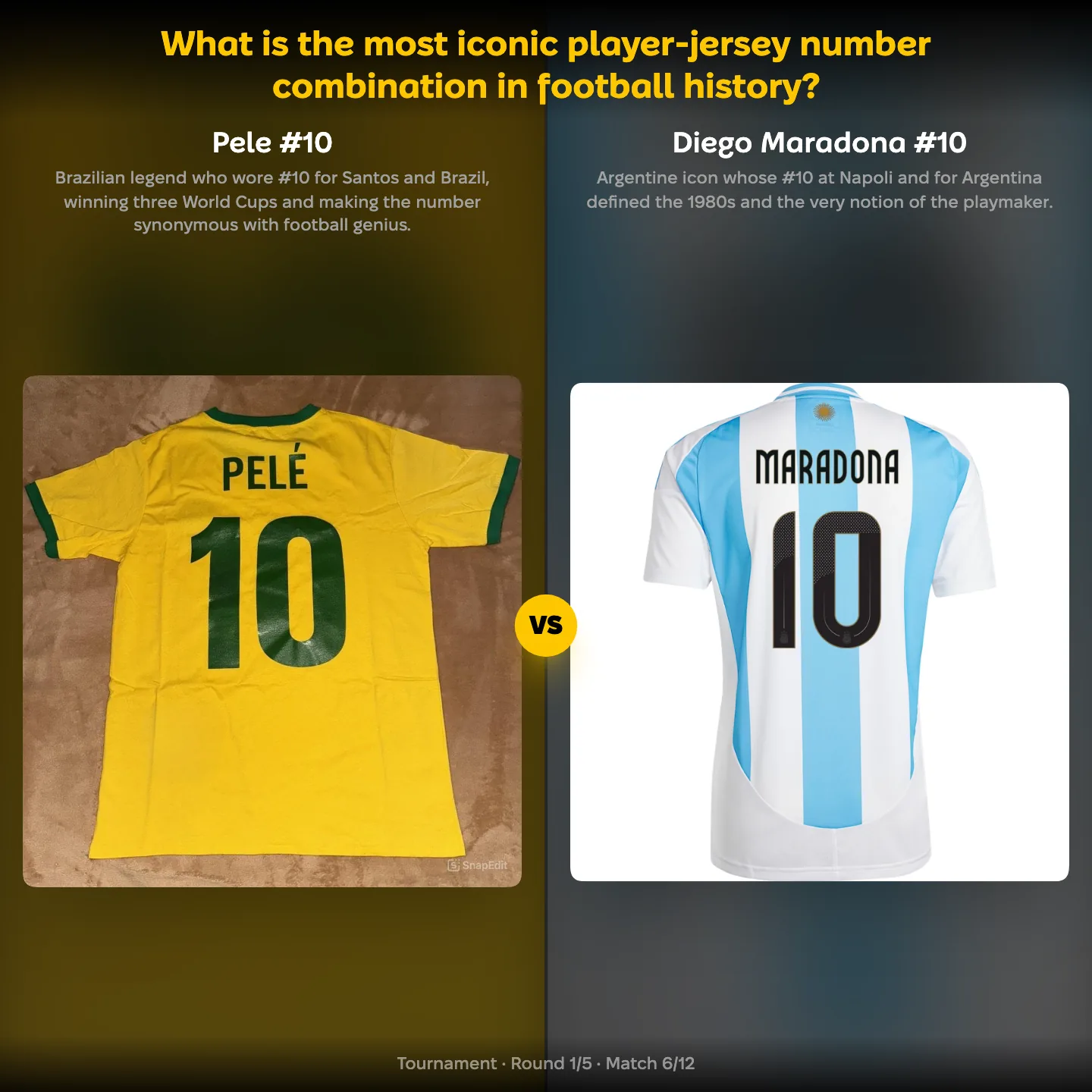
South America's twenty: Garrincha and Messi in the same frame
Narrowing the field to one continent does not narrow the argument. Both men are in the twenty, alongside most of the players either of them ever faced.
Pelé's case here needs a team-mate to state properly. He and Garrincha lined up together for Brazil in six World Cup matches and several Copa América games and never once lost.8
Maradona's case is Mexico 1986 and a decade in which nobody on the continent was better. He is also the only footballer to have broken his own world transfer record: Barcelona paid Boca Juniors £3 million for him in 1982, and Napoli paid £5 million two years later.4
Garrincha is on this list in his own right, and 1962 explains why. Pelé's tournament ended with an injury against Czechoslovakia, Brazil retained the World Cup without him, and Garrincha scored four of the goals that did it.1
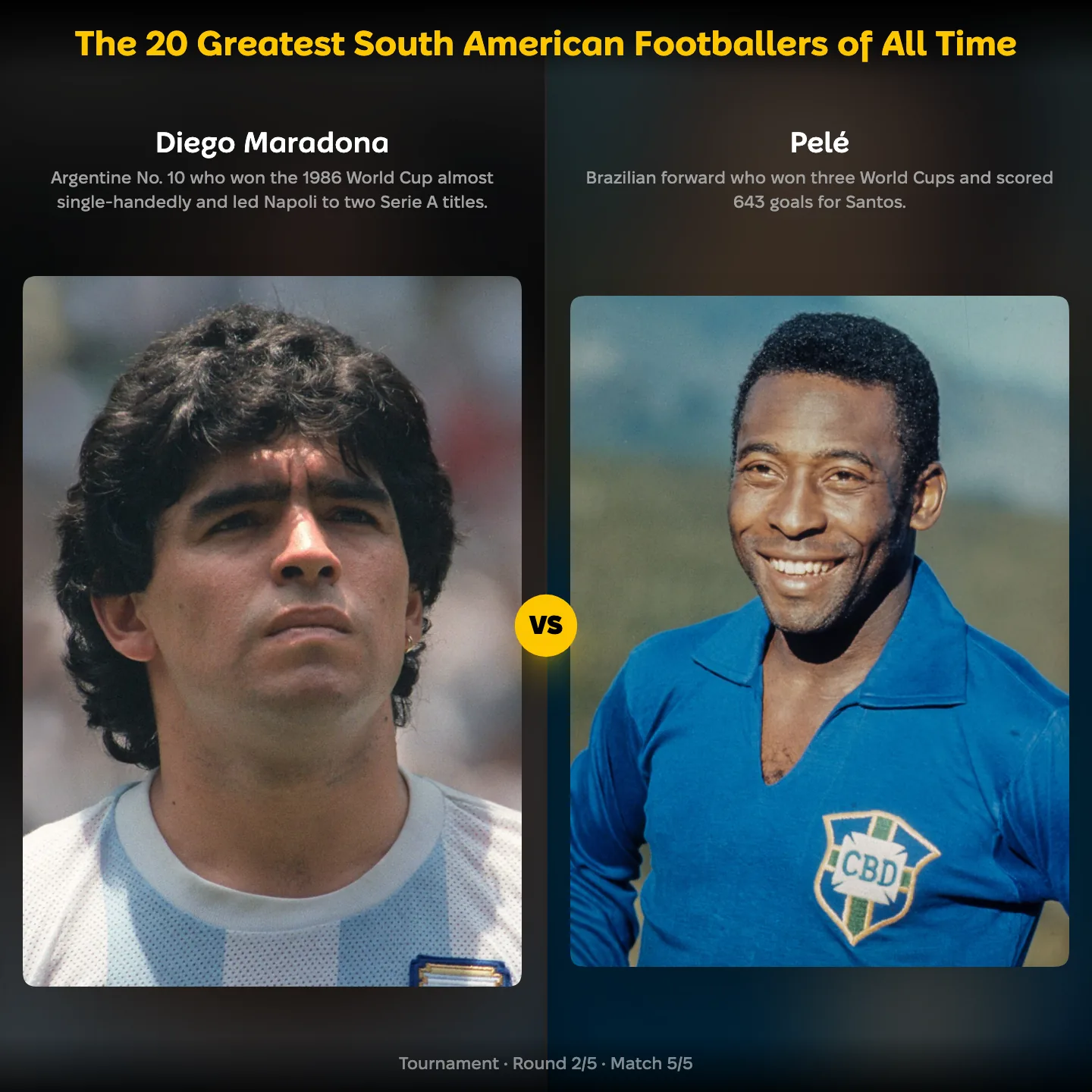
Dribbling on its own: twenty specialists at beating a man
Take away trophies, goals and captaincy, leave only beating a defender with the ball at your feet, and twenty players remain. Pelé and Maradona are both among them.
Maradona's evidence is the England run: four outfield players behind him inside ten seconds, then the goalkeeper, then the finish.
Pelé's evidence is harder to cut into one clip, so count what it produced. He registered six assists at Mexico 1970, still the record for one World Cup, and Maradona's five at Mexico 1986 is the closest anybody has come to it.8
The list works through Garrincha, Cruyff, George Best and Ronaldinho before it reaches Lamine Yamal, who came to the 2026 World Cup at 18 and became one of only four men to start and win a World Cup final as a teenager, 68 years after Pelé did it.9
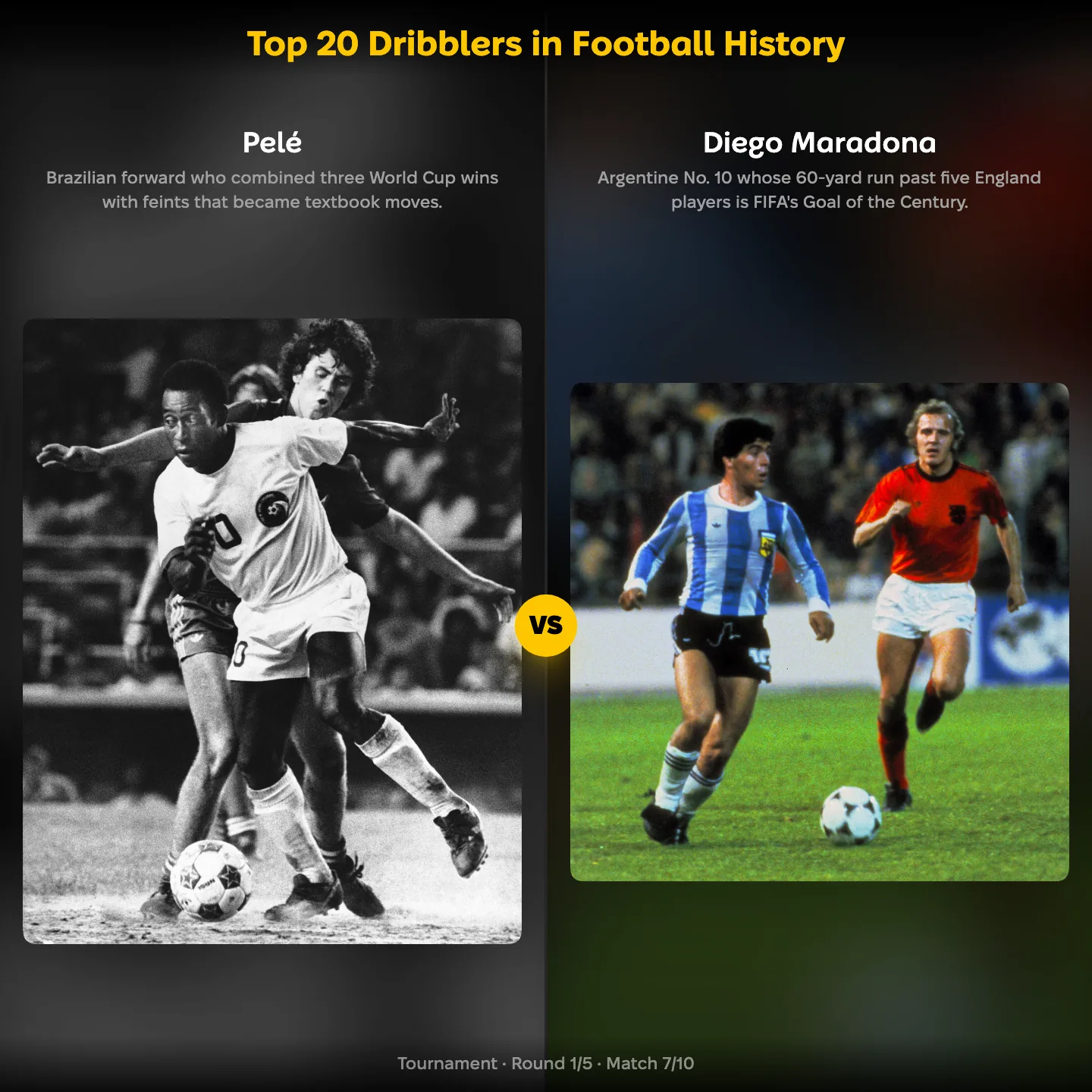
Ranked by build: Maradona next to Xavi, Iniesta and Kanté
This ranking sorts footballers by something none of them chose, which is being small. Pelé and Maradona both qualify for it.
Maradona played low to the ground and was kicked for it more than anyone in the history of the World Cup. He won 152 free-kicks across his tournaments, ahead of every player who came after him, Messi included.4
Pelé is here on the same criterion, on the one list in this article that ignores what either of them won.
The company is Xavi, Andrés Iniesta, Luka Modrić, N'Golo Kanté and Messi. On the other twelve questions here Pelé and Maradona are the reason the list exists; on this one they are two names inside it.
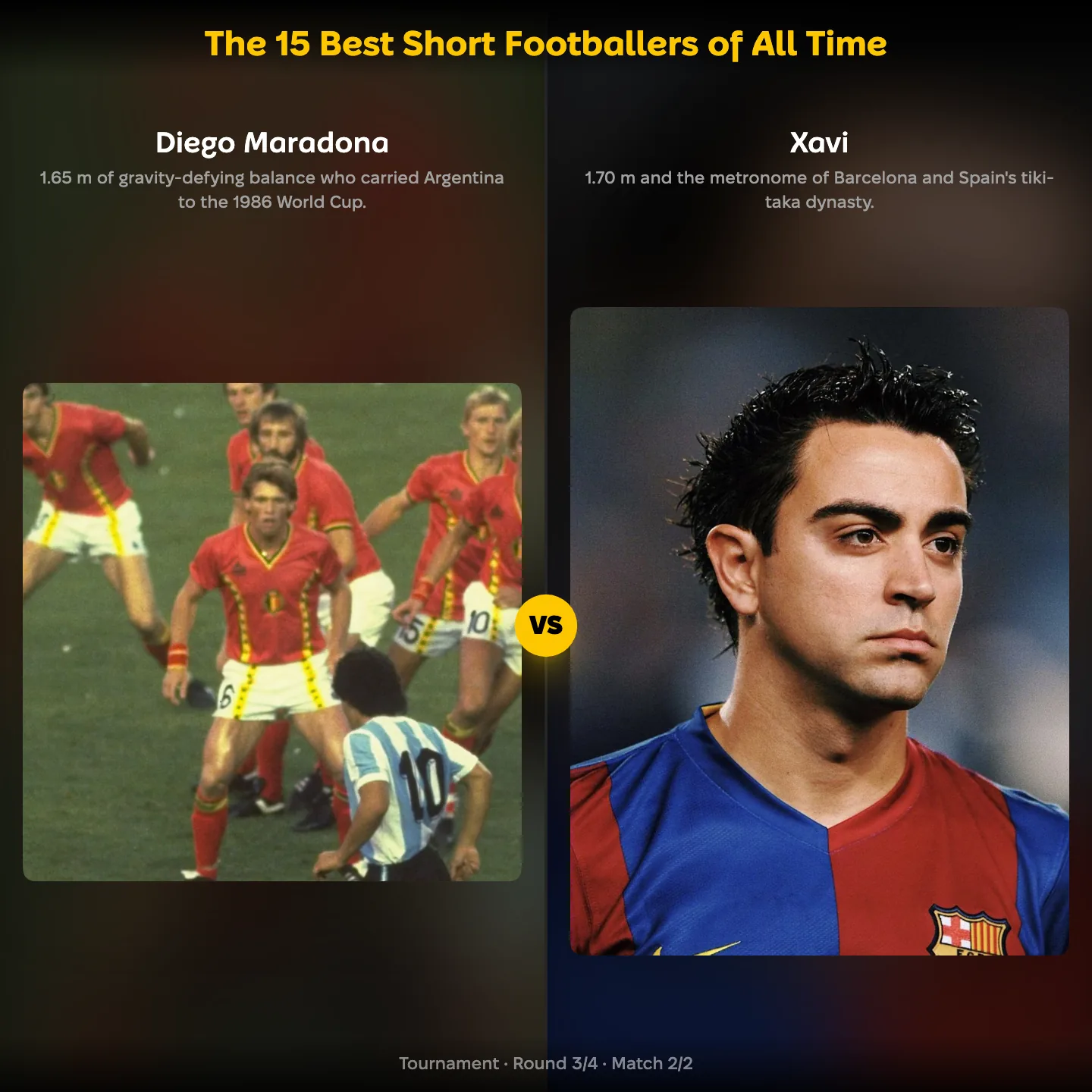
Napoli: the club Maradona found with one trophy in 58 years
Only one of the two men can be ranked here. Pelé never played a club game in Europe; Maradona spent seven seasons at Napoli.
The club he joined in 1984 had won a single major honour in 58 years of existence, the 1961/62 Coppa Italia.4
Seven years later it had two Serie A titles, in 1986/87 and 1989/90, a Coppa Italia, an Italian Super Cup and the 1988/89 UEFA Cup, won 5-4 across two legs against Stuttgart. Napoli then waited until 2022/23 for the next league title and added another in 2024/25.10
The city went further than a trophy cabinet — Naples lists the municipal ground as the Stadio Diego Armando Maradona, 54,726 seats.11 Edinson Cavani, Marek Hamšík and Lorenzo Insigne share the ranking with him, and none of the three has a stadium.
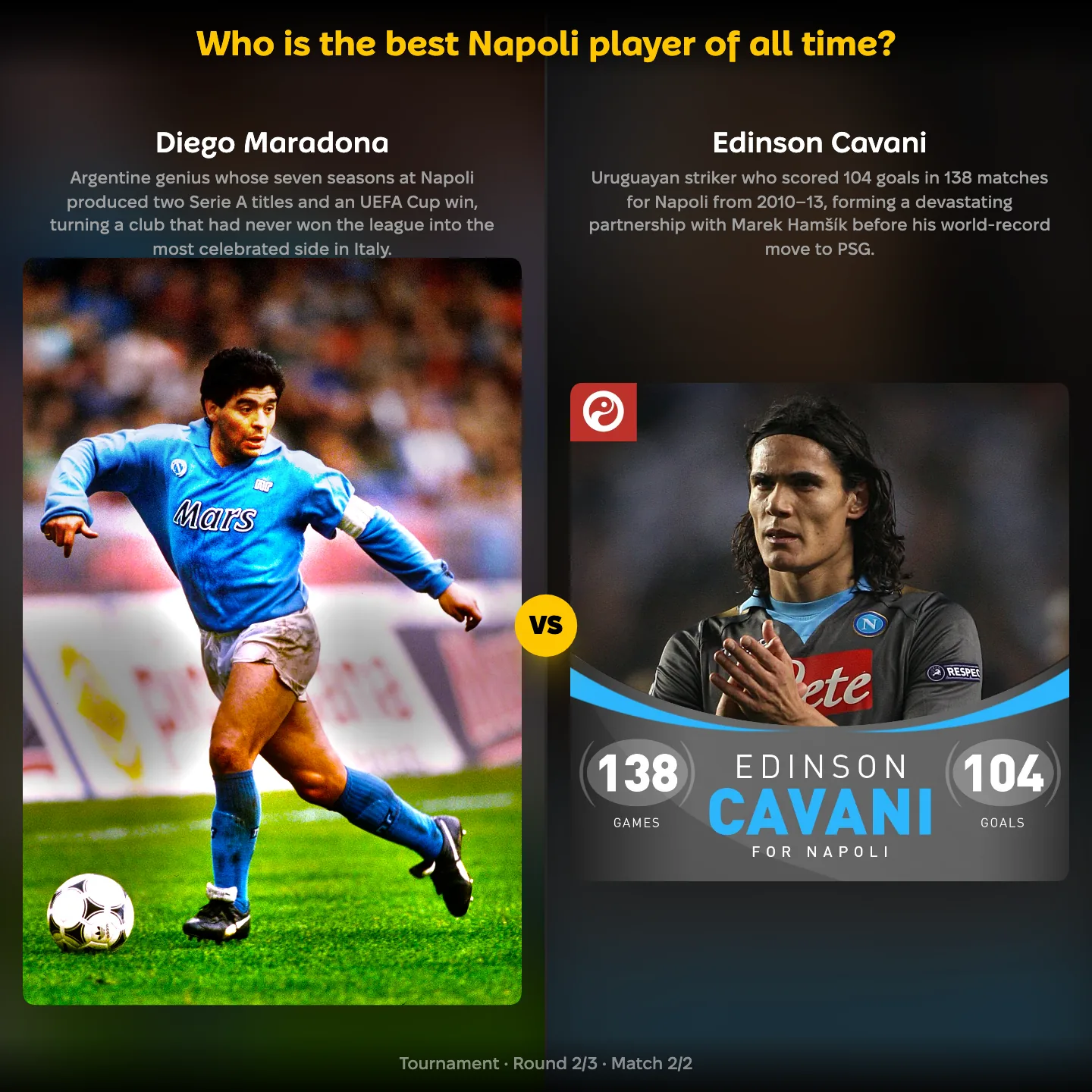
Santos: the club Brazil made Pelé a national treasure to keep
Maradona played club football in Argentina, Spain and Italy. Pelé effectively played for one club, and this is it.
He arrived at Santos at 15 in 1956 and scored on his first-team debut. Inter Milan, Juventus, Manchester United and Real Madrid all tried to buy him, and the Brazilian government under president Jânio Quadros declared him an official national treasure so that he could not be sold abroad.8
Eighteen years there produced 25 major titles, two Copa Libertadores and two Intercontinental Cups among them, plus one calendar year, 1959, in which he scored 127 goals for the club.
Neymar, Robinho, Coutinho and Rodrygo all came off the same Santos academy line and left for Europe in their early twenties. No Santos player will spend eighteen years there again, because no government is going to be asked to prevent it.
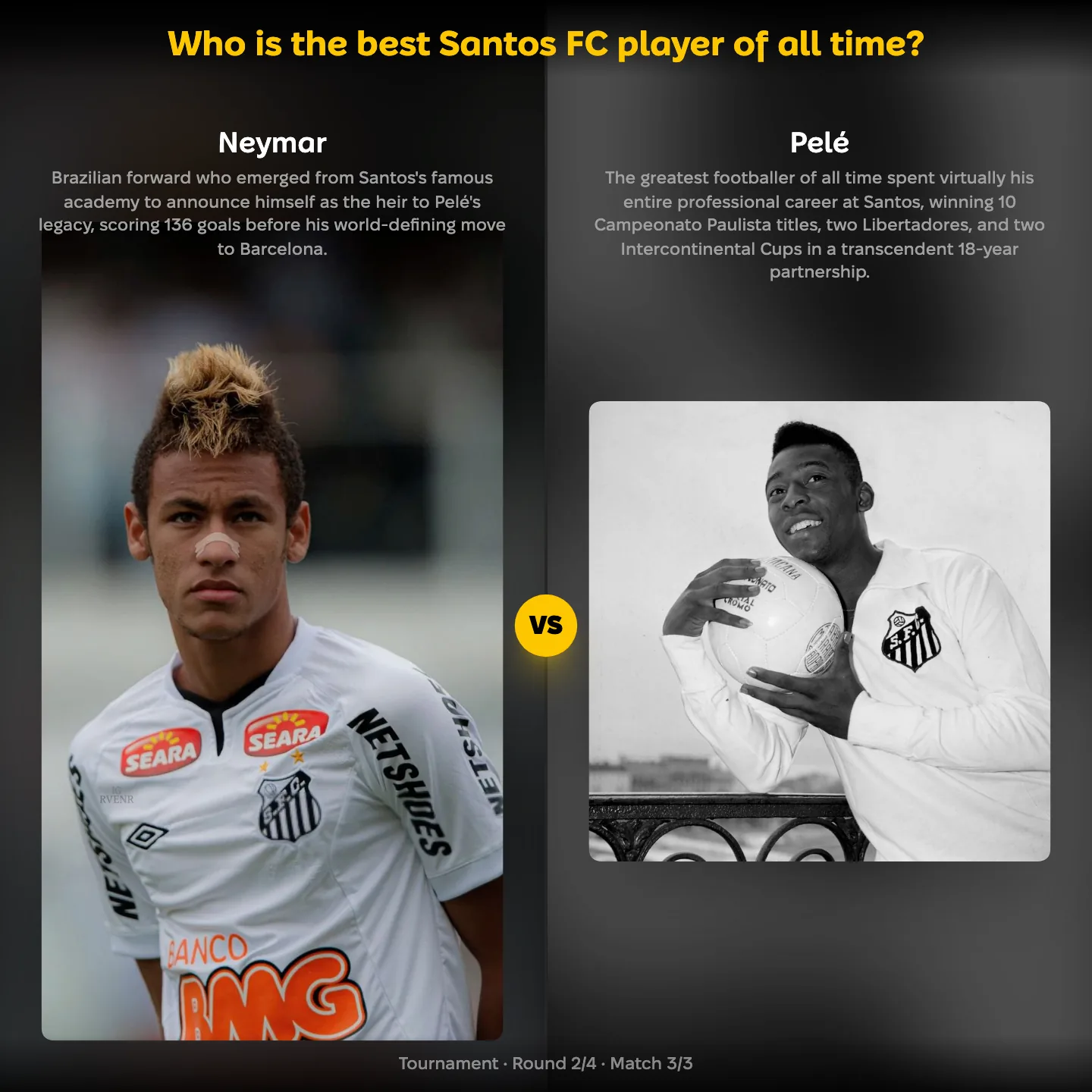
Brazil's greatest: Pelé's scoring record lasted 61 years
This ranking is Brazil only, so Maradona is not eligible for it. Pelé is the reason it is difficult.
He scored 77 goals for Brazil and nobody caught him for 61 years. Neymar finally passed the mark in Belém in September 2023, scoring twice against Bolivia to reach 79, with Ronaldo on 62 and Romário on 56 behind them.12
Zico sits fifth on Brazil's all-time scoring list with 48, and Garrincha and Rivaldo are on this ranking on merits other than goals.
Maradona's equivalent list is Argentina's, where the national federation credits him with 34 goals in 91 matches and exactly one hat-trick, against Austria in Vienna in 1980.13 A passport keeps him off this ranking, and it separates the two men more cleanly than any of their numbers do.
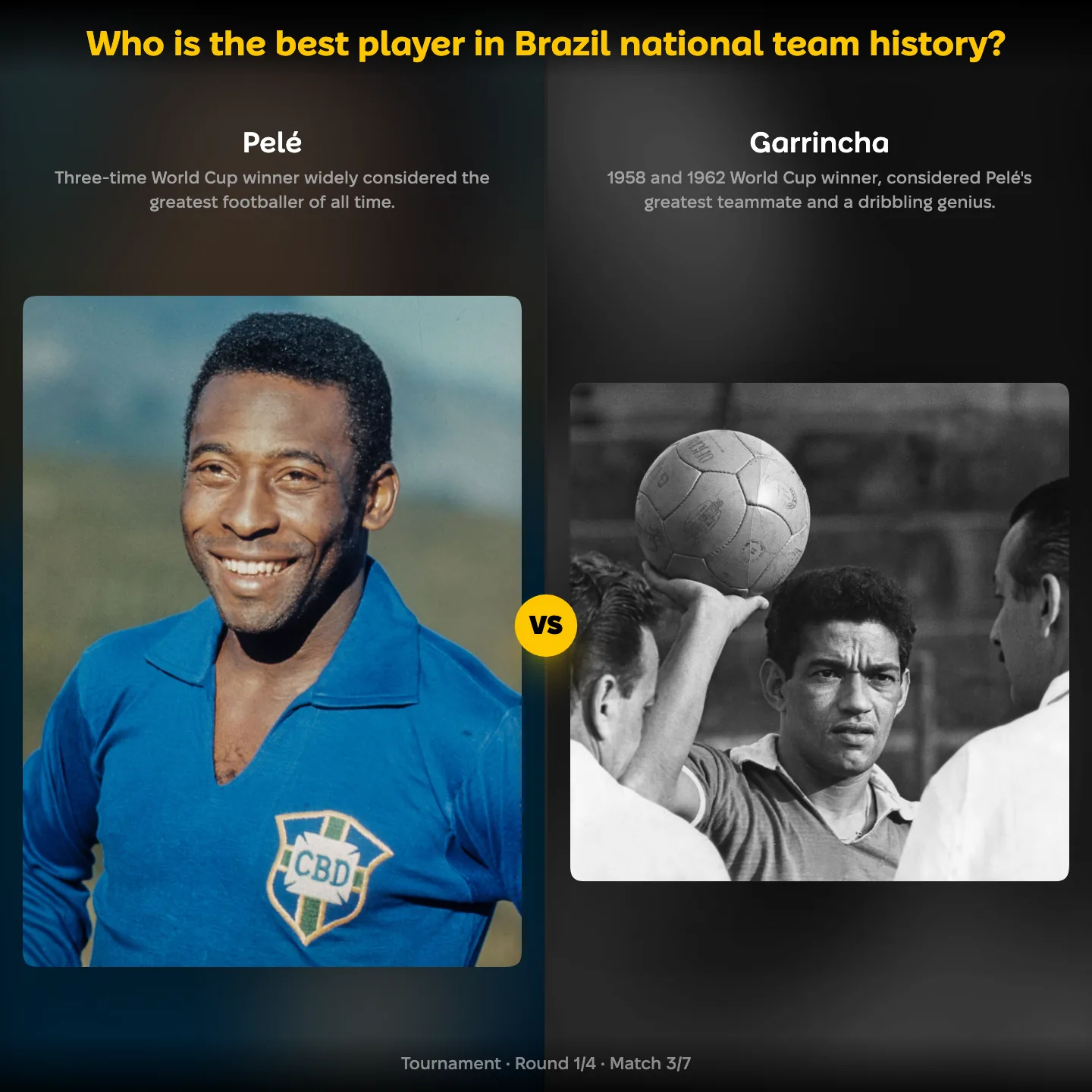
The European Cup: Maradona missed it, Pelé was never allowed in
The European Cup is absent from both careers, and only Maradona appears on this list of twelve players who never won it.
He had the opportunity: Barcelona from 1982, Napoli until 1991, Sevilla after that. The furthest he got in Europe was the 1988/89 UEFA Cup, which was the second-tier competition.10
Pelé is missing for the opposite reason: the tournament was never open to him. A career inside Brazil meant the Copa Libertadores he won twice with Santos was the largest thing he could enter.
Gianluigi Buffon, Zlatan Ibrahimović, Francesco Totti and Roberto Baggio are here too, which is decent evidence that this trophy sorts great careers badly.
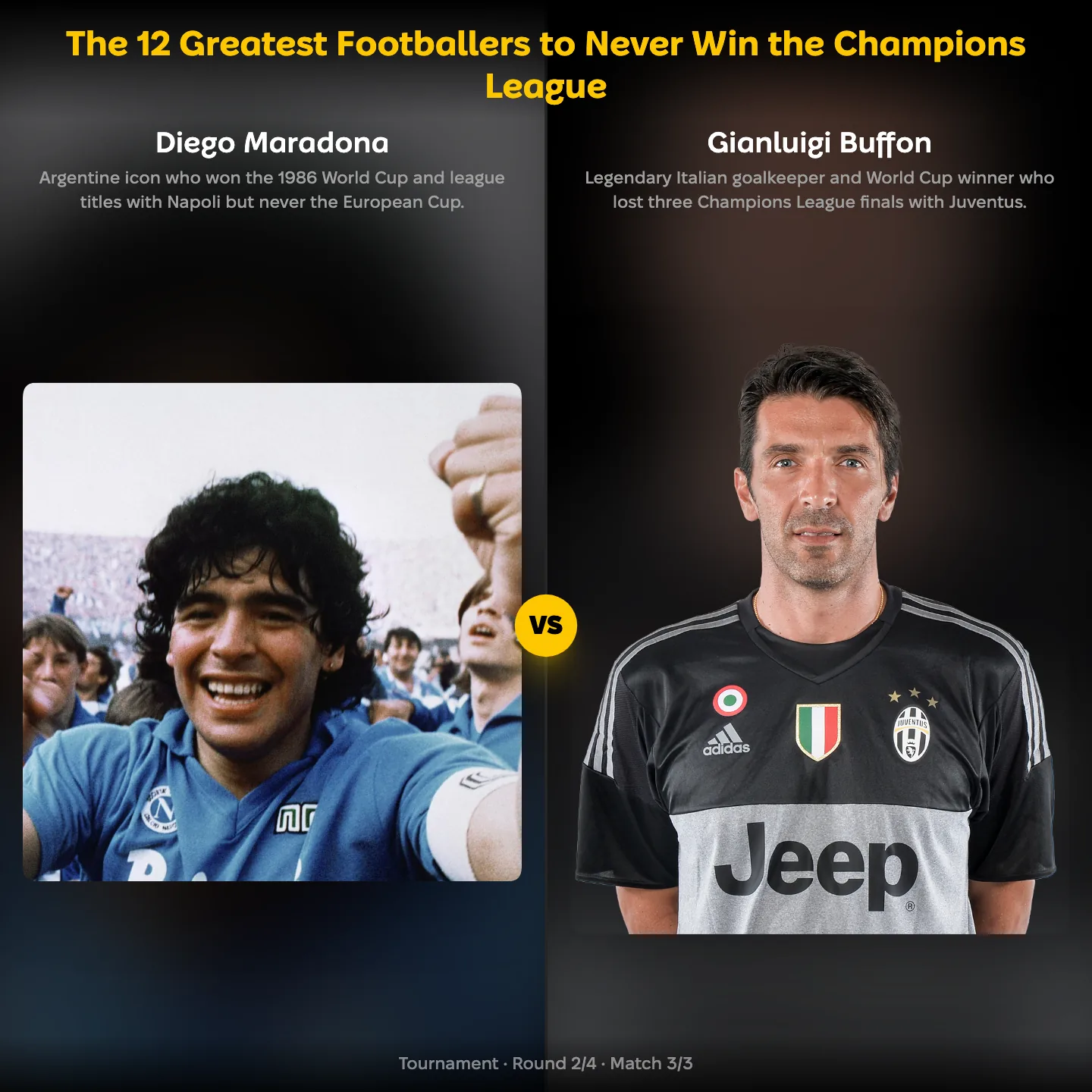
Pelé and Maradona: the verdict that came back as a tie
Thirteen questions, and the wording of each decides which of the two it favours. Count trophies and Pelé is alone; count one June in Mexico and Maradona is; ask about Copa América or the European Cup and both are excluded; sort by build and Xavi, Iniesta and Kanté belong in the same conversation. When football did try to choose, in 2000, it recognised both men at once, and FIFA now puts the earliest chance of anyone equalling Pelé's World Cup haul at 2030.1 Each of the thirteen runs on the head-to-head method.
If your answer is a third name, put it up against these two and see how far it gets.
More rankings, more angles
- Messi vs Ronaldo, Ranked Side by Side — the rivalry that took over from this one
- Lionel Messi, Ranked 16 Different Ways — the man who won the Copa América they missed
- Real Madrid vs Barcelona: 8 Rankings, One Argument — Spain's oldest grudge, eight questions deep
- Magic Johnson vs Larry Bird: 47 Years of the Same Argument — the rivalry that saved the league first
Sources
- FIFA — Pelé's three World Cup titles (1958, 1962, 1970), the only man with three; six goals in four starts at Sweden 1958 including the chip and volley against the hosts; the 1962 injury against Czechoslovakia and Garrincha's four goals; four goals at Mexico 1970; no active player able to equal the record in 2026, next chance 2030: fifa.com (checked 2026-08-03)
- FIFA — Spain beat Argentina 1-0 after extra time in the 2026 World Cup final at New York New Jersey Stadium on 19 July 2026: inside.fifa.com (checked 2026-08-03)
- FIFA — Maradona's second goal against England at the Estadio Azteca on Sunday 22 June 1986, past Beardsley, Reid, Butcher, Fenwick and Shilton, voted the World Cup Goal of the Century; Argentina 2-1 England: fifa.com (checked 2026-08-03)
- FIFA — Maradona's five goals and five assists at Mexico 1986 and the assist for Burruchaga in the 3-2 final; 23 fouls suffered against Italy in 1982 and 53 at Mexico 1986, both records; 152 World Cup free-kicks won, ahead of Messi; the only man to break his own world transfer record (£3m to Barcelona in 1982, £5m to Napoli in 1984); Napoli's single major trophy in 58 years before he signed: fifa.com (checked 2026-08-03)
- CONMEBOL — Pelé top scorer of the 1959 Copa América with eight goals in six matches at 18, his only edition; Argentina champions, Brazil runners-up: conmebol.com (checked 2026-08-03)
- CONMEBOL — Argentina's back-to-back Copa América win in 2024, their sixteenth and a record; Messi starting the final at 37 years and 20 days: conmebol.com (checked 2026-08-03)
- FIFA Museum — Pelé and Maradona jointly recognised as Player of the Century in 2000, Maradona's award decided by a public poll: digital.fifamuseum.com (checked 2026-08-03)
- FIFA — Brazil's 1958 squad numbers assigned at random after they failed to submit them, giving Pelé the No. 10; Santos debut and goal at 15 in 1956; the Brazilian government declaring him a national treasure to block a transfer; 18 years and 25 major titles at Santos including two Copa Libertadores and two Intercontinental Cups; 127 Santos goals in 1959; six assists at Mexico 1970 as the record for one World Cup, with Maradona on five in 1986; never beaten alongside Garrincha for Brazil: fifa.com (checked 2026-08-03)
- FIFA — Lamine Yamal arriving at the 2026 World Cup aged 18, and only four men having started and won a World Cup final as teenagers, Pelé among them: fifa.com (checked 2026-08-03)
- SSC Napoli — club palmarès: Serie A 1986/87, 1989/90, 2022/23 and 2024/25; Coppa Italia 1961/62 and 1986/87; Italian Super Cup 1990/91; UEFA Cup 1988/89: sscnapoli.it (checked 2026-08-03)
- Comune di Napoli — the city's listing for the Stadio Diego Armando Maradona and its 54,726 capacity: comune.napoli.it (checked 2026-08-03)
- FIFA — Pelé's 77 Brazil goals standing for 61 years, Neymar passing the record with two goals against Bolivia in Belém in September 2023 to reach 79, and Brazil's next scorers Ronaldo (62) and Romário (56): fifa.com (checked 2026-08-03)
- Asociación del Fútbol Argentino — Maradona's 34 goals in 91 matches for Argentina and his only hat-trick, against Austria in Vienna in 1980: afa.com.ar (checked 2026-08-03)