
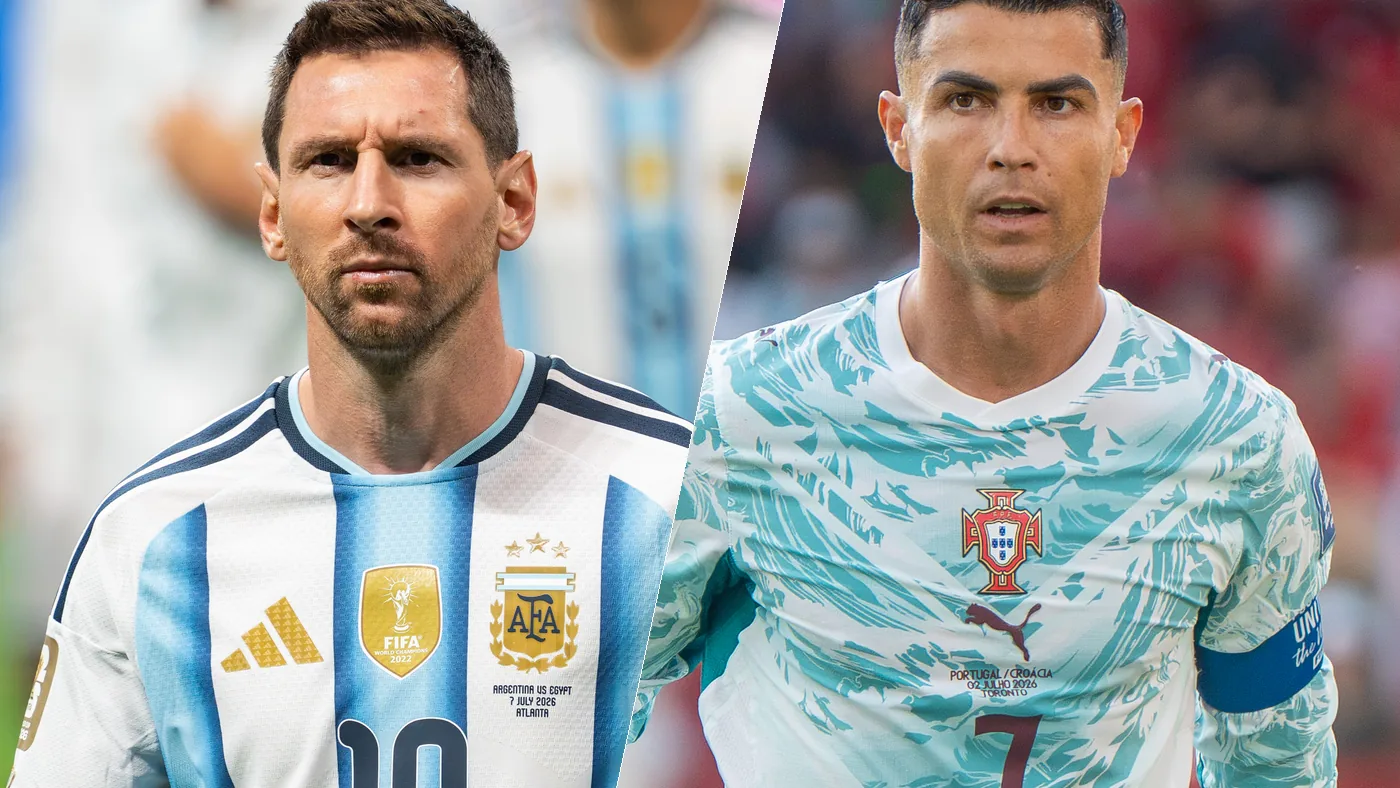
Lionel Messi and Cristiano Ronaldo both played their last World Cup this summer, and Spain ended both of them. Ronaldo went out in the round of 16 in Dallas on 6 July 2026; thirteen days later Messi lost the final in New Jersey — beaten by a Ferran Torres goal in the 106th minute.1 Ronaldo leaves the tournament on 233 caps for Portugal and 146 international goals, more than any man has scored for any country, and Messi leaves it on 207 caps for Argentina and the trophy Ronaldo never won.2 Sixteen rankings on this page hold both names.
Ronaldo could never enter the Copa América, Messi could never enter the Euros, and six World Cups each never once put them on the same pitch. Most of these sixteen lists turn on that.
Pelé, Maradona and Cruyff: the list that outgrows both of them
The widest ranking here asks for the greatest footballer who has played, and Messi and Ronaldo are two entries on it rather than the substance of it.
Messi's case rests on the 2022 World Cup, the result that deleted the last "but he never won it" from his record.
Ronaldo's rests on reach: the international scoring record, the Champions League scoring record, five European titles and league championships in England, Spain and Italy.
Then there is everyone who came first. Pelé won three World Cups, Maradona carried an ordinary Argentina side through 1986, and Cruyff changed what a forward was expected to do with the ball. Stretched across seventy years, twenty of Messi against Ronaldo is one chapter of the ranking rather than the ranking itself.
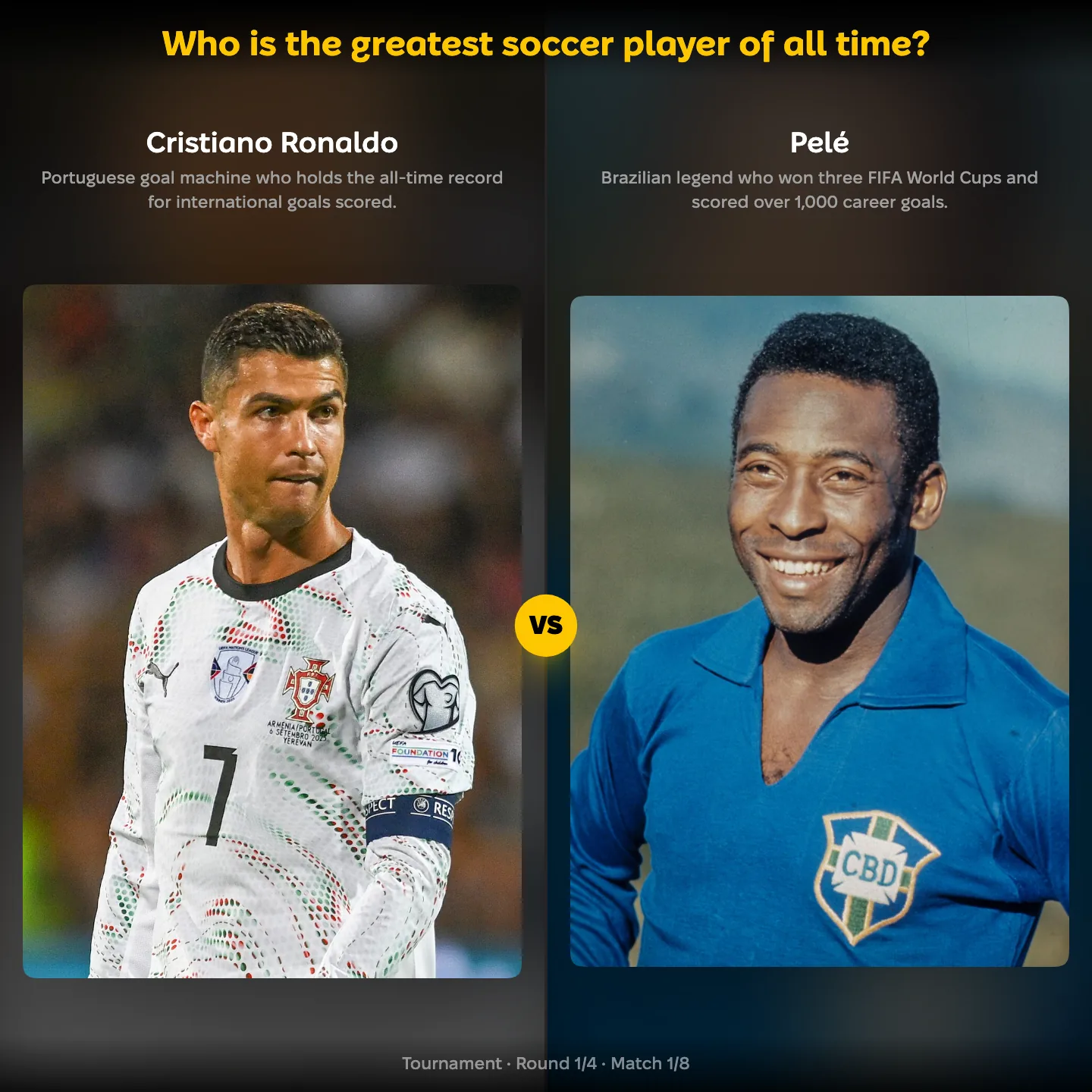
Ballon d'Or: thirteen of the last seventeen went to two men
France Football's award went to Messi or Ronaldo in ten consecutive years, 2008 through 2017, and to nobody else in that stretch.
Messi finished with eight: 2009 to 2012, then 2015, 2019, 2021 and 2023. Ronaldo finished with five, one at Manchester United in 2008 and four at Real Madrid in 2013, 2014, 2016 and 2017. Thirteen of the seventeen awards handed out since 2008 belong to one of them, and 2020 produced no award at all.3
Every other winner since 2000 has exactly one. Luka Modrić, Karim Benzema, Rodri and Ousmane Dembélé are on that list, and so are Ronaldinho, Kaká and Fabio Cannavaro.
The list also dates the rivalry precisely. It opens in 2008, closes in 2023, and by the end Messi was collecting the award as a Major League Soccer player.
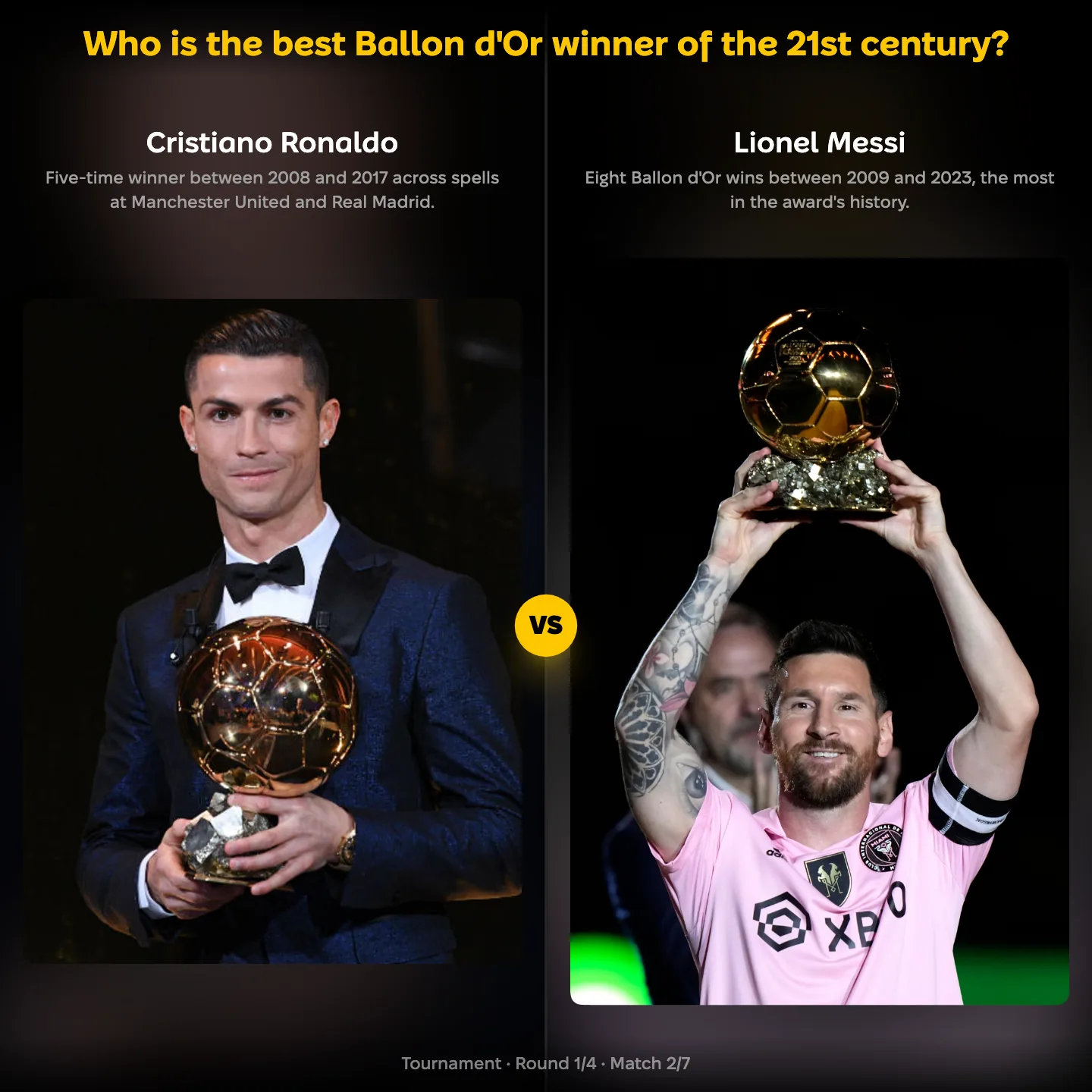
Champions League: Ronaldo's 140 goals against Messi's Barcelona
European nights are where Ronaldo's case is at its strongest and Messi's is merely excellent.
Ronaldo is the all-time leading scorer in the Champions League and in UEFA club competition overall, with 140 goals, and he won the trophy five times, four of them at Real Madrid.4
Messi's counter is a club record rather than a competition one. He scored 120 Champions League goals for Barcelona, more than Ronaldo managed for Real Madrid, and won four titles there.
Neither of them holds the rate. Alfredo Di Stéfano scored 49 in 58 European Cup games, back when the competition was knockout ties from the first round — Real Madrid needed seven matches to win the first one. Paolo Maldini, Zinedine Zidane, Raúl, Clarence Seedorf and Didier Drogba all built their reputations on the same nights.
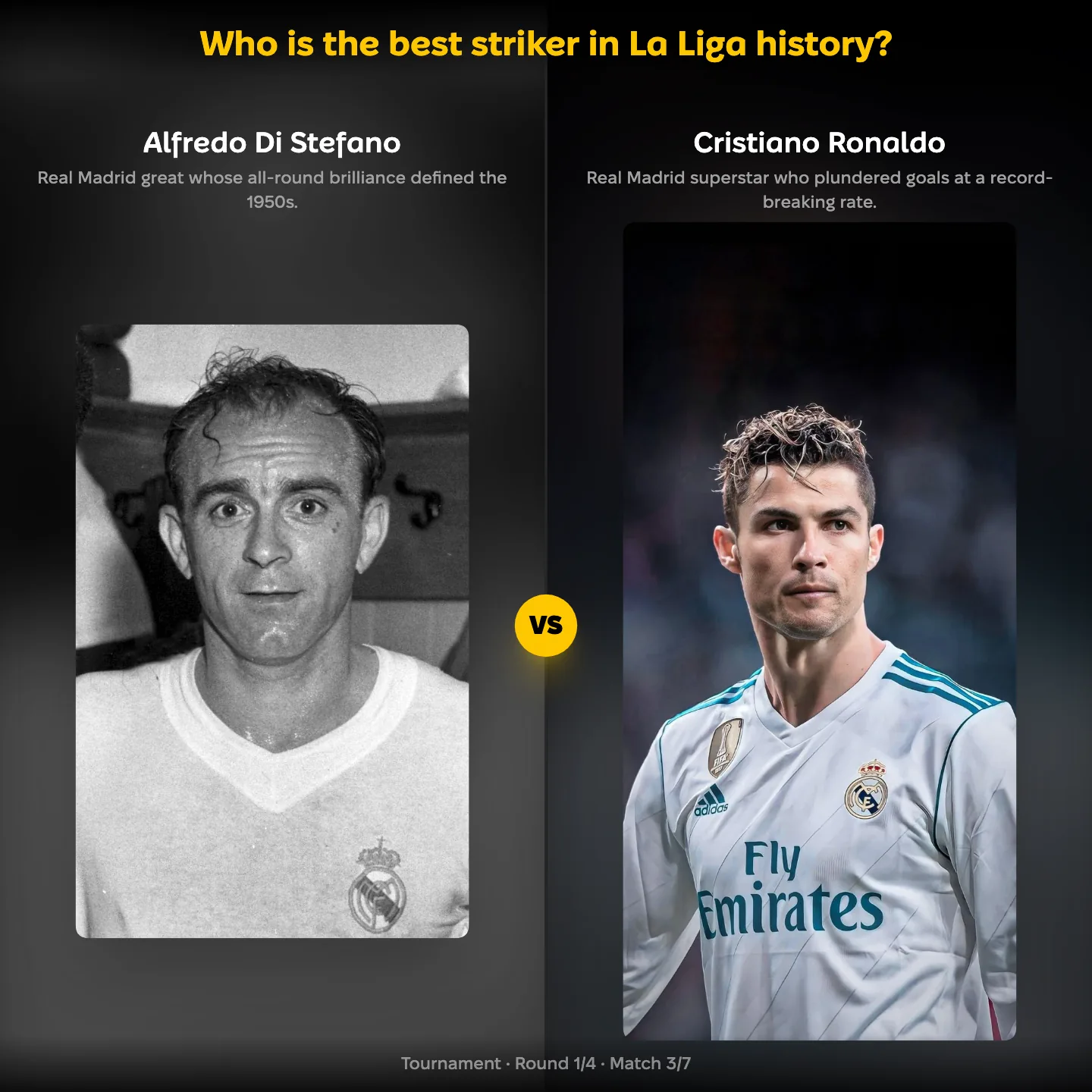
La Liga: 474 goals in 520 games, and eight top-scorer seasons
Messi and Ronaldo spent nine seasons in the same Spanish league, meeting twice a year in it.
Messi is La Liga's all-time leading scorer with 474 goals in 520 matches for Barcelona between 2005 and 2021, a rate of 0.91 a game. He was the league's top scorer in eight separate seasons and scored 36 hat-tricks, and both of those are records too.5
Ronaldo spent nine of his own seasons at Real Madrid over the same stretch, which is why the Spanish scoring charts of the 2010s read as a two-man table.
The rest of this ranking comes from a different game. Telmo Zarra's 251 stood as the league record until Messi passed it with a hat-trick against Sevilla in November 2014, and Zarra, Alfredo Di Stéfano and Hugo Sánchez all played in decades when a Pichichi took thirty goals rather than fifty.
Kylian Mbappé took the World Cup scoring record 32 days after Messi did
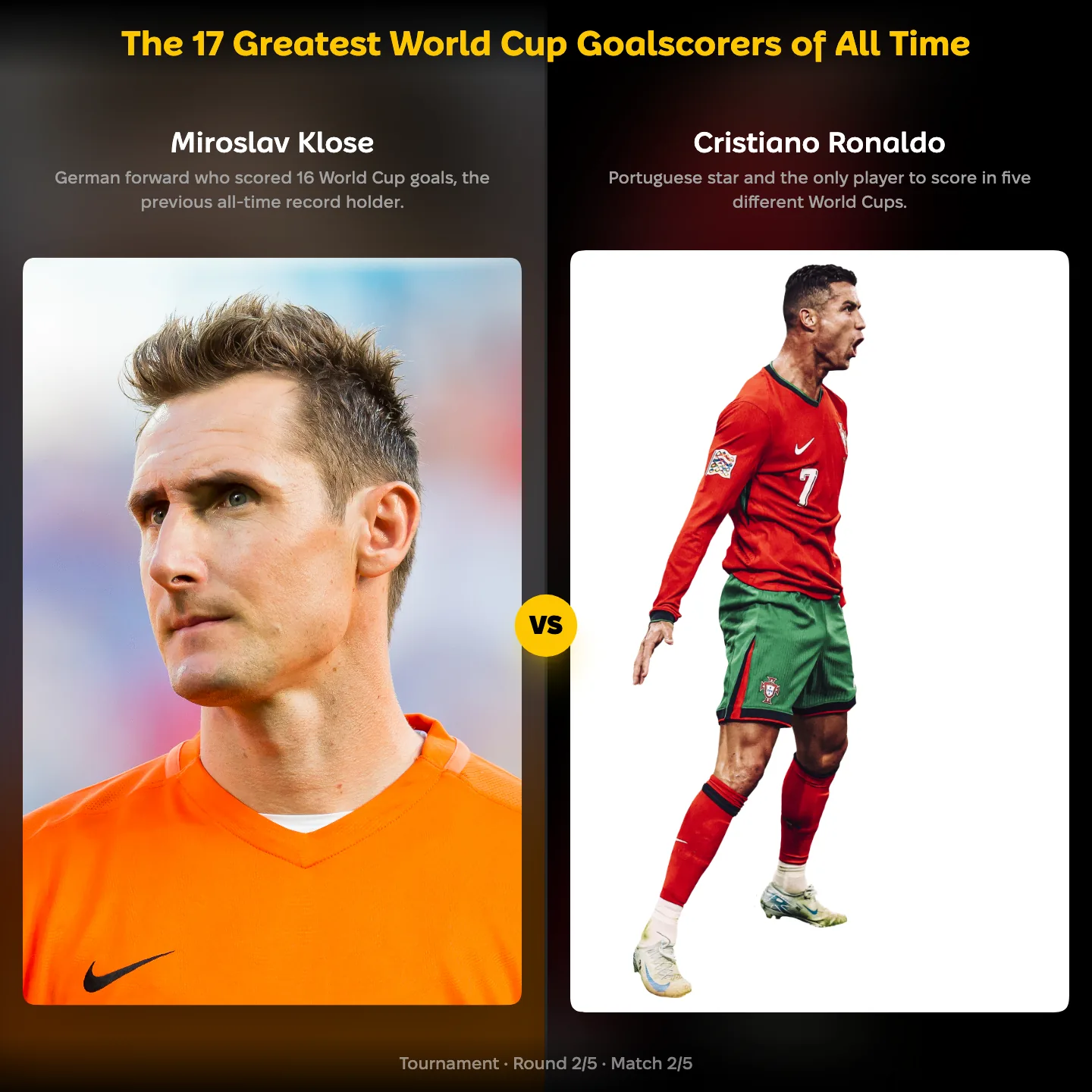
The all-time World Cup scoring list changed hands twice inside five weeks this summer, and Messi is the reason it moved the first time.
Miroslav Klose's 16 goals had stood since 2014. Messi went past them on 22 June in Dallas, scoring twice against Austria after opening the tournament with a hat-trick against Algeria.6
He kept the record for 32 days. Messi finished on 21 World Cup goals and Kylian Mbappé finished on 22, taking it from him on 18 July, the day before Argentina lost the final to Spain.7
Ronaldo was never in this part of the conversation, and the older names put the modern totals in proportion. Just Fontaine scored 13 in the single 1958 tournament, and Gerd Müller reached 14 across only two.
Cruyff, Puskás and the list Messi is disqualified from
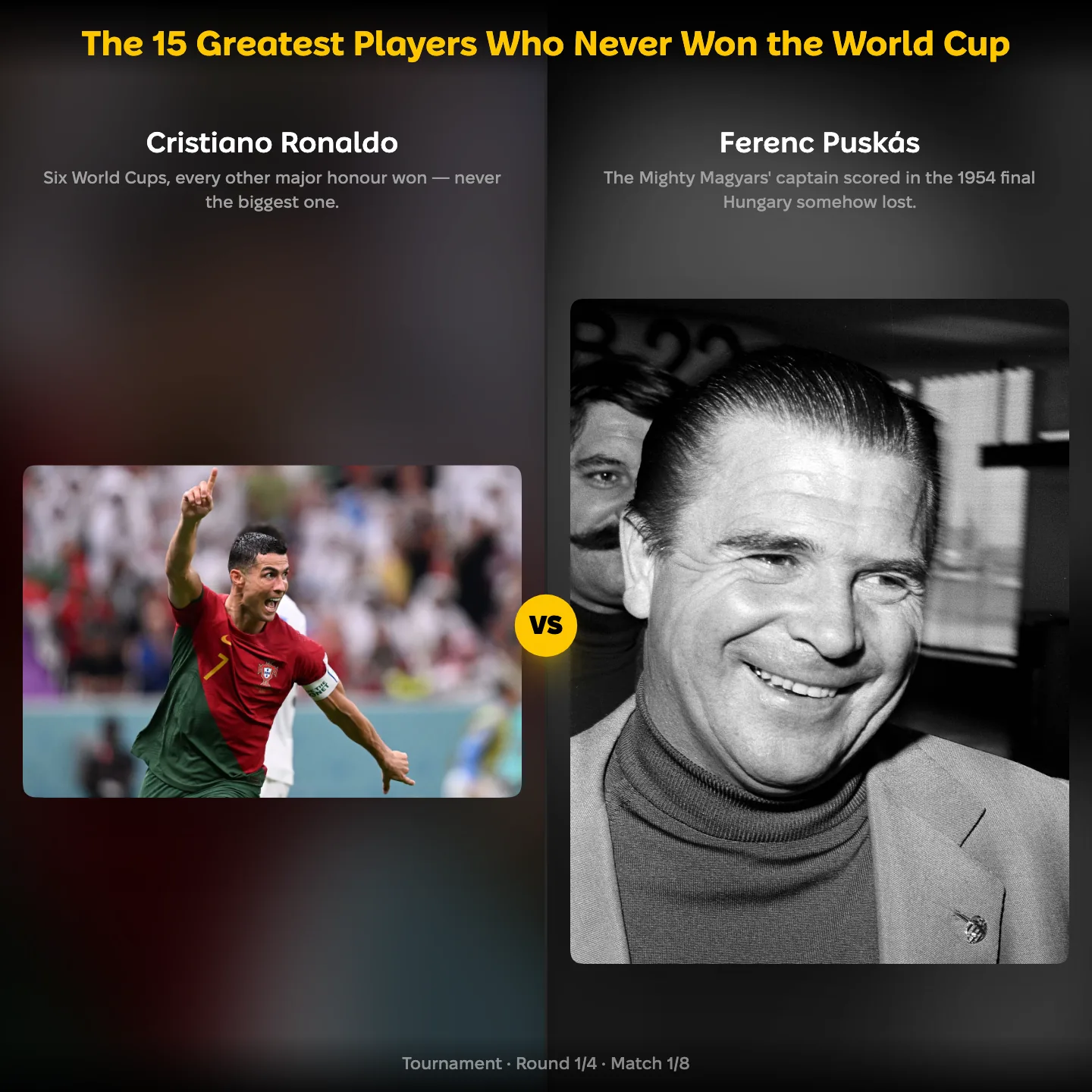
One ranking here excludes Messi by achievement. He won the World Cup in 2022, which removed him from every list of great players who never did.
Ronaldo qualifies, and his own summary of what he did win is short. He told SporTV after the Spain defeat that he had brought Portugal one European Championship and two Nations Leagues, and that the country had won nothing before him. He left the tournament with 27 World Cup appearances, second most in its history, and 11 goals.8
The company on the list explains it better than either man does. Johan Cruyff lost the 1974 final, Ferenc Puskás scored in a 1954 final Hungary somehow lost, and Alfredo Di Stéfano never played at a World Cup at all.
Spain, Dallas and New Jersey: the tournament that ended both careers
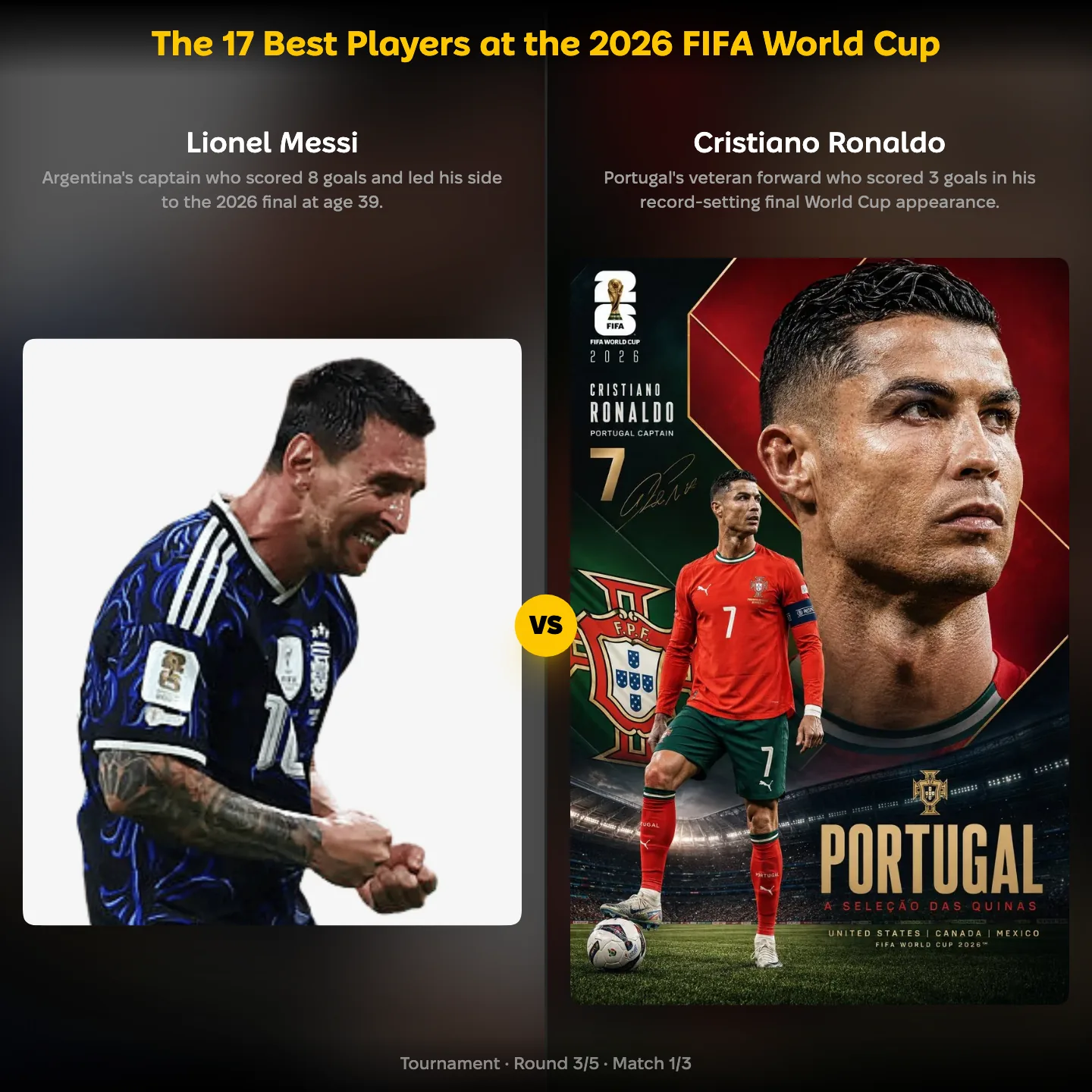
The 2026 World Cup was the last for Messi and Ronaldo, and Spain removed both of them from it.
It was also the first 48-team, 104-match World Cup, played over 39 days across Canada, Mexico and the United States in front of 6,810,966 spectators, and Rodri took the Golden Ball in the final Argentina lost.1
They never met in it. Portugal and Argentina were drawn into opposite halves, and the fixture that would have closed twenty years of this was never scheduled.
The ranking belongs to the side that won: Rodri, Lamine Yamal, Pedri and the Ferran Torres who ended it.
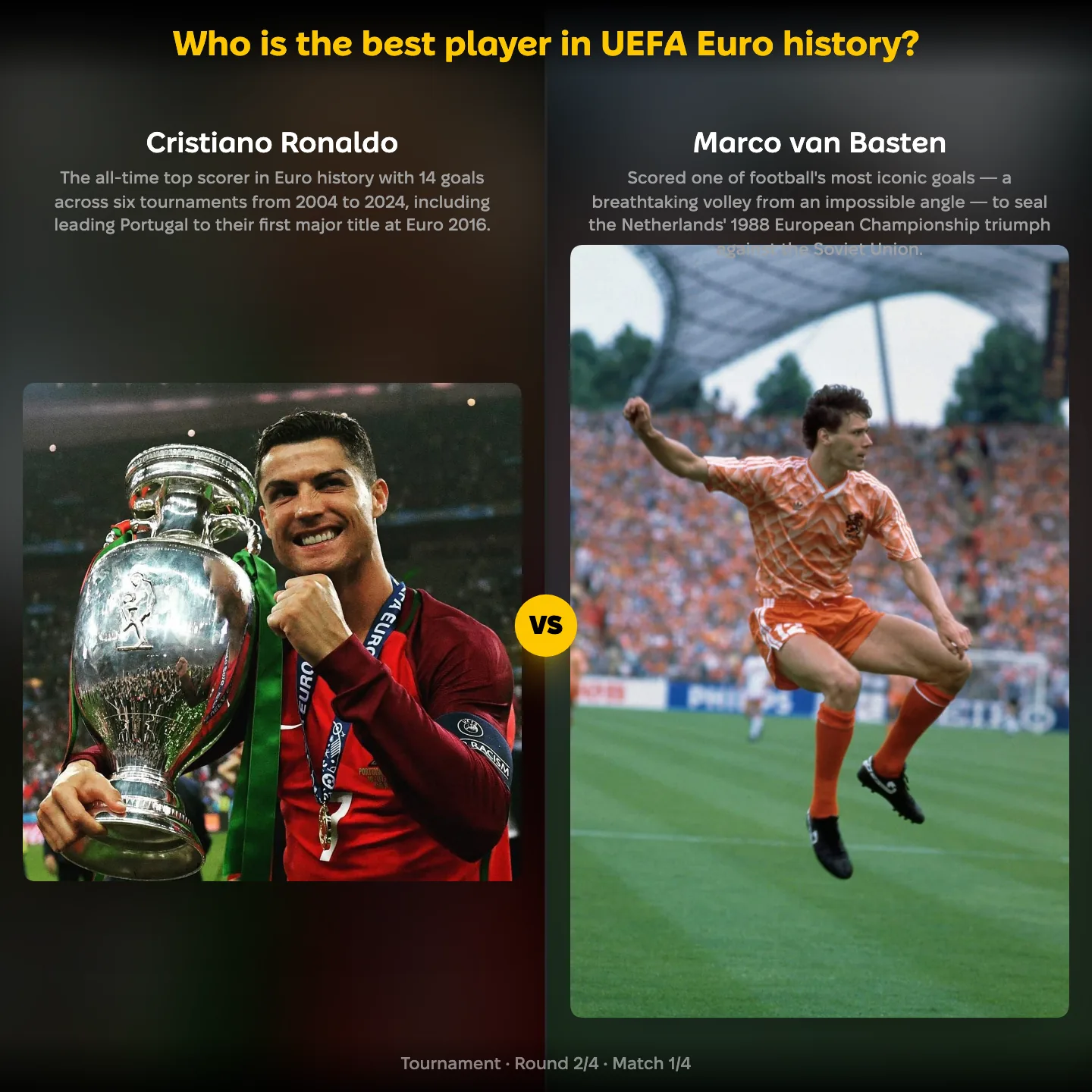
UEFA Euro: Ronaldo's 14 goals, five clear of Platini
The European Championship is one of two tournaments in this article that only one of the two could enter.
Ronaldo is its all-time leading scorer with 14 goals, five ahead of Michel Platini's nine, and Portugal's win at Euro 2016 was the first major title in the country's history.9
Messi is not on this list and never could have been. He was born in Rosario, and the Euros are shut to him for the same reason the Copa América is shut to Ronaldo.
Everyone Ronaldo is measured against here is European by definition: Platini, Marco van Basten, Antoine Griezmann. It is the one place in the article where the comparison the whole page is built on cannot be made.
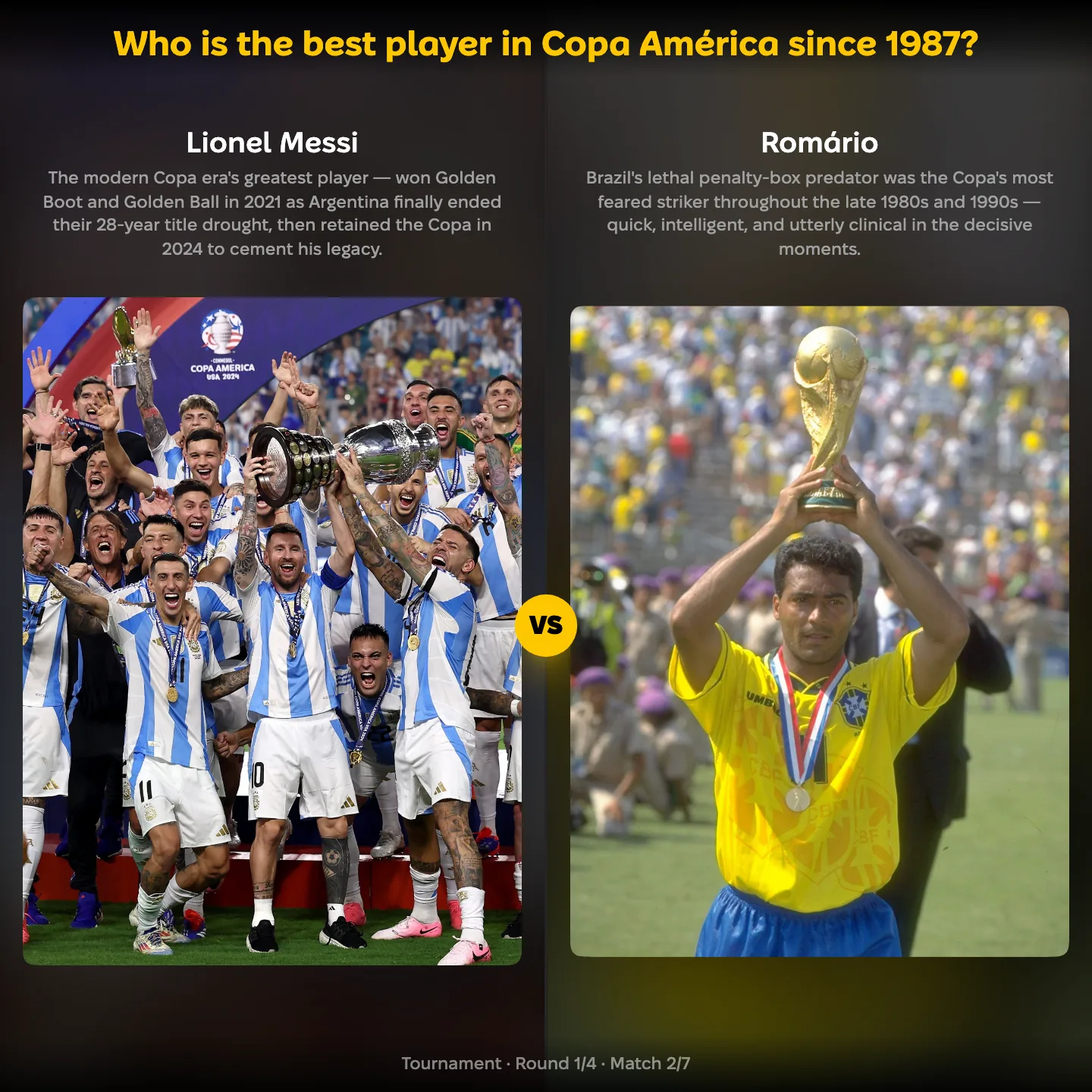
Copa América: Messi's 14 goals, three short of Zizinho
South America's equivalent is the tournament where Messi finally won something in an Argentina shirt.
He has 14 Copa América goals and has scored in six different editions, in 2007, 2015, 2016, 2019, 2021 and 2024, a spread only Zizinho has matched. The tournament record is 17, held jointly by Zizinho and Norberto Méndez from the 1940s.10
Ronaldo has no entry here, for the mirror-image reason Messi has none at the Euros.
Messi's competition on this list is Brazilian, Chilean and Colombian: Romário, Ronaldinho, Ronaldo Nazário, Carlos Valderrama, Alexis Sánchez, Arturo Vidal. It is the one continental ranking where the name he is measured against is not Ronaldo.
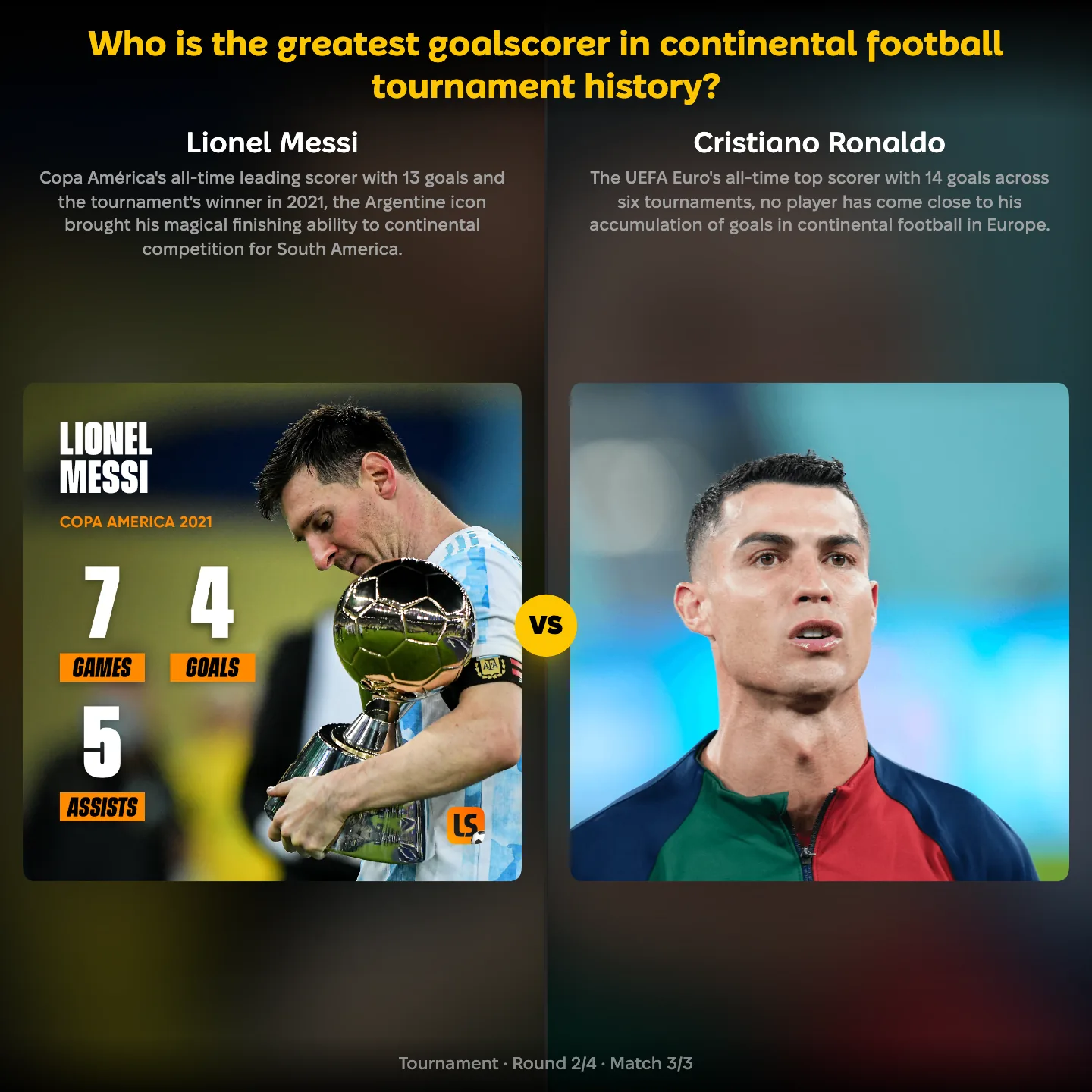
Euro against Copa América: the same total, two different records
One ranking sets the continental tournaments side by side, which is the nearest this rivalry gets to being measured directly.
Ronaldo's 14 Euro goals are a competition record. Messi's 14 at the Copa América are not, because a Brazilian and an Argentine from the 1940s are still clear of him.
The two tournaments do not run on the same clock either. The Copa América has been staged far more often than the Euros, in some stretches in consecutive years, so an identical number of goals means a different thing on each side of the Atlantic.
The list widens past both of them with Ali Daei, Samuel Eto'o and Hossam Hassan, whose totals come from the Asian Cup and the Africa Cup of Nations. Messi and Ronaldo never played a minute in either competition.
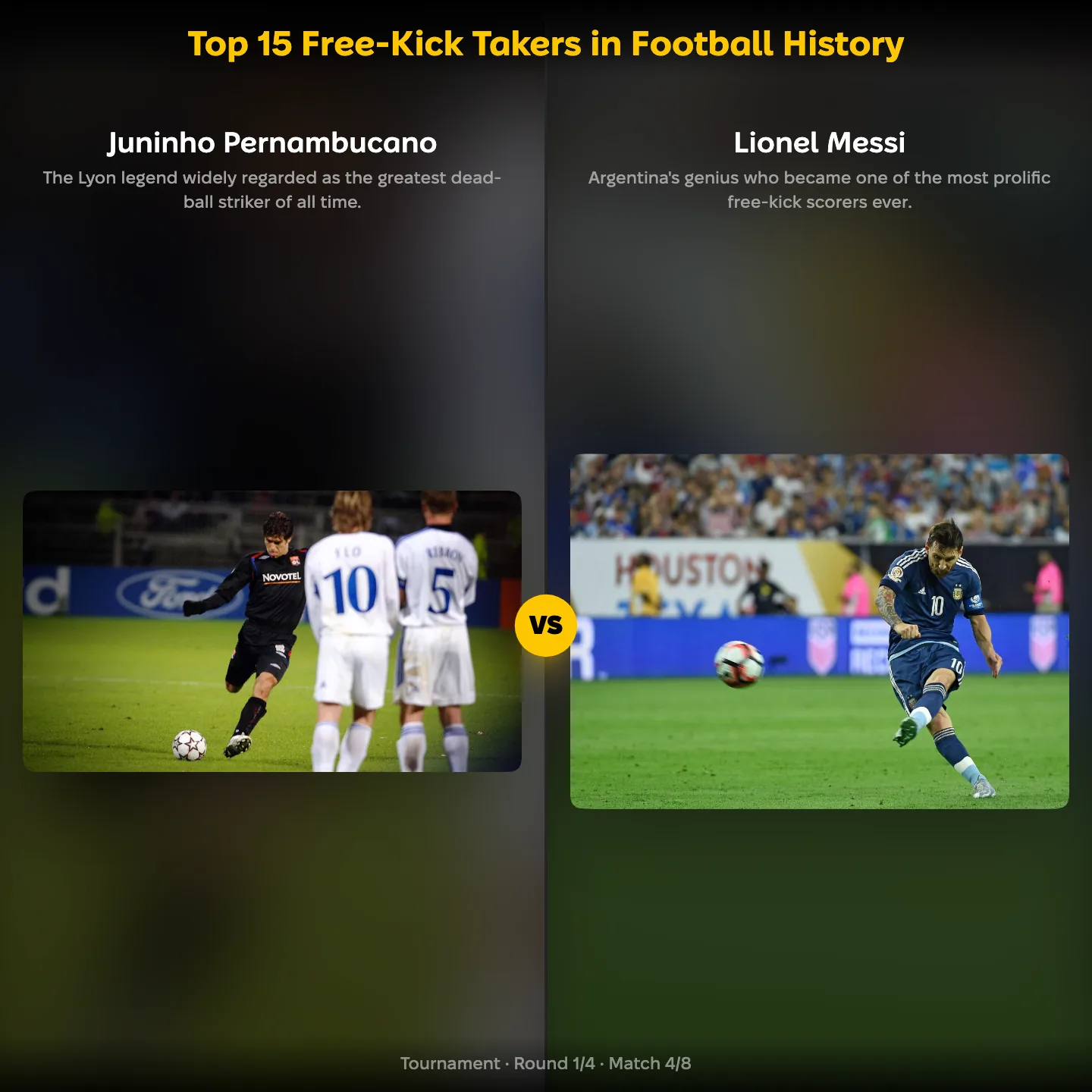
Juninho Pernambucano built a whole career on the free kick
Free kicks are where both of them are famous and neither is the specialist.
Ronaldo's knuckleball run-up was the most copied dead-ball routine of the late 2000s, and goalkeepers spent the following decade learning to read it.
Messi went the other way round. His free-kick returns arrived late, after he settled on a low curled shot inside the near post instead of a strike lifted over the wall.
Juninho Pernambucano made the technique his entire trade, and Roberto Carlos, Andrea Pirlo, Zico, David Beckham and James Ward-Prowse are on the list for the same reason. Messi and Ronaldo are on it as great forwards who also took free kicks, which is a different qualification.
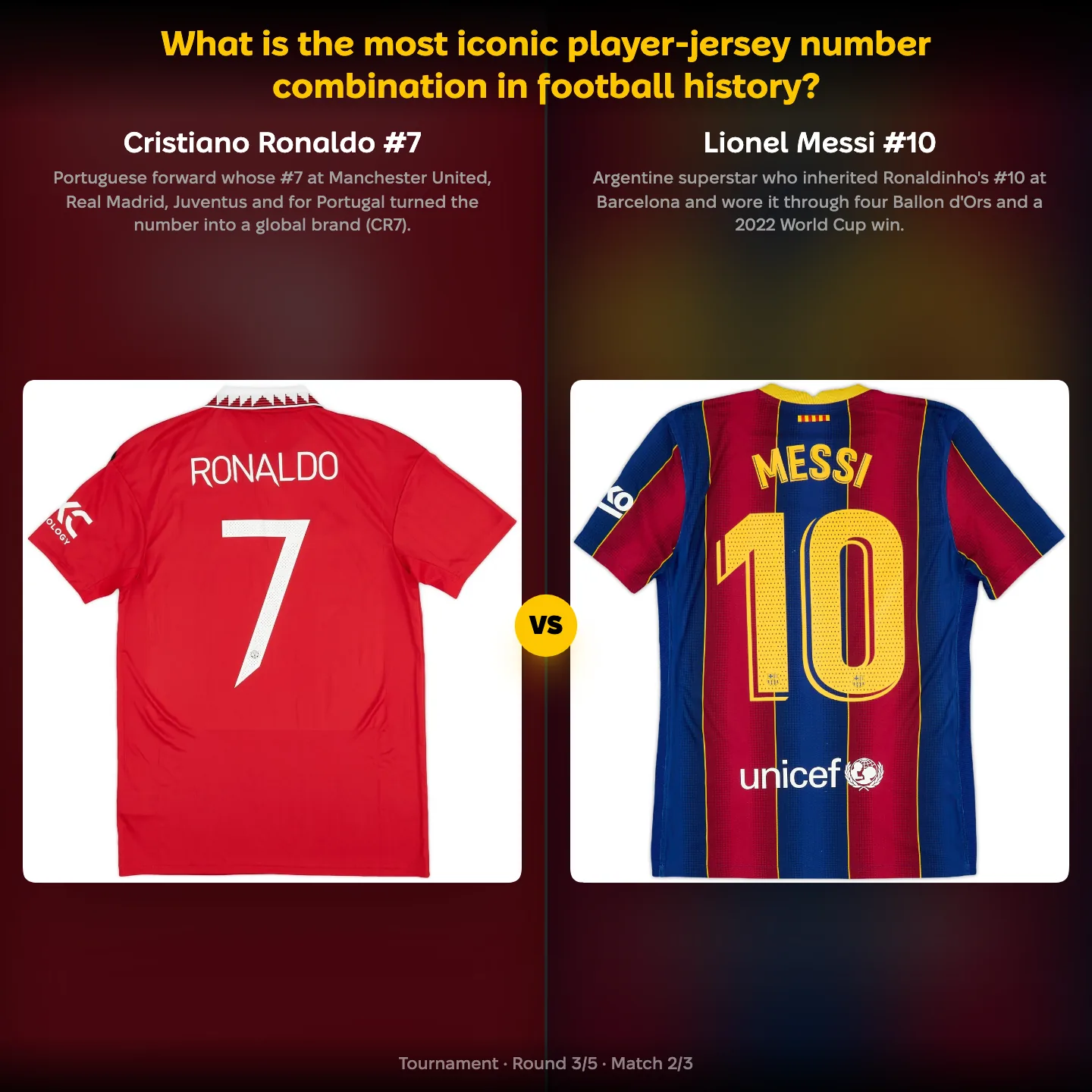
CR7 and the No. 10: two squad numbers that became businesses
One ranking here is about numbers rather than players, and both of them are in it through a shirt.
Ronaldo inherited the 7 at Manchester United in 2003 from George Best, Eric Cantona and David Beckham, and turned CR7 into a clothing line, a hotel chain and a museum.
Messi took the 10 from Ronaldinho at Barcelona in 2008, a number that already ran back through Maradona and Pelé to the point where "a number 10" describes a job rather than a squad position.
The list is full of numbers that outlasted the men who wore them: Cruyff's 14, Maldini's 3, Beckenbauer's 5, Bobby Moore's 6, Pirlo's 21.
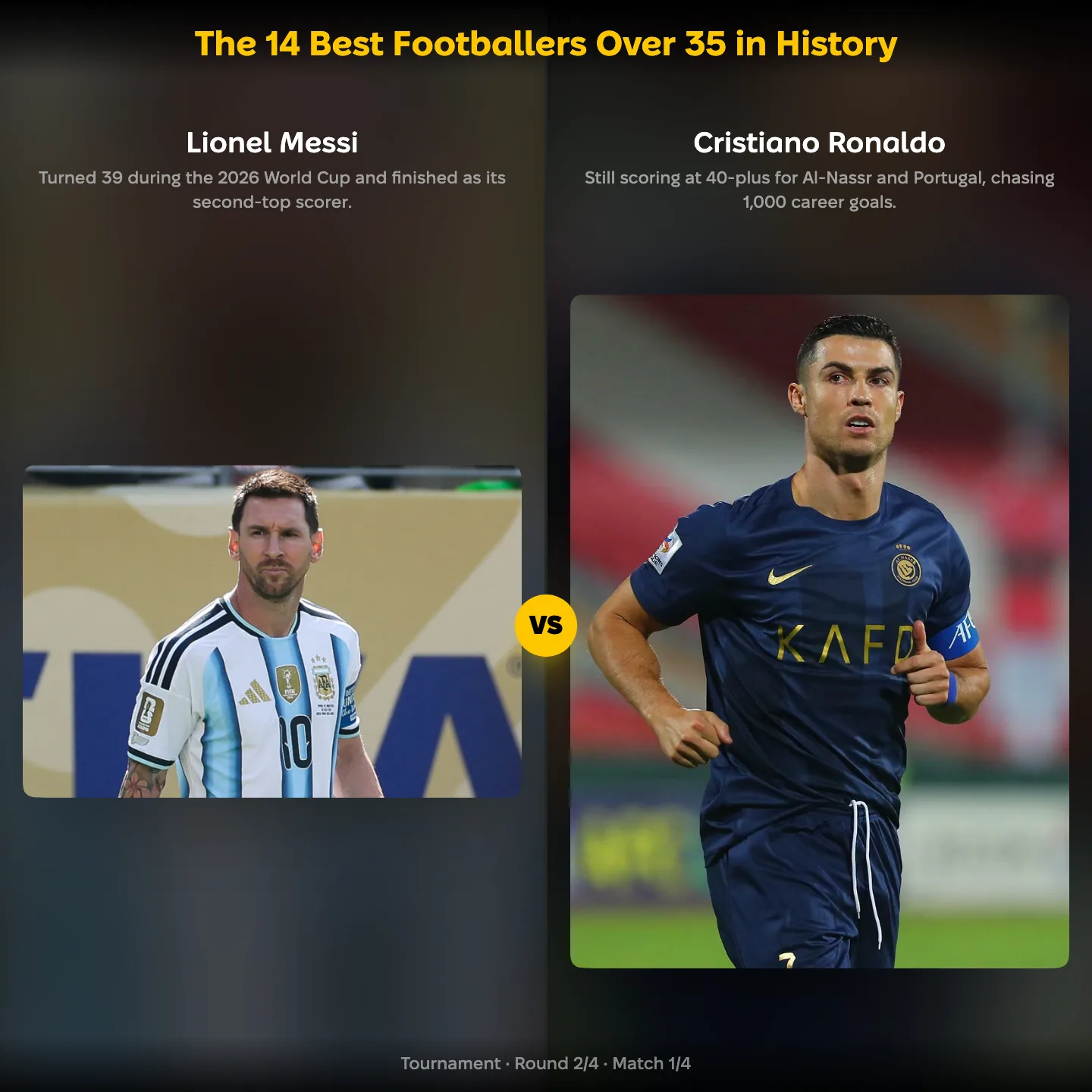
Roger Milla, and the over-35 list forwards are not supposed to reach
This ranking did not exist for most of the rivalry. It opened up because both of them kept playing past the age at which forwards normally stop.
FIFA's list of the oldest World Cup goalscorers has Roger Milla first at 42 years and 39 days, Ronaldo second at 41 years and 147 days for his penalty against Croatia, Pepe third, and Messi fourth at 39 years and 13 days for his goal against Egypt.11
Three of those four are Portuguese or Argentine, and Ronaldo and Messi are two of them.
The rest of the category is goalkeepers and defenders — the honest shape of footballing old age. Gianluigi Buffon, Dino Zoff, Peter Shilton and Javier Zanetti are all on it. Kazuyoshi Miura was still a professional at 57. Messi and Ronaldo are the exceptions on a list that was not built for forwards.
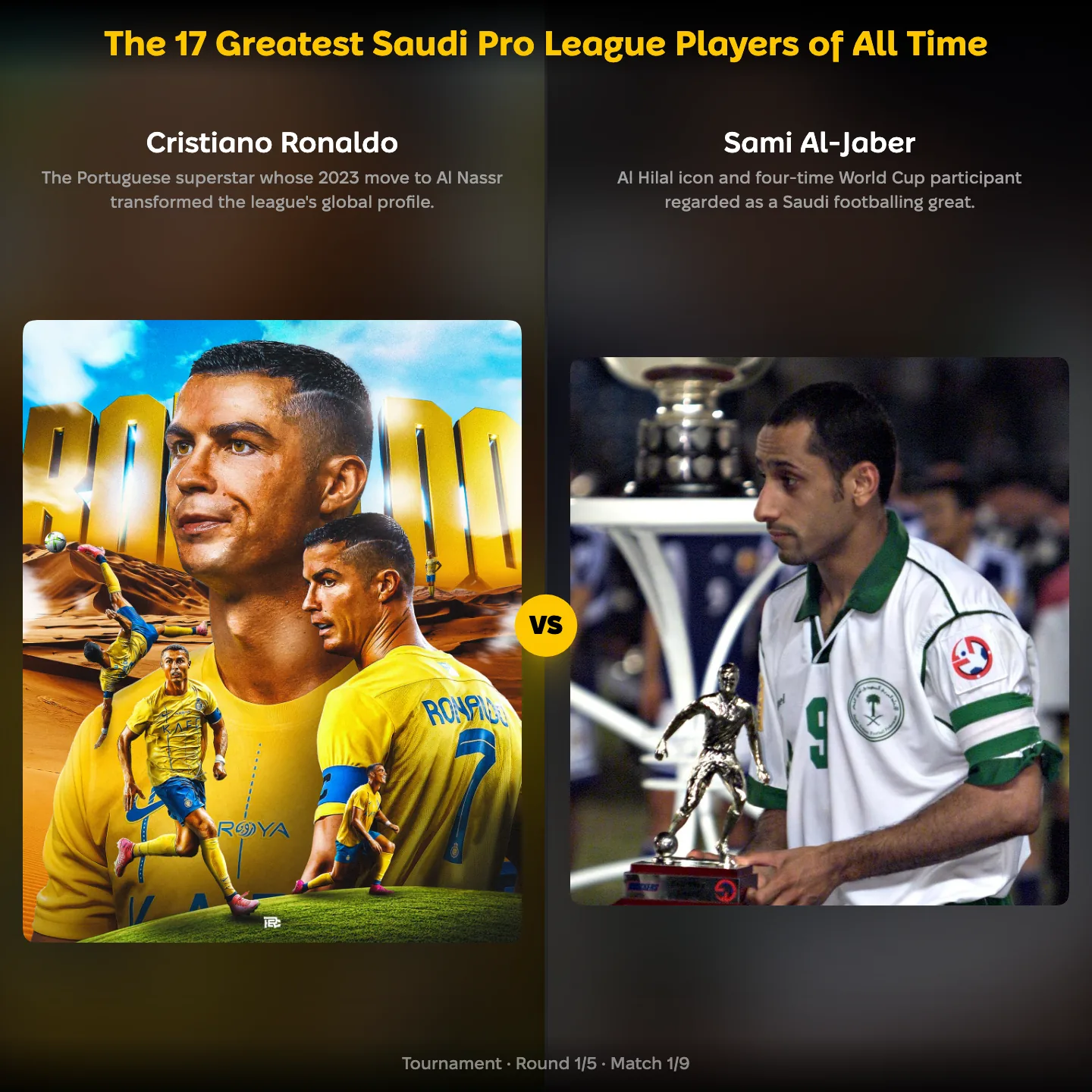
Al Nassr: the league Ronaldo turned into a destination
Ronaldo's move to Al Nassr in January 2023 is the fork where two careers that had run parallel for fifteen years stopped doing so.
Al Nassr announced in June 2025 that he would stay until 2027, a two-year extension the club confirmed itself on social media.12
Messi was linked with the same league in the same summer of 2023 and went to Florida instead. Karim Benzema, Neymar, Sadio Mané, Riyad Mahrez, N'Golo Kanté and Rúben Neves did follow Ronaldo into it, most of them inside two transfer windows.
Saudi football did not start with the imports. Sami Al-Jaber played four World Cups for Saudi Arabia and Saeed Al-Owairan scored the goal that defined the country's 1994 tournament, both of them decades before the money arrived.
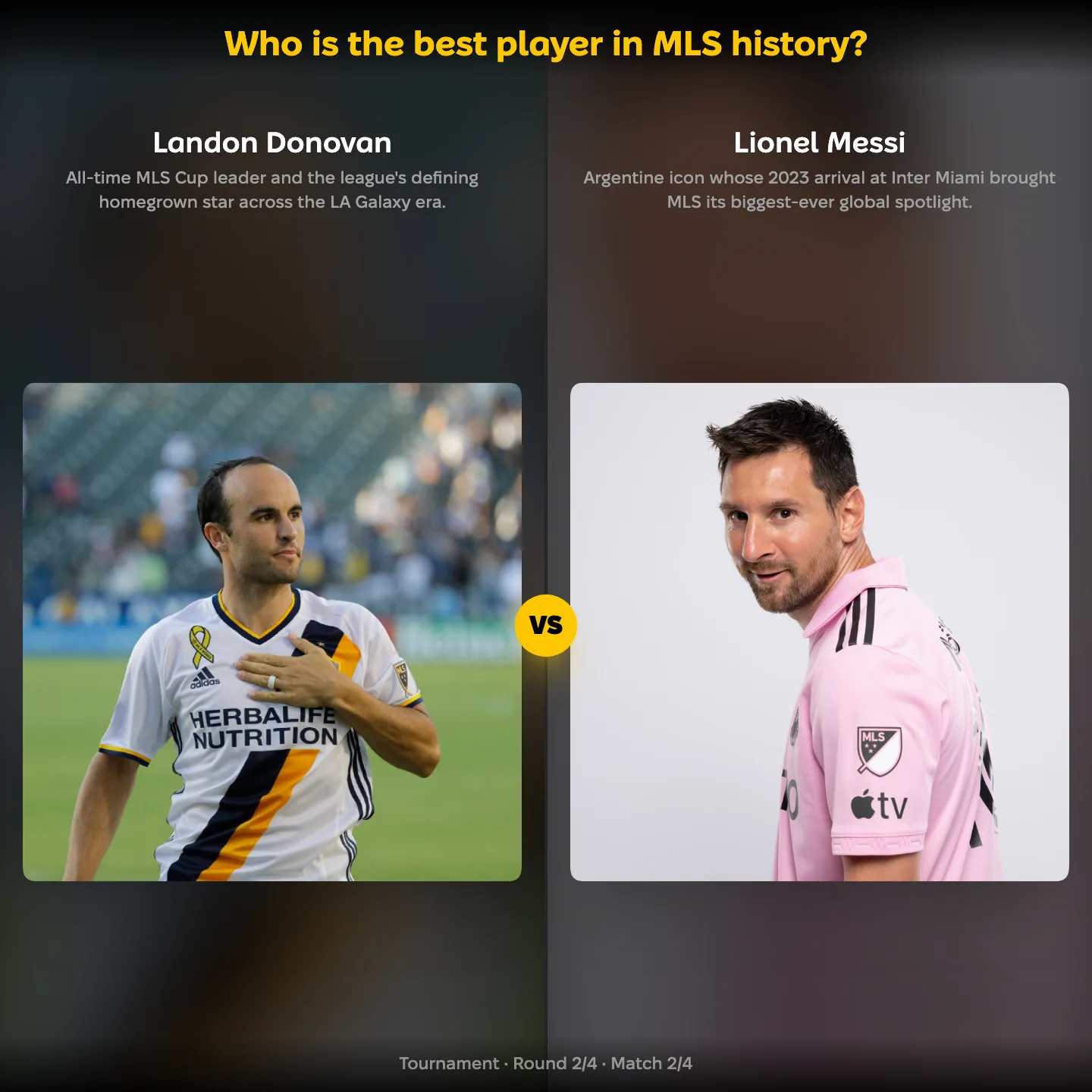
Inter Miami: Messi after Beckham and Donovan
Messi signed for Inter Miami in July 2023 and has said it will be the last club of his career.
The club extended him through the end of the 2028 Major League Soccer season, announcing it with a video of Messi signing on the site of its unfinished stadium at Miami Freedom Park.13
Ronaldo's Saudi move and Messi's American one landed six months apart, and together they are the clearest measure of how differently two forwards of the same age read the same kind of offer.
MLS had thirty years of its own history before either of them arrived. Landon Donovan won six MLS Cups, David Beckham arrived in 2007 as the league's first global signing, and Carlos Valderrama, Marco Etcheverry and Preki built the league in the 1990s.
Michael Jordan, Muhammad Ali, and football as one sport among many
Step outside football and the field widens until Messi and Ronaldo stop being each other's only rival.
Ronaldo's audience was built on two decades of being photographed everywhere, as much as on the goals themselves.
Messi's fame is narrower and more tied to the football itself, and it widened sharply once Argentina won in 2022.
Set against Michael Jordan, Muhammad Ali, Usain Bolt, Serena Williams, Roger Federer, Kobe Bryant and Sachin Tendulkar, the two of them are two names among 32. That is the scale the rivalry never applies to itself.
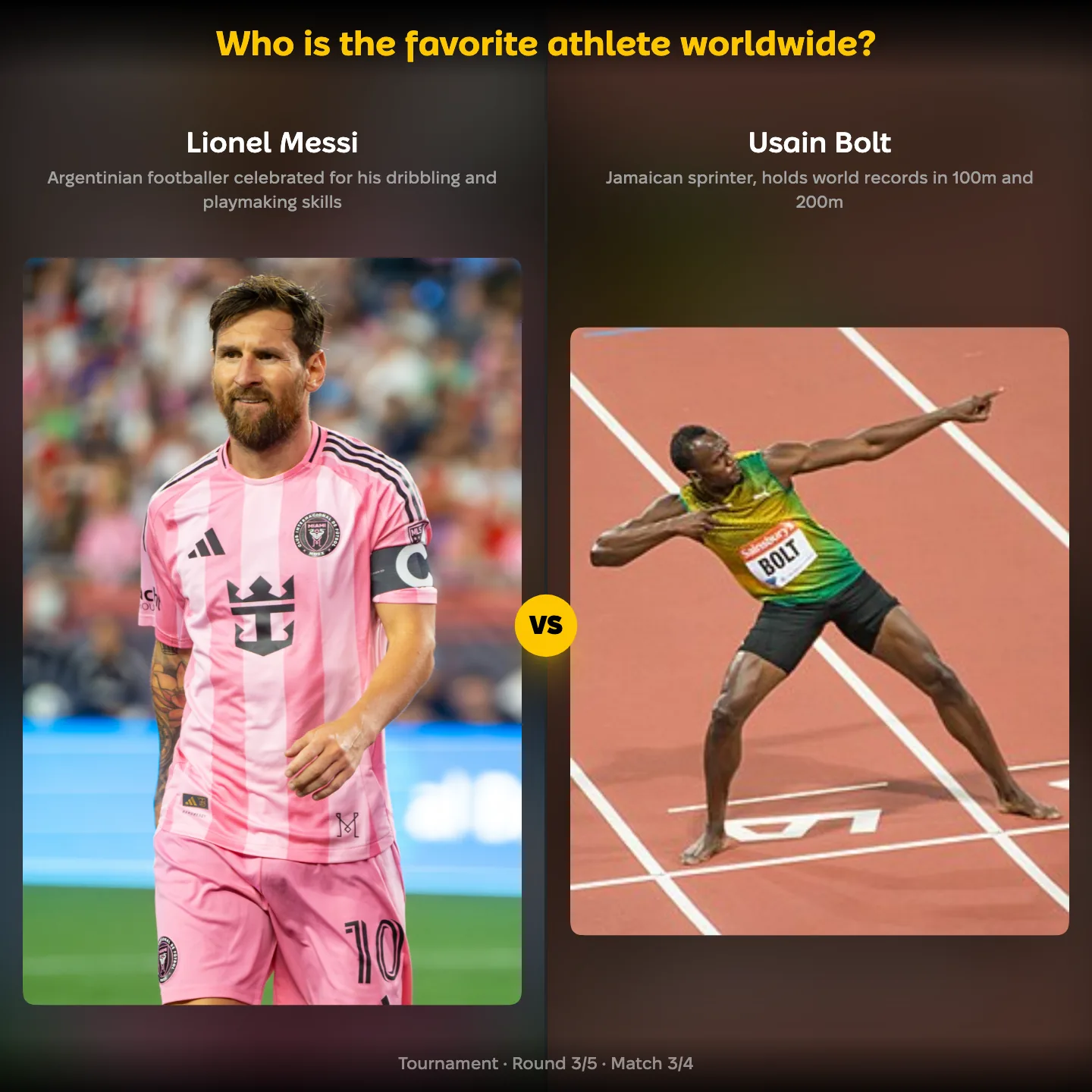
What twenty years of Messi and Ronaldo did not settle
Both of them left the World Cup this summer without ever having faced each other in one, and the tournament meant to be the last word instead handed the scoring record to a 27-year-old Frenchman. Across these sixteen rankings the deciding fact keeps sitting outside the two players: a continent one of them was born on, a draw that kept them apart, a year with no award in it. Each ranking gets there the same way, by comparing one pair at a time.
If your own answer moves depending on which of those questions you were handed, write the question yourself and work the pairs from there.
More rankings, more angles
- Lionel Messi, Ranked 16 Different Ways — the same player with Ronaldo taken out
- Real Madrid vs Barcelona: 8 Rankings, One Argument — the two clubs that staged nine years of this
- Kylian Mbappé Is on Every List, Never in the Same Place — the forward who took the World Cup record
- Pelé vs Maradona — the Answer Changes With the Question — the Argentina-Brazil version, one generation earlier
Sources
- FIFA — 2026 World Cup final result, Ferran Torres' 106th-minute goal, the 48-team/104-match format, the 39-day schedule, attendance of 6,810,966 and Rodri's Golden Ball: inside.fifa.com (checked 2026-08-03)
- Ballon d'Or (official) — Ronaldo's 233 Portugal caps and 146 international goals, Messi's 207 Argentina caps, and Mbappé's 22 World Cup goals against Messi's 21: ballondor.com (checked 2026-08-03)
- Ballon d'Or (official) — complete men's winners list: Messi's eight awards, Ronaldo's five, the unbroken 2008–2017 run, the cancelled 2020 edition and the single wins of Modrić, Benzema, Rodri and Dembélé: ballondor.com (checked 2026-08-03)
- UEFA — Ronaldo as all-time leading scorer in the Champions League and UEFA club competition with 140 goals, Messi's 120 Champions League goals for Barcelona against Ronaldo's 105 for Real Madrid, and Di Stéfano's 49 in 58 European Cup games: uefa.com (checked 2026-08-03)
- Guinness World Records — Messi's 474 La Liga goals in 520 games for Barcelona (2005–2021), his 0.91 goals per game, eight top-scorer seasons, 36 hat-tricks, and Telmo Zarra's previous record of 251: guinnessworldrecords.com (checked 2026-08-03)
- FIFA — Messi passing Klose's 16-goal record against Austria on 22 June 2026 in Dallas, and his opening hat-trick against Algeria: fifa.com (checked 2026-08-03)
- FIFA — the record-holder progression, showing Klose from 2014 to 2026 on 16, Messi from 16 June to 18 July 2026 on 21, Mbappé since 18 July on 22, and Just Fontaine's 13 in 1958: fifa.com (checked 2026-08-03)
- FIFA — Ronaldo's round-of-16 exit to Spain in Dallas, his SporTV remarks about Portugal's European Championship and two Nations Leagues, and his 27 World Cup appearances and 11 goals: fifa.com (checked 2026-08-03)
- UEFA — Ronaldo as the European Championship's all-time leading scorer on 14 goals, five clear of Michel Platini's nine: uefa.com (checked 2026-08-03)
- CONMEBOL Copa América (official) — Messi's 14 Copa América goals, his scoring in six editions from 2007 to 2024, and the tournament record of 17 shared by Zizinho and Norberto Méndez: copaamerica.com (checked 2026-08-03)
- FIFA — oldest World Cup goalscorers, with Roger Milla at 42 years 39 days, Ronaldo at 41 years 147 days for the Croatia penalty, Pepe third and Messi at 39 years 13 days against Egypt: fifa.com (checked 2026-08-03)
- Al Jazeera — Al Nassr's own announcement of Ronaldo's two-year extension to 2027, published 26 June 2025: aljazeera.com (checked 2026-08-03)
- Inter Miami CF (official) — Messi's contract extension through the end of the 2028 MLS season, signed at the Miami Freedom Park stadium site: intermiamicf.com (checked 2026-08-03)