
An order effect is a change in what people choose caused by where an option appears, not by what it is. Being first on a ballot, last on a stage or on the right of a shelf can shift a choice, and people rarely notice that it happened. A primacy effect favours what comes first; a recency effect favours what comes last.
Both have been measured in elections, supermarkets, wine tastings, music competitions and search engines. The size and direction change with the setting. The standard remedy is the same everywhere: randomise the order so that no option keeps the lucky position.
First and last in memory
The two effects were first mapped in memory experiments. In a 1962 study of free recall, Bennet Murdock found that people remembered the first three or four words of a list and the last eight better than the words in between.1 The shape of that result, high at both ends and low in the middle, is known as the serial position curve.
Choice follows memory only part of the way. Maya Bar-Hillel's 2015 review of position effects found that the best place depends on the setting: first on a ballot, the middle on a supermarket shelf, and the start or end of a menu.2
The ballot: being listed first
Elections give the cleanest data, because some places rotate or randomise the order of names. In the 1998 New York City Democratic primary, names were rotated by precinct. Jonathan Koppell and Jennifer Steen found that candidates did better where they were listed first in 71 of 79 contests, and in 7 of them the first-place bonus was larger than the winner's margin.3
California has drawn a random alphabet for its statewide ballots since 1975 and rotates it across districts. Daniel Ho and Kosuke Imai analysed 1978 to 2002 and found that in general elections, first position helped only minor-party candidates. In primaries it helped everyone: major-party candidates gained 1 to 3 points, and ballot order may have changed the winner in up to 12% of primary races.4 In California city council and school board races, Marc Meredith and Yuval Salant found that first-listed candidates won office 4 to 5 percentage points more often than expected.5
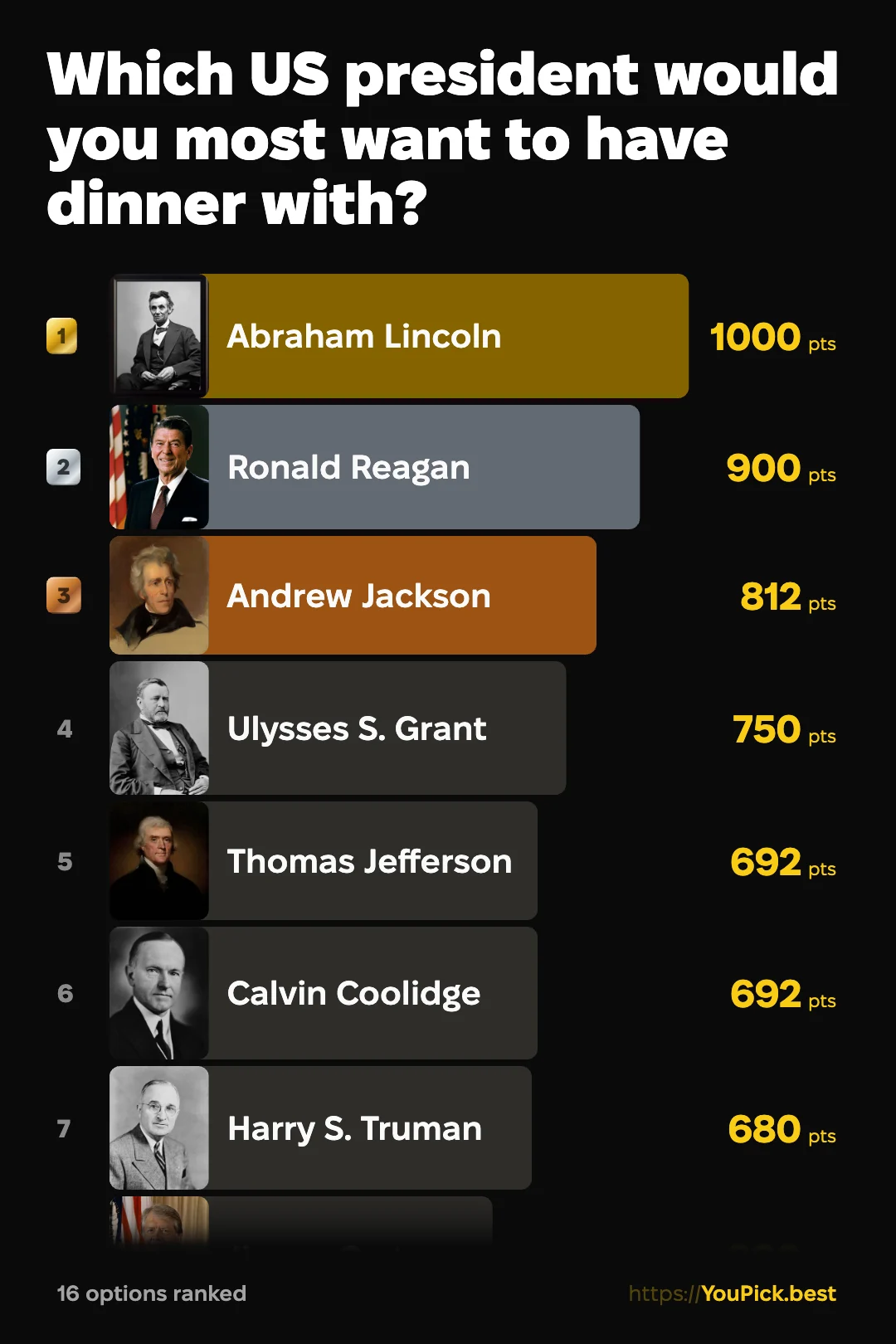
American states have not settled on one rule. As of August 2025, Ballotpedia counted 13 states and the District of Columbia that set candidate order by lot, 4 that rotate it by precinct and 8 that list candidates alphabetically.6 Sixteen US presidents meet in pairs, in a new order for every player, in the president you would most want to have dinner with ranking.
The shelf: four identical pairs of stockings
The best-known position effect in shopping comes from a 1977 experiment by Richard Nisbett and Timothy Wilson. Shoppers asked to pick the best of four pairs of stockings chose the rightmost pair over the leftmost by a factor of almost four to one. The four pairs were identical, and no shopper named position as a reason.7
Two-option choices show the same pull when people hurry. Dana Carney and Mahzarin Banaji tested it in 2012 with chewing gum: quick choosers took the pack presented first 62% of the time, and people who took their time split almost evenly.8
The stage: running orders at Eurovision and the Queen Elisabeth
Contests judged one performance after another tend to reward the later slots. At the Queen Elisabeth music competition in Brussels, Herbert Glejser and Bruno Heyndels found that from 1956 to 1999 finalists who played later in the final week, or later on a given day, received better placings on average.9 The order there is drawn at random, and Victor Ginsburgh and Jan van Ours showed in 2003 that it still correlated with the result, and that the result went on to predict the musicians' later careers.10
Song contests show a similar drift. In Wändi Bruine de Bruin's 2005 analysis, Eurovision songs scored higher the later they were performed, and figure skating judges showed the same pattern.11 Eurovision no longer leaves the whole order to chance: countries now draw which half of the final they perform in, and the producers set the exact sequence.12 Its champions meet again, two at a time, in the best Eurovision winner ranking.
The screen: the top search result
Web search has its own version. In a 2005 eye-tracking study, Thorsten Joachims and colleagues found that people click the first Google result more often even when it is less relevant, a pattern they called trust bias. When the researchers secretly reversed the order of results, the average position of the clicked link moved only from 2.66 to 4.03.13
The hungry judge: when order is not random
Some famous order effects turn out to be about something else. A 2011 study of Israeli parole boards by Shai Danziger and colleagues found favourable rulings fell from about 65% to nearly zero within each session and returned to about 65% after a food break.14
The cases were not in random order. Keren Weinshall-Margel and John Shapard pointed out that the board tried to finish one prison's cases before each break and that prisoners without lawyers usually came last; those prisoners won 15% of the time, against 35% for prisoners with counsel.15 Andreas Glöckner showed in 2016 that the drop could also appear if favourable rulings simply take longer and judges avoid starting a long case just before a break.16 An order effect can only be measured cleanly when the order itself is random.
The remedy: randomise the order
Survey researchers treat the problem as permanent and spread it evenly instead. The Pew Research Center randomises the order of answer options because phone respondents lean toward the options heard last and people reading a questionnaire lean toward the top; randomising does not remove the bias, but it stops any one answer from collecting all of it.17
YouPickBest applies the same rule to every play. The options are shuffled into a new order each time someone starts a ranking, both for the bracket draw and for the King of the Hill queue, so first and last positions land on a different option for each player. Across many plays, the luck of position is shared out instead of being handed to one option. The effect of arriving first or last in a winner-stays sequence is covered in King of the Hill voting.
Common questions
What is an order effect?
A shift in choices caused by the position of an option in a list or sequence rather than by the option itself.
What is the difference between primacy and recency?
Primacy favours what comes first; recency favours what comes last. Which one wins depends on the setting: ballots tend to favour the first name, while judged contests tend to favour late performers.
How do you remove an order effect?
It cannot be removed, only spread out. Randomising or rotating the order for each voter or respondent keeps the advantage from going to the same option every time.
Does being listed first win elections?
It can decide close ones. In the primary Koppell and Steen studied, the bonus for being listed first exceeded the winning margin in 7 of 79 contests.
More on how voting works
- King of the Hill Voting: How Winner-Stays Ranking Works — wine tastings, choice inertia and the reigning option
- What Is an Ideal Type World Cup? Korea's Bracket for Picking a Favourite — a 2009 KBS segment that became a game
- How Head-to-Head Voting Works (and Why It Beats Polls) — star ratings against a single two-way pick
Sources
- Bennet B. Murdock Jr., "The serial position effect of free recall", Journal of Experimental Psychology, 1962, doi:10.1037/h0045106: doi.org (checked 2026-09-23)
- Maya Bar-Hillel, "Position Effects in Choice From Simultaneous Displays", Perspectives on Psychological Science 10(4), 2015: pubmed.ncbi.nlm.nih.gov (checked 2026-09-23)
- Jonathan G. S. Koppell and Jennifer A. Steen, "The Effects of Ballot Position on Election Outcomes", Journal of Politics 66(1), 2004: asu.edu (checked 2026-09-23)
- Daniel E. Ho and Kosuke Imai, "Estimating Causal Effects of Ballot Order from a Randomized Natural Experiment", Public Opinion Quarterly 72(2), 2008: harvard.edu (checked 2026-09-23)
- Marc Meredith and Yuval Salant, working paper on ballot order in California local elections (published in Political Behavior, 2013): upenn.edu (checked 2026-09-23)
- Ballotpedia, "Rules on ballot order and party labeling": ballotpedia.org (checked 2026-09-23)
- Richard E. Nisbett and Timothy D. Wilson, "Telling more than we can know", Psychological Review 84(3), 1977: csulb.edu (checked 2026-09-23)
- Dana R. Carney and Mahzarin R. Banaji, "First Is Best", PLoS ONE 7(6):e35088, 2012: doi.org (checked 2026-09-23)
- Herbert Glejser and Bruno Heyndels, "Efficiency and inefficiency in the ranking in competitions: the case of the Queen Elisabeth Music Contest", Journal of Cultural Economics 25(2), 2001: ideas.repec.org (checked 2026-09-23)
- Victor A. Ginsburgh and Jan C. van Ours, "Expert Opinion and Compensation: Evidence from a Musical Competition", American Economic Review 93(1), 2003: ideas.repec.org (checked 2026-09-23)
- Wändi Bruine de Bruin, "Save the last dance for me: unwanted serial position effects in jury evaluations", Acta Psychologica 118(3), 2005: pubmed.ncbi.nlm.nih.gov (checked 2026-09-23)
- Eurovision Song Contest, "Creating the perfect Grand Final running order", 15 May 2026: eurovision.com (checked 2026-09-23)
- Thorsten Joachims, Laura Granka, Bing Pan, Helene Hembrooke and Geri Gay, "Accurately Interpreting Clickthrough Data as Implicit Feedback", SIGIR 2005: cornell.edu (checked 2026-09-23)
- Shai Danziger, Jonathan Levav and Liora Avnaim-Pesso, "Extraneous factors in judicial decisions", PNAS 108(17), 2011: pubmed.ncbi.nlm.nih.gov (checked 2026-09-23)
- Keren Weinshall-Margel and John Shapard, "Overlooked factors in the analysis of parole decisions", PNAS 108(42), 2011: ncbi.nlm.nih.gov (checked 2026-09-23)
- Andreas Glöckner, "The irrational hungry judge effect revisited", Judgment and Decision Making 11(6), 2016: upenn.edu (checked 2026-09-23)
- Pew Research Center, "Writing survey questions": pewresearch.org (checked 2026-09-23)