
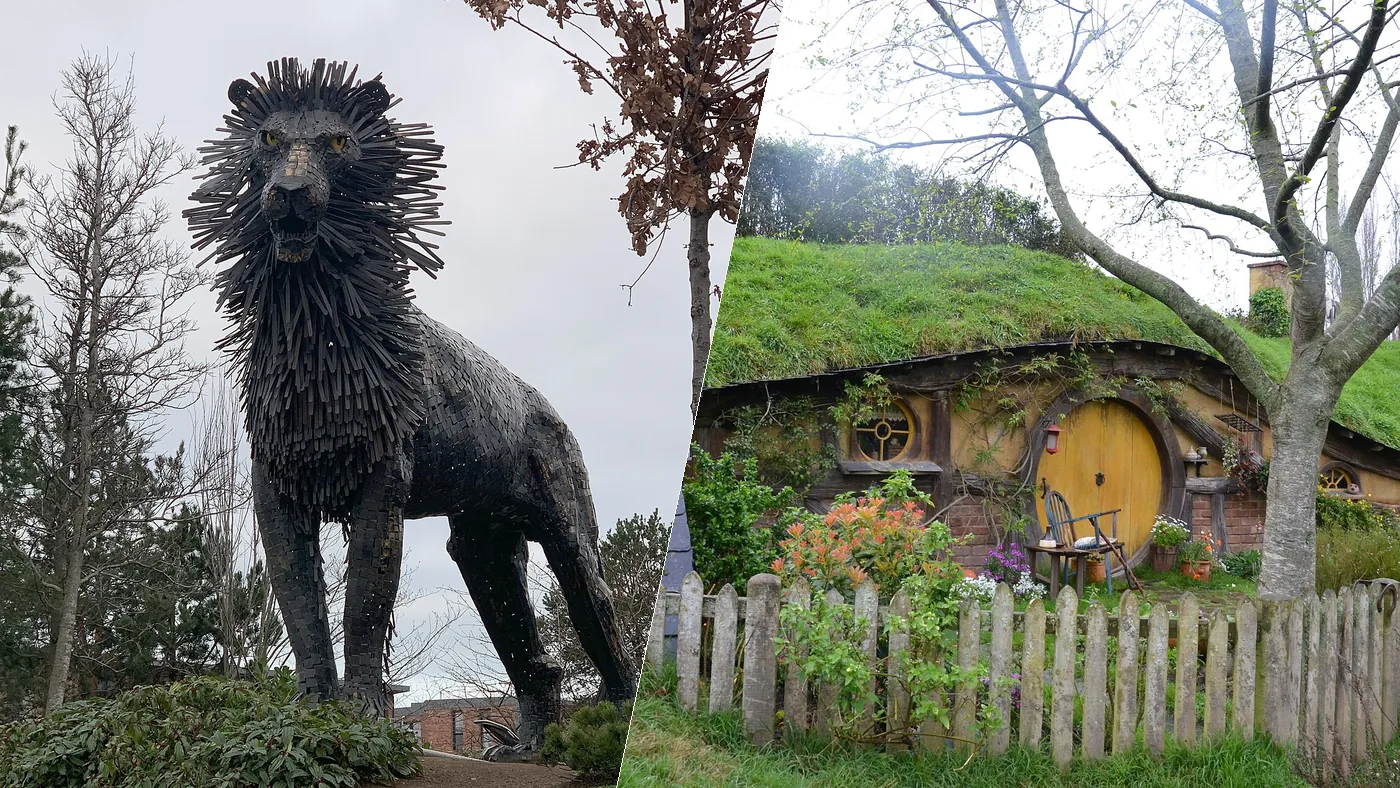
The Chronicles of Narnia and The Lord of the Rings came out of the same Oxford English faculty, written by two friends who read their drafts aloud to each other in pubs and college rooms. Greta Gerwig's Narnia: The Magician's Nephew showed its first trailer in October and opens in theaters and IMAX on February 12, 2027, before it reaches Netflix on April 2.1
C.S. Lewis died on November 22, 1963, after nearly three decades as a fellow of Magdalen College.2 J.R.R. Tolkien outlived him by ten years, and the two men's books have been compared ever since the first of them reached print.
People still type "Narnia vs Lord of the Rings" into search boxes, along with the question of which came first. Tolkien's Hobbit was in print by 1937 and Lewis's wardrobe opened in 1950, four years before The Fellowship of the Ring. These 12 rankings put the two worlds side by side, and eight of them hold both.
Lewis wrote seven short books for children and Tolkien one long book for adults, and the lists split the same way: depth goes to Middle-earth, first encounters go to Narnia.
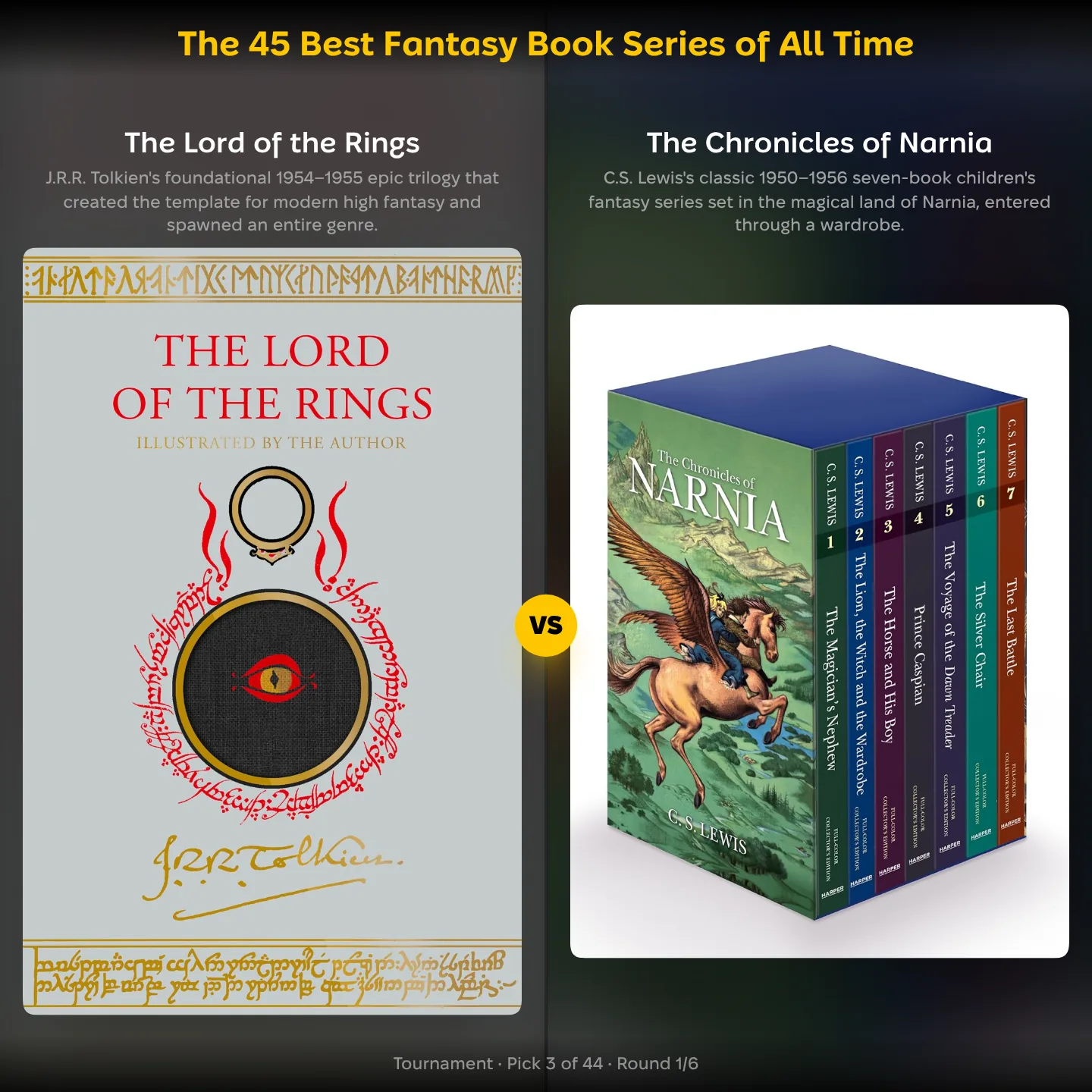
The Lord of the Rings vs Narnia: the best fantasy book series
This ranking holds 45 fantasy series, and The Lord of the Rings and The Chronicles of Narnia are two of its oldest entries. Harry Potter, A Song of Ice and Fire, The Wheel of Time and Discworld fill out the field.
The two series were built in opposite ways. Tolkien's book came out in three volumes between 1954 and 1955, the payoff of work he had begun after The Hobbit in 1937.3 Lewis wrote seven short novels and published them one a year from October 1950 to September 1956.4
Narnia's sales figure is the easier one to pin down: over 100 million copies in 47 languages. The Lord of the Rings casts the longer shadow, since most of the other series on this list borrow its maps, its elves or its dark lords.
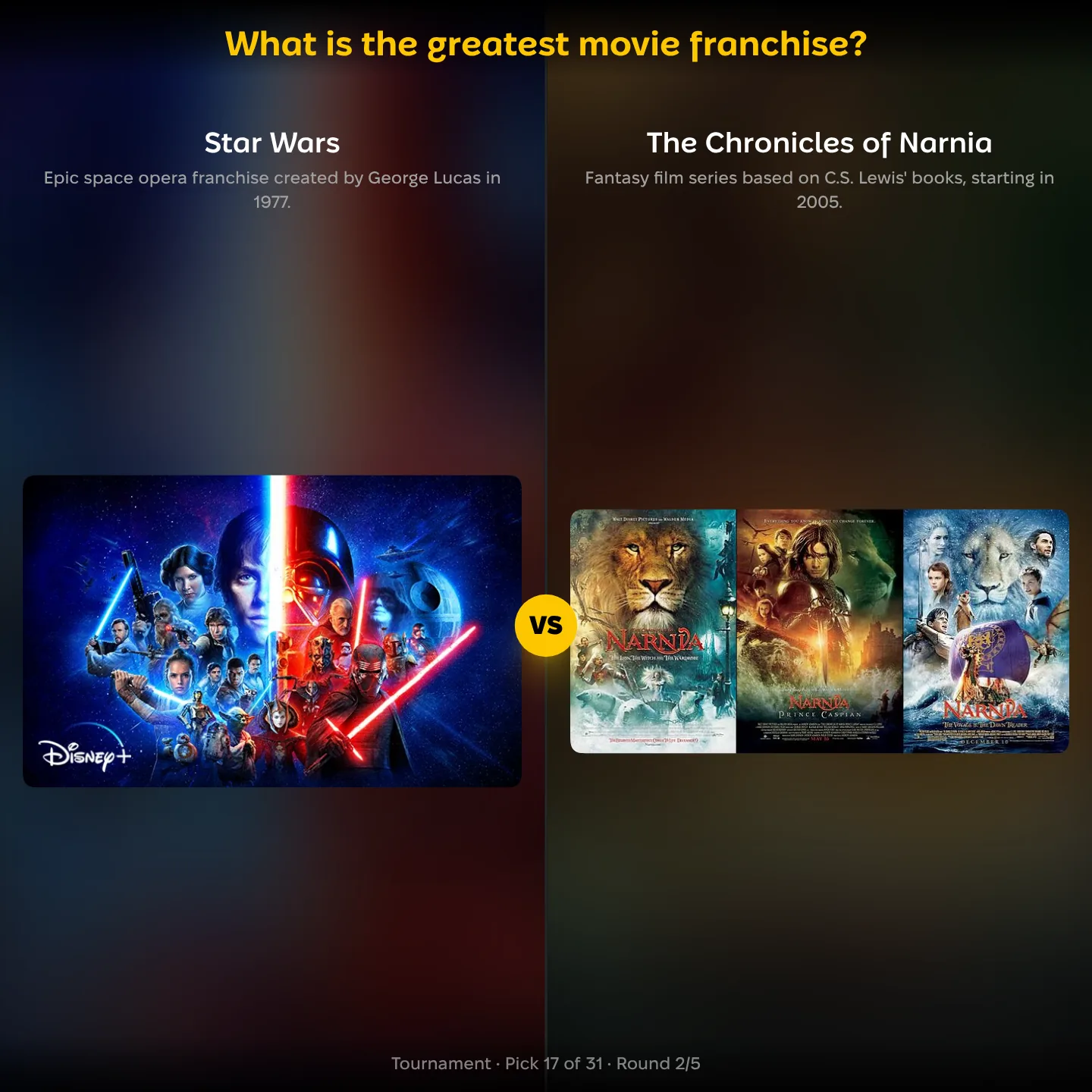
Star Wars, Middle-earth and Narnia: the greatest movie franchise
Thirty-two film series compete here, among them James Bond, Toy Story and Star Wars, which has been running since 1977. The Lord of the Rings and The Chronicles of Narnia are both on the list.
Peter Jackson's trilogy has the record no franchise on the list can match. The Return of the King won 11 Oscars from 11 nominations, Best Picture among them.5
Narnia's film run was shorter and ended badly. Walden Media made three films, in 2005, 2008 and 2010, and Disney pulled out of financing the series after the second one.4 The Voyage of the Dawn Treader went to 20th Century Fox, and the series stopped there.
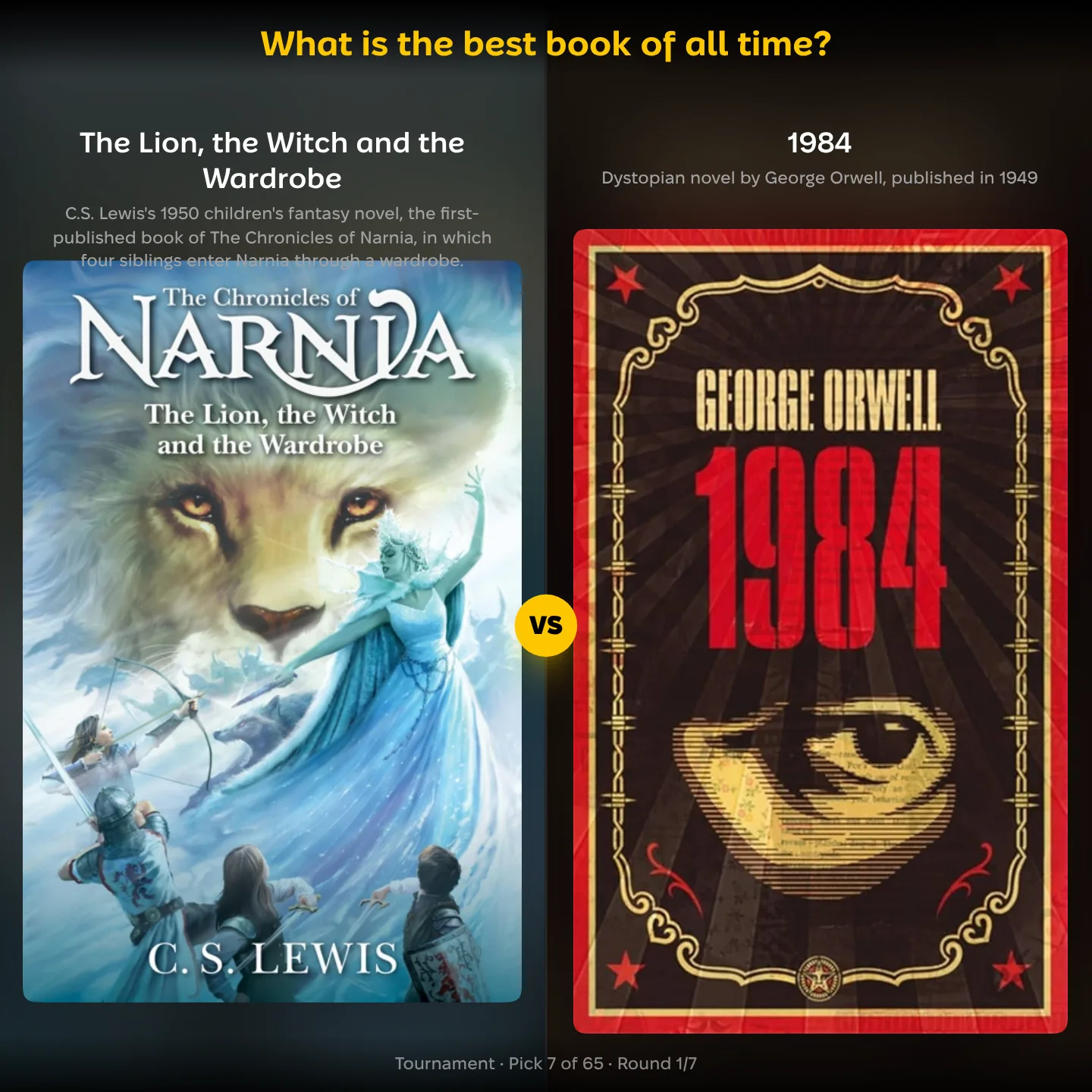
The Lion, the Witch and the Wardrobe among the best books ever written
The broadest book list on the site has 66 titles, and Tolkien is on it twice, with The Lord of the Rings and The Hobbit. The Lion, the Witch and the Wardrobe joined the list for this article, next to 1984, To Kill a Mockingbird and War and Peace.
Lewis's novel is the odd one in that company: a children's book of 17 short chapters, published by Geoffrey Bles in London in 1950. Most of its neighbours are adult novels taught at universities.
Orwell is the obvious opponent. Nineteen Eighty-Four came out in 1949, a year before the wardrobe opened, and its claim on a list like this rests on its politics rather than its storytelling, which is the opposite of the Narnia case.
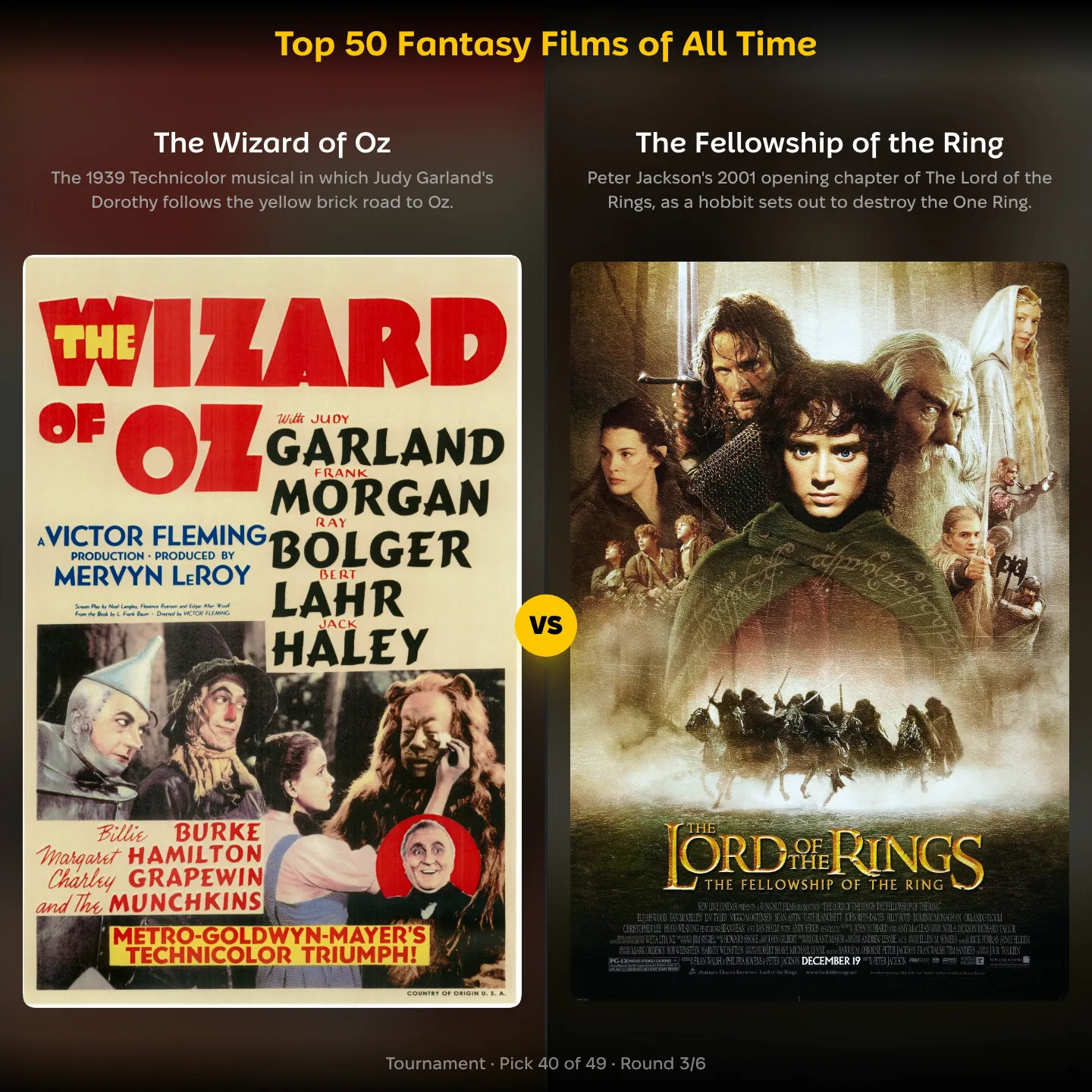
The Fellowship of the Ring vs The Wizard of Oz: top fantasy films
Every Lord of the Rings film is on this list of 50, plus The Hobbit: An Unexpected Journey. Narnia is represented by one film, The Lion, the Witch and the Wardrobe from 2005.
That single film did well. Box Office Mojo records $745,013,115 worldwide for it, $291,710,957 of that in North America.6
The Fellowship of the Ring, released in December 2001, is the one Jackson film that had to prove the idea could work at all.
The Wizard of Oz is its oldest rival on the list. Victor Fleming's 1939 Technicolor musical set the template for a child walking out of an ordinary home into a painted world, which is also what the Pevensies do. Spirited Away and Pan's Labyrinth are the other strong names outside Tolkien.
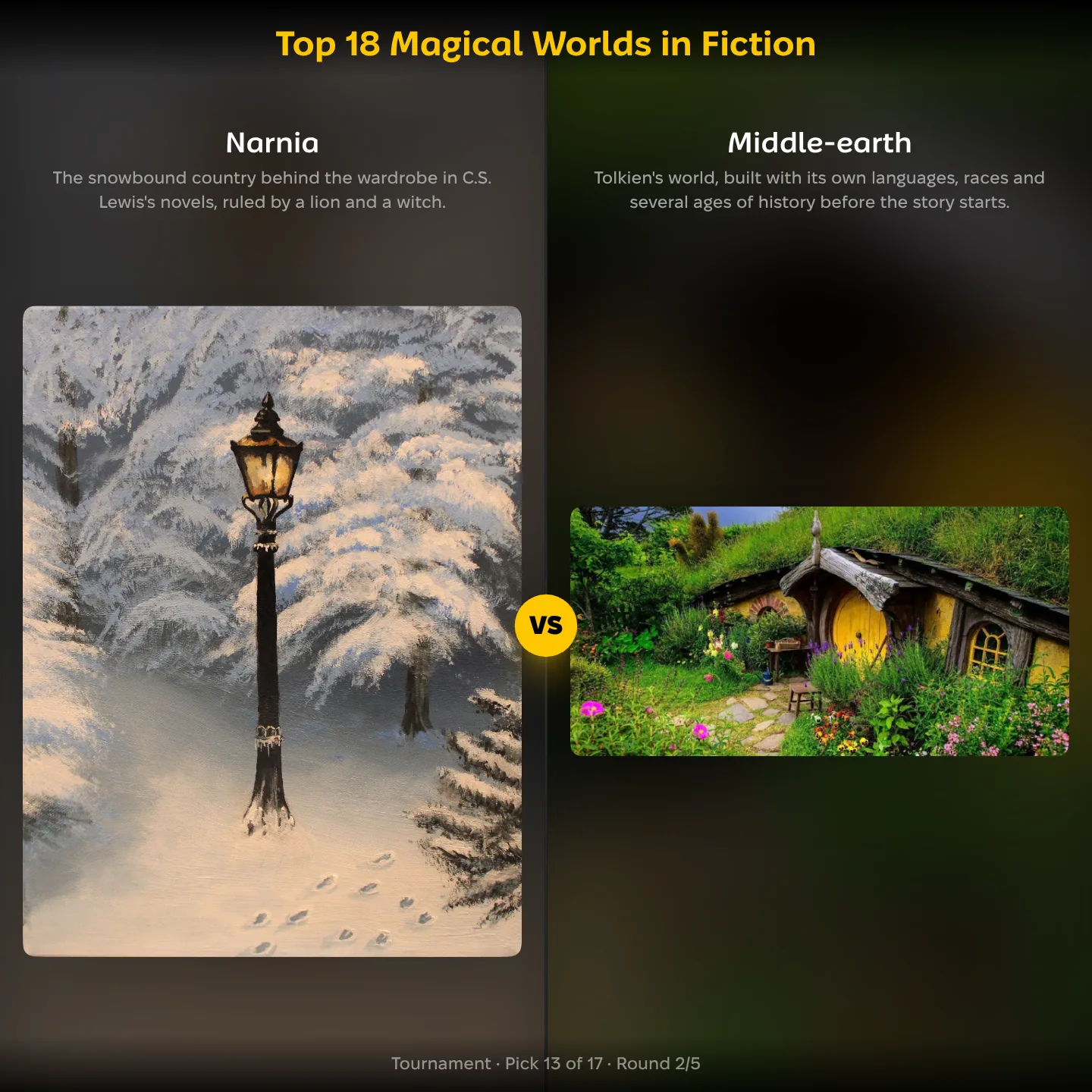
Narnia vs Middle-earth: the best magical world in fiction
The question here is about places rather than books. The 18 worlds include Hogwarts, Oz, Wonderland, Neverland and Westeros, and both Narnia and Middle-earth are among them.
Narnia is a separate world reached by a door: a wardrobe, a painting, a railway platform. Time runs on its own clock, so the Pevensie children can grow up as kings and queens there and come home on the same afternoon they left.
Middle-earth has no door, because Tolkien set it in our own world's imagined distant past. It comes with languages, calendars and several thousand years of history in the appendices.
Hogwarts is the competition both have to beat on a list like this, a school with a train station and a younger readership.
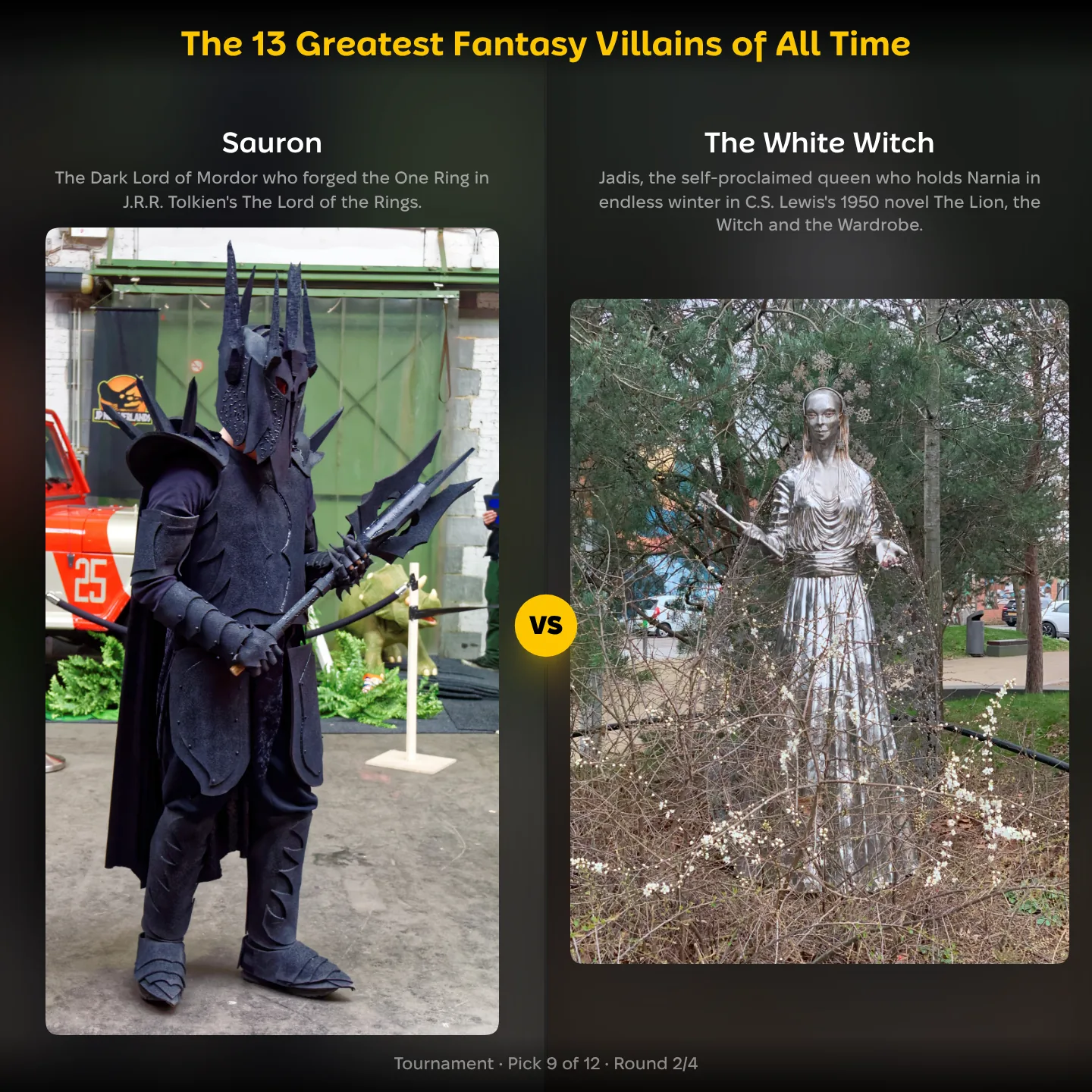
The White Witch vs Sauron: the greatest fantasy villains
Both books built their evil around a ruler, and both rulers are on this list of 13 villains with Lord Voldemort, Maleficent, Cersei Lannister and the Witch-king of Angmar, Sauron's own chief servant.
Lewis's White Witch is a villain you can meet. Jadis calls herself Queen of Narnia, keeps the country in a winter with no Christmas, and turns her enemies into stone statues in her courtyard. She talks, bargains and kills on the page.
Tolkien's Sauron almost never appears. He forged the One Ring and his armies cover the map, but in The Lord of the Rings he is an eye, a shadow and a voice reported by others, and the story's danger comes from what his Ring does to the people who carry it.
Lord Voldemort is the strongest rival to both. J.K. Rowling gave her dark lord a face, a name he was born with and an orphanage childhood, which neither Oxford villain has.
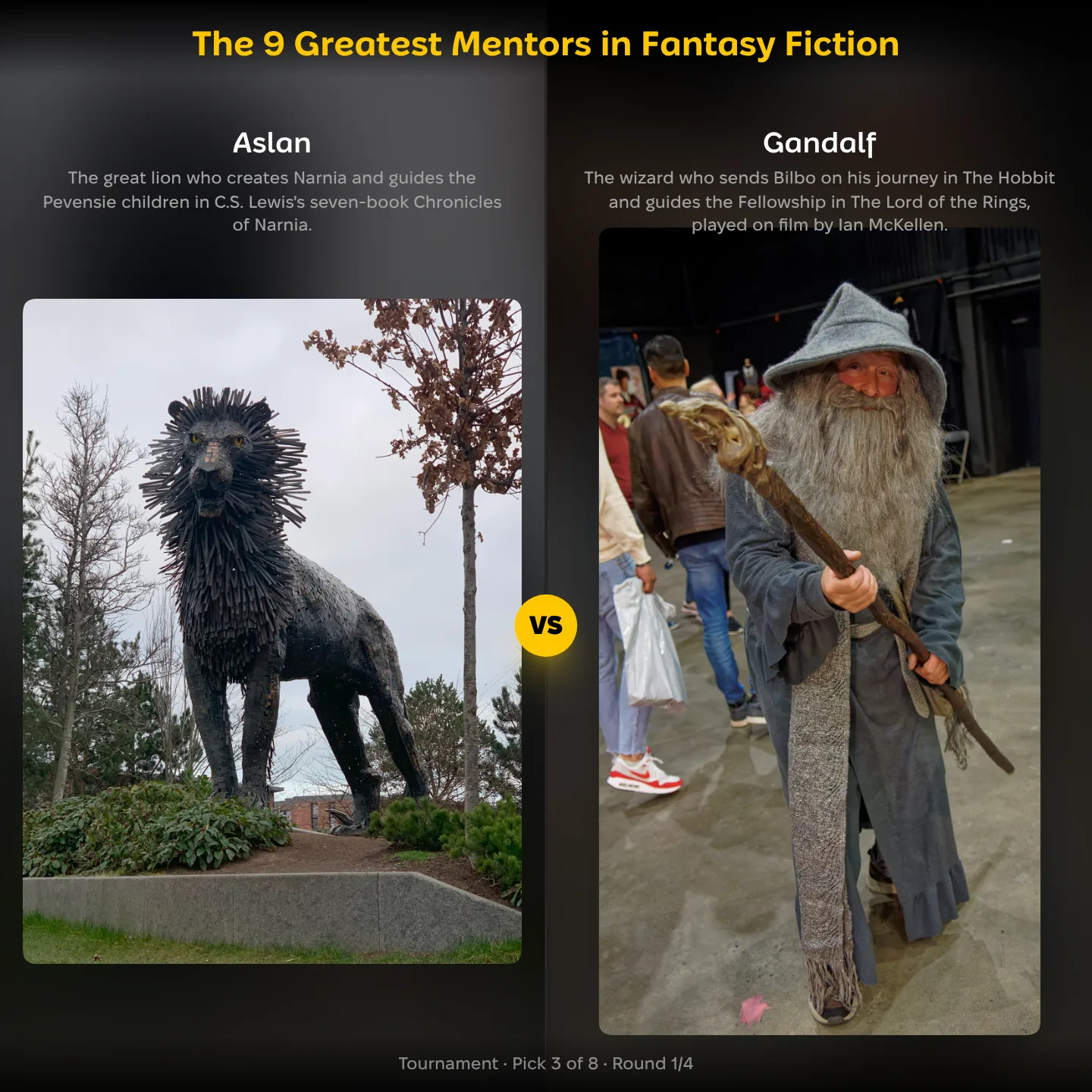
Aslan vs Gandalf: the greatest mentors in fantasy fiction
This is the closest head-to-head in the article, because the two books gave their guides the same arc. Aslan and Gandalf share this list of nine mentors, with Albus Dumbledore, Merlin, Uncle Iroh from Avatar and Geralt of Rivia.
Both characters die and come back. Aslan gives himself up to the White Witch on the Stone Table and returns the next morning. Gandalf falls with the Balrog in Moria and returns as Gandalf the White, stronger than before.
The difference is in what each one is. Aslan is the creator of Narnia and its only character to appear in all seven books, which makes him closer to a god than a teacher. Gandalf is a wizard who gets tired, makes mistakes and smokes a pipe with hobbits, and Ian McKellen played him in six films.
Dumbledore fits the same mould, a white-bearded wizard who dies before the final book's climax and still guides Harry in the King's Cross chapter.
The Fellowship of the Ring vs A Game of Thrones: epic fantasy novels
This list counts single novels. All three Tolkien volumes have a slot, and so does The Lion, the Witch and the Wardrobe.
Epic fantasy is the genre Tolkien shaped, so Lewis's book is the odd entry, a children's novel among doorstops like George R. R. Martin's A Game of Thrones and The Way of Kings.
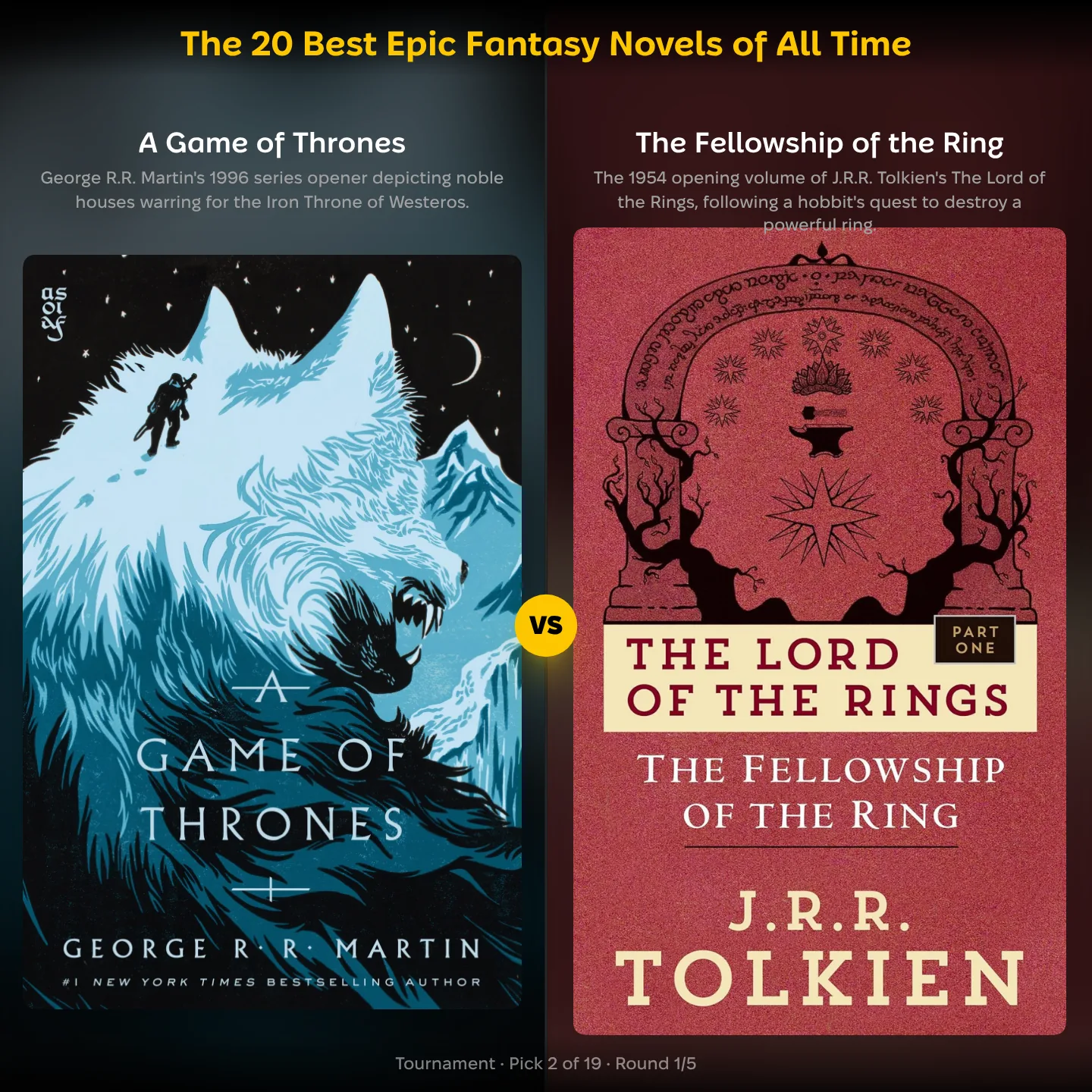
The Hobbit vs The Lion, the Witch and the Wardrobe: children's books
Here the comparison is fair in a way the adult lists are not. Each author has one book on this list of 22 children's classics, with Charlotte's Web, Where the Wild Things Are and The Very Hungry Caterpillar.
The Lord of the Rings is not here. Tolkien's children's book is The Hobbit, which George Allen & Unwin published in 1937 with his own maps and drawings.3 Lewis's is the first Narnia novel, thirteen years younger.
Roald Dahl's Matilda and Harry Potter and the Philosopher's Stone are the other names that could carry this ranking, so the Oxford pair do not have it to themselves.
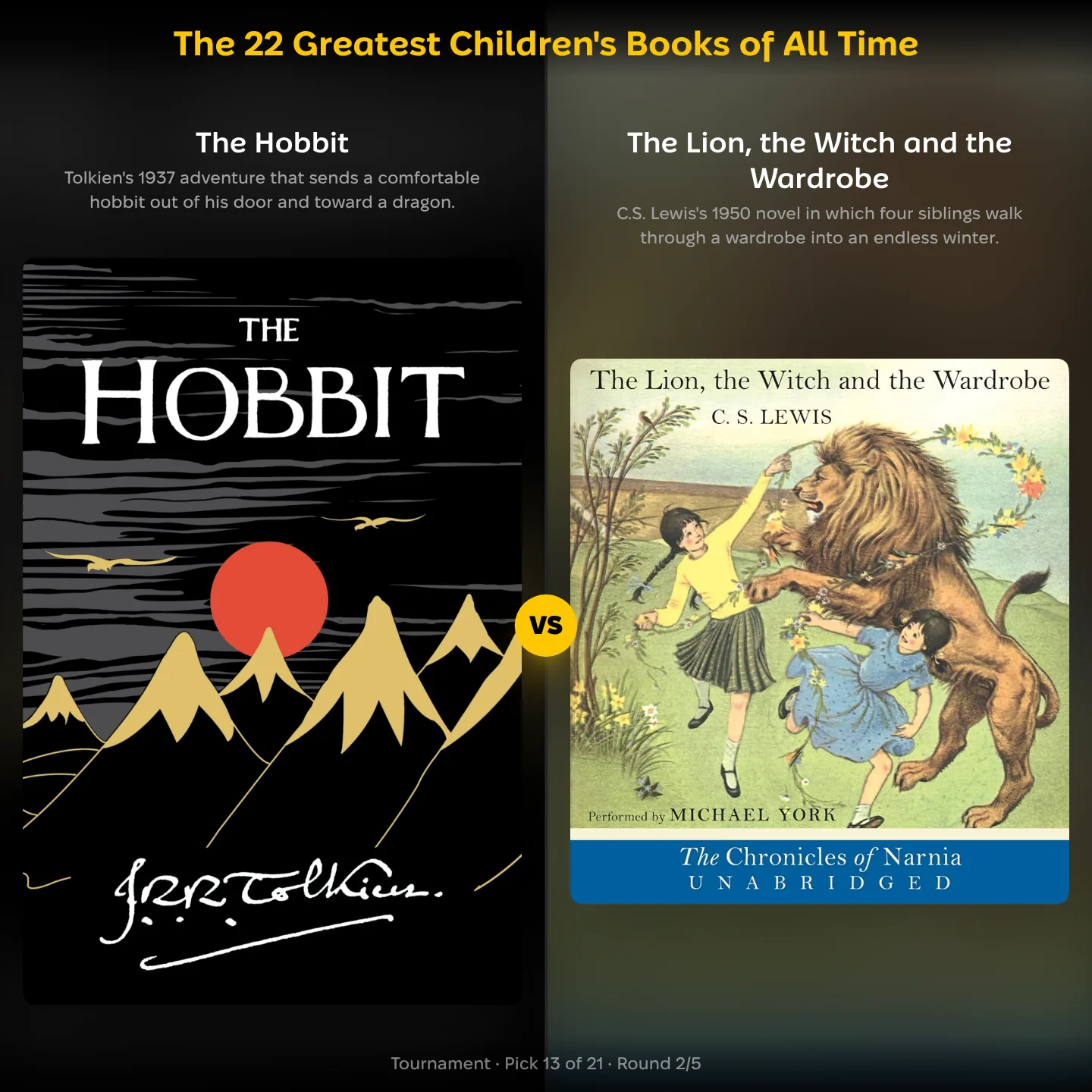
The Hunger Games vs Narnia: young adult novels on film
Young adult is a label only Narnia can wear. The 2005 Lion, the Witch and the Wardrobe appears among 33 adaptations here, with The Hunger Games, Twilight, Holes and Harry Potter and the Sorcerer's Stone. Tolkien's trilogy is absent, and nobody would expect it here.
Narnia predates the label. Lewis wrote for children in 1950, decades before publishers built a separate shelf for teenagers, and the Pevensies are schoolchildren evacuated from wartime London.
The Hunger Games is the model the modern list is built on: a 2012 film from Suzanne Collins's novel, with a teenage heroine and a sequel every year. Against that, the Narnia film is a family picture that happens to star children.
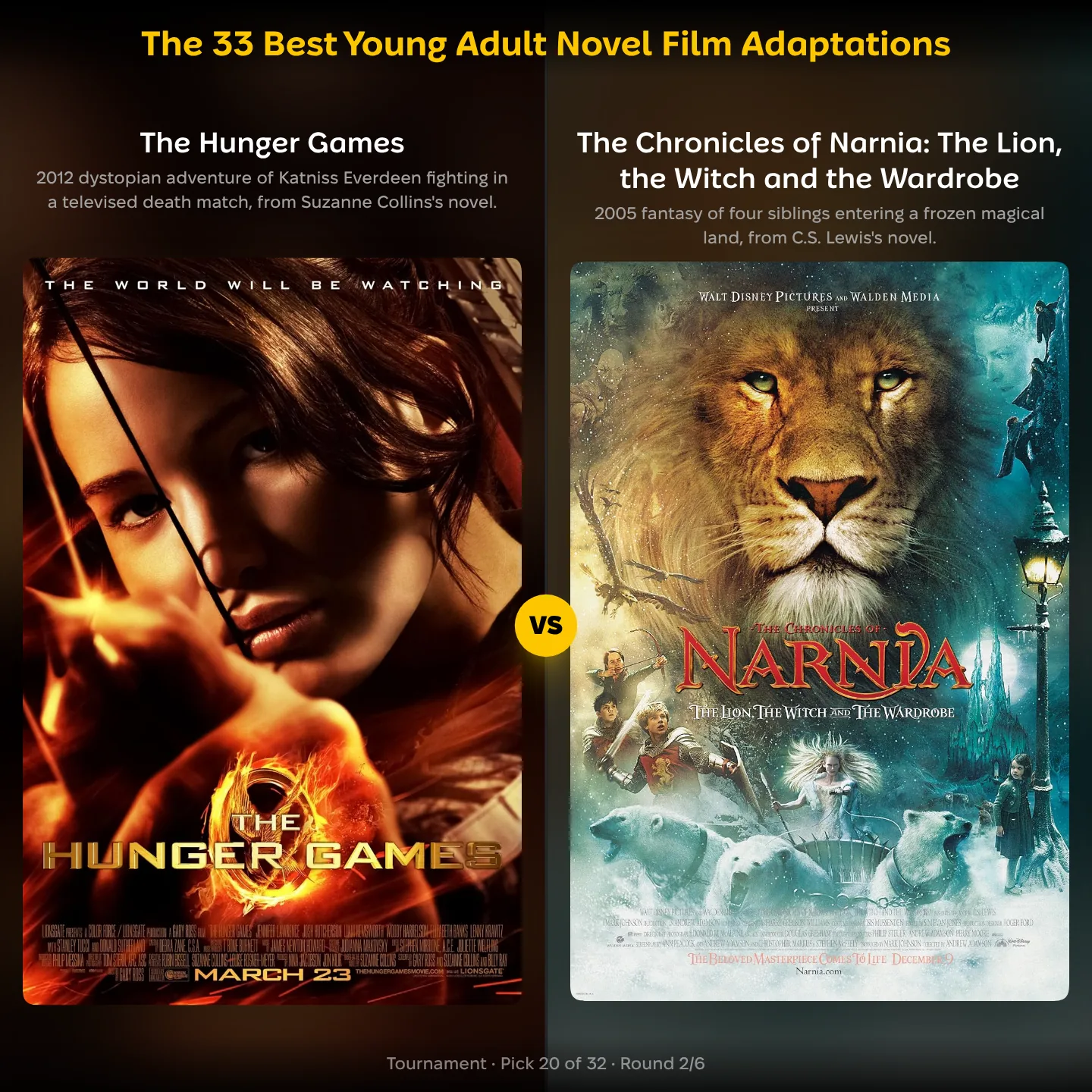
Middle-earth among the greatest British novels
This list of 45 belongs to the literary canon: Middlemarch, Jane Eyre, Bleak House, Mrs Dalloway. The Lord of the Rings is on it. Narnia is not.
The gap reflects how differently the two series get read. The Lord of the Rings is long enough and strange enough to sit beside Frankenstein and Wuthering Heights as a novel for adults. The Chronicles of Narnia are shelved as children's books, and lists like this one rarely make room for those.
Mary Shelley's Frankenstein, published in 1818, is Tolkien's nearest neighbour here, another British book that invented a genre and has been adapted for the screen ever since.
The literary establishment was not always this generous. When Lewis nominated his friend for the 1961 Nobel Prize in Literature, a member of the committee wrote that Tolkien's prose "has not in any way measured up to storytelling of the highest quality".7 The prize went to Ivo Andrić.
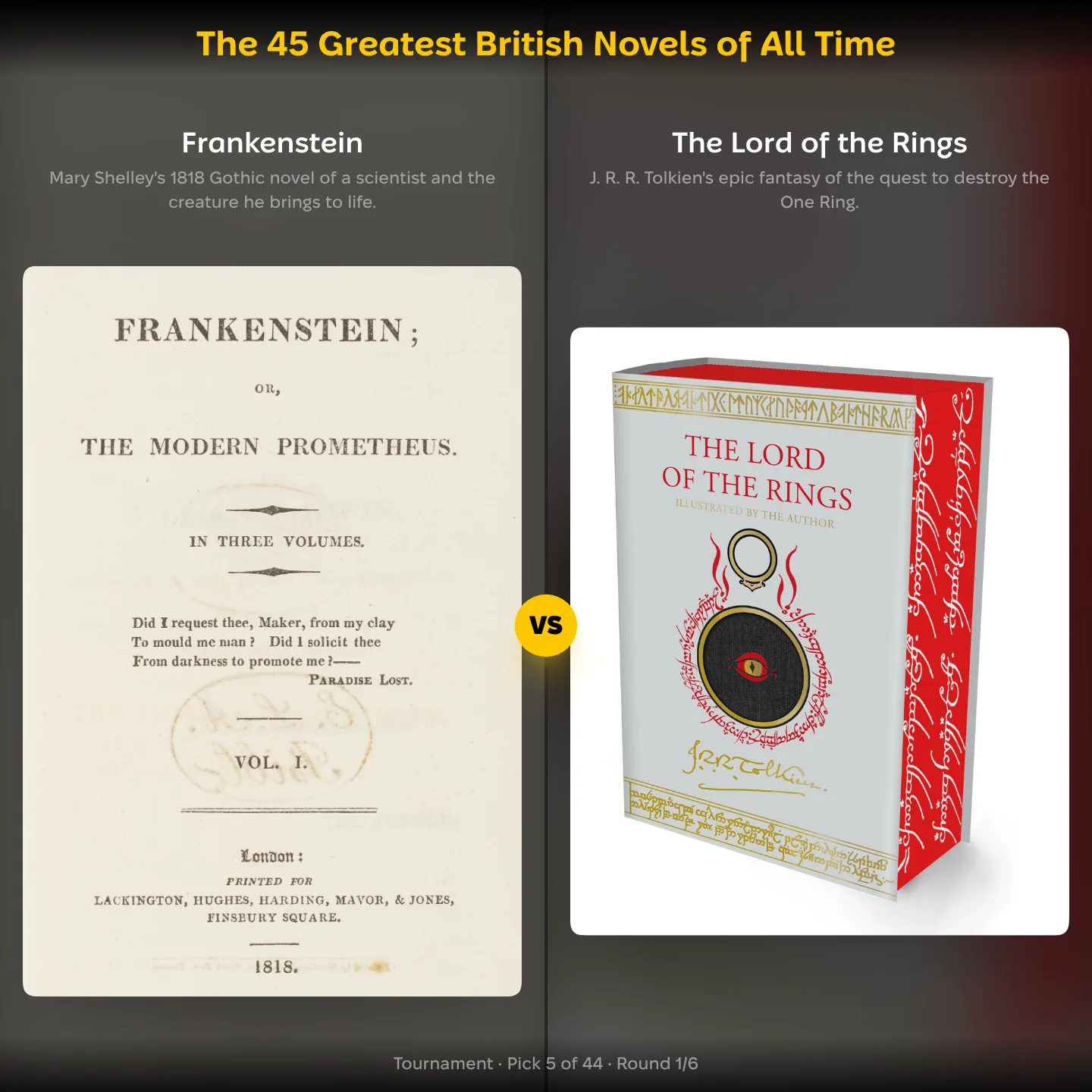
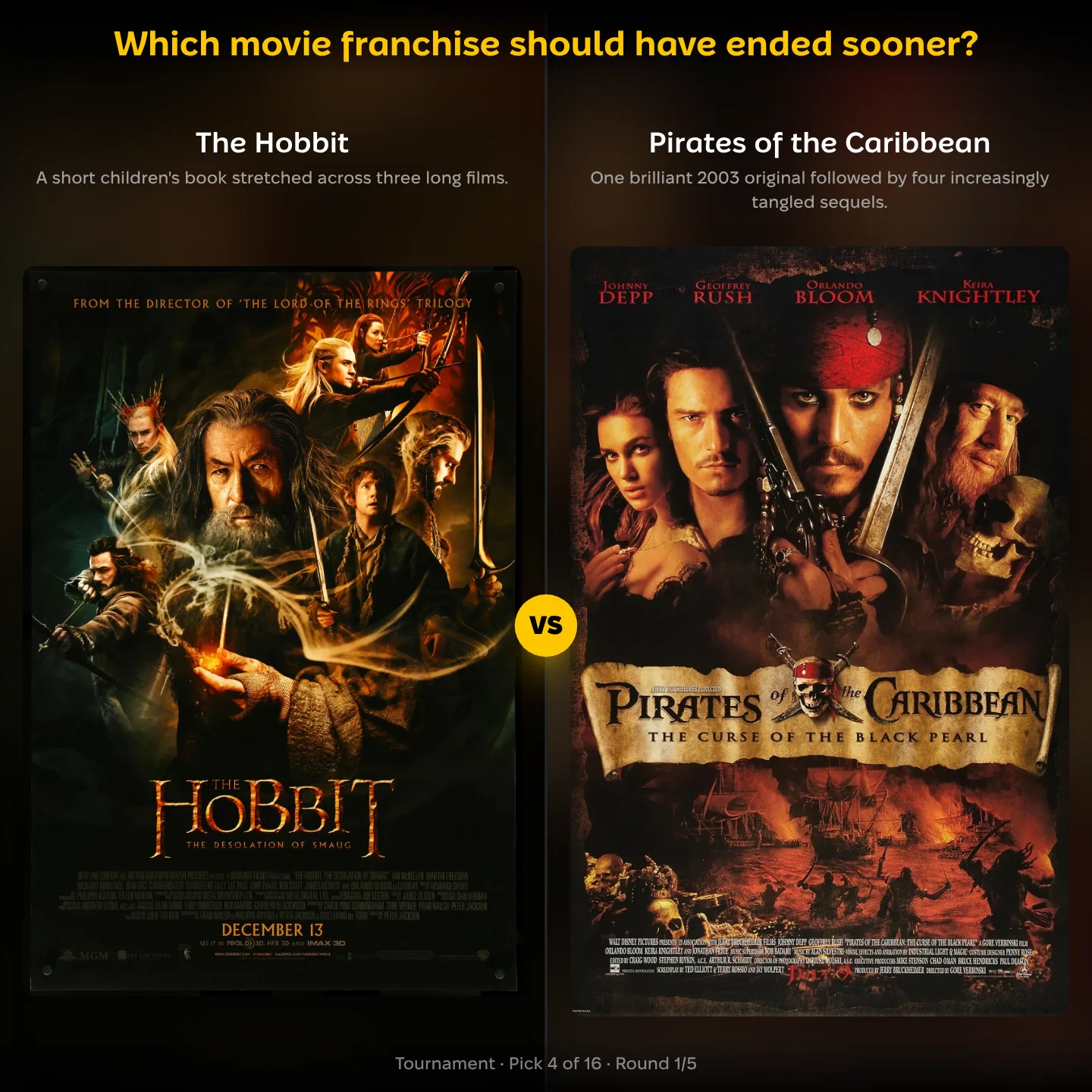
The Hobbit trilogy: the franchise that should have ended sooner
The unflattering list belongs to the Tolkien side. Peter Jackson turned The Hobbit, a single children's novel, into three films released from 2012 to 2014, and that trilogy shares a list of 17 with Pirates of the Caribbean, Jurassic Park and Shrek.
Narnia has the opposite problem. Its films stopped after three when Disney left and Walden Media's rights later lapsed, and four of Lewis's seven books have never reached a cinema screen.
Gerwig's version restarts it at the beginning, with The Magician's Nephew, the book about Narnia's creation. A long Hobbit and a short Narnia film run are two ends of the same studio calculation.
Two Oxford friends, two kinds of reader
Tolkien's case is strongest on the lists that reward a whole world: the canon, the epic novel, the film trilogy. Lewis's case is strongest wherever a first reading counts, the wardrobe and the lion and the witch that a child meets before any of the others, and Gerwig's film is about to hand that first reading to another generation.
All twelve are decided two contenders per round, so the Narnia and Middle-earth matchups belong to whoever plays them. If the list you want is missing, Mr. Tumnus against Samwise or Reepicheep against Legolas, it takes a few minutes to set that ranking up.
More rankings, more angles
- The Lord of the Rings: Best Fantasy Book of All Time? 12 Lists — Tolkien's book alone, from the films to Rings of Power
- Harry Potter Among the Best Fantasy Book Series Ever: 16 Lists — the school both Oxford worlds compete with
- Best Dystopian Books of All Time? The Hunger Games on 12 Lists — Panem from page to screen
Sources
- Netflix Tudum — October 15, 2026: Narnia: The Magician's Nephew in theaters and IMAX on February 12, 2027, on Netflix on April 2, 2027: netflix.com (checked 2026-11-11)
- Magdalen College, Oxford — C.S. Lewis: Tutorial Fellow in English from 1925 to 1954, died 22 November 1963: magd.ox.ac.uk (checked 2026-11-11)
- The Tolkien Estate — biography: The Hobbit published by George Allen & Unwin in 1937, The Lord of the Rings in three volumes in 1954–1955, the Inklings: tolkienestate.com (checked 2026-11-11)
- Wikipedia — The Chronicles of Narnia: seven novels published October 1950 – September 1956, over 100 million copies in 47 languages, Walden Media films of 2005, 2008 and 2010, Disney's withdrawal in December 2008: en.wikipedia.org (checked 2026-11-11)
- Academy of Motion Picture Arts and Sciences — 76th Academy Awards: The Lord of the Rings: The Return of the King, 11 wins from 11 nominations including Best Picture: oscars.org (checked 2026-11-11)
- Box Office Mojo — The Chronicles of Narnia: The Lion, the Witch and the Wardrobe (2005): $745,013,115 worldwide, $291,710,957 domestic: boxofficemojo.com (checked 2026-11-11)
- C.S. Lewis Foundation — Lewis nominated Tolkien for the 1961 Nobel Prize in Literature; the committee's comment on his prose: cslewis.org (checked 2026-11-11)