
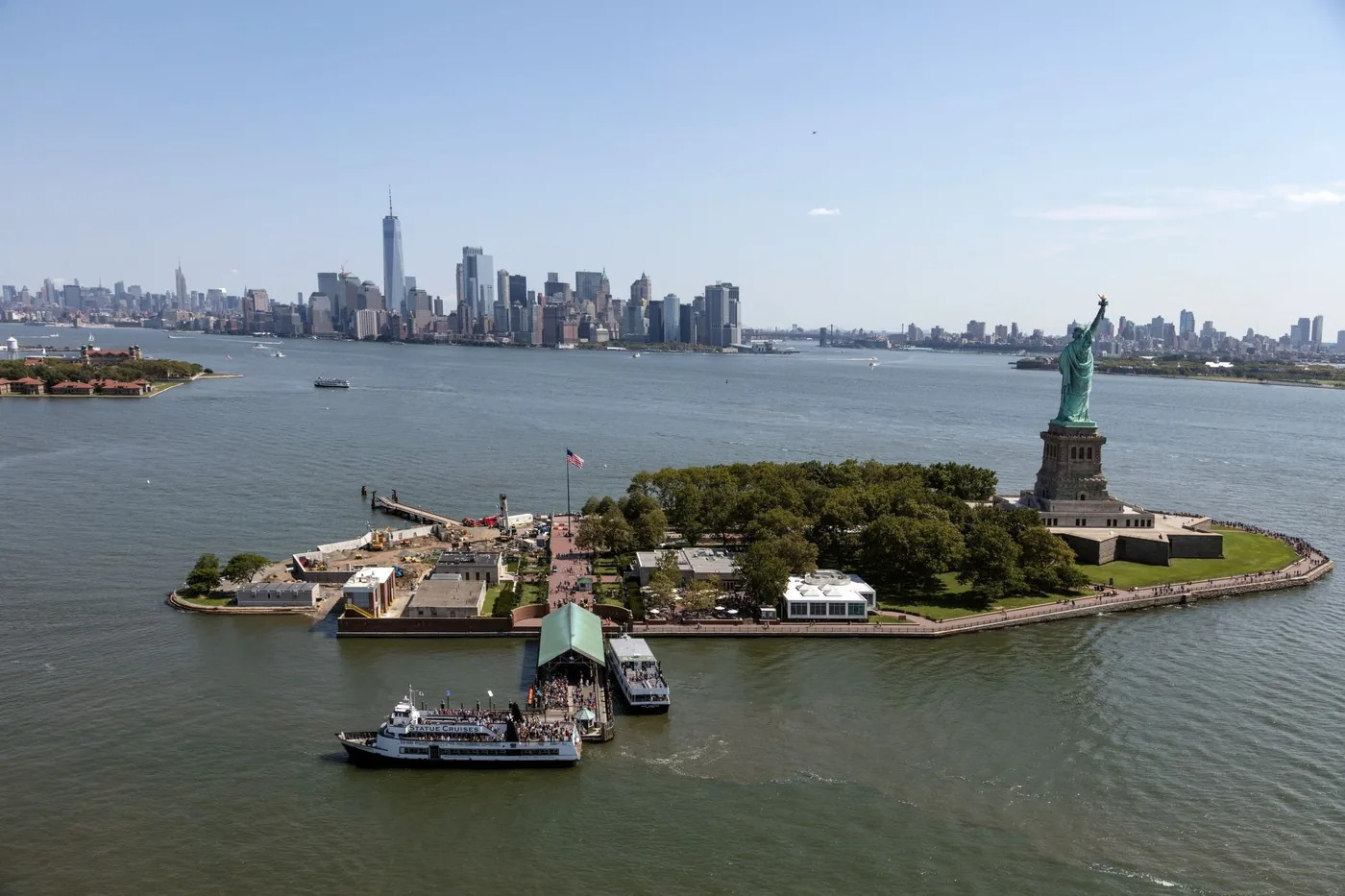

The Statue of Liberty turned 140 on 28 October, and part of the celebration moved to Paris. Until 12 November the first floor of the Eiffel Tower hosts an exhibition about the iron skeleton Gustave Eiffel designed to keep the statue standing in the wind of New York Bay.1 Few objects have ever been honoured inside the tower of their own engineer.
That double passport is why the Statue of Liberty shows up on 13 very different rankings here. It is a world landmark, an American symbol, a French export, a diplomatic gift, a piece of Eiffel's engineering, a UNESCO site, a film location and, on one list, a tourist trap.
The Statue of Liberty belongs to French engineering, American symbolism and New York's ferry queues at once, and every list picks a different owner.
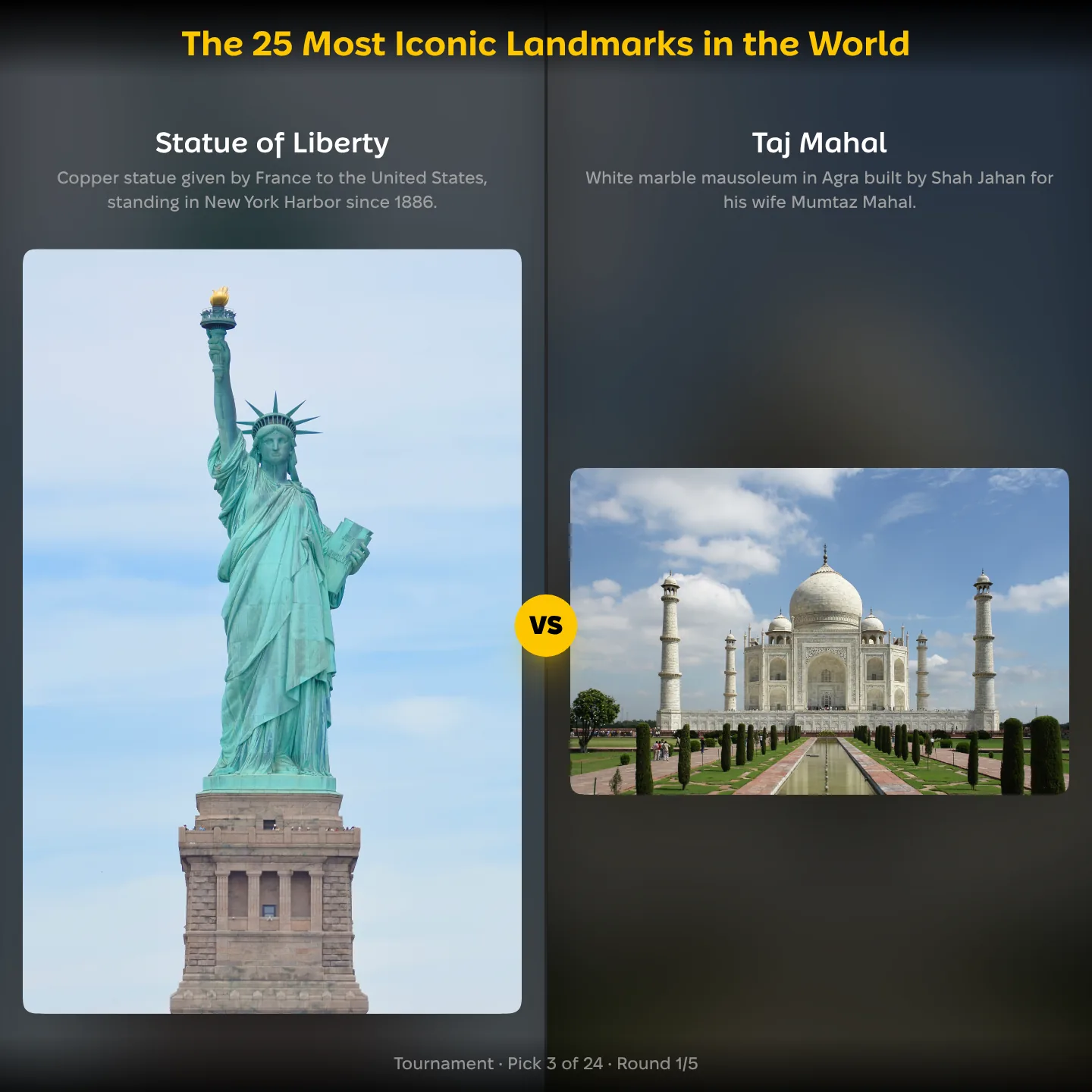
Statue of Liberty vs Taj Mahal: the most iconic landmarks in the world
Of every list in this article, the world's most iconic landmarks is the broadest one holding the Statue of Liberty, and its field is made of postcards: the Eiffel Tower, the Great Wall of China, Machu Picchu, the Colosseum and the Pyramids of Giza.
The statue's claim is a silhouette that needs no caption. A raised torch, a tablet and a crown with seven rays read as one object from across the harbour.2
The Taj Mahal makes a different case. Shah Jahan built it as a tomb for Mumtaz Mahal, so its fame rests on marble and grief rather than on a political idea.
Age is the statue's weak spot here. Giza's pyramids and Stonehenge had stood for more than four thousand years before Bartholdi drew his first sketch.
America's 18 most iconic landmarks, one a former lighthouse
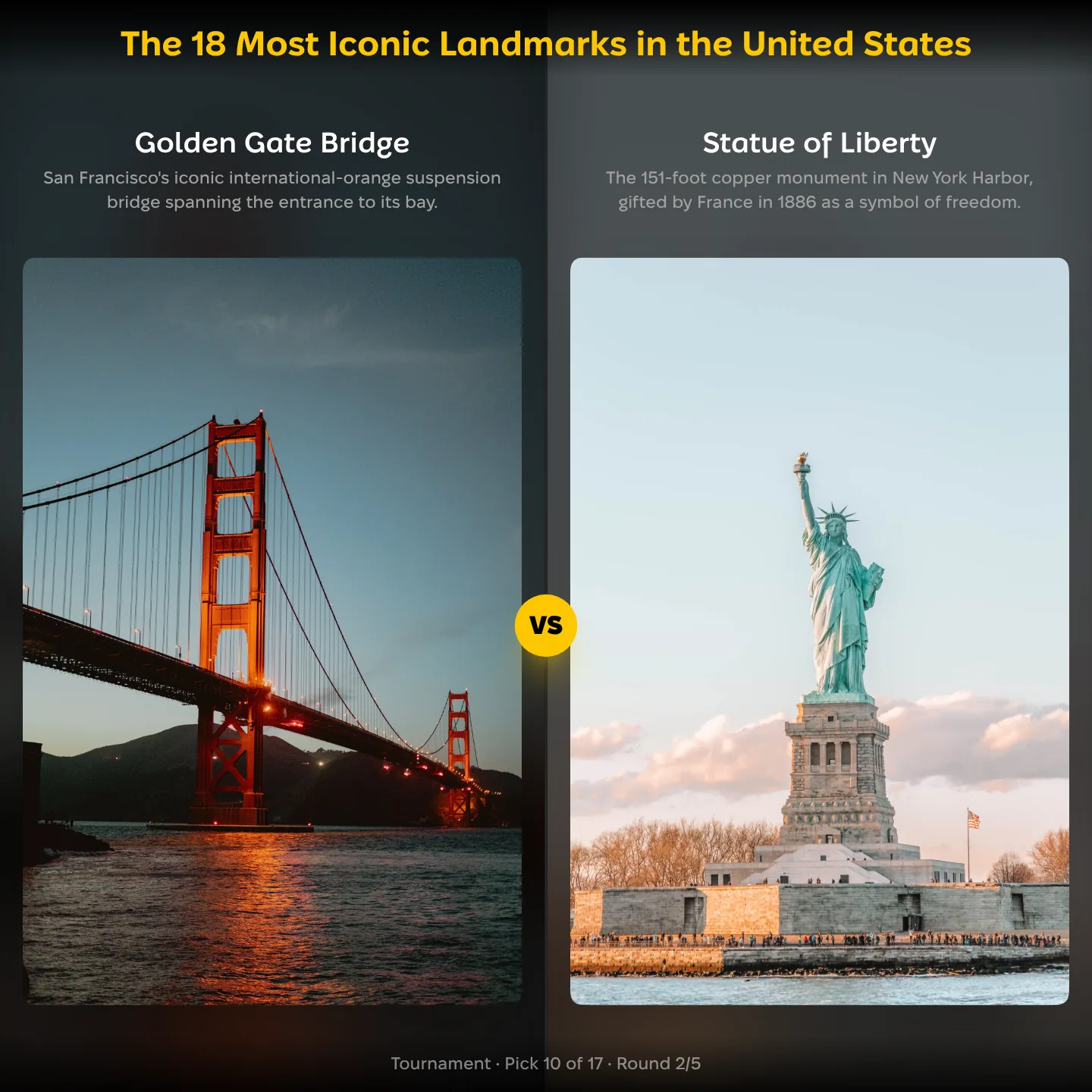
Limit the field to American soil, and the Statue of Liberty becomes one of 18 American landmarks, next to the Grand Canyon, Mount Rushmore, the White House, the Gateway Arch and the Liberty Bell.
The Golden Gate Bridge is the West Coast's reply. It greets ships entering San Francisco Bay the way the statue greets ships entering New York Harbor, and it is painted international orange so the fog cannot hide it.
The statue has a job nobody else on the list ever held. From 1886 to 1902 it was run by the United States Lighthouse Board, with the torch as the light.3
The Grand Canyon has the strongest counter-claim, because nobody had to build it.
Bald Eagle vs Statue of Liberty: the best symbol of the United States
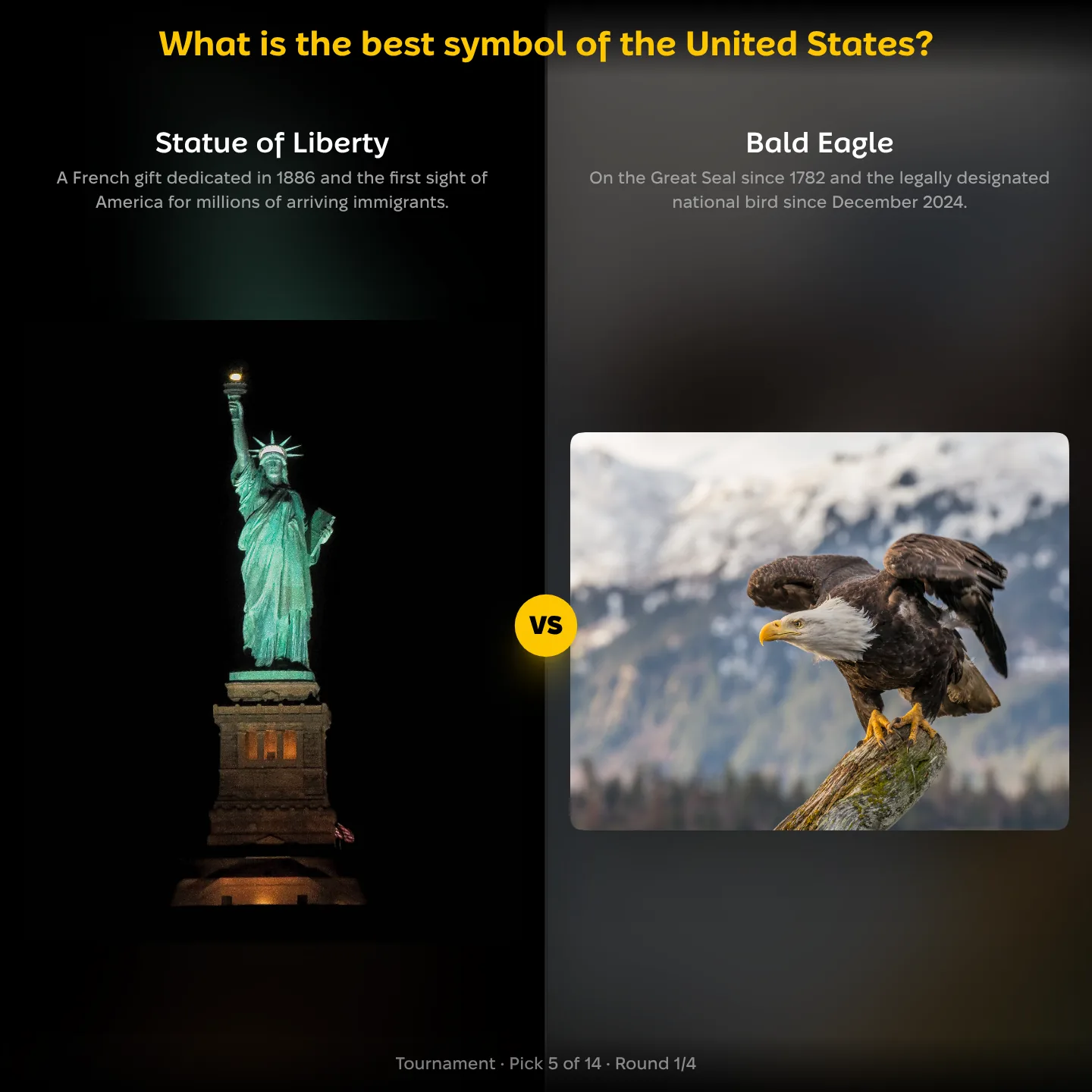
A symbol is judged differently from a landmark. This ranking sets the Statue of Liberty against a bird, a flag, a bell, a cartoon uncle and a dessert: the bald eagle, the Stars and Stripes, the Liberty Bell, Uncle Sam and apple pie.
The statue came late to the job. The eagle went onto the Great Seal in 1782, more than a century before Liberty Island had a pedestal.
What the statue has is a written creed. Emma Lazarus wrote "The New Colossus" on 2 November 1883 for an auction that raised money for the pedestal, and in 1903 its lines went onto a plaque inside it.4 No eagle or flag comes with its own sonnet.
The Liberty Bell is the closest rival in spirit: a cracked Philadelphia bell that abolitionists adopted as an emblem.
New York City's 26 best attractions, and the one that needs a ferry
Inside New York City the Statue of Liberty competes with its neighbours. The list of 26 best tourist attractions also holds Central Park, the Empire State Building, the Brooklyn Bridge, the Met and Ellis Island.
The statue is the only sight on that list that requires a boat. Ferries leave from Battery Park in Manhattan and from Liberty State Park in New Jersey.
Central Park asks nothing of a visitor, not even a ticket, and spreads 843 acres of lawns and lakes across the middle of Manhattan.
Ellis Island blurs the matchup. The same ferry stops at the old immigration station, so the statue and the museum of the people it welcomed are usually one trip.
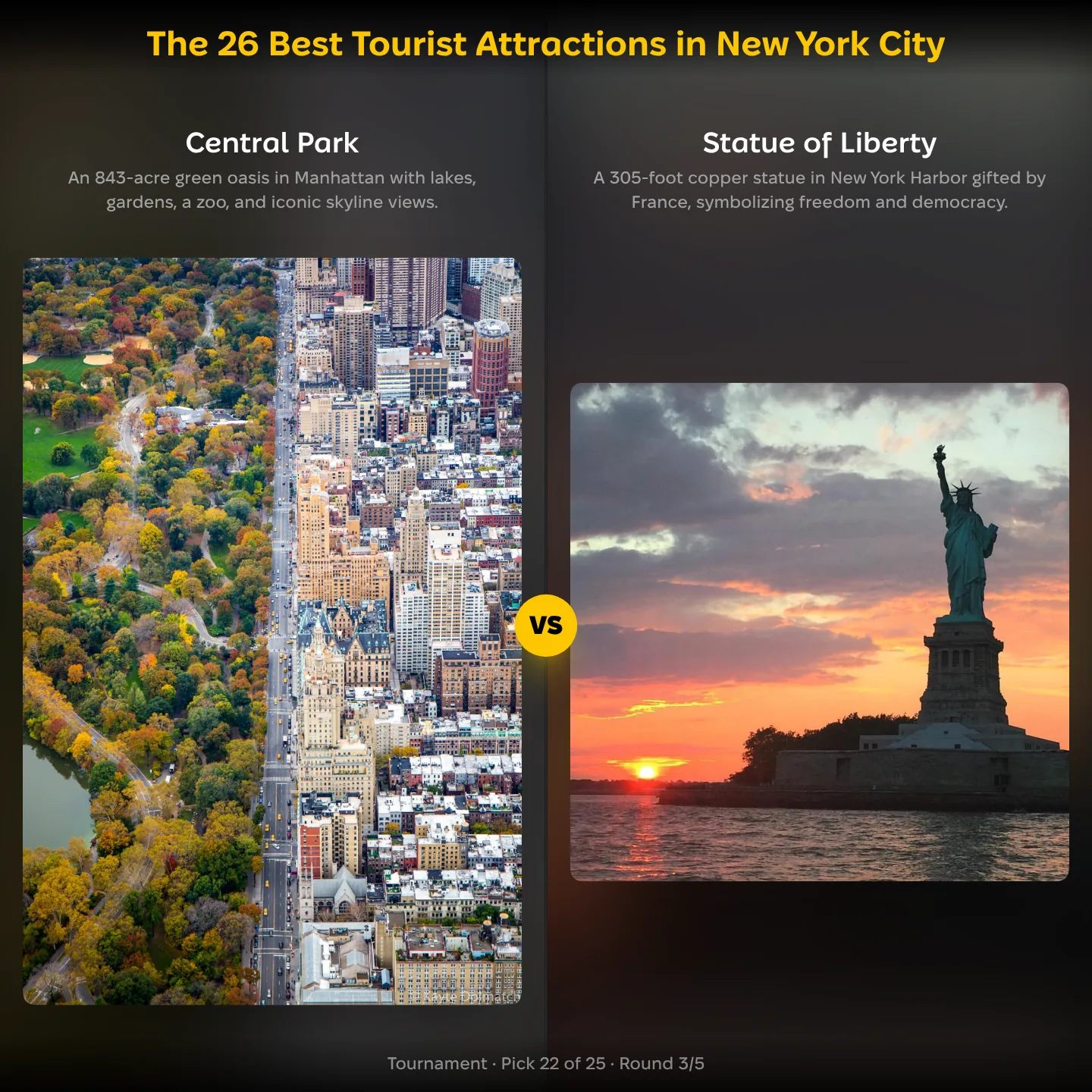
63 places to visit, with Liberty as the half-day trip
The best tourist attraction to visit is the widest net in this article: 63 options, from Antarctica and the Northern Lights to the Maldives, Yellowstone and the Charles Bridge in Prague.
In that company Liberty makes a compact trip. A ferry, a security check and a walk around the pedestal fit into half a day.
The Great Wall of China is the opposite kind of visit, a structure nobody sees more than a fraction of.
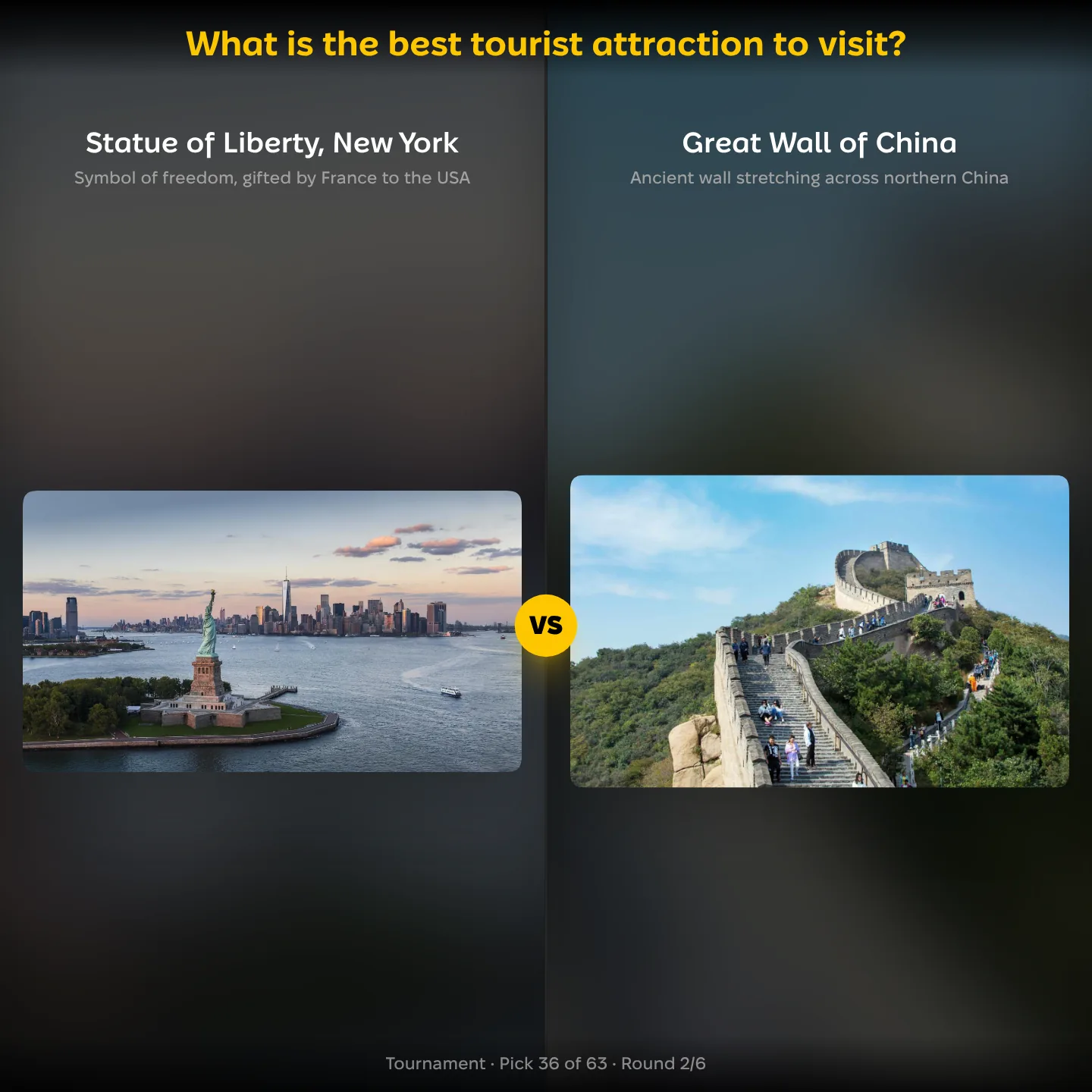
The most significant statue in history: copper against Michelangelo's marble
Among statues the Statue of Liberty faces the Terracotta Army, the Venus de Milo, Rodin's The Thinker, the Moai of Easter Island and Michelangelo's David.
Sculpture critics would not put it first. Its skin is copper sheeting 3/32 of an inch thick, the thickness of two pennies, and 176,000 pounds of it were hammered into shape over a frame.2
Its significance comes from what it did. For generations of immigrants arriving by ship it was the first sight of America.
David has the opposite profile: carved from a single block of marble in Florence, admired first as art and only later as a symbol of the city.
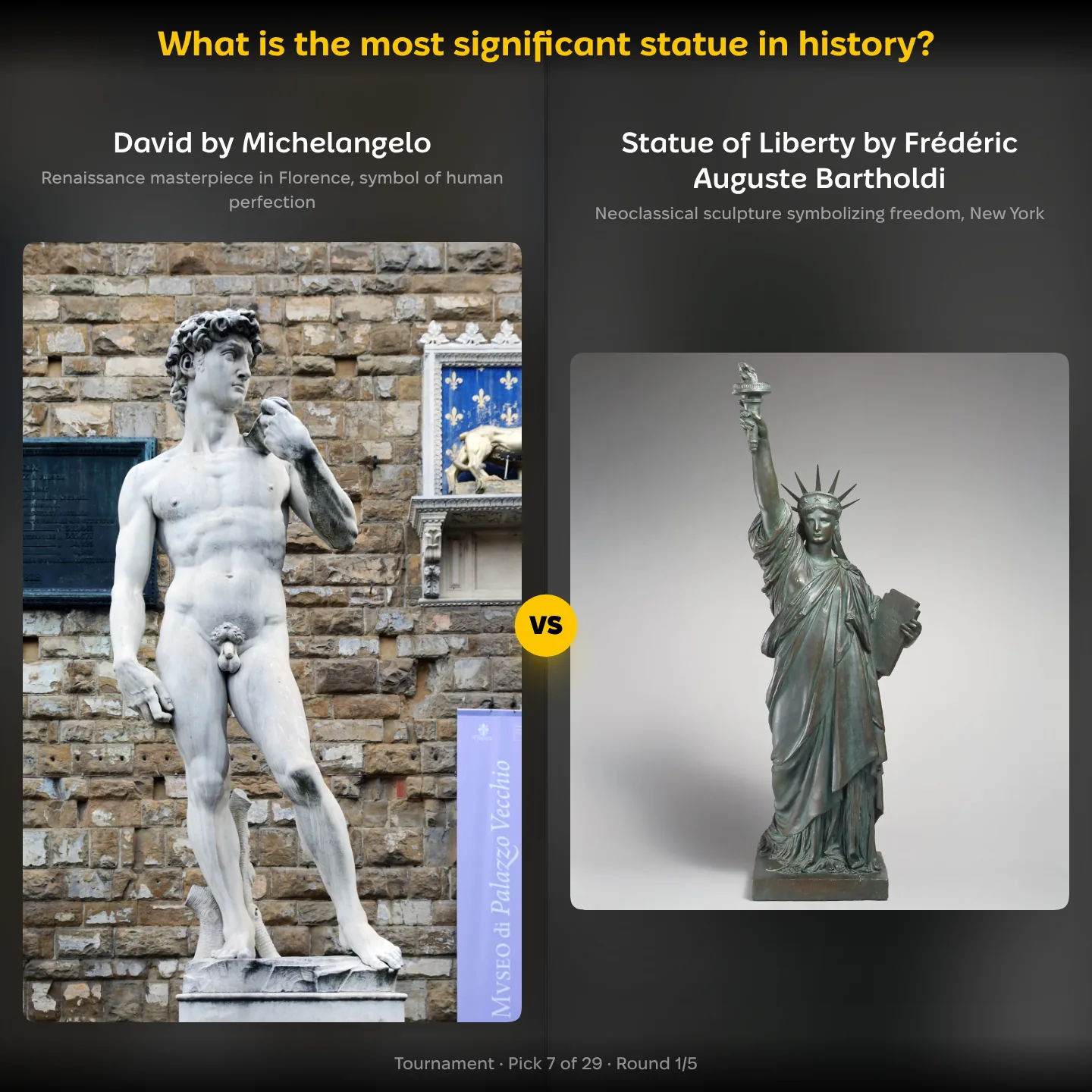
Statue of Unity vs Statue of Liberty: the world's colossal statues
The 23 most impressive colossal statues in the world is the list where the Statue of Liberty looks small. Its field includes the Spring Temple Buddha in Henan, Christ the Redeemer above Rio de Janeiro, The Motherland Calls in Volgograd and the Leshan Giant Buddha carved into a Sichuan cliff.
The Statue of Unity sets the scale. Guinness World Records lists the figure of Vallabhbhai Patel in Gujarat as the tallest statue on Earth, at 182 metres or 597 feet 1 inch, consecrated on 31 October 2018.5
The Statue of Liberty measures 151 feet 1 inch from the top of its base to the torch, about a quarter of that.2
Seniority is its answer. Of the statues on this list that stand taller, only the Leshan Giant Buddha, carved between 713 and 803, is also older.
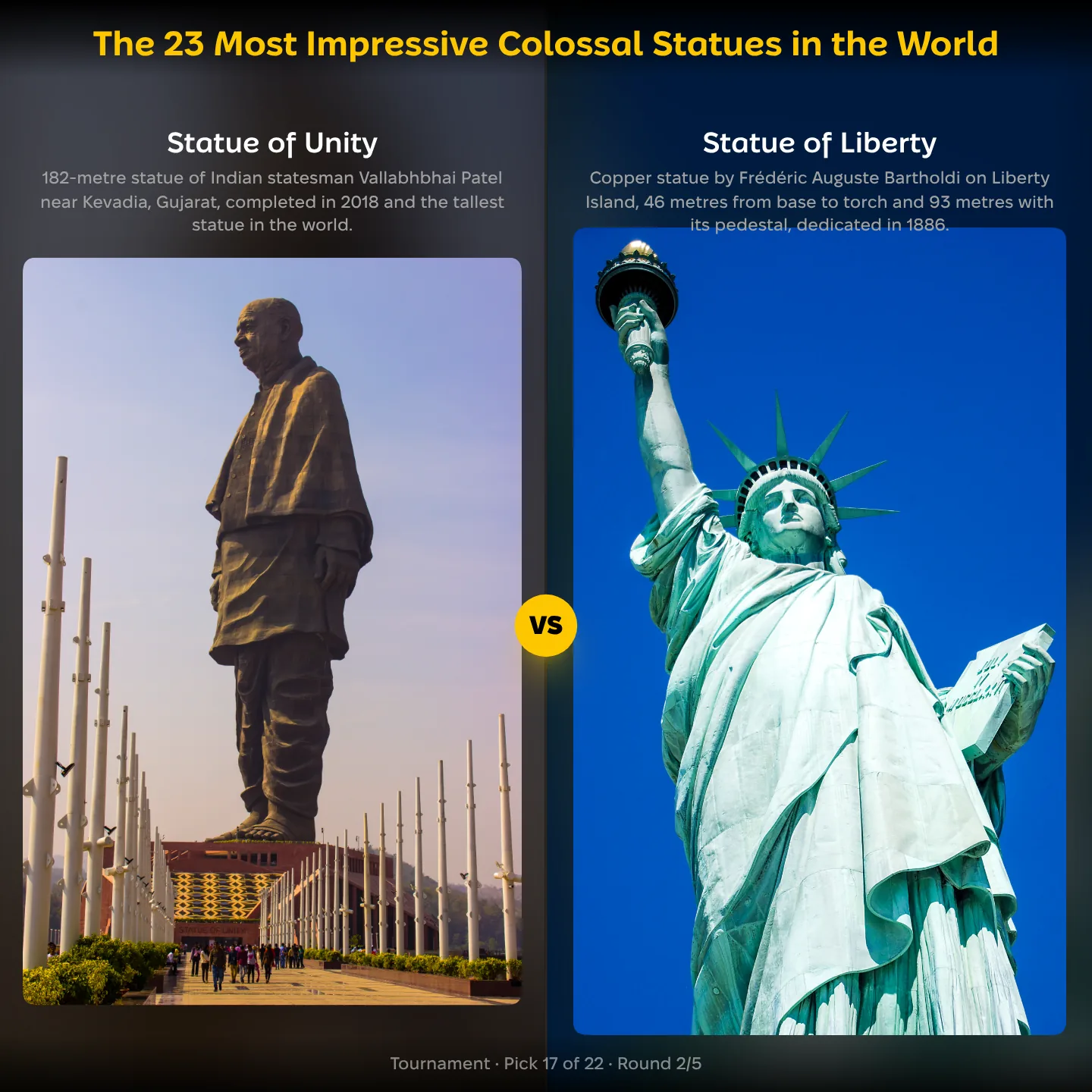
Statue of Liberty vs Impressionism: France's best cultural export
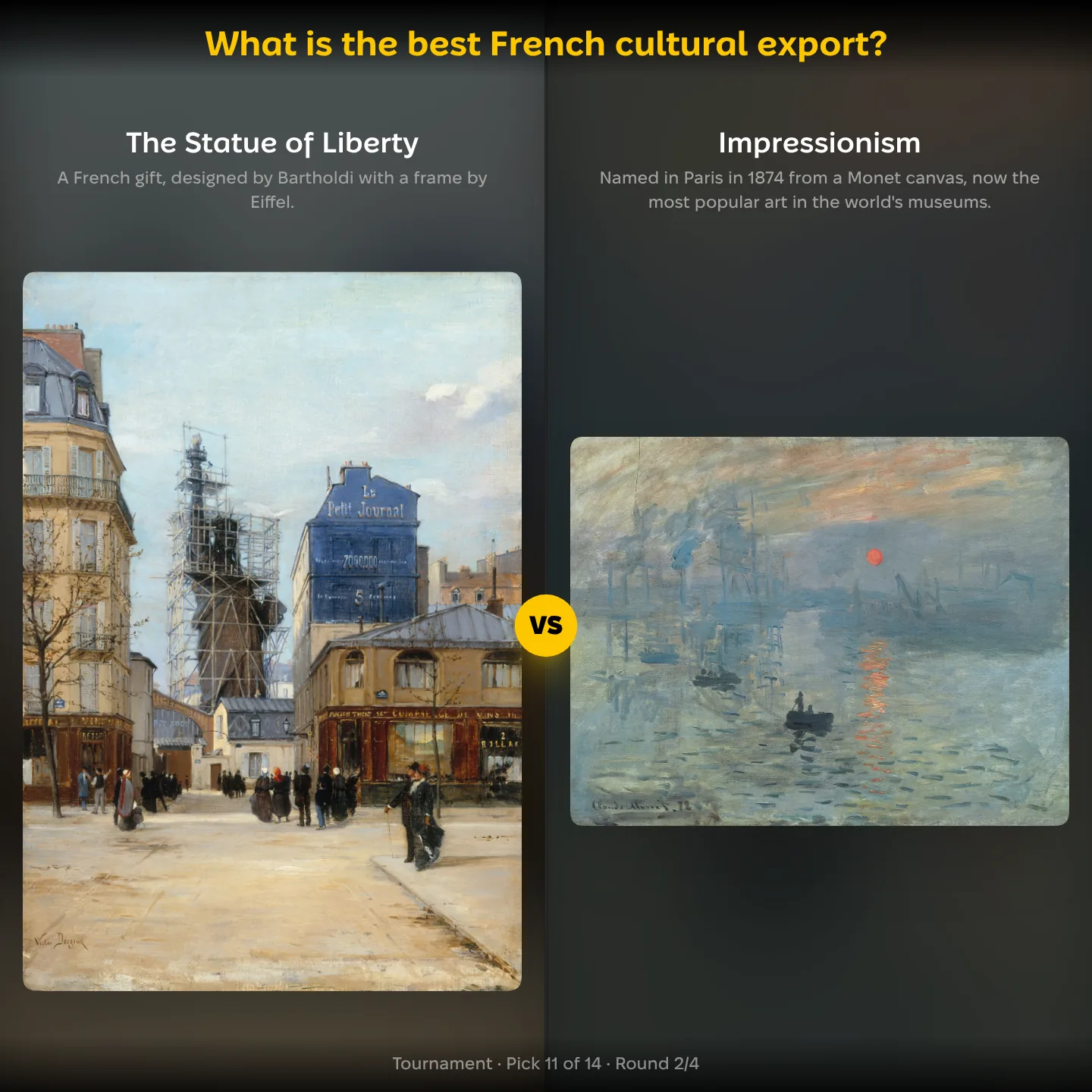
The best French cultural export is the one ranking where the Statue of Liberty stands for France. Its rivals are Impressionism, champagne, the metric system, haute couture, Chanel No. 5 and the Tour de France.
The statue was made in Paris. Bartholdi designed it, and after Eugène Viollet-le-Duc died in 1879 Gustave Eiffel took over the iron framework inside. The finished figure was taken apart into 350 pieces and shipped to New York.3 The picture in this frame is Victor Dargaud's painting of it rising above the rooftops of the rue de Chazelles.
Impressionism has the stronger claim to have changed how people see. The movement took its name in Paris in 1874 from a Monet canvas.
No other export on this list was reassembled on someone else's island.
Statue of Liberty vs Washington's cherry trees: the greatest gift between nations
Diplomatic gifts make an odd field that includes a temple and a giraffe. The greatest gift one country ever gave another sets the Statue of Liberty beside Egypt's Temple of Dendur, the pandas Ling-Ling and Hsing-Hsing, the Resolute Desk and Zarafa, the giraffe that walked from Marseille to Paris in 1827.
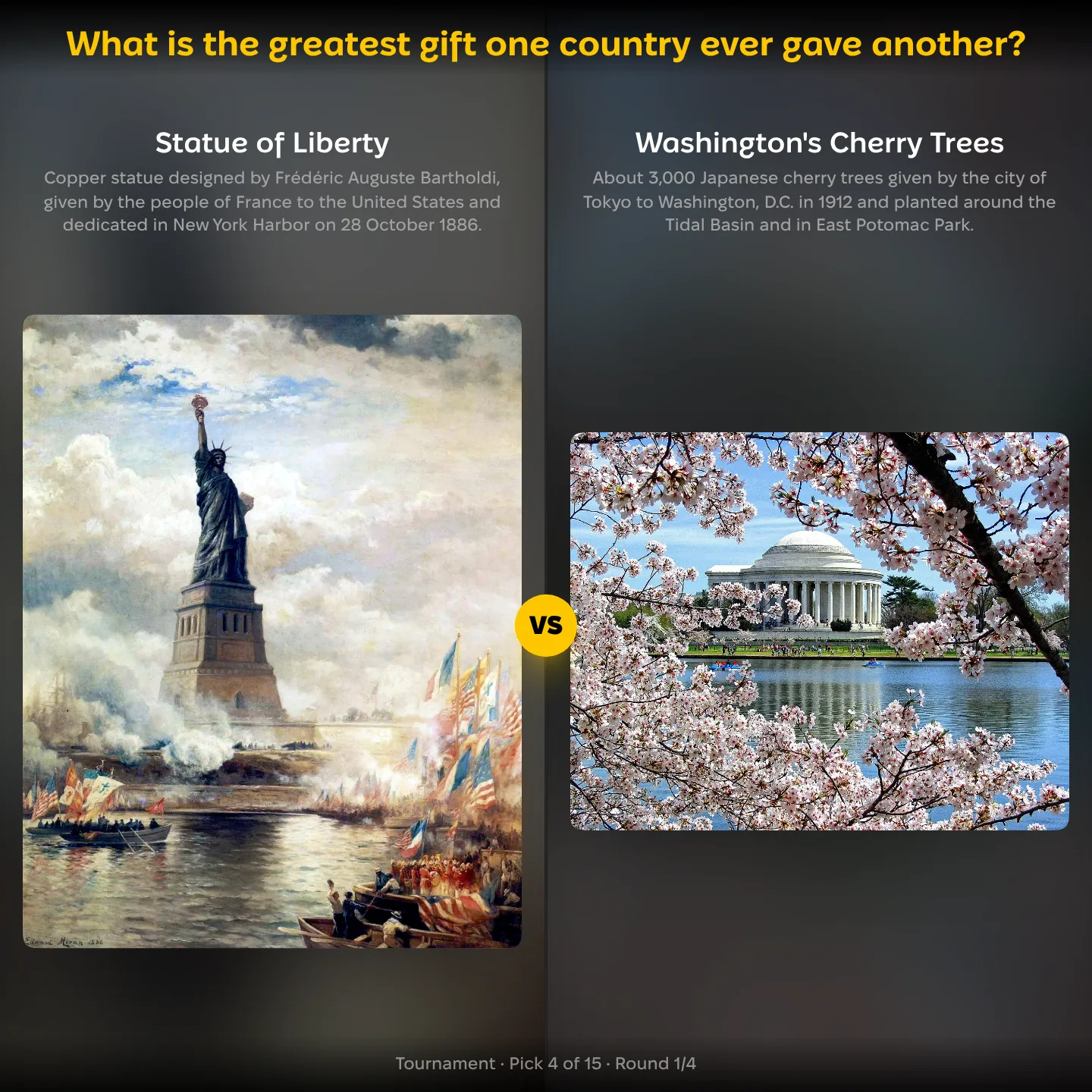
The Statue of Liberty was half a gift. France paid for the statue, and Americans had to fund the pedestal. By 11 August 1885 Joseph Pulitzer's newspaper The World had collected over $100,000, mostly in donations of about $1 or less, from roughly 125,000 people.6
Tokyo's cherry trees are the gentler rival. About 3,000 of them reached Washington in 1912 and were planted around the Tidal Basin and in East Potomac Park.
Some gifts renew themselves. Oslo has sent London a Christmas tree for Trafalgar Square every year since 1947.
Eiffel Tower vs Statue of Liberty: Gustave Eiffel's greatest work
Gustave Eiffel's name sits on one tower, but his firm built bridges, stations and domes across Europe. This ranking of his greatest work holds ten of them, including Budapest's Nyugati station and the Nice Observatory dome, which was designed to float on a ring of liquid.
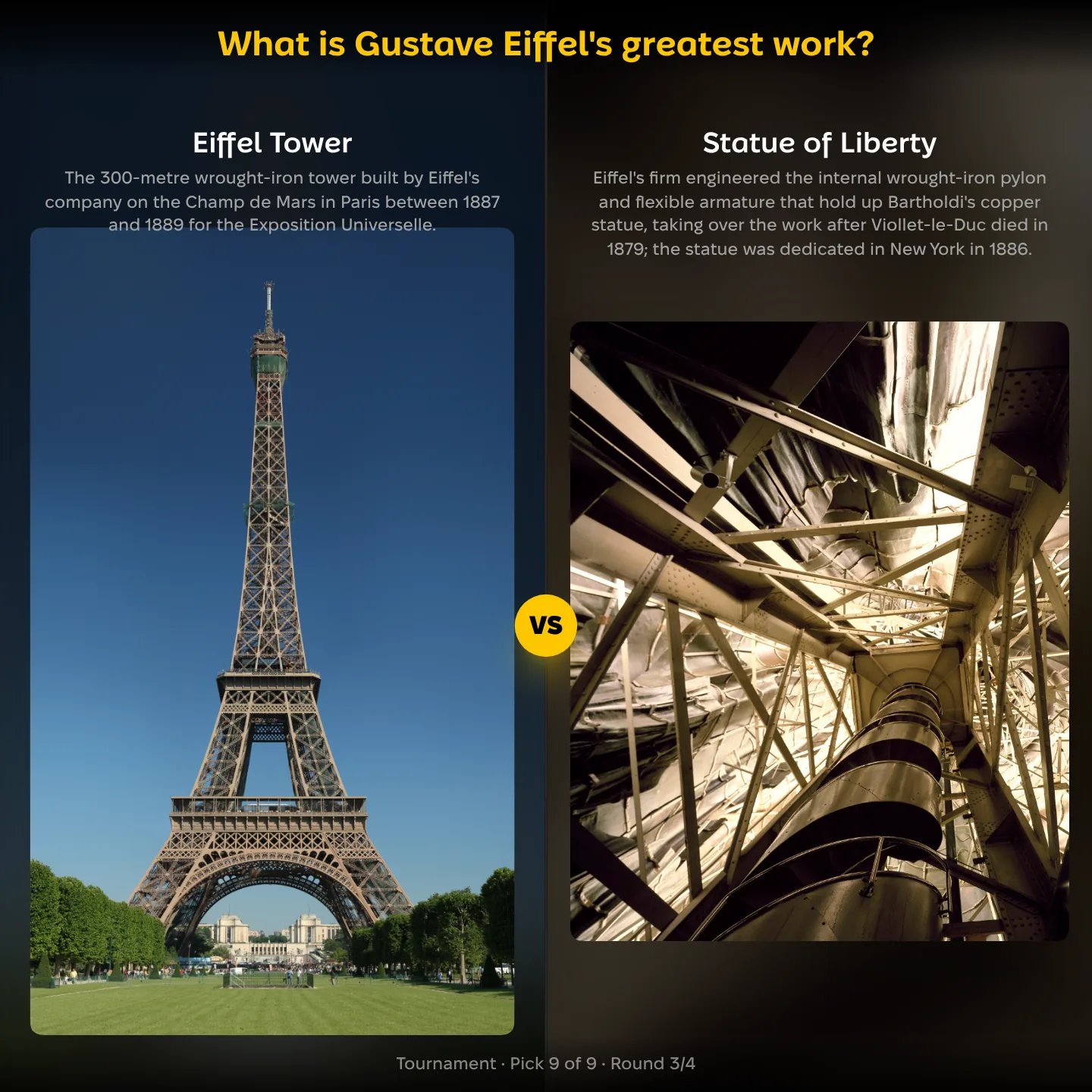
The Statue of Liberty entry is invisible from outside. Eiffel's part is inside: a wrought-iron pylon and a flexible armature that let the thin copper skin move in the wind instead of tearing. The picture in this frame shows that skeleton, photographed looking up from the stairs.
The Eiffel Tower is the obvious favourite and a close relative. Work on the Champ de Mars began in 1887, the year after the statue was dedicated in New York.
The Garabit Viaduct makes the bridge-builder's case: a railway arch over the Truyère gorge, finished in 1884 with a 165-metre main span. Its older sibling, the Maria Pia Bridge in Porto, opened in 1877 with a 160-metre arch over the Douro and set the pattern Garabit scaled up.
Grand Canyon vs Statue of Liberty: America's World Heritage Sites
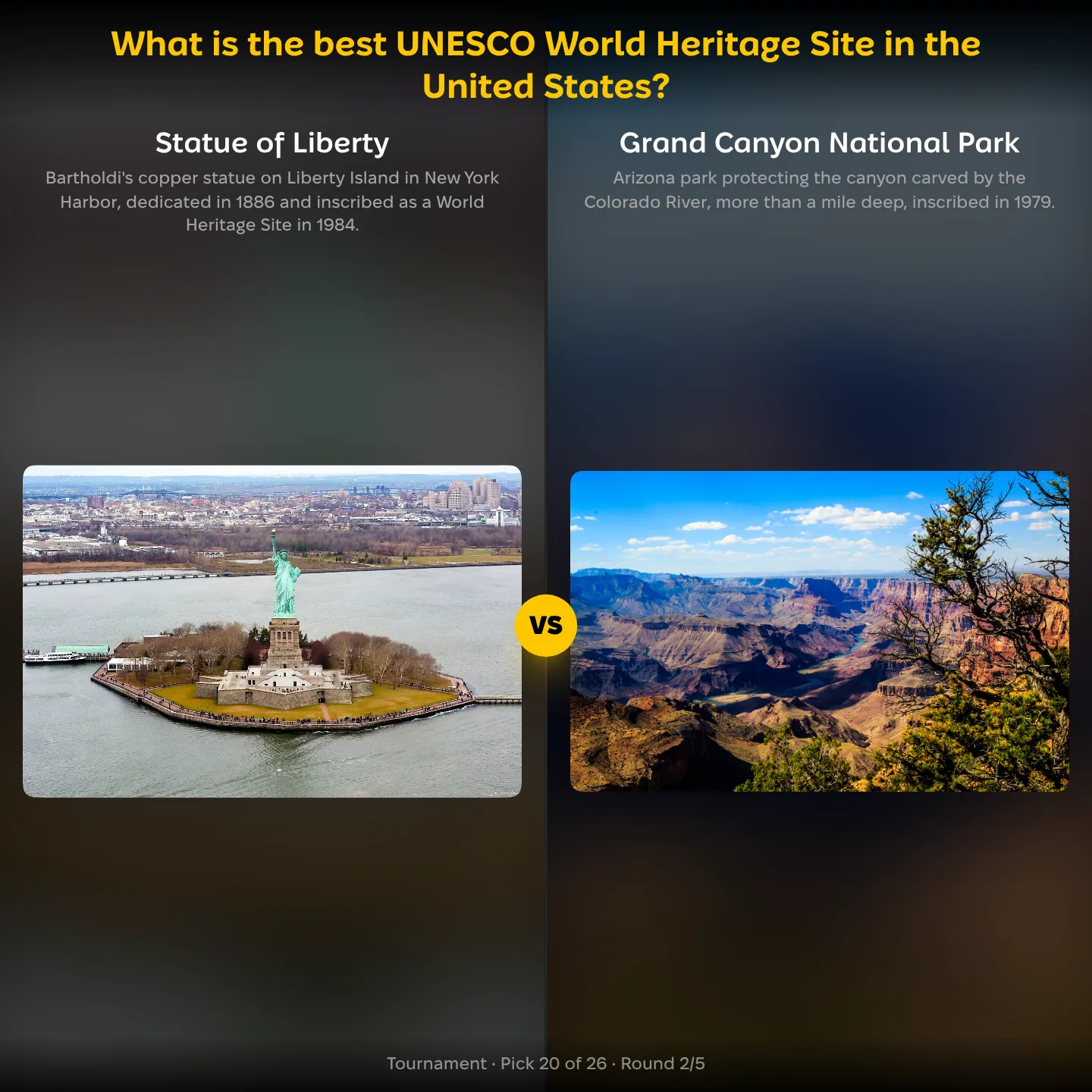
The best UNESCO World Heritage Site in the United States is a closed list of 27, and no other site on it is a sculpture. The rest include Yellowstone, Mesa Verde, Independence Hall, Cahokia Mounds and, since 2026, Georgia's Okefenokee swamp.
UNESCO inscribed the statue in 1984 as a cultural site under criteria (i) and (vi).7 The same year, fundraising began for an $86 million restoration, and the restored statue reopened on 5 July 1986.8
The Grand Canyon answers with geology, a gorge cut by the Colorado River to more than a mile deep.
Independence Hall is the statue's nearest relative on the list. The Declaration of Independence was adopted there on 4 July 1776, the date carved in Roman numerals on the tablet in Liberty's left hand.
Planet of the Apes, 1968: the best movie scene at a landmark
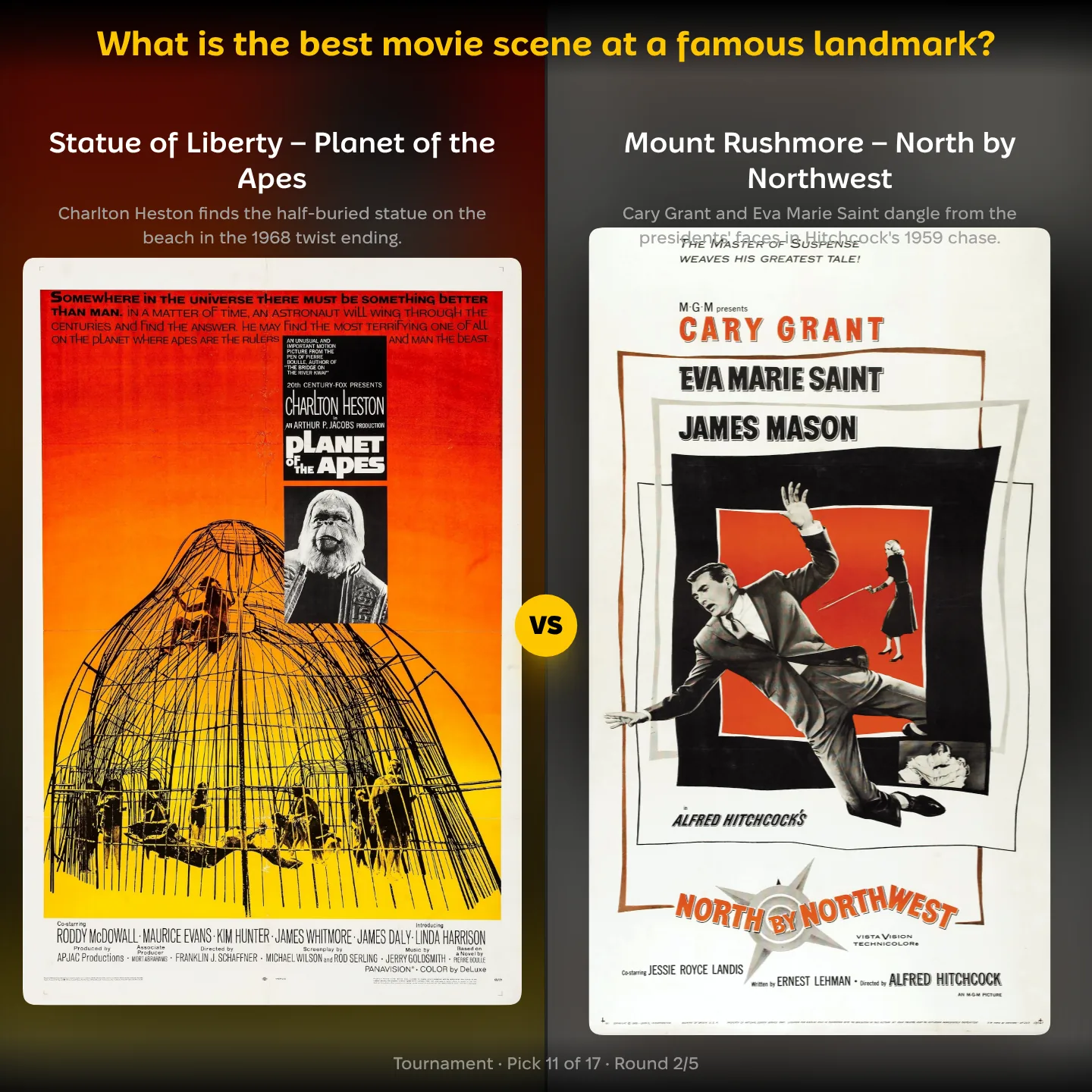
The best movie scene at a famous landmark gives the Statue of Liberty its most famous screen moment: the last shot of Planet of the Apes (1968), in which Charlton Heston finds the statue half-buried on a beach.
The scene works on recognition alone. Viewers need only the torch arm and the crown to understand which planet the astronauts landed on.
Mount Rushmore has Hitchcock. In North by Northwest (1959) Cary Grant and Eva Marie Saint dangle from the presidents' faces.
The Empire State Building appears twice on the same list, with King Kong and Sleepless in Seattle, a reminder of how often New York gets the role.
Statue of Liberty vs Mona Lisa: the most overrated tourist attraction
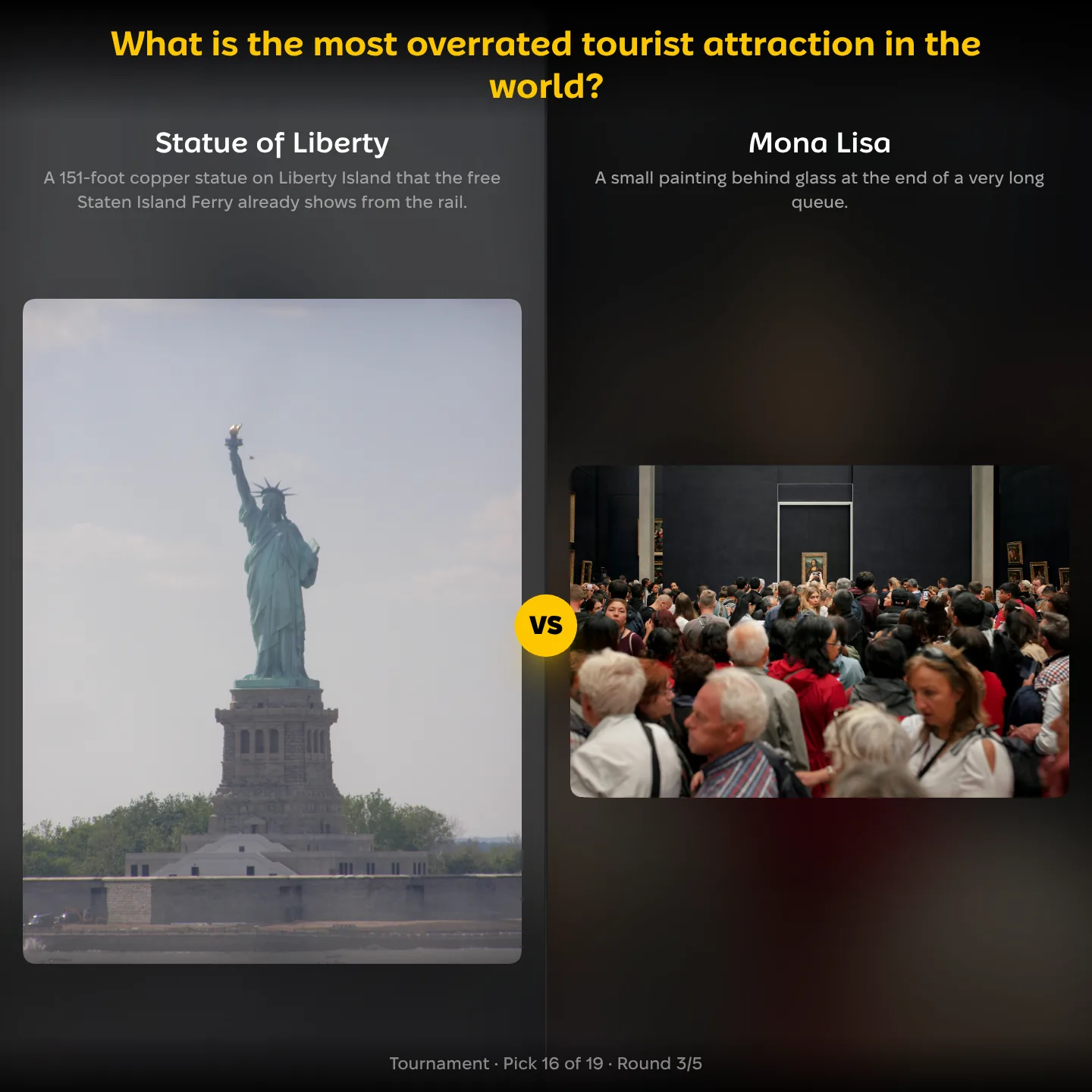
The Statue of Liberty belongs on at least one list where fame counts against it: the most overrated tourist attraction in the world, alongside Times Square, Manneken Pis, the Mona Lisa, the Hollywood Walk of Fame and the Leaning Tower of Pisa.
The complaint is logistics. The free Staten Island Ferry passes close enough to see the statue from the rail, which makes the ticketed crossing a harder sell.
Visits have cooled since the turn of the century. The National Park Service counted 5,509,706 in 2000 and 3,722,029 in 2024.9
The Mona Lisa draws the same complaint in a smaller room. The statue's defence is the crown, where 25 windows look out over the harbour.
Bartholdi's statue, Eiffel's skeleton, Lazarus's poem
The Statue of Liberty is a French sculpture on an American island, held up by an engineer better known for a tower and explained by a poem written to pay for its pedestal. Each ranking here picks one of those owners and ignores the rest, which is how the same copper figure can be the national symbol on one list and an overrated ferry ride on another. Letting voters settle the owners in pairs is the fairest way to make them argue.
If a monument near you leads several lives like this, give it its own ranking and find out which life people choose.
More rankings, more angles
- Stonehenge vs the Pyramids: Which Is Older? 12 Lists Where They Meet — two far older monuments on the same landmark lists
- Is New York City the Best City in the World to Visit? 16 Lists — the harbour city around Liberty Island
- Washington vs Lincoln: Who Was the Better President? 15 Lists — two presidents carved into Mount Rushmore
Sources
- Ville de Paris — exhibition "Lady Liberty, derrière l'icône, le génie d'Eiffel", Eiffel Tower first floor, 12 October to 12 November 2026, for the statue's 140th anniversary: paris.fr (checked 2026-11-07)
- National Park Service — Statue of Liberty statistics: 151 ft 1 in from base to torch, 176,000 lb of copper, sheeting 3/32 in thick, 25 windows and seven rays in the crown: nps.gov (checked 2026-11-07)
- National Park Service — Liberty Island history: Eiffel took over the framework after Viollet-le-Duc died in 1879, the statue shipped in 350 pieces, run by the Lighthouse Board 1886–1902: nps.gov (checked 2026-11-07)
- National Park Service — Emma Lazarus: "The New Colossus" written 2 November 1883 for the pedestal fund auction, placed on a plaque in 1903: nps.gov (checked 2026-11-07)
- Guinness World Records — tallest statue: Statue of Unity, 182 m (597 ft 1 in), consecrated 31 October 2018: guinnessworldrecords.com (checked 2026-11-07)
- National Park Service — Joseph Pulitzer: over $100,000 collected by 11 August 1885, from roughly 125,000 people, most donations about $1 or less: nps.gov (checked 2026-11-07)
- National Park Service — UNESCO World Heritage: inscribed in 1984 as a cultural site under criteria (i) and (vi): nps.gov (checked 2026-11-07)
- National Park Service — history: World Heritage designation, the $86 million restoration, reopening on 5 July 1986: nps.gov (checked 2026-11-07)
- National Park Service — park statistics: 5,509,706 recreation visits in 2000 and 3,722,029 in 2024: nps.gov (checked 2026-11-07)