
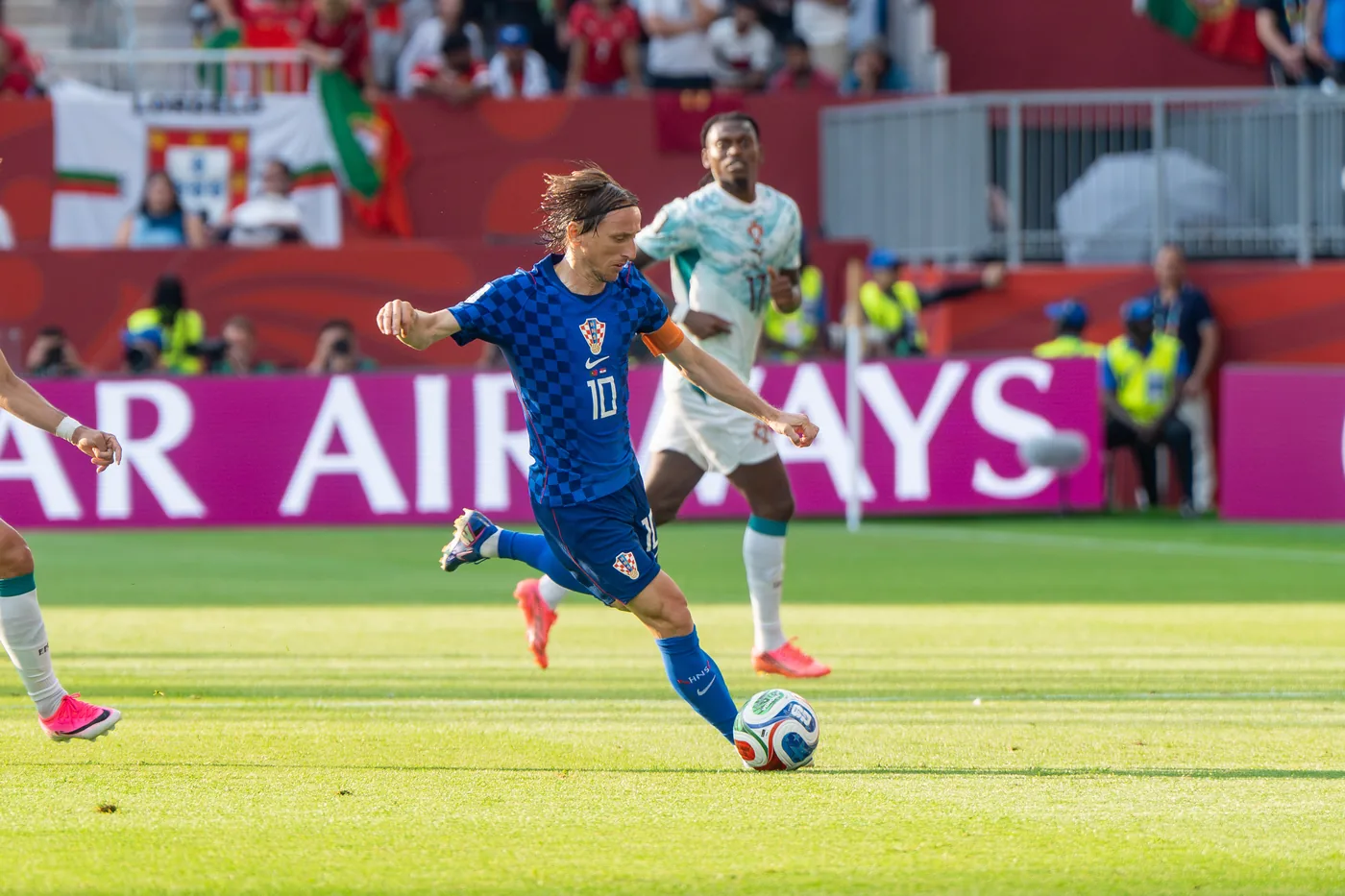
Luka Modrić won his 200th Croatia cap in Toronto on 23 June 2026, in a 1-0 defeat of Panama that kept his country at the World Cup. Among European players, only Cristiano Ronaldo has been picked more often.1 Nine days later Croatia were out, beaten 2-1 by Portugal on a Gonçalo Ramos header in the 94th minute.2
He was 40 throughout, and had been a professional since 2003. Long enough to end up holding the trophy record at Real Madrid, the appearance record for Croatia, and a Spanish newspaper poll from 2012 that he has never quite shaken off.
Fourteen rankings below put him into fourteen different fields.
Nobody has won more with Real Madrid than Modrić, and Croatia have won nothing at all with him. The lists split along that line.
Iniesta, Xavi, Zidane: where Modrić fits in Europe's midfield
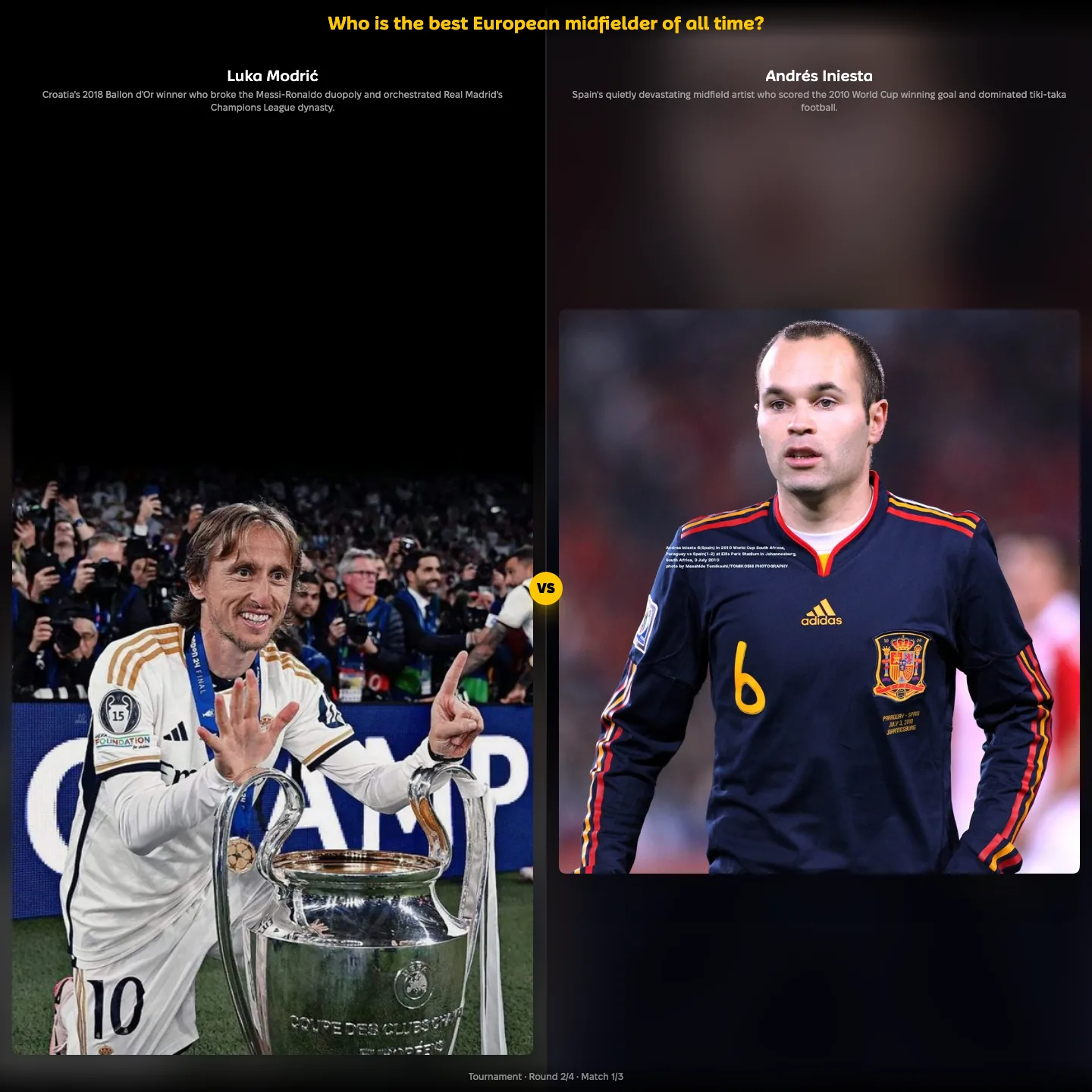
The widest question in the set is the best European midfielder of all time, and the field holds Andrés Iniesta, Xavi, Zinedine Zidane and Johan Cruyff.
Modrić's case is the European Cup. He has won it six times, which is the competition record, shared with Dani Carvajal and Francisco Gento.3
Iniesta's case is the goals that decided things, and Xavi's is the passing system Barcelona and Spain built around him. Both of them won a World Cup — Modrić did not.
Ivan Rakitić played with Modrić for Croatia and with Iniesta at Barcelona. He said the two of them "are from a different planet", and that he would put both in the same team.1
Ballon d'Or 2018: the year Modrić interrupted Messi and Ronaldo
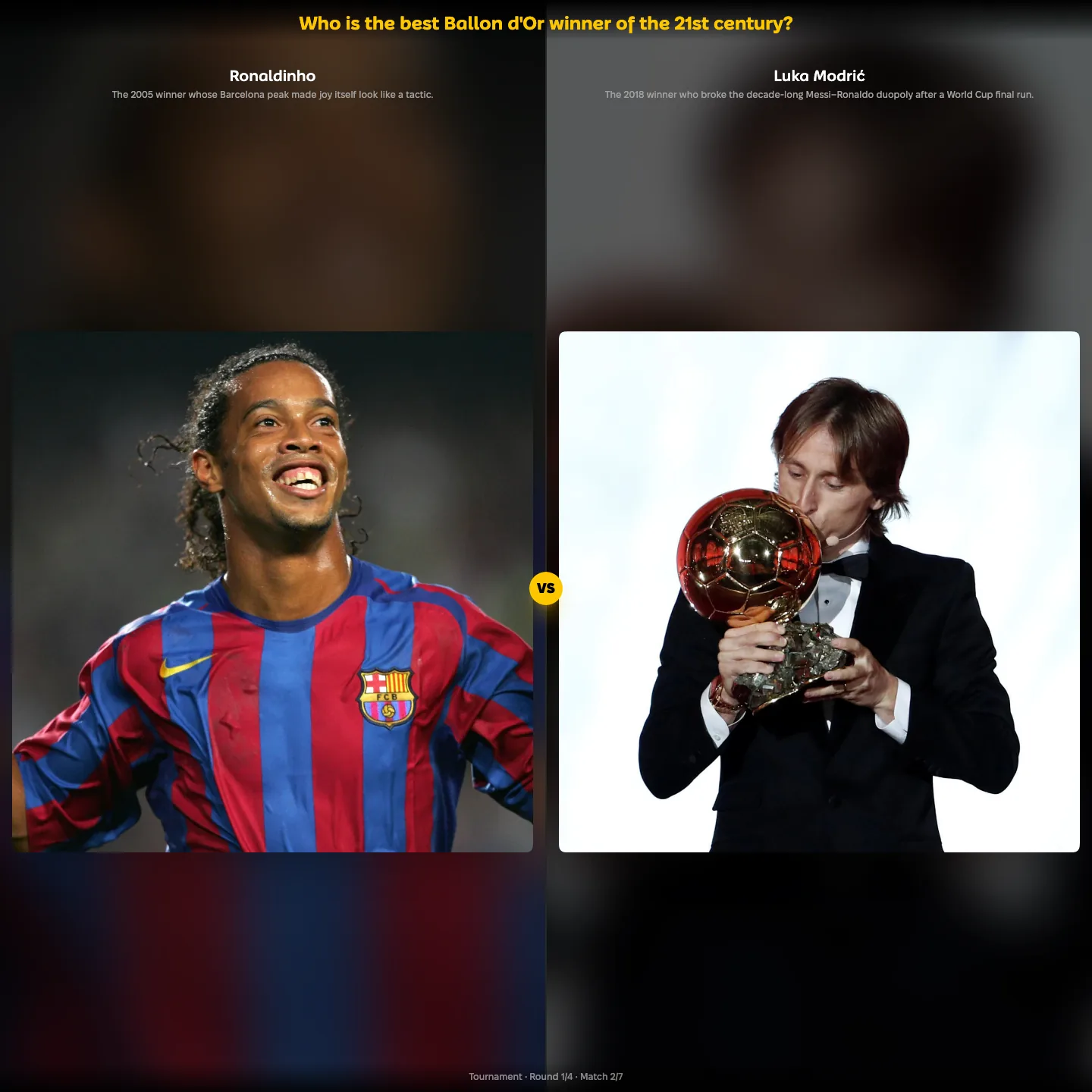
Every Ballon d'Or winner since 2000 stands in this field, and Modrić has exactly one award to bring to it.
He won it in Paris on 3 December 2018, finishing ahead of Cristiano Ronaldo and Antoine Griezmann, with Lionel Messi fifth. The previous winner who was not Messi or Ronaldo had been Kaká, eleven years earlier.4
One season measured against two dynasties is a thin case on paper. It is also the season that ended ten consecutive awards shared between two players, and no other name in this field can say the same.
Modrić vs Kroos: Real Madrid's most decorated player ever
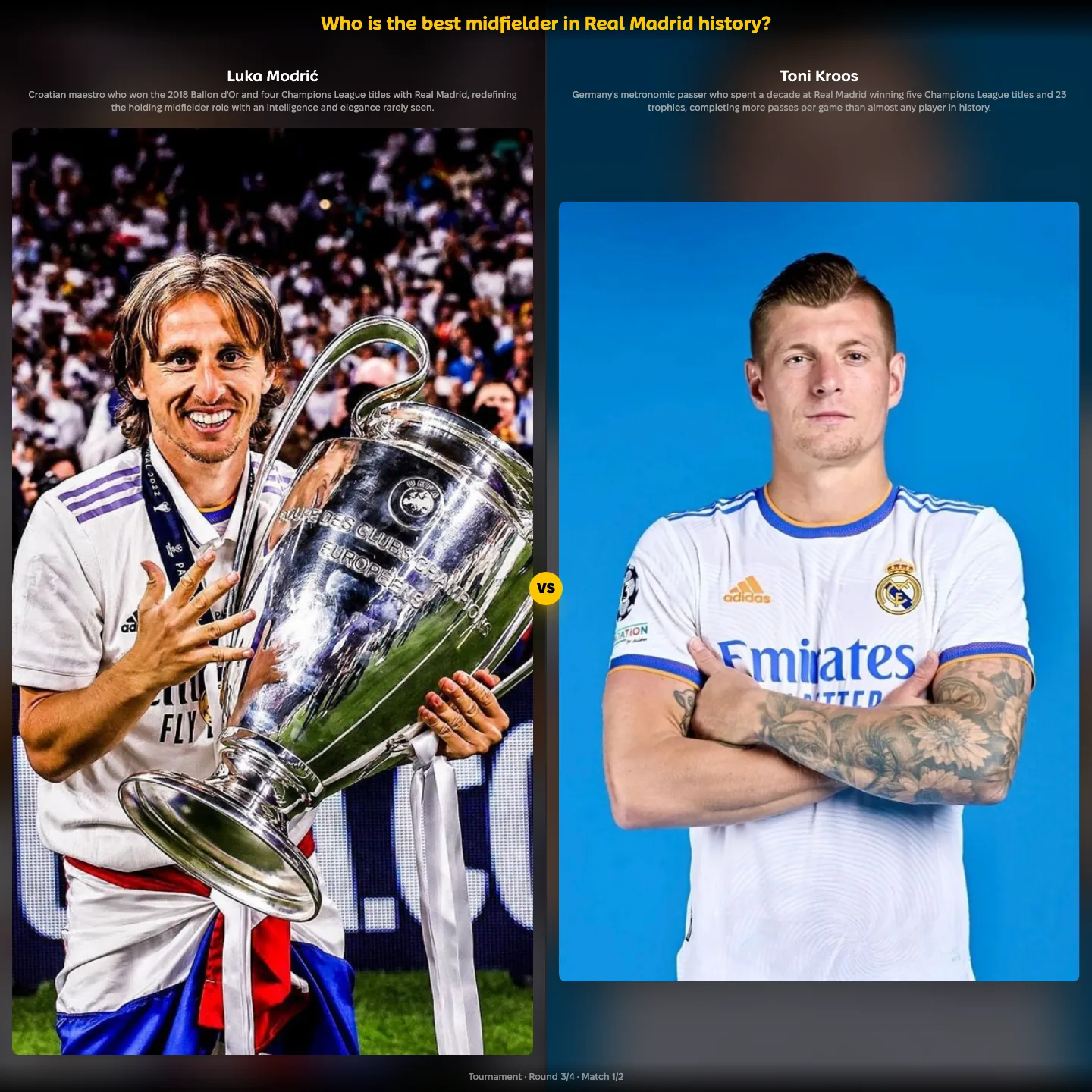
Narrow the room to one club and Modrić meets Toni Kroos, Zinedine Zidane the player, Claude Makélélé and every midfielder Real Madrid have fielded since 1902.
The club's own farewell note counted 13 seasons, 590 appearances and 43 goals, and called him the most decorated player in Real Madrid's 123-year history, on twenty-eight trophies.5
Kroos is the comparison most people reach for, because the two of them started together in a midfield that kept reaching European finals. Dani Carvajal is the one the numbers put closest: one trophy behind,3 and level on European Cups after the same Wembley night in 2024.1
Zidane complicates it from the other direction. Five seasons against thirteen, one European Cup against six, and a volley in the 2002 final that supporters still describe shot by shot. Longevity and highlight reel are different measures, and this ranking makes readers choose one.
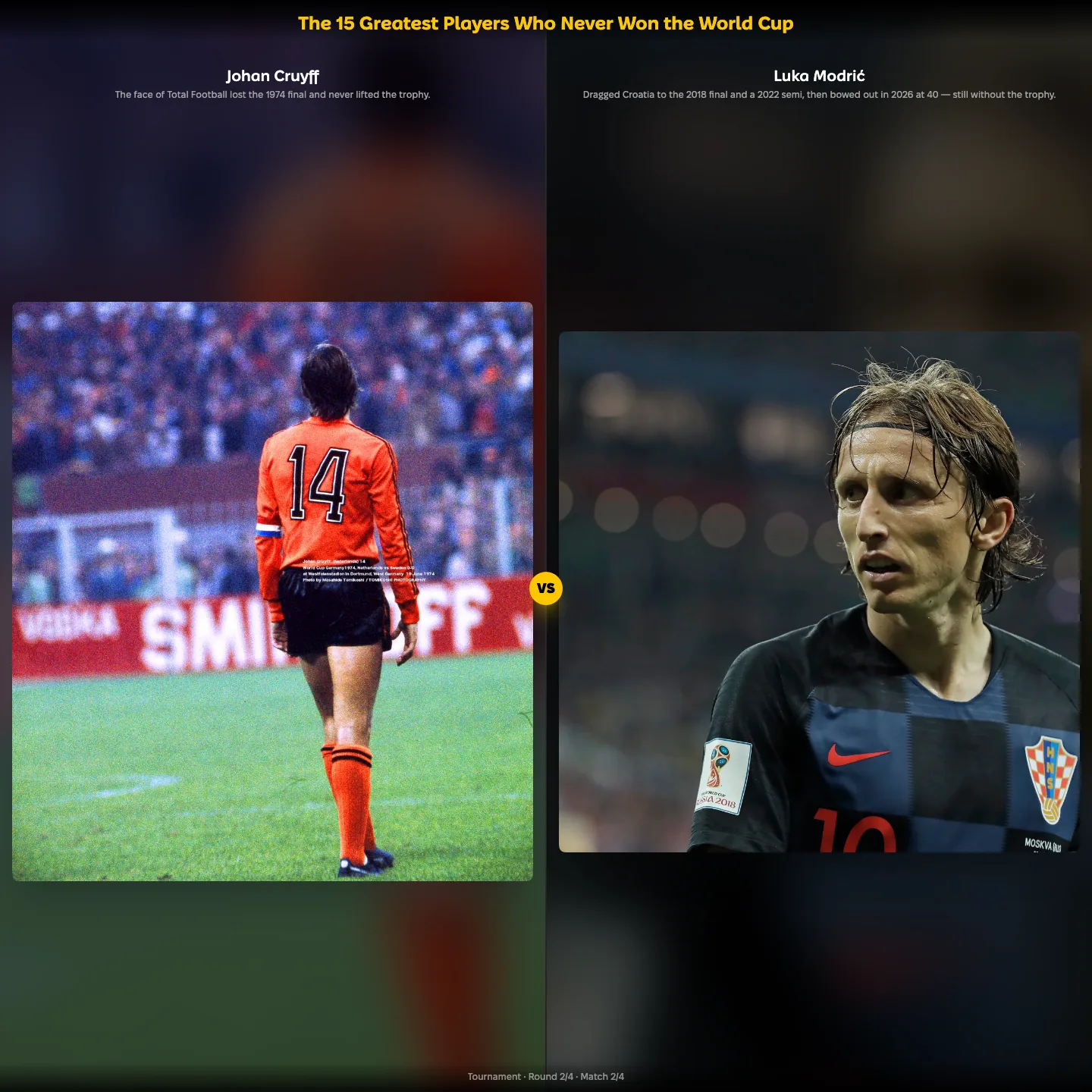
Cruyff, Eusébio, Modrić: great careers with no World Cup
This ranking is built on an absence, and Modrić has the strongest recent claim on a place in it. Johan Cruyff, Eusébio, Roberto Baggio and Ferenc Puskás are the historical company.
Croatia went further with him than they had gone without him. He captained them to the 2018 final in Moscow, which France won 4-2, and to third place in Qatar in 2022 after beating Morocco 2-1.3
The near-misses did not stop at the World Cup. Spain beat Croatia on penalties in the 2023 Nations League final,1 and in seven European Championships Croatia have never gone beyond the quarter-finals.6
Scale is the counter-argument. Cruyff and Puskás lost finals too, for football nations with a century of history behind them; Croatia's first competitive campaign as an independent country was the run to Euro 96. Modrić took the newest of those countries to a World Cup final.
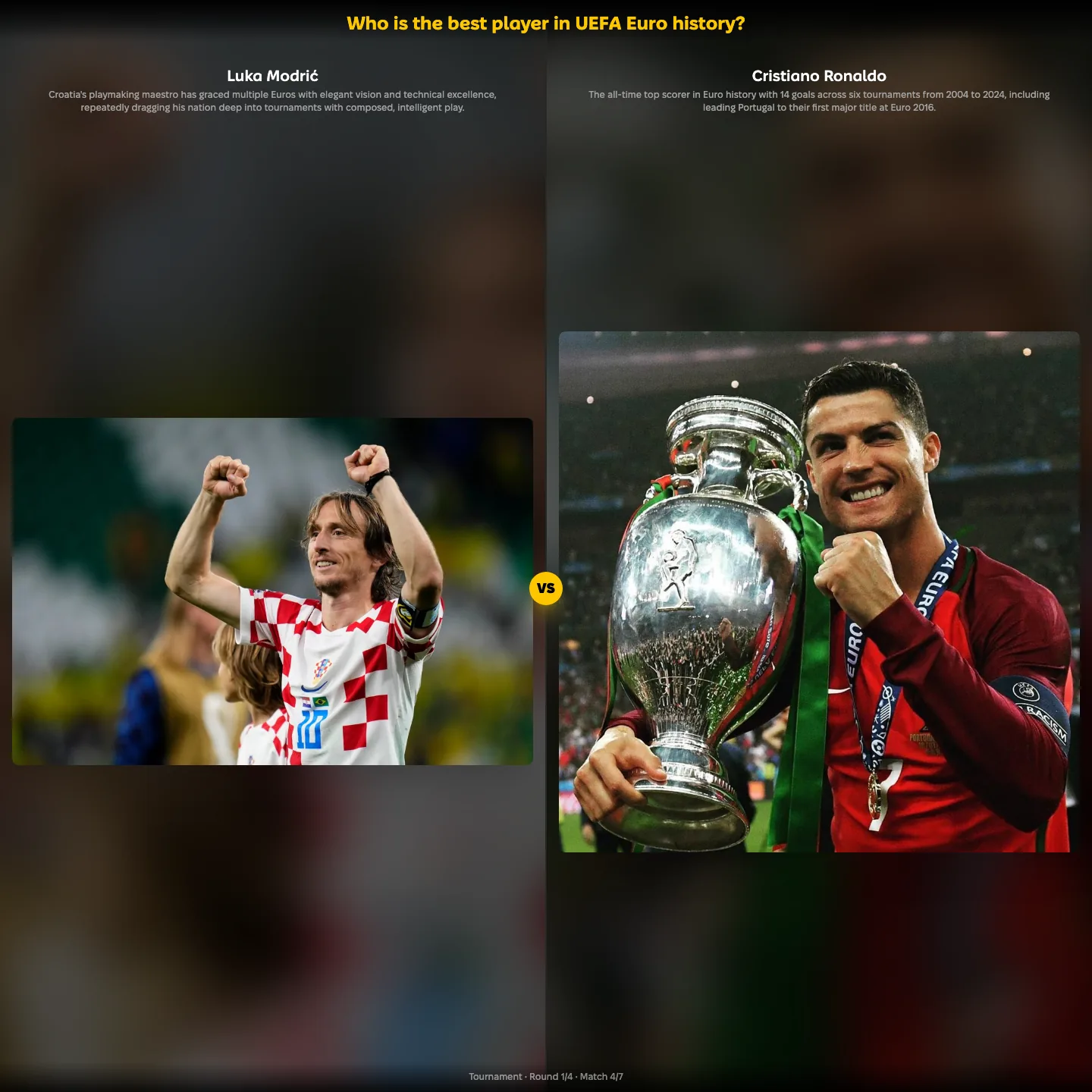
Euro 2008 and Euro 2024: Croatia's youngest and oldest scorer are the same player
The best player in European Championship history is the ranking where Modrić brings the appearances and none of the deep runs. Michel Platini, Cristiano Ronaldo and Marco van Basten are at the front of the field.
His Euro record covers a wider span of time than anyone's. He is Croatia's youngest scorer at the tournament, at 22 years and 273 days against Austria in 2008, and its oldest, at 38 years and 289 days against Italy in 2024.6 That second goal made him the oldest scorer in the competition's history.1
Sixteen Euro appearances across five tournaments and four goals: no other Croatian has more of either.6 It has produced nothing. Croatia have played four knockout matches at a Euro and won none of them. Platini and Ronaldo both have a winner's medal.
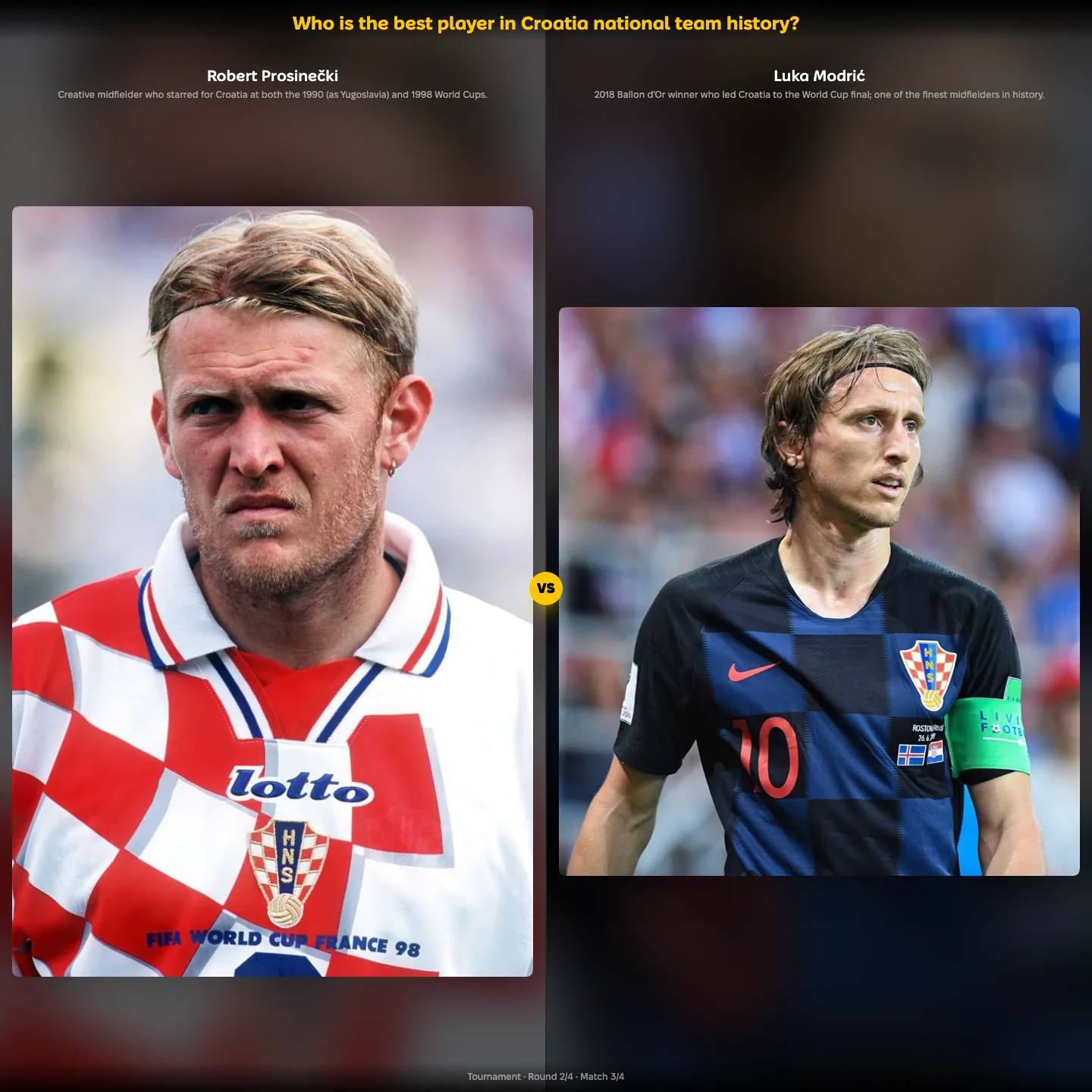
Croatia's best ever: Modrić past Šuker, Boban and Prosinečki
This is the one ranking where Modrić has no gap to explain. Davor Šuker, Zvonimir Boban, Robert Prosinečki and Darijo Srna are the generation he followed.
Nobody has played for Croatia more often, and nobody has won the country's player-of-the-year award more than his twelve times.3 Šuker, whom he passed, has six.1
Prosinečki was in the 1998 side that reached a World Cup semi-final in Croatia's first attempt at the tournament, so he is entitled to defend his own era. He does the opposite. There is no way of looking at it, he said, in which Modrić does not deserve the title of the best Croatian in history.1
Boban's case runs on a different clock. He captained that 1998 team when the country itself was seven years old, and he won a Champions League at Milan long before Modrić arrived there. Modrić inherited a Croatia that already knew how to reach tournaments.
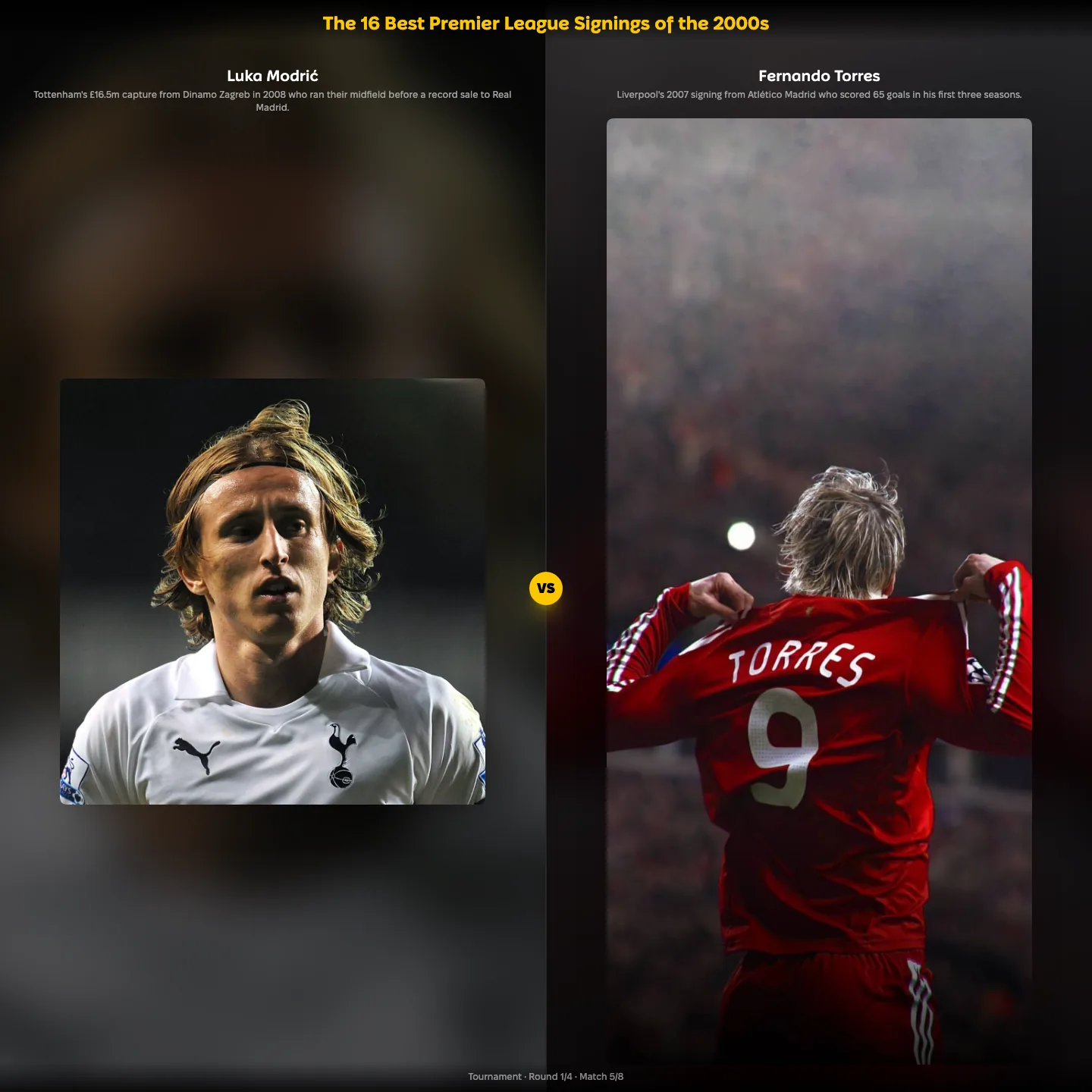
Juande Ramos' first signing of 2008
Barcelona, Chelsea and Arsenal had all looked at Modrić before Tottenham made him Juande Ramos' first buy of the summer of 2008; in north London he was played out of position and criticised for lacking physical strength.1 He left four years later with no trophy, which is hard to defend against Cristiano Ronaldo and Didier Drogba on a ranking of the decade's best Premier League buys.
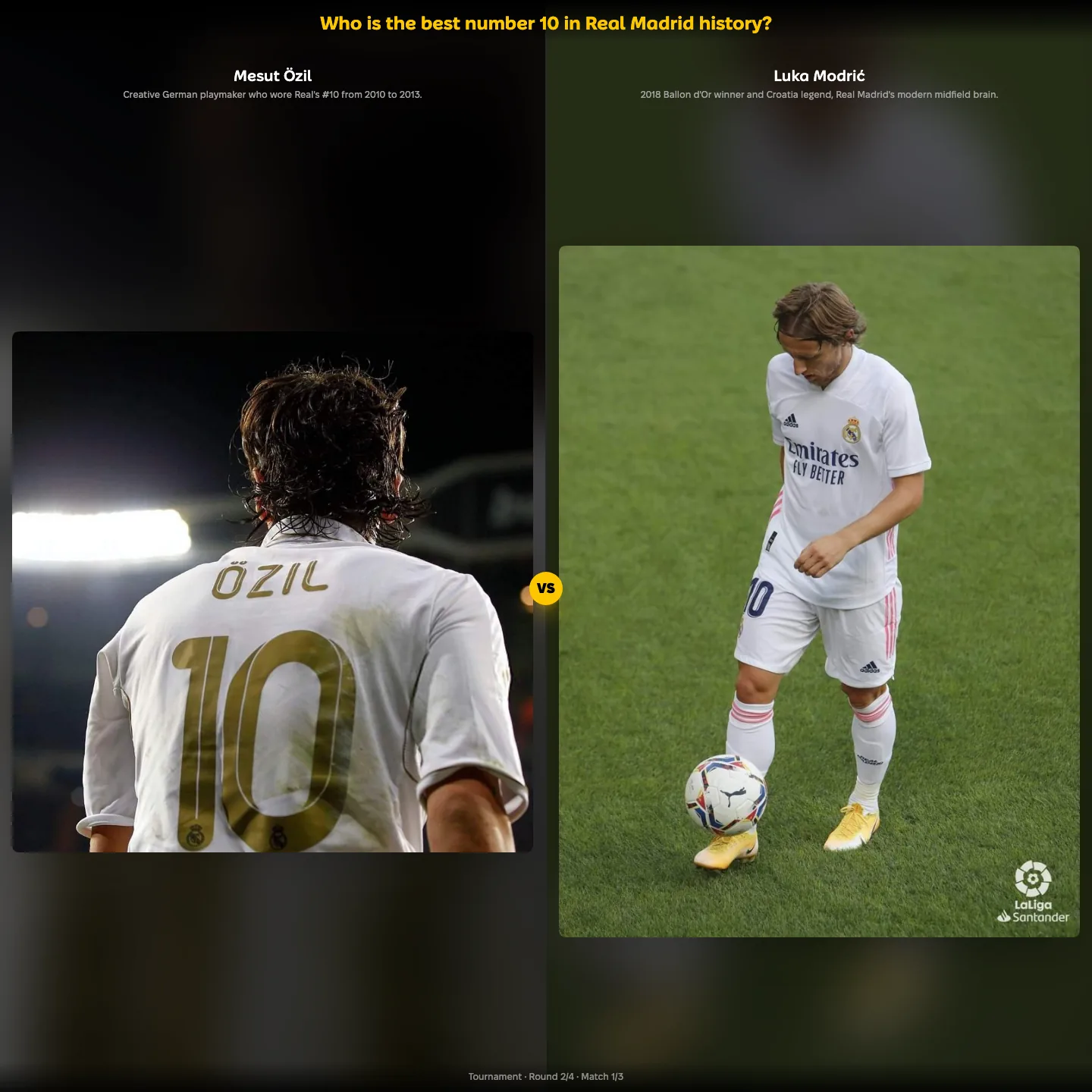
Real Madrid's No. 10: Puskás, Özil, Modrić, Mbappé
Modrić wore Real Madrid's No. 10 from 2017-18 until he left, taking it over from James Rodríguez and handing it on to Kylian Mbappé. Ferenc Puskás, Michael Laudrup, Luís Figo, Wesley Sneijder and Mesut Özil had it before him.7
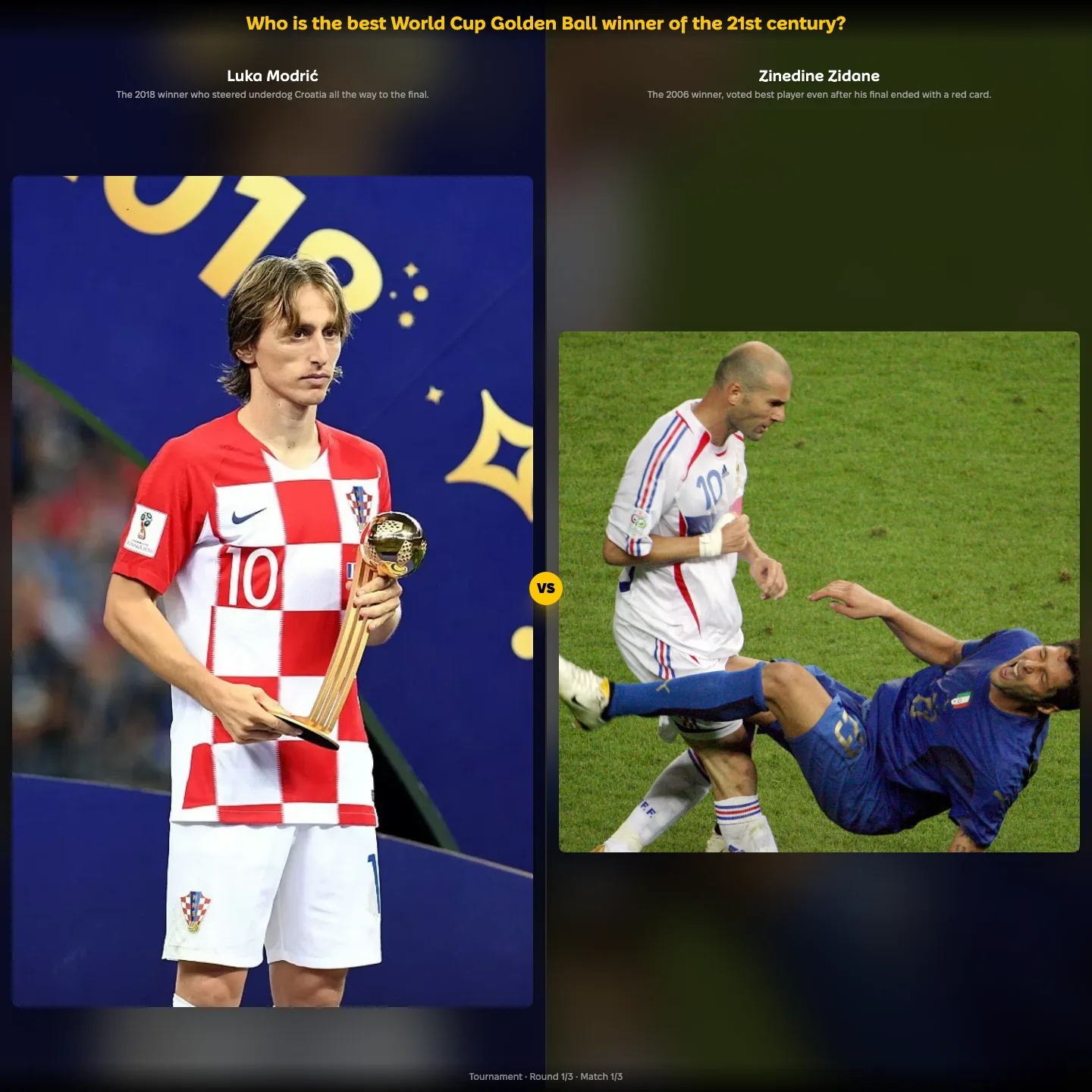
Golden Ball: Modrić in 2018, Zidane in 2006, Rodri in 2026
The adidas Golden Ball goes to one player per World Cup, so this is the smallest field of the fourteen. Seven awards this century, six men: Oliver Kahn, Zinedine Zidane, Diego Forlán, Lionel Messi twice, Modrić and Rodri.8
Modrić won the 2018 edition after captaining Croatia through three knockout rounds, two of them settled on penalties. He added FIFA's Bronze Ball in Qatar four years later.1
Rodri is the newest arrival. Spain beat Argentina 1-0 in extra time in New Jersey on 19 July 2026, and in that final he completed 101 of his 105 passes.8
Kahn is the outlier: the only goalkeeper to have won it.
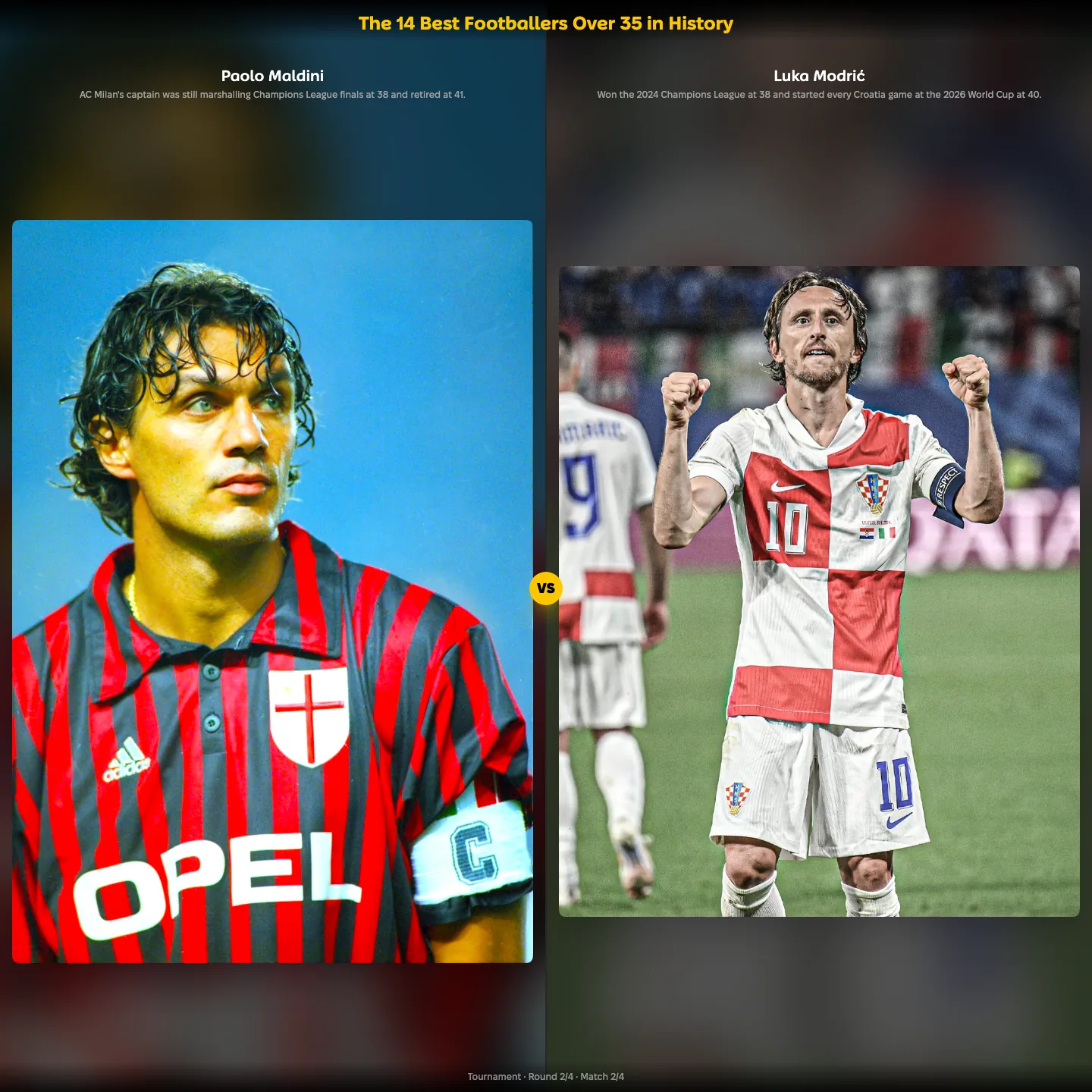
Maldini, Zanetti, Modrić: careers that kept going past 35
Late careers as their own category, with Paolo Maldini, Javier Zanetti and Zlatan Ibrahimović. Modrić has the clearest modern entry.
He won his sixth European Cup at 38, at Wembley in June 2024, and took a fifth UEFA Super Cup two months later, a record for a player.1
The international half went further still. At 40 he set up Nikola Vlašić's 83rd-minute winner against Ghana, the oldest assist in World Cup history.9 His 200th cap had come four days before that.
Maldini and Zanetti did their late work in defence — a job that asks different things of the legs than running a midfield. That is the honest counter to putting Modrić above them here.
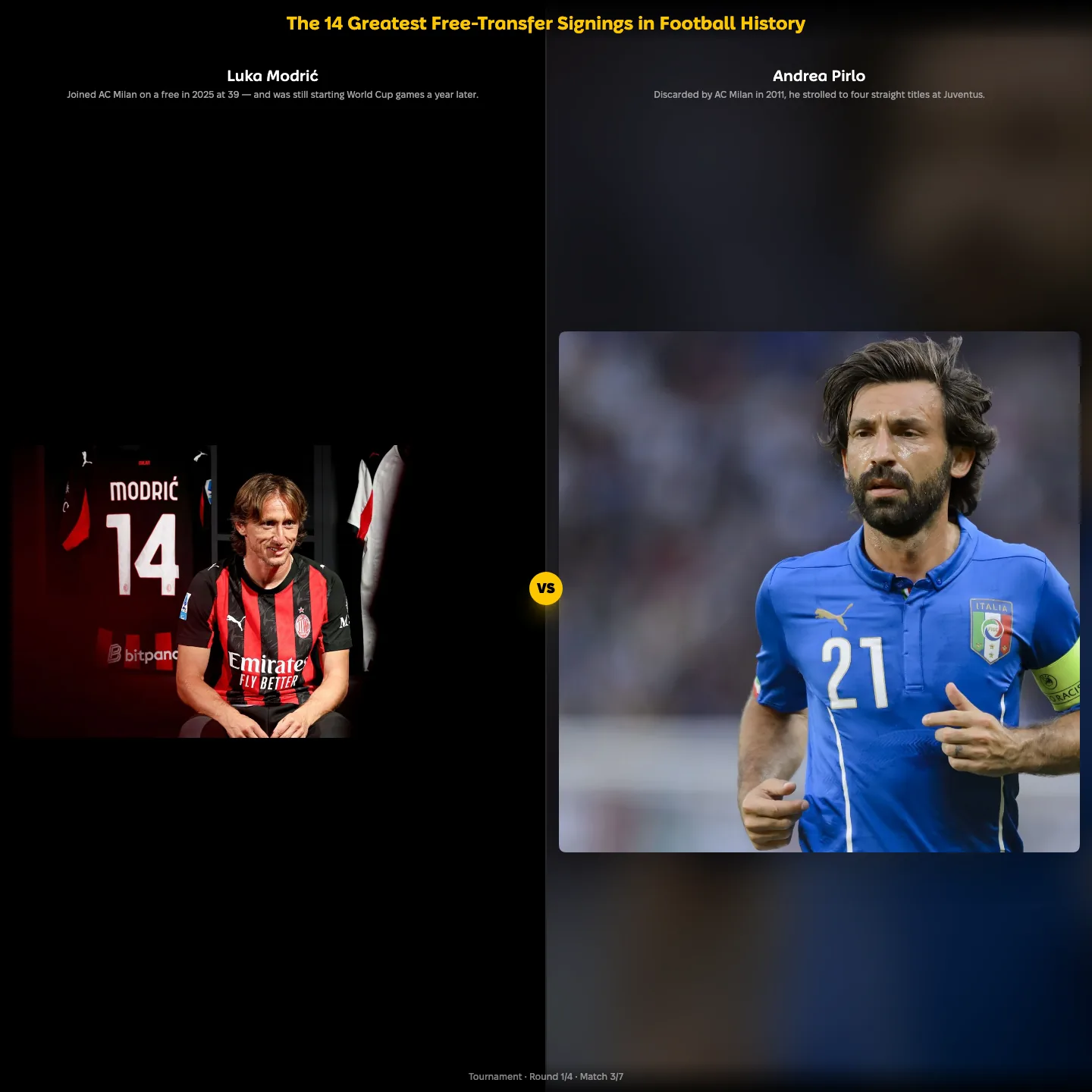
AC Milan got a Ballon d'Or winner for no fee
Real Madrid announced on 22 May 2025 that Modrić would leave after the Club World Cup.5 Seven weeks later AC Milan announced him on a contract to 30 June 2026, with an option for a second season and the No. 14 shirt.10 Andrea Pirlo and Robert Lewandowski are the names beside him on football's free-transfer list, and neither of them arrived anywhere carrying a Ballon d'Or.
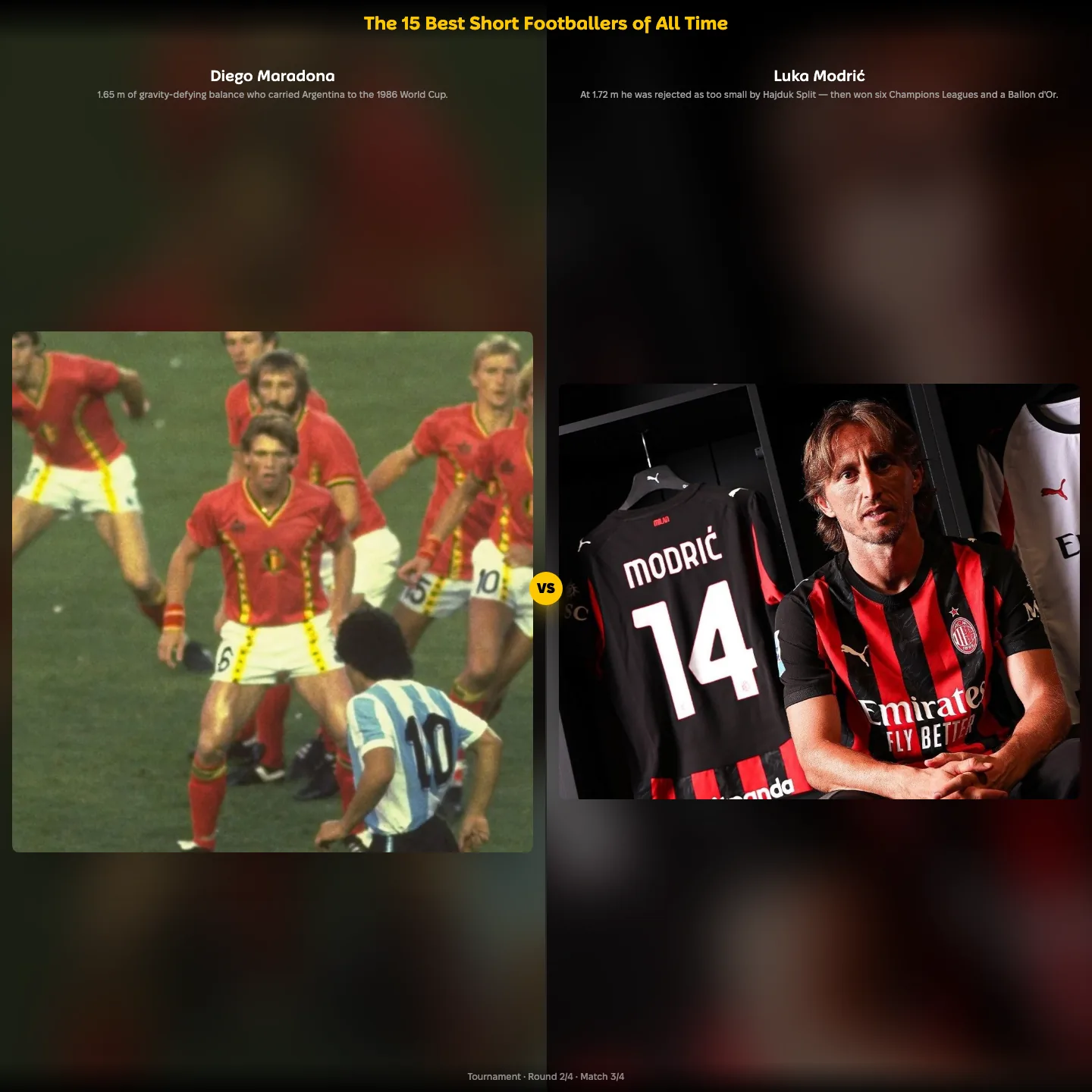
1.72 m: Modrić on the same list as Maradona, Messi and Xavi
AC Milan list Modrić at 1.72 m and 66 kg.11 That puts him on a ranking of football's best short players, beside Diego Maradona, Lionel Messi and Xavi.
The size nearly cost him a career. Hajduk Split, the big club in his part of Croatia, passed him over, and he developed at Zadar instead.1 FIFA's own profile records that several clubs turned him down as a boy because of his slight build.3
His line on all of it: "You don't have to be a giant to play football."1
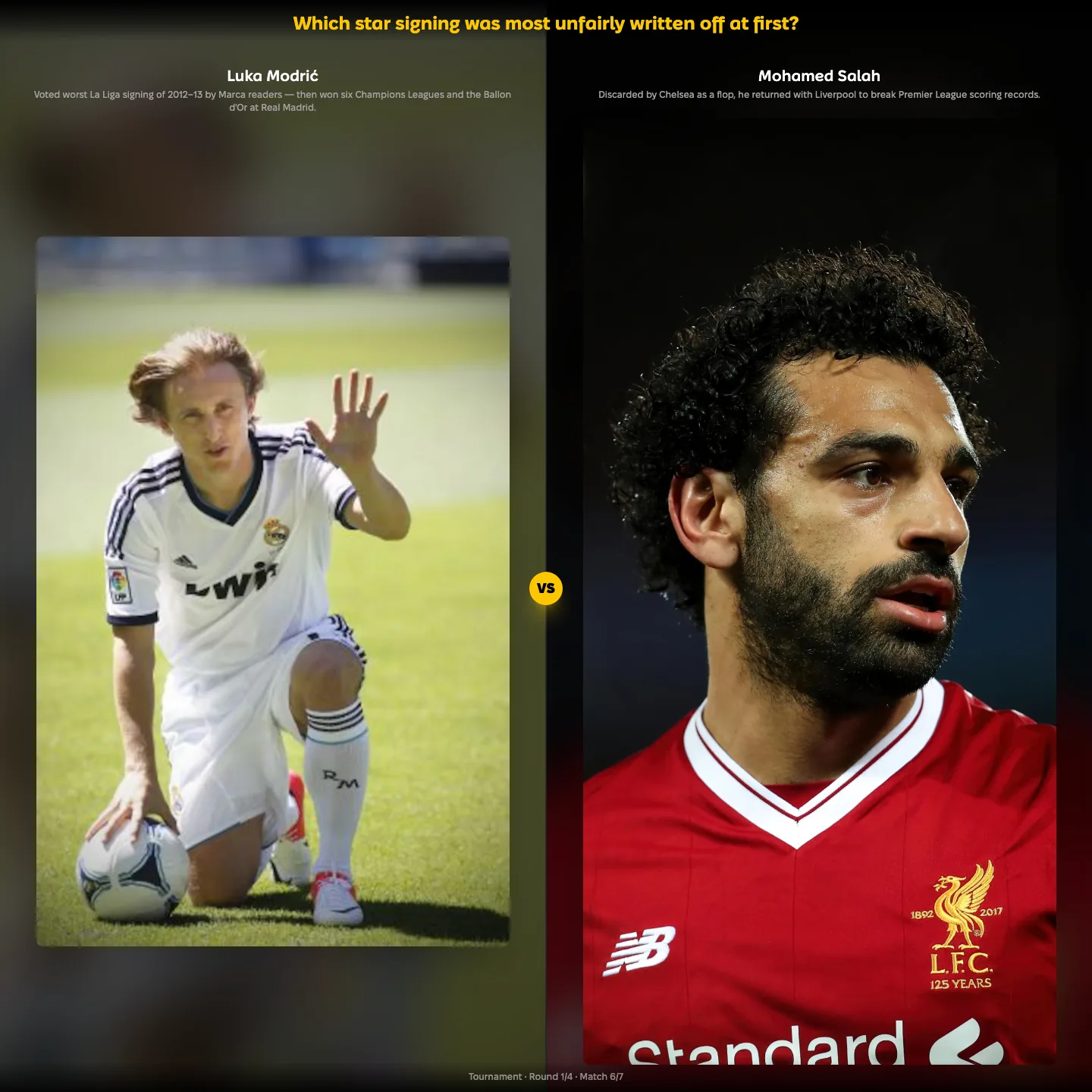
Marca's worst signing of the year: Modrić, 2012
Real Madrid signed Modrić from Tottenham in the summer of 2012. Before that calendar year was out, a vote on Marca's website had him down as the worst signing of the year.1
José Mourinho, the manager who bought him, described the reception afterwards: the Spanish press said Madrid had bought the worst player in the club's history, and he "is not at all the worst player in Real Madrid's history".
The correction took five years to arrive and then arrived twice. UEFA named Modrić its men's player of the year for 2017-18, ahead of Cristiano Ronaldo, who messaged him to say the award was deserved; France Football's jury reached the same verdict that December.1
Mohamed Salah belongs on this list for the same reason, and his version was quicker: Chelsea decided he was not going to work in England and loaned him to Italy. Modrić's rehabilitation ran on a much slower clock, which is what makes the two of them odd neighbours here.
Dinamo Zagreb: Modrić, Boban, and the loan that made him
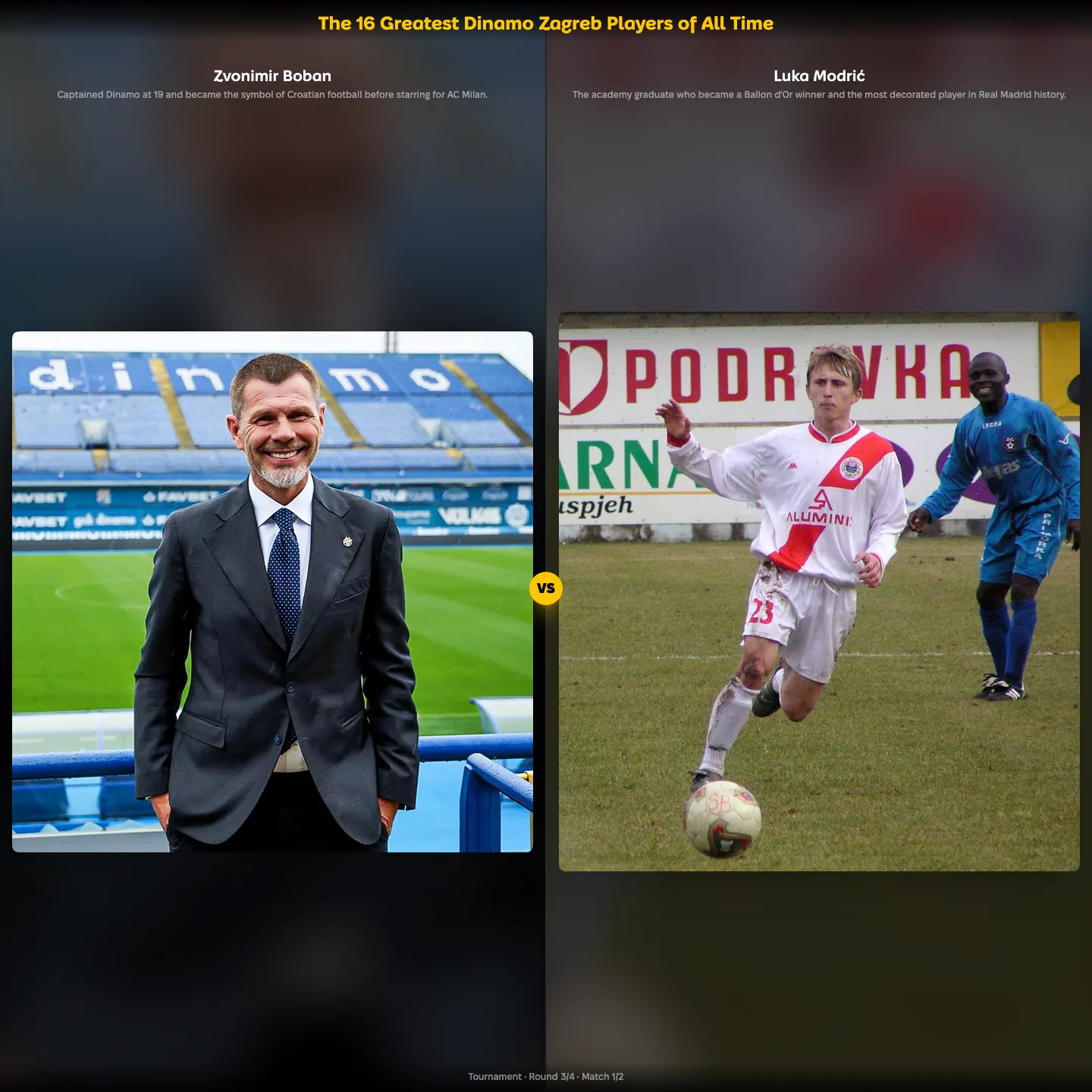
Dinamo Zagreb's all-time ranking is where Modrić begins, against Zvonimir Boban and everyone else the Maksimir has produced.
Dinamo signed him and sent him straight out again. He spent 2003-04 on loan at Zrinjski in Bosnia and Herzegovina, sent there to toughen up, and was voted the league's player of the season at 18.1
The following year, on loan at Inter Zaprešić, he was Croatia's young player of the year while his loan club finished second in the table and Dinamo finished seventh. He went back to Zagreb on a ten-year contract and won three championships and two Croatian Cups in three seasons.
Boban, whose place at the top of this list Modrić took, has been generous about it. "He always reads attacking and defensive situations before anyone else," he said.1
AC Milan have Modrić under contract until June 2027
Milan extended his deal to 30 June 2027 on 23 July 2026; he turns 41 in September.12 So the fourteen questions above stay open for another season, and the boy Hajduk Split sent home keeps adding to both halves of his record — the winning one and the empty one.
If you want to see how an order like this actually gets built, here is the comparison method behind every list on the site. Then pick a name you have an opinion about and build one yourself.
More rankings, more angles
- How Many Ways Can You Rank Kevin De Bruyne? — Chelsea let this one go first
- Where Does Rodri Actually Rank? — the 2026 Golden Ball, fourteen ways
- How Many Ways Can You Rank James Rodríguez? — one summer in Brazil, a dozen clubs after it
- Greatest Number 10 Ever? Francesco Totti at 50, on 16 Lists — Roma's No. 10 until 40, one club for 25 seasons
Sources
- UEFA — Luka Modrić career milestones: Hajduk Split passing him over and his development at Zadar, the Zrinjski and Inter Zaprešić loans and the awards that followed, the ten-year Dinamo contract and three championships, Juande Ramos' 2008 Tottenham signing and the Barcelona, Chelsea and Arsenal interest, the Marca website vote and Mourinho's response, UEFA Men's Player of the Year 2017/18, the sixth European Cup at Wembley and the record fifth UEFA Super Cup, the oldest goal in European Championship history, the 2023 Nations League final, the 200th cap and the European appearance record, Šuker's six player-of-the-year awards, and the Rakitić, Prosinečki and Boban quotes: uefa.com (checked 2026-08-03)
- FIFA — Portugal 2-1 Croatia match report, round of 32, Toronto, 2 July 2026, Gonçalo Ramos' winner in the fourth minute of stoppage time: fifa.com (checked 2026-08-03)
- FIFA — Luka Modrić player profile: six European Cups as the joint competition record with Dani Carvajal and Francisco Gento, 28 Real Madrid trophies (one ahead of Carvajal), twelve Croatia player-of-the-year awards, the clubs that turned him down for his slight build, the 4-2 defeat by France in the 2018 final and the 2-1 win over Morocco for third place in 2022: fifa.com (checked 2026-08-03)
- Associated Press, via The Globe and Mail — the 2018 Ballon d'Or on 3 December 2018, Modrić ahead of Ronaldo and Griezmann with Messi fifth, and Kaká as the previous winner from outside the pair: theglobeandmail.com (checked 2026-08-03)
- Real Madrid — official announcement of Modrić's departure, 22 May 2025: 13 seasons, 590 appearances, 43 goals, 28 titles, and the most decorated player in the club's 123-year history: realmadrid.com (checked 2026-08-03)
- UEFA — Croatia's European Championship records: seven tournaments with quarter-finals in 1996 and 2008 as the best result, a knockout record of four matches without a win, Euro 96 as the country's first competitive campaign, and Modrić as both youngest (22y 273d) and oldest (38y 289d) Croatian scorer with 16 appearances and four goals across five tournaments: uefa.com (checked 2026-08-03)
- beIN Sports — Real Madrid's No. 10 after Modrić: Mbappé taking the shirt, Modrić wearing it from 2017-18, and Puskás, Laudrup, Figo, Sneijder, Özil and James Rodríguez before him: beinsports.com (checked 2026-08-03)
- FIFA — Rodri's 2026 adidas Golden Ball, the full list of previous winners including Modrić in 2018, Spain's 1-0 extra-time win over Argentina in the final, and Rodri's 101 completed passes from 105: fifa.com (checked 2026-08-03)
- ESPN — Modrić's assist for Nikola Vlašić's 83rd-minute winner in Croatia's 2-1 defeat of Ghana as the oldest assist in World Cup history: espn.com (checked 2026-08-03)
- AC Milan — official statement on signing Modrić, 14 July 2025: contract to 30 June 2026 with an option to 30 June 2027, the No. 14 shirt, and the honours listed including the 2018 Ballon d'Or: acmilan.com (checked 2026-08-03)
- AC Milan — Luka Modrić squad profile: height 1.72 m, weight 66 kg: acmilan.com (checked 2026-08-03)
- ESPN — Modrić's Milan contract extension to June 2027, announced 23 July 2026, and his 41st birthday in September: espn.com (checked 2026-08-03)