# Winston Churchill, Ranked 15 Different Ways
> Winston Churchill sits on fifteen unrelated rankings: greatest Briton, greatest orator, most overrated figure, Nobel laureate and amateur painter.
*By YPB Team · Published August 19, 2026 · https://youpick.best/articles/winston-churchill-ranked-many-ways*
---
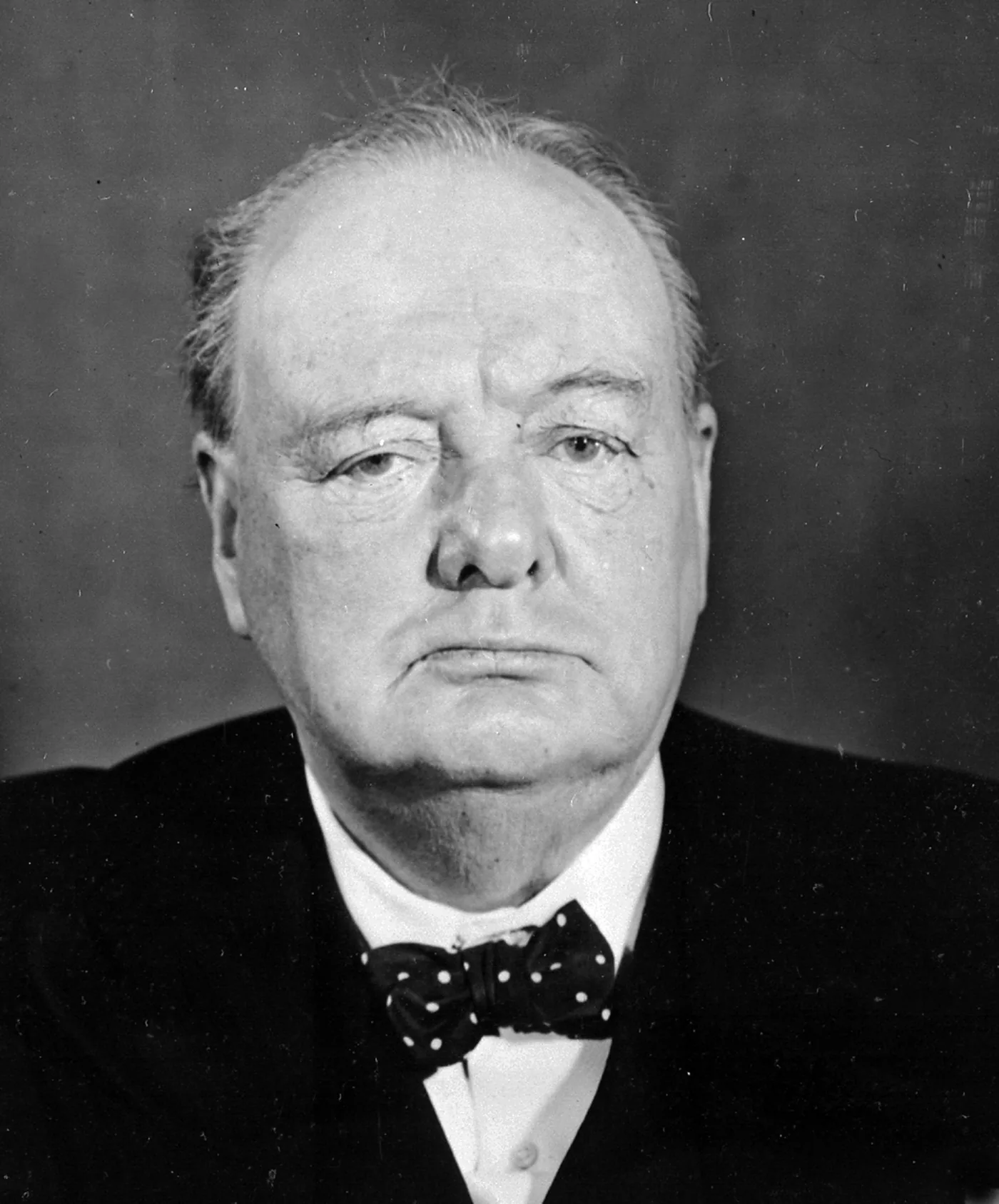
Winston Churchill, photographed for the Central Office of Information in March 1945. The National Archives (UK), public domain.
Winston Churchill has been a cavalry subaltern, a captured journalist, a sacked First Lord of the Admiralty, a prime minister twice over, a Nobel laureate in literature and an honorary American. Since 23 May 2026 he has also been a painter with a show in central London: the Wallace Collection is hanging more than fifty of his canvases in the first major retrospective of his painting since he died, and it runs until 29 November.1
That is an unusual amount of ground for one man to cover, and it means he qualifies for rankings that share no subject matter at all. We built fifteen of them.
> Fifteen lists all have room for Churchill, and they cannot agree what he was: the man who held the war together, the man his own voters turned out weeks after the war in Europe ended, and the hobby painter nobody ever commissioned.
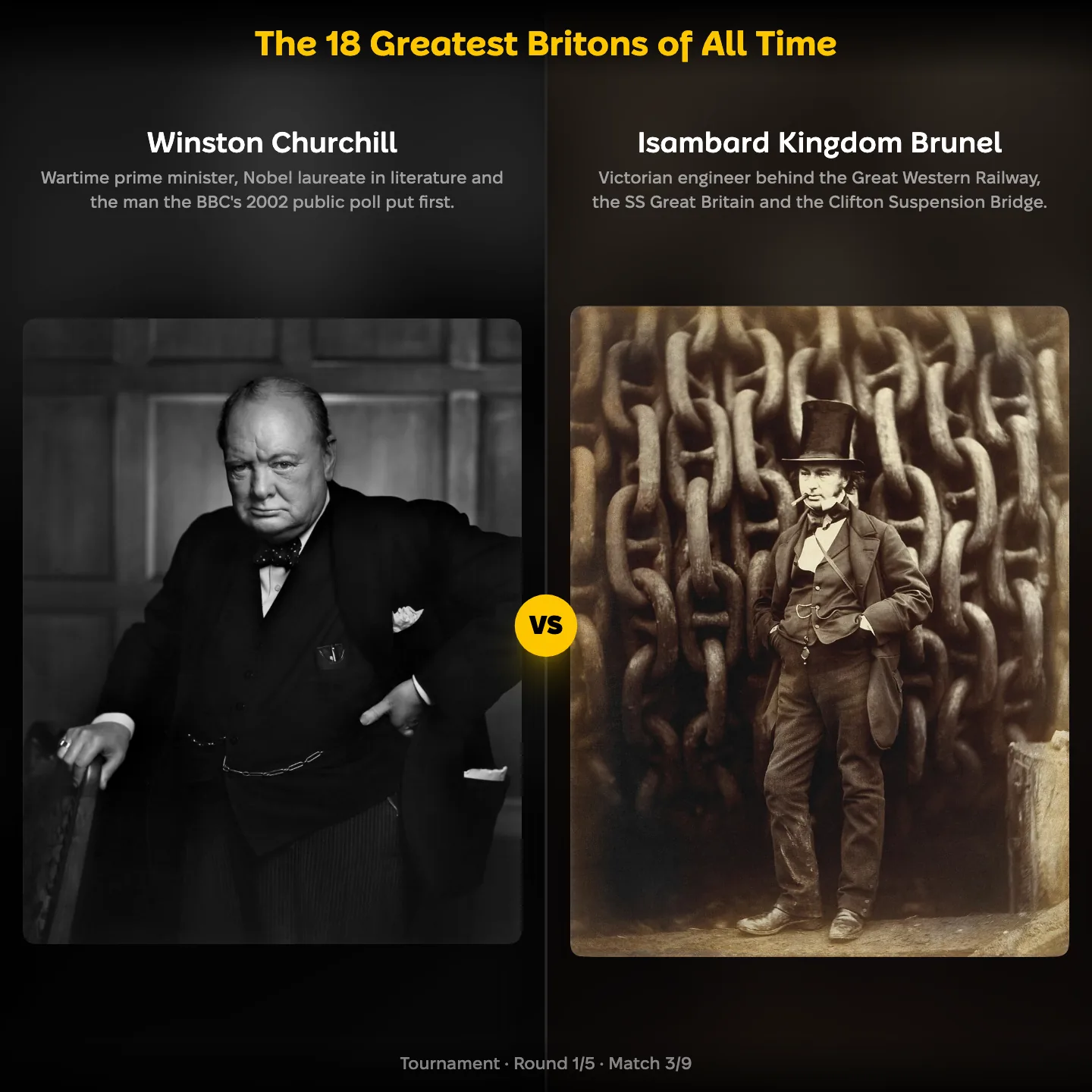
## Churchill vs Brunel: the vote that picked a Briton
Ranking the greatest Briton of all time means setting a politician beside engineers, physicists, playwrights and monarchs, then comparing people who share nothing but a passport. Churchill's claim rests on 1940, when he took office with Britain fighting alone and made refusing to negotiate the national position.
Isambard Kingdom Brunel's claim is physical and still standing: the Great Western Railway, the SS Great Britain, the Clifton Suspension Bridge.
Behind them come Shakespeare, Darwin, Newton, Elizabeth I and Alan Turing. "Greatest" is doing several different jobs in one word.
A politician against an engineer, with eighteen centuries of talent in the same bracket. Play it →
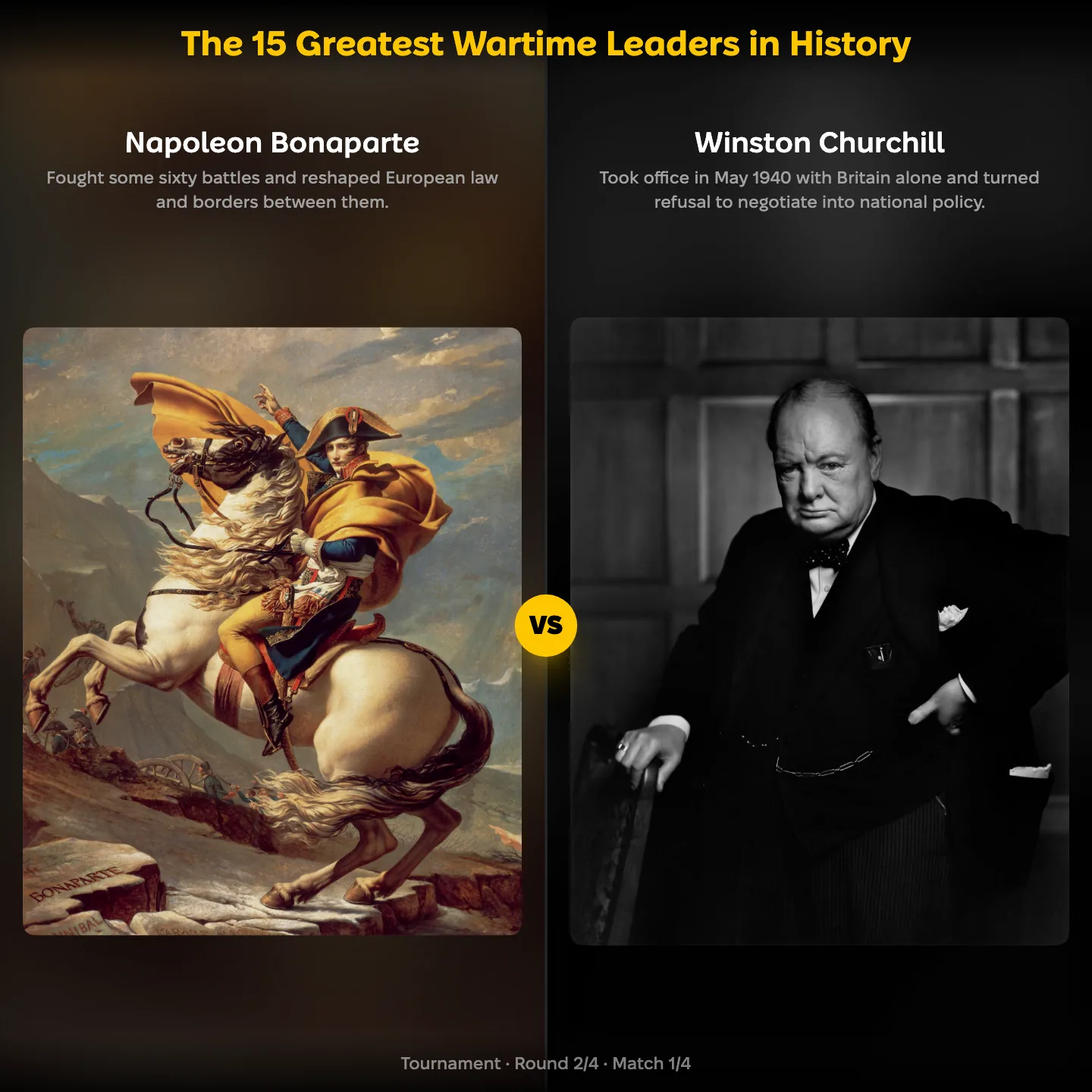
## Napoleon, Caesar and a prime minister who never commanded an army
Narrow the question to wartime leadership and Churchill's position gets stranger, not safer. Most of the names on a list of great wartime leaders led from the field. Alexander crossed a continent without losing a major battle, Hannibal took elephants over the Alps, Napoleon fought some sixty engagements.
Churchill fought none of them. His war was speeches, telegrams, map rooms and a working relationship with Franklin Roosevelt that kept American supply flowing before America was in the war.
That is a real category of leadership, and it is not the category the ancient half of this list belongs to.
The comparison also flatters him in one specific way: Caesar and Napoleon both lost their wars in the end, and he did not.
Napoleon on the left, and a man who ran his war from a basement in Whitehall. Play it →
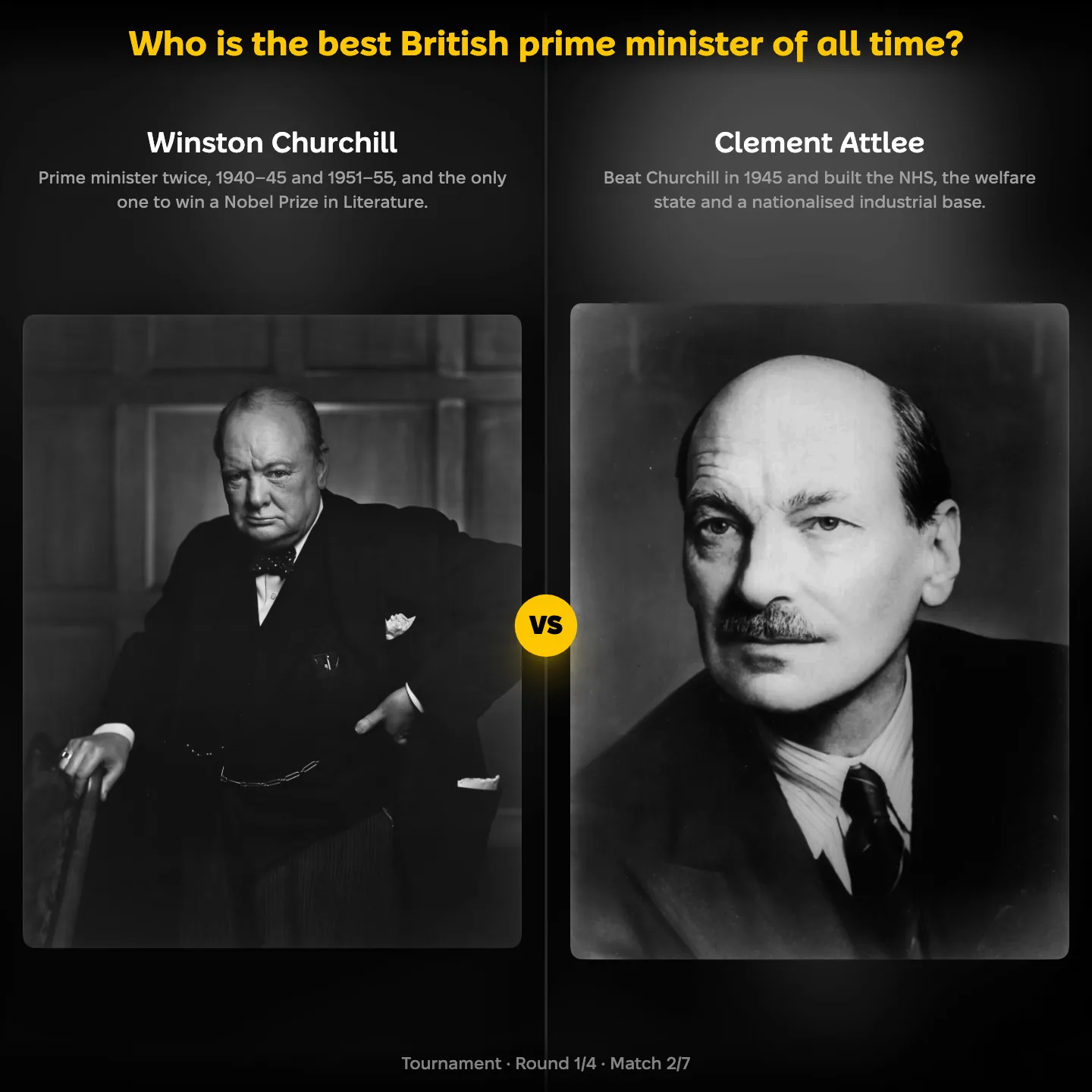
## Attlee vs Churchill: the job they both held
Churchill was prime minister twice, from 1940 to 1945 and again from 1951 to 1955.3 On a list of British prime ministers he is competing inside his own trade, which makes the standard of comparison much harder.
Clement Attlee is the reason it is hard. Attlee served as Churchill's deputy through the war, beat him at the ballot box immediately afterwards, and then built the National Health Service and the welfare state.
Historians who rank the office tend to weigh construction against crisis, and those two men are the cleanest example of each.
Further down sit the nineteenth-century heavyweights: Gladstone with four separate premierships, Peel founding the police and splitting his party over the Corn Laws, Disraeli buying into the Suez Canal. Robert Walpole is still the longest-serving at nearly twenty-one years.
The wartime leader against the man who beat him and built the NHS. Play it →
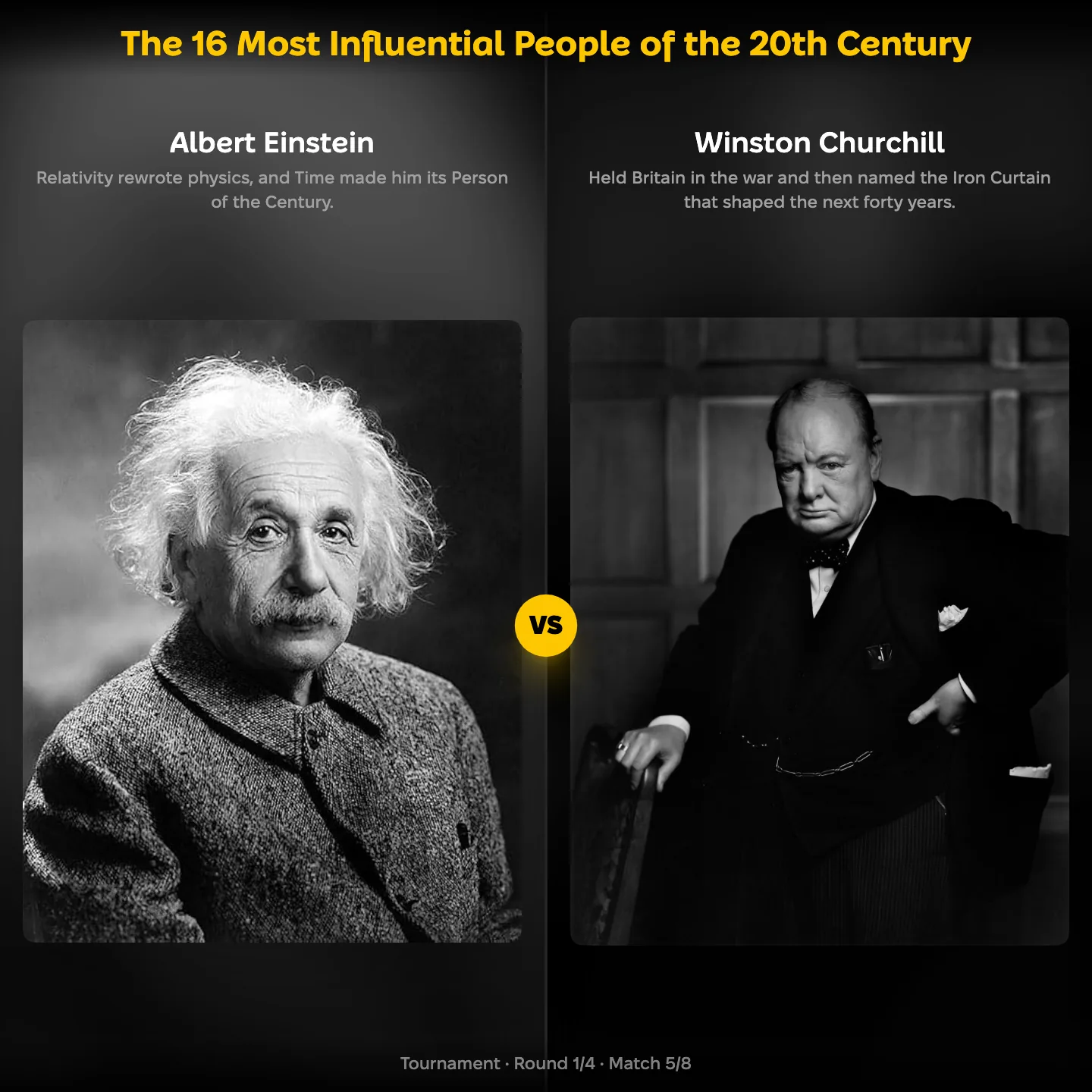
## Einstein, Gandhi and a very short list for a whole century
Ask which people shaped the twentieth century and the politicians immediately have to share the page with scientists, and Churchill is on a list where relativity and penicillin are competing entries.
His case here is less about the war than about what he named afterwards. The phrase "iron curtain", delivered in Missouri in 1946, gave the next forty years of European politics its working description.
He also finished the century with a distinction no other foreigner had held: in April 1963 John F. Kennedy signed a proclamation making him the first honorary citizen of the United States.5
Albert Einstein, Marie Curie, Alexander Fleming, Alan Turing and Rosa Parks occupy the same fifteen slots, and several of them changed daily life more thoroughly than any politician of the period.
Relativity against rhetoric, on a list that also holds Curie, Turing and Rosa Parks. Play it →
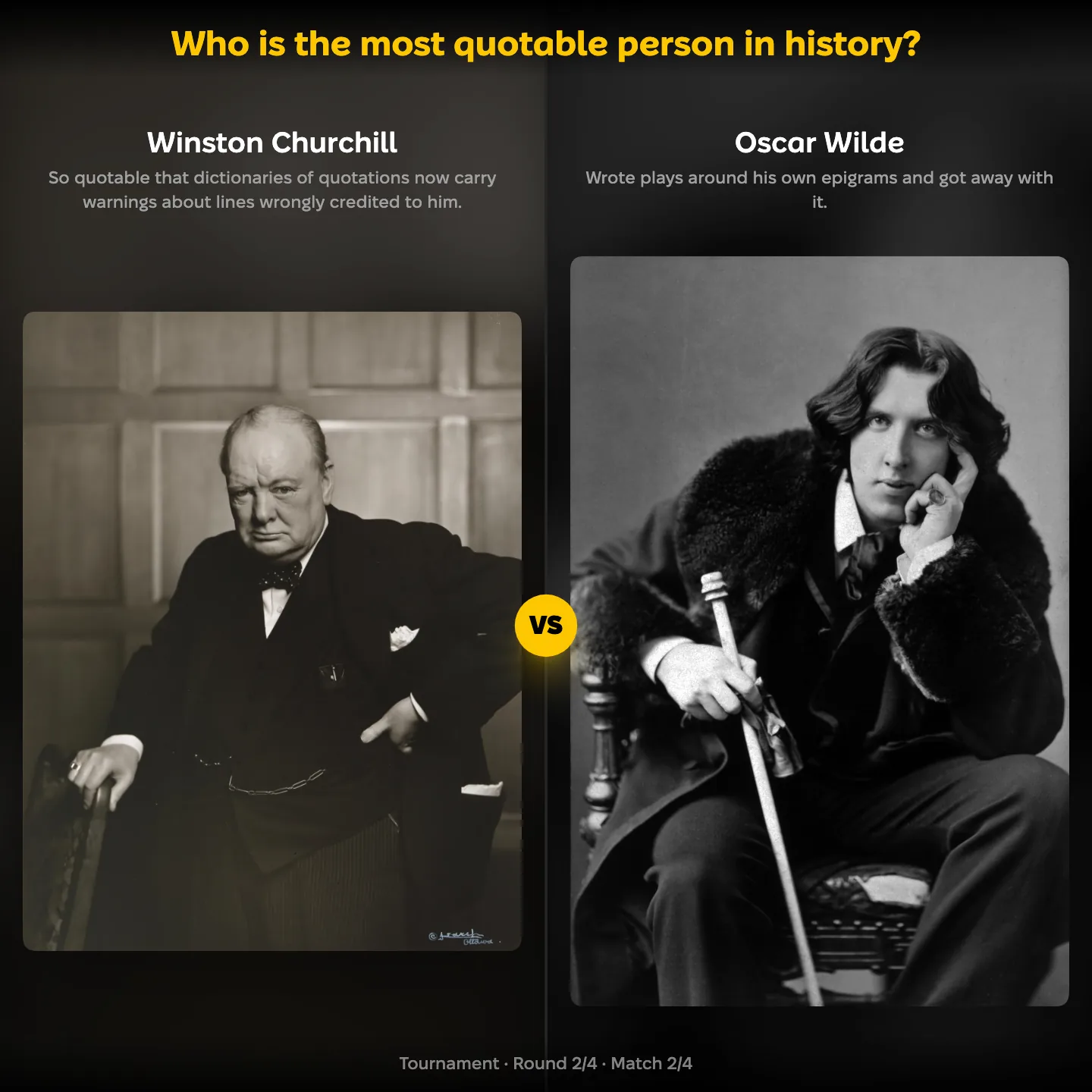
## Wilde, Twain and the problem of things Churchill never said
Churchill belongs on a list of the most quotable people in history for a slightly embarrassing reason: he is quoted so heavily that reference works now carry warnings about lines wrongly credited to him. The real ones are compact and built for delivery, drafted in advance and read from notes.
Oscar Wilde wrote plays around his own epigrams. Mark Twain has the same misattribution problem, from the other end of the profession.
Dorothy Parker was simply the sharpest voice in a room built for sharp voices.
Two men whose collected wit includes a great deal they never wrote. Play it →
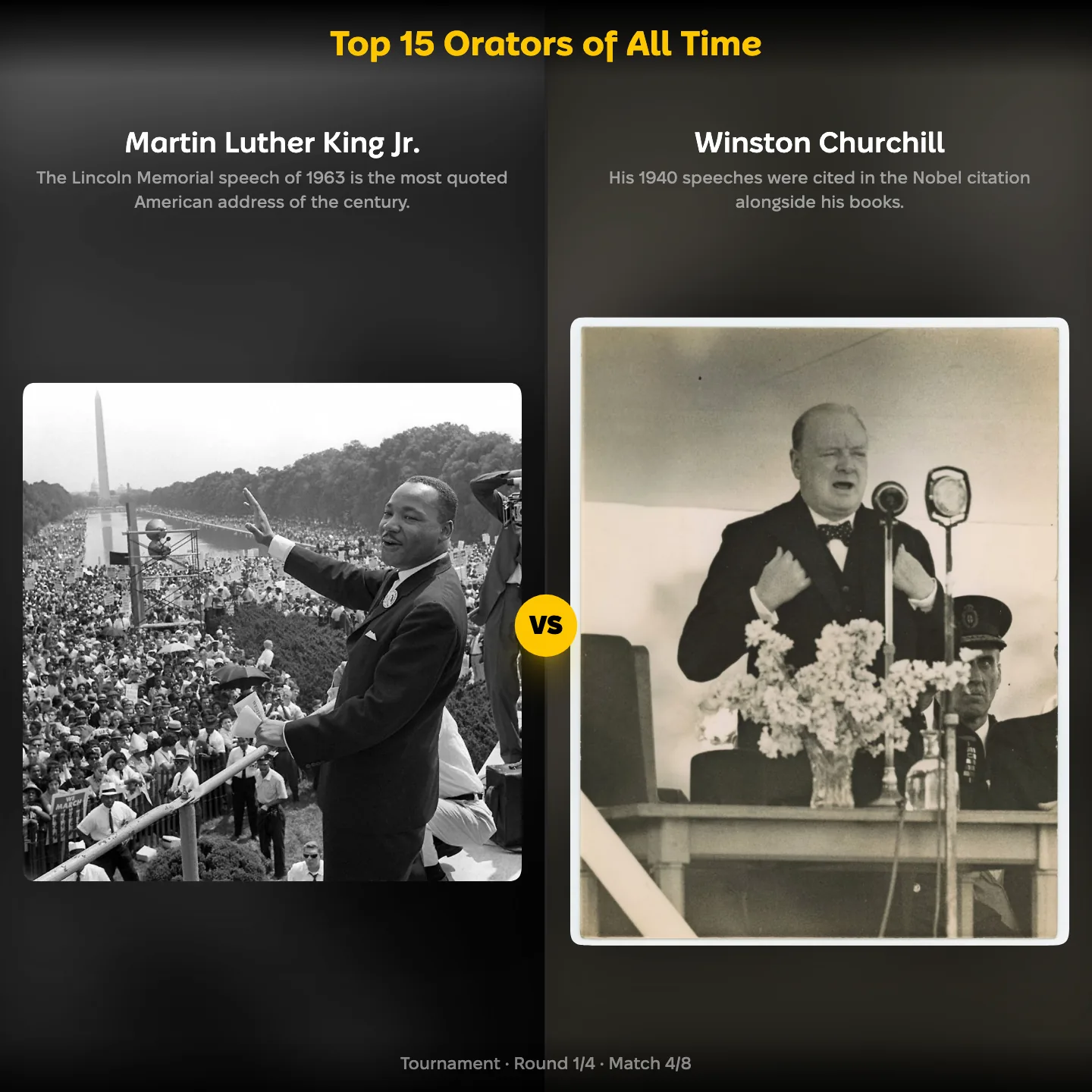
## Cicero to Martin Luther King: the company Churchill's speeches keep
A ranking of the greatest orators is the one place where Churchill's core skill is the only thing being measured. The Swedish Academy thought the same: when it gave him the Nobel Prize it cited his oratory alongside his books.
Ranked against Cicero and Demosthenes he is a modern entry with a modern advantage, because the recordings exist and the 1940 broadcasts can still be played.
Ranked against Martin Luther King and Abraham Lincoln he has a harder time. King's 1963 address at the Lincoln Memorial is the most quoted American speech of the century, and Lincoln reframed a civil war in 272 words while the day's main speaker talked for two hours.
Frederick Douglass, Sojourner Truth and Nelson Mandela each spoke for their own freedom rather than a nation's survival.
The Lincoln Memorial in 1963 against a microphone in wartime London. Play it →
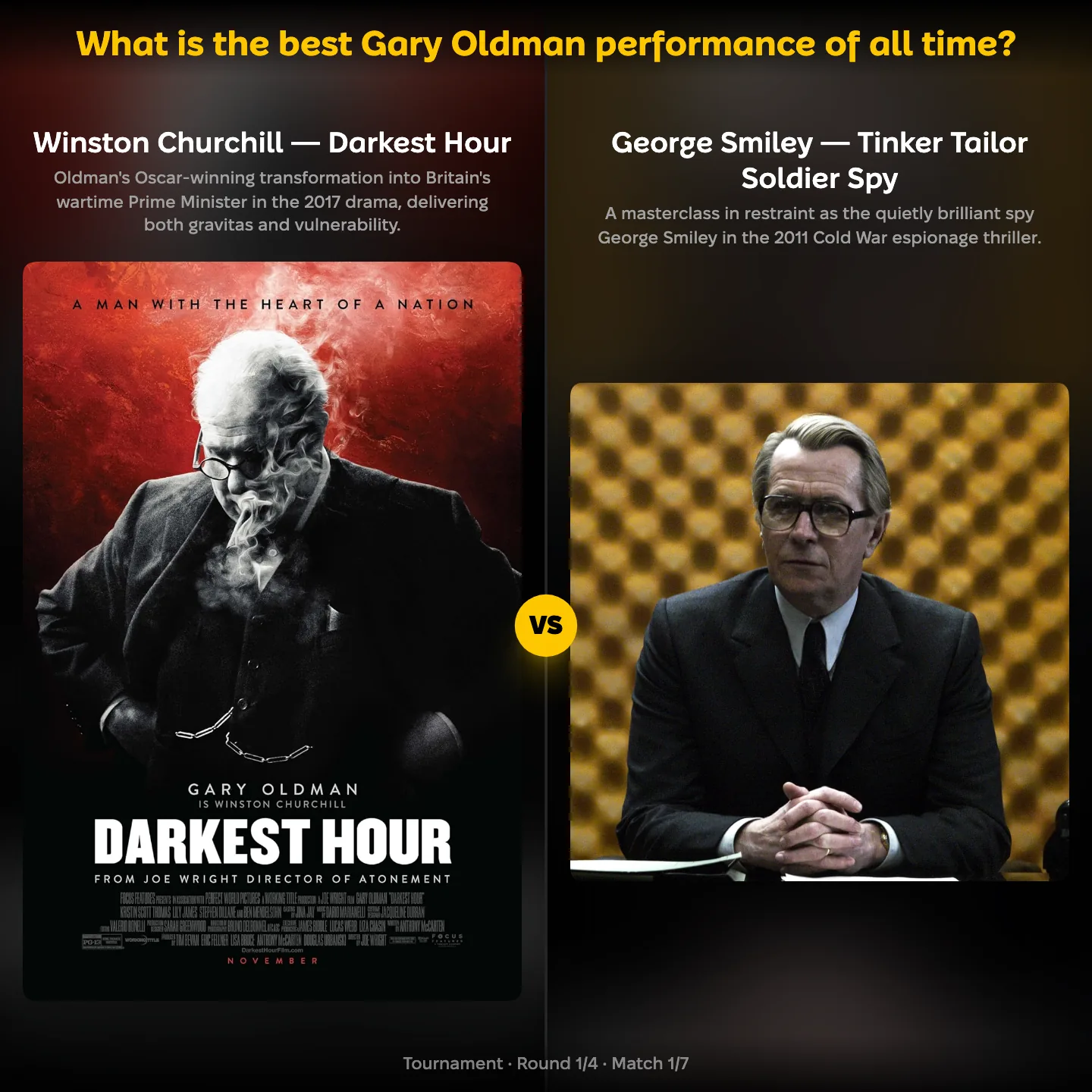
## Gary Oldman's Churchill: four hours in the make-up chair
Here Churchill stops being a candidate and becomes a part. Ranking Gary Oldman's performances means judging his Churchill in *Darkest Hour* against everything else Oldman has done, and the role took the 2018 Academy Award for Best Actor.9
The prosthetics took four hours a day to apply, which is the sort of detail that wins awards and also invites the suspicion that the make-up did the work.
The competition is unusually strong. George Smiley in *Tinker Tailor Soldier Spy* is the opposite performance: no prosthetics, almost no movement, and the whole character carried in pauses.
Sid Vicious, Commissioner Gordon, Count Dracula and Norman Stansfield fill out the rest, a career few actors could assemble.
An Oscar-winning Churchill against the quietest spy Oldman ever played. Play it →
## John Lithgow's Churchill: the same man, on television
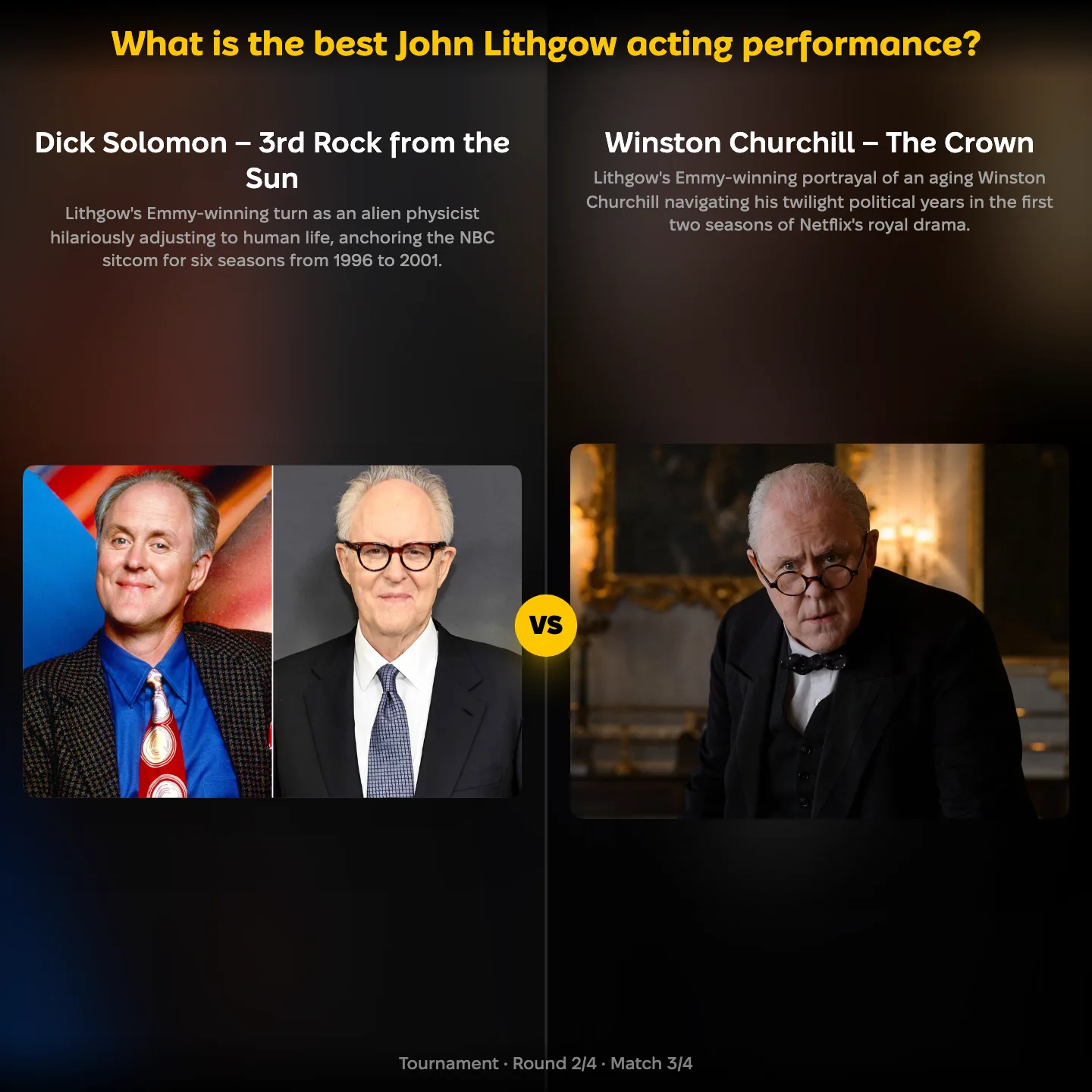
Churchill is a role good enough that two actors have won major prizes for it in the same decade, which is why he appears twice in this article as a performance rather than a person. John Lithgow played him across the opening two seasons of *The Crown* and won an Emmy.
Lithgow's version is the late Churchill: out of step with a young queen, physically diminished, still unwilling to leave the stage.
The role sits oddly in his catalogue. Lithgow spent six seasons as an alien physicist in *3rd Rock from the Sun*, voiced Lord Farquaad in *Shrek*, and played a serial killer in *Dexter* frightening enough to win him another Emmy.
Ranking him means deciding whether range or depth is the thing being rewarded.
A sitcom alien against an Emmy-winning Churchill, from the same actor. Play it →
## Downing Street, 1951: the return after the landslide
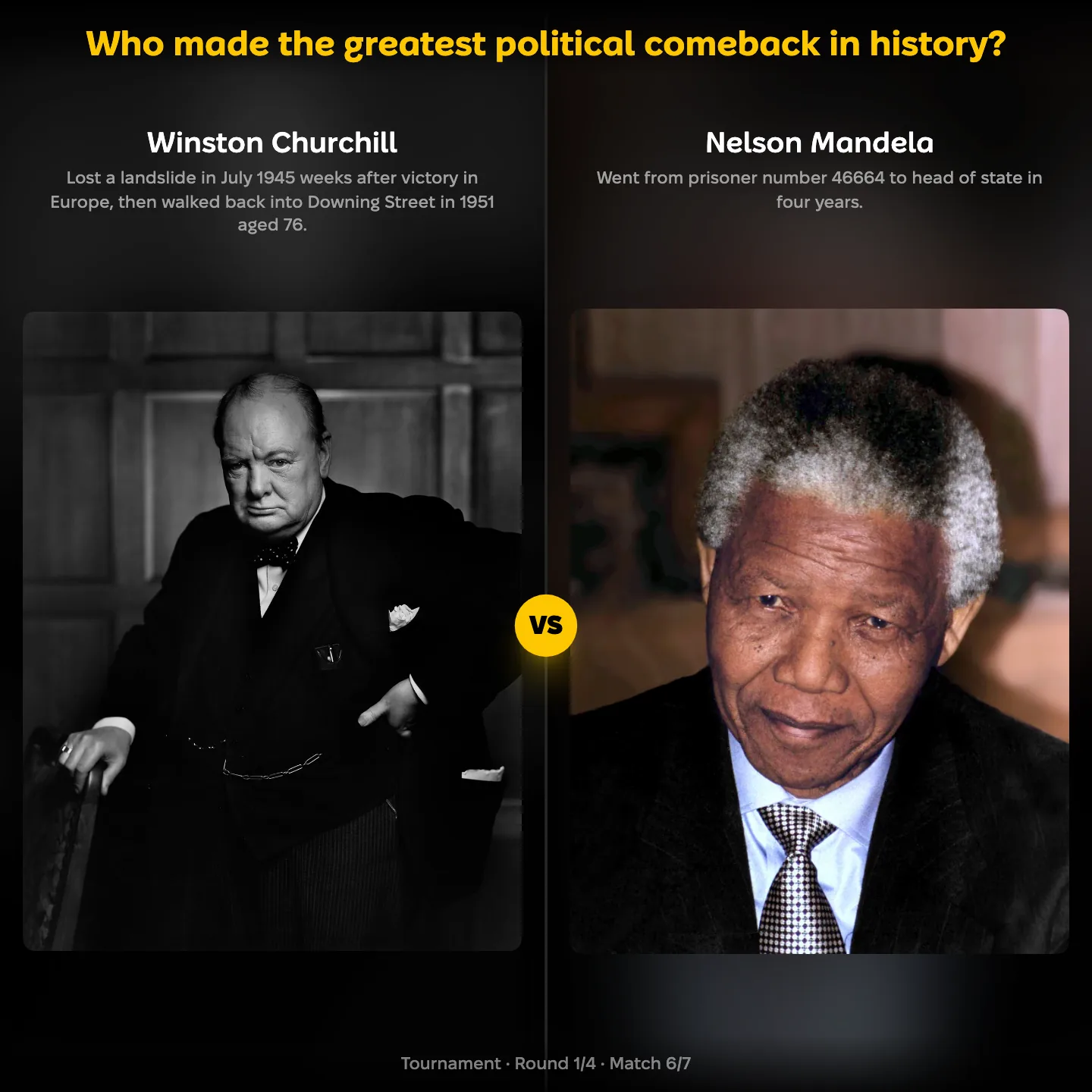
The most useful fact about Churchill is one his admirers tend to skip. On 5 July 1945, two months after Germany surrendered, Britain voted his party out and handed Labour a majority of 146 seats, with 47.7 per cent of the vote against the Conservatives' 36.2.7
His personal approval at the end of the war had been above eighty per cent. Voters separated the man from the party, and from the question of who should build the peace.
He came back in 1951, aged seventy-six, and served another four years.
That puts him on a list with Charles de Gaulle, recalled in 1958 to found a new republic, and Nelson Mandela, who was released from prison and elected head of state within four years. Grover Cleveland is the technical champion of the category: the only American president to lose the White House and win it back.
Out in a landslide in 1945, back in office by 1951. Play it →
## Columbus, Edison and the list nobody wants
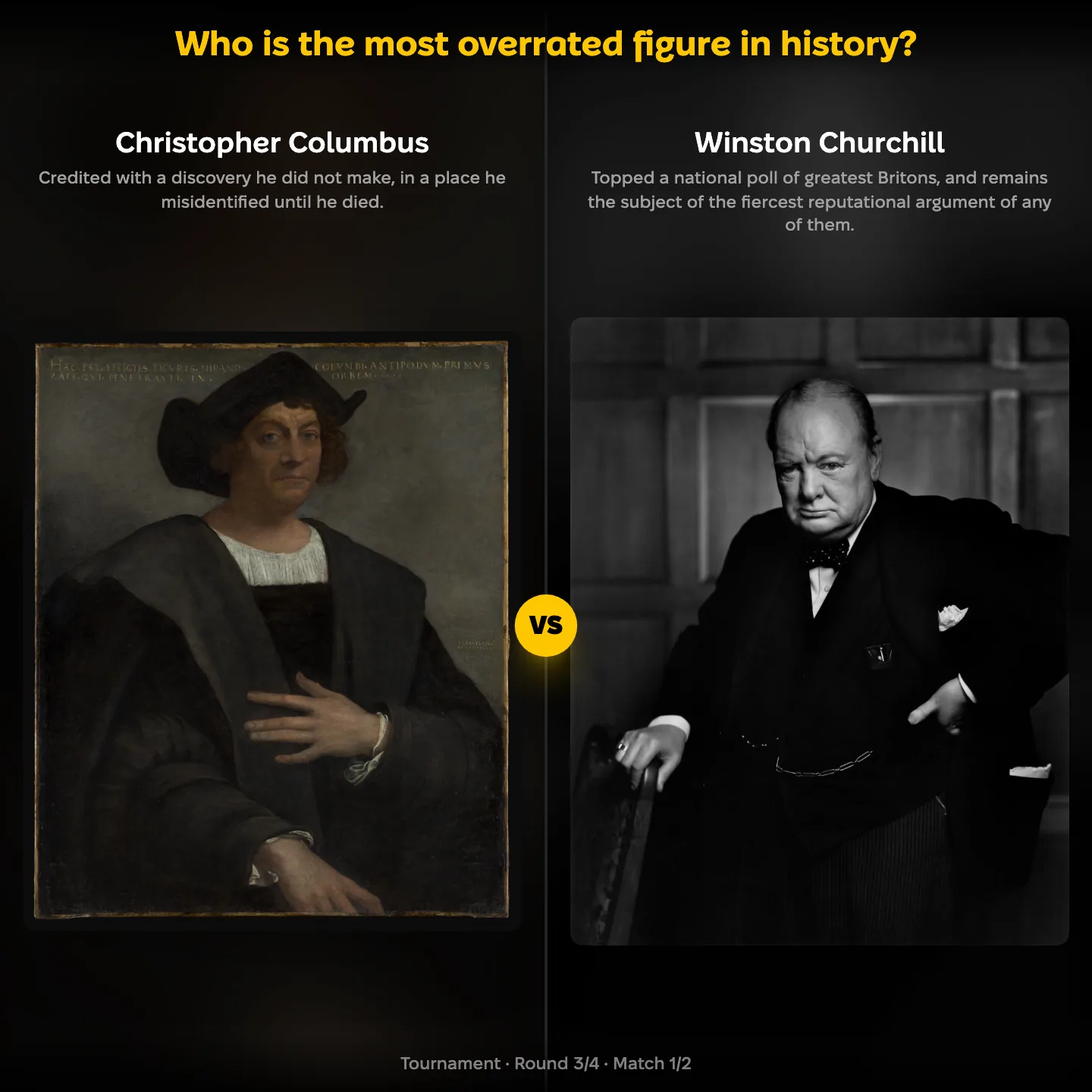
An honest article about Churchill cannot skip the ranking where his name is the accusation. He is the most argued-over reputation in modern British history, and the charges are specific.
As First Lord of the Admiralty he championed the Dardanelles operation. The landings at Gallipoli began in April 1915, the campaign failed, and by May he had lost the Admiralty for a token cabinet post; he resigned from the government that November and went to the Western Front as an infantry officer.6
His record in India has become the loudest part of that case. A 2019 study in *Geophysical Research Letters*, reported by Al Jazeera, put the 1943 Bengal famine down to policy failure rather than drought, singling out the wartime grain-import restrictions imposed by his government; the famine is estimated to have killed up to three million people.10
The other names here are reputations built on someone else's work: Christopher Columbus, credited with a discovery he did not make; Thomas Edison, whose workshops did much of what carries his name; Ferdinand Magellan, who died less than halfway round.
The list where being famous is the charge, not the defence. Play it →
## Havel, Vargas Llosa and writers who ended up in office
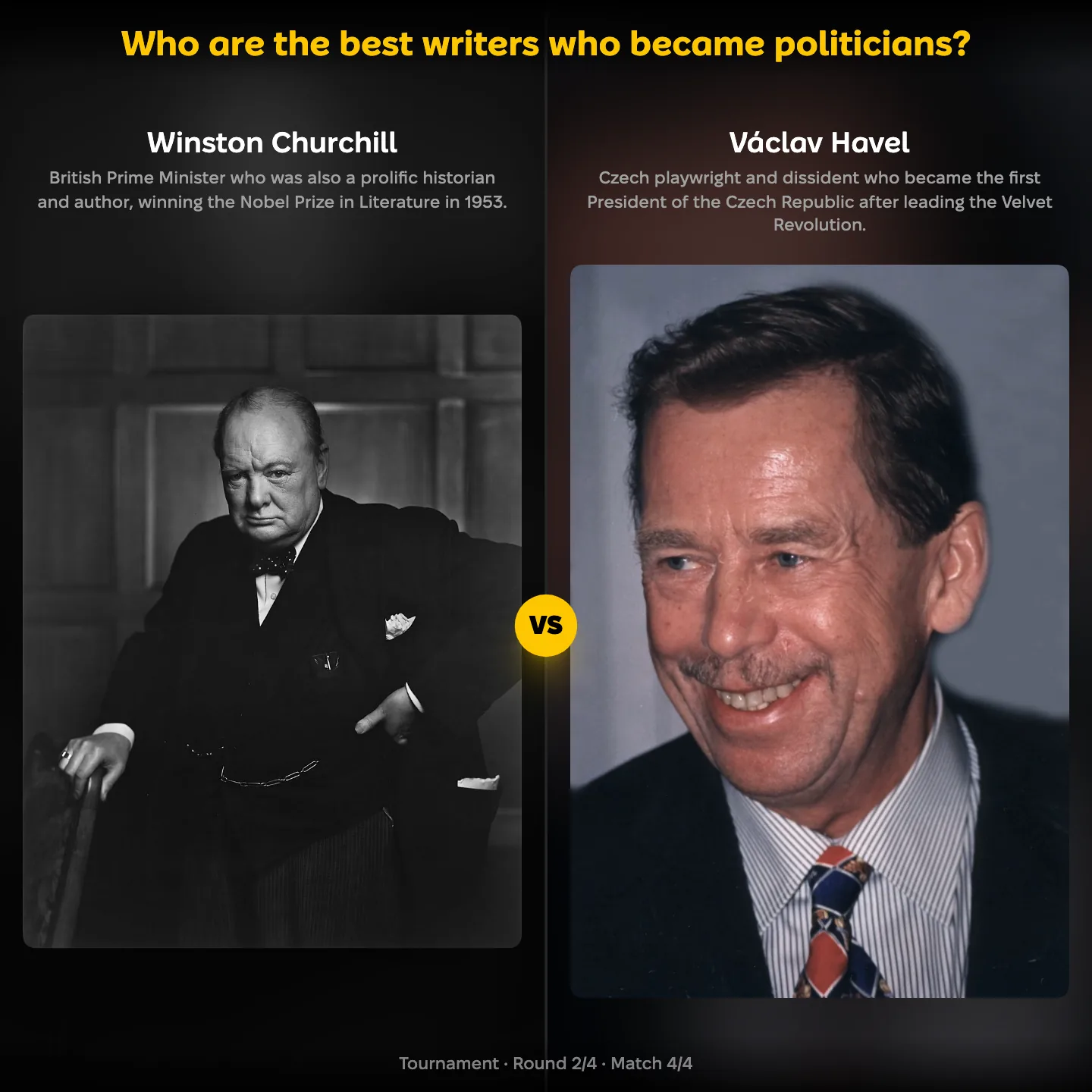
Churchill fits this category so neatly it could have been built for him. He published his first book at twenty-four and never really stopped, and the writing paid for the politics for most of his life.
Václav Havel is the strongest counter-case: a playwright banned and imprisoned under one regime, then the first president of the Czech Republic after helping to end it.
Benjamin Disraeli is the closer parallel, a working novelist who reached Downing Street and kept publishing once he was there. Mario Vargas Llosa, Wole Soyinka and Aleksandr Solzhenitsyn made the same crossing.
A prime minister who wrote for a living, against a playwright who became a president. Play it →
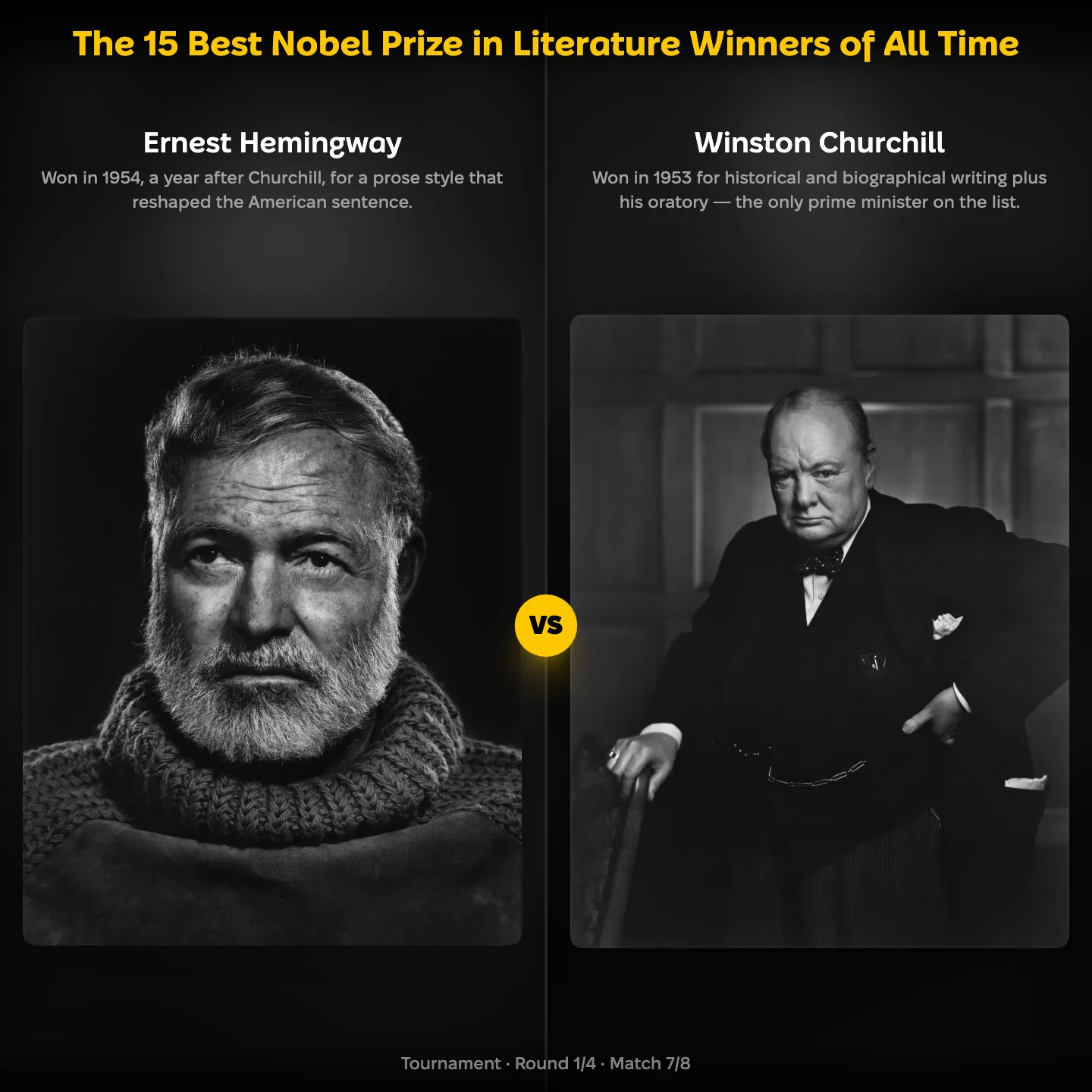
## Hemingway won it the year after Churchill did
Here the prize on the shelf stops helping. Churchill received the Nobel Prize in Literature in 1953, for what the Swedish Academy called his mastery of historical and biographical description as well as his brilliant oratory.4
Ernest Hemingway won the same prize the following year, for a prose style that rearranged the American sentence.
Around him stands the twentieth-century canon: Gabriel García Márquez, Toni Morrison, Albert Camus, William Faulkner, Samuel Beckett, Rabindranath Tagore. Churchill is the only prime minister among them, and a statesman's memoirs are a different kind of writing from *One Hundred Years of Solitude*.
There is a second twist in his Nobel record. He was nominated twice for the Peace Prize, in 1945 and 1950, and never won that one.
Consecutive laureates, and not remotely the same kind of writer. Play it →
## The Wallace Collection has his paintings back on a London wall
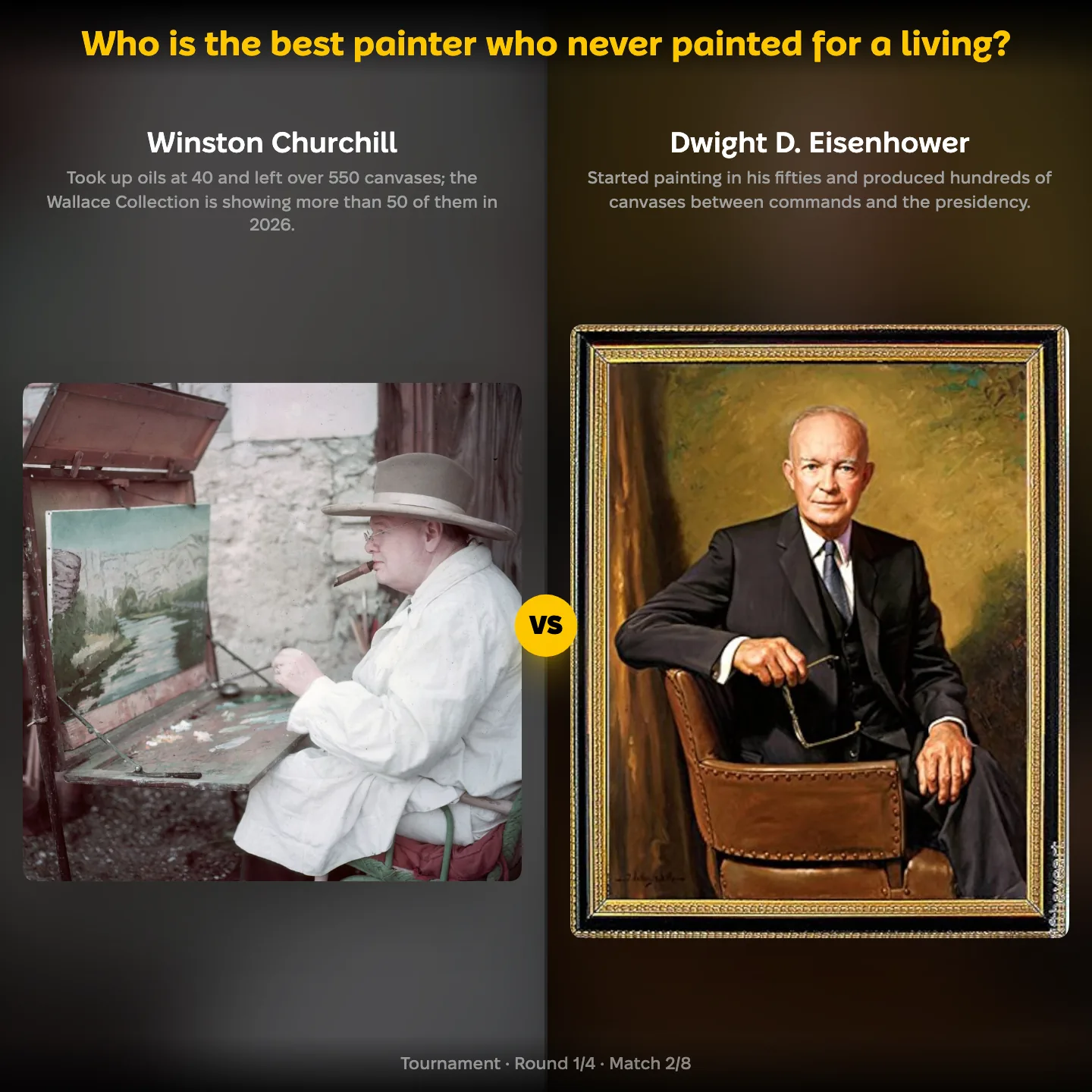
Churchill picked up a paintbox at forty, in the months after the Dardanelles cost him the Admiralty, and produced more than 550 known canvases over the rest of his life.2 Mostly landscapes, mostly Mediterranean light, and nearly all of them made for his own satisfaction rather than for sale.
His studio at Chartwell in Kent still holds the largest collection of them on public display.2 He also wrote an essay about the habit, *Painting as a Pastime*, urging it on anyone whose working life involved too much worry.
That record puts him at the head of a category of people who painted seriously without ever needing the income. Dwight Eisenhower is the obvious rival: he started in his fifties and kept going through two commands and a presidency.
Tony Bennett signed his canvases Benedetto and placed one in the Smithsonian. David Bowie painted for decades and rarely exhibited, Joni Mitchell calls herself a painter derailed by music, and Anthony Hopkins turned to high-colour abstracts late enough to make it a second career.
Churchill at the easel, against a general who took up oils in his fifties. Play it →
## The Morning Post, 1899: filing copy and getting captured
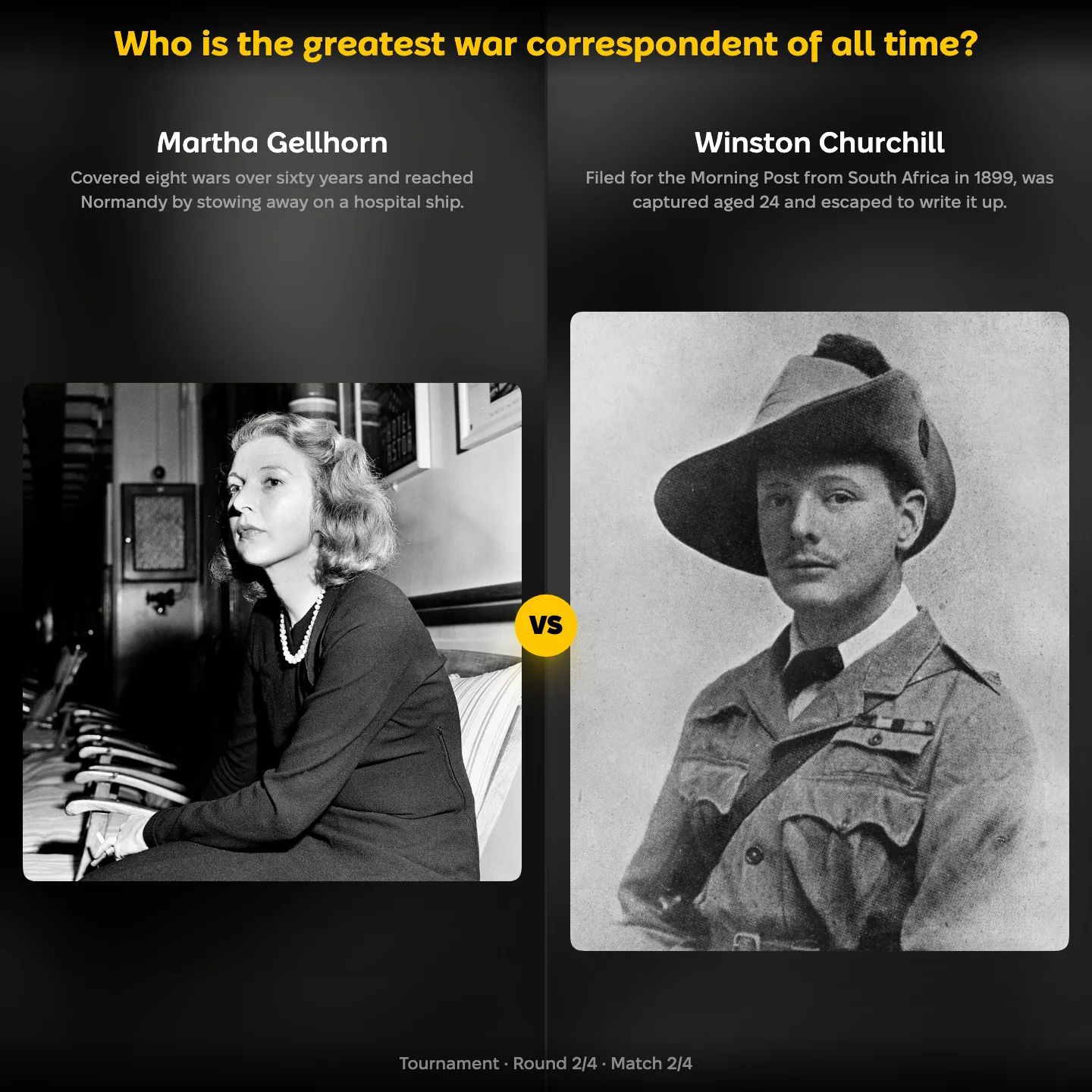
Churchill was a working reporter before he was anything else. He went to South Africa for the *Morning Post*, and on 15 November 1899, aged twenty-four, Boer forces ambushed his armoured train and took him prisoner; he escaped from Pretoria after a month and wrote the whole thing up.8
The escape made him famous enough in Britain to win a parliamentary seat the following year, so his political career began as a by-product of journalism.
Against career correspondents his ranking gets harder. Martha Gellhorn covered eight wars across sixty years and reached Normandy by stowing away on a hospital ship. Ernie Pyle wrote from the foxhole rather than headquarters and won a Pulitzer for it.
Marie Colvin, Robert Capa and William Howard Russell complete the shortlist. None of them treated a war posting as a way into government.
Martha Gellhorn against the 24-year-old who filed from South Africa. Play it →
## Gibbon, Herodotus and four volumes on Marlborough
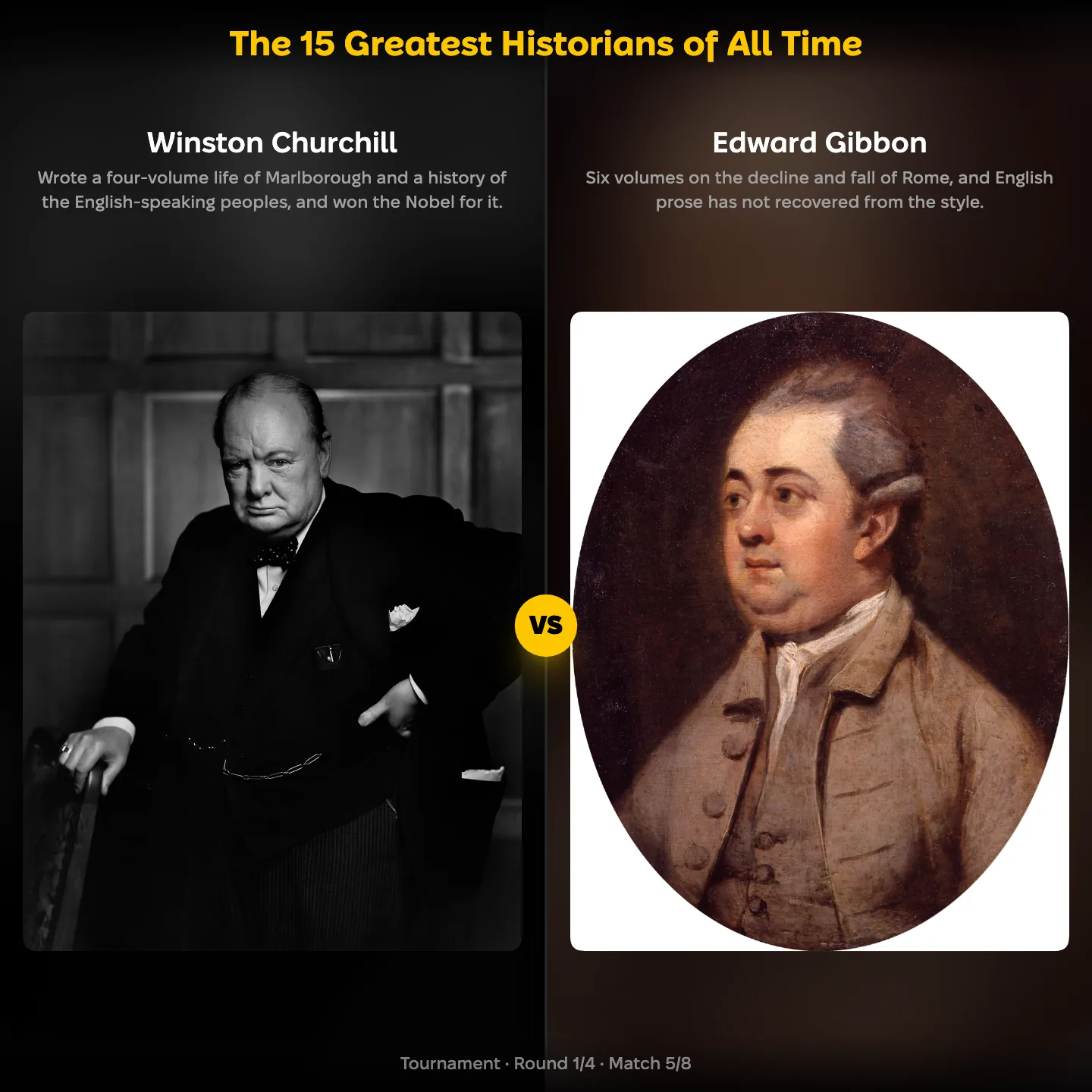
Churchill would probably have picked this ranking to be judged on. He wrote a four-volume life of his ancestor the Duke of Marlborough, a six-volume account of the Second World War and a history of the English-speaking peoples, and it is the historical writing rather than the memoirs that earned the Nobel citation.
Ranked among historians he is an amateur in the old sense: no doctorate, no post, and a subject he had usually been standing inside.
Edward Gibbon set the standard for English historical prose with six volumes on the decline and fall of Rome. Herodotus and Thucydides invented the discipline, and Ibn Khaldun effectively invented social history in the fourteenth century.
Barbara Tuchman won two Pulitzers without a doctorate either, which is the strongest precedent Churchill has here.
The man who wrote the war, against the man who wrote Rome. Play it →
## Fifteen questions, fifteen different Churchills
Every one of these lists has a decent claim on him, and the man they describe is different in each. The soldier who got captured, the minister who lost the Admiralty, the speaker, the painter, the historian and the politician his own electorate dismissed are all the same man, and the order they belong in depends entirely on which of them you asked about.
Each of these rankings is sorted by [putting two contenders in front of you and taking the winner](/articles/what-is-pairwise-comparison), repeated until an order emerges.
If your own field has a figure who keeps qualifying for categories with nothing in common, there is a ranking in that.
## More rankings, more angles
- [Theodore Roosevelt: Rough Rider, Nobel Laureate, Teddy Bear](/articles/theodore-roosevelt-ranked-many-ways) — another statesman with a Nobel and too many careers
- [Leonardo da Vinci Is on Every List. Never in the Same Place](/articles/leonardo-da-vinci-ranked-many-ways) — the painter Churchill's hobby has to answer to
- [Washington vs Lincoln: Who Wins Which List?](/articles/washington-vs-lincoln-ranked) — the two presidents every American list starts with
Sources
The Wallace Collection — Winston Churchill: The Painter, 23 May to 29 November 2026, more than 50 works, billed as the first major retrospective of his paintings since his death: wallacecollection.org (checked 2026-08-18)
National Trust, Chartwell — Churchill produced over 550 known canvases: nationaltrust.org.uk (checked 2026-08-18)
GOV.UK, past prime ministers — Churchill's terms of office, 1940–1945 and 1951–1955: gov.uk (checked 2026-08-18)
International Churchill Society — the 1953 Nobel Prize in Literature, its citation, and his 1945 and 1950 Peace Prize nominations: winstonchurchill.org (checked 2026-08-18)
The American Presidency Project — Proclamation 3525, signed 9 April 1963, declaring Churchill an honorary citizen of the United States: presidency.ucsb.edu (checked 2026-08-18)
Churchill Archives Centre, University of Cambridge — the Dardanelles campaign, his removal from the Admiralty in May 1915 and his resignation that November: archives.chu.cam.ac.uk (checked 2026-08-18)
The Conversation — the 1945 general election: polling on 5 July, a Labour majority of 146 seats, 47.7% to 36.2%, and Churchill's approval rating at the end of the war: theconversation.com (checked 2026-08-18)
National Army Museum — Churchill's capture on 15 November 1899, aged 24, while working as a war correspondent for the Morning Post, and his escape a month later: nam.ac.uk (checked 2026-08-18)
Al Jazeera — reporting the February 2019 Geophysical Research Letters study attributing the 1943 Bengal famine to policy failure rather than drought, and the estimate of up to three million deaths: aljazeera.com (checked 2026-08-18)
CBS News — Gary Oldman's Best Actor win at the 2018 Academy Awards for playing Churchill in Darkest Hour: cbsnews.com (checked 2026-08-18)