# Amelia Earhart Crossed the Atlantic as Baggage, Then Flew It Alone
> Amelia Earhart flew for nine years and turns up on twelve rankings about pilots, explorers, unsolved disappearances and Mount Rushmore. Each one asks something different.
*By YPB Team · Published September 2, 2026 · https://youpick.best/articles/amelia-earhart-ranked-many-ways*
---
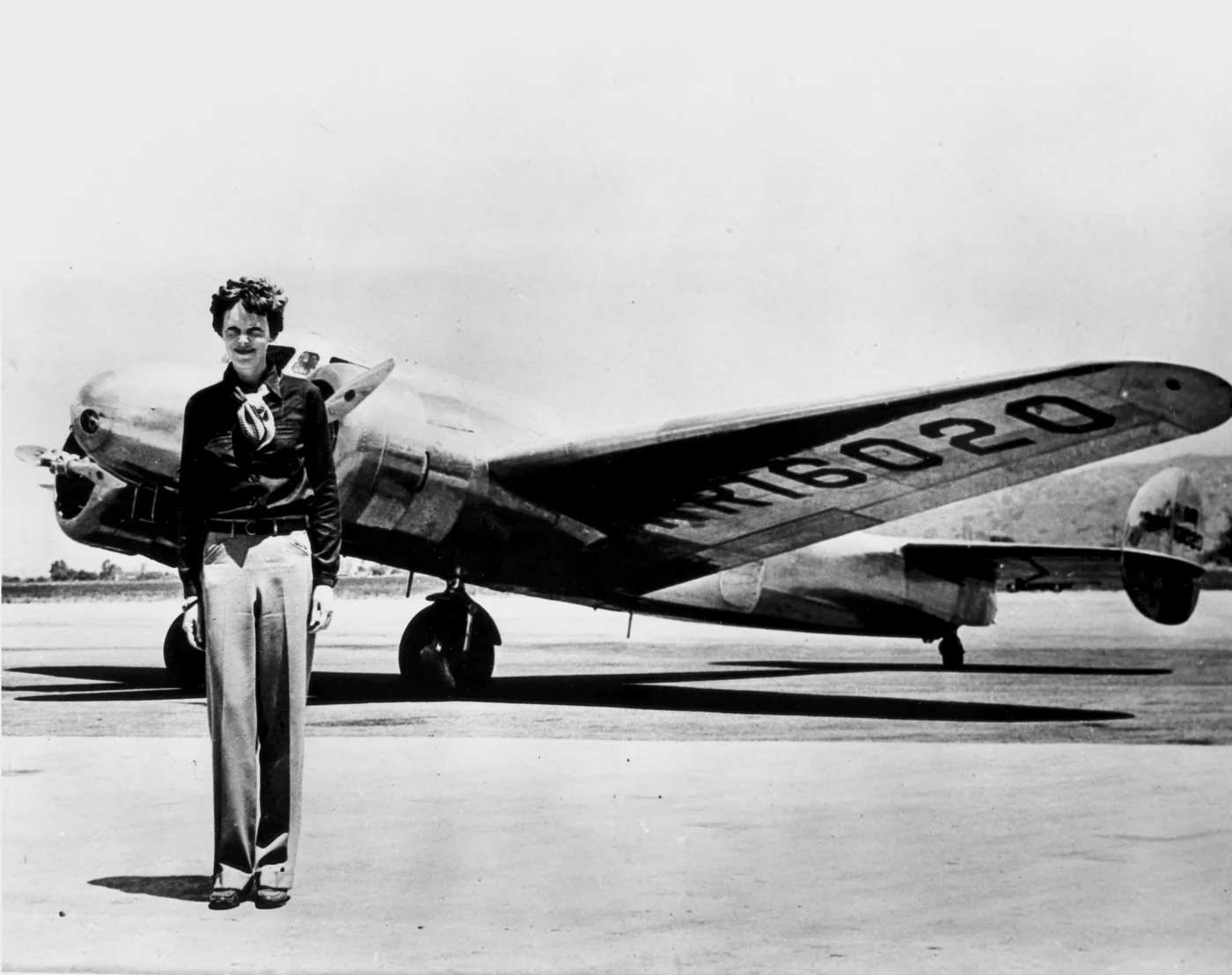
Amelia Earhart with the Lockheed Electra she disappeared in — photograph by the Smithsonian Institution, public domain.
In the first week of October 2026, a Purdue University and Archaeological Legacy Institute team sails 830 nautical miles from Tarawa to a coral atoll called Nikumaroro to look at a shape in a lagoon.1 They are looking for a twin-engine Lockheed Electra that has been missing since 2 July 1937. Amelia Earhart's flying career ran nine years, from a passenger seat in 1928 to the Pacific in 1937, and it is short enough to summarise in a paragraph.
Sorting her is harder. Twelve rankings on this site hold her name, and they cannot agree on what she was.
> Earhart flew for nine years and turns up on lists about pilots, explorers, mysteries and monuments — the disagreement is about which of those she was best at.
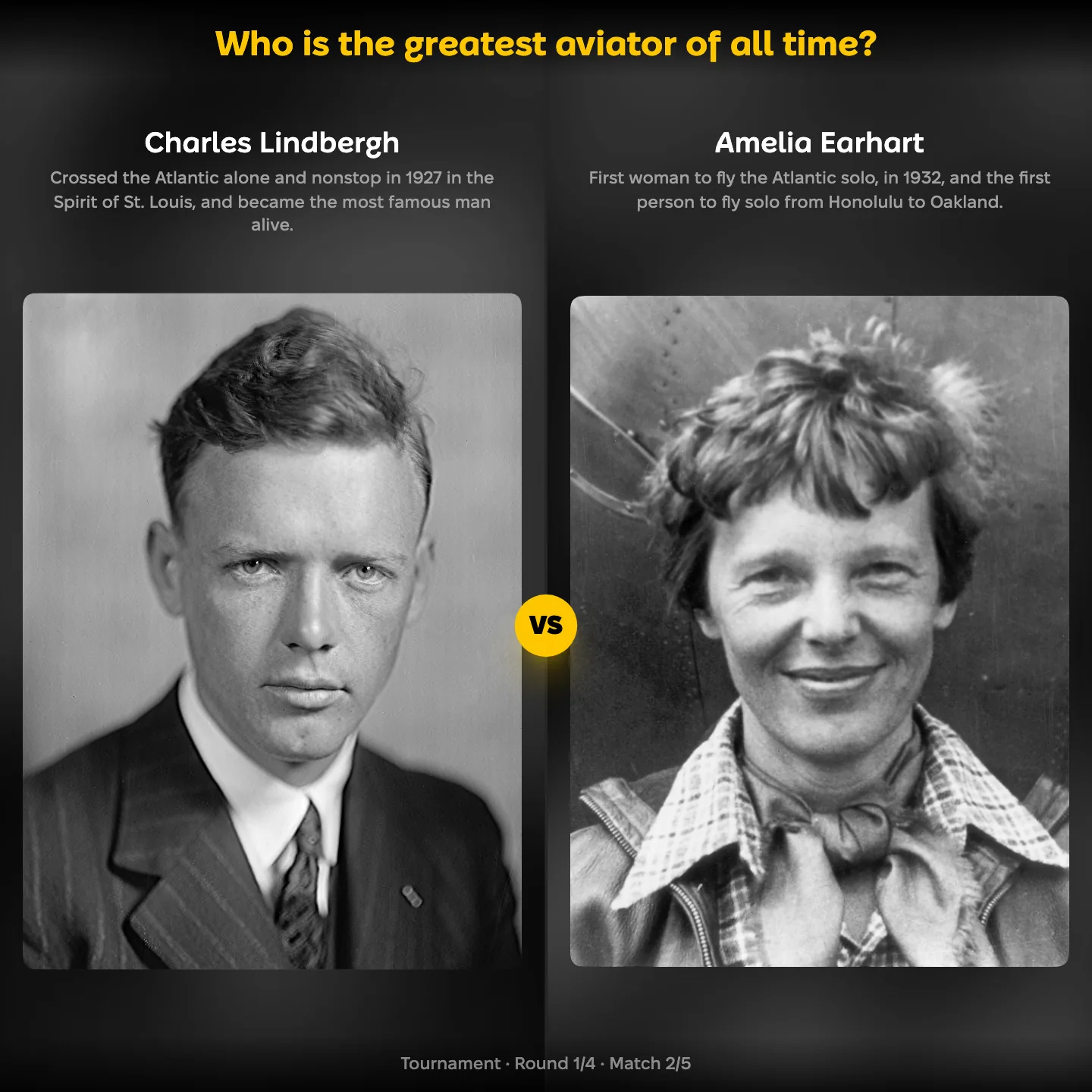
## Charles Lindbergh vs Amelia Earhart: second across the Atlantic
Pilots get ranked on what they flew first. That is a narrow test, and it is the one where Earhart's case is weakest.
Lindbergh crossed the Atlantic alone and nonstop in May 1927. Earhart did the same thing five years later, on 20–21 May 1932, leaving Harbour Grace in Newfoundland and landing near Londonderry about fifteen hours later in a Lockheed Vega 5B; Congress gave her the Distinguished Flying Cross for it.2 Second is second.
The list also holds Orville and Wilbur Wright, who made the whole category possible in twelve seconds in 1903, and Chuck Yeager, who went past the speed of sound in 1947 with two cracked ribs.
Earhart's rebuttal is January 1935: the first solo flight by anyone, of either sex, from Honolulu to Oakland.3 That one nobody had done, in either direction.
Nine names that changed what an aeroplane could do. Play it →
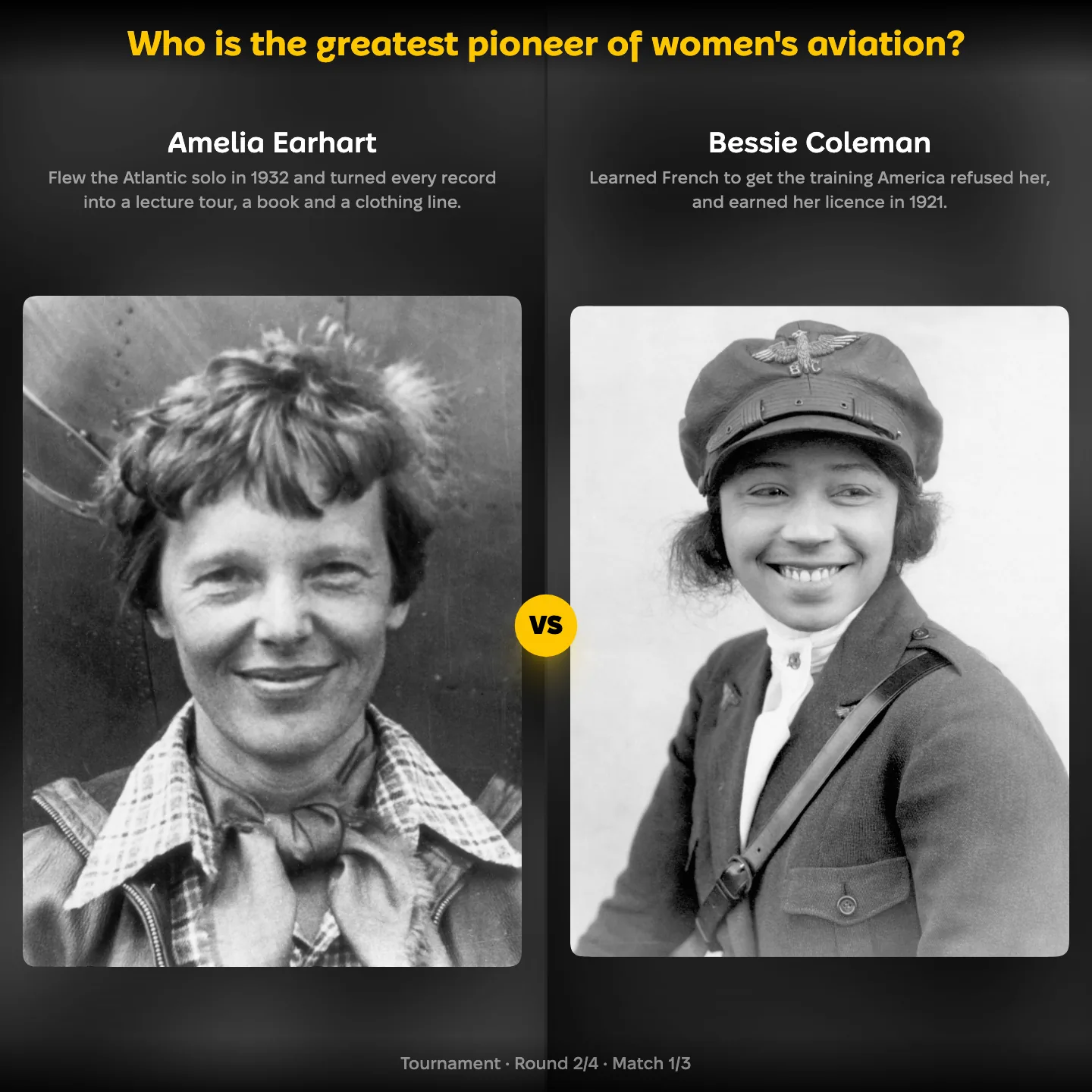
## Bessie Coleman: the licence America refused
Narrow the field to the women who got there first, and the argument changes shape entirely.
Bessie Coleman could not get flight training in the United States, so she learned French and qualified in France in 1921 — the first Black woman anywhere to hold a pilot's licence. Raymonde de Laroche had taken the world's first woman's licence in France in 1910. Harriet Quimby was the first American woman licensed, in 1911, and the first woman to fly the English Channel.
Earhart came later than all three and outran them on reach. She flew the Atlantic alone in 1932, then turned each record into a lecture tour, a book and a luggage line — the promotion was part of the method rather than a distraction from it.
Amy Johnson, Jacqueline Cochran and Valentina Tereshkova complete a list where "first" means something different in every entry.
Where "first" means something different in every entry. Play it →
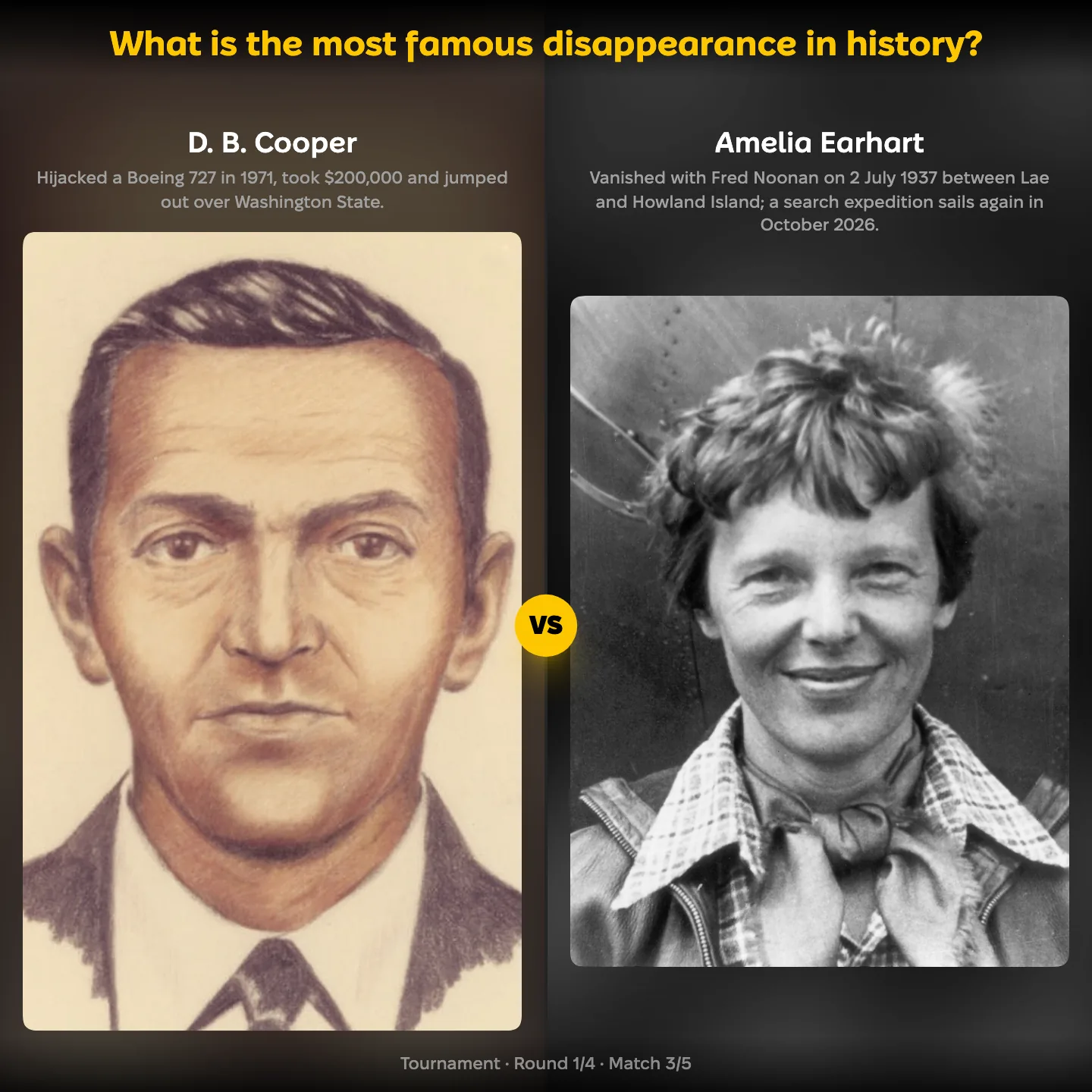
## D. B. Cooper vs Amelia Earhart: the list where vanishing is the qualification
Some rankings measure achievement. This one measures absence.
Earhart and her navigator Fred Noonan left Lae for Howland Island on 2 July 1937, could not find the island and lost radio contact with the Coast Guard cutter *Itasca*.3 Eighty-nine years later, the Taraia Object in the Nikumaroro lagoon — first noticed on satellite imagery in 2020, and apparently sitting in the same spot in photographs from 1938 — is why anyone is still sailing out there.1
D. B. Cooper is the American rival: a man who hijacked a Boeing 727 in 1971, took $200,000 and stepped out of it over Washington State.
Malaysia Airlines Flight 370 turned off course in March 2014 with 239 people aboard. The Roanoke colony was found empty in 1590 with CROATOAN carved into a post. Jimmy Hoffa walked out of a Michigan restaurant car park in 1975.
Fame on this list tracks how long the search has run rather than how many people went missing. Roanoke has been unexplained for four centuries and draws a fraction of the attention. Earhart's attracts expeditions because there is a specific object in a specific lagoon to go and look at, which is a thing almost no other entry here can offer.
The one list where being unfindable is the qualification. Play it →
## Lewis and Clark went on foot; Earhart went over the top
American exploration is usually told on foot, by river and by sledge. A pilot on the list forces the question of whether covering ground counts as discovering it.
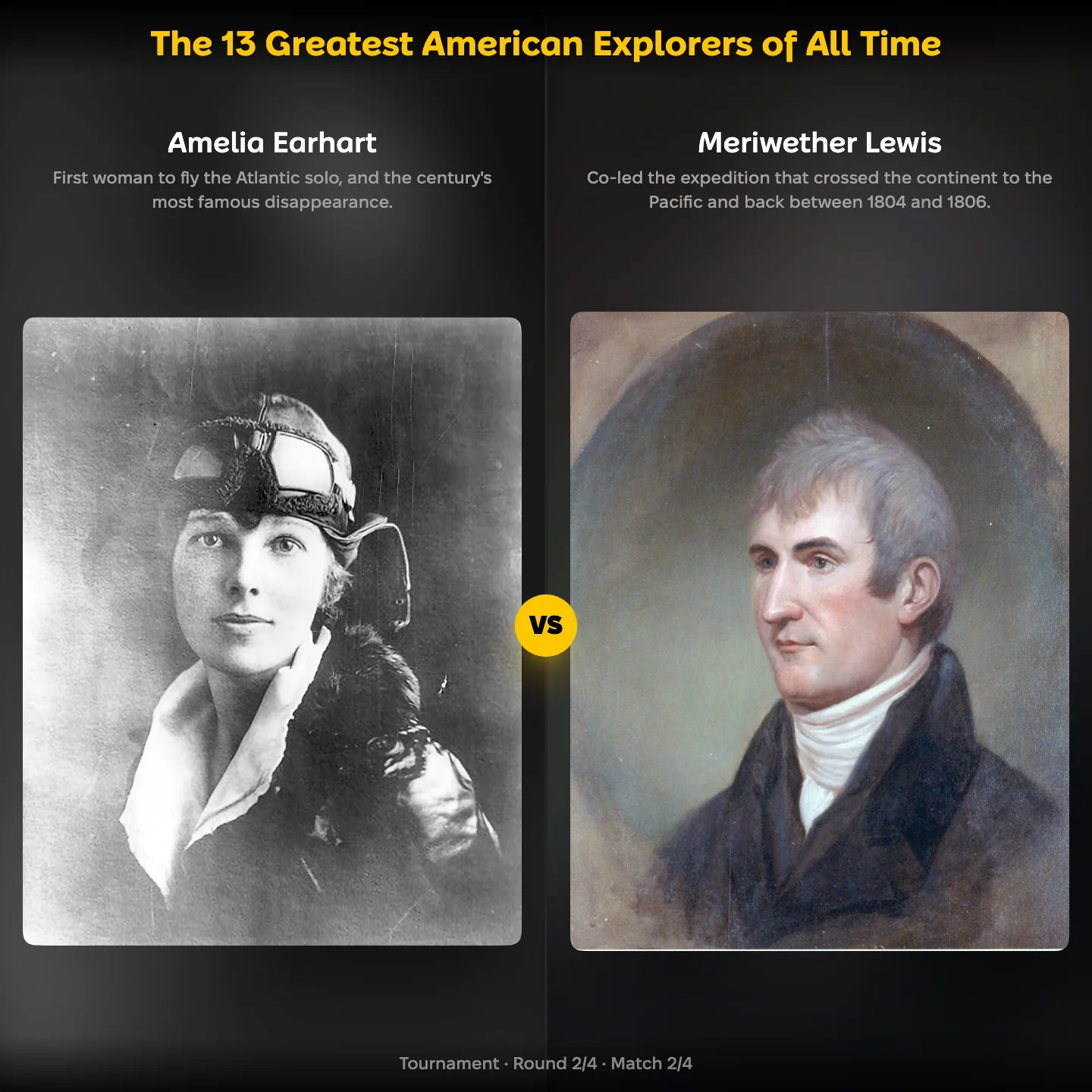
Meriwether Lewis and William Clark crossed the continent to the Pacific and back between 1804 and 1806. Robert Peary and Matthew Henson went for the North Pole. John Wesley Powell ran the Colorado through the Grand Canyon with one arm.
Earhart's routes were already on the map. What was not established was that a single person could fly them, and the 1935 Honolulu–Oakland leg is the entry that puts her here rather than in a category of her own.
Neil Armstrong and Sally Ride sit on the same list and settle the principle: if leaving the ground disqualified you, neither of them would be on it either.
Put her among Lewis, Clark and Armstrong and the flying starts to look like exploring. Play it →
## Shackleton, Amundsen, Scott: the century that ran out of blanks
By 1900 the land map had almost nothing left on it, so the twentieth century's explorers went for the poles, the summits, the trenches and orbit.
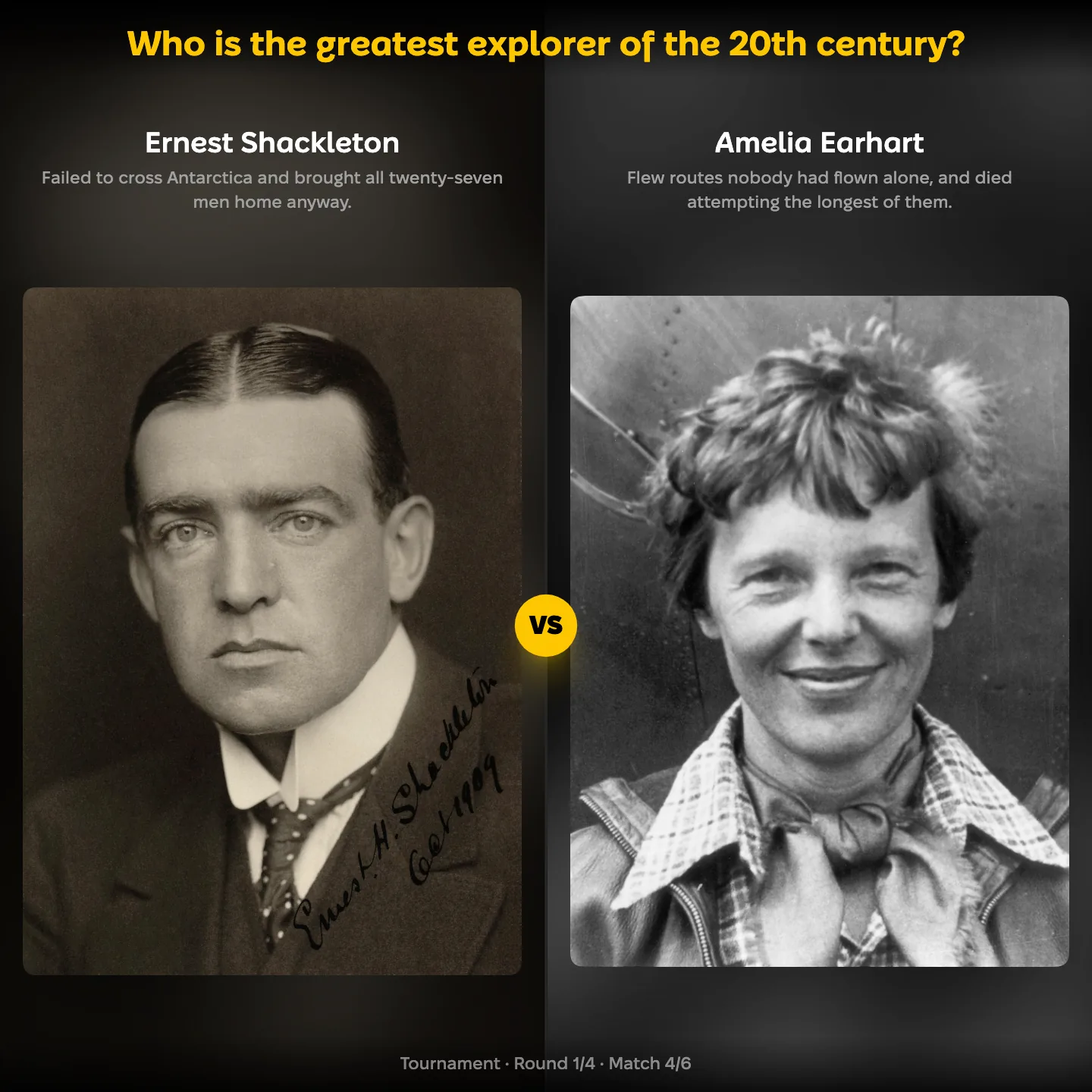
Ernest Shackleton failed to cross Antarctica and brought all twenty-seven of his men home, which is why he is remembered better than several people who succeeded at what they set out to do. Roald Amundsen reached the South Pole in December 1911 and Robert Falcon Scott died coming back from it a month behind him.
Earhart belongs in this company on the same logic as Shackleton: an attempt that failed is not automatically a footnote. Hers is the failure that generated the longest search.
Edmund Hillary and Tenzing Norgay took Everest in May 1953, Jacques Piccard went to the floor of the Mariana Trench in 1960 and Yuri Gagarin left the atmosphere in 1961 — four directions in one century, with no shared unit of measurement.
Widen it past America and the poles, the summit and the Moon all get a vote. Play it →
## Harriet Tubman, Rosa Parks, and the one who changed no laws
Ask which American woman mattered most and the answers are almost all about changing a law or a life. Earhart changed neither.
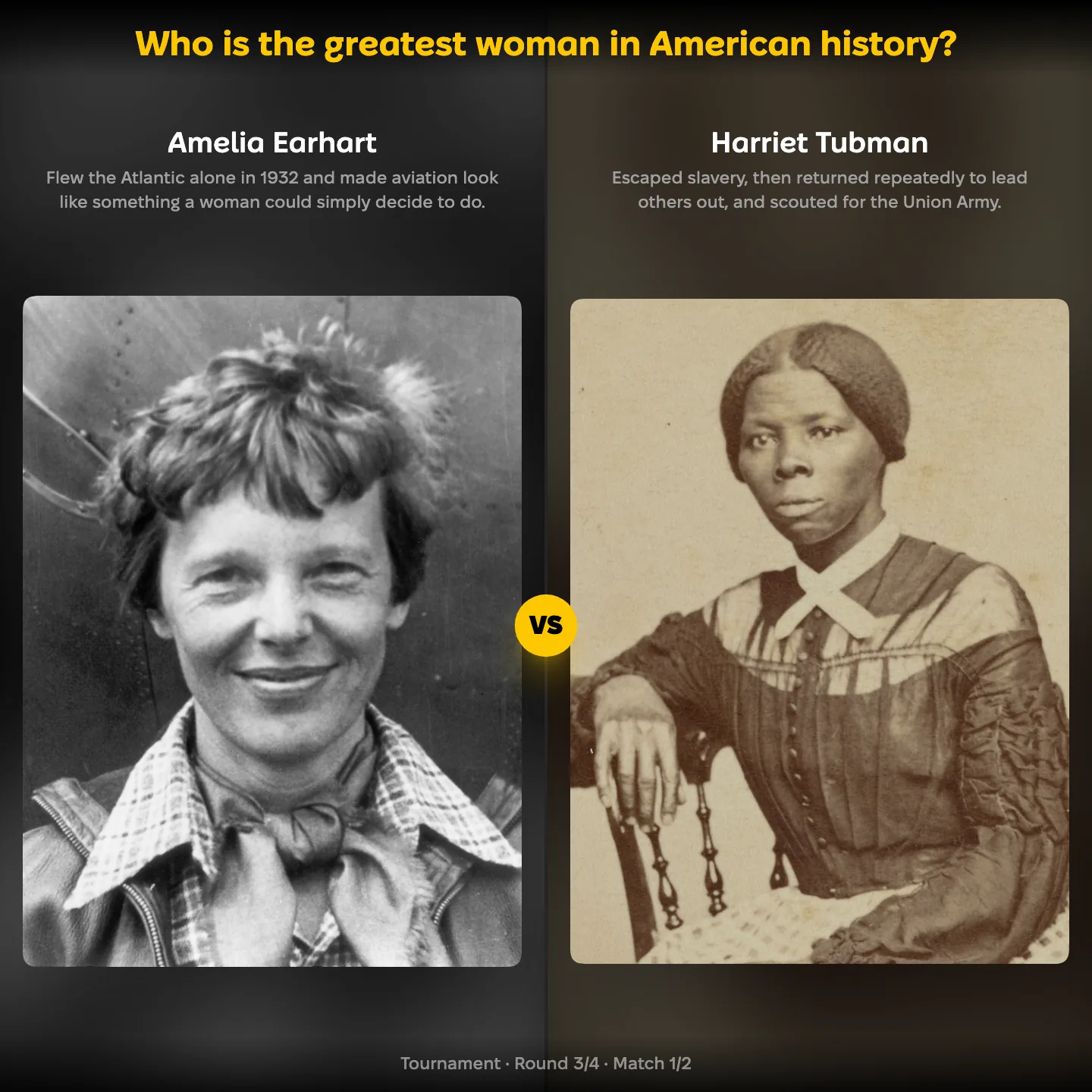
Harriet Tubman escaped slavery and went back repeatedly to lead others out, then scouted for the Union Army. Rosa Parks stayed in her seat in Montgomery in 1955. Susan B. Anthony spent fifty years arguing for the vote and was tried in 1872 for casting one. Ruth Bader Ginsburg argued the cases that made sex discrimination unconstitutional before she sat on the court that decided them.
Earhart's contribution was demonstrative rather than legislative: she made a technical profession look like something a woman could simply decide to enter, and she did it in 1932, when almost nobody was arguing that in public.
Katherine Johnson, Rachel Carson and Clara Barton widen the list further, and between them they show that "greatest" here is four different questions wearing one heading.
A pilot on a list of reformers, judges and scientists. Play it →
## The 1930s belonged to the newsreels, and she was in them
The 1930s belong to whoever the newsreels ran most, and Earhart's records fall squarely inside them: the Atlantic in 1932, the Pacific in 1935, the disappearance in 1937.
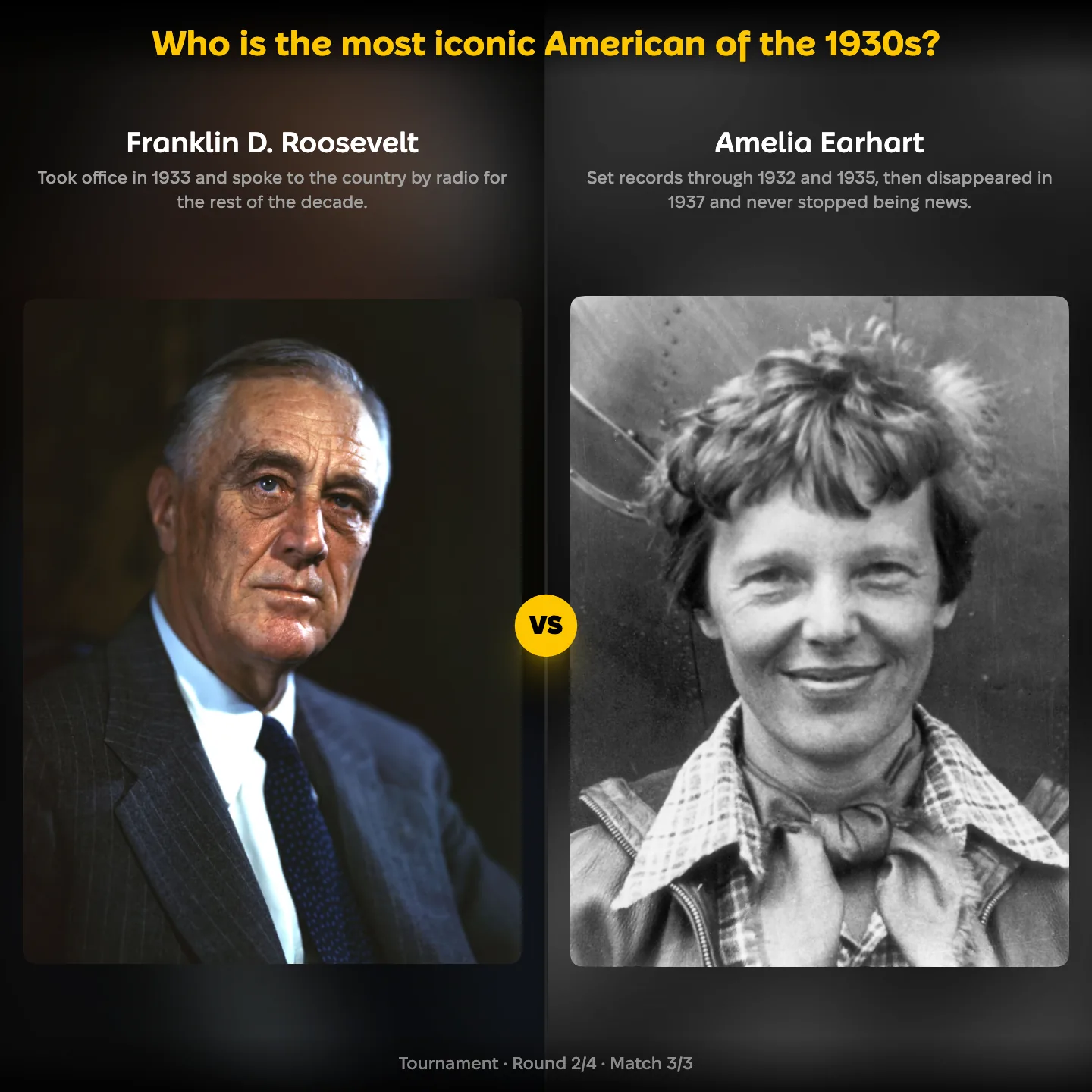
Franklin D. Roosevelt took office in 1933 and then spoke to the country by radio for the rest of the decade, which is a hard act to out-broadcast.
Earhart's advantage is that her decade did not end when the decade did. A president leaves office; a search does not close.
Babe Ruth finished his career in 1935, Shirley Temple was the top box-office draw in America for four straight years from 1935, Jesse Owens won four golds in Berlin in 1936, and a small claiming horse called Seabiscuit beat War Admiral in 1938 and outdrew the White House in column inches.
Her decade, measured against a president, a home-run record and a racehorse. Play it →
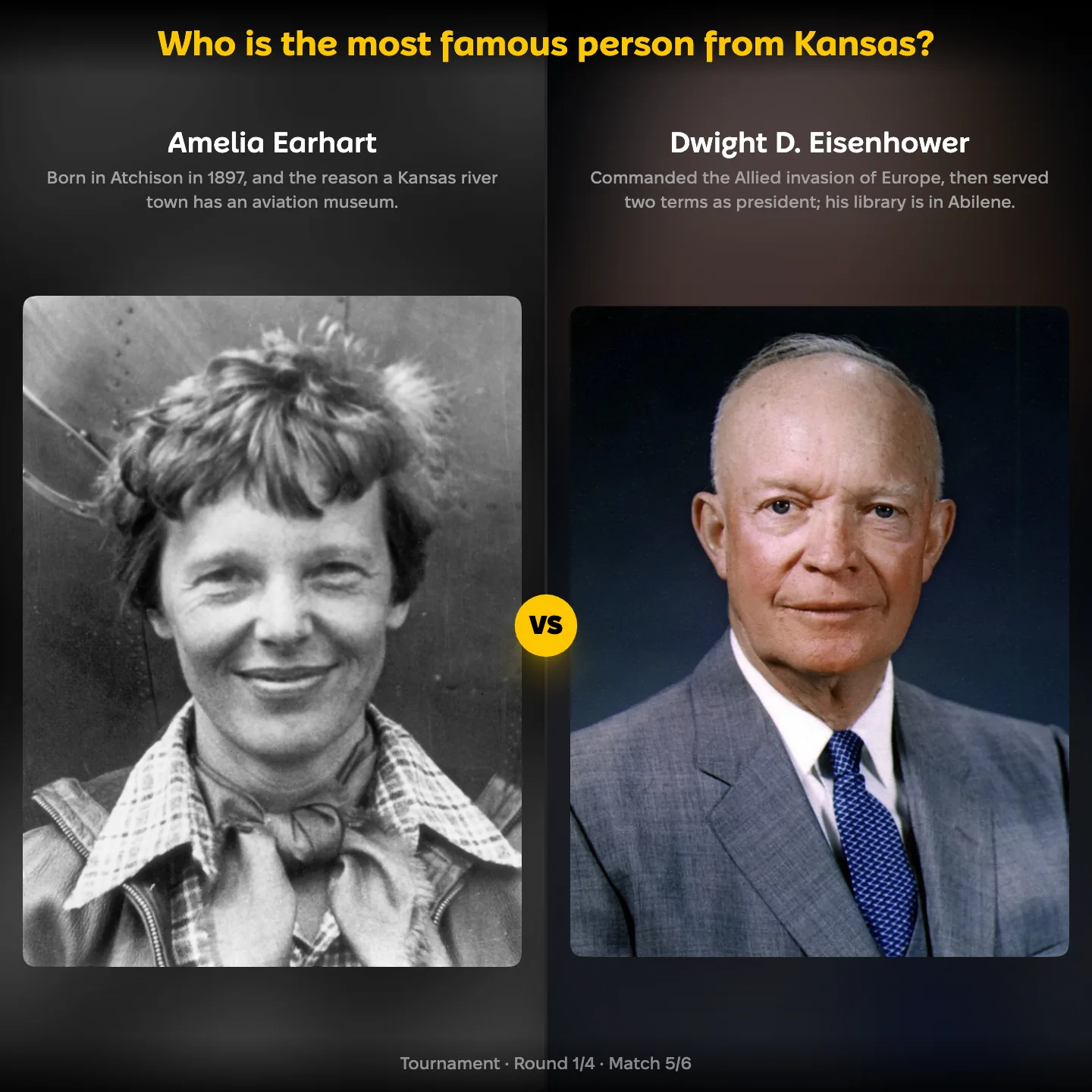
## Atchison vs Abilene: Kansas has two candidates
Kansas holds under three million people and has produced a supreme commander, a president, a bebop revolution and the most-searched missing person in the world.
Earhart was born in Atchison on 24 July 1897, in a house above the Missouri River that is now a museum.4
Dwight D. Eisenhower grew up 150 miles west in Abilene, commanded the Allied invasion of Europe and then served two terms as president; his presidential library sits there.
Charlie Parker was born in Kansas City, Kansas, and had rebuilt jazz around bebop before he was thirty. Gordon Parks, Buster Keaton, Hattie McDaniel and Langston Hughes are all on the same list, which is a lot of range for a state people drive through.
Atchison against Abilene: the aviator against the general who became president. Play it →
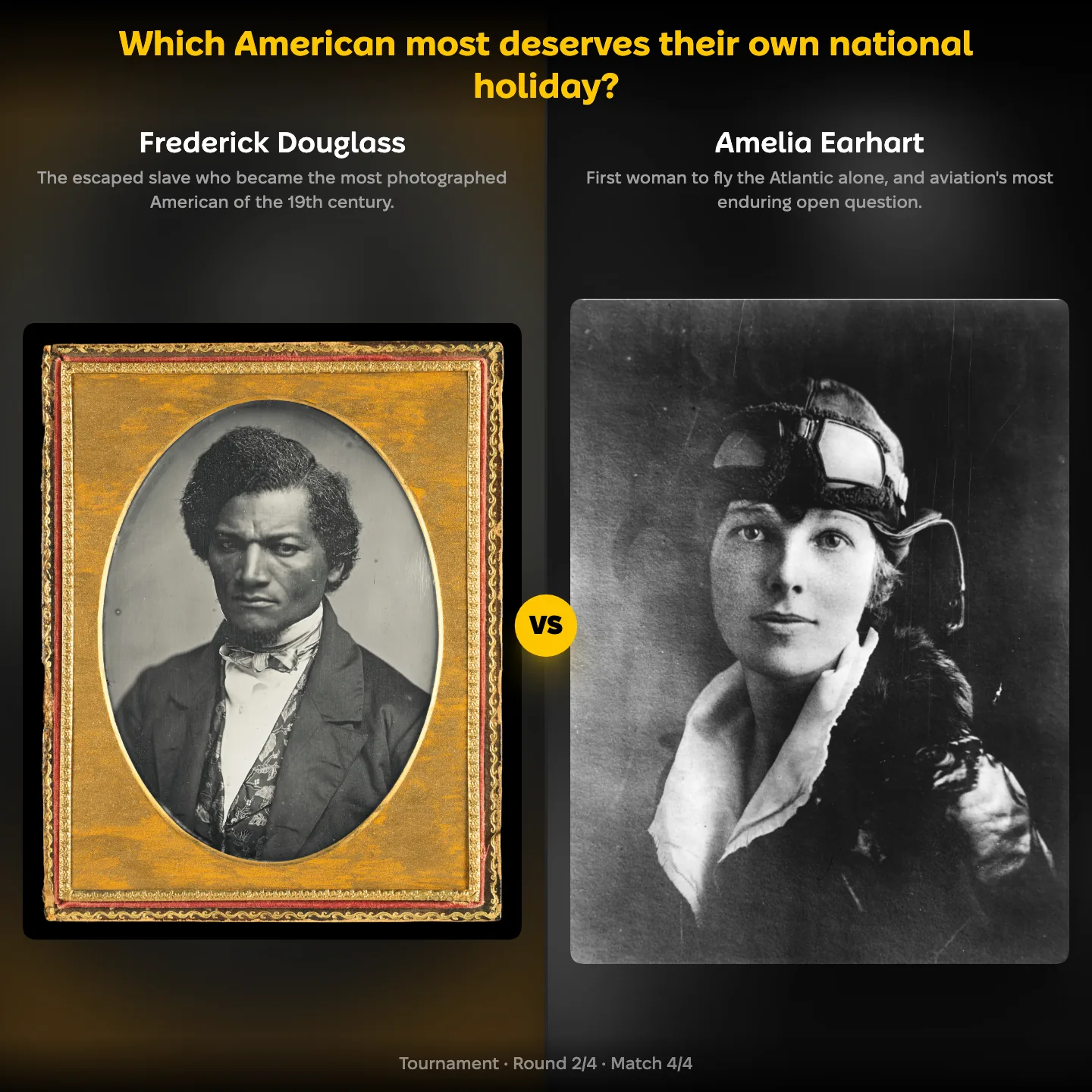
## Frederick Douglass has an argument; Earhart has a story
A national holiday is a claim about what a country wants to teach, not about who it finds interesting. That is a different test, and it moves Earhart.
Frederick Douglass escaped slavery and became the most photographed American of the nineteenth century, arguing the case for abolition in print and on platforms for fifty years.
Earhart's achievements were personal rather than civic. A day off in her name would commemorate courage in the abstract, where Douglass's would commemorate an argument the country had to have.
George Washington, Abraham Lincoln, Rosa Parks, Jonas Salk and Jackie Robinson fill out a list where nearly every candidate changed a law, a disease or a rule — and that company is what makes the aviator stand out.
Fame is not the same as a day off, and this list separates them. Play it →
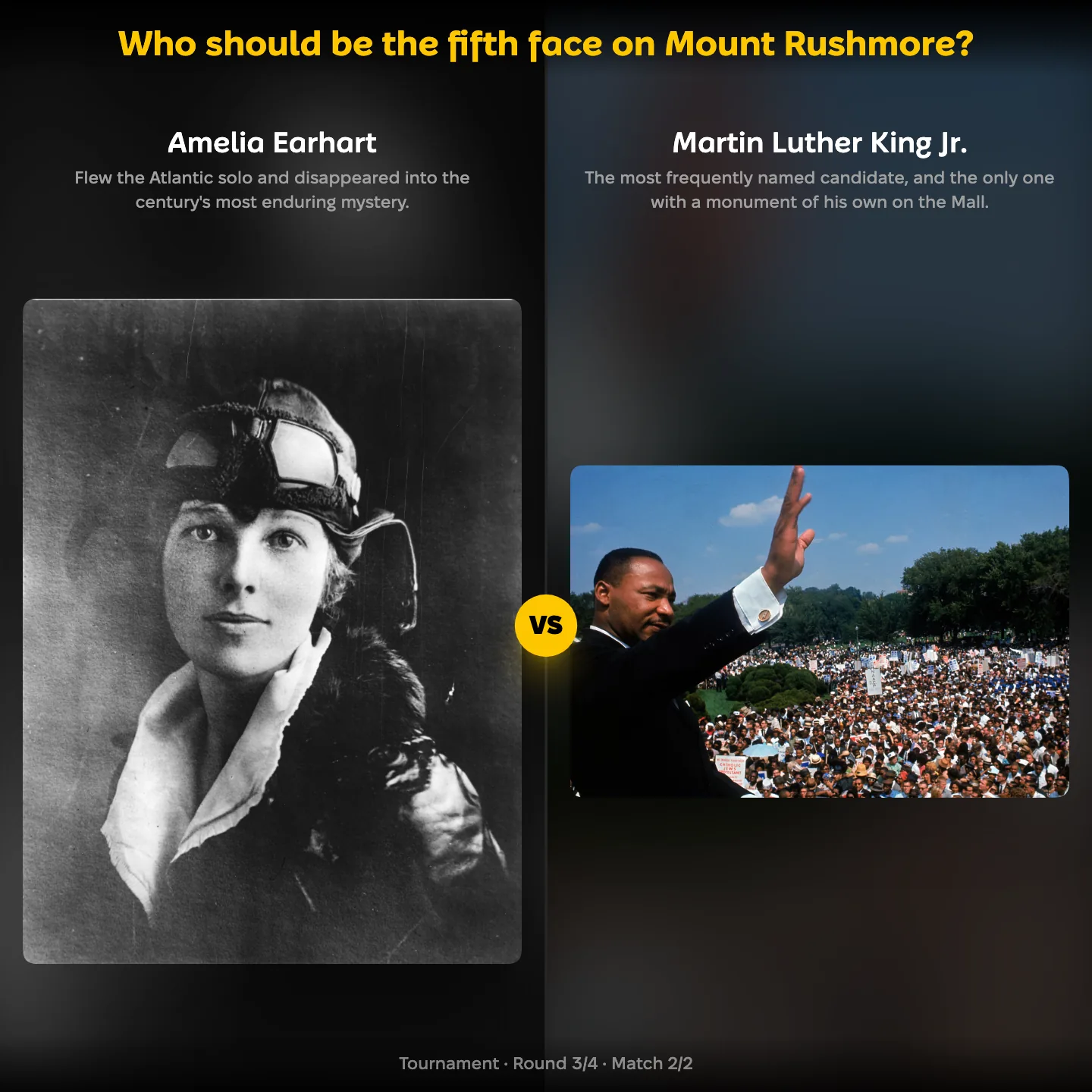
## Mount Rushmore: fourteen candidates, one space in the granite
Rushmore's four faces are presidents, and Earhart held no office and signed nothing.
Neil Armstrong is on the same list of fourteen candidates, which is the entire argument for her: if a mountain can commemorate going somewhere first, she qualifies on identical grounds.
Fourteen candidates for one space in the granite. Play it →
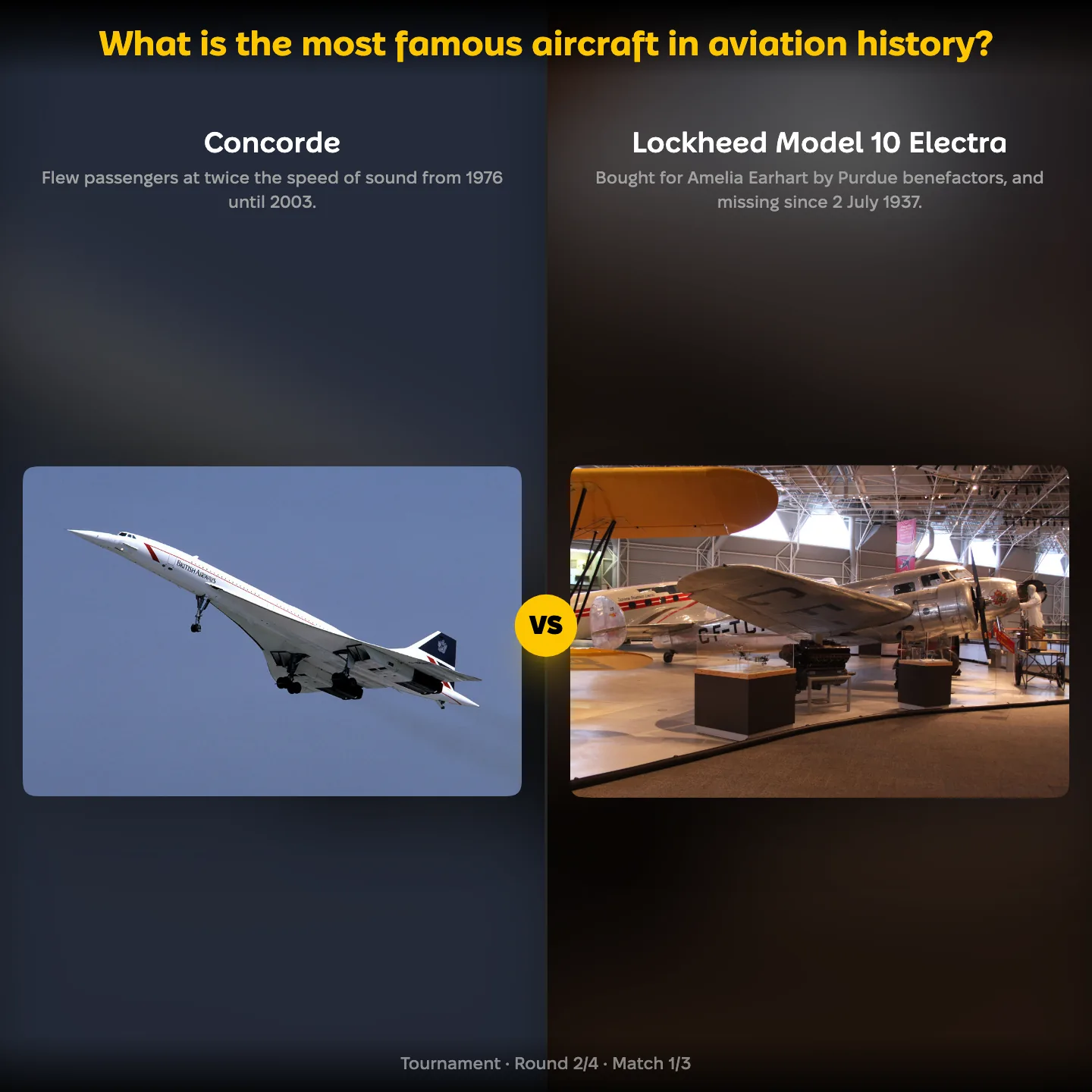
## Concorde vs the Lockheed Electra: the aeroplane nobody has photographed since 1937
Rank aircraft instead of pilots and Earhart appears as a machine. The Electra is the only entry on the list whose current location is unknown.
Purdue benefactors bought her the twin-engine Lockheed Model 10-E in 1936, the year after she joined the university as a visiting professor at President Edward Elliott's invitation.5 It is the aircraft the October expedition is going to Nikumaroro to look for.
Concorde carried passengers at twice the speed of sound from 1976 to 2003 and is the aeroplane most people can draw from memory.
The Wright Flyer, the Spirit of St. Louis, the Boeing 747 and the SR-71 Blackbird are all on the list, and every one of them can be visited in a museum. That is exactly what the Electra has instead of a display case: an expedition.
Her Electra against Concorde, the Flyer and the Spirit of St. Louis. Play it →
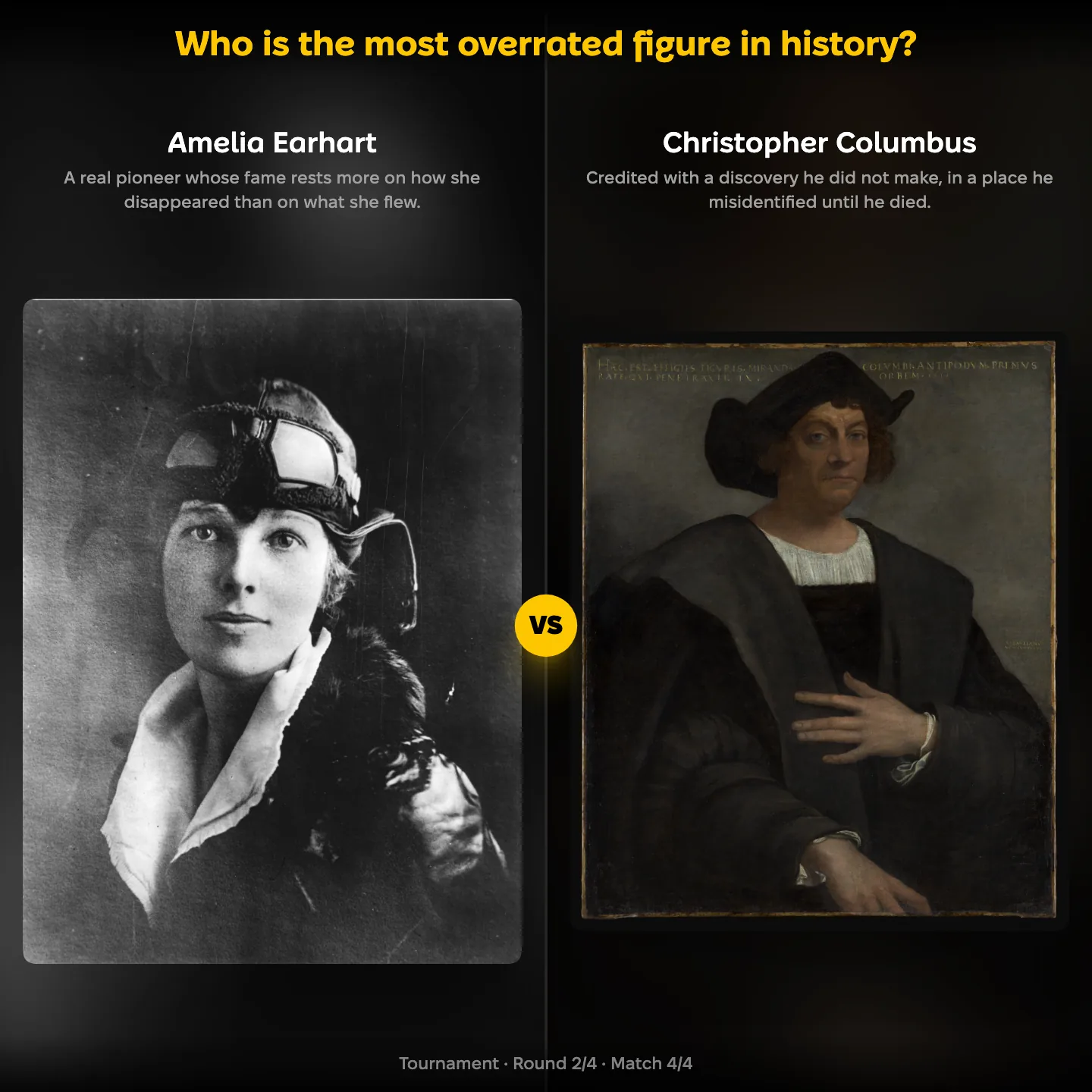
## Christopher Columbus vs Amelia Earhart: the honest list
Somebody always puts Earhart on the overrated list, and the reason is on the record rather than in the comments.
Her first Atlantic crossing, on the *Friendship* in June 1928, was as a passenger. She said so herself: "Stultz did all the flying — had to. I was just baggage."3 The fame started there, four years before the flight that earned it.
The documented weakness is radio and navigation rather than flying. Harry Manning, the maritime navigator with the radio skills the crew needed, left before the second world attempt, and neither Earhart nor Fred Noonan had them.6 The first attempt had already ended in March 1937 when the Electra ground-looped on takeoff in Honolulu.
Christopher Columbus, Thomas Edison, Napoleon Bonaparte and Nikola Tesla are the company on this list, and the pattern is the same in each case: a real achievement, and a reputation that outgrew it.
The honest lens, and the reason it is arguable. Play it →
## Twelve lists, four different Earharts
Across these twelve rankings Earhart is a pilot, an explorer, an unsolved case and a candidate for a monument, and the four versions barely overlap. The reason the argument stays open is that each list is asking about a different nine years of the same life — and the one question that could close it is the one an expedition sails towards in October.
If you want to see how each of these gets settled, it is one matchup at a time: [the head-to-head method](/articles/what-is-pairwise-comparison) is the whole mechanism.
Know someone whose reputation depends entirely on which list you read? Make the list and find out.
## More rankings, more angles
- [Theodore Roosevelt: Rough Rider, Nobel Laureate, Teddy Bear](/articles/theodore-roosevelt-ranked-many-ways) — a president on the explorers' list too
- [15 Rankings, One Benjamin Franklin](/articles/benjamin-franklin-ranked-many-ways) — the other Rushmore candidate who was never president
- [Washington vs Lincoln: Who Wins Which List?](/articles/washington-vs-lincoln-ranked) — two presidents, one holiday argument
Sources
Purdue University Newsroom — ALI/Purdue Taraia Object Expedition, October 2026 departure, Nikumaroro and the 830-nautical-mile sail: purdue.edu (checked 2026-08-31)
Smithsonian National Air and Space Museum — the 1932 solo Atlantic crossing, the Lockheed Vega 5B and the Distinguished Flying Cross: airandspace.si.edu (checked 2026-08-31)
PBS American Experience — Earhart timeline: the 1928 Friendship crossing and her "just baggage" remark, the January 1935 Honolulu–Oakland solo, the March 1937 ground-loop, and the 2 July 1937 Lae–Howland flight and loss of contact with the Itasca: pbs.org (checked 2026-08-31)
National Women's History Museum — born in Atchison, Kansas, 24 July 1897: womenshistory.org (checked 2026-08-31)
Purdue Engineering — Earhart's 1935 appointment as a visiting professor and the Purdue-funded Lockheed 10-E Electra: purdue.edu (checked 2026-08-31)
Smithsonian Time and Navigation — Earhart's radio and navigation limitations and Harry Manning's departure from the crew: timeandnavigation.si.edu (checked 2026-08-31)