
What is the best FIFA World Cup official match ball of all time?
Every four years, a new official ball takes centre stage as the world watches the greatest football tournament on Earth. From the hand-stitched leather balls of the 1960s to today's high-tech synthetic spheres, which FIFA World Cup match ball is the most iconic of all time?
 1
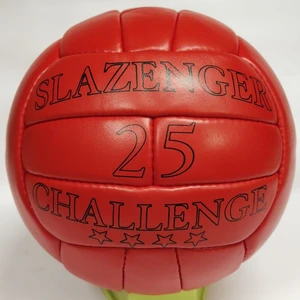
1Challenge 4-Star (1966)
The original 32-panel hand-stitched leather ball used at the 1966 World Cup in England, representing the pre-synthetic era of football when natural materials defined the game.
 2
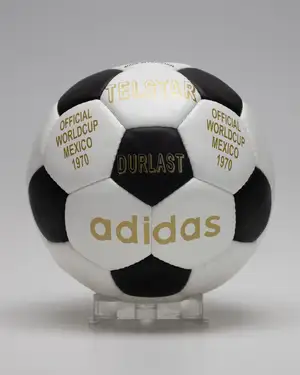
2Telstar (1970)
The iconic black-and-white 32-panel ball designed by Adidas for the 1970 Mexico World Cup, created with high contrast to be easily visible on black-and-white television broadcasts.
 3
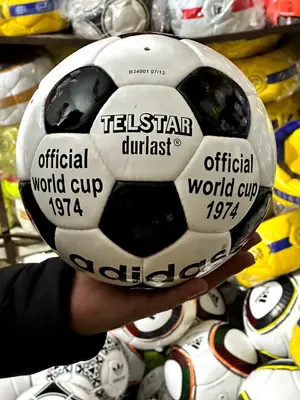
3Telstar Durlast (1974)
The evolved Telstar design for the 1974 West Germany World Cup featuring the iconic Durlast polyurethane coating, one of the first synthetic-coated match balls in football history.
 4
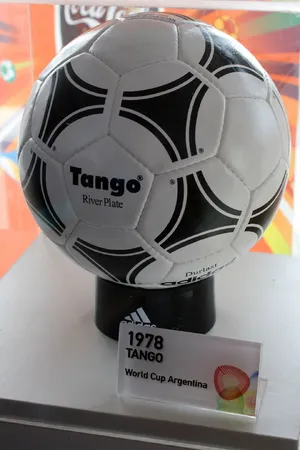
4Tango (1978)
Adidas' ground-breaking 1978 Argentina World Cup ball featuring the revolutionary 20-panel Tango design with interlocking circles, a silhouette that influenced ball design for decades.
 5
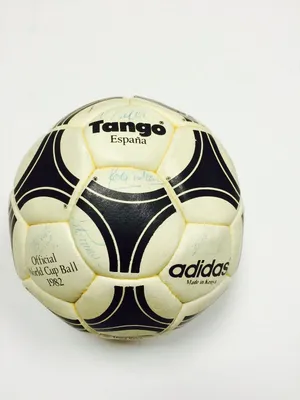
5Tango España (1982)
The enhanced Tango design used at the 1982 Spain World Cup, featuring a water-resistant synthetic exterior and improved durability compared to its 1978 predecessor.
 6
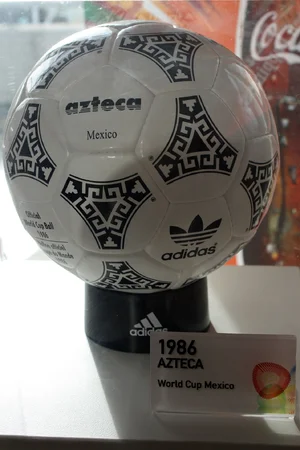
6Azteca (1986)
The 1986 Mexico World Cup ball became the first fully synthetic football used at a World Cup, featuring an Aztec-inspired pattern and dramatically improved water resistance.
 7
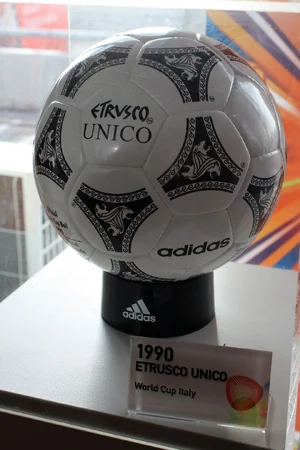
7Etrusco Unico (1990)
The 1990 Italy World Cup ball featuring an Etruscan-inspired lion head pattern, remembered for its role in the tournament that introduced the penalty shootout as a decisive World Cup mechanism.
 8
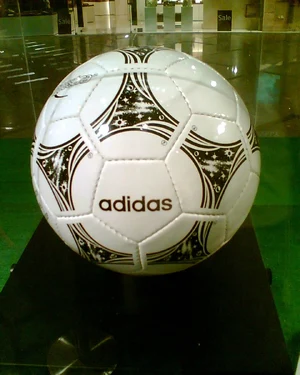
8Questra (1994)
The 1994 USA World Cup ball featuring a foam layer for improved shock absorption, used in the tournament that gave birth to the Golden Goal rule and saw Brazil win on penalties.
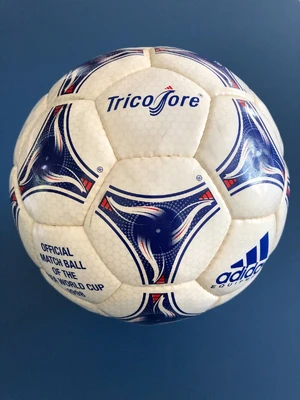 9
9Tricolore (1998)
The 1998 France World Cup ball was the first multicoloured ball in World Cup history, featuring a tricolour design inspired by the French flag used in the tournament where France won their first World Cup.
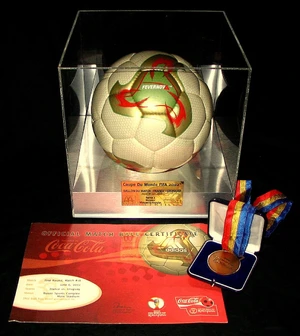 10
10Fevernova (2002)
The 2002 Japan/South Korea World Cup ball featuring a distinctive triangular pattern, controversial for its unpredictable flight path that confounded goalkeepers throughout the tournament.
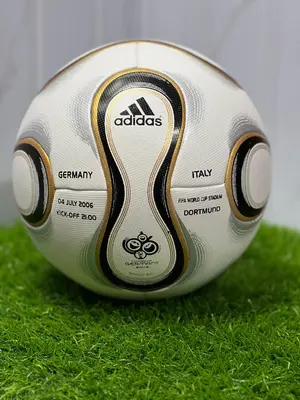 11
11Teamgeist (2006)
The 2006 Germany World Cup ball featured just 14 panels compared to the traditional 32, resulting in a rounder ball with more consistent flight that was praised by players and goalkeepers.
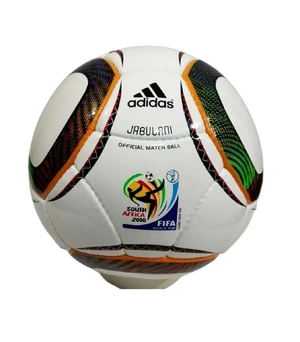 12
12Jabulani (2010)
The 2010 South Africa World Cup ball reduced to just 8 panels, becoming one of the most controversial balls in World Cup history for its unpredictable knuckling flight that troubled goalkeepers.
 13
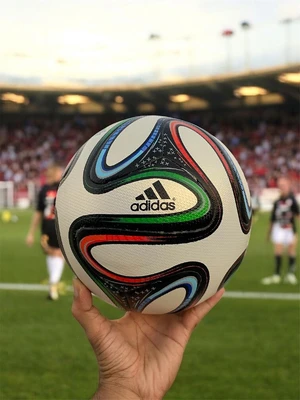
13Brazuca (2014)
The 2014 Brazil World Cup ball used just 6 symmetrical panels with a textured surface, widely praised as one of the most flight-stable World Cup balls ever produced.
 14
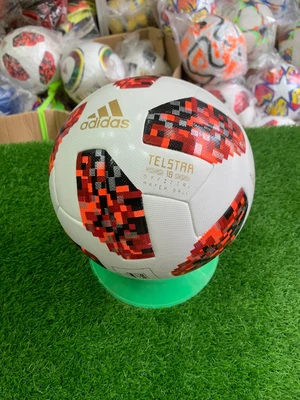
14Telstar 18 (2018)
The 2018 Russia World Cup ball paid homage to the iconic 1970 original Telstar with its black-and-white pixelated pattern while incorporating the latest thermally bonded panel technology.
 15
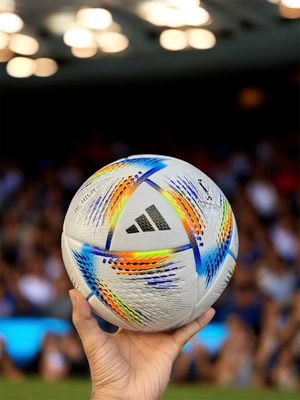
15Al Rihla (2022)
The 2022 Qatar World Cup ball named meaning "The Journey" in Arabic, featuring bold geometric patterns inspired by Qatari culture and achieving unprecedented flight speed and consistency.
Comments
No comments yet. Be the first!
0/1000