# Washington vs Lincoln: Who Wins Which List?
> George Washington and Abraham Lincoln share fifteen rankings: presidents, speeches, monuments, money and one federal holiday, in the year America turns 250.
*By YPB Team · Published August 19, 2026 · https://youpick.best/articles/washington-vs-lincoln-ranked*
---
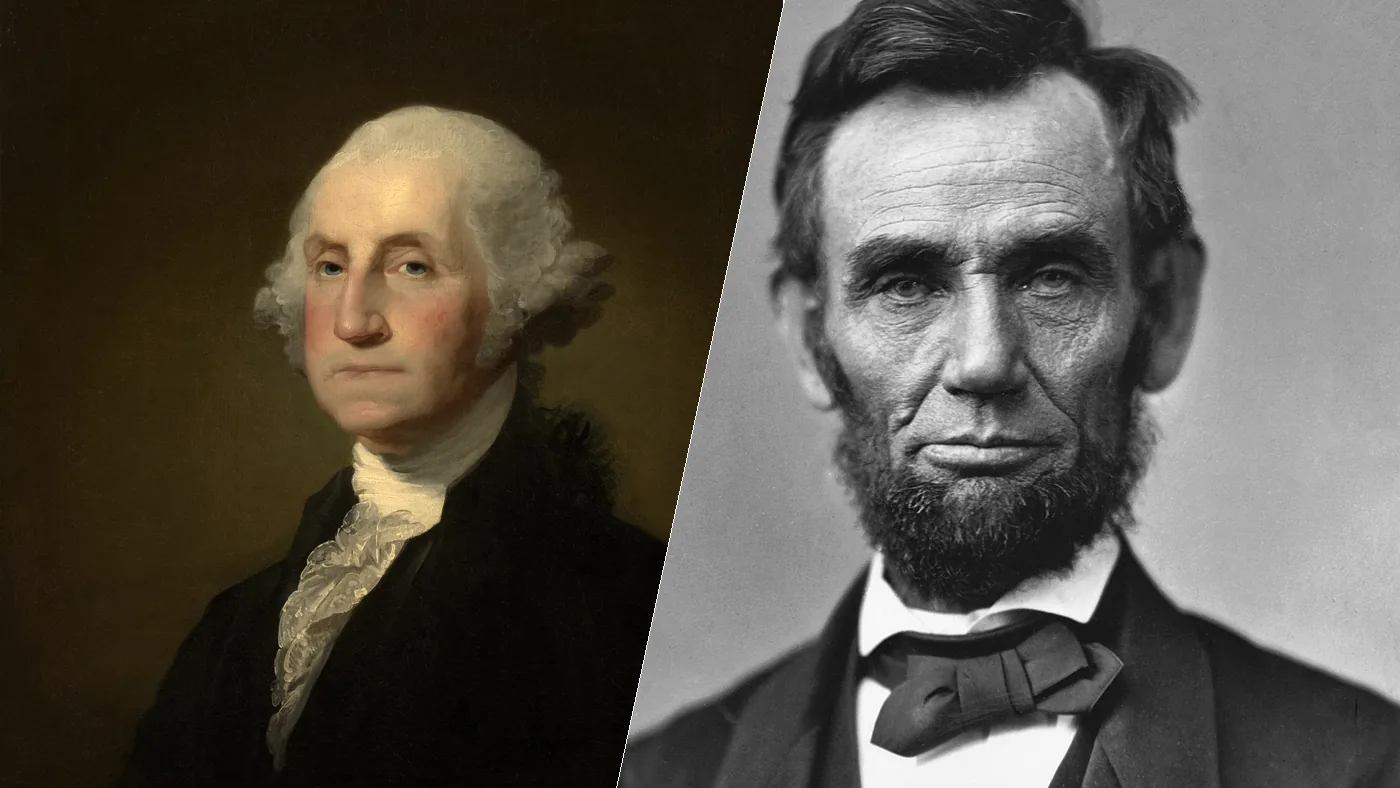
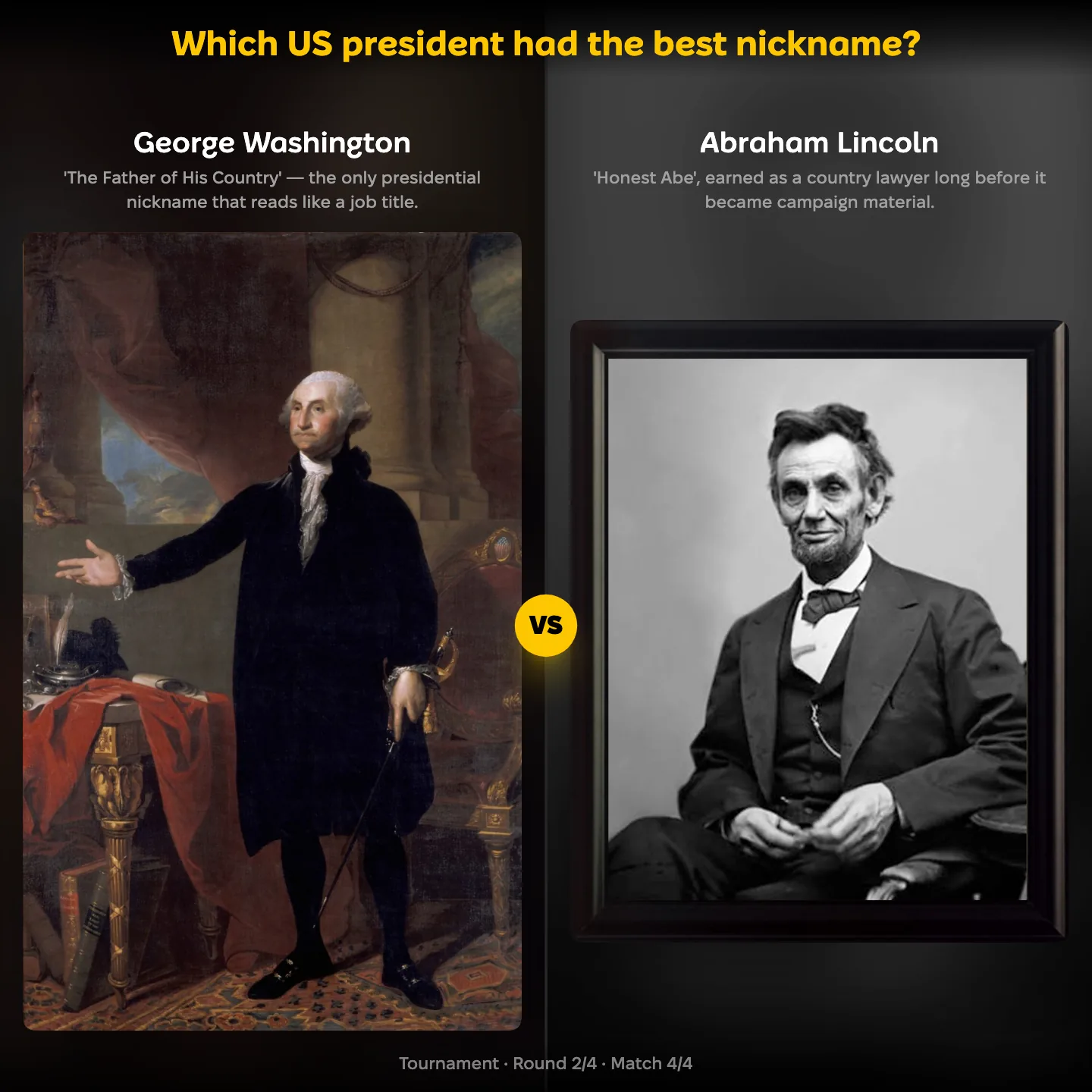
George Washington painted by Gilbert Stuart in 1803 (Clark Art Institute) and Abraham Lincoln photographed by Alexander Gardner on 8 November 1863. Both images are in the public domain. Fifteen rankings where the two of them meet.
George Washington and Abraham Lincoln get compared every February. This year the comparison gets loud: the United States turns 250 on 4 July, and the anniversary carries a full calendar of exhibitions, touring museums and one-year-only Mint designs.1 Washington built the office. Lincoln kept the country the office governs.
Historians' surveys have parked the two of them in the top three for decades, usually with Lincoln first and Washington a place behind.2 That is one question, asked one way. Here are fifteen more.
> Washington founded the republic and Lincoln kept it, and the two trade places the moment a list stops asking who built the country and starts asking who saved it.
## Washington vs Lincoln: the list they are both supposed to win
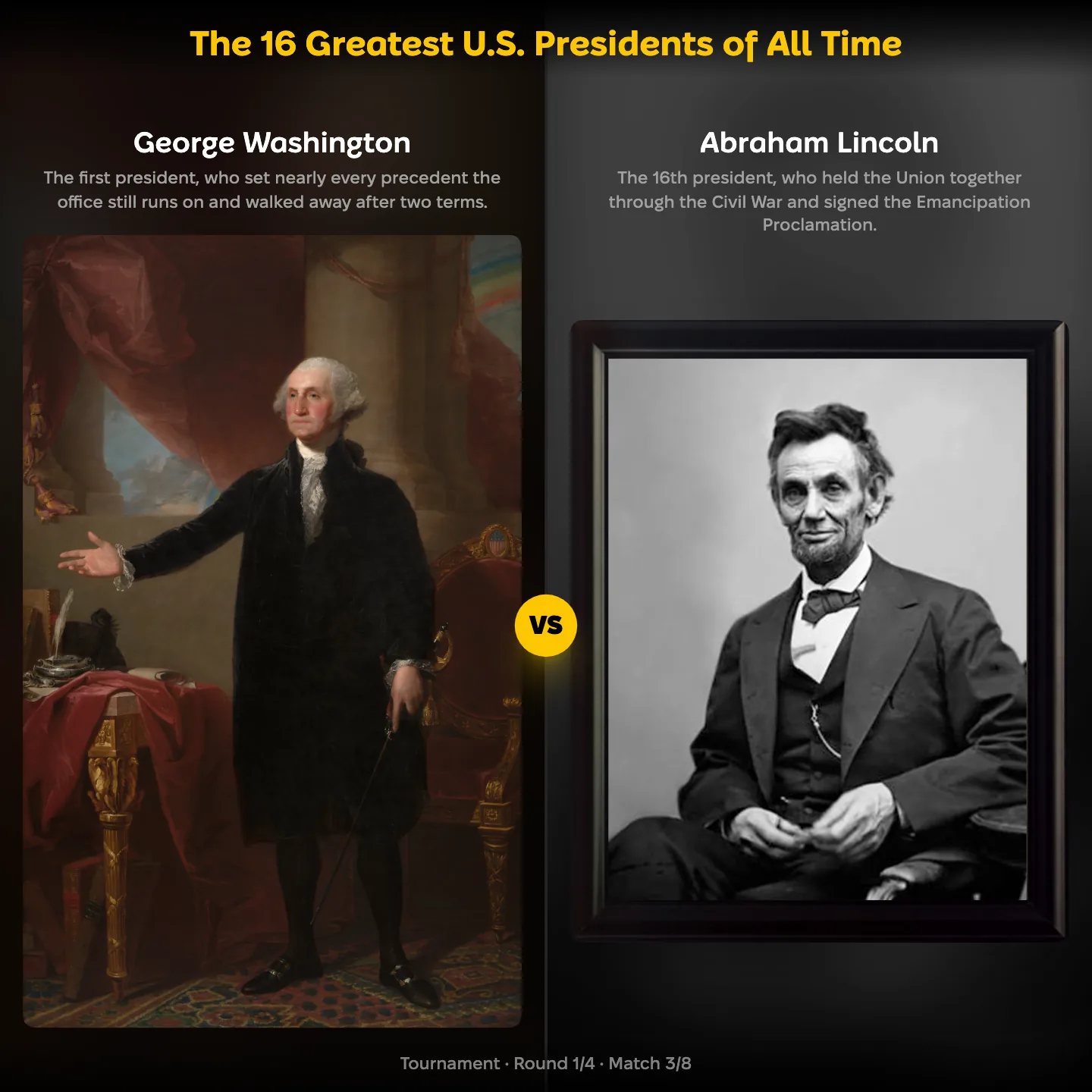
The greatest-US-presidents ranking is where these two are normally set against each other.
Washington's case is procedural and enormous. He is the only president every single elector voted for, and he did it twice: 69 of 69 votes in 1789, then 132 of 132 in 1792.3 Nobody has been close since. He then chose both exits himself, giving up the army after the war and the presidency after two terms, which is what turned a temporary office into a permanent institution.
Lincoln's case is what he did with the office Washington had already made safe. He took it in March 1861 with seven states already gone and spent every day he held it at war. The Union he handed back in April 1865 was a different constitutional object from the one he was handed.
Franklin D. Roosevelt is the third name that keeps the list honest, with Jefferson, Theodore Roosevelt and Eisenhower behind him. The objection to Washington is that he never faced a test the country might have failed; the objection to Lincoln is that he inherited a country that already existed.
The list both men are supposed to win, with one seat at the top. Play it →
## The dollar bill and the penny: whose face America carries
American money is the one ranking both men have already won outside this page. What is left to settle is who earned it harder.
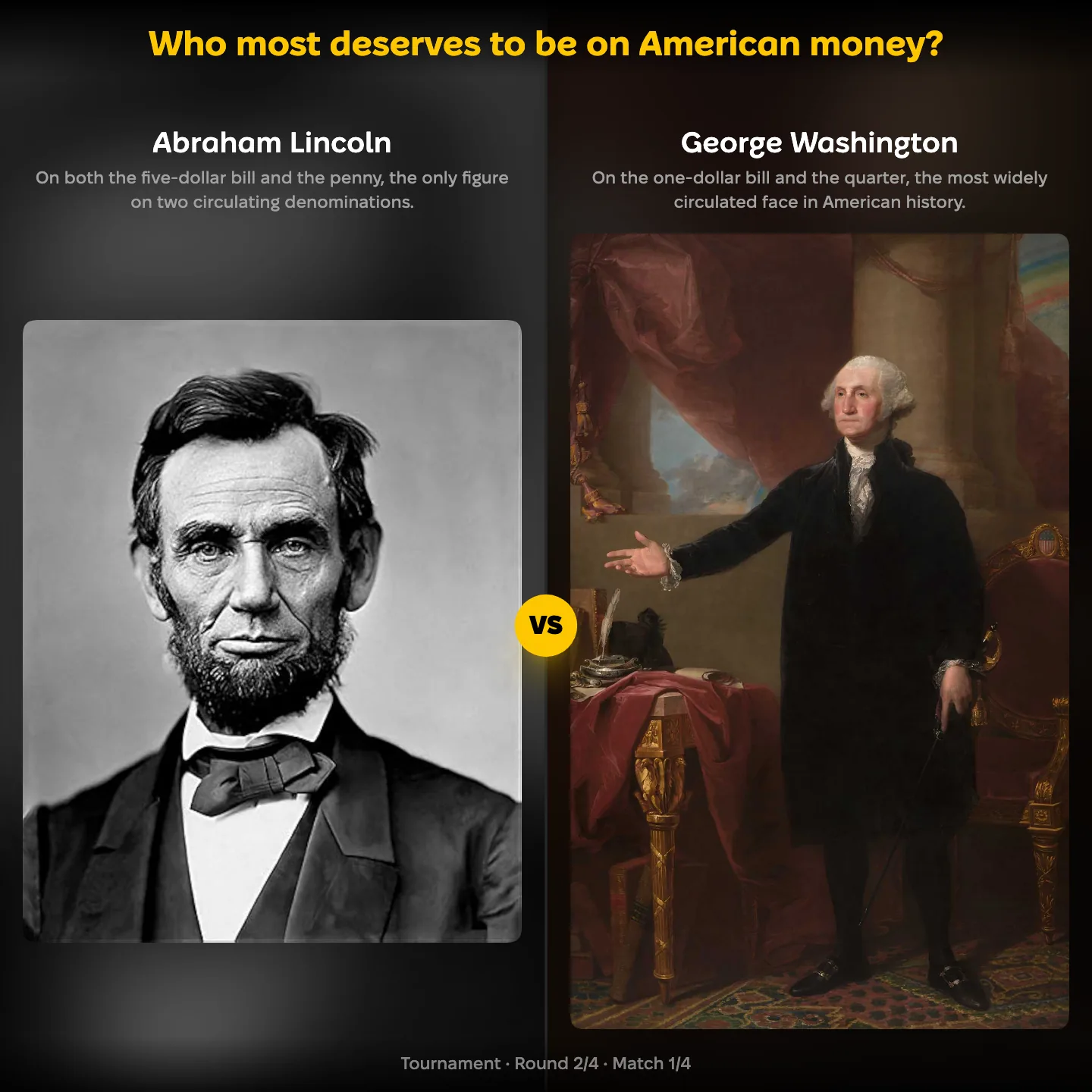
Washington is on the one-dollar bill and the quarter.
Lincoln is on the five and the penny, the only person on two circulating denominations at once.
Alexander Hamilton, Benjamin Franklin, Jefferson and Harriet Tubman fill out the list. Hamilton and Franklin are the awkward names: neither was president, and both sit on bigger bills than Lincoln's.
One of them is on the dollar and the quarter, the other on the penny and the five. Play it →
## Washington vs Mandela: leaders who handed power back
Move the frame off the United States and onto all of recorded history, and both Americans shrink to two entries among eighteen.
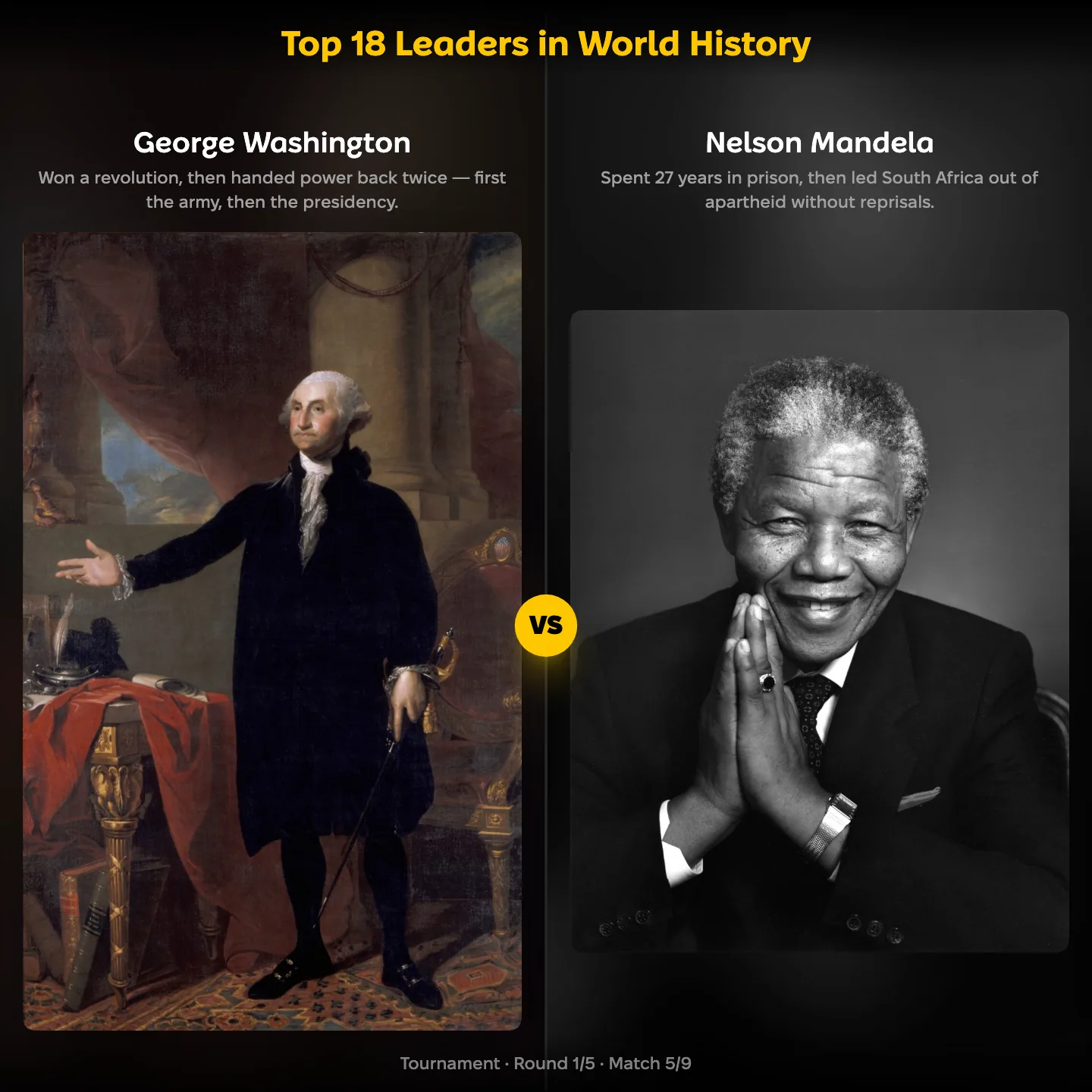
Washington's claim travels better than Lincoln's here, because giving power up is rarer than winning it. He resigned his commission at the end of the war and then left the presidency after two terms, when nothing except his own judgement required him to.
Nelson Mandela is the modern version of that same act, which is why the frame sets him against Washington: 27 years in prison, one term as president, then out of the building.
Lincoln never had the chance to hand anything back. Julius Caesar, Genghis Khan, Napoleon Bonaparte and Alexander the Great are here too. Not one of them gave anything back.
Eighteen names from all of history, and two of them are American presidents. Play it →
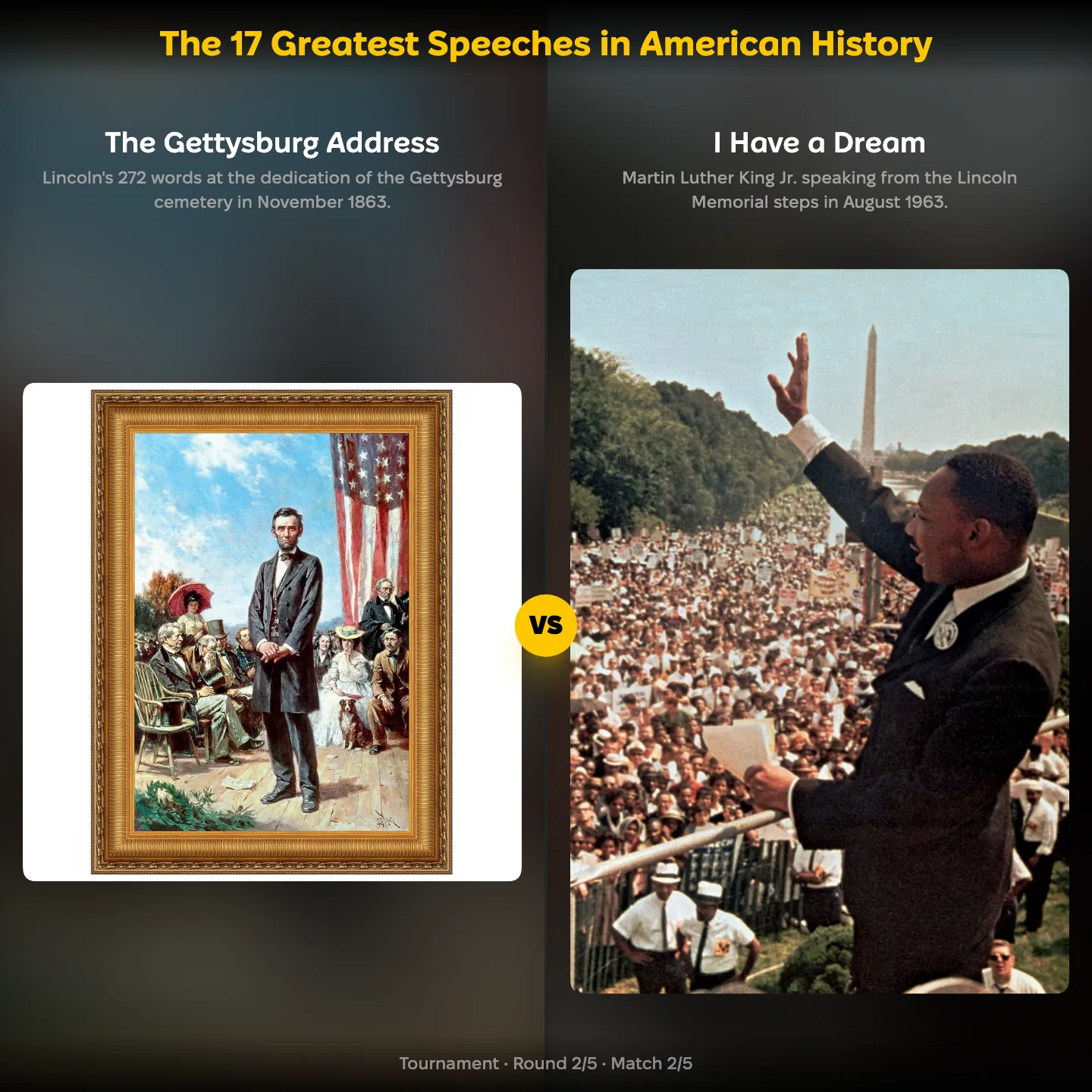
## The Gettysburg Address vs I Have a Dream
Both men left the country something it still quotes, which makes the speeches ranking the cleanest head-to-head in this article.
Lincoln's Gettysburg Address ran to about 272 words and took two minutes on 19 November 1863. Edward Everett, the day's featured speaker, had gone on for two hours before him.4
Washington's Farewell Address was never spoken at all. He issued it as an open letter dated 19 September 1796 and let the newspapers carry it, which is why it is the longer, colder and more practical of the two documents.5
Martin Luther King Jr. is the third name here, and he delivered "I Have a Dream" from the steps of the Lincoln Memorial. Frederick Douglass, Sojourner Truth, Barbara Jordan and Lou Gehrig share the ranking, which shows how wide the category runs.
272 words spoken in two minutes, against a farewell that was posted rather than delivered. Play it →
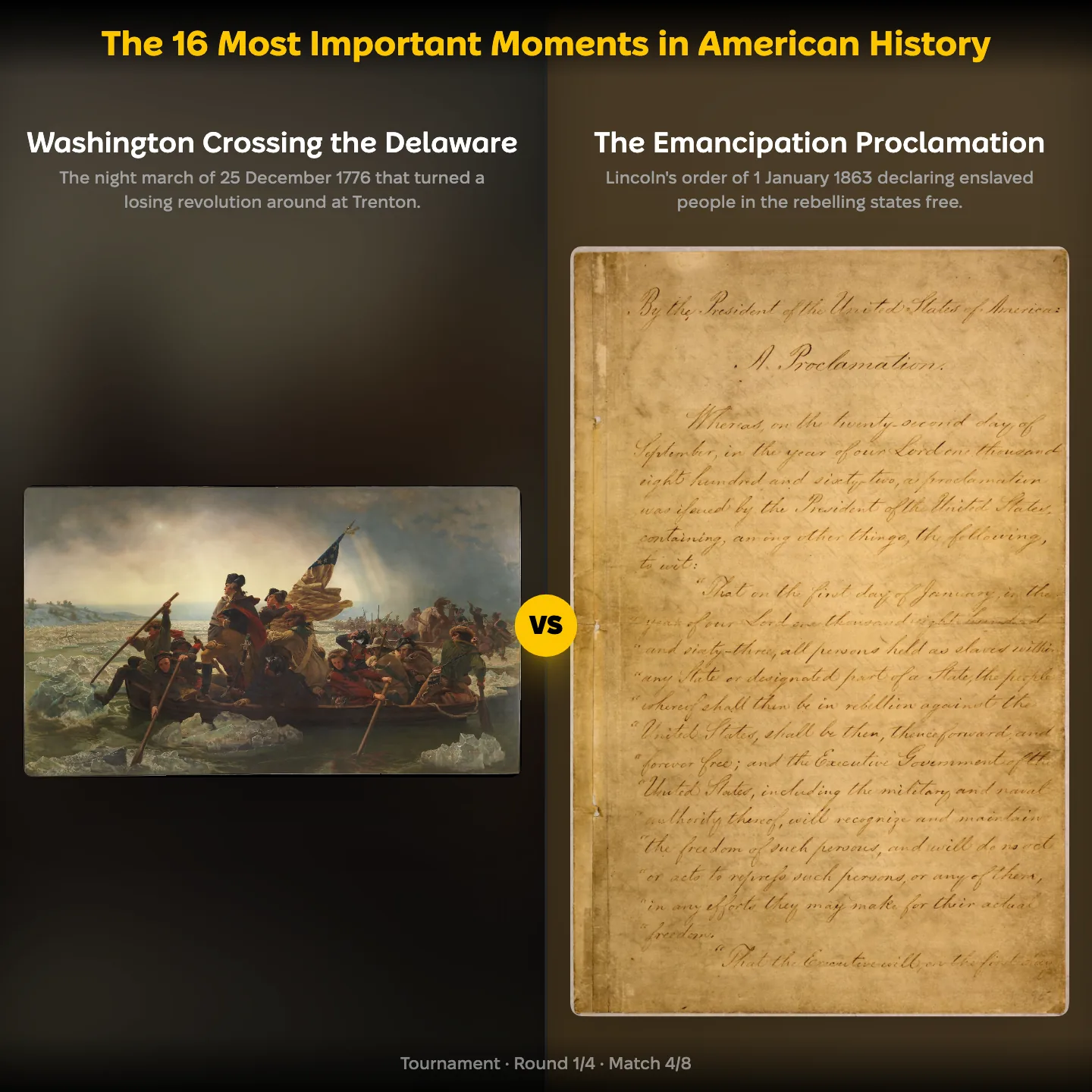
## Crossing the Delaware, and the order that freed the enslaved
The moments ranking drops the men and keeps their two biggest days, so this frame is a painting against a manuscript.
Washington crossed the Delaware on the night of 25 December 1776 and took Trenton the next morning, after a year in which the revolution had mostly been losing.
Lincoln signed the Emancipation Proclamation on 1 January 1863, declaring that enslaved people in the rebelling states "are, and henceforward shall be free".6 It reached only the territory the Union did not control, which is the standard objection to it and a fair one.
The Declaration of Independence, the Louisiana Purchase, the Apollo 11 landing and the 19th Amendment are on the same list. Set against a Moon landing, a river crossing in the dark looks small, until you notice it decided whether there would be a country left to launch anything from.
The men step out of the frame and their two biggest days step in. Play it →
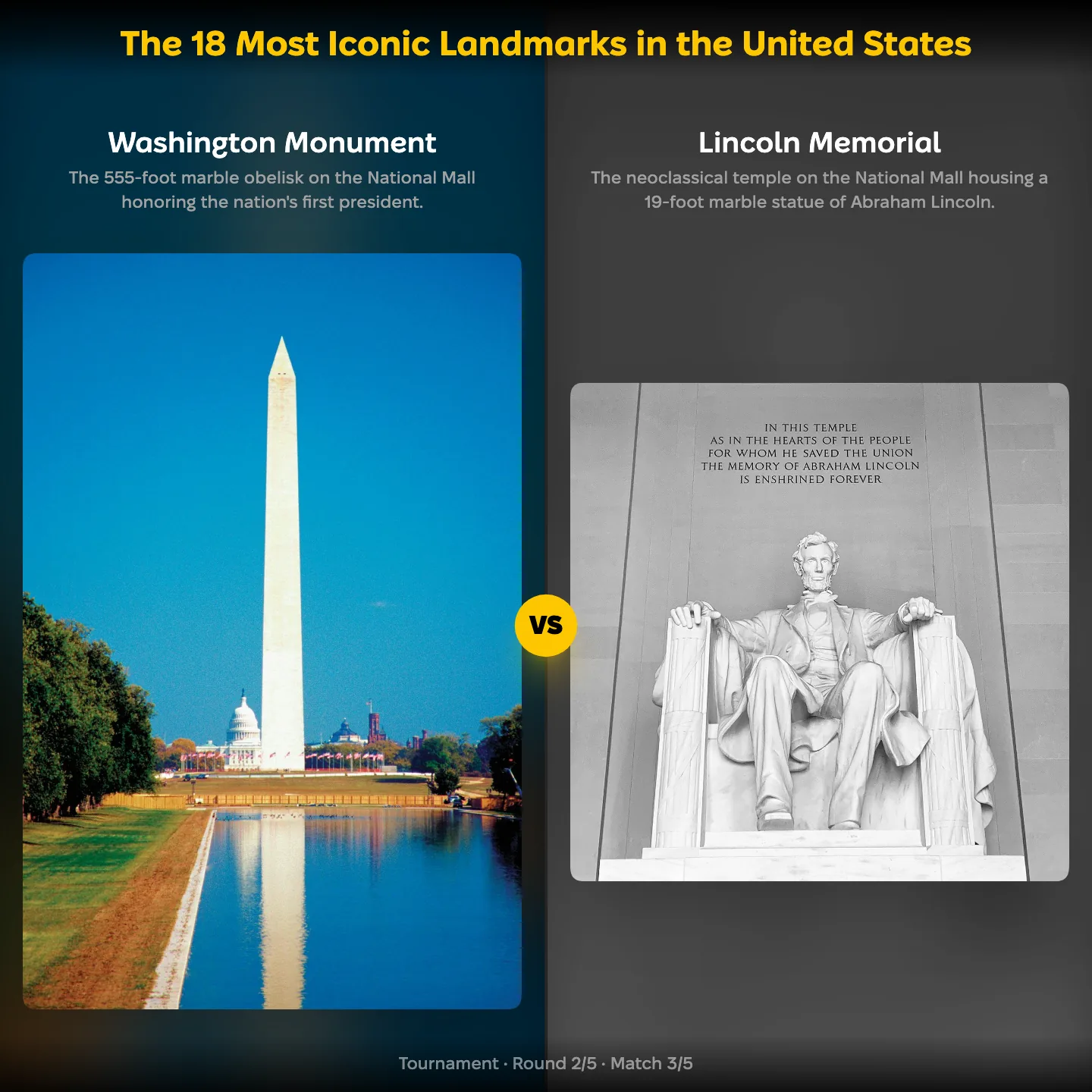
## The Washington Monument vs the Lincoln Memorial
Both men are also buildings, standing at opposite ends of the same axis on the National Mall, and the landmarks ranking makes them compete as architecture instead of biography.
The Washington Monument is a marble obelisk 555 feet 5⅛ inches tall, built in two phases between 1848 and 1884, and no structure on earth stood taller when the capstone went on.7
The Lincoln Memorial is a neoclassical temple raised between 1914 and 1922 to Henry Bacon's design, holding Daniel Chester French's nineteen-foot seated Lincoln carved in Georgia marble.8
Neither is the favourite. The Statue of Liberty, the Grand Canyon and Mount Rushmore, where both men are carved a second time, are what makes this the hardest list in the article for either of them.
An obelisk at one end of the Mall, a seated marble figure at the other. Play it →
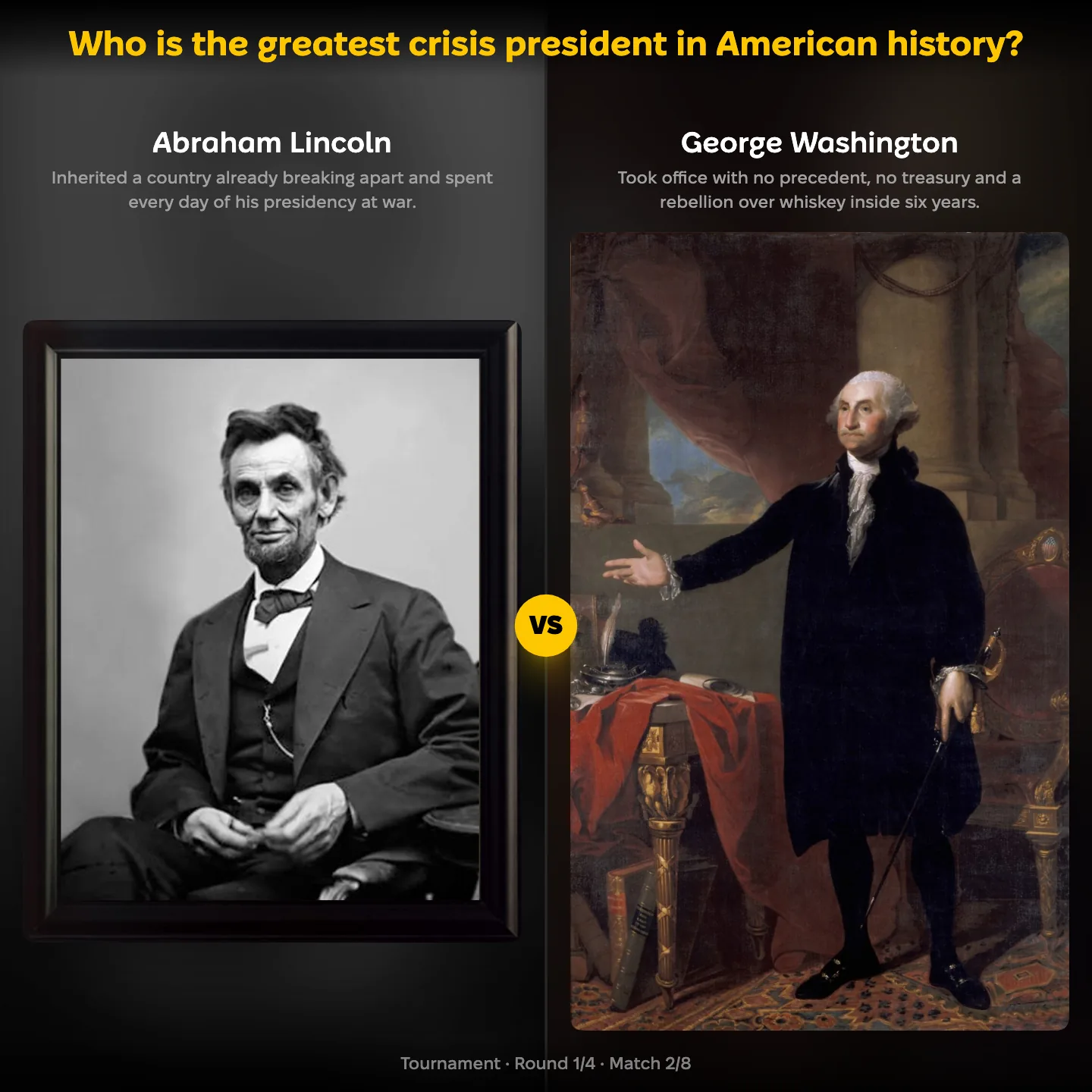
## Fort Sumter and the Whiskey Rebellion: the crisis test
A crisis-president ranking asks something narrower than greatness. It asks what was already on fire when you arrived.
Washington's answer is that nothing had been tested. There was no treasury, no precedent for any decision he made, and by 1794 an armed revolt in western Pennsylvania over a tax on whiskey, which he rode out to meet at the head of a militia army.
Lincoln's answer is Fort Sumter, fired on six weeks after his inauguration, and the four years that came after it.
Franklin D. Roosevelt, Harry S. Truman and James Madison, who watched the British burn the White House in 1814, are the serious competition. Madison is the reminder that surviving a crisis and being remembered for one are different achievements.
One inherited a blank page, the other a country coming apart. Play it →
## Washington vs Franklin: the list Lincoln was born too late for
Lincoln cannot enter this ranking. He was born in 1809, twenty-two years after the Constitution was signed.
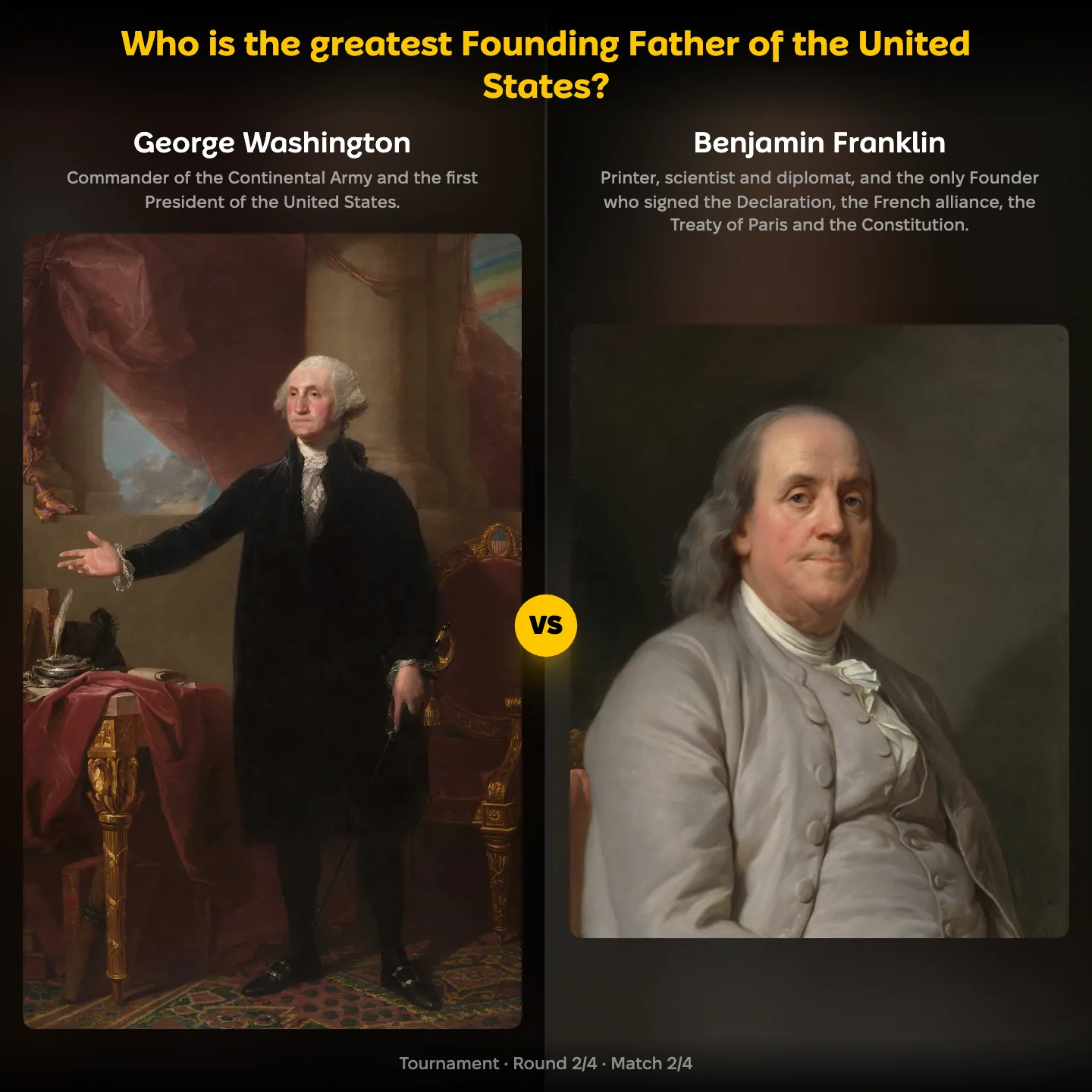
Washington chaired the Constitutional Convention in 1787 and then had to be the first president under the document it produced, which is a claim no other Founder can make.
Benjamin Franklin is what turns this into a contest. Printer, scientist and diplomat, he put his name to the Declaration, the French alliance, the Treaty of Paris and the Constitution, which nobody else did.
Jefferson, Hamilton, Madison, John Adams, Thomas Paine and John Jay are also here, on a list where being merely excellent gets you nowhere.
A list Lincoln missed by twenty-two years. Play it →
## The overrated list: Lincoln is on it, Washington is not
Any honest comparison of two national monuments needs the list where one of them is a target, and this is that list.
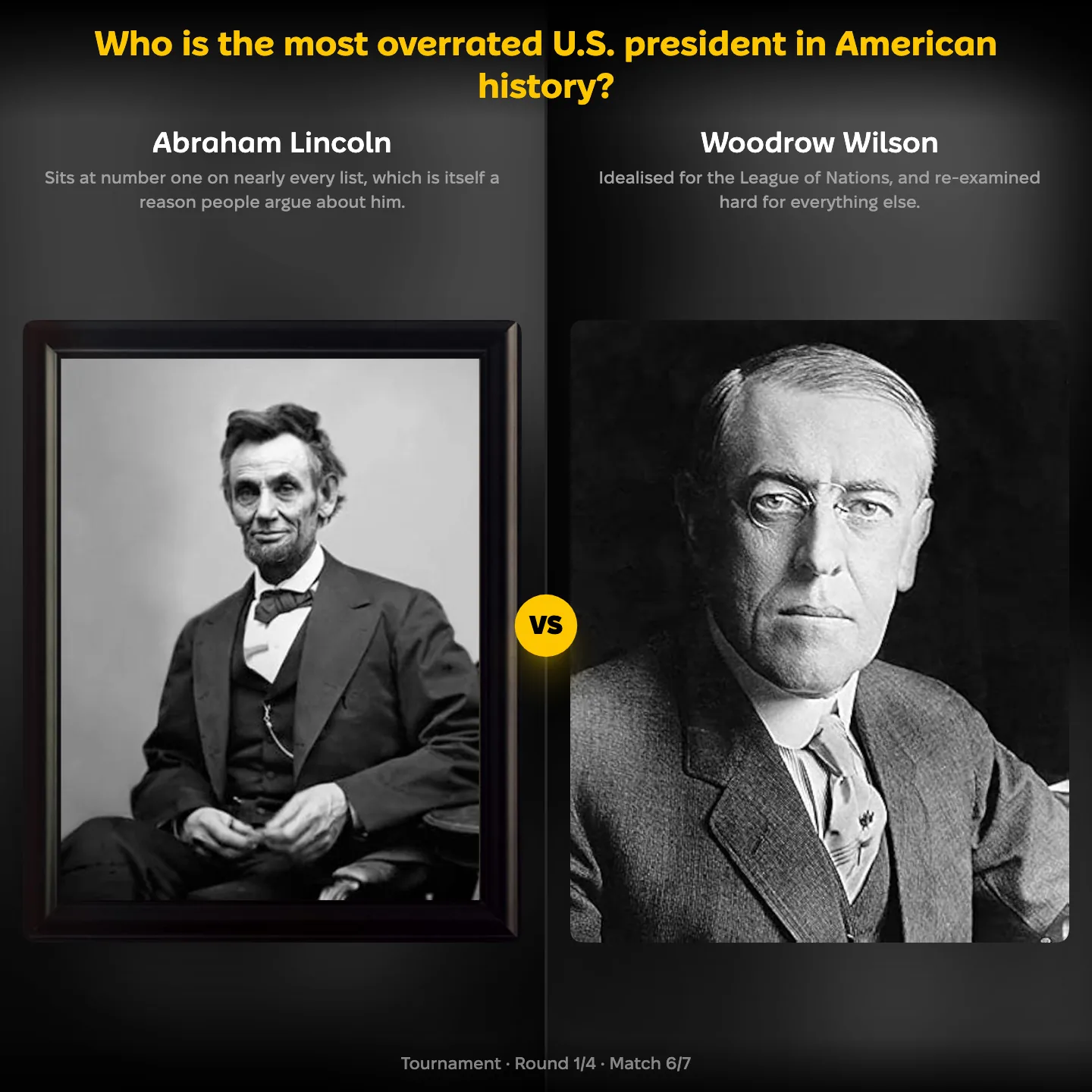
Lincoln is on it. The charge is not his record but the sanctification around it: he stands first on nearly every historians' poll,2 and the Emancipation Proclamation deliberately exempted the areas the Union already held.
Washington is absent, which is not the same as clean. His will, written in July 1799, freed the 123 people he personally enslaved and left untouched the 153 dower enslaved people who had come from Martha Washington's first marriage.9
Woodrow Wilson, Andrew Jackson and both Roosevelts are the names carrying this ranking, which suggests the category is really about reputations that outgrew their evidence.
The unflattering list, and only one of the two is even on it. Play it →
## Churchill, de Gaulle and the one American general on the list
The wartime-leaders ranking is the second place Lincoln is missing, and the reason is a technicality that says something anyway: he never held a military command.
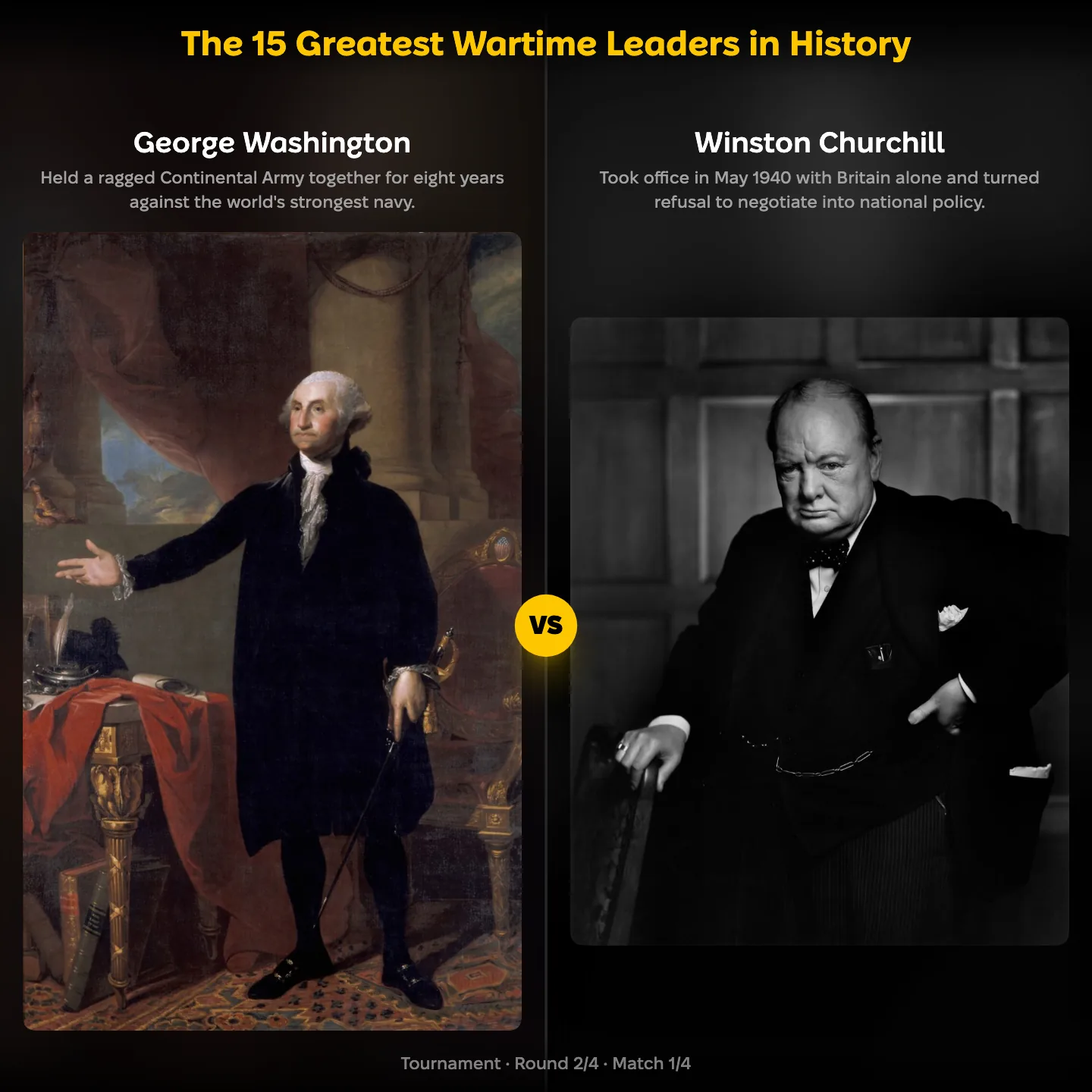
Washington held one for eight years, against the strongest navy in the world, with an army that lost most of its battles and never dissolved.
Winston Churchill carries the outside-world case here, with Franklin D. Roosevelt, Charles de Gaulle and Dwight D. Eisenhower behind him and Hannibal, Boudica and Simón Bolívar further down.
Lincoln's absence is arguable, though. He worked through generals until he found Grant, read artillery manuals in the White House, and directed a war that none of the professional soldiers on this list had to win from a desk.
The general made this list. The commander-in-chief who never wore a uniform did not. Play it →
## A Kentucky log cabin against Andrew Carnegie's cotton mill
The self-made ranking is Lincoln's best list and Washington's worst, because Washington was not self-made in any sense the phrase normally carries.
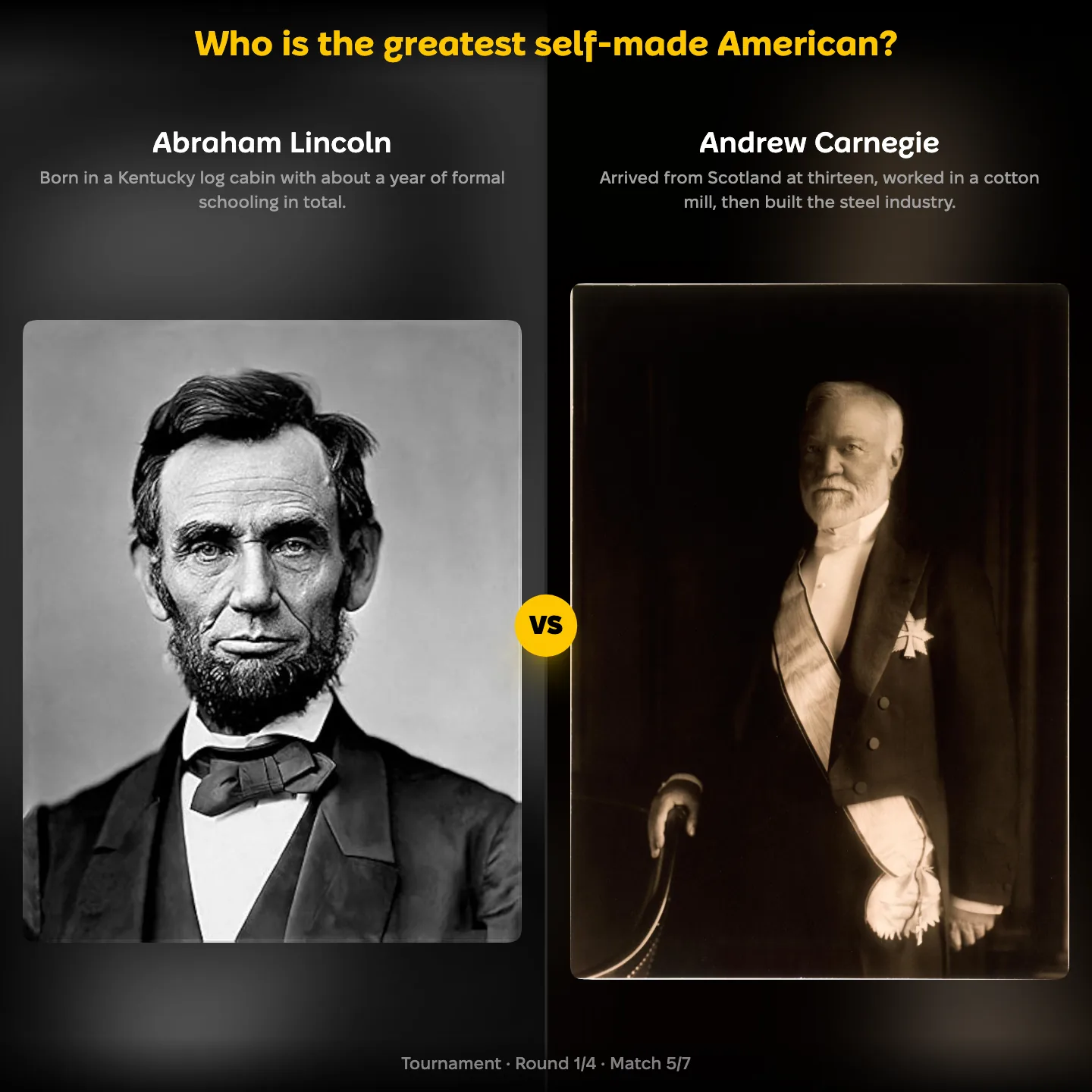
Lincoln was born in a Kentucky log cabin, taught himself law out of borrowed books, and is the only US president ever granted a patent: No. 6,469, a system of inflatable chambers for lifting steamboats over shoals, issued on 22 May 1849.10
Andrew Carnegie is the opponent in the frame, and he started further back still: Scotland at thirteen, a cotton mill, then most of the American steel industry.
Washington inherited land, married into a great deal more, and was one of the wealthiest men in Virginia. Frederick Douglass, Booker T. Washington and Madam C.J. Walker are also on this list, and all three began with less than Lincoln did.
A log cabin qualifies. A Virginia plantation does not. Play it →
## The Father of His Country vs Honest Abe
Nicknames make the least serious ranking here, and the most revealing one about how each man was sold to the public.
Washington's is barely a nickname. "The Father of His Country" is a job description that stuck, and it was in print while he was still alive to read it.
Lincoln's is a character reference. "Honest Abe" came out of his years as a country lawyer in Illinois and was working as campaign material by 1860.
Old Hickory, Teddy, Silent Cal, Ike and Unconditional Surrender Grant fill the rest of the field.
A job title against a character reference. Play it →
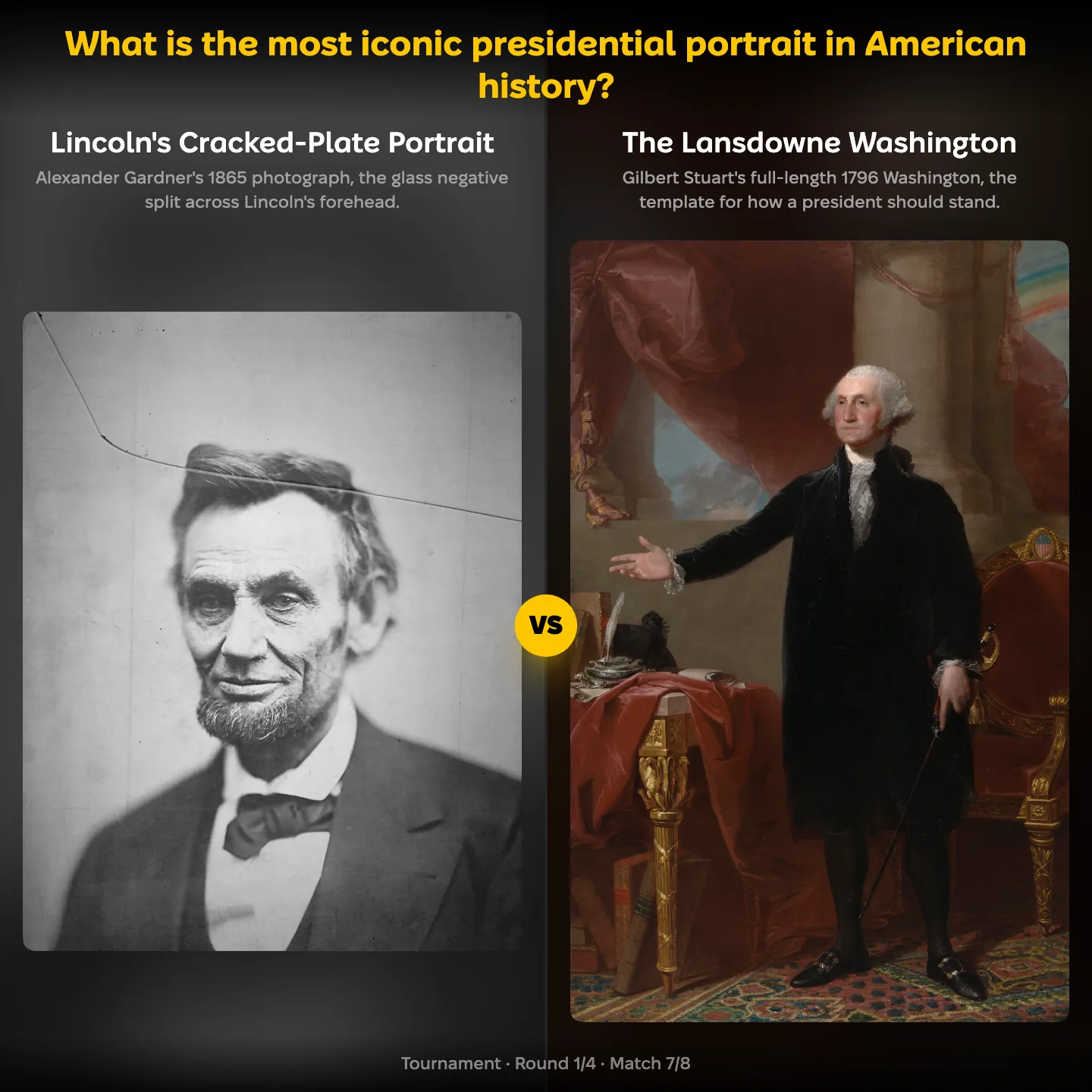
## The Lansdowne portrait vs the cracked plate
Each man has a single image that does the remembering for him, and the portraits ranking judges those images as pictures rather than as presidents.
Washington's is Gilbert Stuart's Lansdowne portrait of 1796: full length, one arm out, a pose that fixed how an American president gets painted. Stuart's unfinished Athenaeum head, painted the same year, also made this ranking, and it sits on every one-dollar bill.
Lincoln's is Alexander Gardner's photograph from 1865, with a crack running across the glass negative above his forehead. Gardner made it weeks before Lincoln was shot at Ford's Theatre on the evening of 14 April 1865; he died the next morning at 7:22.11
Sargent's Theodore Roosevelt, Shoumatoff's unfinished Franklin D. Roosevelt and Kehinde Wiley's Obama are the modern entries, and all three had a camera or a commission the earlier two never did.
A painting that invented the pose, against a negative that broke. Play it →
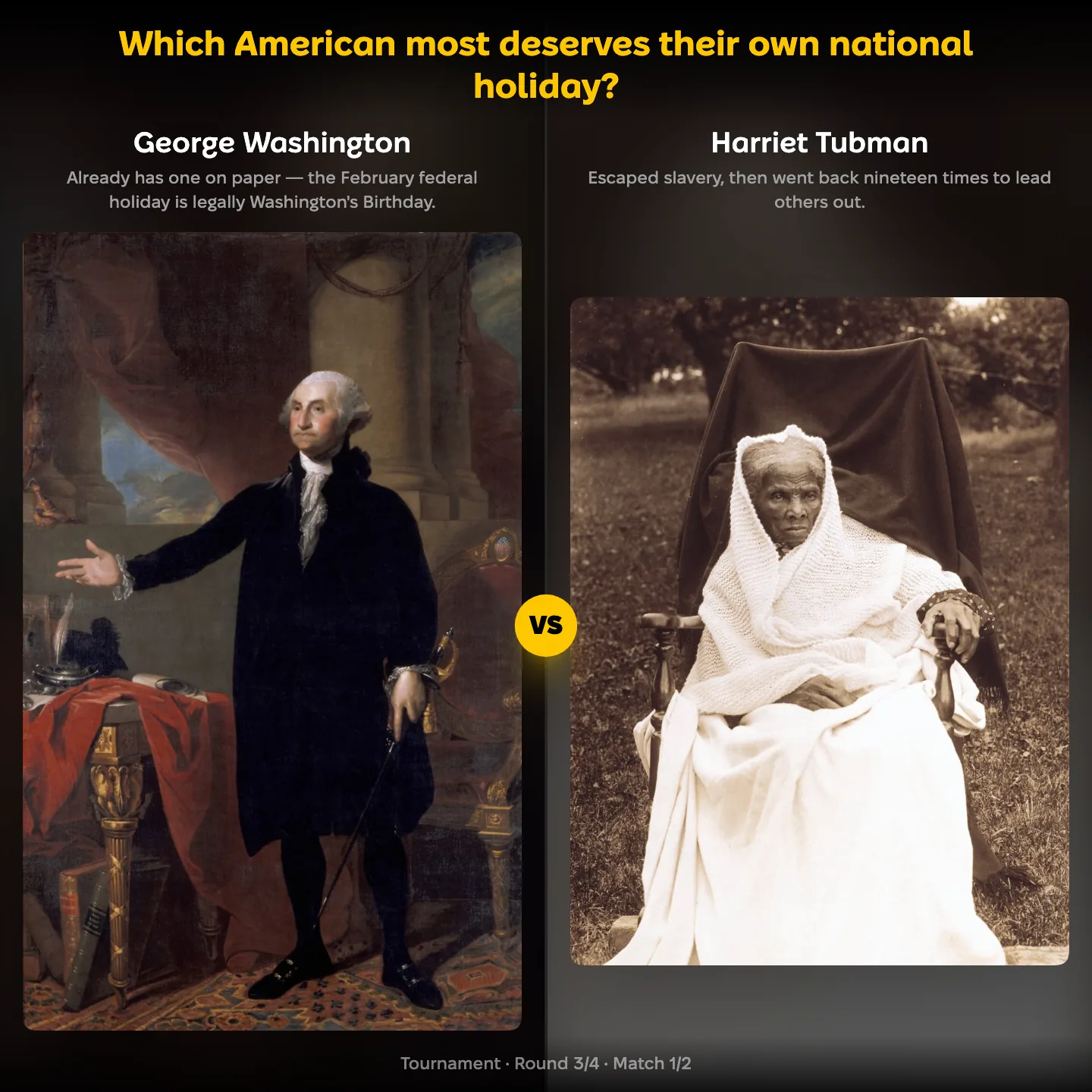
## Washington's Birthday is federal. Lincoln's never was.
On national holidays the outside world has already decided, and it decided for exactly one of these two.
The February federal holiday is legally Washington's Birthday. Retailers and wall calendars call it Presidents' Day; the United States Code does not.12
Lincoln's 12 February birthday is marked by a number of individual states and has never been made federal, after more than a century of attempts.
Harriet Tubman stands opposite Washington in this frame, and she is the strongest case on the list: she escaped slavery and then went back nineteen times to bring other people out. Rosa Parks, Jonas Salk, Neil Armstrong and Frederick Douglass are here too, and none of them has a day either.
One of them already has the third Monday in February. Play it →
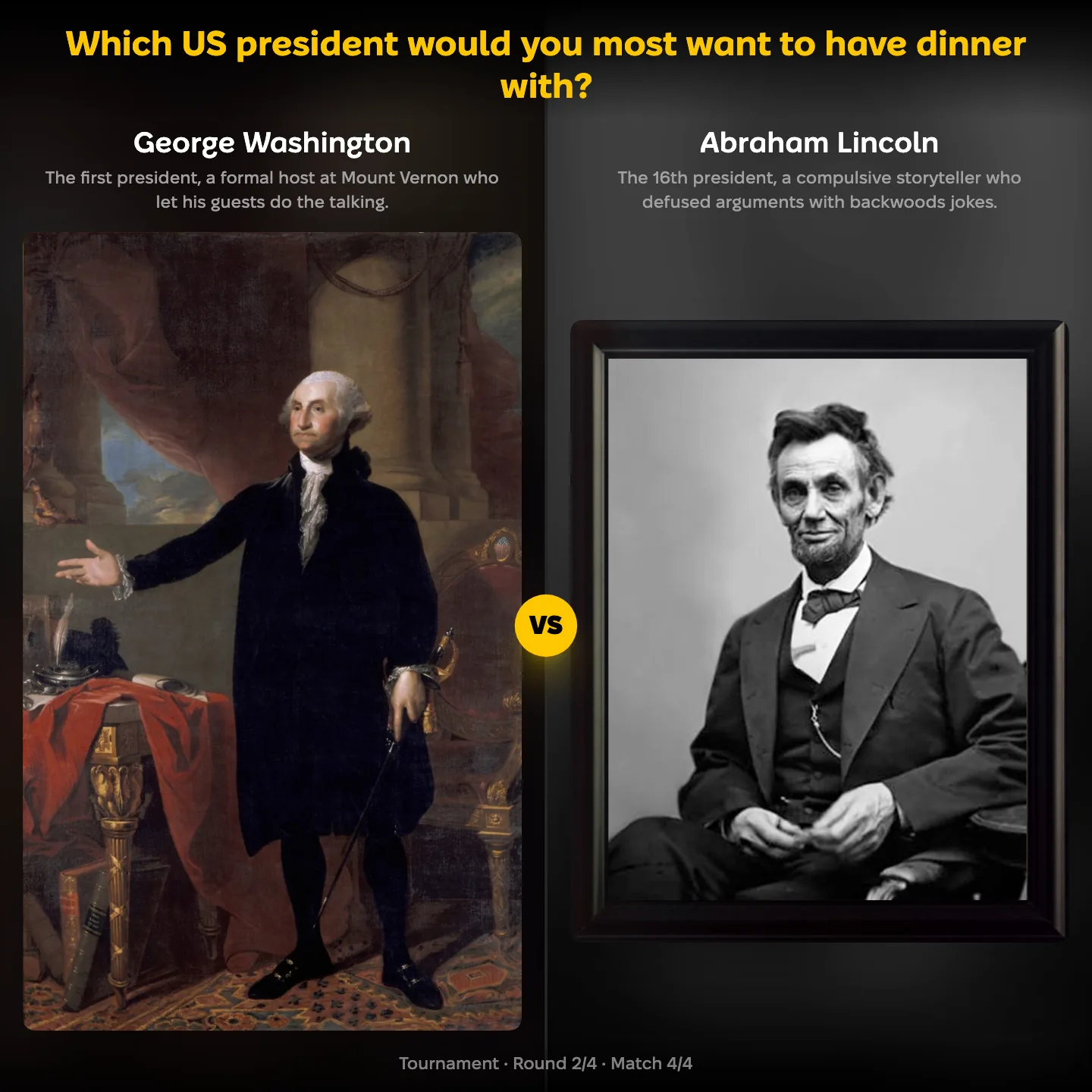
## Dinner at Mount Vernon, dinner with Honest Abe
The last ranking is the frivolous one, and it is the only list here where being the greater president is a disadvantage.
Washington was a formal host. He kept a fixed hour at Mount Vernon, sat at the head of the table, and was known for letting his guests carry the conversation while he said very little.
Lincoln was the reverse. He told stories compulsively and used backwoods jokes to break deadlocks in cabinet meetings, which is a skill that transfers to a dinner table more or less unchanged.
Thomas Jefferson brings the wine cellar, Theodore Roosevelt brings the volume, and Calvin Coolidge brings a silence so complete it became his nickname.
The formal host against the man who told stories until everyone forgot what they were arguing about. Play it →
## What the marble leaves open
Fifteen lists put the same two men in the same room and come back with different answers, because founding a country and saving one are separate jobs that happen to share a job title. Washington is unbeatable on the lists about beginnings and ineligible for the lists about hardship. Lincoln is the exact reverse, and that is why February has to carry both of them.
Every one of these rankings gets settled by [comparing two names at a time](/articles/what-is-pairwise-comparison). That is how a list ends up disagreeing with the survey that inspired it.
Have two names that keep showing up together? Make the ranking and see where the pair splits.
## More rankings, more angles
- [15 Rankings, One Benjamin Franklin](/articles/benjamin-franklin-ranked-many-ways) — the Founder who never wanted the top job
- [Theodore Roosevelt: Rough Rider, Nobel Laureate, Teddy Bear](/articles/theodore-roosevelt-ranked-many-ways) — a president who ended up on a toy
- [Winston Churchill, Ranked 15 Different Ways](/articles/winston-churchill-ranked-many-ways) — a Nobel in literature and 500 oil paintings
Sources
National Archives — Freedom 250, the United States Semiquincentennial programme for 2026: archives.gov (checked 2026-08-19)
National Archives — Electoral College results, 1789 and 1792 (checked 2026-08-19)
National Park Service, Lincoln Home National Historic Site — the Gettysburg Address, its date, length and Edward Everett's two-hour oration: nps.gov (checked 2026-08-19)
Wikisource — Washington's Farewell Address, dated 19 September 1796 and issued as an open letter to the public: wikisource.org (checked 2026-08-19)
National Archives — the Emancipation Proclamation, 1 January 1863, including its text and its limits: archives.gov (checked 2026-08-19)
National Park Service — Washington Monument history: height and the 1848–1884 construction phases: nps.gov (checked 2026-08-19)
National Park Service — Lincoln Memorial design: Henry Bacon, Daniel Chester French and the nineteen-foot statue: nps.gov (checked 2026-08-19)
George Washington's Mount Vernon — the 1799 will and the enslaved people it did and did not free: mountvernon.org (checked 2026-08-19)
Smithsonian Magazine — Lincoln as the only US president granted a patent, No. 6,469 of 22 May 1849: smithsonianmag.com (checked 2026-08-19)
National Park Service, Ford's Theatre National Historic Site — the assassination of 14 April 1865 and Lincoln's death the following morning: nps.gov (checked 2026-08-19)
Legal Information Institute, Cornell Law School — 5 U.S.C. §6103, which names the February federal holiday "Washington's Birthday": law.cornell.edu (checked 2026-08-19)