# The Condorcet Paradox: When Majority Preferences Run in a Circle
> Most prefer A to B, B to C, yet C to A. Condorcet's 1785 paradox, Arrow's theorem, and how often real elections and online polls actually cycle.
*By YPB Team · Published September 26, 2026 · https://youpick.best/articles/the-condorcet-paradox*
---
The Condorcet paradox is the situation in which a group's majority preferences run in a circle: most people prefer A to B, most prefer B to C, and yet most prefer C to A. Every voter can have a perfectly consistent order and the group still has none. It is named after the Marquis de Condorcet, who described it in 1785.
The paradox matters to anyone who adds up pairwise choices, because it means a crowd can fail to have a best option at all. How often that happens in real votes has been measured, and the data are more reassuring than the theory.
## Three friends and a restaurant
Three friends are choosing where to eat. Ana ranks pizza over sushi over tacos. Ben ranks sushi over tacos over pizza. Carla ranks tacos over pizza over sushi.
Put two options to a vote at a time. Pizza beats sushi, because Ana and Carla prefer it. Sushi beats tacos, with Ana and Ben. Tacos beat pizza, with Ben and Carla. Each head-to-head result has a clear two-to-one majority, and the three results together form a loop with no top.
Nobody in the group is being inconsistent. The circle exists only in the total. A voting procedure that meets the options in pairs will then produce whichever winner the order of the votes allows, which is why the [King of the Hill](/articles/king-of-the-hill-voting) format and parliamentary amendment votes can be steered by the agenda.
## Condorcet in 1785, Arrow in 1951
Condorcet published the observation in his Essai sur l'application de l'analyse à la probabilité des décisions rendues à la pluralité des voix, printed in Paris by the Imprimerie Royale in 1785.1
Kenneth Arrow turned it into a general result. In Social Choice and Individual Values, published in 1951, he proved that with three or more options, no method of combining individual rankings into a group ranking can meet a short list of reasonable conditions at once. As the Stanford Encyclopedia of Philosophy summarises them: the method accepts any individual rankings, respects a preference everyone shares, has no dictator, and ranks any two options only by how people rank those two.2 Arrow shared the 1972 Nobel prize in economics with John Hicks; the prize announcement cites his "possibility theorem".3
## How often a crowd has no winner
The theoretical answer depends on a model in which every possible ranking is equally likely. Under that model, with three options and a very large electorate, there is a clear winner about 91.2% of the time, which leaves no winner in roughly 8.8% of cases. With 10 options the chance of a clear winner falls to about 51.1%, and with 27 options to about 25.5%, according to a 2020 paper by Jan Hązła, Elchanan Mossel, Nathan Ross and Guangqu Zheng that builds on work by Georges-Théodule Guilbaud in 1952.4
Real votes look different. A 2025 study by Barbaro and Kurella examined 253 elections in 59 countries, using survey data on how 424,413 respondents ranked the parties or candidates, and found no robust evidence of a majority cycle in any of them.5 Andrew Myers analysed 10,354 polls run on the Condorcet Internet Voting Service with at least 10 votes each: 83.1% had a Condorcet winner, rising to 97.9% of polls with 100 or more votes and 98.8% with 300 or more.6
Cycles do occur. Peter Kurrild-Klitgaard documented one in a poll of Danish voters' preferences for prime minister, compared two candidates at a time, in a 2001 paper in Public Choice.7 The model with every ranking equally likely is the worst case for cycles, which is why theory predicts more of them than elections show.8
## Circles in football, dice and lizards
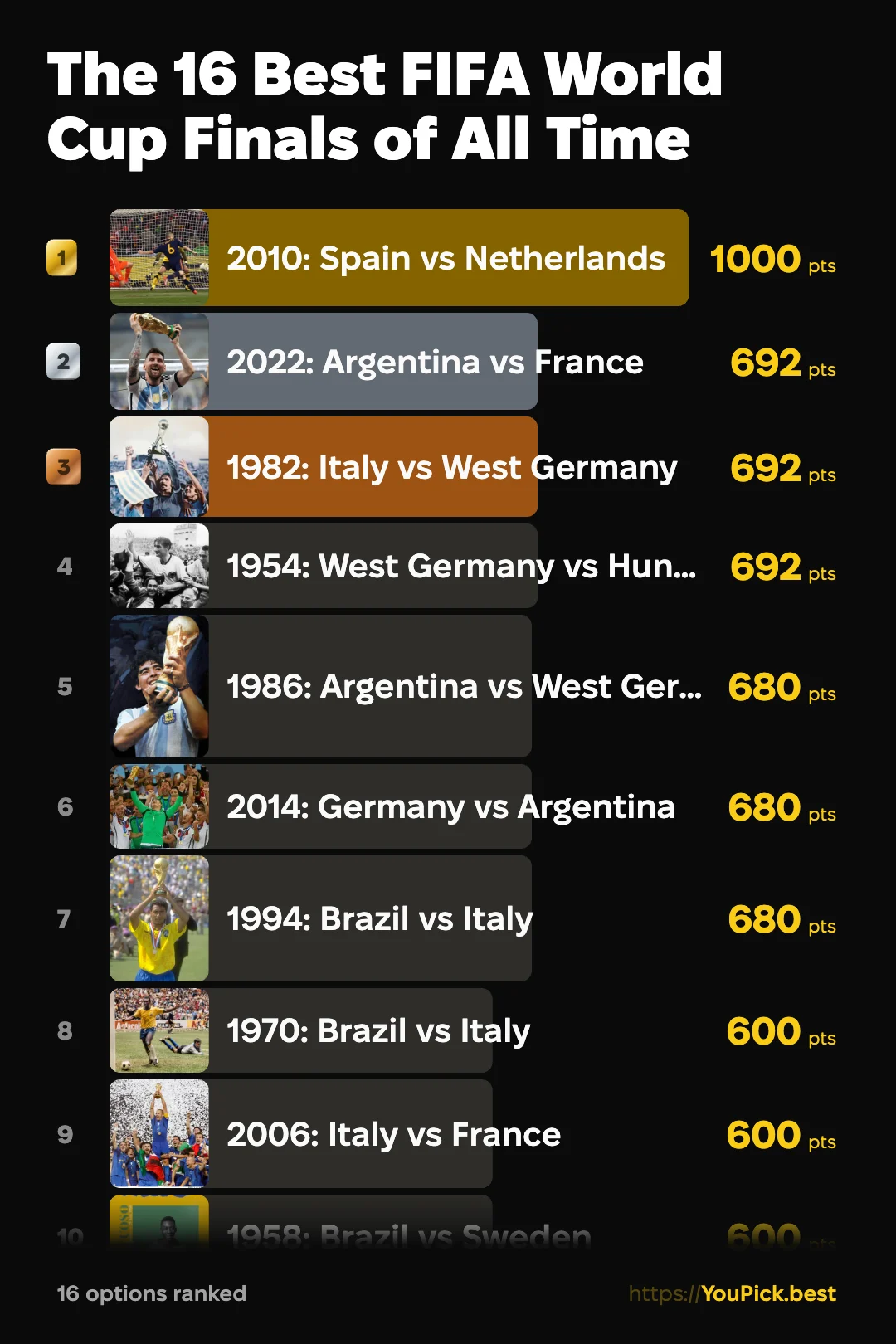
Sport produces its own loops. In Group E of the 1994 World Cup, Ireland beat Italy 1–0, Italy beat Norway 1–0, Norway beat Mexico 1–0 and Mexico beat Ireland 2–1. All four teams finished on 4 points, and Norway went out.9 World Cup finals are compared in pairs in the [16 best World Cup finals](/ranking/the-16-best-fifa-world-cup-finals-of-all-time) ranking, and this year's sides in the [best team at the 2026 World Cup](/ranking/what-is-the-best-team-at-the-2026-fifa-world-cup).
Games can be built on purpose to cycle. Martin Gardner described Efron's dice in Scientific American in December 1970: a set of four dice in which each die beats the next with probability two in three, and the last beats the first.10 Rock, paper, scissors is the simplest version, and the type chart of the Pokémon games follows the same rule, with fire beating grass, grass beating water and water beating fire; the monsters themselves meet in the [16 greatest Pokémon](/ranking/the-16-greatest-pokemon-of-all-time) ranking.
Nature runs one as well. Among side-blotched lizards, Barry Sinervo found that orange-throated males take territory from blue males, yellow-throated "sneaker" males steal matings from orange ones, and blue males guard their mates against yellow ones, so the share of each type cycles over about five years.11
## Who votes with Condorcet methods
A Condorcet method elects the Condorcet winner, the option that wins all of its one-on-one majority votes, whenever one exists, and falls back on a rule for cycles when it does not. The Debian project adopted one for its internal votes in 2003: its constitution compares every pair of options and then drops the weakest defeats until one option remains.12 The Wikimedia Foundation counted its board of trustees elections of 2008, 2009 and 2011 with the Schulze method, another Condorcet method.13
Plurality voting, where each voter names a single favourite, can miss the head-to-head winner. In Myers's data, plurality missed it in 14% of polls and instant-runoff voting in about 6%.
## What a circle looks like on a results page
A results page on YouPickBest is always a straight line: every option gets a score, and scores can be ordered. A circle in the crowd's preferences therefore cannot appear as a loop. It would show up as a cluster of options with close scores, each winning some of its matchups against the others, and the order inside the cluster can change as new votes arrive.
The scores come mainly from each option's win rate across all its matchups, not from who beat whom in a particular pair. The poll data above suggest a true circle gets rarer as more people vote, because a head-to-head winner became more likely as polls grew. The weights behind each score are explained in [how rankings are scored](/articles/how-rankings-are-scored).
Sixteen World Cup finals in one straight line, whatever the head-to-head loops inside it. Play it →
## Common questions
### What is the Condorcet paradox?
A situation in which majority preferences between pairs of options form a loop, so that the group has no option that beats all the others, even though each voter's own order is consistent.
### What is a Condorcet winner?
An option that wins a majority against each rival when the two are compared alone. The paradox is the case in which no such option exists.
### How common is the Condorcet paradox in real elections?
Rare. A 2025 study of 253 national elections found no robust example, although individual cycles have been documented, such as in a Danish poll on the choice of prime minister.
### Is the Condorcet paradox the same as Arrow's theorem?
No. The paradox is one example of a group preference going in a circle. Arrow's theorem, proved in 1951, shows that no method of combining rankings can avoid such problems while meeting a set of basic fairness conditions.
## More on how voting works
- [King of the Hill Voting: How Winner-Stays Ranking Works](/articles/king-of-the-hill-voting) — the flying club that picked its agenda
- [What Is Pairwise Comparison? The Simple Way to Rank Anything](/articles/what-is-pairwise-comparison) — the idea of judging two at a time
- [Order Effects: When the First or Last Option Wins](/articles/order-effects) — ballots, stockings and the hungry judge
Sources
Condorcet, Essai sur l'application de l'analyse à la probabilité des décisions rendues à la pluralité des voix, Paris, Imprimerie Royale, 1785: gallica.bnf.fr (checked 2026-09-23)
Stanford Encyclopedia of Philosophy, "Arrow's Theorem": plato.stanford.edu (checked 2026-09-23)
Nobel Prize, press release for the 1972 prize in economic sciences: nobelprize.org (checked 2026-09-23)
Jan Hązła, Elchanan Mossel, Nathan Ross and Guangqu Zheng, "The Probability of Intransitivity in Dice and Close Elections" — probabilities of a clear winner for 3, 10 and 27 options: arxiv.org (checked 2026-09-23)
Barbaro and Kurella, study of majority cycles in 253 elections, Public Choice, 2025 (discussion paper version): uni-mainz.de (checked 2026-09-23)
Andrew C. Myers, analysis of polls on the Condorcet Internet Voting Service, Public Choice Society, 2024: cornell.edu (checked 2026-09-23)
Peter Kurrild-Klitgaard, "An Empirical Example of the Condorcet Paradox of Voting in a Large Electorate", Public Choice 107, 2001: ideas.repec.org (checked 2026-09-23)
Ilia Tsetlin, Michel Regenwetter and Bernard Grofman, "The impartial culture maximizes the probability of majority cycles", Social Choice and Welfare, 2003: doi.org (checked 2026-09-23)
RSSSF, World Cup 1994 full results, Group E: rsssf.org (checked 2026-09-23)
Martin Gardner, "Mathematical Games", Scientific American 223(6), December 1970 — Efron's non-transitive dice: scientificamerican.com (checked 2026-09-23)
Barry Sinervo, study of alternative male strategies in side-blotched lizards, Genetica, 2001: pubmed.ncbi.nlm.nih.gov (checked 2026-09-23)
Debian Constitution, section A.5 — the Condorcet/Clone Proof SSD voting method, adopted in 2003: debian.org (checked 2026-09-23)
Wikimedia Foundation, Board elections 2008 — counted with the Schulze method: meta.wikimedia.org (checked 2026-09-23)