# Hemingway vs Fitzgerald: One Won the Nobel, One Wrote Gatsby
> Ernest Hemingway and F. Scott Fitzgerald meet on 16 rankings: the best American novel, the Lost Generation, the Pulitzer shelf, the most overrated classic.
*By YPB Team · Published September 13, 2026 · https://youpick.best/articles/hemingway-vs-fitzgerald-ranked*
---
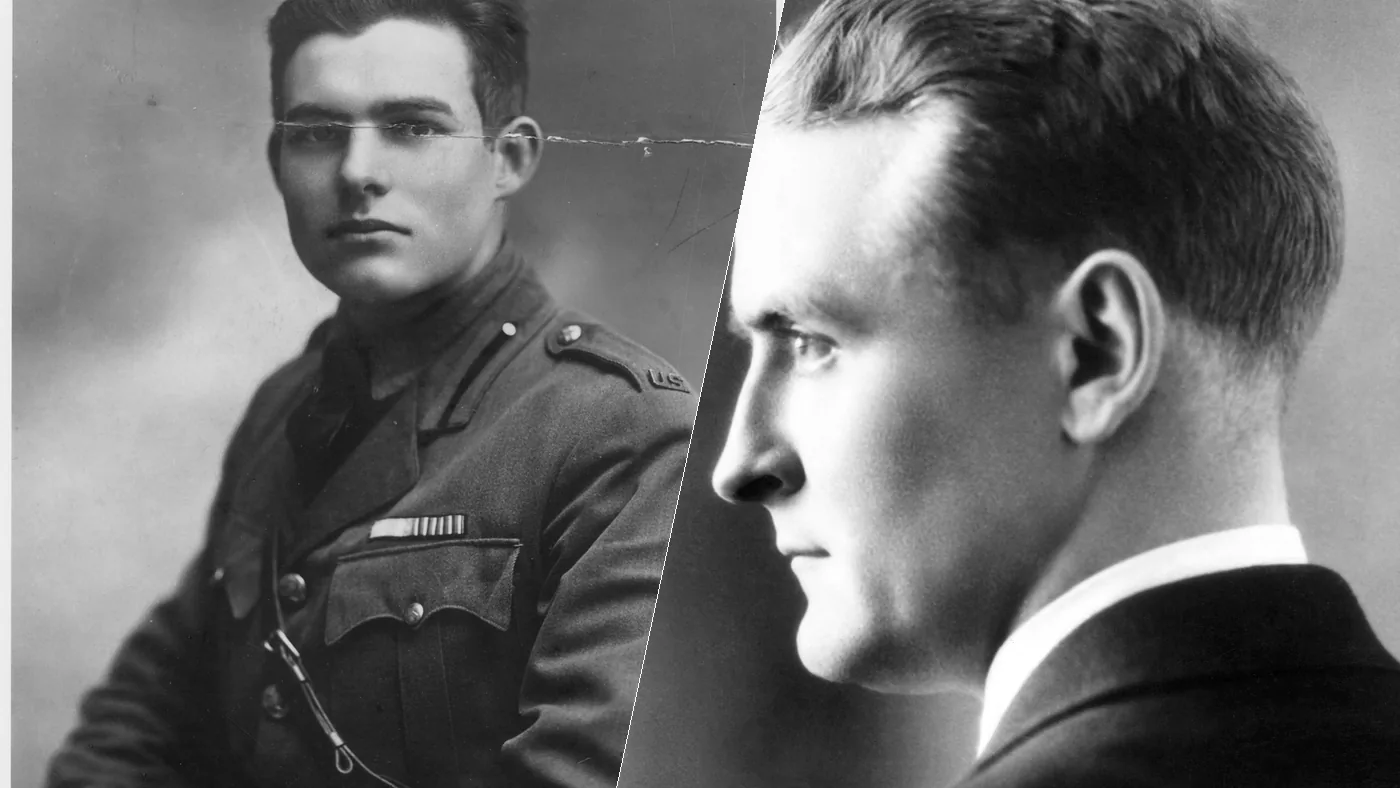
Ernest Hemingway (1918) and F. Scott Fitzgerald (c. 1926) — 16 rankings where they meet. Photos: U.S. National Archives and a Scribner's publicity portrait, both public domain, via Wikimedia Commons.
Ernest Hemingway and F. Scott Fitzgerald met in Paris in 1925, when Fitzgerald was Scribner's leading novelist and Hemingway had published two small books almost nobody had bought. Fitzgerald recommended the newcomer to his own editor, Max Perkins, told Perkins not to ask him for too many changes, then read the manuscript of The Sun Also Rises and advised cutting its opening. Hemingway cut the first thirty pages and published on 22 October 1926, in a first printing of 5,090 copies.1 That book turns a hundred next month.
The Library of Congress keeps one novel by each of them in its Books That Shaped America exhibition: Gatsby for Fitzgerald, For Whom the Bell Tolls for Hemingway.2 Only one of the two lived long enough to collect a Pulitzer and a Nobel.
> Fitzgerald opened the door at Scribner's and Hemingway walked through it into the prizes. The 16 lists below are still arguing about which of them got the better deal.
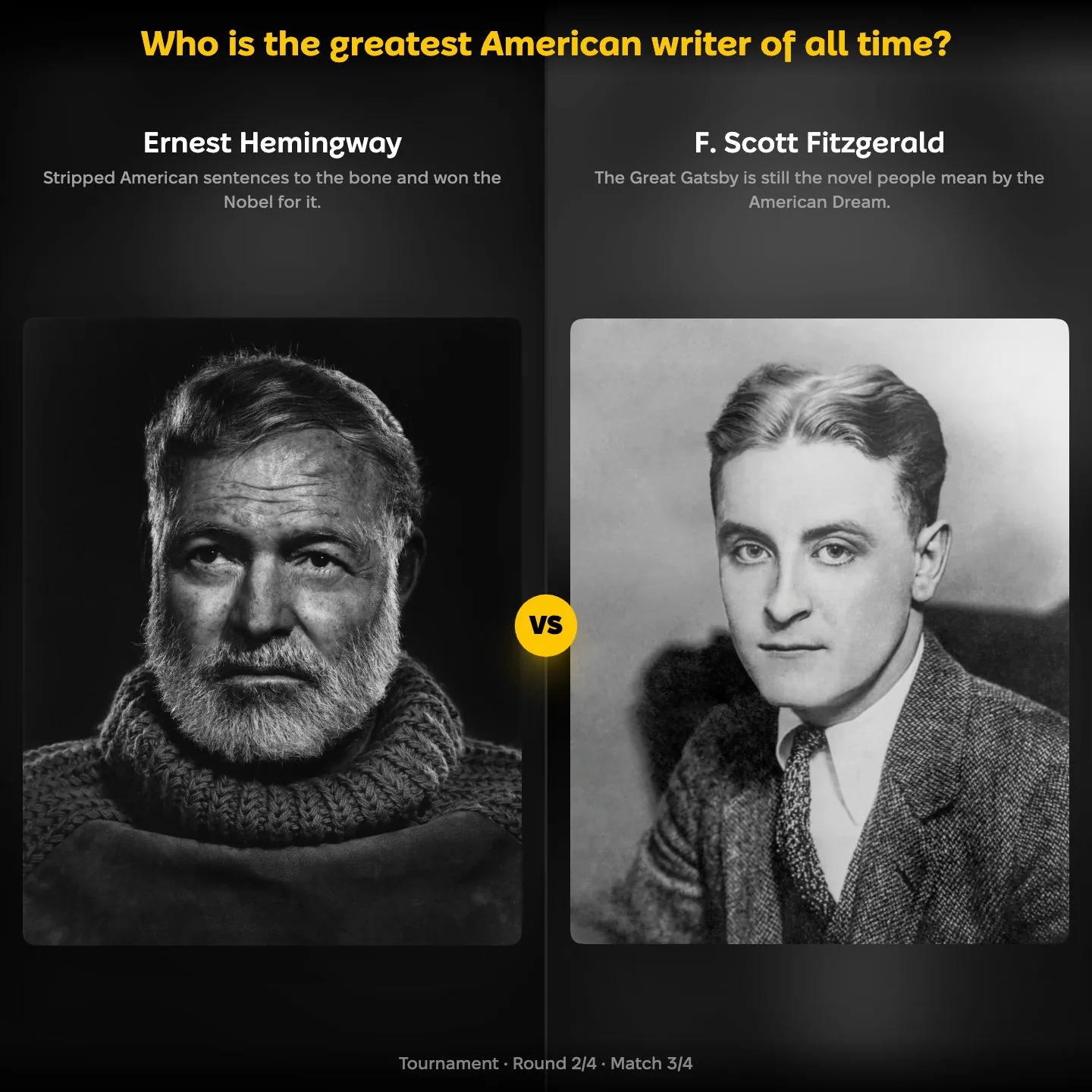
## Hemingway vs Fitzgerald: the greatest American writer
The widest ballot in this article carries fourteen names. Hemingway and Fitzgerald are two of them.
Hemingway's case is the hardware. The Swedish Academy gave him the 1954 Nobel Prize in Literature for "his mastery of the art of narrative, most recently demonstrated in The Old Man and the Sea, and for the influence that he has exerted on contemporary style".3 That citation credits him with changing how other people write, which is a bigger claim than any single book. It is also the claim that has aged best: the short declarative sentence is now the default register of American prose, journalism included.
Fitzgerald has no prize to set beside it. He died of a heart attack in Hollywood on 21 December 1940, aged 44, with his best novel out of favour and his last one unfinished.4 What he has instead is one book that refuses to leave the culture. Durability, measured differently.
Twain is on the same ballot. So are Morrison, Whitman, Poe and Baldwin, and that company changes the question: on a list this wide the two of them stop being each other's rival and become two entries among the founders.
Fourteen founders on one ballot, and these two are next to each other again. Play it →
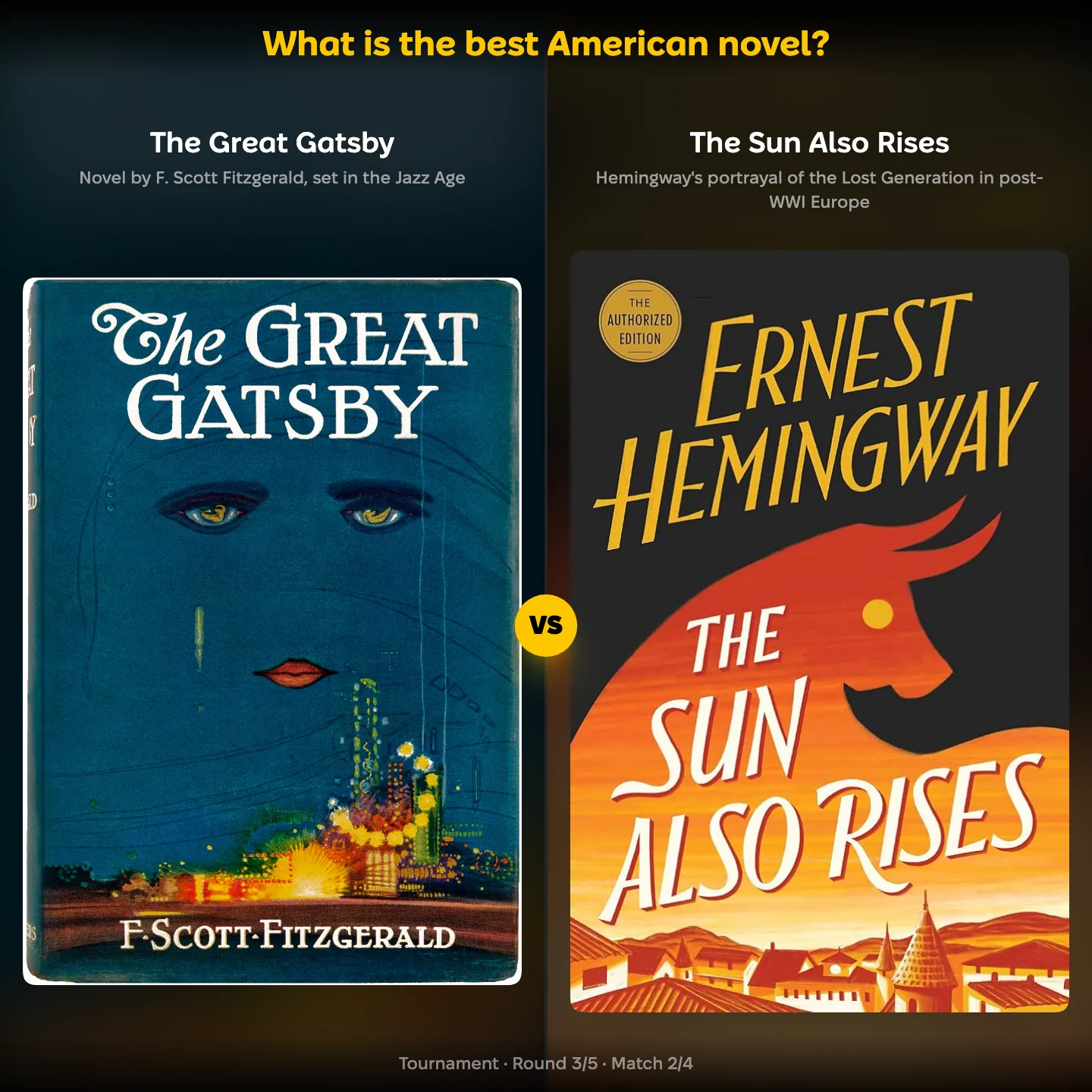
## The Great Gatsby vs The Sun Also Rises: the best American novel
Thirty-two novels compete here, and the two writers arrive with very different luggage. Hemingway has four books on the list. Fitzgerald has one.
Hemingway's four span twenty-six years, from the 1926 debut to the 1952 novella: The Sun Also Rises, A Farewell to Arms, For Whom the Bell Tolls, The Old Man and the Sea.
Fitzgerald's one is The Great Gatsby, and in 1925 it looked like the weaker career. Reviews were mixed, the first two printings did not sell out, and the book was close to forgotten when he died. What revived it was the army: the Council on Books in Wartime printed 155,000 pocket-sized copies for troops in 1945, each one estimated to have been read and passed along seven times.5
Moby-Dick, Beloved and Huckleberry Finn also compete here, and any of the three carries a claim that predates or outlives both men.
Four Hemingway novels are on this list. Fitzgerald brought one. Play it →
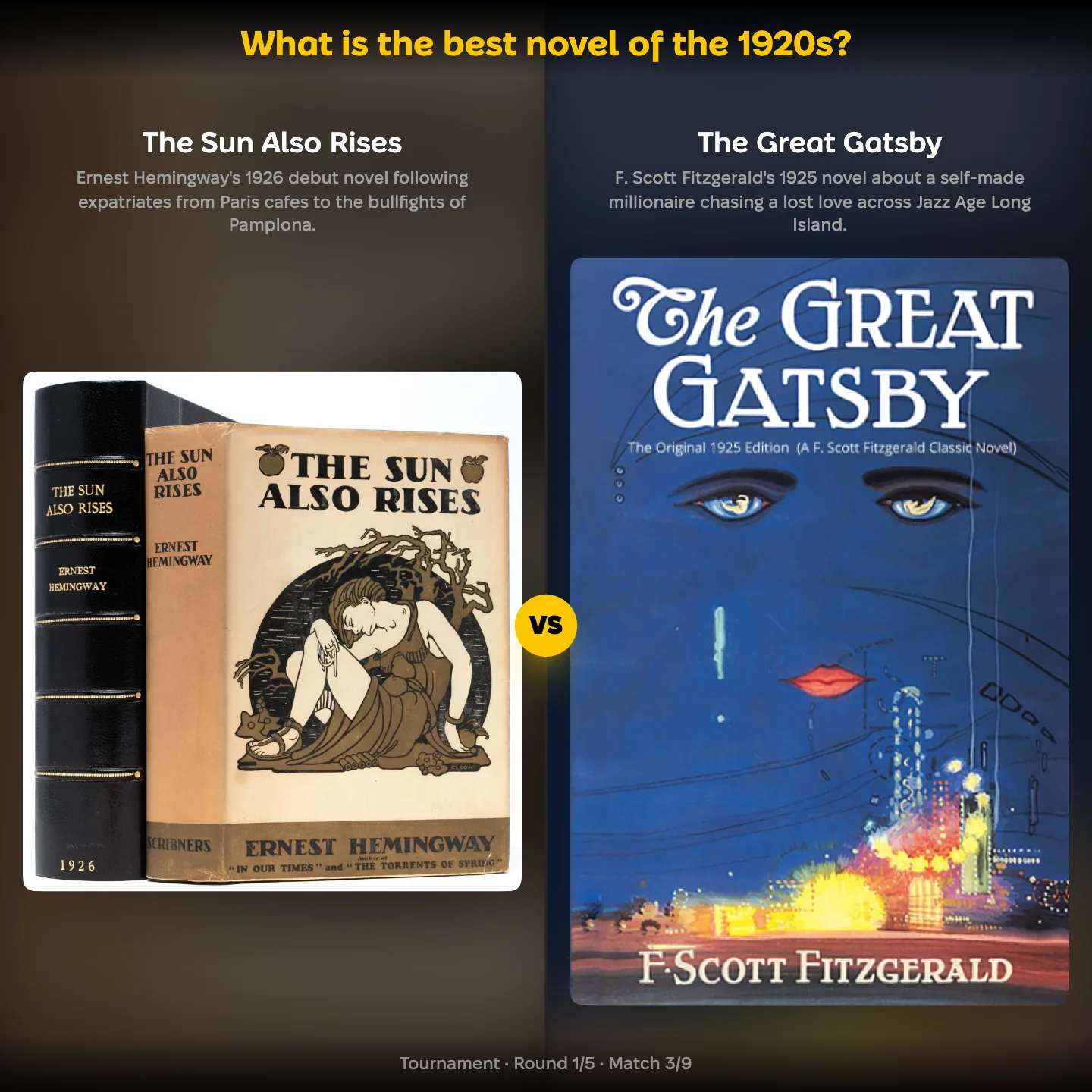
## Ulysses, Mrs Dalloway, and two Americans in the 1920s
Eighteen novels published inside ten years, and both men are here with the books that made them.
Fitzgerald went first. The Great Gatsby was published in April 1925, and without it he is on none of these lists.
Hemingway followed eighteen months later with the manuscript Fitzgerald had marked up. Two books, two publishers' seasons apart, and the friendship never recovered its balance afterwards.
The decade did not belong to either of them. Ulysses, Mrs Dalloway, To the Lighthouse, The Trial and All Quiet on the Western Front are on the same ballot, which is a European wall to climb. Both 1925 titles here, Gatsby and Mrs Dalloway, entered the US public domain together on 1 January 2021.6
1925 against 1926, with Joyce and Woolf on the same ballot. Play it →
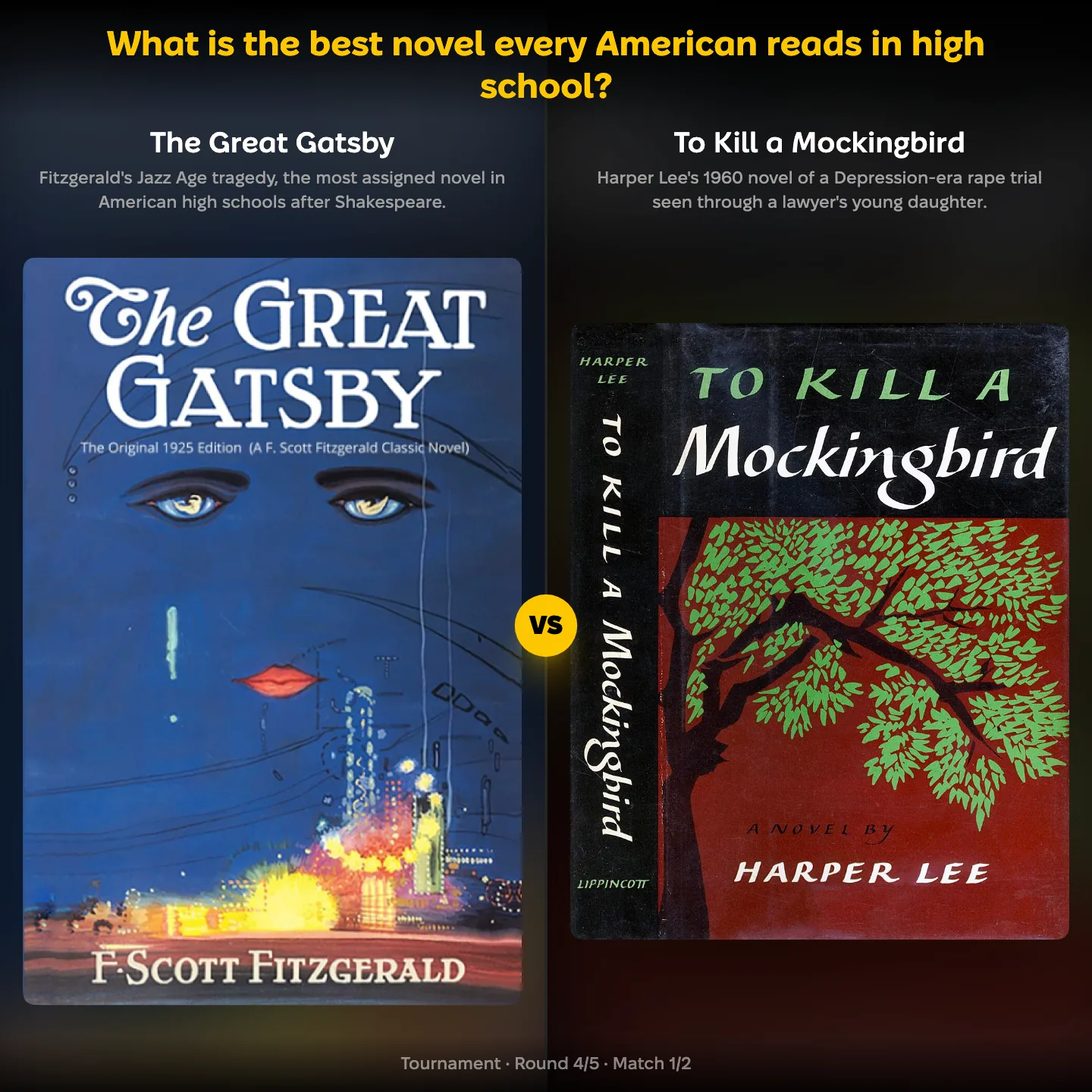
## The Great Gatsby vs To Kill a Mockingbird: the assigned-reading list
Eighteen novels that American teenagers get handed, and both writers are on the list.
Fitzgerald's entry is the one every syllabus has. Since 1 January 2021 The Great Gatsby has been in the US public domain, so any publisher can print it, and the price of a classroom set fell accordingly.6
Hemingway's entry is The Old Man and the Sea, short enough to be finished in two evenings and simple enough to be discussed in one lesson. Neither quality is why he wrote it that way, and both are why it stays on reading lists.
To Kill a Mockingbird, Of Mice and Men, 1984 and Lord of the Flies are the rest of the American high-school canon, and none of their authors needed a rival to be measured against.
Fitzgerald wrote the set text; Hemingway wrote the short one. Play it →
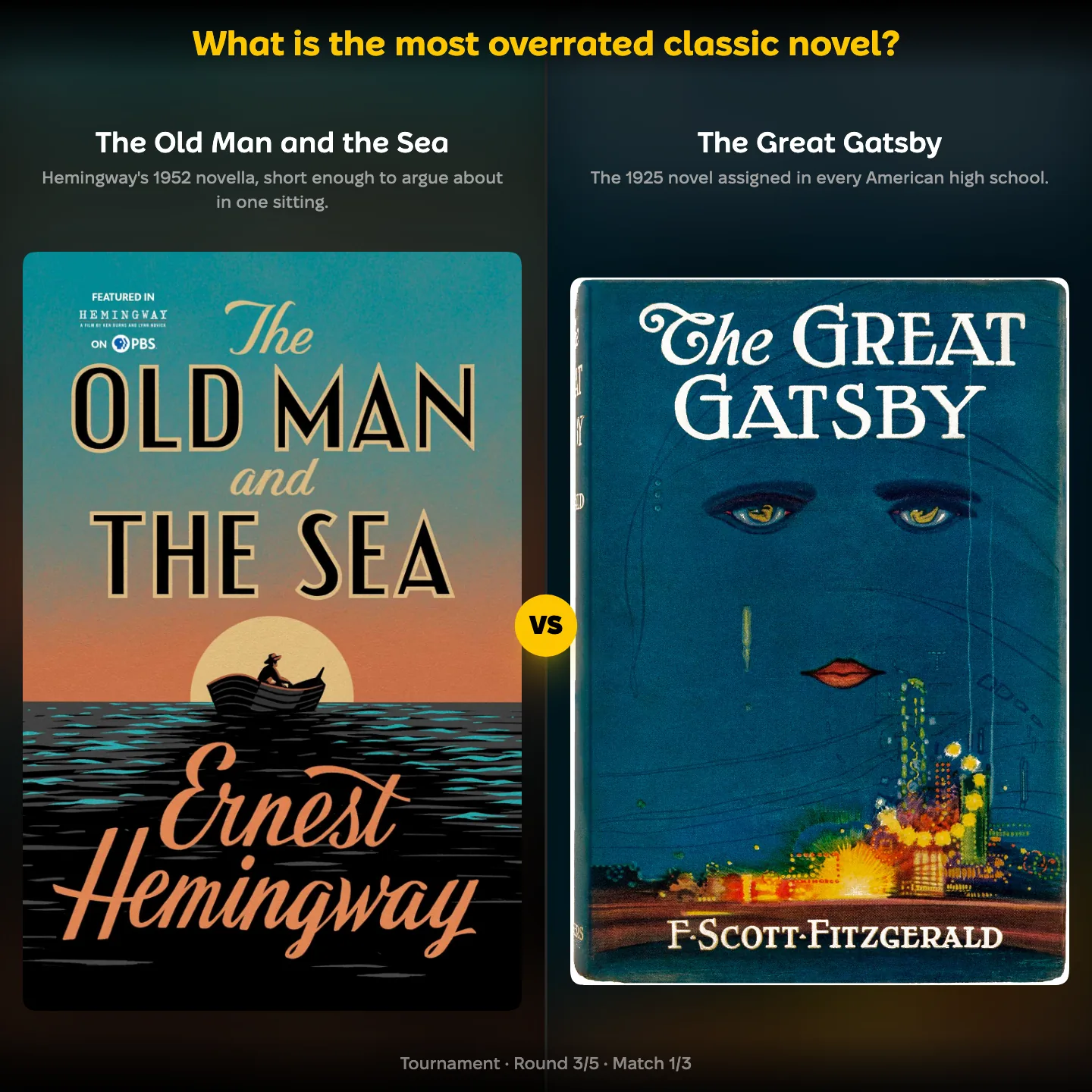
## Fifty Shades and Ulysses on one list with Gatsby
Eighteen classics nominated for being less good than their reputation, and both men are on it. Being taught everywhere is the charge here, not the defence.
Fitzgerald is here because saturation invites the accusation. A novel handed to every fifteen-year-old in the country accumulates a constituency of people who resented it at the time.
Hemingway's novella arrives from the other direction: the shortest book on his shelf, and the one that collected the prizes. Some readers see a fable rewarded for being quick to finish.
Ulysses, Moby-Dick, Atlas Shrugged and Fifty Shades of Grey share the list, so the accusation lands on Joyce and on airport paperbacks alike.
The one list where both of them are accused of the same thing. Play it →
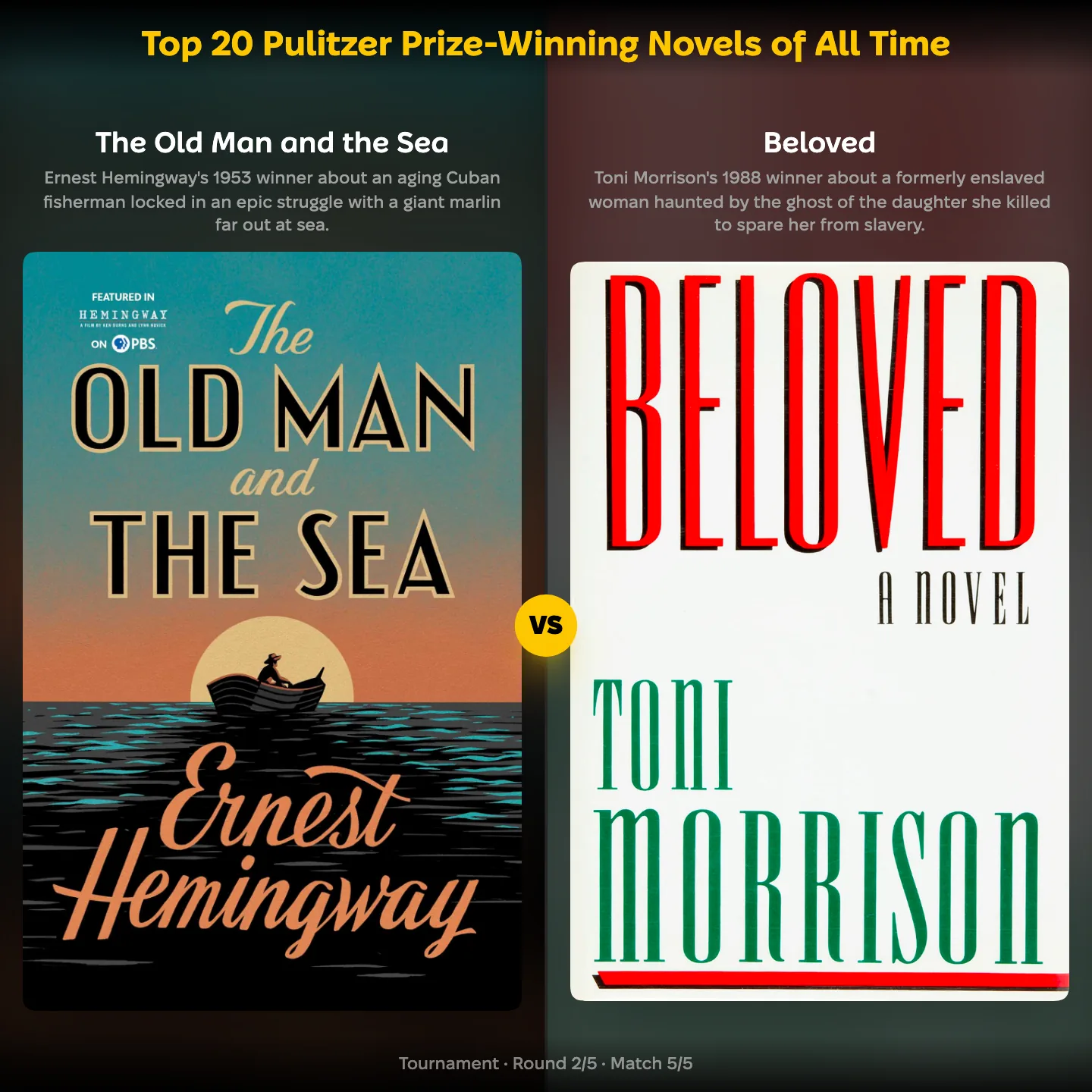
## The Old Man and the Sea vs Beloved: the prize Fitzgerald never won
Twenty Pulitzer-winning novels, and this is a list Fitzgerald was never eligible for.
The Old Man and the Sea took the 1953 Pulitzer Prize for Fiction for Scribner, and the Swedish Academy named that same novella a year later.7 A hundred-odd pages about a Cuban fisherman and a marlin did more for Hemingway's standing than the two novels before it.
Fitzgerald is absent because he never won. No Pulitzer, no Nobel, nothing from the bodies that decide what stays in print; his recognition arrived after he was dead, and it arrived through readers rather than committees.
Toni Morrison's Beloved, To Kill a Mockingbird and The Grapes of Wrath fill out the rest, which puts Hemingway's one winner in a queue rather than at the front of it.
Hemingway won this in 1953. Fitzgerald never entered the building. Play it →
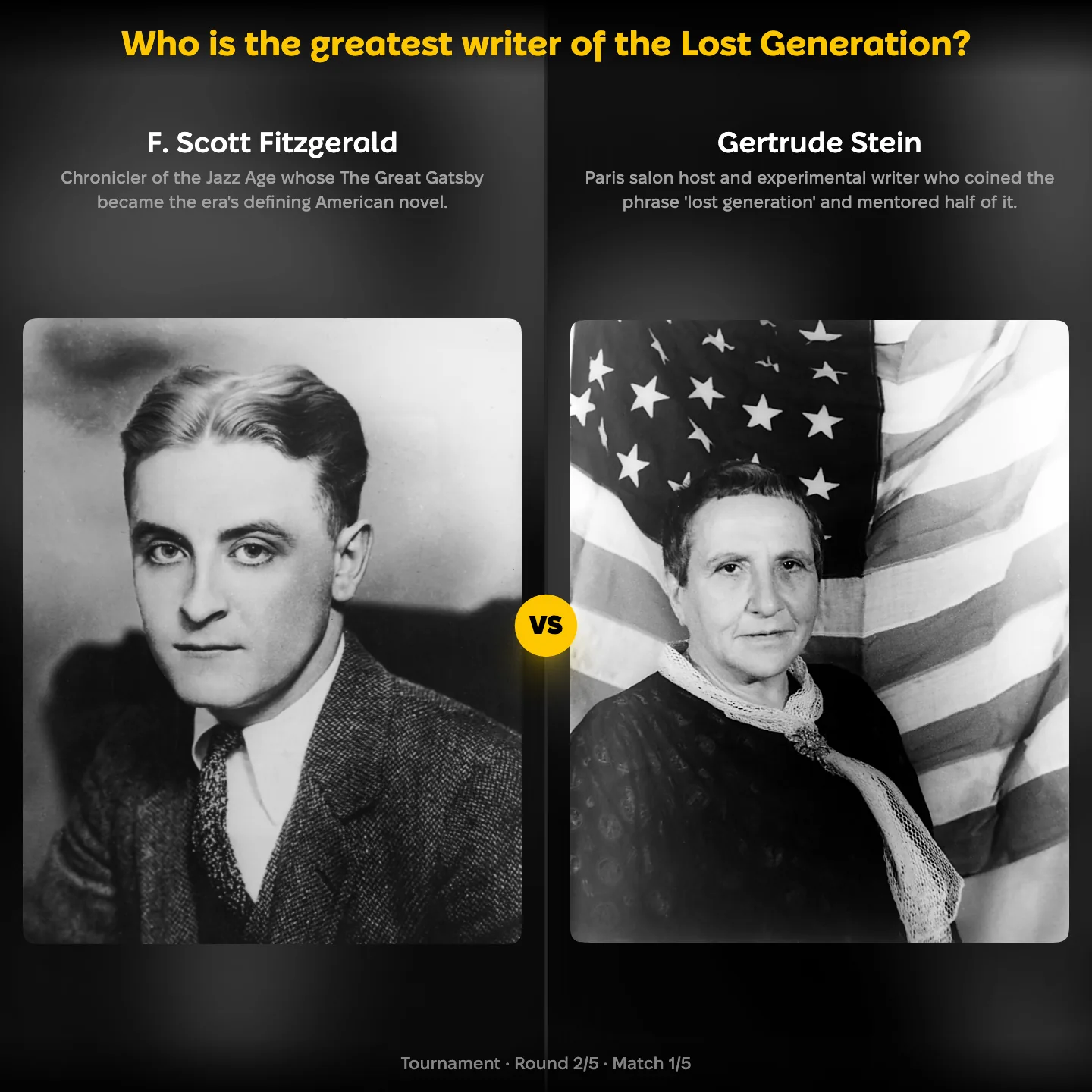
## Gertrude Stein named the Lost Generation. Hemingway printed it
Seventeen writers of the Lost Generation on one list, and the woman who supplied the phrase is one of them.
Hemingway's claim is documentary. He put the phrase in print, as an epigraph to The Sun Also Rises, and credited it to Gertrude Stein in conversation. Every use of "Lost Generation" since then runs through that page.
Fitzgerald's claim is chronological. He was the one with the readers and the money when the group formed, and he is the reason Scribner's took the rest of them seriously. Zelda Fitzgerald is a candidate here as well, which the 1920s would not have predicted.
Stein herself hosted the salon most of these people passed through. Dos Passos, T. S. Eliot, Ezra Pound and Ford Madox Ford round out a field where being American was optional and being in Paris was not.
Stein named the generation. Both of these two then defined it in print. Play it →
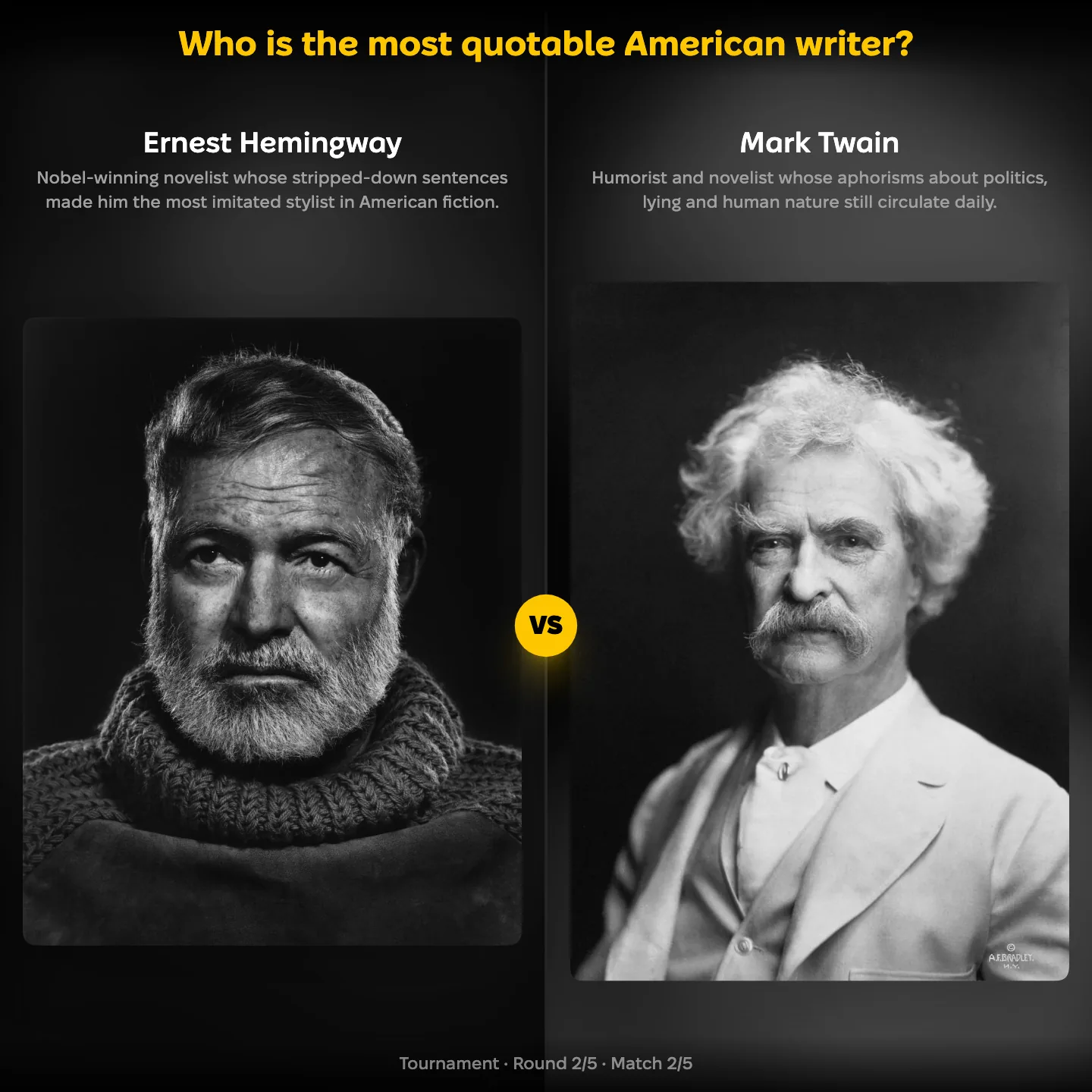
## Hemingway vs Mark Twain: the most quotable American
Eighteen writers on one list, and both of these two are here as stylists rather than novelists.
Hemingway's problem is that his most famous sentence probably isn't his. "For sale: baby shoes, never worn" is attached to his name everywhere, and Quote Investigator found no substantive evidence he wrote it: versions of the story were in print by 1906, when he was seven, and the attribution to him first surfaced in 1989.8
Fitzgerald's most quoted line is one he definitely wrote, the last sentence of The Great Gatsby, about boats and the current and the past. He also supplied the name for the decade both of them worked in, in a 1922 collection called Tales of the Jazz Age.
Twain is the reason this list is hard. So are Dorothy Parker and Hunter S. Thompson, three writers whose day job was the sentence rather than the novel.
The most famous Hemingway sentence is one nobody can prove he wrote. Play it →
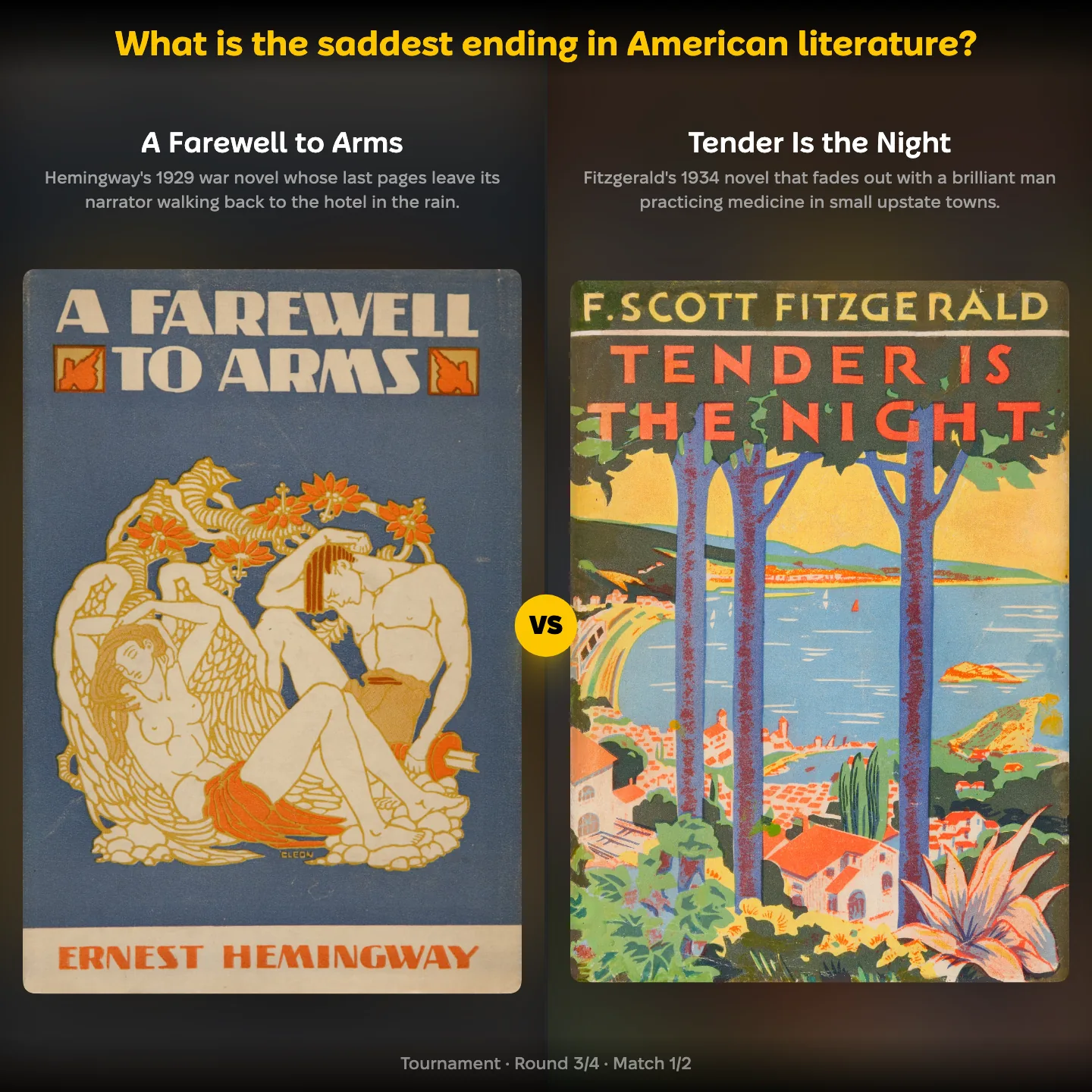
## A Farewell to Arms vs Tender Is the Night: the saddest last page
Sixteen novels, four of them by these two men.
Hemingway worked harder on his ending than on anything else in the book. He said he rewrote the last pages of A Farewell to Arms thirty-nine times to get the words right, and Scribner's 2012 Hemingway Library Edition collected the alternative endings together for the first time.9
Fitzgerald's saddest ending is not Gatsby's. Tender Is the Night, published in 1934, leaves Dick Diver practising medicine in progressively smaller upstate towns, a man fading out of his own novel while his wife's money holds.
Of Mice and Men, Beloved and The Road sit alongside them. None finishes in the rain in Switzerland, or in a town too small to name.
Thirty-nine attempts at one ending, against a man quietly running out of towns. Play it →
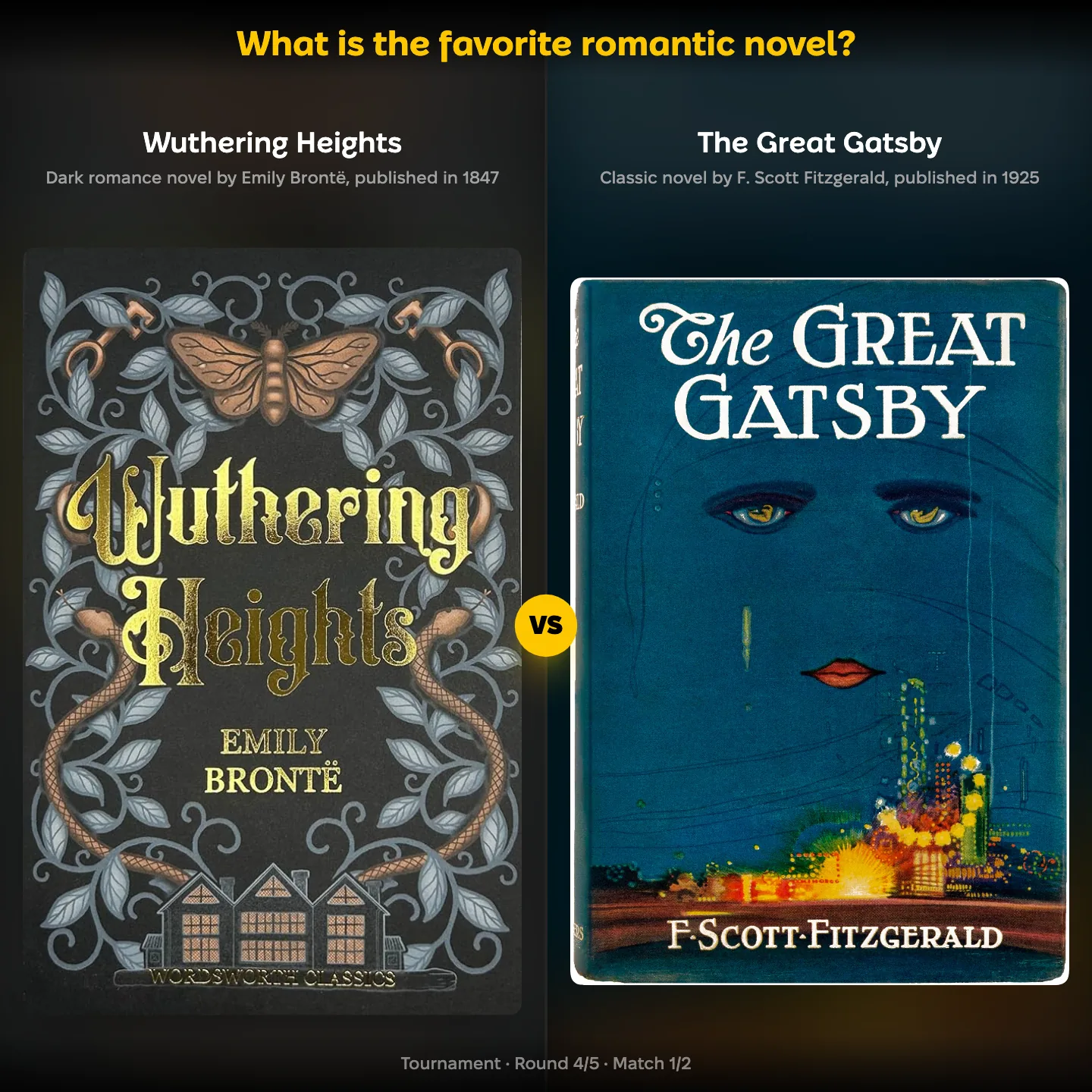
## The Great Gatsby vs Wuthering Heights: Gatsby as a love story
Thirty-two romantic novels, mostly Austen, Brontë and the modern paperback shelf. Fitzgerald appears once. Hemingway does not appear.
The Great Gatsby qualifies because the plot is a man rebuilding his whole life around one woman he met five years earlier. Strip out the Jazz Age and it is a story about wanting somebody back.
Hemingway's absence is the odd part. A Farewell to Arms is a love story by any definition, an ambulance driver and an English nurse and a death in childbirth, and it turns up on no romance ranking anywhere.
Pride and Prejudice, Jane Eyre and Anna Karenina set the terms here, and none of them was written by an American in the twentieth century.
Fitzgerald made this list. Hemingway's own love story did not. Play it →
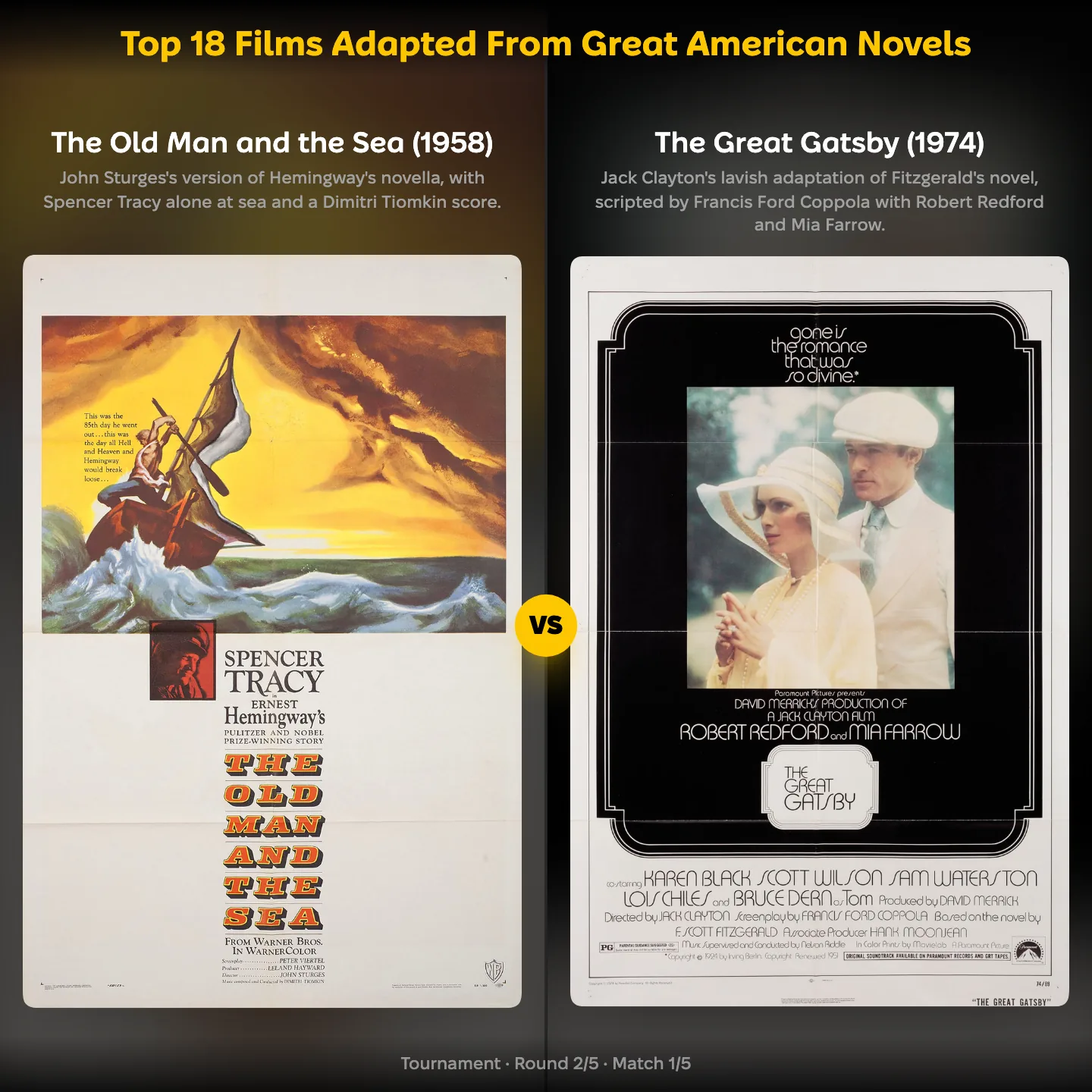
## Redford, Luhrmann, and Spencer Tracy alone in a boat
Eighteen films made from American novels, and both writers are represented by other people's work.
Fitzgerald has two entries here, one more than he has anywhere else in this article: Jack Clayton's 1974 Gatsby with Robert Redford and Mia Farrow, scripted by Francis Ford Coppola, and Baz Luhrmann's 2013 version. Neither is anybody's favourite film. Both keep the novel in circulation.
Hemingway's entry is the 1958 Old Man and the Sea, with Spencer Tracy alone in a boat for most of the running time. Another one is coming: Michael Winterbottom's A Farewell to Arms, with Tom Blyth as Frederic Henry, went to the Cannes market in May 2026.10
The Godfather is on this list, along with To Kill a Mockingbird, No Country for Old Men and The Grapes of Wrath. The best adaptations rarely come from the most famous prose.
Spencer Tracy in a boat, against Redford in a white suit. Play it →
## The Great Gatsby vs The Catcher in the Rye: the jacket that got written into the book
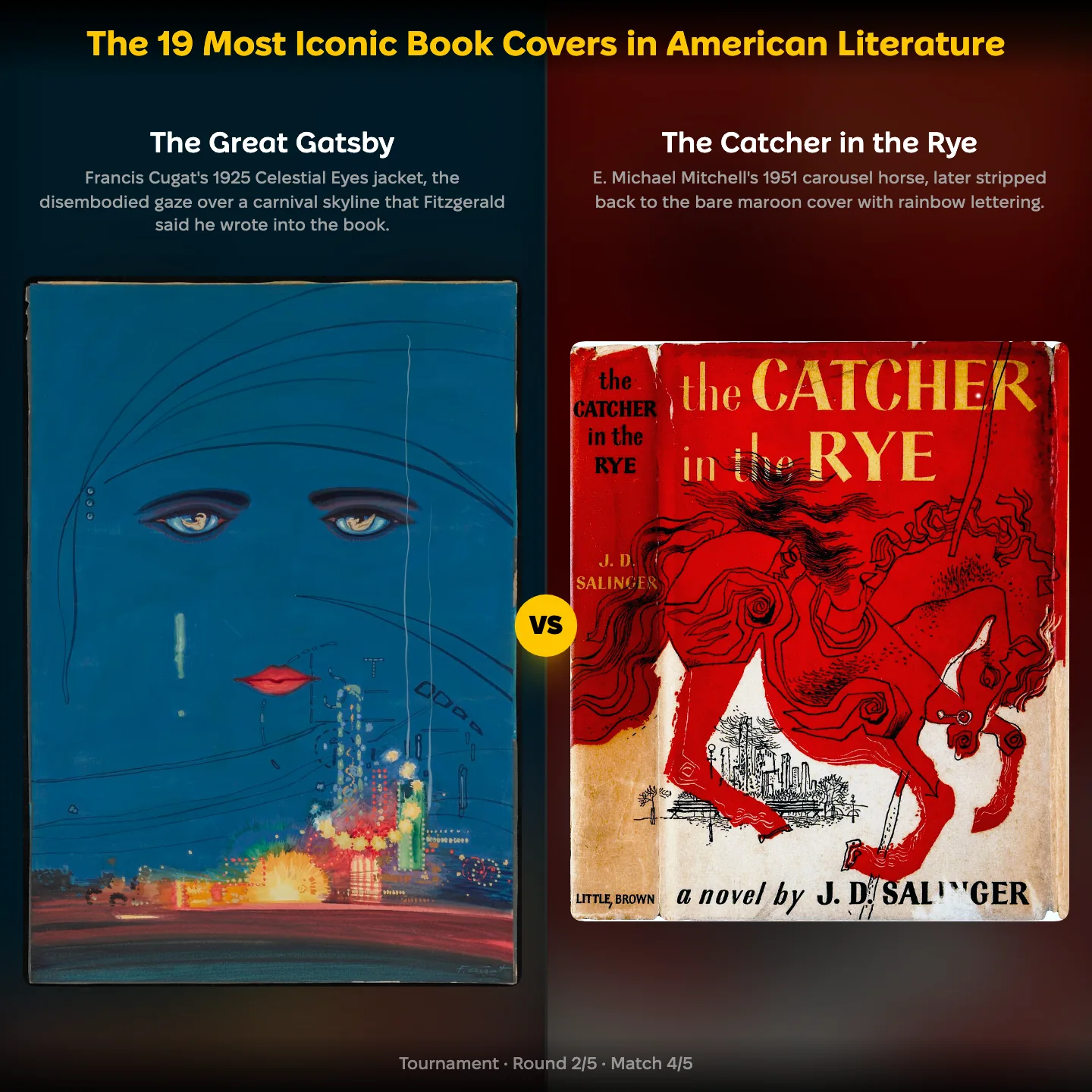
Nineteen American book jackets, and the story behind one of them beats the picture.
Francis Cugat painted the Celestial Eyes jacket, the disembodied gaze over a carnival skyline, before Fitzgerald had finished the novel, and was paid $100 for it. Fitzgerald saw a draft, panicked that Scribner's would hand it to another author, and wrote to Max Perkins: "For Christ's sake don't give anyone that jacket you're saving for me. I've written it into the book."11
What he meant has been argued about ever since, and the leading candidates are Daisy's eyes over the city and the billboard eyes of Doctor T. J. Eckleburg. Either way the jacket came first and the sentences were fitted to it, which almost never happens.
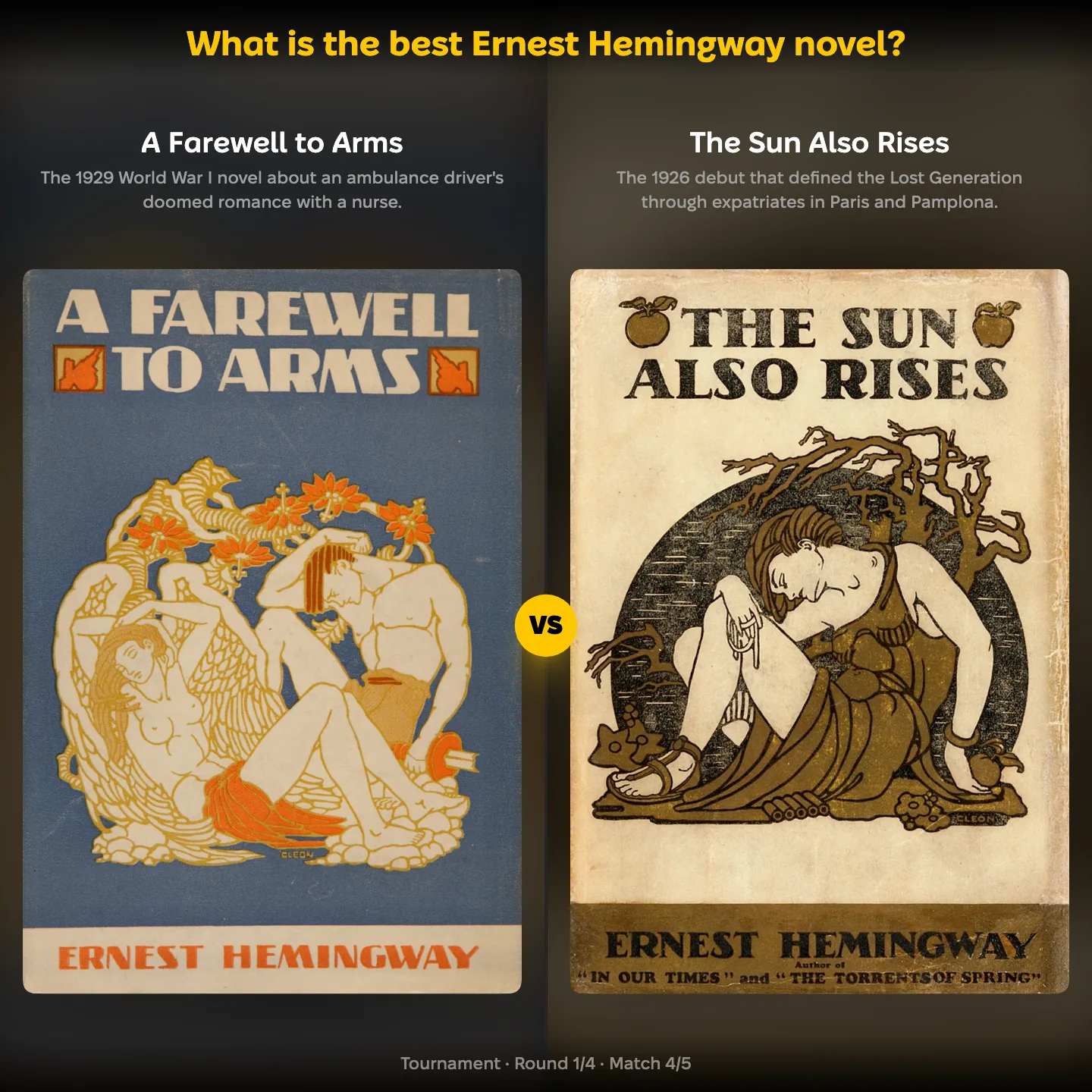
Hemingway is here three times, for the jackets of his 1926 debut, A Farewell to Arms and the 1952 novella. None of those three comes with an anecdote. His covers are typography and design; Fitzgerald's is a plot point.
E. Michael Mitchell's carousel horse for The Catcher in the Rye sits across the frame, with Moby-Dick, On the Road and Beloved further down.
A $100 painting that a novelist rewrote his book around. Play it →
## Victor Hugo's Paris, and the two Americans renting rooms in it
Nineteen novels set in Paris, most of them French, and the two Americans on the list are these two.
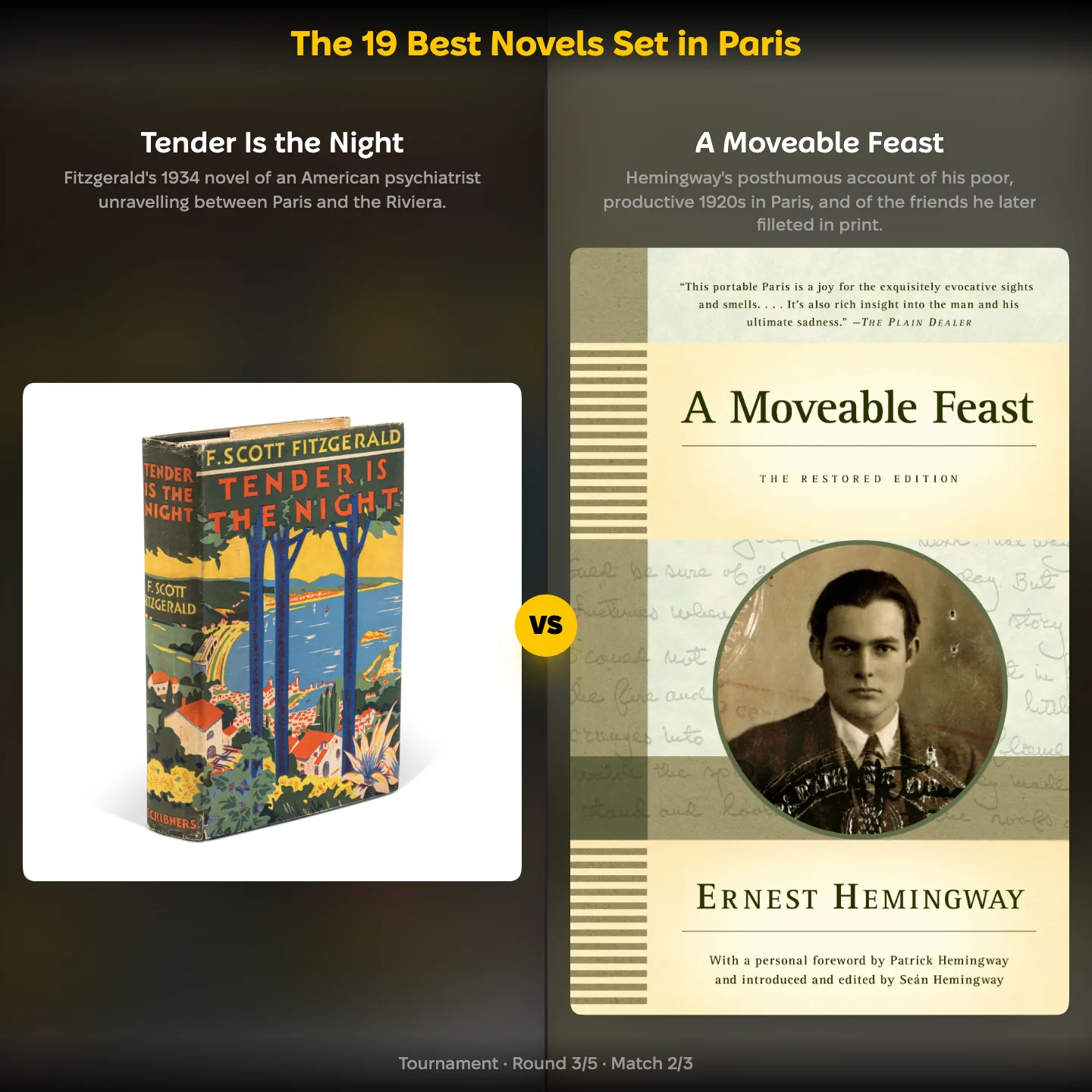
Hemingway's is A Moveable Feast, which is also the source of most of what people think they know about this friendship. He wrote it in the late 1950s and it was published in 1964, three years after his death, as an account of being poor and productive in the 1920s. Fitzgerald appears in it as a talented man who could not hold his drink.
Fitzgerald's is Tender Is the Night, the novel he spent nine years on while Zelda was in and out of clinics. Its Paris is expensive rather than cheap, which is the difference between the two men in one word.
Les Misérables, The Hunchback of Notre-Dame and Le Père Goriot occupy the rest of the list, and no American is going to beat Victor Hugo at describing this city.
One of them wrote the cheap Paris, the other the expensive one. Play it →
## Hills Like White Elephants vs Babylon Revisited: the short-story shelf
Seventeen American short stories, and Hemingway's claim here is on the form itself rather than on one entry.
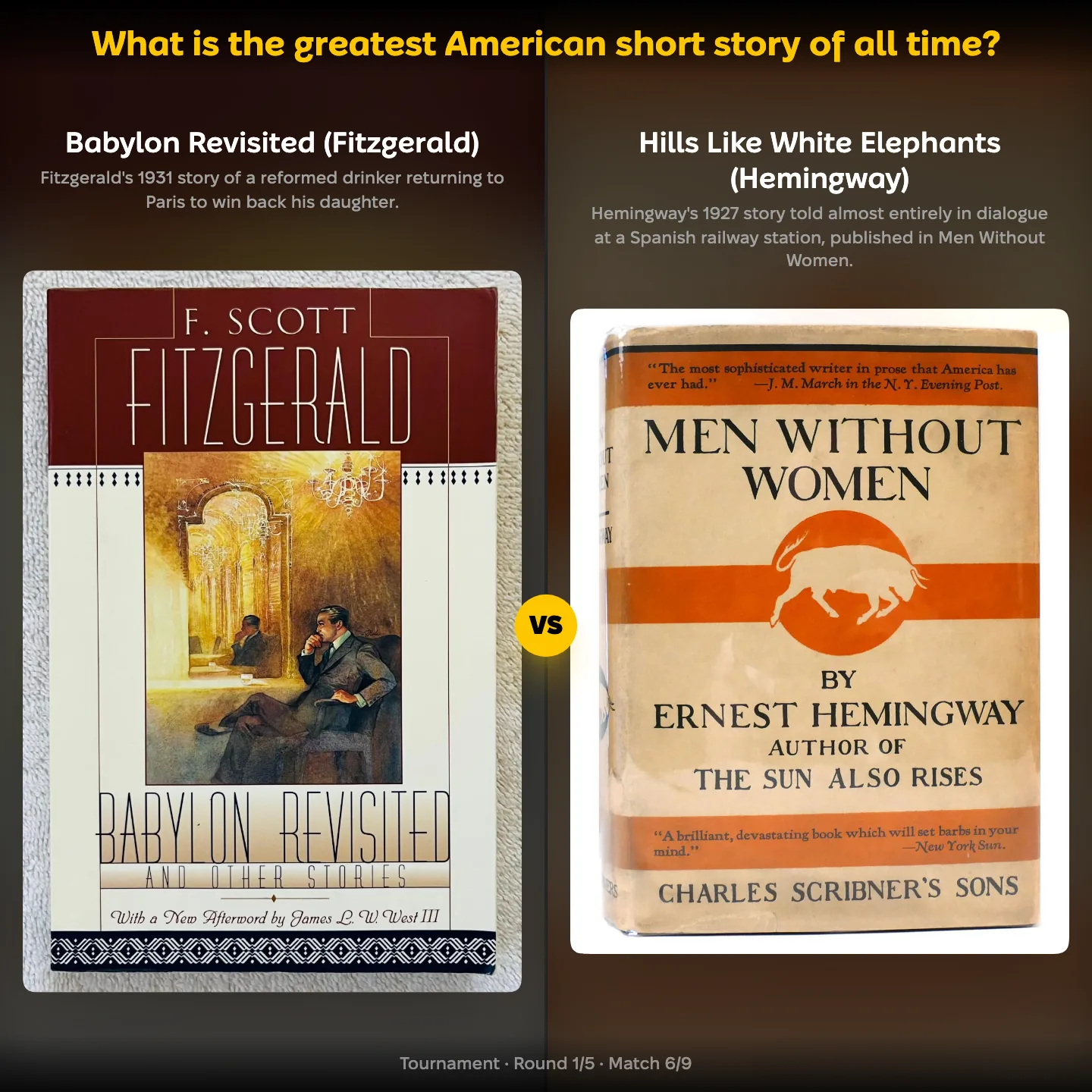
"Hills Like White Elephants" is almost entirely dialogue between a man and a woman at a Spanish railway station, and it never once names the thing they are arguing about. It appeared in 1927 in Men Without Women, the collection that followed his debut novel.
Fitzgerald's entry is "Babylon Revisited", published in 1931: a reformed drinker comes back to Paris to persuade his sister-in-law to give him his daughter.
Shirley Jackson's "The Lottery" and Melville's "Bartleby, the Scrivener" are the real competition. Hemingway is on the list twice, since "The Snows of Kilimanjaro" is here as well.
Two Paris stories, one written from the outside and one from inside the bar. Play it →
## Catch-22 vs A Farewell to Arms: the war novel Fitzgerald never wrote
Nineteen American war novels, and Fitzgerald is missing from all of them. That absence is the cleanest fact in this article.
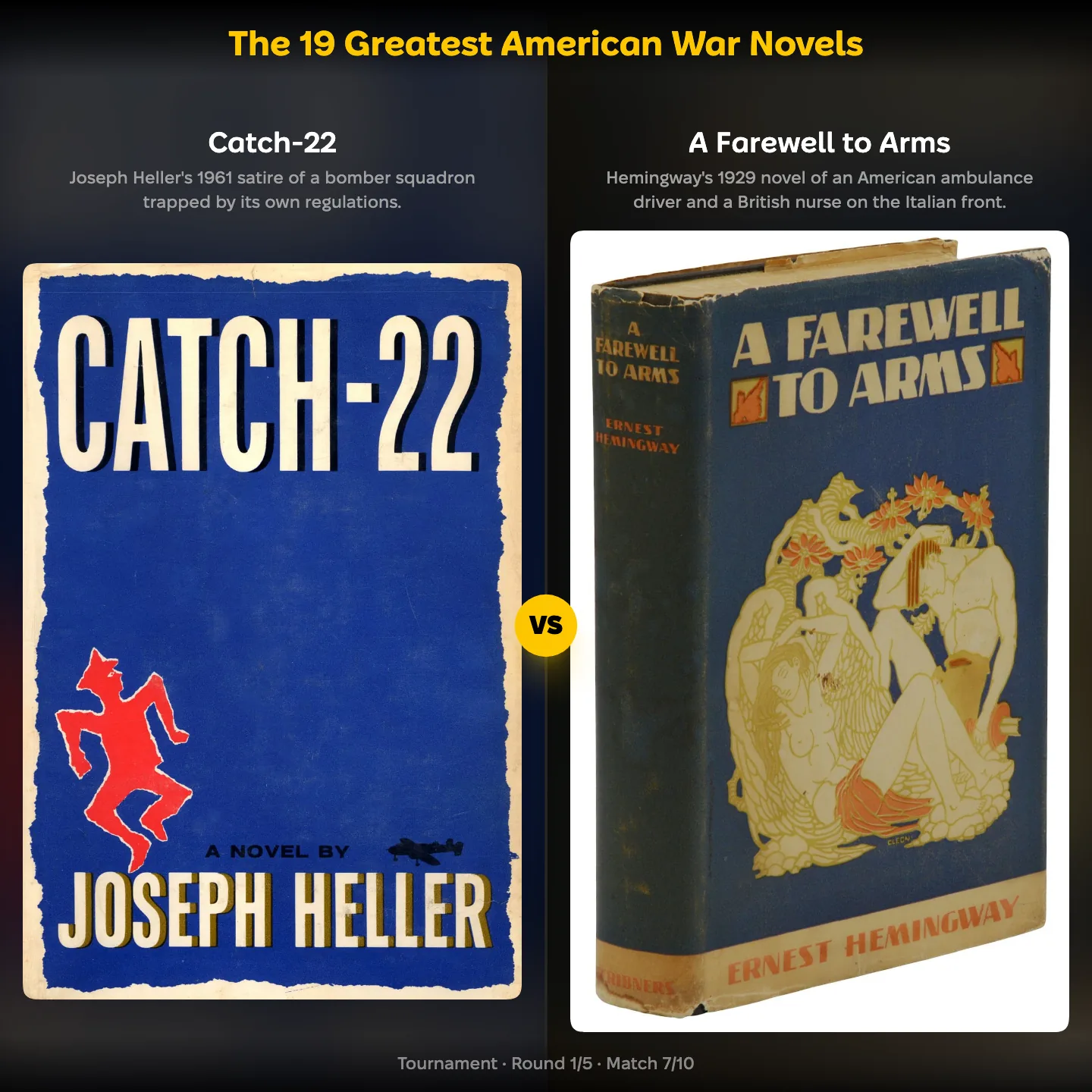
Hemingway is on it twice, once for each of his wars: A Farewell to Arms for Italy in 1918, For Whom the Bell Tolls for Spain in the 1930s, which he covered as a newspaper correspondent before he wrote about it.12
Fitzgerald joined the army in November 1917 and spent the war stationed in Alabama, where he met Zelda Sayre in July 1918.4 His subject turned out to be money and the damage it does, not combat.
Catch-22, Slaughterhouse-Five and The Things They Carried are the other names in this field, and all three were written by men who did go.
Two wars for Hemingway. Fitzgerald spent his in Alabama. Play it →
## Nine Hemingway novels, and no room for Fitzgerald
This is the one ranking in the article Fitzgerald cannot enter. Nine Hemingway novels, nobody else, including the ones nobody defends: Across the River and into the Trees, The Torrents of Spring, the posthumous Garden of Eden.
A Farewell to Arms, published in 1929, came out of the job Hemingway actually did. He drove an ambulance for the American Red Cross in Italy, and handed that job to his narrator, Frederic Henry.12
Fitzgerald published four novels to Hemingway's seven and never accumulated enough shelf to be sorted this way.
The only list here with no room for Fitzgerald at all. Play it →
## Neither of them settled it
Hemingway published seven novels, rebuilt the English sentence, and has the awards to prove somebody noticed. Fitzgerald published four, died at 44 with his best book out of favour, and wrote the one American novel a teenager somewhere is being handed this week. The two records do not convert into each other, which is why the question keeps coming back in new words.
Every list above got its order the same way, by [two names at a time, then two more](/articles/how-rankings-are-scored), so what you see is the sum of a lot of small decisions rather than one critic's verdict.
There is a lens none of these 16 covers. Make it, and find out who survives it.
## More rankings, more angles
- [Stephen King Wrote Horror. The Lists Keep Filing Him Elsewhere](/articles/stephen-king-ranked-many-ways) — the other American novelist who will not stay in one category
- [Agatha Christie: 100 Years On, 15 Different Lists](/articles/agatha-christie-ranked-many-ways) — the other centenary on this shelf
- [Dracula: 538 Films, and Stoker Never Saw Transylvania](/articles/dracula-ranked-many-ways) — a novel that outgrew its author
Sources
Britannica and the Hemingway estate — The Sun Also Rises, published by Charles Scribner's Sons in October 1926: britannica.com, ernesthemingwayofficial.com (checked 2026-09-09)
Library of Congress — "Books That Shaped America" exhibition items, listing The Great Gatsby (Scribner's, 1925) and For Whom the Bell Tolls (Scribners, 1940): loc.gov (checked 2026-09-09)
The Nobel Prize — Nobel Prize in Literature 1954, Ernest Hemingway, with the award citation: nobelprize.org (checked 2026-09-09)
Britannica — F. Scott Fitzgerald: died 21 December 1940 in Hollywood, aged 44; joined the army in November 1917 and was stationed near Montgomery, Alabama in July 1918: britannica.com (checked 2026-09-09)
Carleton College — the Armed Services Edition of The Great Gatsby: 155,000 copies, each estimated to have been read and passed along seven times: carleton.edu (checked 2026-09-09)
Duke Law, Center for the Study of the Public Domain — Public Domain Day 2021: works published in 1925, including The Great Gatsby and Mrs Dalloway, entered the US public domain on 1 January 2021: web.law.duke.edu (checked 2026-09-09)
The Pulitzer Prizes — 1953 winners: Fiction, The Old Man and the Sea by Ernest Hemingway (Scribner): pulitzer.org (checked 2026-09-09)
Quote Investigator — no substantive evidence that Hemingway composed "For sale: baby shoes, never worn"; earlier versions from 1906 and the first attribution to him in 1989: quoteinvestigator.com (checked 2026-09-09)
Simon & Schuster (Scribner) — A Farewell to Arms: The Hemingway Library Edition: Hemingway said he rewrote the ending thirty-nine times, and the edition collects the alternative endings for the first time: simonandschuster.com (checked 2026-09-09)
Deadline, 16 May 2026 — Michael Winterbottom's A Farewell to Arms with Tom Blyth taken to the Cannes market by Embankment Films and Tribune Pictures: deadline.com (checked 2026-09-09)
Smithsonian Magazine — Francis Cugat's Celestial Eyes jacket, the $100 fee, and Fitzgerald's letter to Max Perkins: smithsonianmag.com (checked 2026-09-09)
Britannica — Ernest Hemingway: ambulance driver for the American Red Cross in the First World War, and A Farewell to Arms' narrator Frederic Henry in the Italian ambulance service: britannica.com (checked 2026-09-09)